Market Snapshot
Key Takeaways
Market Overview & Analysis
Report Summary
This analysis sizes the China automotive lubricants aftermarket, encompassing all finished fluid lubricants, functional chemical fluids and lubricating greases procured for the scheduled maintenance, mechanical overhaul and operational top-up of in-use, licensed on-road motor vehicles, evaluated at the wholesale-to-service channel boundary representing net ex-distributor acquisition expenditure. The market explicitly excludes initial OEM factory fill and factory warranty pre-delivery fills, industrial equipment lubricants, railroad traction oils, marine bunkering lubricants and aviation fluids. The market is sized in RMB billion and USD billion at a constant 7.10 RMB per USD exchange rate across a 2021-2025 historical period and a 2026-2030 forecast period, with 2025 as the base year.
The China automotive lubricants aftermarket grew from 3.36 billion liters (RMB 80.64 billion) in 2021 to 3.48 billion liters (RMB 98.50 billion) in 2025, and is projected to reach 3.51 billion liters (RMB 118.20 billion) by 2030, a 3.71% compound annual value growth rate despite a near-zero 0.17% compound annual volume growth rate. This growth reflects a structural decoupling between physical fluid consumption and wholesale value, driven by the transition toward premium, low-viscosity full synthetic formulations required to meet mandatory national standards GB 11121-2025 and GB 11122-2025, which enter enforcement on 1 July 2026.
The Baseline Trajectory aligns with the State Council's 15th Five-Year Carbon Peak Action Plan, targeting new energy vehicles reaching approximately 30% of the operational automobile fleet by 2030 (roughly 110 million units), with average vehicle retirement ages remaining stable at 14 to 15 years and full mandatory enforcement of GB 11121-2025 and GB 11122-2025 commencing 1 July 2026. This trajectory yields aftermarket physical volume of 3.51 billion liters (+0.17% CAGR) and wholesale value of RMB 118.20 billion (USD 16.65 billion at 3.71% CAGR) by 2030. The Accelerated NEV Transition scenario, reaching only RMB 109.50 billion (USD 15.42 billion) at a 2.14% value CAGR with volume contracting to 3.18 billion liters (-1.78% CAGR), is triggered if the Ministry of Ecology and Environment tables draft China 7 emissions standards by late 2027 alongside expanded municipal scrappage incentives, pushing new energy vehicle sales past 75% of new additions by 2028. The Prolonged ICE and Hybrid Longevity scenario, reaching RMB 124.80 billion (USD 17.58 billion) at a 4.84% value CAGR with volume expanding to 3.72 billion liters (+1.34% CAGR), is triggered if sustained consumer demand for extended-range electric vehicles and plug-in hybrids across lower-tier markets, combined with eased municipal license plate restrictions, extends average ownership duration beyond 8.5 years.
Market Dynamics
Key Drivers
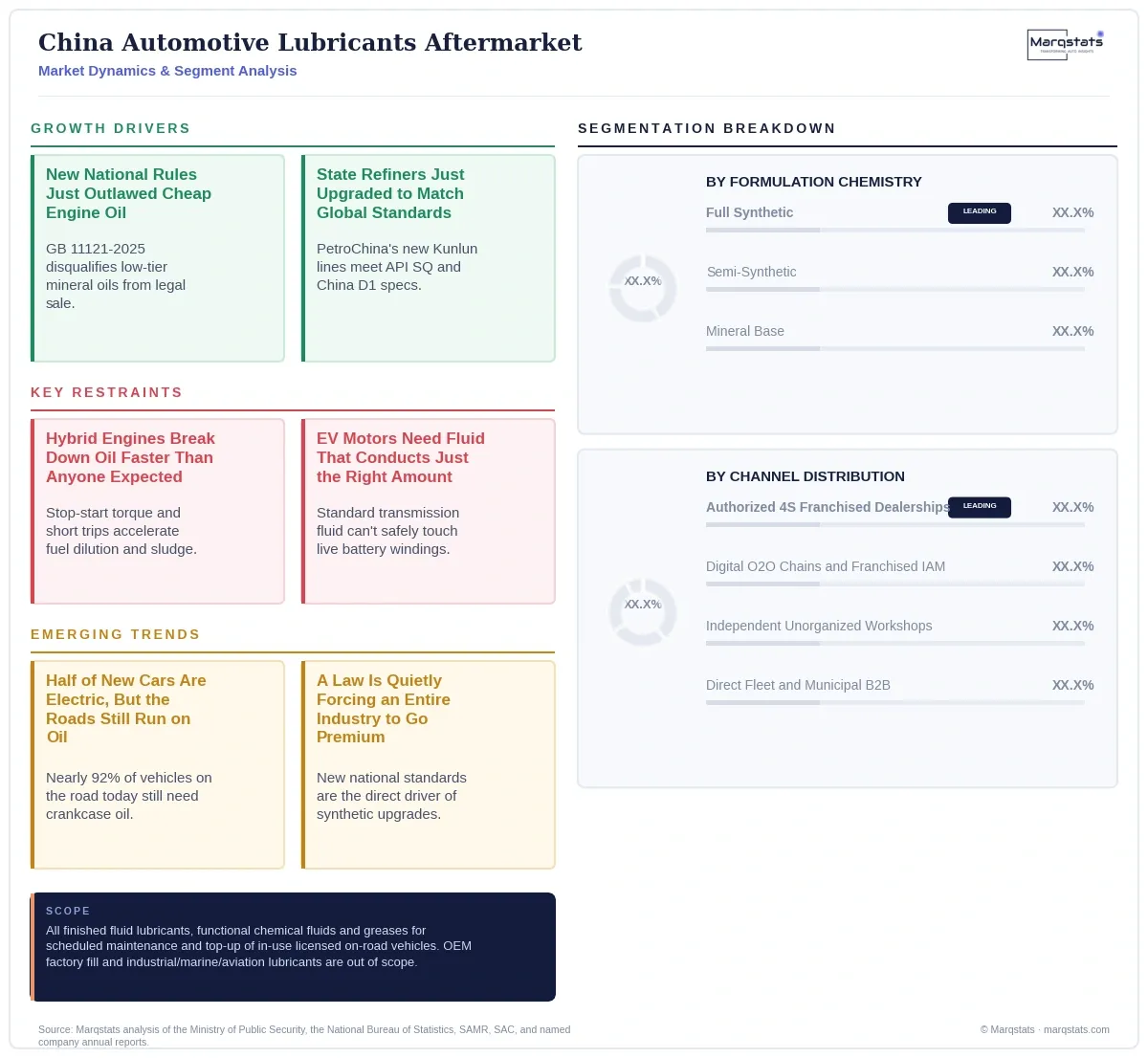
- Mandatory statutory reformulation anchors baseline value growth independent of consumer discretionary spending, exemplified by the Standardization Administration of China's 30 June 2025 issuance of GB 11121-2025 and GB 11122-2025, entering mandatory enforcement on 1 July 2026 and effectively disqualifying low-tier API SJ and SL mineral oils from legal commercial distribution nationwide.
- State-owned petrochemical enterprises are executing coordinated technical upgrades to match international performance standards, exemplified by PetroChina Lubricant Company's 2026 renewal of its Kunlun lubricant portfolio, introducing the Tianrun gasoline series formulated to API SQ standards and the Tianwei diesel series engineered to China D1 specifications.
- Multinational formulators are securing volume by partnering directly with domestic new energy vehicle manufacturers, exemplified by ExxonMobil (China) Investment Co.'s January 2026 strategic partnership with BYD to co-develop hybrid-specific lubricants and supply manufacturing plants directly.
- Digital direct-to-consumer channel strategies are bypassing traditional multi-tiered wholesale distribution, exemplified by Shell (China) Limited's exclusive release of its Shell Helix Ultra Lightning 2.0 product line through the Tuhu Car Care network, circumventing conventional wholesale markups entirely.
- Domestic independent blenders are diversifying beyond traditional crankcase oils to mitigate long-term volumetric exposure to fleet electrification, exemplified by Jiangsu Lopal Tech. Co., Ltd. expanding into lithium-iron-phosphate battery materials, low-conductivity battery coolants and data center immersion fluids alongside its core lubricants business.
Key Restraints
- Hybrid powertrain operating conditions accelerate lubricant degradation in ways conventional formulations were not engineered to handle, since combustion engines in hybrid systems engage abruptly under wide-open throttle without a gradual thermal warm-up cycle, and frequent short-trip usage prevents engine oil from reaching stabilized operating temperatures, inhibiting continuous evaporation of water vapor condensation and unburned fuel blow-by and accelerating fuel dilution and low-temperature sludge formation.
- Battery electric vehicle driveline fluids require highly specialized electrical and thermal properties that standard automotive transmission fluids cannot satisfy, since integrated electric drive units place fluid in direct contact with live high-voltage copper windings and specialized polymers, demanding dedicated fluids that balance electrical conductivity precisely to dissipate static charges without risking dielectric breakdown or leakage currents.
- Municipal vehicle registration data exhibits notable statistical distortions driven by administrative license plate quotas and preferential commercial leasing programs, since Tier-1 megacity license plate lotteries constrain traditional internal combustion registrations locally while used vehicles are frequently re-registered across secondary and tertiary prefectures, requiring lubricant suppliers to calibrate raw registration figures against regional commercial vehicle mileage data rather than relying on registration counts alone.
- The three-year transition window granted to commercial diesel D1 specifications under GB 11122-2025 creates a genuine near-term compliance ambiguity for fleet operators, since operators must navigate simultaneous obligations under legacy and updated diesel standards during the transition period while planning long-term procurement contracts.
Key Trends
- The fact that 91.74% of China's operating vehicle parc still requires crankcase lubricants despite new energy vehicles capturing 49.38% of 2025 new vehicle registrations demonstrates that new-vehicle electrification statistics substantially overstate near-term aftermarket lubricant demand contraction, since the operational parc changes far more slowly than point-of-sale registration mix.
- The consistency between GB 11121-2025's mandatory 1 July 2026 enforcement date and the market's structural shift toward full synthetic formulations, projected to expand from 42.30% to 59.20% of volume share by 2030, demonstrates that Chinese regulatory policy is functioning as a direct, quantifiable accelerant for premiumization rather than merely a compliance formality.
- The divergence between the market's near-zero 0.17% physical volume compound annual growth rate and its considerably higher 3.71% value compound annual growth rate indicates that revenue-focused market participants face a fundamentally different growth trajectory than volume-focused blenders and distributors evaluating this market.
- The finding that authorized 4S franchised dealership channel share contracts from 39.00% to 28.01% while digital online-to-offline chains expand from 27.01% to 41.00% between 2025 and 2030 demonstrates that China's aftermarket distribution structure is undergoing genuine channel disintermediation, independent of whether individual lubricant brands actively pursue that shift.
- The fact that specialized hybrid powertrain lubricant formulations command a 25% to 40% wholesale price premium over standard products indicates that the mechanical operating stresses unique to hybrid systems, rather than marketing differentiation alone, are creating a genuine, technically justified value buffer for formulators even as volumetric engine runtime declines industry-wide.
Strategic Implications
For a market entrant, standard passenger car crankcase lubricants present substantial structural barriers given entrenched brand loyalties around state-owned refiners and multinational brands; capital is better directed toward specialized low-viscosity hybrid crankcase oils, ultra-low viscosity dielectric e-axle fluids and immersion cooling fluids for high-performance battery packs, while entrants should bypass traditional multi-tiered wholesale distribution and secure direct private-label or co-branded supply agreements with digital workshop chains such as Tuhu and JD Auto or emerging domestic new energy vehicle manufacturers lacking dedicated fluid divisions.
For an established lubricant formulator, managing product margins as overall volumetric demand plateaus requires standardizing passenger vehicle portfolios on low-SAPS chemistries compatible with China 6b gasoline particulate filter systems ahead of the mandatory 1 July 2026 GB 11121-2025 enforcement date and discontinuing non-compliant API SL and SM product lines; incumbents must also establish dedicated product lines and technical training programs for independent and O2O workshop networks to counter channel shift away from traditional franchised 4S dealerships, while upgrading commercial diesel offerings to satisfy GB 11122-2025 D1 specifications to secure long-term contracts with commercial logistics fleets.
For an upstream refiner or chemical investor, production investments must align with the shifting chemical requirements of modern automotive lubricants by curtailing legacy Group I solvent-extraction refining and redirecting capital toward hydrocracked Group III and catalytic dewaxed Group III+ base oil capacity, addressing the ongoing domestic deficit in high-purity basestocks, while additive synthesis programs should prioritize domestic production of low-ash magnesium detergents and specialized anti-foaming chemistries engineered for high-rpm integrated electric drive systems.
Outlook
Baseline Trajectory (Status Quo Electrification): RMB 118.20 billion (USD 16.65 billion) by 2030, a 3.71% five-year value CAGR, at a physical volume of 3.51 billion liters (+0.17% volume CAGR). This trajectory aligns with the State Council's 15th Five-Year Carbon Peak Action Plan targeting new energy vehicles reaching approximately 30% of the operational automobile fleet by 2030 (roughly 110 million units), with average vehicle retirement ages remaining stable at 14 to 15 years and full mandatory enforcement of GB 11121-2025 and GB 11122-2025 commencing 1 July 2026.
Accelerated NEV Transition (Rapid Fleet Displacement): RMB 109.50 billion (USD 15.42 billion) by 2030, a 2.14% five-year value CAGR, at a physical volume of 3.18 billion liters (-1.78% volume CAGR). The specific trigger is the Ministry of Ecology and Environment tabling draft China 7 light-duty emissions standards by late 2027, accompanied by expanded municipal internal combustion vehicle scrappage incentives and zero-emission urban delivery zones across more than 50 major cities, pushing new energy vehicle sales past 75% of new additions by 2028 and expanding the operational new energy vehicle fleet to 145 million units by 2030.
Prolonged ICE and Hybrid Longevity (Extended Service Lifecycle): RMB 124.80 billion (USD 17.58 billion) by 2030, a 4.84% five-year value CAGR, at a physical volume of 3.72 billion liters (+1.34% volume CAGR). The specific trigger is sustained consumer demand for extended-range electric vehicles and plug-in hybrids across Tier 3 through Tier 5 markets, combined with broader vehicle retention extending average ownership duration beyond 8.5 years and municipal authorities easing license plate restrictions to stimulate local consumer spending, limiting the 2030 new energy vehicle fleet to only 85 million units.
Market Segmentation
Passenger car motor oil represented the largest product category at 2.217 billion liters (63.71% share) in 2025, contracting slightly to 2.155 billion liters (61.40% share) by 2030, anchored by state-owned and multinational formulators including Shell, ExxonMobil, Sinopec and PetroChina, with volumetric erosion offset by continued premiumization toward full synthetic formulations.
Heavy-duty motor oil accounted for 0.804 billion liters (23.10% share) in 2025, declining modestly to 0.772 billion liters (21.99% share) by 2030, anchored by Kunlun, Great Wall, TotalEnergies and Unified, sustained by commercial logistics fleets requiring compliance with mandatory China D1 diesel specifications under GB 11122-2025.
Transmission and driveline fluids together with dedicated electric vehicle drive and thermal fluids represented a combined 0.306 billion liters (8.79% share) in 2025, expanding to 0.432 billion liters (12.31% share) by 2030, with dedicated EV fluids specifically growing more than fourfold from 0.024 to 0.116 billion liters as integrated electric drive units and immersion battery cooling systems proliferate.
Full synthetic formulations expand from 1.472 billion liters (42.30% share) in 2025 to 2.078 billion liters (59.20% share) by 2030, built on API Group III/III+, gas-to-liquid and polyalphaolefin base stocks, capturing nearly 60% of total volume as GB 11121-2025's low-viscosity requirements displace legacy chemistries.
Semi-synthetic formulations, built on hydrotreated Group II base stocks with Group III boost, contract from 1.187 billion liters (34.11% share) in 2025 to 0.916 billion liters (26.10% share) by 2030, functioning as a transitional chemistry for cost-sensitive segments migrating toward full synthetic products.
Mineral base formulations, comprising Group I solvent-refined and heavy Group II monogrades, contract sharply from 0.821 billion liters (23.59% share) in 2025 to just 0.516 billion liters (14.70% share) by 2030, as GB 11121-2025's strict 0.80% sulfated ash maximum effectively disqualifies low-tier mineral oils from legal commercial distribution.
Digital online-to-offline chains and franchised independent aftermarket workshops represent the fastest-growing distribution channel, expanding from 0.940 billion liters (27.01% share) in 2025 to 1.439 billion liters (41.00% share) by 2030, exemplified by TUHU Car Inc. generating RMB 8.78 billion in first-half 2026 revenue across more than 8,000 workshops and 175 million platform users.
Authorized 4S franchised dealerships contract from 1.357 billion liters (39.00% share) in 2025 to 0.983 billion liters (28.01% share) by 2030, losing volume as post-warranty vehicle owners migrate toward digital O2O chains offering transparent mobile application pricing and standardized service workflows.
Independent unorganized workshops together with direct fleet and municipal commercial B2B channels represented a combined 1.183 billion liters (33.99% share) in 2025, shifting to 1.088 billion liters (30.99% share) by 2030, with direct fleet and municipal commercial B2B specifically expanding from 0.278 to 0.421 billion liters as municipal transit depots and express delivery fleets consolidate procurement.
By Geography
East China (Yangtze River Delta)
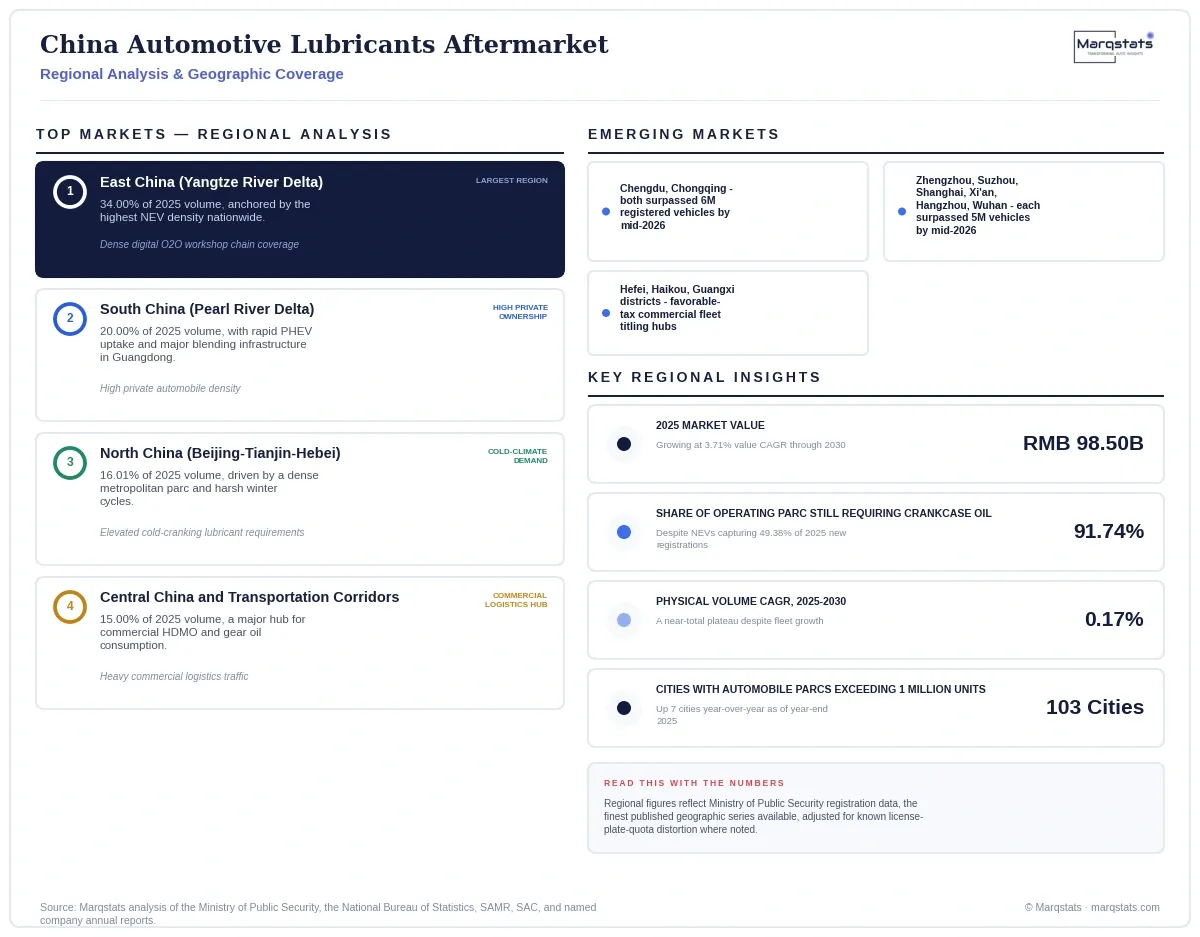
East China represents the largest regional market at 34.00% of 2025 volume (1.183 billion liters), anchored by the highest new energy vehicle density nationwide, rapid transition toward 0W-20 and 0W-16 synthetic formulations, and dense digital O2O workshop chain coverage across the region.
South China (Pearl River Delta)
South China accounted for 20.00% of 2025 volume (0.696 billion liters), characterized by high private automobile density and rapid plug-in hybrid uptake, with major blending infrastructure concentrated in Guangdong province supporting regional distribution.
North China (Beijing-Tianjin-Hebei)
North China represented 16.01% of 2025 volume (0.557 billion liters), driven by a dense metropolitan parc centered on Beijing and elevated cold-cranking lubricant requirements during harsh winter operating cycles.
Central China and Transportation Corridors
Central China and its transportation corridors accounted for 15.00% of 2025 volume (0.522 billion liters), functioning as a major hub for commercial heavy-duty motor oil and gear oil consumption driven by heavy commercial logistics traffic.
Western and Southwestern Economic Belt
The Western and Southwestern Economic Belt represented 14.99% of 2025 volume (0.522 billion liters), with rapidly growing automobile parcs in Chengdu and Chongqing, both surpassing six million registered vehicles by mid-2026, and complex mountainous terrain driving elevated driveline and thermal wear.
How Competition Is Evolving
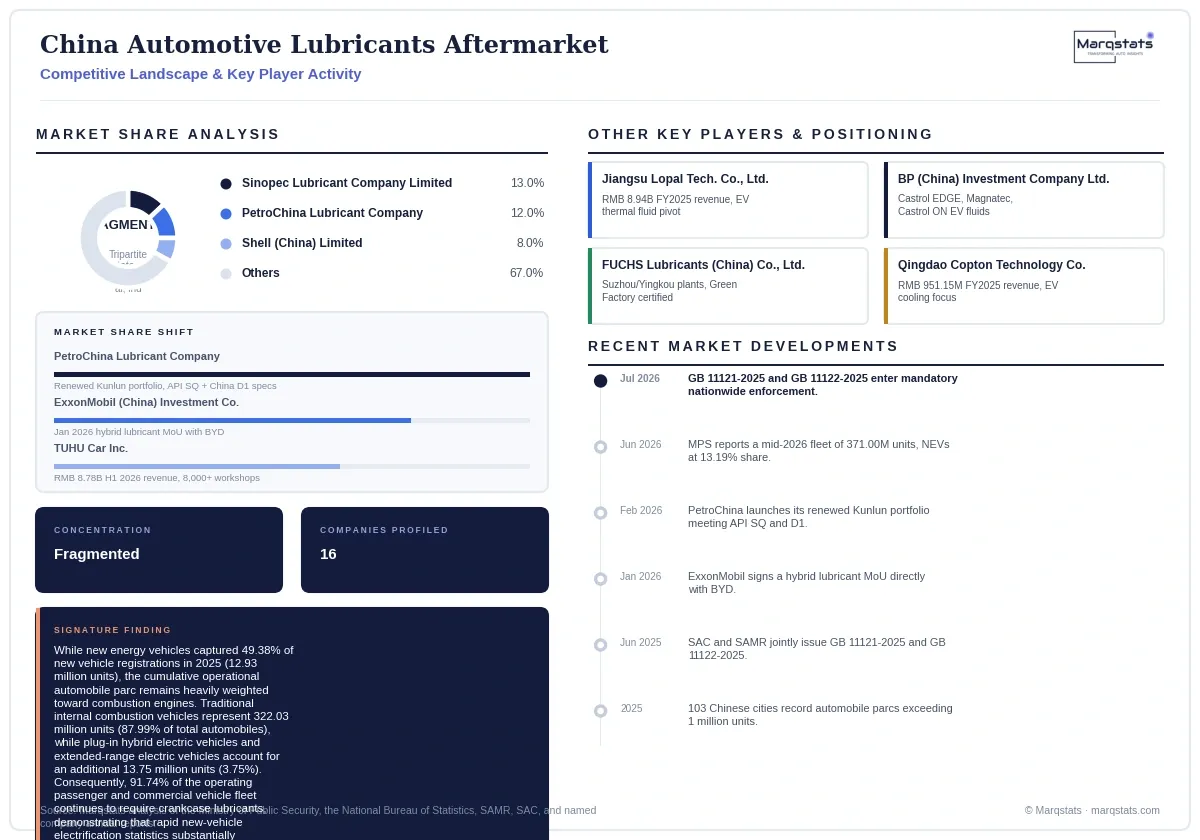
The competitive structure of China's automotive lubricants aftermarket is characterized by a tripartite division among state-owned petrochemical corporations, multinational lubricant formulators and independent domestic chemical blenders, with no single vendor commanding dominant share; Sinopec Lubricant Company Limited and PetroChina Lubricant Company anchor state-owned refining integration, while Shell, ExxonMobil, BP and TotalEnergies maintain established brand equity across premium passenger car segments and 4S dealership networks.
Firms compete differently by tier: state-owned enterprises leverage refining integration and domestic base oil infrastructure to lead commercial transport and bulk fleet sectors, multinational formulators compete on premium brand equity and direct OEM co-engineering partnerships, exemplified by ExxonMobil's hybrid technology memorandum of understanding with BYD signed in January 2026, and domestic independent formulators including Jiangsu Lopal Tech. Co., Ltd. expand market share through direct integration with digital O2O platforms and competitive pricing in secondary and tertiary markets.
The most significant recent competitive-landscape development is PetroChina Lubricant Company's 2026 renewal of its Kunlun lubricant portfolio, introducing the Tianrun gasoline series formulated to API SQ standards and the Tianwei diesel series engineered to China D1 specifications, demonstrating a technical upgrade by domestic refiners to match international performance standards ahead of the mandatory 1 July 2026 GB 11121-2025 and GB 11122-2025 enforcement date.
Companies Covered
The report profiles 16+ companies with full strategy and financials analysis, including:
Recent Market Activity
Table of Contents
Coverage & Segmentation
Coverage spans the China automotive lubricants aftermarket, encompassing all finished fluid lubricants, functional chemical fluids and lubricating greases procured for the scheduled maintenance, mechanical overhaul and operational top-up of in-use, licensed on-road motor vehicles, evaluated at the wholesale-to-service channel boundary. The market is sized in RMB billion and USD billion at a constant 7.10 RMB per USD exchange rate across a 2021-2025 historical period and a 2026-2030 forecast period, with 2025 as the base year. Three segmentation dimensions are quantified: product category, formulation chemistry, and channel distribution.
Excluded from scope: initial OEM factory fill and factory warranty pre-delivery fills completed within vehicle manufacturing assembly plants, industrial equipment lubricants, railroad traction oils, marine bunkering lubricants, aviation fluids and process oils. A separate Marqstats study addresses the global automotive lubricants aftermarket on a comparable basis.