Market Snapshot
Key Takeaways
Market Overview & Analysis
Report Summary
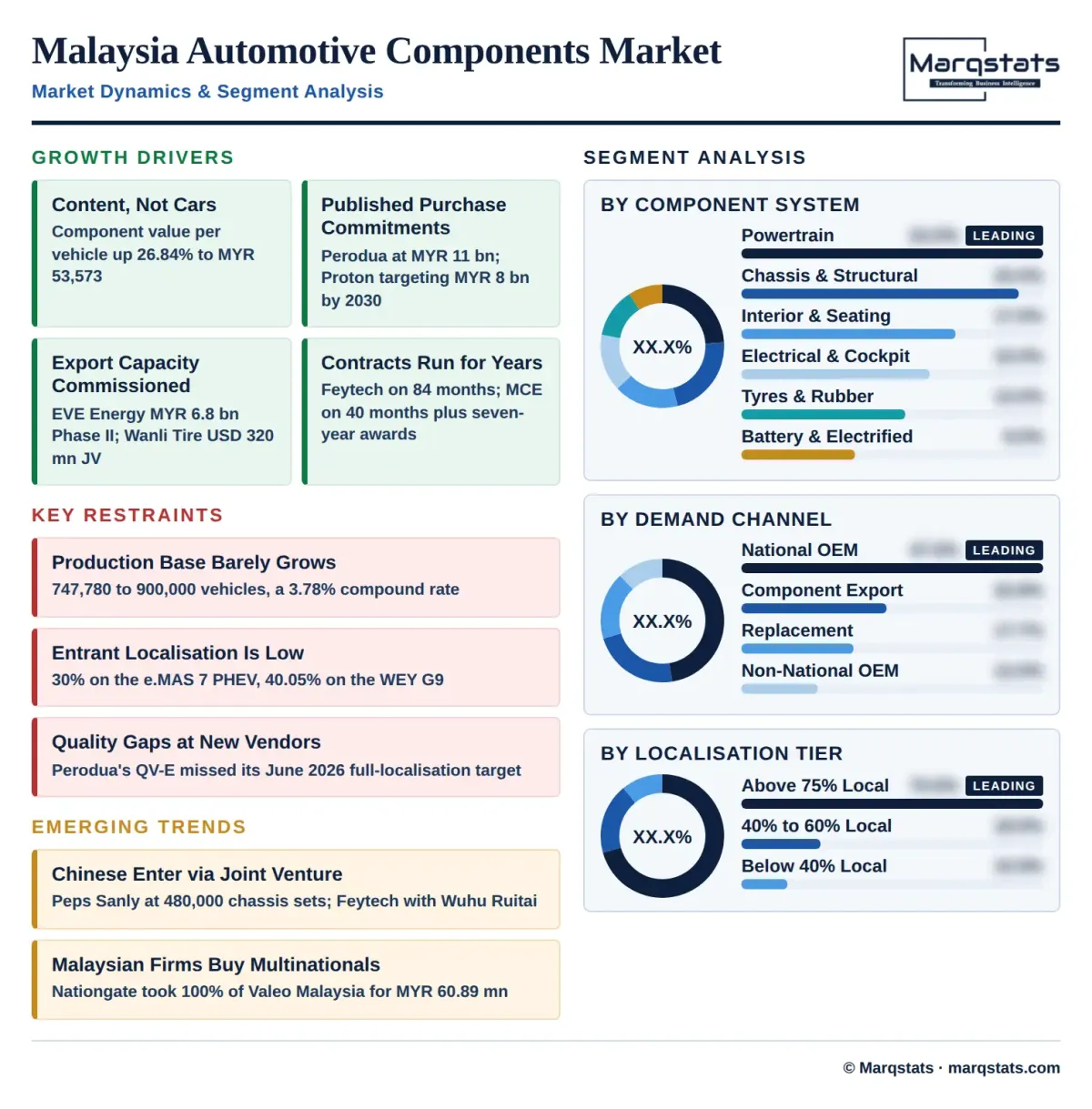
Malaysia's automotive components market is growing on content rather than on cars. Domestic vehicle production of 747,780 units in 2025 was down 5.4% on the prior year, and the forecast puts it at 900,000 by 2030, a 3.78% compound rate that no supplier would build capacity against on its own. What suppliers are building capacity against is the value of what goes into each of those vehicles, which rises 26.84% across the same window.
The measure is the value of automotive components manufactured and supplied within Malaysia, covering chassis and structural modules, interior and seating, powertrain and driveline, electrical and cockpit electronics, tyres and rubber, and battery cells, materials and electrified powertrain units. It counts supply to national manufacturers, to non-national assemblers, to export markets and to domestic replacement manufacture. The value added by the assembly operation itself is a separate and adjacent panel, and the retail value of finished vehicles belongs to the vehicle markets that carry them.
The analysis is written for Tier-1 and Tier-2 suppliers assessing where contracted demand is actually growing, assemblers negotiating localisation commitments against completely knocked down policy, investors pricing announced capacity against a slow-growing domestic production base, and policymakers weighing local content thresholds against the entrants those thresholds are aimed at.
Malaysia Automotive Components Market Size and Forecast
Component supply value is estimated at USD 7.52 billion in 2025, USD 8.10 billion in 2026 and USD 11.48 billion by 2030, an increase of USD 3.96 billion against 152,220 additional vehicles assembled. Component value per vehicle moves from MYR 42,237 to MYR 53,573, or USD 10,056 to USD 12,756 at a constant MYR 4.20 per USD.
Two growth rates apply and the second is the higher one. The five-year value rate connecting 2025 and 2030 is 8.83%; the four-year rate connecting 2026 and 2030 is 9.11%. The 0.28-point gap is small because 2026 is neither a peak nor a trough for this panel: production rises 1.63% while component value rises 7.71% on contracts that were signed before the year began.
Value compounds 5.05 points ahead of volume at 8.83% against 3.78%, and the gap is localisation. Perodua bought MYR 11 billion of parts from local vendors against 370,370 vehicles produced, or MYR 29,700 per unit, and Proton bought MYR 4 billion from Malaysian suppliers against roughly 158,000 units, or MYR 25,316 per unit. Both figures rise through the window as content moves from imported to domestic rather than because either company builds materially more cars.
The volume series is deliberately locked to the domestic vehicle production figure used across this programme's Malaysian manufacturing pages, at 747,780 units in 2025 and 900,000 by 2030. Two panels measuring different layers of the same industry cannot carry two different readings of the one official series either of them depends on, and the component panel and the assembly panel are built on the same base for that reason.
A sizing range is published rather than a point. The 2030 figure sits within a band of USD 10.20 billion to USD 13.10 billion against 850,000 to 950,000 vehicles, corresponding to rates of 6.28% and 11.75%, and the spread turns on export capacity utilisation rather than on domestic demand.
The Two National Manufacturers Set the Localisation Floor
Perodua and Proton produced an estimated 528,370 vehicles in 2025, 70.66% of national output, and the Ministry of International Trade and Industry put localisation for Proton-Geely and Perodua-Daihatsu above 75% as of 31 March 2026, with the two groups holding 63% of local vehicle sales and employing more than 700,000 people across their supply chains.
Their purchase commitments are published and dated. Perodua bought MYR 11 billion of parts from local vendors in 2025. Proton's local purchase value exceeded MYR 17 billion cumulatively across 2021 to 2025 with a MYR 30 billion projection to 2030, and separately it sourced MYR 4 billion of parts and services from Malaysian suppliers in 2025 against a MYR 8 billion target by 2030. The two disclosures use different bases and are reported here as published rather than forced to reconcile.
Doubling Proton's Malaysian supplier spend from MYR 4 billion to MYR 8 billion by 2030 requires a 14.87% compound rate against a production base growing at 3.78%. That single commitment is the clearest published statement of how much of this market's growth is content rather than volume.
Powertrain Localisation Is Being Built at Tanjung Malim
Proton's Tanjung Malim powertrain hub has taken more than MYR 121 million of investment since 2022, works with 16 suppliers of which eight are Malaysian, employs more than 500 people, and has a design capacity of up to 240,000 engines a year with a plan for up to 400,000 units a year by 2028. It is the largest single localisation commitment in the Malaysian components base.
The hub is share capture rather than category growth, which is why powertrain and driveline is the slowest-growing system segment at a 4.93% compound rate despite carrying the largest 2025 value at an estimated USD 1,804.80 million. Engines built at Tanjung Malim displace imported units; they do not add powertrain content to the national fleet. The content that is being added sits in the electrified powertrain segment, which is measured separately.
Electrified powertrain localisation is running on a parallel track. Proton's new energy vehicle plant took a MYR 37 million expansion to 42,000 units a year and employs 391 people, though the e.MAS 7 plug-in hybrid carries only 30% local parts content. UMW Toyota began hybrid battery assembly at Bukit Raja in January 2026 with 97% of battery components sourced locally and capacity of up to 30,000 batteries a year, which is the highest localisation rate disclosed for any electrified component in the country.
Chassis Modules Are Localising Fastest Among the Structural Systems
EP Manufacturing and China's Sanly Auto Parts opened the Peps Sanly chassis assembly facility at Tanjong Malim in August 2026, a MYR 9.5 million investment across 9,909 square metres producing 40,000 sets a month, or 480,000 sets a year, of front corner, subframe and rear axle modules for the Proton Saga, Persona, Iriz, AMA02 and AMA05. Capacity of 480,000 sets against 747,780 vehicles assembled nationally is a single facility covering nearly two thirds of national demand for those modules.
EP Manufacturing's own results show what that contracting is worth. First-half 2026 revenue reached MYR 372.87 million against MYR 253.23 million a year earlier, with net profit of MYR 6.7 million against MYR 1.05 million, and second-quarter revenue of MYR 212.68 million against MYR 127.7 million on net profit of MYR 5.15 million against MYR 277,000. Its Pegoh operation assembles more than 1,000 vehicles a month for Great Wall Motor, SAIC and XPeng and is adding a paint facility for up to 30,000 vehicles a year.
The Mazda programme is the template for how non-national localisation now proceeds. The Malaysian Investment Development Authority and Bermaz Auto enrolled 16 Malaysian suppliers in a vendor development programme for the third-generation CX-5 in September 2026, targeting 60% local content once completely knocked down assembly at Inokom begins in 12 to 16 months, with five memoranda exchanged between Malaysian and Japanese firms. Inokom's Paint Shop 3 opened in August 2026 at a cost of MYR 300 million, adding 50,000 bodies a year for total paint capacity of 100,000 units.
The Growth Is in Export, and Export Does Not Depend on Malaysian Demand
Component export compounds at 12.89%, the fastest of the four demand channels, moving from an estimated USD 1,714.29 million in 2025 toward an estimated USD 3,142.86 million by 2030. The capacity behind it is battery and tyre rather than conventional parts, and almost none of it was built for the domestic market.
EVE Energy completed Phase II of its Malaysian battery plant in February 2026 at MYR 6.8 billion with more than 1,000 jobs. Novolyte, the Shenzhen Capchem subsidiary, targeted commissioning of an electrolyte plant at Kulim in the third quarter of 2026 at approximately 30,000 metric tonnes a year. Wanli Tire and Berjaya Property signed a joint venture on 6 July 2026 for a plant at Bukit Tagar, Selangor, at approximately USD 320 million across 67.9 acres, designed for 1.2 million truck and bus radial and 5 million passenger car radial tyres a year and more than 1,000 jobs.
Tyre supply restructured after Goodyear ceased Shah Alam operations in 2024, which moved Proton's S70 from Kumho to Giti tyres and left a domestic gap the Wanli plant is sized to fill. Nationgate completed the acquisition of Valeo Malaysia's operation on 31 December 2025 for MYR 60.89 million in cash, taking full ownership, which moved an established multinational electronics operation into Malaysian hands.
Chinese Entrants Localise Least and Are Being Pushed Hardest
Local content disclosed by the newer entrants runs well below the national manufacturer floor. The Proton e.MAS 7 plug-in hybrid carried 30% local parts content as of 31 July 2026 and the Great Wall Motor WEY G9 carried 40.05% as of January 2026 against a target of 5,000 units domestic and 5,000 export a year. Stellantis committed EUR 5.3 million in September 2026 to localisation at its Gurun plant for the Leapmotor C10 and B10.
Policy is applying direct pressure. The Ministry of International Trade and Industry set a MYR 100,000 local minimum price for BYD completely knocked down models as of 31 March 2026, and the Malaysian Automotive Component Parts Manufacturers association and the Perodua Suppliers Association both backed the ministry's completely knocked down policy clarification in April 2026. Perodua's QV-E targeted full localisation by June 2026 at an initial 500 units a month against more than 200 reservations, and its delays are the clearest available signal of quality gaps at newly qualified suppliers.
Market Dynamics
Key Drivers
- Localisation is the primary driver, lifting component value per vehicle from MYR 42,237 to MYR 53,573, a 26.84% increase that delivers more of the USD 3.96 billion of value added than the 152,220 additional vehicles do.
- National manufacturer purchase commitments are published and rising, with Perodua at MYR 11 billion in 2025 and Proton targeting MYR 8 billion of Malaysian supplier spend by 2030 against MYR 4 billion in 2025.
- Export capacity is being commissioned independently of domestic demand, including EVE Energy's MYR 6.8 billion Phase II plant, Novolyte's 30,000-tonne electrolyte facility and a USD 320 million Wanli Tire joint venture.
- Long-duration contracts are locking in supplier revenue, with Feytech on an 84-month MYR 96.83 million Proton agreement and MCE Holdings on a 40-month MYR 54.28 million Perodua package plus roughly MYR 37.9 million of seven-year Proton contracts.
- Completely knocked down policy is forcing content into entrant models, with a MYR 100,000 local minimum price set for BYD models and Mazda targeting 60% local content on the third-generation CX-5.
Key Restraints
- The production base grows at only 3.78%, from 747,780 to 900,000 vehicles, and fell 5.4% in 2025, so no supplier can justify capacity on domestic volume growth alone.
- Entrant localisation rates remain low at 30% for the Proton e.MAS 7 plug-in hybrid and 40.05% for the Great Wall Motor WEY G9, which caps content value on the fastest-growing part of the vehicle market.
- Newly qualified suppliers have shown quality gaps, with Perodua's QV-E missing its June 2026 full-localisation target against an initial 500 units a month and more than 200 reservations.
- Established multinational capacity has exited, with Goodyear ceasing Shah Alam operations in 2024 and Proton moving the S70 from Kumho to Giti tyres before replacement capacity was in place.
Key Trends
- Battery cells, materials and electrified powertrain is the fastest system segment at 15.27%, moving from an estimated USD 676.80 million to USD 1,377.60 million between 2025 and 2030.
- Chinese suppliers are entering through joint ventures rather than wholly owned plants, including EP Manufacturing with Sanly at 480,000 chassis sets a year and Feytech with Wuhu Ruitai on Chery seat production.
- Malaysian companies are acquiring multinational operations rather than only supplying them, with Nationgate taking 100% of Valeo Malaysia's operation for MYR 60.89 million on 31 December 2025.
- Electronics content is moving into internal combustion models, with MCE Holdings' MYR 54.28 million Perodua package for audio displays, reverse cameras and driver assistance components its first such project on an internal combustion vehicle.
Market Segmentation
Chassis, body and structural modules accounted for an estimated USD 1,654.40 million in 2025, 22.00% of the market, growing to an estimated USD 2,353.40 million or 20.50% by 2030 at a 7.30% compound rate. The Peps Sanly facility at Tanjong Malim alone carries 480,000 sets a year of front corner, subframe and rear axle modules across five Proton platforms.
Interior, seating and trim accounted for an estimated USD 1,278.40 million in 2025, 17.00% of the market, growing to an estimated USD 1,779.40 million or 15.50% by 2030 at a 6.84% compound rate. Feytech's 84-month, MYR 96.83 million Proton seat cover contract through Gosford Leather Industries is the segment's largest disclosed award.
Powertrain and driveline accounted for an estimated USD 1,804.80 million in 2025, the largest system at 24.00% of the market, growing to an estimated USD 2,296.00 million or 20.00% by 2030 at a 4.93% compound rate, the slowest of the six. Proton's Tanjung Malim hub at up to 240,000 engines a year, rising toward 400,000 by 2028, captures share from imports rather than adding category volume.
Electrical, electronics and cockpit systems accounted for an estimated USD 1,128.00 million in 2025, 15.00% of the market, growing to an estimated USD 2,066.40 million or 18.00% by 2030 at a 12.87% compound rate. MCE Holdings holds a 40-month, MYR 54.28 million Perodua package and roughly MYR 37.9 million of seven-year Proton electronics and mechatronics contracts.
Tyres and rubber components accounted for an estimated USD 977.60 million in 2025, 13.00% of the market, growing to an estimated USD 1,607.20 million or 14.00% by 2030 at a 10.45% compound rate. The Wanli Tire and Berjaya Property joint venture at approximately USD 320 million is designed for 1.2 million truck and bus radial and 5 million passenger car radial tyres a year.
Battery cells, materials and electrified powertrain accounted for an estimated USD 676.80 million in 2025, the smallest system at 9.00% of the market, growing to an estimated USD 1,377.60 million or 12.00% by 2030 at a 15.27% compound rate, the fastest of the six. EVE Energy's MYR 6.8 billion Phase II plant and Novolyte's 30,000-tonne electrolyte capacity at Kulim are the anchor assets.
Supply to Perodua and Proton accounted for an estimated USD 3,571.43 million in 2025, 47.47% of the market, growing at a 7.47% compound rate to an estimated 44.61% share by 2030. The channel is the most visible in the market because both companies publish their purchase values, at MYR 11 billion and MYR 4 billion respectively in 2025.
Supply to Japanese, European and Chinese assemblers operating in Malaysia accounted for an estimated USD 904.76 million in 2025, 12.03% of the market, growing at a 10.99% compound rate to an estimated 13.28% share by 2030. Mazda's 60% local content target for the third-generation CX-5 and Stellantis' EUR 5.3 million Gurun commitment are the segment's near-term drivers.
Component export accounted for an estimated USD 1,714.29 million in 2025, 22.78% of the market, growing at a 12.89% compound rate to an estimated 27.39% share by 2030, the fastest of the four channels. Battery cells, electrolyte and tyres carry most of the growth and none of it depends on Malaysian vehicle demand.
Domestic replacement manufacture accounted for an estimated USD 1,333.33 million in 2025, 17.72% of the market, growing at a 4.86% compound rate to an estimated 14.73% share by 2030, the slowest of the four. The channel tracks the national vehicle parc rather than new production and is the most stable series in the panel.
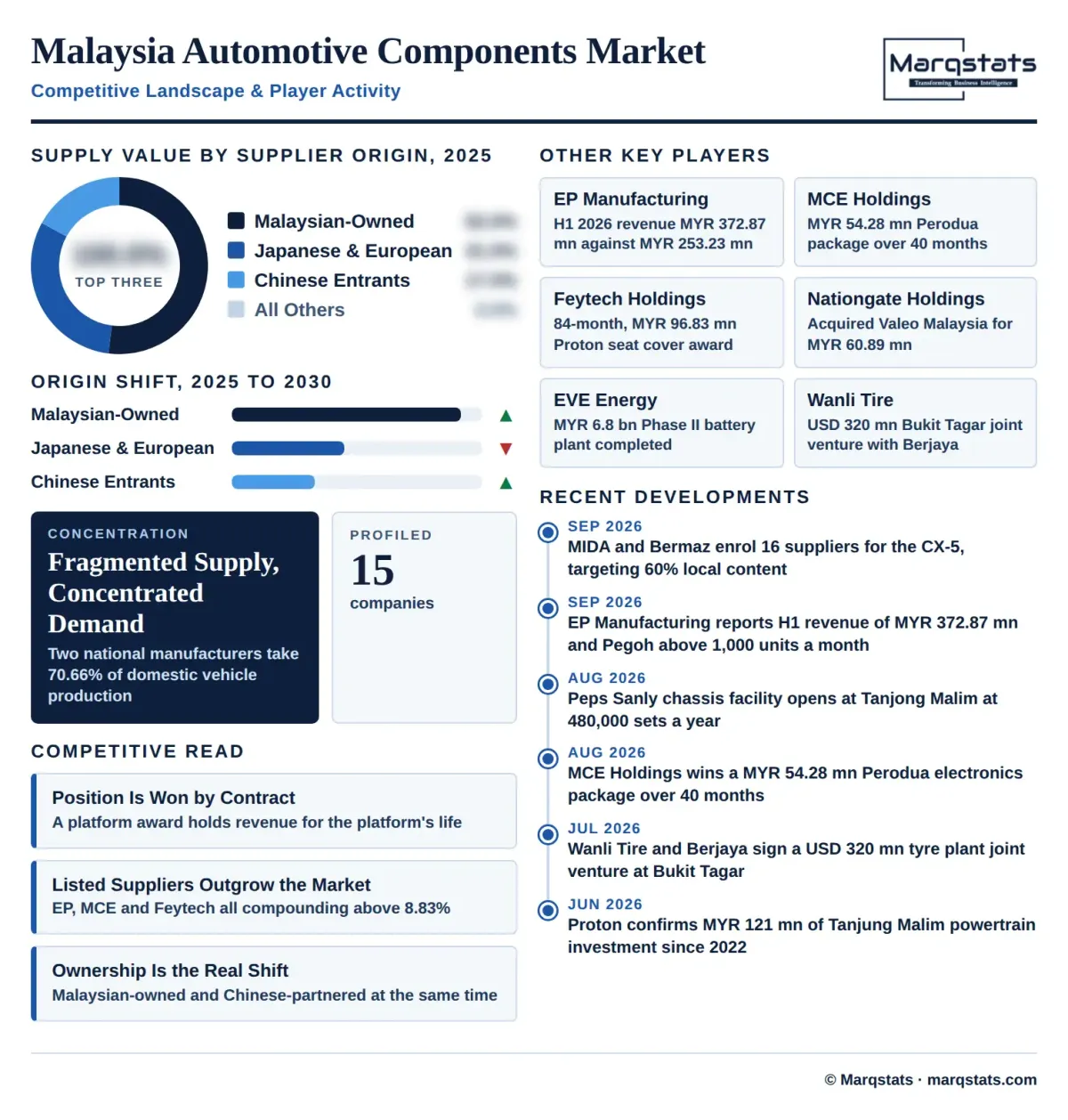
Malaysian-owned suppliers accounted for an estimated USD 3,910.40 million in 2025, 52.00% of the market, and hold the majority position through the window. EP Manufacturing, MCE Holdings, Feytech, Nationgate and Betamek are the listed core, with EP Manufacturing's first-half 2026 revenue at MYR 372.87 million against MYR 253.23 million a year earlier.
Japanese and European multinationals accounted for an estimated USD 2,331.20 million in 2025, 31.00% of the market, and lose share through the window without losing absolute value. Nationgate's MYR 60.89 million acquisition of Valeo Malaysia's operation on 31 December 2025 is the clearest single instance of the transfer underway.
Chinese supplier entrants and joint ventures accounted for an estimated USD 1,278.40 million in 2025, 17.00% of the market, and are the fastest-growing origin group. The route into Malaysia is the joint venture rather than the wholly owned plant, as with EP Manufacturing and Sanly at 480,000 chassis sets a year and Feytech's FTRT Autoparts venture with Wuhu Ruitai supplying four Chery models from Subang.
Vehicles assembled at above 75% local content accounted for an estimated 528,082 units in 2025, 70.62% of national production, and are almost entirely Perodua and Proton models. The Ministry of International Trade and Industry confirmed the above-75% rate for both national groups as of 31 March 2026.
Vehicles assembled at 40% to 60% local content accounted for an estimated 138,339 units in 2025, 18.50% of national production, covering established Japanese and European completely knocked down programmes and the Great Wall Motor WEY G9 at 40.05%. Mazda's 60% target for the third-generation CX-5 sits at the top of this tier.
Vehicles assembled at below 40% local content accounted for an estimated 81,359 units in 2025, 10.88% of national production, and include the Proton e.MAS 7 plug-in hybrid at 30%. The tier shrinks through the window as completely knocked down policy and the MYR 100,000 local minimum price for BYD models push content upward.
By Geography
Selangor and the Klang Valley Industrial Belt
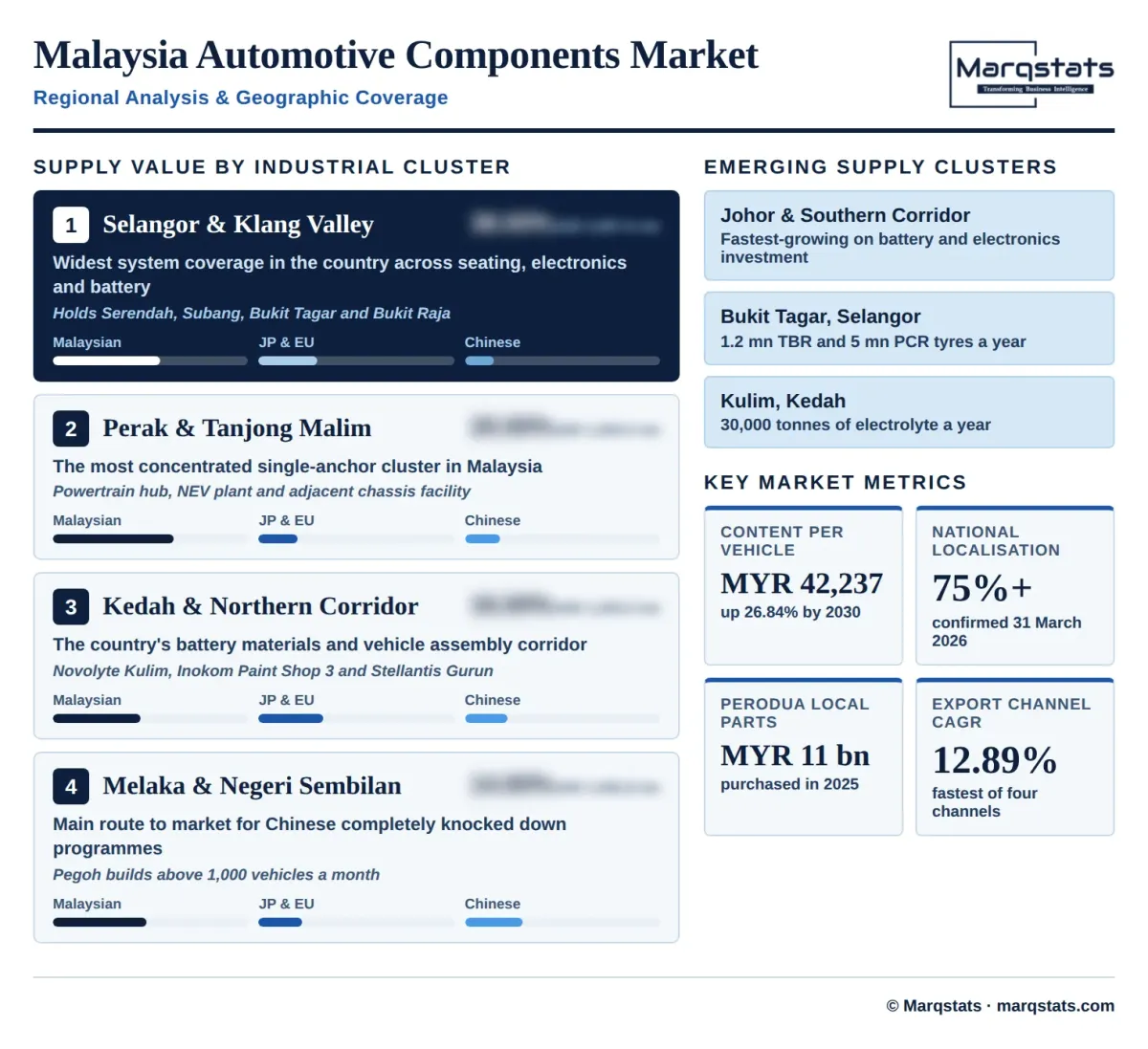
Selangor and the Klang Valley account for an estimated USD 2,857.60 million of component supply in 2025, 38.00% of the market, and carry the widest system coverage in the country. The belt holds MCE Holdings' Serendah hub, Feytech's Subang seat operation, the Wanli joint venture site at Bukit Tagar across 67.9 acres, and UMW Toyota's Bukit Raja hybrid battery assembly at up to 30,000 batteries a year.
Perak and the Tanjong Malim Corridor
Perak accounts for an estimated USD 1,504.00 million, 20.00% of the market, and is the most concentrated single-anchor cluster in Malaysia. Proton's Tanjung Malim complex carries the powertrain hub at up to 240,000 engines a year, the new energy vehicle plant expanded to 42,000 units, and the adjacent Peps Sanly chassis facility at 480,000 sets a year.
Kedah and the Northern Corridor
Kedah accounts for an estimated USD 1,203.20 million, 16.00% of the market, and is the country's battery materials and assembly corridor. Novolyte's Kulim electrolyte plant at approximately 30,000 tonnes a year, Inokom's Kulim operation with its MYR 300 million Paint Shop 3 at 50,000 bodies a year, and the Stellantis Gurun plant with its EUR 5.3 million Leapmotor localisation sit inside it.
Melaka and Negeri Sembilan
Melaka and Negeri Sembilan account for an estimated USD 1,052.80 million, 14.00% of the market, anchored on EP Manufacturing's Pegoh operation assembling more than 1,000 vehicles a month for Great Wall Motor, SAIC and XPeng with a new paint facility for up to 30,000 vehicles a year. The cluster is the main route to market for Chinese completely knocked down programmes.
Johor and the Southern Corridor
Johor accounts for an estimated USD 902.40 million, 12.00% of the market, and is the fastest-growing region on battery and electronics investment. Berjaya Assembly's Tampoi plant assembles Jetour's entire Malaysian volume, which reached 5,048 units in the first half of 2026, and the state's electronics base supplies both automotive and non-automotive demand.
How Competition Is Evolving
Malaysia's automotive components market is moderately fragmented and the fragmentation is a function of the customer base rather than of the supplier base. Two national manufacturers account for 70.66% of domestic production and publish their purchase values, so supplier position is determined by contract awards from a small number of buyers rather than by open-market share. A supplier that wins a Perodua or Proton platform holds that revenue for the platform's life, which is why the disclosed contract durations run to 84 months and seven years.
The listed Malaysian suppliers are the clearest read on competitive movement because their awards are announced to the exchange. EP Manufacturing more than doubled second-quarter net profit to MYR 5.15 million on revenue of MYR 212.68 million, MCE Holdings won its first internal combustion project carrying driver assistance content at MYR 54.28 million over 40 months, and Feytech secured an 84-month MYR 96.83 million seat cover agreement. None of these is a large company by international supplier standards, and all three are growing faster than the market.
The structural change underway is ownership rather than share. Nationgate acquired 100% of Valeo Malaysia's operation for MYR 60.89 million in cash on 31 December 2025, moving a multinational electronics operation into Malaysian hands, while Chinese suppliers are entering through joint ventures with Malaysian partners rather than through wholly owned plants. The combination is producing a supplier base that is increasingly Malaysian-owned and increasingly Chinese-partnered at the same time.
Companies Covered
The report profiles 15+ companies with full strategy and financials analysis, including:
Recent Market Activity
Table of Contents
Coverage & Segmentation
The analysis measures the value of automotive components manufactured and supplied within Malaysia from 2021 to 2030, with 2025 as the base year and 2026 to 2030 as the forecast period, covering chassis and structural modules, interior and seating, powertrain and driveline, electrical and cockpit electronics, tyres and rubber components, and battery cells, materials and electrified powertrain units, together with the completely knocked down and local content policy framework that governs supplier qualification. The value added by the assembly operation itself is a separate and adjacent panel measuring a different layer of the same industry. The retail value of finished vehicles belongs to the vehicle markets that carry them and is never added to this panel. Values are expressed in USD at a disclosed constant MYR 4.20 per USD.
Coverage spans six component systems, four demand channels, three supplier origin groups and three localisation tiers, with five regional clusters analysed on supply value and anchor facility capacity. Domestic vehicle production is carried as the unit series at 747,780 in 2025 and component value per vehicle assembled as a derived series at MYR 42,237, and both are published alongside the value panel because a market whose content value is rising faster than its unit base cannot be represented by either alone. Fifteen entities are profiled across listed Malaysian suppliers, national and international manufacturers whose purchase decisions set demand, and the foreign investors building export capacity.