Market Snapshot
Middle bar: base-year value × (1 + CAGR), rounded to two decimals. This is a calculated illustration, not a separately researched annual estimate.
The Asia-Pacific electric harbour craft market is estimated at USD 270.0 million in 2025 and is projected to reach USD 1,410.4 million by 2030, at a CAGR of 39.19%. Deliveries rise from 54 fully-electric vessels a year to 328, a 43.45% CAGR, with Singapore growing fastest at 58.97% as its 2030 new-build requirement approaches and China holding the largest current share at 57.4% of vessels.
Market size and forecast figures are generated using Marqstats' proprietary estimation framework, updated as of September 2026.
This report counts new fully-electric harbour craft delivered in Asia-Pacific — port workboats operating within port limits, spanning crew and supply launches, harbour tugs and tow boats, port-limit passenger ferries and bunkering support craft. Seagoing vessels, inland-waterway cargo barges, pleasure craft and hybrid or biofuel-capable diesel vessels are excluded. The Marqstats Europe Electric Inland Shipping report covers the inland analogue, which is a different vessel class with a different duty cycle and a different owner of the battery.
Singapore's port authority set the region's clock: from 2030, every new harbour craft licensed in the port must be fully electric, capable of running B100 biofuel, or compatible with net-zero fuels such as hydrogen, with the entire fleet net-zero by 2050. That deadline is pulling an order book forward through 2028 and 2029, and Singapore's share of regional deliveries rises from 20.4% to 34.1% across the forecast. But the rule contains a route around itself, and understanding it is the difference between forecasting hundreds of electric vessels and forecasting thousands.
Key Takeaways
Market Overview & Analysis
Report Summary
This report sizes the Asia-Pacific electric harbour craft market — fully-electric workboats delivered into port service across the region. Harbour craft are the vessels that never leave port limits: the launches carrying crews to anchored ships, the tugs that move them, the small ferries running fixed port routes, and the support craft servicing bunkering operations. They are among the most electrifiable vessels afloat, because they return to the same berth every night and rarely travel far from it.
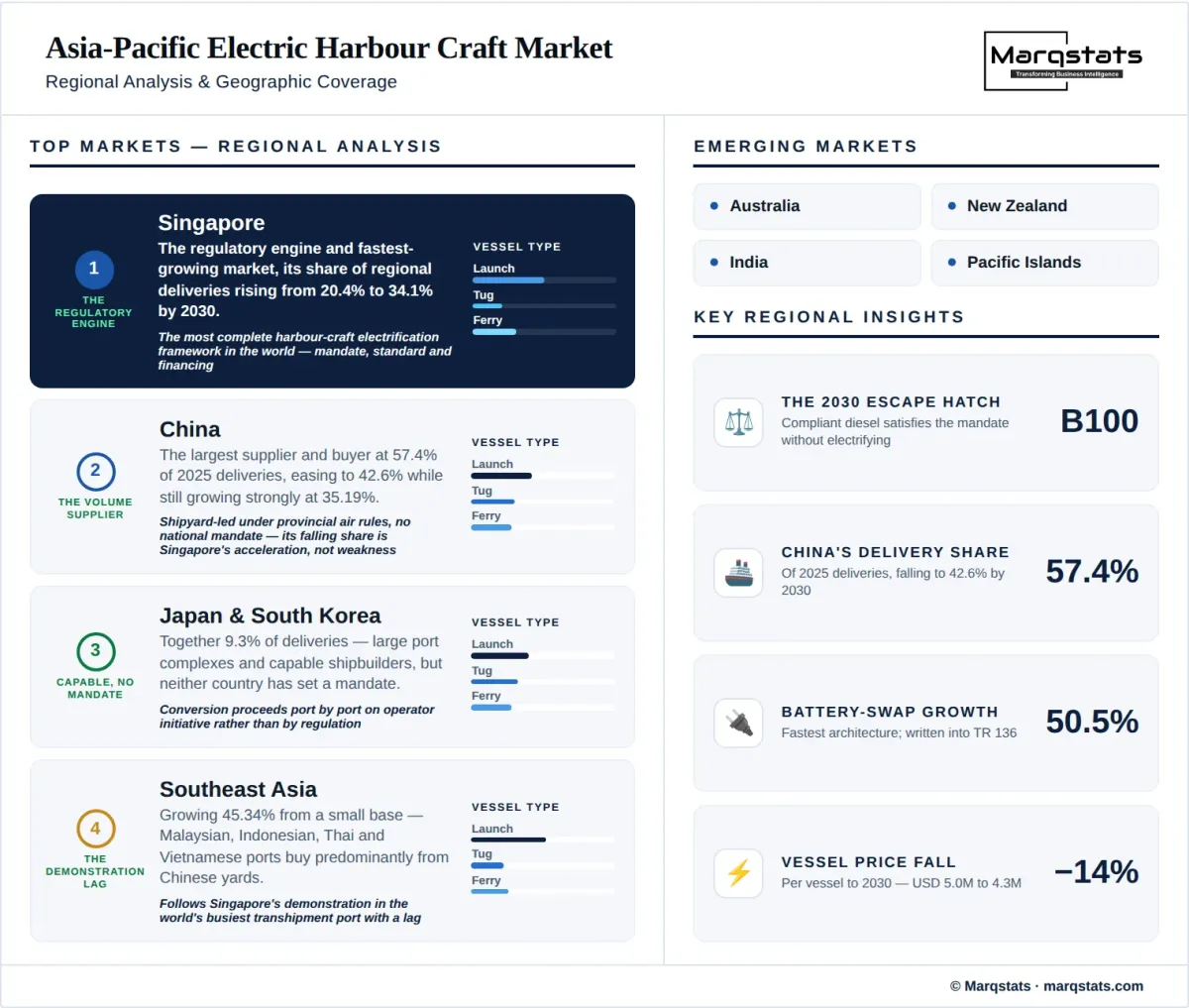
Singapore is the regulatory engine. Its port authority has ruled that from 2030 all new harbour craft must be fully electric, capable of using B100 straight biofuel, or compatible with net-zero fuels such as hydrogen, with the full fleet operating net-zero by 2050. Supporting architecture followed: Technical Reference 136, published on 25 March 2025, sets the electric harbour craft charging standard, incorporating the Combined Charging System and aligning with the international standards covering both charging systems and battery swap. Financing runs through a green enterprise scheme offering risk-sharing of up to 70% across seven participating banks, and the first charging point was established at Shell's Pulau Bukom facility.
The forecast's central judgement concerns what that mandate actually compels. Because modern diesel engines can already run at least one form of straight biofuel without modification, a shipowner can order a conventional diesel newbuild in 2030 and comply through B100 capability alone. The rule therefore guarantees a fuel transition but not an electric one, which is why this report forecasts 328 electric vessels a year by 2030 rather than the wholesale fleet conversion the headline implies. Electric harbour craft will be bought where the duty cycle and the economics justify them — short fixed routes, high daily utilisation, shore power already at the berth — and B100 will absorb the rest.
China's position is different and larger in the near term. Its shipyards build electric workboats for domestic ports without a comparable mandate, driven by provincial air quality programmes and by the same cost logic that made China the world's largest electric bus market. China supplies 57.4% of 2025 regional deliveries. But its growth is shipyard-led and incremental, while Singapore's is regulation-led and accelerating, so the two lines cross in share terms across the forecast even as both grow strongly in absolute volume.
Market Dynamics
Key Drivers
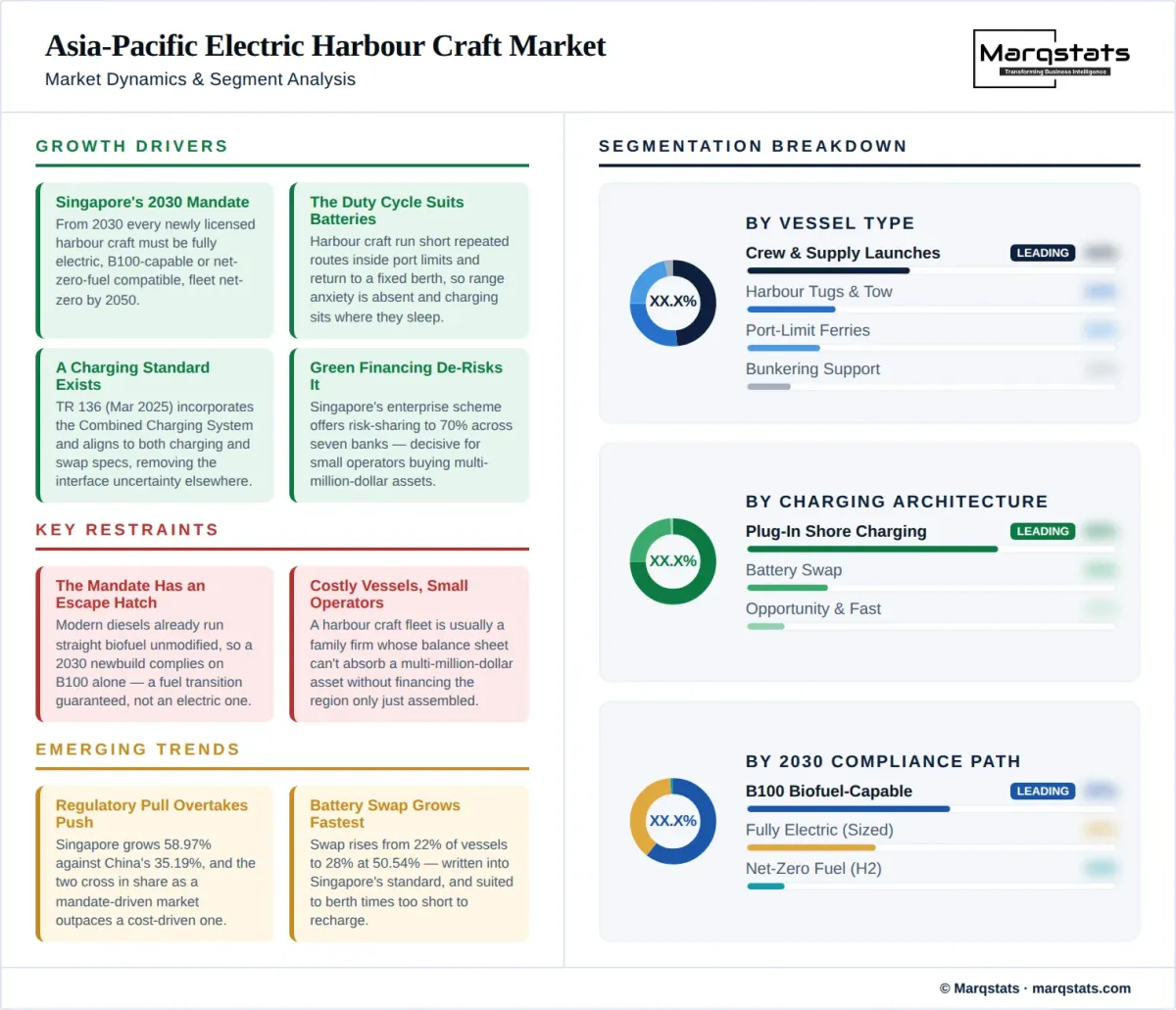
Singapore's 2030 new-build requirement is the only binding harbour craft mandate in the region: from that year every newly licensed vessel must be fully electric, B100-capable or net-zero-fuel compatible, with the entire fleet net-zero by 2050.
The duty cycle suits batteries better than almost any vessel class. Harbour craft operate inside port limits on short repeated runs and return to a fixed berth, so range anxiety is structurally absent and shore charging can be sited where the vessel already sleeps.
A charging standard exists and includes swap. Technical Reference 136, published 25 March 2025, incorporates the Combined Charging System and aligns to the international specifications for both charging systems and battery swap, removing the interface uncertainty that stalls early marine electrification elsewhere.
Green financing de-risks the purchase. Singapore's enterprise financing scheme offers risk-sharing of up to 70% through seven participating financial institutions, which matters disproportionately in a sector of small operators buying assets that cost several million dollars each.
Chinese shipyards supply at scale and at price. China builds 57.4% of the region's electric harbour craft and its yards are the default supplier for Southeast Asian buyers, applying the same cost structure that made Chinese electric buses the global benchmark.
Key Restraints
The mandate can be satisfied without electrification. Modern diesel engines already run straight biofuel without modification, so a conventional newbuild ordered in 2030 complies through B100 capability alone — the rule guarantees a fuel transition, not an electric one.
Vessels cost several million dollars each and operators are small. A harbour craft fleet is typically owned by a family firm or a small operator whose balance sheet cannot absorb a multi-million-dollar asset without the financing support the region has only recently assembled.
Charging infrastructure barely exists outside Singapore. Regional ports have shore power at a handful of berths, and no other Asia-Pacific jurisdiction has published an equivalent charging standard, so vessels ordered outside Singapore face bespoke shoreside engineering.
Battery weight competes with payload and bollard pull. For tugs in particular, the energy needed for towing duty translates into battery mass that displaces the very capability the vessel is bought for, which is why tugs grow more slowly than launches.
Key Trends
Regulatory pull is overtaking shipyard push. Singapore grows at 58.97% against China's 35.19%, and the two cross in share terms as a mandate-driven market outpaces a cost-driven one.
Battery swap grows fastest among charging architectures at 50.54%, rising from 22% of vessels to 28%, because it is written into Singapore's standard and because swapping suits vessels whose berth time is too short to recharge.
Prices fall 14% across the forecast, from USD 5.0 million to USD 4.3 million per vessel, as launches and ferries outgrow high-value tugs and as Chinese yard capacity scales — which is why unit growth outruns value growth by 4.26 points.
Crew and supply launches consolidate as the volume class, from 44% of deliveries to 48% at 45.97%, because their short fixed routes and modest power requirements make them the cheapest vessel in the fleet to electrify.
Market Segmentation
The volume class at 44% of 2025 deliveries rising to 48% by 2030, growing at 45.97%. Launches ferry crews and stores to anchored vessels on short repeated runs inside port limits, returning to a fixed berth between trips. Modest power requirements and predictable routes make them the cheapest harbour craft to electrify and the first class any operator converts.
At 24% of deliveries easing to 21%, growing at 39.67% — the slowest class. Towing duty demands sustained high power, and the battery mass required competes directly with the bollard pull the vessel exists to deliver. Electric tugs are being built and they work, but the engineering trade-off is real and it caps the class's share.
Steady at 20% of deliveries throughout, growing at 43.45% in line with the market. Fixed-route passenger services inside port limits combine predictable energy demand with berth dwell time at both ends of every run, and passenger comfort gains from the absence of engine noise and vibration add a commercial argument no cargo vessel has.
At 12% of deliveries easing to 11%, growing at 40.97%. Support vessels servicing bunkering and port operations run irregular patterns that suit batteries less well than scheduled services, and the segment converts where a specific operator commits rather than as a class.
The dominant architecture at 68% of 2025 vessels, easing to 62% by 2030 at 40.82%. Technical Reference 136 incorporates the Combined Charging System, giving Singapore-registered vessels a defined interface, and plug-in remains the default wherever a vessel has enough berth time to recharge conventionally.
The fastest-growing architecture at 50.54%, rising from 22% of vessels to 28% by 2030. Swap is explicitly within the scope of Singapore's charging standard, and it solves the problem plug-in cannot: a vessel whose berth time is measured in minutes rather than hours can exchange a pack and return to service immediately.
Steady at 10% of vessels, growing at 43.45%. High-power charging during short scheduled stops suits fixed-route ferries in particular, and the architecture borrows directly from bus opportunity charging — the same equipment vendors, the same duty-cycle logic, scaled up for marine power levels.
By Geography
Singapore
The regulatory engine and the fastest-growing market at 58.97%, rising from 20.4% of regional deliveries to 34.1% by 2030. The 2030 new-build requirement, the TR 136 charging standard published in March 2025, the green financing scheme with risk-sharing to 70%, and the first charging point at Pulau Bukom together form the most complete harbour craft electrification framework anywhere in the world.
China
The largest supplier and buyer at 57.4% of 2025 deliveries, falling to 42.6% by 2030 while growing at 35.19%. Chinese shipyards build electric workboats for domestic ports under provincial air quality programmes rather than a national mandate, and the same cost structure that made China the world's largest electric bus market applies here. Its declining share reflects Singapore's acceleration, not Chinese weakness.
Japan and South Korea
Together 9.3% of deliveries rising to 9.8%, growing at 44.96%. Both countries operate large port complexes with established shore power programmes, and both have domestic shipbuilders capable of electric workboat construction — but neither has set a harbour craft mandate, so conversion proceeds port by port on operator initiative.
Southeast Asia Excluding Singapore
Growing at 45.34% from 7.4% of deliveries to 7.9%. Malaysian, Indonesian, Thai and Vietnamese ports buy predominantly from Chinese yards, and adoption follows Singapore's demonstration effect with a lag — the region watches what works in the world's busiest transhipment port before committing capital.
Australia and Rest of Asia-Pacific
Steady at roughly 5.5% of deliveries, growing at 43.97%. Australian port operators convert on air quality and corporate emissions commitments rather than regulation, and the segment includes New Zealand, South Asian and Pacific island ports where individual vessel orders rather than programmes drive volume.
How Competition Is Evolving
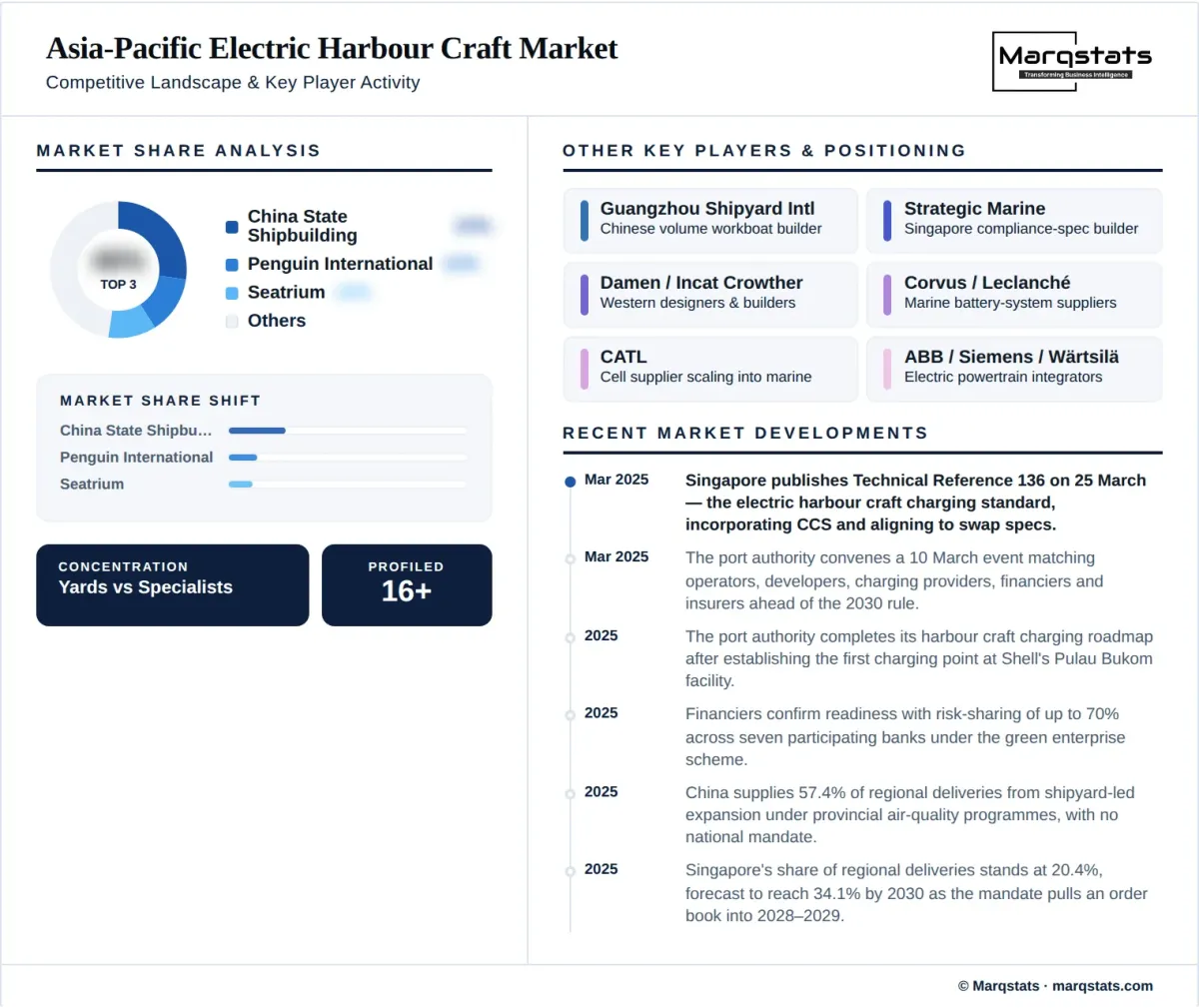
The market divides between Chinese yards supplying volume and Singapore-anchored specialists supplying the regulated market. China State Shipbuilding Corporation's subsidiaries and a set of provincial yards build the majority of Asia-Pacific electric harbour craft, and their cost position is decisive for buyers outside Singapore's regulatory perimeter. Their vessels are competent and cheap, and Southeast Asian operators buy them by default.
Concentration is low and the market has no dominant supplier, which is unusual for a vessel class this specialised. Harbour craft are built in small yards to owner specification rather than in series, so a builder's position rests on relationships with port operators and on having delivered a working electric vessel before. That gives early movers a reference advantage disproportionate to their volume, and it means competitive position in this market is measured in named deliveries rather than in share points.
Singapore's own builders and integrators occupy the higher-value position the mandate created. Yards and naval architects including Penguin International, Seatrium and Strategic Marine build harbour craft for the Singapore market, and their advantage is not construction cost but compliance: a vessel built to TR 136 with a defined charging interface, financeable under the green enterprise scheme and licensable under the 2030 rule, is a different product from a generic electric workboat. Battery and system suppliers including Corvus Energy, Leclanché and Chinese cell makers compete for the powertrain content beneath.
The competitive question the forecast turns on is whether the electric specialists or the diesel yards capture the 2030 transition. Because B100 capability satisfies the mandate, conventional builders can meet the rule with a modest specification change and no electrification at all — which means the electric vessel builders are not competing against non-compliance but against a compliant diesel alternative that costs a fraction as much. The specialists' answer has to be operating economics, and it works only where utilisation is high enough for fuel and maintenance savings to repay a multi-million-dollar premium. That constraint, more than any technical limit, is what sets the size of this market.
Companies Covered
Companies covered in the report include:
Recent Market Activity
Table of Contents
Coverage & Segmentation
This study covers new fully-electric harbour craft delivered in Asia-Pacific across 2021 to 2030, measured at vessel value in US dollars. Segmentation runs across four vessel types, three charging architectures and five regional markets. Harbour craft are defined as vessels operating within port limits. Seagoing vessels, inland-waterway cargo barges, pleasure craft, and hybrid or biofuel-capable diesel vessels are excluded — the last exclusion matters most, because a B100-capable diesel newbuild satisfies Singapore's 2030 requirement while contributing nothing to this market.
The boundary against the Marqstats Europe Electric Inland Shipping report is deliberate and should not be crossed. Inland cargo vessels operate on rivers and canals over long distances with a different duty cycle, and a large share of their installed battery energy belongs to an energy provider rather than the vessel owner. Harbour craft stay inside port limits, run short repeated routes and own their batteries. The two markets share a propulsion technology and nothing else, and their unit economics are not comparable.
Vessel values are stated per delivered craft and fall from roughly USD 5.0 million in 2025 to USD 4.3 million by 2030 — a 14% decline driven by mix rather than by any vessel becoming cheaper. Launches and small ferries, which cost a fraction of an electric tug, grow faster than the tug class, so the average falls as the market broadens. That is why unit deliveries compound at 43.45% against 39.19% on value, and readers modelling a specific vessel class should work from class-level values rather than the blend.