Market Snapshot
Key Takeaways
Market Overview & Analysis
Report Summary
Algeria's commercial vehicle market is being rebuilt from three directions at once and none of them is demand. Assembly capacity is returning through Chinese and European partnerships, a one-off tax exemption is creating an artificial bus supply channel, and a national market that halved in a year is recovering. The result is a category whose 2026 shape tells you almost nothing about its 2031 shape.
The market is measured here as annual new commercial vehicle sales in Algeria, spanning light commercial vehicles, medium and heavy trucks, and buses and coaches, across locally assembled and imported supply. It counts registrations rather than production, which distinguishes it from the manufacturing analysis where the same plants appear as capacity rather than as supply.
The analysis is written for manufacturers assessing entry or capacity commitment, importers and assemblers positioning against the bus exemption window, fleet operators comparing total cost of ownership as unfamiliar brands return, and investors screening a category whose announced capacity exceeds its addressable demand several times over. It segments into light commercial, truck and bus throughout, because the 2026 bus measure distorts one of those three and not the others.
Algeria Commercial Vehicle Market Size and Forecast
Commercial vehicle sales are estimated at approximately 23,000 units in 2025, rising to about 34,000 in 2026 and 67,000 by 2031. The 2025 estimate reflects the 42.76% contraction in Algeria's total vehicle market to 102,651 units and a commercial share consistent with known light commercial, truck and bus activity, and it should be treated as triangulated rather than as an official category total.
Two growth rates apply and both are published. The six-year rate connecting 2025 and 2031 is 19.51%. The five-year rate connecting 2026 and 2031 is 14.53%, and the 4.98-point gap exists because 2026 carries an exceptional step of roughly 11,000 units driven almost entirely by a bus exemption that does not repeat.
The 2026 estimate assumes total market demand recovers, local truck and light commercial assembly restarts contribute, and the duty-exempt bus programme creates an exceptional fleet renewal supply channel. The 10,000 units in that programme are a ceiling and a programme allocation rather than automatically all realised registrations in 2026, and the estimate does not assume full take-up.
The 2031 figure is driven by domestic complete knock-down capacity, logistics and construction demand, bus fleet renewal and greater vehicle availability, and it is deliberately capped below announced combined nameplate capacity to reflect utilisation risk. Emin Auto's Tamazoura plant alone reports 100,000 units of nameplate against a 67,000-unit forecast for the entire category.
Market value moves from approximately USD 690 million to USD 2,211 million across the forecast, on a disclosed per-vehicle convention rising from about USD 30,000 to USD 33,000. Value therefore compounds at 21.42% against 19.51% for units, because the mix deepens toward medium and heavy trucks and buses as local heavy vehicle capability grows.
The Bus Exemption and What It Distorts
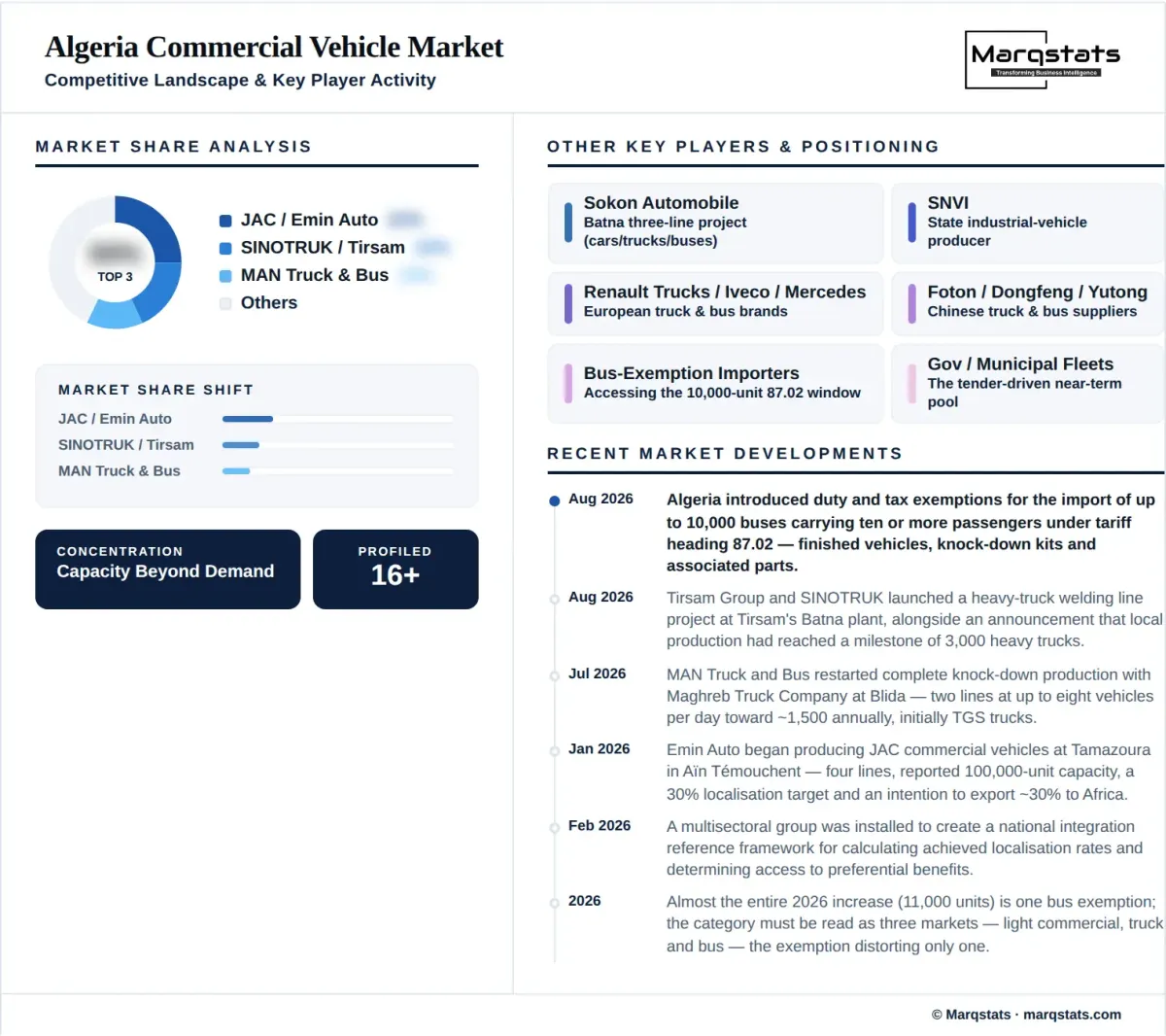
Algeria introduced duty and tax exemptions in August 2026 for the import of up to 10,000 buses designed to carry ten or more passengers under tariff heading 87.02, covering finished vehicles as well as complete and semi knock-down kits and associated parts, exempt from customs duties, value added tax and specified additional levies under the 2026 finance law framework.
The scale of that measure relative to the market it lands in is the reason it dominates this forecast. Ten thousand units equal 43.48% of the entire estimated 2025 commercial vehicle market and 29.41% of the 2026 estimate, and the roughly 11,000-unit increase between those two years is close to the exemption allocation on its own.
The measure is a ceiling rather than a delivery schedule and should never be read as realised registrations. Take-up depends on importer and assembler response, fleet buyer financing, vehicle availability and the administrative process for accessing the exemption, and a forecast assuming full conversion of the allocation within one year would overstate the category materially.
Because the exemption covers kits as well as finished vehicles, it creates opportunity on both sides of the supply question simultaneously. A complete build-up importer can access it, and so can a complete or semi knock-down assembler, which means the measure stimulates local assembly capability rather than only imports and its effects outlast the allocation itself.
The segmentation consequence is that this category must be analysed as three markets rather than one. The bus exemption distorts passenger commercial vehicle demand in 2026 and does not touch light commercial or truck demand at all, so any single category growth rate for 2026 describes a composite that no participant experiences.
Capacity Against Demand: The Tamazoura Problem
Emin Auto began production of JAC commercial vehicles at its Tamazoura factory in Aïn Témouchent in January 2026. The plant reports four production lines and annual nameplate capacity of 100,000 units, a target of 30% localisation within four years and an intention to export nearly 30% of output to African markets.
That nameplate figure is 4.35 times the entire estimated 2025 commercial vehicle market and 1.49 times the 2031 forecast for the whole category. Nameplate capacity of this scale is not an output forecast and must not be treated as one, and the research pack says so explicitly rather than leaving it to inference.
Utilisation risk is therefore the central issue for every manufacturer in this market rather than a caveat attached to one. Several announced plants carry nameplate capacity far above recent national category sales, and a plant running at a fraction of capacity carries fixed cost against a market that contracted 42.76% within the investment horizon of its own commissioning.
The export ambition is what makes the capacity arithmetic conceivable. Thirty percent of 100,000 units would be roughly 30,000 vehicles a year directed at African markets, which exceeds Algeria's entire 2025 commercial vehicle market on its own, and it would convert a plant sized beyond domestic demand into one sized for a continent.
Two Manufacturers, Two Opposite Export Postures
Algeria now hosts two large vehicle manufacturing investments taking directly contradictory positions on export. Emin Auto states an intention to export nearly 30% of Tamazoura output to African markets, while Stellantis management has described its Algerian passenger vehicle operation as serving Algerian demand, stating that the group sells in Algeria what it produces in Algeria.
Both positions are internally rational and they describe different businesses. A European group with existing African and European supply routes has little reason to serve them from Algeria; a Chinese commercial vehicle partnership building 100,000 units of capacity in a market of 23,000 has no alternative but to look outward.
For a policymaker the divergence is the most informative signal in the sector. Algeria's industrial framework can produce either import substitution or an export platform, and the two require different things: import substitution needs local content and domestic demand recovery, while an export platform needs certification, homologation, logistics and aftersales capability in destination markets that no Algerian plant has yet demonstrated.
The Heavy Truck Pipeline
Tirsam Group and SINOTRUK launched a heavy truck welding line project at Tirsam's Batna plant in August 2026, alongside an announcement that local production had reached a milestone of 3,000 heavy trucks. A welding line moves an operation from assembly toward localised body and structural processes, which is a more meaningful capability marker in this market than a unit count.
MAN Truck and Bus restarted complete knock-down production with Maghreb Truck Company at the Blida plant in July 2026, with two lines capable of assembling up to eight vehicles per day and a stated medium-term target of around 1,500 locally assembled vehicles annually, initially focused on TGS trucks. That target is approximately 6.52% of the 2025 commercial vehicle market.
The contrast between those two programmes is instructive for anyone sizing an entry. MAN has set a target deliberately below its theoretical line capacity and roughly proportionate to realistic heavy truck demand; JAC has commissioned nameplate capacity several times the entire category. Both are defensible strategies and they carry entirely different risk profiles.
Fleet buyers will decide which succeeds on criteria that have nothing to do with capacity. Uptime, parts availability, financing and service coverage determine heavy truck purchases as unfamiliar brands return to the market, and a manufacturer without a national service network competes for price-sensitive single-unit buyers rather than for the fleet volume that justifies a plant.
Regulation: Three Frameworks, Three Purposes
Three distinct regulatory instruments govern how a commercial vehicle reaches an Algerian buyer, and conflating them is the most common analytical error in this market. Executive Decree 22-384 governs local vehicle manufacturing activity including integration and local content obligations for accredited plants. Executive Decree 22-383 governs dealer and import conditions separately.
The 2026 finance law framework adds a third instrument of a different kind, exempting up to 10,000 buses under tariff heading 87.02 from customs duties, value added tax and specified additional levies whether finished or unassembled. It is a temporary demand measure rather than a structural industrial one, and it expires with its allocation.
The 2026 national integration reference framework, commissioned in February 2026 to calculate achieved localisation rates and determine access to preferential benefits, will affect manufacturers seeking preferential treatment and deepen local supplier qualification requirements. For a commercial vehicle assembler it converts JAC's 30% localisation target from an intention into a measurable obligation.
Four Demand Pools That Behave Differently
A commercial vehicle market entry strategy in Algeria should identify government and municipal fleet procurement, logistics fleets, construction and mining operators, and small business distribution as distinct addressable pools rather than as one category. The bus exemption speaks almost entirely to the first of those and barely touches the others.
Government and municipal fleet renewal is the pool the 10,000-bus allocation is designed to serve, and it buys on tender criteria, grant availability and administrative process rather than on commercial return. It is the largest single near-term opportunity in the category and the least accessible to a manufacturer without local representation.
Logistics, construction and mining demand tracks economic activity and hydrocarbon investment rather than policy, and it is where heavy truck localisation at Batna and Blida is aimed. Small business distribution demand is the natural target for Chinese light commercial capacity at Tamazoura, and it is the most price-sensitive and least service-demanding of the four.
Market Dynamics
Key Drivers
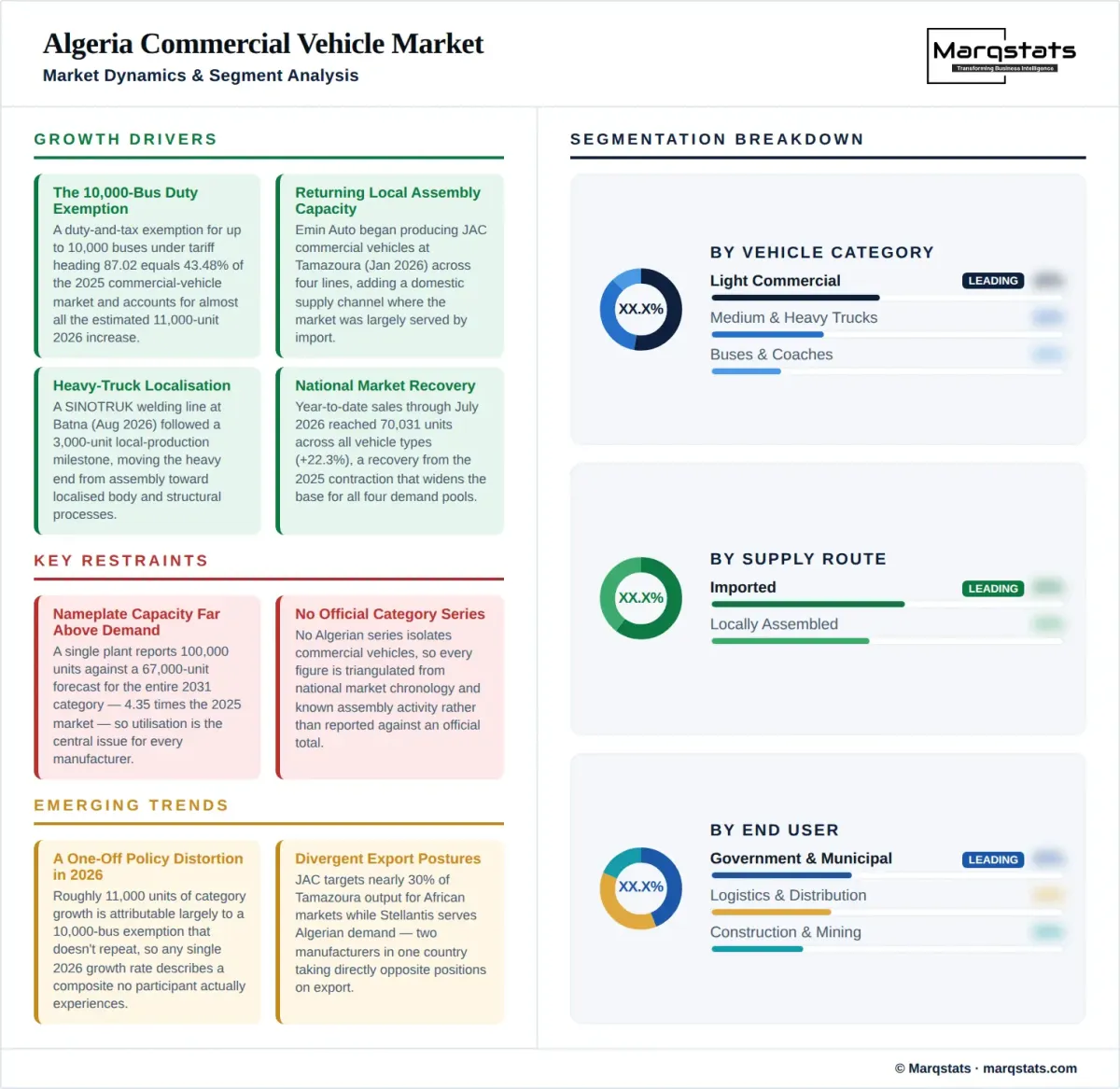
- The duty and tax exemption covering up to 10,000 buses under tariff heading 87.02, equal to 43.48% of the estimated 2025 commercial vehicle market.
- Returning local assembly capacity, with Emin Auto producing JAC commercial vehicles at Tamazoura from January 2026 across four lines.
- Heavy truck localisation, with a SINOTRUK welding line at Batna from August 2026 following a 3,000-unit local production milestone.
- National market recovery, with year-to-date sales through July 2026 reaching 70,031 units across all vehicle types, up 22.3%.
- European manufacturer return, with MAN restarting complete knock-down production at Blida in July 2026 toward around 1,500 vehicles annually.
Key Restraints
- Announced nameplate capacity far above demand, with a single plant reporting 100,000 units against a 67,000-unit forecast for the entire 2031 category.
- Extreme market volatility, with national vehicle sales contracting 42.76% to 102,651 units in 2025 before recovering.
- No official commercial vehicle category series, which makes every figure in this market triangulated rather than reported.
- Service and parts network gaps as unfamiliar brands return, which constrain access to the fleet volume that justifies local capacity.
Key Trends
- A one-off policy distortion in 2026, with roughly 11,000 units of category growth attributable largely to a 10,000-bus exemption allocation.
- Divergent export postures, with JAC targeting nearly 30% of output for African markets against Stellantis serving Algerian demand.
- Assembly deepening into manufacturing, shown by a heavy truck welding line at Batna rather than by additional assembly lines.
- Value outpacing units at 21.42% against 19.51% as the mix deepens toward medium and heavy trucks and buses.
Market Segmentation
The largest category by unit volume and the natural target for Chinese capacity at Tamazoura, where Emin Auto reports 100,000 units of nameplate across four lines from January 2026. Light commercial demand tracks small business distribution and is the most price-sensitive of the three categories, which suits a supply route built on volume rather than on service depth.
The category where local capability is deepening fastest, with Tirsam reaching a 3,000 heavy truck production milestone and launching a SINOTRUK welding line at Batna in August 2026, and MAN targeting around 1,500 vehicles annually at Blida, approximately 6.52% of the 2025 category. Purchases here are decided on uptime, parts availability and service coverage rather than on price.
The category the 2026 policy measure targets directly, through an exemption covering up to 10,000 units under tariff heading 87.02 equal to 43.48% of the 2025 commercial vehicle market. Because the exemption covers kits as well as finished vehicles, it stimulates assembly capability rather than imports alone and its effects outlast the allocation.
The route the regulatory framework rewards, governed by Executive Decree 22-384 and its integration obligations, and now spanning Tamazoura, Batna and Blida. It is growing from a small base toward capacity that reaches 100,000 units of nameplate at one plant alone, which is 4.35 times the entire 2025 category.
The historical supply route and still substantial, governed separately under Executive Decree 22-383 for dealer and import conditions. Import supply remains the flexible channel that absorbs demand volatility in a market that contracted 42.76% in 2025 and is recovering 22.3% year-to-date in 2026.
A temporary route created by the 2026 framework, covering up to 10,000 buses under tariff heading 87.02 exempt from customs duties, value added tax and specified additional levies. It is a ceiling and programme allocation rather than a delivery schedule, and take-up depends on importer response, fleet financing and administrative access.
The largest addition to supply capacity, spanning JAC through Emin Auto at 100,000 units of Tamazoura nameplate, SINOTRUK through the Tirsam welding line partnership, and Sokon and other groups broadening light and medium availability. Chinese investment carries the export ambition in this market, at nearly 30% of intended Tamazoura output.
The heavy truck and tractor position, held principally by MAN through the Maghreb Truck Company restart at Blida targeting around 1,500 vehicles annually on two lines running up to eight vehicles a day. European strategy here is deliberately proportionate to demand rather than to capacity.
Manufacturers serving the market through import channels and historical assembly relationships rather than through current local capacity, competing inside a national market of 102,651 total vehicles in 2025. Their position depends on dealer and import conditions under Executive Decree 22-383 rather than on manufacturing accreditation.
The pool the 10,000-bus exemption is designed to serve, buying on tender criteria, grant availability and administrative process rather than on commercial return. It is the largest single near-term opportunity in the category and the least accessible to a manufacturer without local representation.
Demand tracking economic activity rather than policy, and the pool that justifies the heavy truck localisation at Batna and Blida. Fleet buyers here prioritise uptime, parts availability, financing and service coverage as unfamiliar brands return, which is why a 1,500-vehicle target with service depth can outperform a 100,000-unit nameplate without it.
A demand pool tied to infrastructure and hydrocarbon investment rather than to the 22.3% consumer market recovery, and the natural market for SINOTRUK heavy trucks built through the Tirsam partnership. Duty cycles here are severe enough that parts availability determines vehicle choice more strongly than in any other pool.
The most price-sensitive pool and the natural target for light commercial capacity at Tamazoura, where four production lines report 100,000 units of nameplate. These buyers accept a shorter service network in exchange for capital cost, which is the only pool where a capacity-led strategy can convert without a parts network first.
Urban and regional freight movement served principally by light commercial vehicles, and the application where Chinese supply at Tamazoura is most directly aimed. It is the highest-volume application in a category estimated at 23,000 units in 2025 and the least demanding on service infrastructure.
The application requiring the heaviest specifications and the deepest support, served by MAN TGS tractors from Blida and SINOTRUK heavy trucks through Tirsam's Batna operation with its 3,000-unit local production milestone. Downtime cost here is high enough that parts lead times outweigh purchase price.
The application transformed by the 2026 exemption covering up to 10,000 buses under tariff heading 87.02, equal to 43.48% of the 2025 commercial vehicle market. It spans municipal transit, intercity coach and staff transport, and the exemption's coverage of kits means assembly capability built for it persists after the allocation.
Tippers, mixers, tankers and municipal service bodies built on commercial chassis, tied to construction and hydrocarbon investment rather than to the 22.3% national sales recovery. Bodybuilding is locally performable and generates documented local content, which makes it disproportionately valuable against the integration obligations under Executive Decree 22-384.
By Geography
Algiers and the Northern Metropolitan Belt
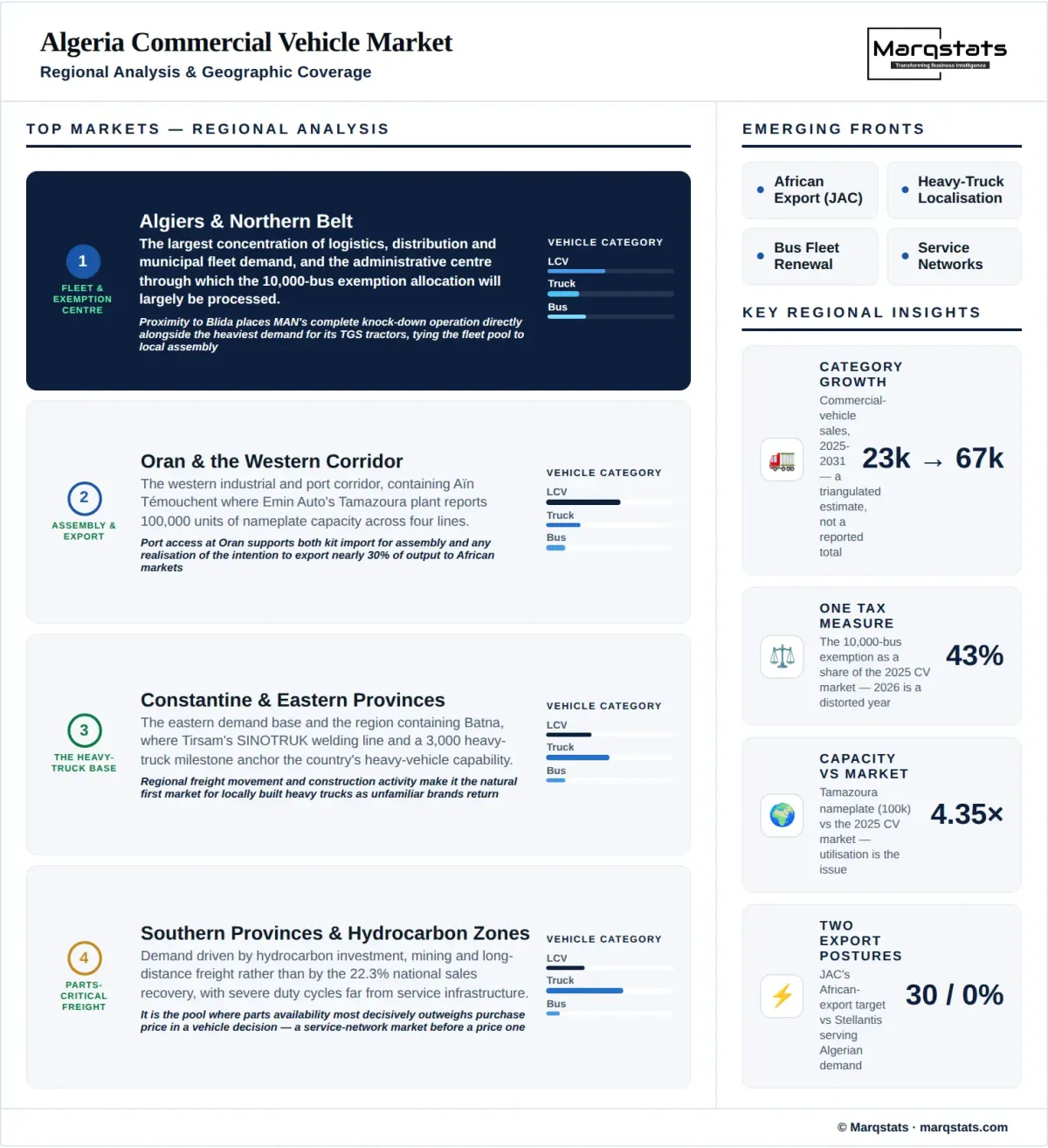
The largest concentration of logistics, distribution and municipal fleet demand in the country, and the administrative centre through which the 10,000-bus exemption allocation will largely be processed. Proximity to Blida places MAN's complete knock-down operation directly alongside the heaviest demand for its TGS tractors.
Oran and the Western Corridor
The western industrial and port corridor, containing Aïn Témouchent where Emin Auto's Tamazoura plant reports 100,000 units of nameplate capacity across four lines. Port access at Oran supports both kit import for assembly and any realisation of the intention to export nearly 30% of output to African markets.
Constantine and the Eastern Provinces
The eastern demand base and the region containing Batna, where Tirsam's SINOTRUK welding line and a 3,000 heavy truck production milestone anchor the country's heavy vehicle capability. Regional freight movement and construction activity make it the natural first market for locally built heavy trucks.
The Southern Provinces and Hydrocarbon Zones
Demand driven by hydrocarbon investment, mining and long-distance freight rather than by the 22.3% national sales recovery, and characterised by severe duty cycles and extended distances from service infrastructure. It is the pool where parts availability most decisively outweighs purchase price in a vehicle decision.
How Competition Is Evolving
Algeria's commercial vehicle supply is being rebuilt by new entrants rather than contested by incumbents. Emin Auto with JAC holds the largest announced capacity at 100,000 units of Tamazoura nameplate, MAN with Maghreb Truck Company holds the heavy truck position at around 1,500 vehicles a year, and Tirsam with SINOTRUK holds the deepest local heavy truck manufacturing capability after a 3,000-unit milestone.
The competitive question is capacity conversion rather than share defence. A category estimated at 23,000 units in 2025 cannot absorb the capacity already announced, so the operators that succeed will be those whose commercial capability matches their industrial capability rather than those with the largest lines.
The two strategies on display carry entirely different risk profiles. MAN has set a medium-term target of around 1,500 vehicles, roughly 6.52% of the 2025 category and deliberately below its theoretical line capacity; JAC has commissioned nameplate 4.35 times the entire category. Neither is wrong, and they will be judged on different timescales.
Bus supply is the one part of the competitive picture that policy has temporarily rewritten. The exemption covering up to 10,000 units under tariff heading 87.02 creates opportunity for complete build-up importers and for complete and semi knock-down assemblers simultaneously, which means competitive position in buses during 2026 depends on exemption access rather than on manufacturing capability.
For a fleet buyer none of this is the deciding factor. Uptime, parts availability, financing and service coverage determine commercial vehicle purchases as unfamiliar brands return, and a manufacturer that builds a national service network ahead of capacity will convert demand that a manufacturer with capacity and no network cannot reach.
Companies Covered
The report profiles 15+ companies with full strategy and financials analysis, including:
Recent Market Activity
Table of Contents
Coverage & Segmentation
This study measures annual new commercial vehicle sales in Algeria from 2021 to 2031, with 2025 as the base year and 2026 to 2031 as the forecast period, spanning light commercial vehicles, medium and heavy trucks, and buses and coaches across locally assembled and imported supply. It counts registrations rather than production, which distinguishes it from the manufacturing analysis where the same plants appear as capacity.
Coverage spans three vehicle categories, three supply routes, three brand origins, four end-user pools and four applications, alongside four regional clusters analysed on demand composition, port access and duty cycle rather than quantified share. Market value is carried as a reference series in USD on a disclosed per-vehicle convention. Fifteen entities are profiled across assemblers, importers and international manufacturers.