Market Snapshot
Middle bar: base-year value × (1 + CAGR), rounded to two decimals. This is a calculated illustration, not a separately researched annual estimate.
The Vietnam truck market size is estimated at USD 2,159.36 million in 2025 and is projected to reach USD 3,759.40 million by 2030, growing at a CAGR of 11.73% over 2026 – 2030. Annual deliveries rise from about 73,053 trucks to 114,700, a 9.44% annual rate, while the average price per truck rises from about USD 29,600 to USD 32,800 as heavy rigid trucks and tractor heads gain share. Measured from 2026, value grows at 8.49% a year.
Marqstats defines the market as the value of new goods trucks and tractor heads registered or delivered in Vietnam, in four payload classes: light-duty trucks below 3.5 tonnes, medium-duty trucks from 3.5 to 12 tonnes, heavy-duty rigid trucks above 12 tonnes and tractor heads. Pickups, buses, minibuses, vans carrying passengers, trailers, special-purpose vehicles built on passenger platforms and aftermarket bodies are excluded. Values are in US dollars at ex-VAT delivered prices, converted at VND 26,009 per US dollar, the 2025 annual average.
Heavy-duty rigid trucks account for an estimated 32.42% of 2025 value and light-duty trucks for 45.45% of units. Diesel trucks account for 97.09% of value and domestically assembled trucks for 62.82%. The Red River Delta and Northern Midlands account for 38.50% of 2025 value. The study segments the market by payload class, powertrain, sourcing and region.
Key Takeaways
Market Overview & Analysis
Report Summary
Marqstats sizes the Vietnam truck market bottom-up, from the number of trucks reaching Vietnamese operators in each supply layer multiplied by class prices. In 2025 Marqstats estimates 73,053 new goods trucks and tractor heads were delivered at an average ex-VAT price of about USD 29,600, a market of USD 2,159.36 million, or about VND 56.2 trillion.
Official totals blur this market. VAMA reported members' retail sales of 313,359 vehicles in 2025, up 6%, made up of 218,974 passenger vehicles and 94,385 commercial vehicles. Within commercial vehicles, trucks reached 70,746, up 24%, and buses 8,668, up 12%. Including imports by non-members, VAMA's own total was 375,736 vehicles, up 10.5%, of which CKD assembly accounted for 179,243 and CBU imports for 196,493. VinFast with 175,099 vehicles and Hyundai Thanh Cong with 53,229 vehicles sit outside the association. VAMA also lists pickups, which Vietnam registers as passenger cars and which are excluded here.
The truck count is therefore built in four layers. VAMA member trucks, after removing 27,093 pickups, give 43,653 trucks. Hyundai Thanh Cong, outside VAMA, adds about 11,400 trucks; its commercial line sold 12,882 vehicles in 2025 including buses. Chinese-brand importers outside the association, led by VIMID, Hai Au and Hoang Huy, add about 14,000, and smaller assemblers add about 4,000. The layers sum to 73,053 trucks.
Customs data support the importer layer. Vietnam imported 205,630 completely built-up vehicles in 2025, worth USD 4.74 billion and up 31.1%, and the group of transport vehicles, which includes trucks, rose 88.9% to 28,338 units. From the start of 2026 to 15 October, customs recorded 35,794 imported trucks, up 67.8% on a year earlier. Marqstats treats imports as the fastest-growing source of supply, with imported completely built-up trucks at 25.87% of 2025 units.
Demand follows infrastructure and trade. The government approved a 2026 – 2030 public investment plan of VND 8.22 million billion, and on 19 December 2025 broke ground on 234 projects worth VND 3.4 million billion. Expressways, ports, industrial parks and housing projects consume tippers, mixers and tractor heads, while retail and export manufacturing drive light and medium trucks in the south.
Operators buy on cost per tonne-kilometre and finance. Chinese heavy trucks list at a discount to Japanese and Korean equivalents that Marqstats estimates at 30% to 40%, and are delivered faster, so they won much of the 2025 infrastructure cycle. Japanese and Korean brands keep their position in refrigerated, parcel and corporate fleets where uptime and resale value outweigh the purchase price.
Vietnam Truck Market Size and Forecast
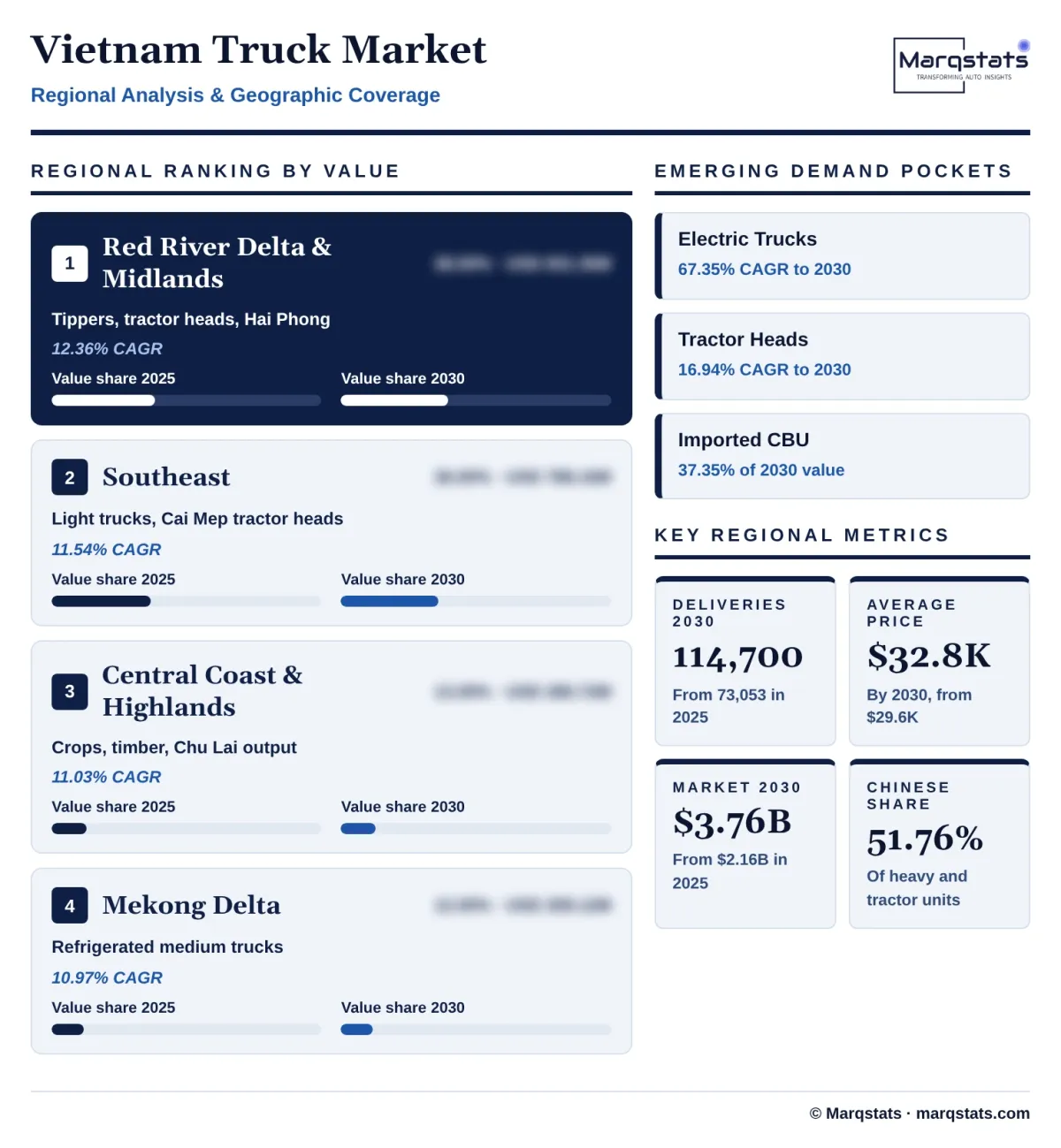
The Vietnam truck market grows from USD 2,159.36 million in 2025 to USD 3,759.40 million in 2030, a CAGR of 11.73%. Marqstats expects deliveries of about 88,235 trucks worth USD 2,714.02 million in 2026, 94,159 worth USD 2,942.52 million in 2027, 100,520 worth USD 3,191.55 million in 2028 and 107,352 worth USD 3,463.05 million in 2029, before reaching 114,700 trucks in 2030.
2026 is a step-up year. VAMA reported that commercial vehicle sales rose 28% in the first half of 2026, customs recorded imported trucks up 67.8% from January to 15 October, and VIMID reported revenue up 142% in the first quarter and 83% in the first nine months. Marqstats therefore models 2026 unit growth of 20.78%, with heavy rigid trucks up 30% and tractor heads up 35%, before growth settles to 8.49% a year in value over 2026 – 2030.
Price per truck rises with mix more than with inflation. Marqstats assumes class prices of USD 14,000 for light, USD 33,000 for medium, USD 56,000 for heavy rigid trucks and USD 43,500 for tractor heads in 2025, rising to USD 14,800, 34,500, 58,000 and 45,500 by 2030. The average price therefore rises from about USD 29,600 to USD 32,800, so value grows at 11.73% while deliveries grow at 9.44%.
The class mix shifts to heavier trucks. Light-duty trucks fall from 45.45% to 40.54% of units, while tractor heads rise from 11.98% to 15.96% and heavy rigid trucks from 17.11% to 19.18%. By value, tractor heads rise from 17.63% to 22.15% and heavy rigid trucks from 32.42% to 33.94%.
Sourcing stays balanced. Domestic assembly accounts for 62.82% of 2025 value and 62.65% of 2030 value, and imported completely built-up trucks for 37.18% and 37.35%. Imports grow slightly faster, at 11.83% a year against 11.67% for domestic assembly, because heavy trucks and tractor heads come mainly from China.
Marqstats tracks four indicators to monitor the forecast: monthly VAMA and customs data for trucks, public investment disbursement by province, container throughput at Hai Phong and Cai Mep-Thi Vai, and bank lending terms for transport operators.
The scope boundary matters for comparisons. VAMA truck totals include 27,093 pickups; the 43,653 member trucks used here exclude them, while Hyundai Thanh Cong, importers and other assemblers sit outside the association count and are Marqstats estimates.
Market Dynamics
Key Drivers
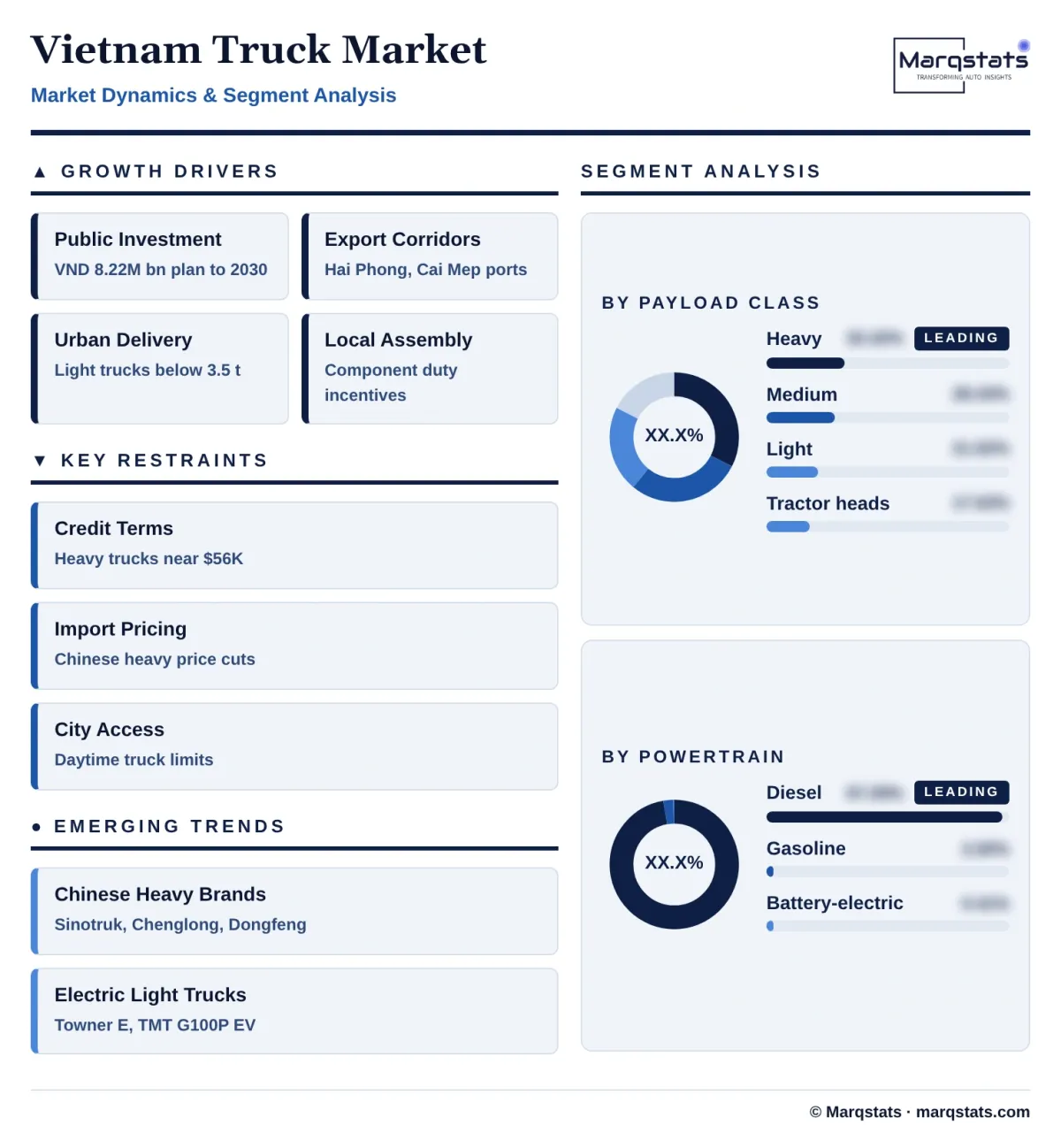
Five forces are lifting demand for new goods trucks and tractor heads in Vietnam.
- Public investment in expressways and ports. The 2026 – 2030 plan of VND 8.22 million billion, with 234 projects worth VND 3.4 million billion started on 19 December 2025, consumes dump trucks, mixers and tractor heads and supports four- and five-axle rigid carriers.
- Export-led industrial growth. Electronics, textiles, footwear, seafood and agricultural exports move through the Hai Phong, Cai Mep-Thi Vai and border-gate corridors, raising demand for container tractor heads and medium trucks.
- E-commerce and urban delivery. Retail and parcel growth in Ho Chi Minh City and Hanoi favours light trucks below 3.5 tonnes, which suit daytime access rules and short routes.
- Local assembly incentives. Automotive industry decrees, including Decree 116/2017/ND-CP and its amendments, allow zero preferential duty on components that domestic producers cannot source locally, which supports THACO, Hyundai Thanh Cong, Isuzu and Hino assembly.
- Fleet renewal under emission and weight rules. Euro 5 standards for new vehicles under Decision 49/2011/QD-TTg, in force since 2022, and stricter overloading enforcement push operators toward newer, higher-capacity trucks.
Key Restraints
Four constraints limit how fast Vietnamese truck demand converts into deliveries.
- Financing and credit conditions. Heavy trucks cost USD 50,000 to 60,000 each, and owner-operators rely on bank and dealer finance with loan-to-value limits, so credit tightening slows heavy truck purchases quickly.
- Import competition and price pressure. Low-priced Chinese trucks set the price level in heavy classes, squeezing assemblers that carry fixed plant costs and leaving little room for price increases.
- Urban access restrictions. Cities limit medium and heavy trucks during the day, so operators split loads onto smaller vehicles and limit the use of heavy classes in the major retail markets.
- Fuel quality and charging infrastructure. Euro 5 trucks need low-sulphur diesel and urea, which are less common on provincial routes, and public charging for electric trucks remains concentrated in major cities.
Key Trends
Four shifts are changing which trucks Vietnamese fleets buy and how they pay for them.
- Chinese heavy-duty brands gain share. Sinotruk, Chenglong and Dongfeng supply a growing part of tippers, rigid carriers and tractor heads through distributors outside the association, led by VIMID, whose reported revenue more than doubled in 2025.
- Electric light trucks scale up. THACO launched the Towner E with a 945 kg payload and a 41.86 kWh CATL battery pack in September 2026, and TMT Motors announced the G100P EV, with a 990 kg payload and about 300 km of range, in October 2026.
- Four- and five-axle rigid carriers. Overloading enforcement makes operators buy trucks that carry legal payloads on more axles, raising the share of heavy rigid trucks in value.
- Dealer finance and service networks. Distributors compete through financing programmes, service points on expressway corridors and spare parts availability as much as on list price.
Strategic Implications
- For assemblers, scale in light and medium trucks and a credible heavy range decide margins. THACO, Hyundai Thanh Cong, Isuzu and Hino hold domestic assembly positions that depend on component incentives and distribution depth.
- For importers and distributors, the heavy end is where growth is. Delivery speed, parts stock and dealer finance matter more than brand heritage when buyers are construction contractors and haulage firms.
- For lenders and leasing companies, concentration on a few Chinese heavy brands creates residual value risk. Pricing used-truck values and the supply of spare parts will decide how far loan-to-value ratios can rise.
- For fleet operators, class choice follows route and city rules. Light and electric trucks suit daytime urban delivery, medium trucks suit refrigerated and provincial distribution, and four- and five-axle rigid trucks and tractor heads suit expressway and port work.
- For policy makers, fuel quality and charging infrastructure along freight corridors decide how quickly Euro 5 and electric trucks deliver emission cuts.
Market Segmentation
Light-duty trucks below 3.5 tonnes account for 45.45% of 2025 units, 33,200 trucks, and 21.52% of value, USD 464.80 million, rising to USD 688.20 million by 2030, a 8.17% CAGR, while their share falls to 18.31%. Thaco Towner and Kia Frontier, Hyundai Mighty and Isuzu models serve parcel, retail and market delivery, and the class carries the electric launches of 2026.
Medium-duty trucks from 3.5 to 12 tonnes account for 28.43% of 2025 value, USD 613.80 million, on 18,600 trucks, rising to USD 962.55 million by 2030, a 9.42% CAGR. Refrigerated bodies for seafood, fruit and rice, box trucks and provincial distribution trucks from Thaco Ollin, Hino, Isuzu and Hyundai dominate the class.
Heavy-duty rigid trucks above 12 tonnes are the largest class by value, with 32.42% in 2025, USD 700.00 million, on 12,500 trucks. Value rises to USD 1,276.00 million and 33.94% by 2030, a 12.76% CAGR. Four- and five-axle tippers and carriers from Sinotruk, Chenglong, Thaco Auman and Hino serve construction, quarrying and bulk cargo.
Tractor heads account for 17.63% of 2025 value, USD 380.76 million, on 8,753 trucks, and grow fastest among diesel classes, at 16.94% a year, to USD 832.65 million and 22.15% of 2030 value. Container work at Hai Phong and Cai Mep-Thi Vai and cross-border trade through Lang Son and Lao Cai drive demand for 6x4 heads.
Diesel trucks account for 97.09% of 2025 value, USD 2,096.56 million, on 66,653 trucks, and grow at 11.28% a year to USD 3,577.40 million and 95.16% of 2030 value. Euro 5 engines with common-rail injection and urea systems are standard across all four classes, and every heavy truck and tractor head in the market is diesel.
Gasoline trucks, mainly small mini-trucks sold for city delivery, account for 2.50% of 2025 value, USD 54.00 million, on 6,000 units, and grow at 4.25% a year to USD 66.50 million and 1.77% of 2030 value as electric models take over small-load work.
Battery-electric trucks account for 0.41% of 2025 value, USD 8.80 million, on about 400 trucks, and grow at 67.35% a year to USD 115.50 million, 5,500 trucks and 3.07% of 2030 value. THACO Towner E and TMT G100P EV lead the launches, and light electric trucks of under one tonne dominate the segment.
Trucks assembled in Vietnam from CKD or SKD kits account for 62.82% of 2025 value, USD 1,356.56 million, on 54,153 trucks, and grow at 11.67% a year to USD 2,355.25 million and 62.65% of 2030 value. THACO at Chu Lai, Hyundai Thanh Cong at Ninh Binh, Isuzu in Ho Chi Minh City and Hino in Hanoi anchor domestic assembly.
Imported completely built-up trucks account for 37.18% of 2025 value, USD 802.80 million, on 18,900 trucks, and grow at 11.83% a year to USD 1,404.15 million and 37.35% of 2030 value. Heavy trucks and tractor heads from China dominate imports, followed by light commercial vehicles from ASEAN under zero preferential duty.
By Geography
Red River Delta and Northern Midlands
The Red River Delta and Northern Midlands is the largest region by value, with 38.50% of 2025, USD 831.35 million, rising to USD 1,488.72 million by 2030, a 12.36% CAGR, and 39.60% of the market. The region uses the most heavy tippers and tractor heads, driven by expressway and ring-road projects around Hanoi, quarrying in Ha Nam, Ninh Binh and Hoa Binh, manufacturing hubs in Bac Ninh, Bac Giang and Thai Nguyen, and the Hai Phong and Lach Huyen port complex. Border gates at Lang Son and Lao Cai add cross-border tractor head demand.
Southeast
The Southeast accounts for 36.50% of 2025 value, USD 788.16 million, and reaches USD 1,360.90 million by 2030, a 11.54% CAGR, with 36.20% of the market. Ho Chi Minh City, Binh Duong, Dong Nai, Long An and Ba Ria-Vung Tau form the retail and export manufacturing basin, where light delivery trucks, refrigerated medium trucks and container tractor heads serving Cai Mep-Thi Vai dominate. Daytime restrictions on medium and heavy traffic push demand toward smaller trucks.
Central Coast and Highlands
The Central Coast and Highlands account for 13.00% of 2025 value, USD 280.72 million, rising to USD 473.68 million by 2030, a 11.03% CAGR, while the share falls to 12.60%. Demand follows coffee, rubber, pepper, cassava and timber harvests along National Routes 14, 19 and 26, which suit medium and heavy rigid trucks with high clearance and torque. THACO's Chu Lai complex in Quang Nam ships finished trucks to both the north and the south.
Mekong Delta
The Mekong Delta accounts for 12.00% of 2025 value, USD 259.12 million, rising to USD 436.09 million by 2030, a 10.97% CAGR, while the share falls to 11.60%. Can Tho, Tien Giang and Dong Thap generate demand for medium trucks with insulated and refrigerated bodies carrying seafood, fruit and rice, and for tippers serving riverside construction.
How Competition Is Evolving
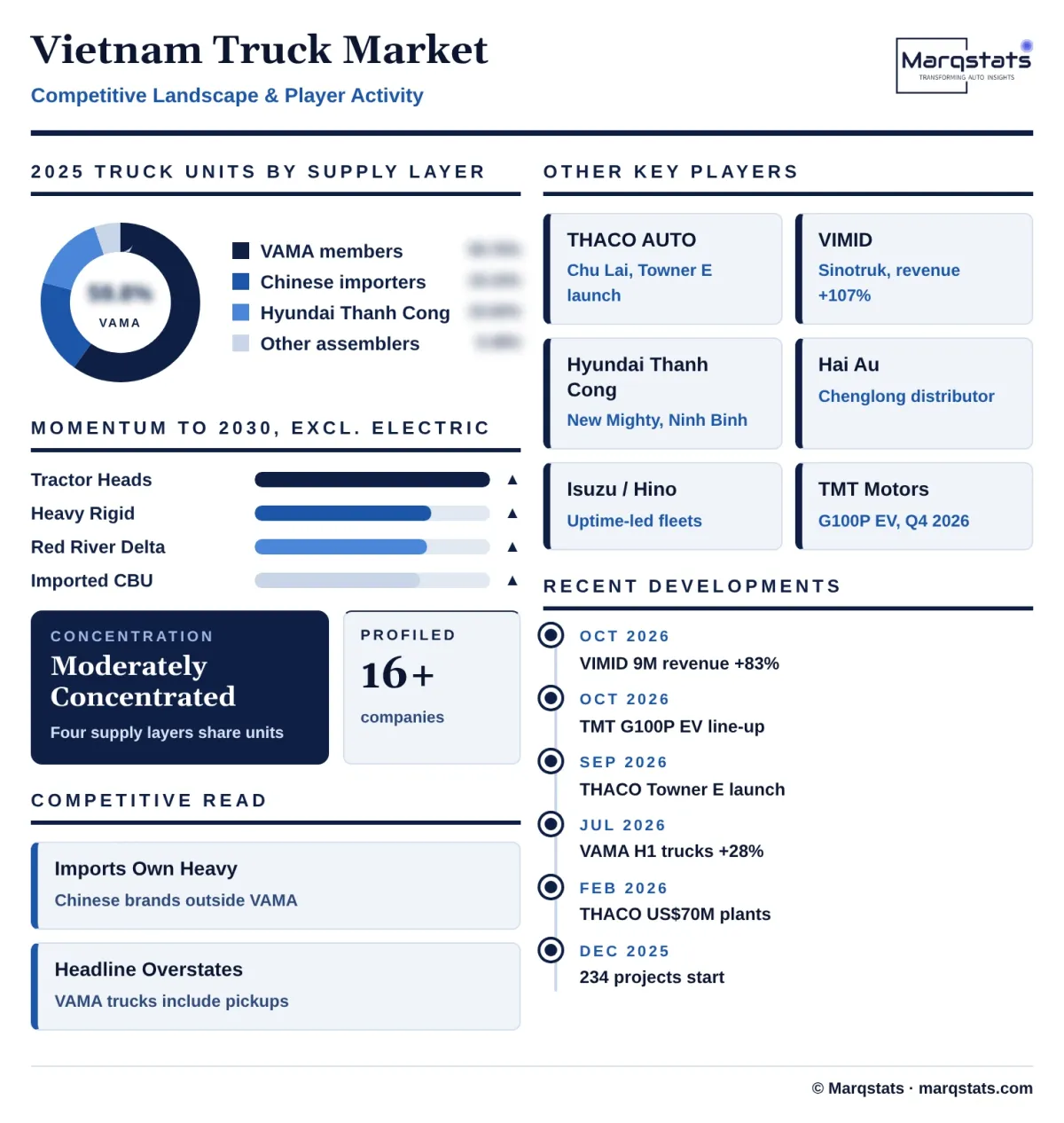
The Vietnam truck market is moderately concentrated and splits into four supply layers. Marqstats estimates VAMA member trucks, excluding pickups, at 59.76% of 2025 units, Hyundai Thanh Cong at 15.60%, Chinese-brand importers outside the association at 19.16% and other assemblers at 5.48%. Brand-level unit figures are reported inconsistently across sources, so Marqstats reports layers and cites brand data only where companies have stated it.
THACO AUTO is the largest assembler. It delivered more than 90,000 vehicles of all types in 2025, of which trucks and buses exceeded 26,000, and in February 2026 THACO Industries announced three factories worth US$70 million. It sells Towner, Kia Frontier, Ollin, Forland, Auman and Mitsubishi Fuso trucks from a production base at Chu Lai. Within VAMA, Thaco Truck sales rose 55% in 2025 and Hino sales rose 131%.
Hyundai Thanh Cong, a joint venture of TC Group and Hyundai Motor, assembles New Mighty light and medium trucks in Ninh Binh and sells the Xcient tractor head and HD270 chassis. Its commercial line sold 12,882 vehicles in 2025 including buses, and it is outside VAMA reporting. Isuzu Vietnam in Ho Chi Minh City and Hino Motors Vietnam in Hanoi compete on uptime and resale value among corporate and refrigerated fleets.
Chinese-brand importers lead heavy trucks. VIMID distributes Sinotruk Howo and Sitrak, reporting revenue of VND 8.05 trillion in 2025 (up 107%), about VND 2,750 billion in the first quarter of 2026 (up 142%) and about VND 10,000 billion over nine months (up 83%) with net profit of VND 638 billion. It delivered 7,800 vehicles from January to August 2026. Hai Au distributes Chenglong and Hoang Huy distributes Dongfeng and Navistar tractor heads.
Competition is decided by price, delivery time, financing and service reach. Chinese brands win on price and availability in heavy classes, Japanese and Korean brands on uptime and resale value in medium and light classes, and local assemblers on incentives and distribution. Electric light trucks add a new contest in 2026, led by THACO and TMT Motors.
Companies Covered
Companies covered in the report include:
Recent Market Activity
Table of Contents
Coverage & Segmentation
The study covers the Vietnam truck market, with 2025 as the base year, 2021 – 2025 as the historical period and 2026 – 2030 as the forecast period. Values are in US dollars at ex-VAT delivered prices, converted at VND 26,009 per US dollar, and volumes are annual deliveries of new goods trucks and tractor heads. The market is segmented by payload class, powertrain, sourcing and region.
Pickups, buses, minibuses, passenger vans, trailers, special-purpose vehicles on passenger platforms, used trucks and aftermarket bodies are excluded. VAMA lists 27,093 pickups within its truck sales of 70,746; Marqstats removes them, and the Marqstats Vietnam Passenger Car analysis also leaves them out, so the two figures can be added. Segment, regional and layer splits are Marqstats estimates built on association releases, customs data, company filings and price benchmarks.