Market Snapshot
Middle bar: base-year value × (1 + CAGR), rounded to two decimals. This is a calculated illustration, not a separately researched annual estimate.
The Thailand truck market size is estimated at USD 1,138.43 million in 2025 and is projected to reach USD 1,648.10 million by 2030, growing at a CAGR of 7.68% over 2026 – 2030. Sales of trucks above 5 tonnes rise from 15,305 to 19,200 units, a 4.64% annual rate, as average chassis value climbs from USD 74,383 to USD 85,839.
Marqstats defines the market as the wholesale value of new medium and heavy goods trucks above 5 tonnes gross vehicle weight sold domestically in Thailand, as reported by the Federation of Thai Industries (FTI) Automotive Industry Club, from 4-wheel medium trucks to 10-wheel rigids and semi-trailer tractor heads, such as the Isuzu FRR, FTR, FVM and GXZ, Hino 500 FG, FL, FM and UM1A, Mitsubishi Fuso Fighter and Scania, Volvo and Foton Auman models. Value is counted for the chassis-cab at the manufacturer or importer gate in US dollars, before value added tax, registration fees and body building. Pickups, pickup passenger vehicles, buses, coaches and commercial vans are excluded.
Heavy rigid trucks account for 36.23% of 2025 value, diesel trucks for 98.71% and freight and container logistics for 44.68%. The Bangkok Metropolitan Region accounts for 40.00% of value, while the Eastern Economic Corridor, where Laem Chabang port feeds the industrial parks of Chonburi and Rayong, grows fastest at 9.23% a year.
Key Takeaways
Market Overview & Analysis
Report Summary
Marqstats sizes the Thailand truck market as the wholesale value of new goods trucks above 5 tonnes gross vehicle weight that Thai buyers purchase each year. It follows the weight break used by the Federation of Thai Industries (FTI) Automotive Industry Club, whose monthly statistics report trucks in a 5 tons to over 10 tons category separately from one-ton pickups, pickup passenger vehicles and passenger cars. The category covers 4-wheel medium trucks, 6-wheel and 10-wheel rigid trucks and semi-trailer tractor heads, whether built in Thailand or imported fully built.
The category is small inside a large industry. In 2025 the FTI counted 621,166 domestic sales of all vehicles, of which passenger cars and SUVs were 404,845, one-ton pickups 143,072, pickup passenger vehicles 43,916, trucks above 5 tons 15,305 and other vehicle types 13,283. Trucks above 5 tons were therefore 2.46% of domestic sales by units. On the production side, Thailand built 1,455,569 vehicles, of which 905,113 were trucks in the FTI definition, and 893,921 of those were one-ton pickups, mostly for export. Only 11,192 units, or 1.24% of truck output and 0.77% of all vehicle output, were medium and heavy trucks. The Department of Land Transport (DLT) recorded 58,700 first registrations of trucks under the Land Transport Act in 2025 (30,464 non-scheduled and 28,236 private), about the same as 58,998 in 2024, but that count covers every weight class, so the 15,305 trucks above 5 tons are 26.07% of it.
Demand moved the opposite way from output in 2025. Domestic sales of trucks above 5 tons fell 4.62% to 15,305 units from 16,046 units in 2024, but production for the domestic market fell 33.57% to 11,192 units from 16,848 units. The FTI shows zero export production for this class, so the 4,113 units by which sales exceeded output reflect imported trucks and changes in dealer stock. Marqstats reads the gap as imported trucks, mostly fully built Chinese and European models, plus a drawdown of unsold stock; the FTI series reports the total only, and the gap is the central finding of the analysis.
The market has since turned. The FTI reported domestic sales of 7,690 trucks in January – May 2026, up 31.39%, with March alone at 2,253 units, up 53.06%, and battery-electric units at 71. Production in the broader category from under 5 tons to over 10 tons reached 7,149 units, up 95.49%. Across all vehicles the FTI recorded 465,970 domestic sales in January – August 2026, up more than 15%, even as it cut its 2026 production outlook to a 3.33% contraction in July because of hostilities in the Middle East that weigh on exports.
Value rests on prices as well as units. At the 2025 average rate of THB 33.74 per US dollar, Marqstats estimates the 2025 market at about THB 38.41 billion, which is USD 1,138.43 million, and the 2026 market at USD 1,301.17 million, a rise of 14.30% on 11.07% more trucks. The 2025 average chassis value is about USD 74,383, or THB 2.51 million, because 10-wheel rigids and tractor heads make up 47.40% of units.
Thailand Truck Market Size and Forecast
The Thailand truck market grows from USD 1,138.43 million in 2025 to USD 1,648.10 million in 2030, a CAGR of 7.68%. Volume supplies most of the growth: domestic sales rise at 4.64% a year, from 15,305 to 19,200 trucks, and the average chassis value rises at 2.91% a year, from about USD 74,383 to USD 85,839, because tractor heads and battery-electric trucks take a larger share and list prices rise with Euro 5 equipment.
The 2025 value is built bottom-up from the FTI unit total and class prices. Marqstats splits the 15,305 units into about 2,150 medium 4-wheel trucks at about THB 1.45 million, 5,900 six-wheel trucks of 10 to 16 tonnes at THB 1.85 million, 4,350 heavy rigid trucks above 16 tonnes at THB 3.20 million and 2,905 tractor heads at THB 3.60 million. Prices are chassis-cab values at the manufacturer or importer gate, before value added tax and before the dry-freight, tipper, mixer or tanker body that Thai body builders fit. Six-wheel trucks sit at 38.55% of units, close to the pattern in the Isuzu 2022 FRR launch material, which put medium 6-wheel trucks at about 24% of the Thai truck market and left a further large share to the bigger FTR 6-wheel range.
The year-by-year path starts from a recovery. Marqstats expects 17,000 trucks in 2026, up 11.07%, because January – May 2026 sales were already 31.39% higher than a year earlier, and the second half of 2025 contained purchases pulled forward by the corporate tax deduction for electric trucks, which limits further growth in the second half of 2026. Growth then slows to 3.82% in 2027, 3.40% in 2028, 2.74% in 2029 and 2.40% in 2030 as the replacement cycle matures. Value follows at USD 1,301.17 million in 2026, USD 1,390.44 million in 2027, USD 1,479.12 million in 2028 and USD 1,563.91 million in 2029.
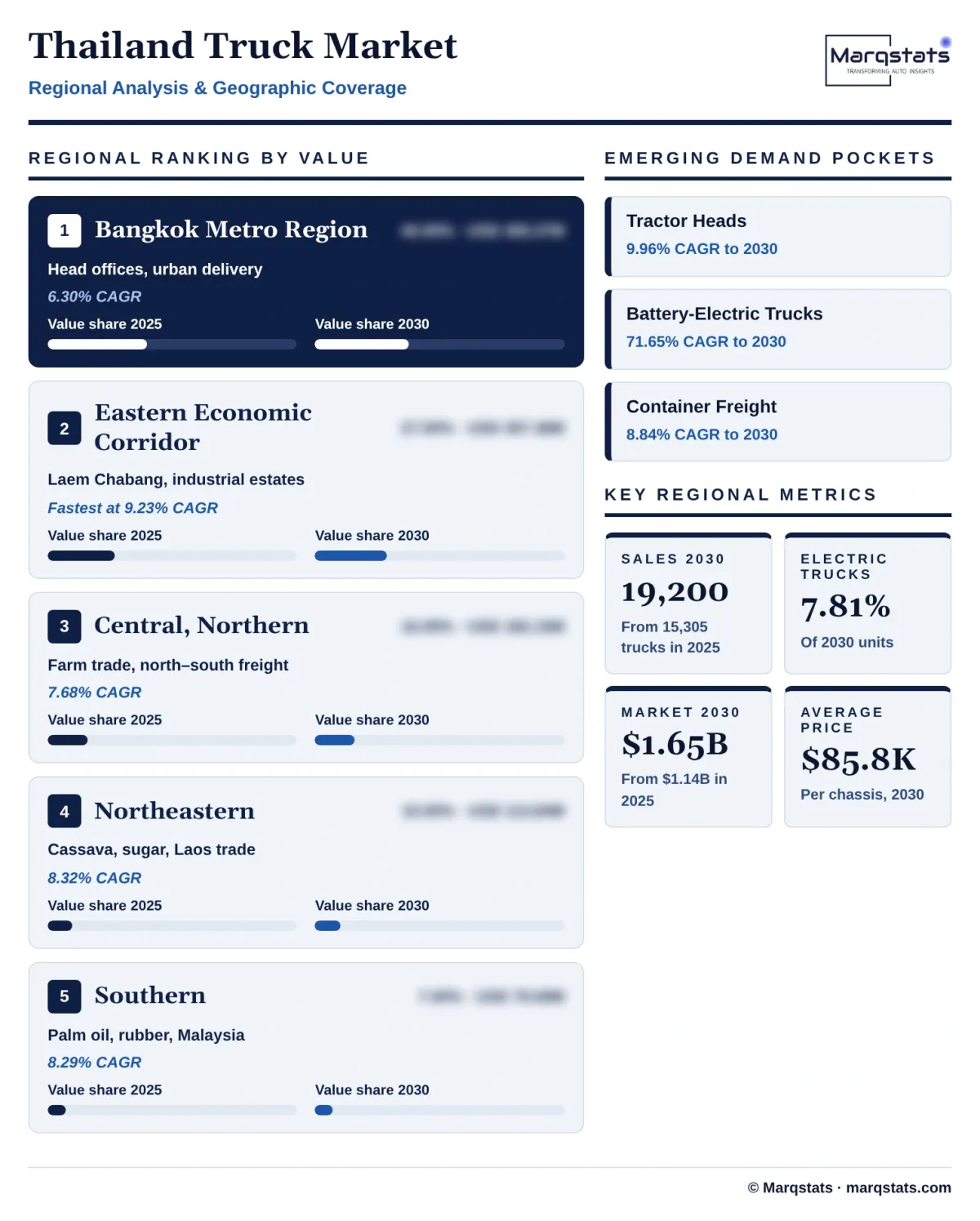
Battery-electric trucks add value faster than volume. Marqstats expects battery-electric sales to rise from 110 units in 2025 to 1,500 in 2030, and priced at about 1.8 times a diesel truck of the same class, their share of value reaches 13.24% in 2030 against 7.81% of units. The FTI series for 2026 supports a low starting point: 20 battery-electric units in January – March and 71 by May.
Marqstats tracks four indicators to monitor the forecast: the FTI monthly domestic sales and production releases for trucks above 5 tons, the pace at which Euro 5 ranges replace earlier models at Hino, Isuzu and Mitsubishi Fuso, container throughput at Laem Chabang and the Thai land borders, and the commercial lending stance of Thai banks toward small hauliers.
Market Dynamics
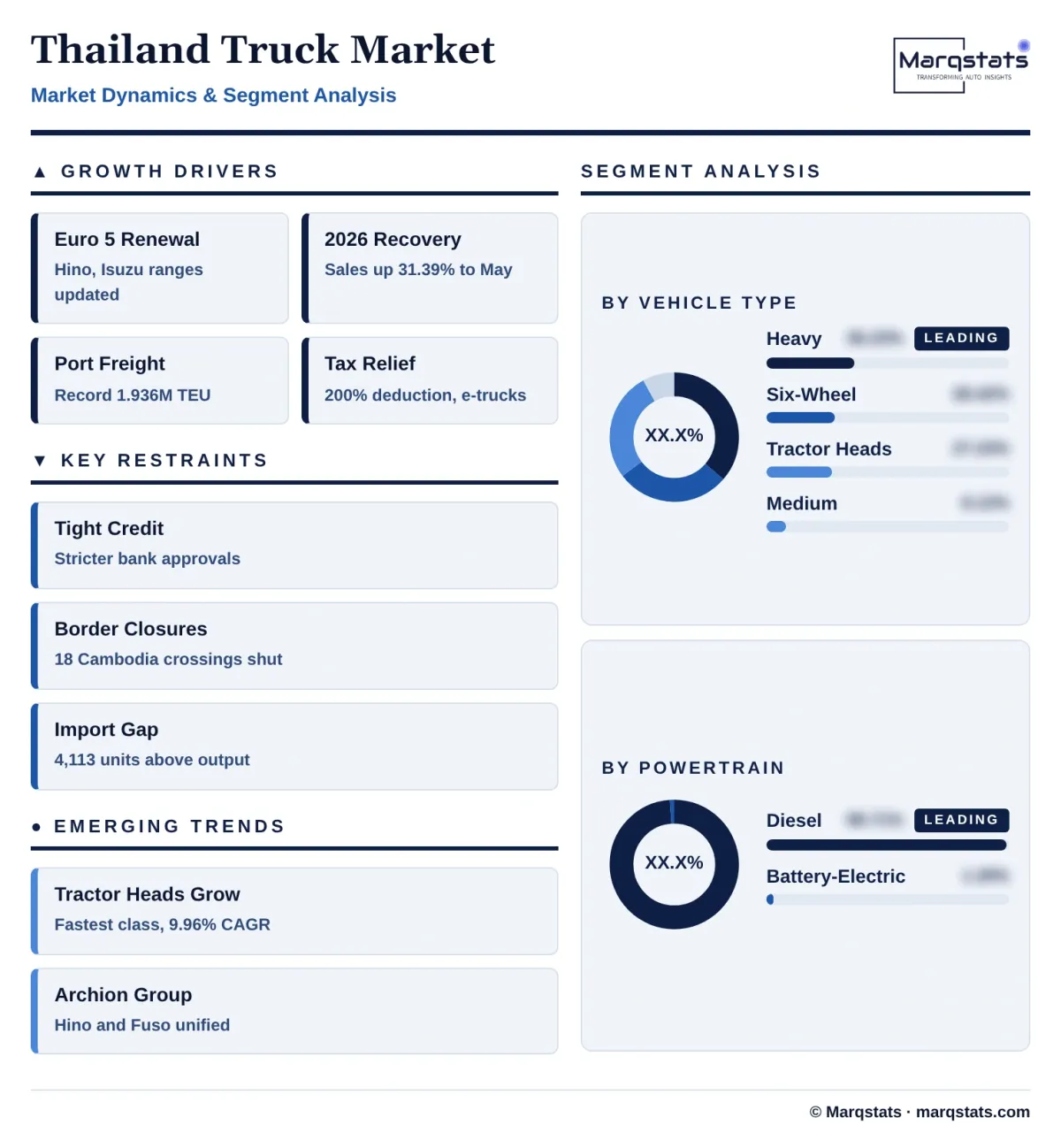
Key Drivers
Five forces are lifting demand for new medium and heavy trucks in Thailand after a soft 2025.
- A Euro 5 replacement cycle is under way. DieselNet lists the Euro V standard for heavy diesel trucks and buses in Thailand under Thai Industrial Standard TIS 3046-2563 from January 2024, and manufacturers have been bringing complete ranges into line since: Hino opened its Euro 5 line on 24 April 2025 with the UM1A tractor and the FL and FM 10-wheel trucks, launched the Euro 5 FG 6-wheel truck on 31 October 2025, and appointed Day Yingchol, its first Thai president, on 11 March 2026 to lead sales of Euro 5 trucks. Older Euro 3 and Euro 4 trucks are the natural replacement pool.
- The 2026 sales recovery is already visible. The FTI reported 7,690 domestic truck sales above 5 tons in January – May 2026, up 31.39%, with 4,722 units in the first quarter, up 31.57%, and 2,253 units in March alone, up 53.06%. That recovery follows two soft years, in which sales fell from 16,046 units in 2024 to 15,305 in 2025, and it points to pent-up replacement by operators who delayed purchases.
- Port and transit freight keeps tractor demand rising. The DP World terminal at Laem Chabang handled a record 1.936 million TEU in 2025 and won a five-year concession extension for berth B5 from May 2026 to April 2031, while Hutchison Ports Thailand passed 50 million TEU in December 2025. Thai transit trade reached THB 99.8 billion in July 2025, up 32.5%, and every container or transit load that moves by road needs a tractor head and a semi-trailer.
- Corporate tax relief gives electric trucks a cost lane. Royal Decree No. 798, issued on 9 September 2025, allows a deduction of 200% of the purchase cost for new large electric trucks and buses made or assembled in Thailand, against 150% for fully imported vehicles, for contracts dated 27 March to 31 December 2025, with online registration at the Revenue Department by 31 May 2026 under Director-General Notification No. 464 of 20 January 2026. The Cabinet draft estimated the relief at 10,000 vehicles, of which 4,000 trucks, with a tax cost of THB 10.6 billion.
- Deep local assembly keeps supply close to buyers. Thai plants built 11,192 trucks above 5 tons in 2025, all for the domestic market. Scania assembles truck cabs, chassis and bus chassis at its plant in the Bangkok Free Trade Zone after a THB 800 million investment, and CP Foton, the joint venture of Beiqi Foton Motor and the CP Group, opened a US$60 million plant with a 40% local procurement target. Local plants shorten delivery times and let operators buy against the tax relief for domestic assembly.
Key Restraints
Four constraints keep the market below its earlier volumes and slow the shift to electric trucks.
- Credit is tight for small hauliers. The FTI said in September 2025 that stricter credit approvals and weak buyer finances cut pickup sales 10.92% and proposed a THB 5 billion fund to guarantee banks against losses of up to THB 50,000 per repossessed pickup. Marqstats expects the same lending stance to hold back owner-operators who buy 4-wheel and 6-wheel trucks on instalments.
- Border closures cut cross-border haulage. Thailand closed 18 crossings with Cambodia after clashes on 24 to 28 July 2025, and bilateral trade fell nearly 100% to THB 376 million in July 2025, with exports down 97%. Trucks that served the Cambodian corridors lost work, which delays replacement among northern and eastern border hauliers.
- Imports and stock cut into local output. Production for the domestic market fell 33.57% in 2025 while sales fell only 4.62%, so 4,113 units, or 26.87% of sales, were met by imports and dealer stock. Chinese and European brands that import fully built trucks take sales from Thai plants, and dealers clearing old stock reduce factory orders even when sales hold.
- Export weakness, fuel costs and the Middle East conflict reduce industrial demand. Fuel prices rose THB 6 a litre on 26 March 2026, and the FTI cut its 2026 production outlook in July 2026 to a 3.33% contraction from earlier growth of 3%, citing hostilities in the Middle East, and January – August 2026 vehicle exports fell 6% to 565,040 units. Higher fuel costs squeeze small hauliers, and factories that ship less need fewer inbound trucks, which limits growth in manufacturing and food distribution fleets.
Key Trends
Four shifts are changing which trucks Thai fleets buy, who builds them and how they are powered.
- Tractor heads and container logistics gain share. Marqstats expects tractor heads to grow from USD 309.96 million to USD 498.22 million, a 9.96% CAGR, because Laem Chabang container volumes, rail-connected inland container yards such as the DP World facility at Khon Kaen and transit trade with China and Singapore favour semi-trailer combinations over rigid trucks.
- Battery-electric trucks move from pilot to order book. The FTI series shows 71 battery-electric sales in January – May 2026, including 35 in May, and Royal Decree No. 798 gave buyers a cost advantage for Thai-assembled models until the end of 2025. Marqstats expects electric sales to reach 1,500 trucks by 2030, with light-medium delivery trucks first and tractors later.
- Local production recovers faster than sales. The FTI reported production of 7,149 trucks in January – May 2026, up 95.49%, against sales growth of 31.39%, which lifts the output-to-sales ratio from 62.48 to 92.96 per 100 compared with the same months of 2025.
- Japanese brands consolidate while Chinese brands localise. Daimler Truck and Toyota unified Hino and Mitsubishi Fuso under Archion Corporation on 1 April 2026, with each keeping about 25% of the new group, and Chinese makers such as Foton are building Thai plants to meet local content rules.
Strategic Implications
- For truck makers, the practical route to share is an assembly or kit footprint in Thailand with a Euro 5 range. Royal Decree No. 798 doubled the deduction for Thai-assembled electric trucks against imports, and the 2025 gap of 4,113 units between output and sales shows how much room imported brands have taken when local capacity is thin.
- For fleet operators, the 2026 recovery is a window to renew Euro 3 and Euro 4 trucks while tractor and rigid supply is stable. Operators that tender early lock in Euro 5 models and finance terms before the demand rise reaches the order books of Isuzu, Hino and Mitsubishi Fuso dealers.
- For body builders and parts suppliers, the market is a chassis market with a heavy bodywork and aftermarket layer. Tippers, mixers, tankers and refrigerated bodies add value after the chassis sale that Marqstats does not count here, and the 1,500-unit battery-electric segment by 2030 needs high-voltage harnesses, thermal management and charger services.
- For financiers, truck lending is a defensive book when the used-truck market is deep. Banks and leasing firms that finance tractors for Laem Chabang haulers or tippers for contractors can use the FTI monthly release as a leading indicator, and lenders that offer residual-value products on electric trucks reach buyers that conventional bank terms turn away.
- For investors and logistics developers, the Eastern Economic Corridor is the growth region, with 9.23% a year to 2030. Truck-charging hubs, depots and driver services along the Laem Chabang to Bangkok and the Chonburi to Rayong corridors will see tractor density rise before other regions.
Market Segmentation
Four-wheel medium trucks of 5 to 10 tonnes account for 8.12% of 2025 value, USD 92.40 million, and grow at 4.08% a year to USD 112.83 million. Marqstats estimates about 2,150 units in 2025, covering models such as the Isuzu ELF NPR and NQR and comparable Hino and Mitsubishi Fuso Canter models that distributors, food and beverage companies and municipal fleets buy for urban delivery.
Six-wheel trucks of 10 to 16 tonnes account for 28.42% of 2025 value, USD 323.50 million, and grow at 7.47% a year to USD 463.69 million. They are the largest class by units, about 5,900 in 2025 or 38.55%, and include the Isuzu FRR and FTR, the Hino 500 FG with Euro 5 and the Fuso Fighter, which carry general cargo, beverages, agricultural produce and packaged goods across the central and northern regions.
Heavy rigid trucks above 16 tonnes account for 36.23% of 2025 value, USD 412.57 million, and grow at 6.80% a year to USD 573.36 million. About 4,350 units were sold in 2025, mostly 10-wheel and 12-wheel cargo trucks, tippers and mixers such as the Isuzu FVM and FVZ and the Hino 500 FL and FM, bought by contractors, quarry and cement operators and by industrial park logistics firms.
Tractor heads for semi-trailers account for 27.23% of 2025 value, USD 309.96 million, and grow fastest, at 9.96% a year, to USD 498.22 million and 30.23% of the market. About 2,905 units were sold in 2025, including the Isuzu GXZ, the Hino 500 UM1A, UD Trucks, Scania, Volvo and Mercedes-Benz models and Chinese tractors from Foton, Sinotruk and SHACMAN that serve container, fuel and long-haul freight.
Diesel trucks account for 98.71% of 2025 value, USD 1,123.79 million, and grow at 4.94% a year to USD 1,429.97 million, while their share falls to 86.76%. Euro 5 diesel engines now sit in the new ranges from Hino and the other Japanese makers, and nearly every truck sold in 2025 ran on diesel.
Battery-electric trucks account for 1.29% of 2025 value, USD 14.64 million, and grow at 71.65% a year to USD 218.13 million and 13.24% of the market. Marqstats estimates 110 units in 2025 and 1,500 in 2030, mostly light-medium delivery trucks first, then rigids and tractors from Chinese makers such as Foton, SANY and BYD, helped by the Royal Decree No. 798 deduction that favours Thai assembly.
Freight and container haulage accounts for 44.68% of 2025 value, USD 508.52 million, and grows at 8.84% a year to USD 776.53 million and 47.12% of the market. It covers tractor heads, port transfers from Laem Chabang and general cargo hauliers, and it grows fastest among end uses because container and transit flows keep rising.
Construction, mining and infrastructure account for 29.51% of 2025 value, USD 335.99 million, and grow at 6.70% a year to USD 464.60 million. Tippers, mixers and heavy rigids serve roads, rail, port works and quarries, and the segment follows the pace of public investment.
Agriculture and food distribution account for 15.07% of 2025 value, USD 171.60 million, and grow at 6.47% a year to USD 234.74 million. Six-wheel trucks move rice, sugar cane, cassava, fruit and processed food between farms, mills and cold stores.
Manufacturing, retail and municipal use accounts for 10.74% of 2025 value, USD 122.32 million, and grows at 7.08% a year to USD 172.23 million. Industrial parks, distribution centres and city services buy medium and six-wheel trucks, including most of the early electric models.
By Geography
Bangkok Metropolitan Region
The Bangkok Metropolitan Region, covering Bangkok, Samut Prakan, Samut Sakhon, Pathum Thani, Nonthaburi and Nakhon Pathom, accounts for 40.00% of 2025 value, USD 455.37 million, and grows at 6.30% a year to USD 618.04 million and 37.50% by 2030. Registration shares overstate the capital because fleet head offices, lessors and banks register trucks there while the trucks work on national corridors. Marqstats allocates value by registration address, as buyers and lenders do, and treats the figure as an estimate.
Eastern Economic Corridor
The Eastern Economic Corridor, covering Chonburi, Rayong and Chachoengsao, accounts for 27.00% of 2025 value, USD 307.38 million, and grows fastest, at 9.23% a year, to USD 477.95 million and 29.00% by 2030. Laem Chabang port, where the DP World terminal handled 1.936 million TEU in 2025, and the industrial estates behind it generate the container, auto-parts and chemicals freight that needs tractor heads and heavy rigids.
Central and Northern Thailand
Central and Northern Thailand account for 16.00% of 2025 value, USD 182.15 million, and grow at 7.68% a year to USD 263.70 million. Agricultural trade, sugar and rice milling, and the north to south freight routes create steady demand for six-wheel trucks, and the Cambodia and Myanmar border closures of 2025 reduced cross-border work in the east and west of this belt.
Northeastern Thailand
Northeastern Thailand accounts for 10.00% of 2025 value, USD 113.84 million, and grows at 8.32% a year to USD 169.75 million. The region ships cassava, sugar and rice and trades with Laos, and the DP World inland container yard at Khon Kaen with a rail shuttle to Laem Chabang gives hauliers shorter first-mile work.
Southern Thailand
Southern Thailand accounts for 7.00% of 2025 value, USD 79.69 million, and grows at 8.29% a year to USD 118.66 million. Palm oil, rubber and seafood, and cross-border transport to Malaysia, drive demand for six-wheel and medium trucks, and the region is the smallest buyer because rail and coastal shipping carry part of its bulk freight.
How Competition Is Evolving
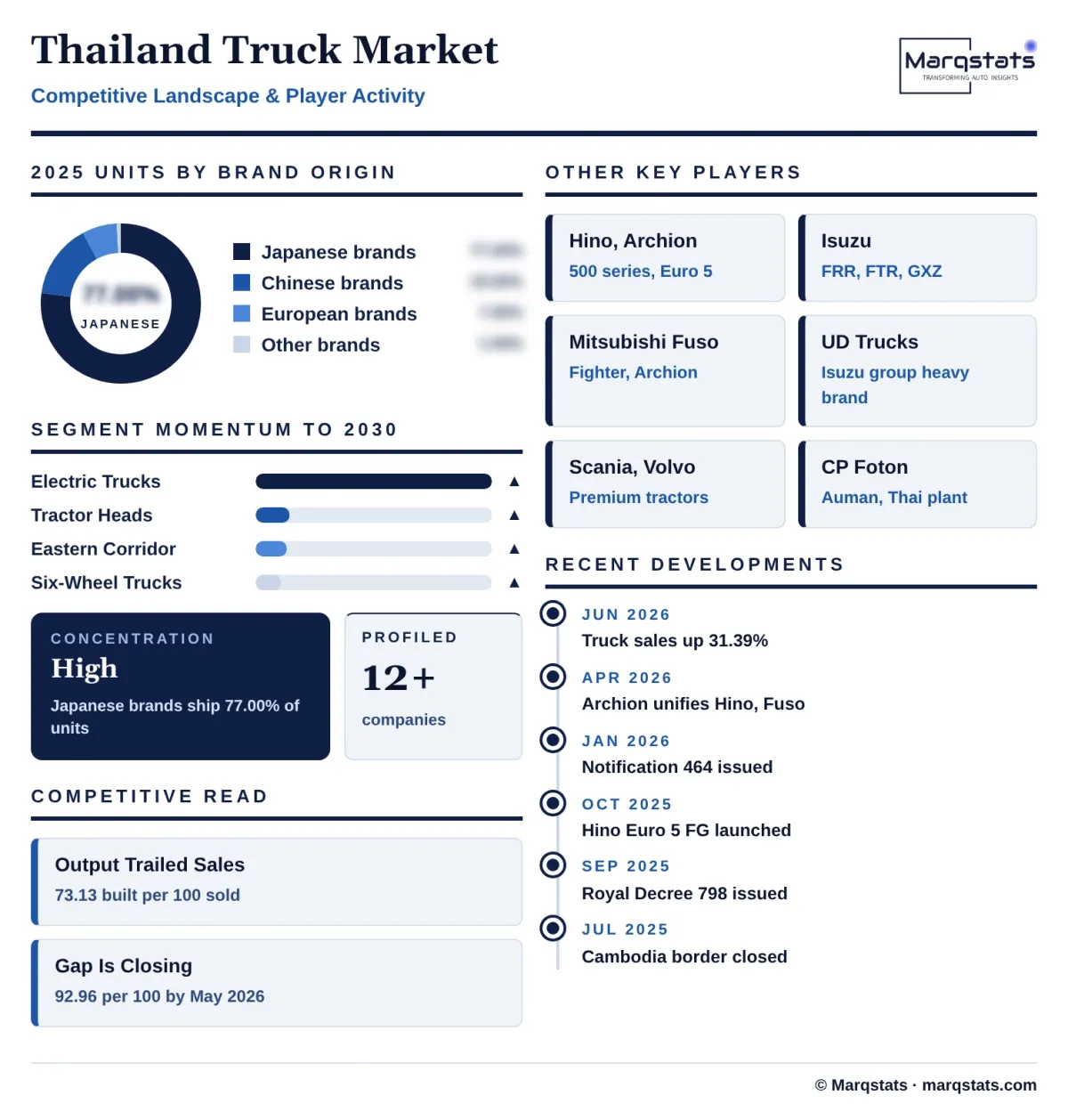
The market is highly concentrated and led by Japanese brands. Marqstats estimates that Japanese makers, led by Isuzu, Hino, Mitsubishi Fuso and UD Trucks, supplied about 77.00% of 2025 units, Chinese brands about 15.00%, European brands about 7.00% and other brands about 1.00%. The layers are built from the FTI local output of 11,192 trucks, which sits almost entirely in Japanese plants and the Scania and CP Foton assembly lines, plus the 4,113 units that were imported, and Marqstats reports origin layers, not shares for individual companies.
Hino and Isuzu hold the service-sensitive centre of the market. Tri Petch Isuzu Sales Co., Ltd. sells the FRR, FTR, FVM, FVZ and GXZ ranges, and Hino Motors Sales (Thailand) Limited sells the 500 series with Euro 5 engines in the UM1A, FL, FM and FG models, with Hino naming its first Thai president in March 2026 to lead sales of those models. The April 2026 unification of Hino and Mitsubishi Fuso under Archion Corporation, in which Daimler Truck and Toyota each keep about 25%, puts two of the four Japanese brands under one owner and may combine their Thai dealer networks over time.
European and Chinese brands compete at the top and bottom of the price range. Scania, Volvo Trucks and Mercedes-Benz sell premium tractors and heavy rigids where fuel economy and telematics set the buying case, and Scania assembles chassis in the Bangkok Free Trade Zone. Beiqi Foton Motor, through CP Foton, has built a Thai plant, and Sinotruk, SHACMAN and Dongfeng sell tractors and tippers at lower prices, so Marqstats estimates that the Chinese layer is the main source of the imports that filled the 2025 gap between output and sales.
Competition is shifting from list price to total cost and policy. Operators weigh fuel consumption, Euro 5 compliance, financing terms and tax relief, and Royal Decree No. 798 favours electric models assembled in Thailand with a 200% deduction against 150% for imports. Brands that combine local assembly, finance partners and nationwide workshops are best placed to win the 2026 recovery.
Companies Covered
Companies covered in the report include:
Recent Market Activity
Table of Contents
Coverage & Segmentation
The study covers the Thailand truck market, with 2025 as the base year, 2021 – 2025 as the historical period, of which 2024 and 2025 are quantified from Federation of Thai Industries releases, and 2026 – 2030 as the forecast period. It covers new medium and heavy goods trucks above 5 tonnes gross vehicle weight sold domestically in Thailand, following the FTI category of trucks of 5 tons and above, segmented by vehicle type, powertrain, end use and region. Values are wholesale chassis-cab values at the manufacturer or importer gate in US dollars, before value added tax, registration fees and body building, and baht figures use the 2025 average of THB 33.74 per US dollar.
The ladder from the FTI vehicle totals starts at 621,166 domestic sales of all vehicles in 2025. Less 404,845 passenger cars and SUVs, 143,072 one-ton pickups, 43,916 pickup passenger vehicles and 13,283 other vehicle types, and with 745 units, or 0.12%, left unallocated in the FTI published categories, it leaves the 15,305 trucks above 5 tons that the analysis sizes. Pickups and pickup passenger vehicles are excluded and are covered by the live Marqstats Thailand Pickup Truck Market report (142,900 units in 2025). Buses and coaches, commercial vans and passenger vans are excluded and are covered in a separate Marqstats analysis of the Thailand bus and coach market. The DLT first-registration count for all trucks under the Land Transport Act (58,700 in 2025) spans every weight class and is not added to the FTI-based figure.
Electric trucks are included here only as the FTI-reported battery-electric sales of trucks above 5 tons, 110 units in 2025 on Marqstats estimates. The live Marqstats Thailand Electric Commercial Vehicle Market report counts battery-electric registrations across light, medium and heavy trucks and buses on a registration basis, so its figures are wider than this market and must not be added to it. Fleet-level data on Department of Land Transport truck registrations by weight class, truck bodies, trailers, used trucks, off-road mining dump trucks, agricultural tractors and aftermarket parts are excluded.