Market Snapshot
Middle bar: base-year value × (1 + CAGR), rounded to two decimals. This is a calculated illustration, not a separately researched annual estimate.
The Malaysia truck market size is estimated at USD 482.46 million in 2025 and is projected to reach USD 752.03 million by 2030, growing at a CAGR of 9.28% over 2026 – 2030. New registrations of trucks and prime movers rise from about 13,131 units to about 16,900 units, a 5.18% annual rate, while the average value per vehicle climbs from about USD 36,740 to USD 44,500, a 3.91% annual rate, as the mix moves toward heavier trucks and prime movers.
Marqstats defines the market as the ex-distributor value of new goods trucks and prime movers sold in Malaysia: light trucks up to 8.5 tonnes gross vehicle weight such as the Isuzu ELF, Hino 300 Series and Foton Aumark, medium trucks of 8.5 to 16 tonnes such as the Isuzu Forward and UD Condor, heavy rigid trucks above 16 tonnes, and prime movers for articulated combinations. Value is counted for a chassis-cab with a basic standard body. Pick-ups, panel vans, buses, terminal tractors that work inside port yards, special-purpose bodies fitted after sale and used trucks are excluded.
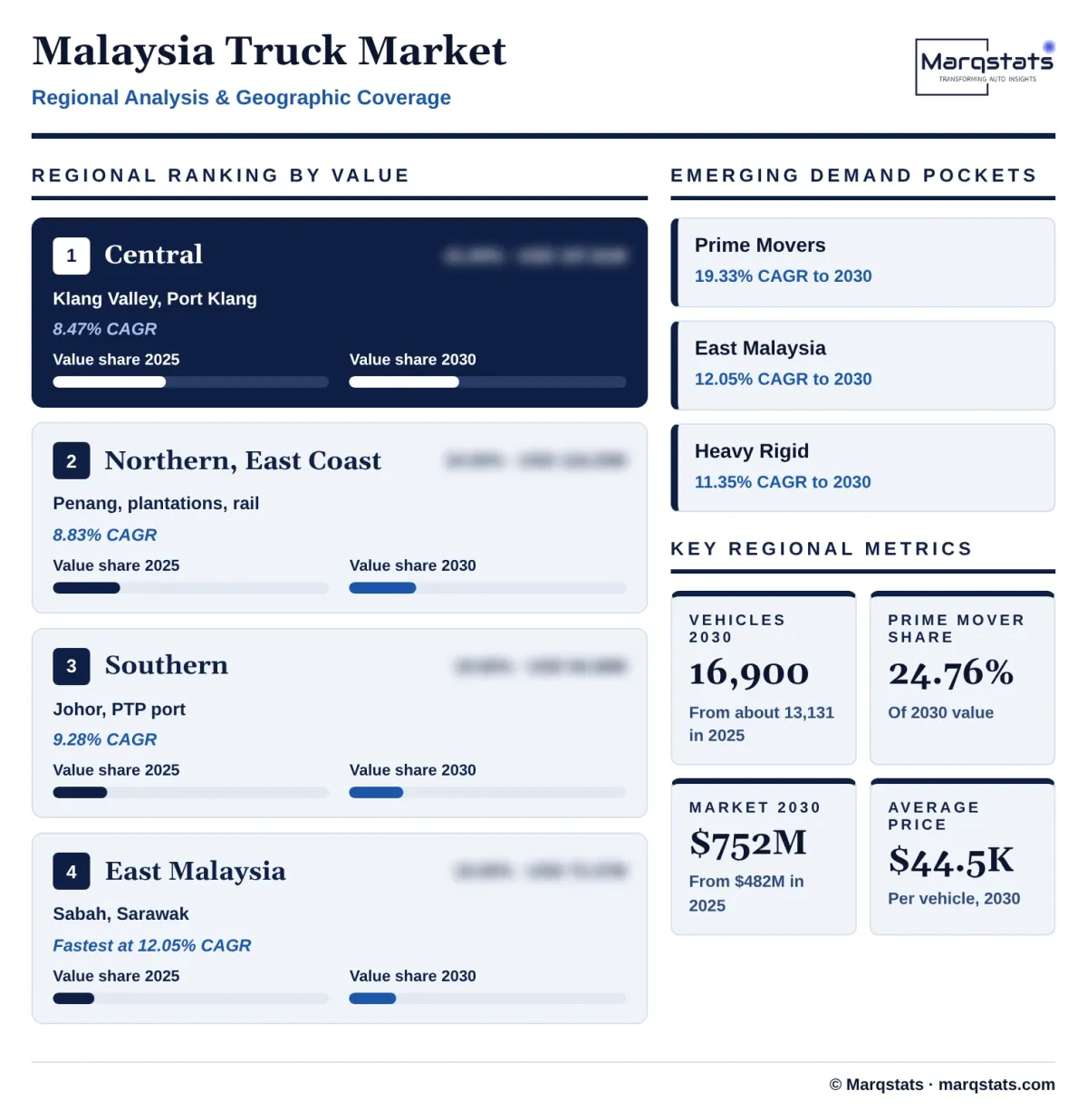
Light trucks account for 55.21% of 2025 value, logistics and distribution for 38.00% and diesel trucks for 99.35%. Prime movers are the fastest-growing vehicle class, at 19.33% a year, as haulage fleets restock after a sharp fall in 2025, and East Malaysia is the fastest-growing region, at 12.05% a year, helped by road building and the extension of fleet fuel cards to Sabah and Sarawak.
Key Takeaways
Market Overview & Analysis
Report Summary
Marqstats sizes the Malaysia truck market as the ex-distributor value of new goods trucks and prime movers sold to Malaysian operators. The market is valued at chassis-cab level with a basic standard body, which keeps it comparable across light, medium and heavy classes and avoids counting the very different cost of dropside, box, tipper, tanker or refrigerated bodies that body builders fit after sale. Marqstats estimates that 2025 registrations were about 13,131 vehicles, of which about 12,264 were trucks and about 867 were prime movers.
The truck market is a small part of Malaysian vehicle sales but a large part of its freight capacity. The Malaysian Automotive Association reported total industry volume of 820,752 vehicles in 2025, up 0.5%, of which passenger vehicles were 759,098 and commercial vehicles 61,654, down 11.4% from 69,567 in 2024. Pick-ups, which Marqstats estimates at about 45,426 units in 2025, make up most commercial vehicle sales, and panel vans and buses add about 3,097 more. Trucks and prime movers are the remaining 13,131 units, about 1.60% of total industry volume.
The 2025 base year was a trough for heavy vehicles. The Malaysian Automotive Association recorded 5,262 trucks and 372 prime movers in the first half of 2025, down 23.6% and 62.5% from the first half of 2024, as buyers waited for Euro 5 models, tightened credit and reacted to the removal of the broad diesel subsidy. Marqstats estimates that registrations recovered in the second half, as Isuzu alone reported 6,880 truck deliveries for the full year, and that prime movers ended 2025 at about 867 units against about 2,100 in 2024.
Recovery is visible in 2026. For the first half of 2026 the association reported trucks up about 9% and prime movers up about 112%, even as total commercial vehicle sales fell 10.7% to 23,718 units because pick-up sales dropped 19.2% to 15,653. Marqstats estimates about 6,524 trucks and prime movers in the first half of 2026, up 15.8% on the first half of 2025, and about 14,400 for the full year, which is about 9.7% above 2025.
The market grew from an estimated USD 440.00 million in 2021 (a Marqstats estimate) to USD 482.46 million in 2025 at current prices, with volumes dipping in 2025. Government spending, plantation and construction activity, port volumes and e-commerce distribution all support demand for trucks, while a higher cost of diesel for private owners and a stricter approach to fuel subsidies make fleet operators more careful about replacement timing. Marqstats counts the 2025 trough and 2026 rebound together when it sets the forecast, so the 9.28% CAGR reflects both normal replacement and a catch-up in prime movers.
Malaysia Truck Market Size and Forecast
The Malaysia truck market grows from USD 482.46 million in 2025 to USD 752.03 million in 2030, a CAGR of 9.28%. Volume contributes about three fifths of the growth and price about two fifths: registrations grow at 5.18% a year, from about 13,131 to about 16,900 vehicles, and the average value per vehicle rises at 3.91% a year, from about USD 36,740 to USD 44,500. Marqstats holds the exchange rate at MYR 4.28 per US dollar, the 2025 average, throughout the forecast and lets Malaysian ringgit prices rise by 2.00% a year.
The 2025 value is built bottom-up from vehicle classes and ringgit prices. Marqstats estimates about 9,500 light trucks, about 1,700 medium trucks, about 1,064 heavy rigid trucks and about 867 prime movers. Ex-distributor prices are estimated at RM 120,000 for a light truck, RM 175,000 for a medium truck, RM 280,000 for a heavy rigid truck and RM 380,000 for a prime mover, which are USD 28,037, USD 40,888, USD 65,421 and USD 88,785 at MYR 4.28. These sit within observed list prices: the Isuzu NPR and NPR Pro are listed at about RM 125,000 to RM 131,000, the Isuzu FRR 90 at about RM 119,000 to RM 158,000, UD Condor CD5 trucks at about RM 159,000 to RM 169,000, a UD tipper at about RM 268,000, and new prime movers at about RM 333,000 to RM 425,000.
The unit base is anchored on reported sales. Isuzu Malaysia reported 6,880 trucks delivered in 2025 and a 56.1% share, which implies a segment of about 12,264 trucks. Of Isuzu deliveries, 6,362 were ELF light trucks and 494 were Forward medium trucks, leaving about 24 Giga heavy trucks. The association recorded 5,262 trucks in the first half of 2025, so Marqstats estimates about 7,002 trucks in the second half, a ratio of 1.33 to the first half. Applying the same ratio to the 372 prime movers recorded in the first half gives about 867 for the year.
Heavier classes drive most of the value gain. Marqstats expects light truck registrations to grow from about 9,500 to about 11,000, medium trucks from about 1,700 to about 2,350, heavy rigid trucks from about 1,064 to about 1,650 and prime movers from about 867 to about 1,900, which brings prime movers back to the level of 2024. Prime movers and heavy rigid trucks together rise from 30.38% to 40.61% of value.
Marqstats tracks four indicators to monitor the forecast: monthly Malaysian Automotive Association truck and prime mover registrations, the number of companies and vehicles enrolled in the Subsidised Diesel Control System, awards under the 13th Malaysia Plan for roads, rail and ports, and the pace at which makers move full ranges to Euro 5 engines.
Market Dynamics
Key Drivers
Five forces are lifting new truck and prime mover registrations in Malaysia after the 2025 trough.
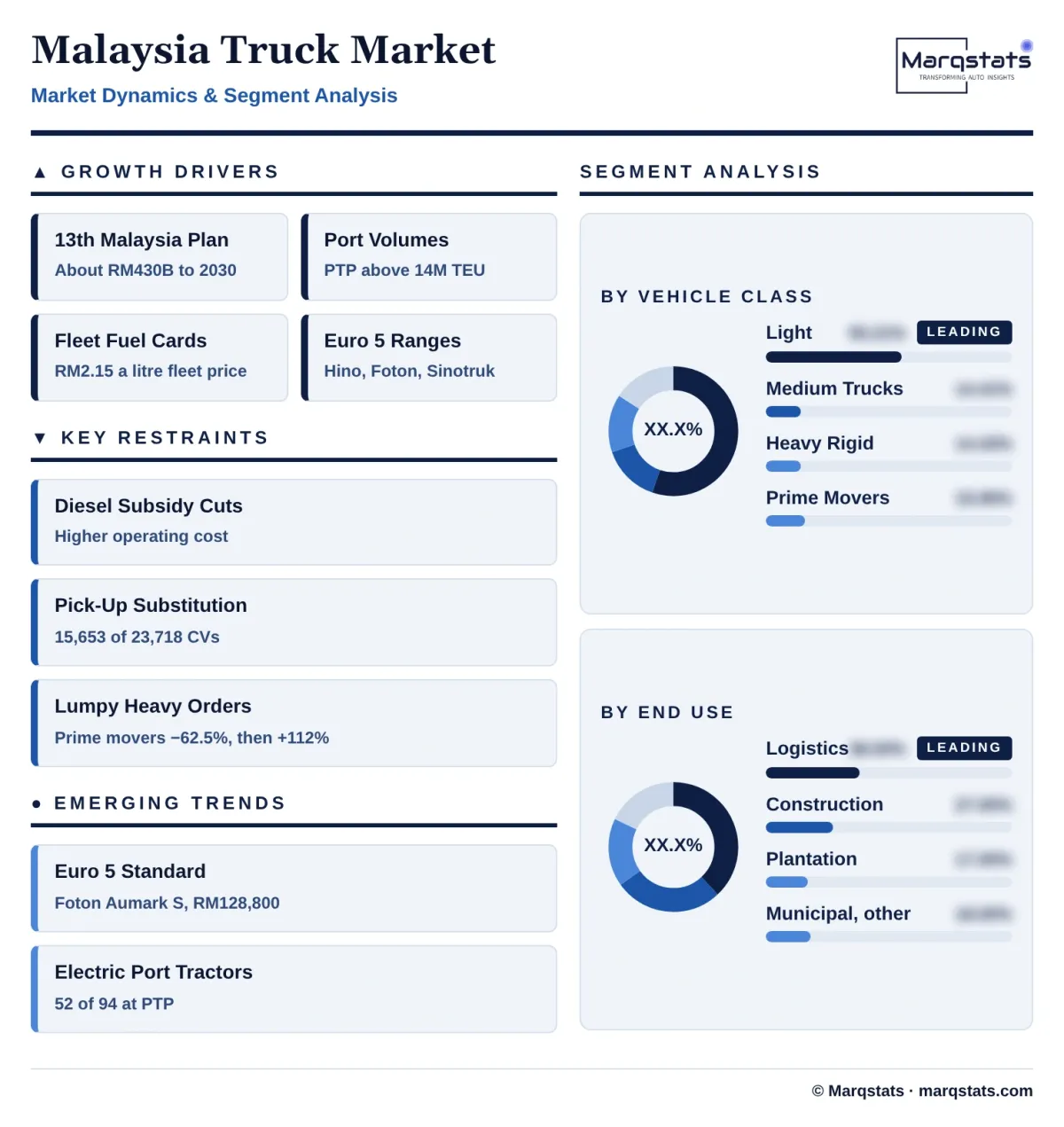
- The 13th Malaysia Plan lifts construction demand. The plan for 2026 – 2030 earmarks about RM430 billion of development spending, and the government has said that connectivity projects including roads and rail will be pushed in 2026. Tippers, mixers and heavy rigids serve this work, and prime movers move the cement, steel and equipment that feed it.
- Port and trade volumes need long-haul tractors. Port of Tanjung Pelepas handled a record of more than 14 million twenty-foot equivalent units in 2025 and Westports also set a record, so container haulage between ports, inland depots and factories supports orders for prime movers.
- Fleet fuel cards make diesel cost predictable. The Subsidised Diesel Control System lets registered commercial fleets buy diesel at RM 2.15 a litre from July 2026, against RM 2.10 for private owners under BUDI Diesel. By 18 July 2026, 172,955 companies and 464,797 vehicles were registered, and enrolment was extended to Sabah and Sarawak, which gives East Malaysian fleets the same support as the peninsula.
- New Euro 5 ranges give buyers a reason to replace. Hino opened pre-bookings for its 300 Series Euro 5 4-wheeler on 1 August 2025 and 6-wheeler on 1 October 2025, Foton launched the Aumark S Euro 5 with an automated manual gearbox in May 2026, Sinotruk introduced a Howo Euro V range in April 2025, and UD began Euro 5 assembly of its range in Malaysia in 2024. Euro 5 diesel at 10 parts per million sulphur has been sold nationwide since April 2021, so fuel is ready.
- E-commerce and food distribution need light trucks. Parcel, grocery and beverage distributors run large fleets of 3 to 5 tonne trucks, and these customers replace on fixed cycles that do not depend on construction activity, which keeps light truck volumes steady when other segments fall.
Key Restraints
Four constraints keep the pace of recovery measured and uneven across segments.
- Diesel subsidy rationalisation raises operating costs. Since the targeted scheme began in June 2024, fleets outside the fuel card system pay market diesel prices, and small operators that do not qualify can delay replacement or keep older trucks on the road.
- Pick-up substitution. Many small businesses buy double-cab and single-cab pick-ups instead of light trucks for short loads. The association reported that pick-ups were 15,653 of 23,718 commercial vehicles in the first half of 2026, so a share of potential light truck demand is met by a vehicle that falls outside this market.
- Used and reconditioned trucks. Operators with tight budgets buy used trucks and keep older trucks in service. Because a new light truck costs about RM 120,000 and a new prime mover about RM 380,000, financing terms and residual values strongly affect when fleets replace.
- Lumpy heavy-vehicle demand. Prime mover registrations fell 62.5% in the first half of 2025 and rose about 112% in the first half of 2026, which shows how a few large fleet orders or postponed deliveries can swing annual volume.
Key Trends
Four shifts are changing how Malaysian operators specify, finance and fuel their trucks.
- Euro 5 becomes the standard specification. Makers are moving full ranges to Euro 5 engines and automated manual gearboxes, as with the Foton Aumark S, which uses a Cummins ISF 3.8 engine producing 154 PS and a ZF 6-speed automated gearbox at RM 128,800.
- Locally assembled trucks gain share. UD Trucks and Isuzu assemble trucks in Malaysia, and local assembly lets them hold prices and shorten delivery times, which suits buyers who plan around the diesel fuel card and financing cycles.
- Chinese heavy-truck makers widen their range. Sinotruk introduced a Euro V Howo range in April 2025 through Sino Mobile and Heavy Equipment, and Chinese brands compete on price in tippers, cargo trucks and prime movers.
- First electric tractors appear in port yards. Port of Tanjung Pelepas ordered 94 Terberg terminal tractors in December 2025, 52 of them electric, and put the first 21 electric units into service on 11 August 2026. Yard tractors are not road-registered trucks, so they are outside this market, but they show how port operators are testing battery power before road fleets do.
Strategic Implications
- For truck makers and distributors, the 2026 rebound is concentrated in prime movers and heavy classes, so stock and financing support should follow heavy-duty orders from construction, port and plantation fleets rather than retail light-truck traffic.
- For logistics and distribution fleets, enrolment in the Subsidised Diesel Control System and an agreed replacement cycle for 3 to 5 tonne trucks are the most reliable ways to control cost per kilometre, because the fuel card price of RM 2.15 a litre is fixed for registered commercial fleets.
- For construction and quarry contractors, 13th Malaysia Plan awards are the best lead indicator. Tippers and mixers are ordered in the months after contracts are awarded, and East Malaysian projects require trucks that are serviced by local dealers.
- For lenders and leasing companies, residual values on Euro 5 trucks and the gap between new and used prices are the main risks. Prime mover volumes can swing by more than 100% a year, so portfolio limits by vehicle class matter.
- For foreign makers considering entry, the market is concentrated and dealer reach is decisive. A new entrant needs local assembly or a distributor with service points in Central, Southern, Northern and East Malaysian regions, plus competitive Euro 5 pricing in the 7.5 to 9.9 tonne class.
Market Segmentation
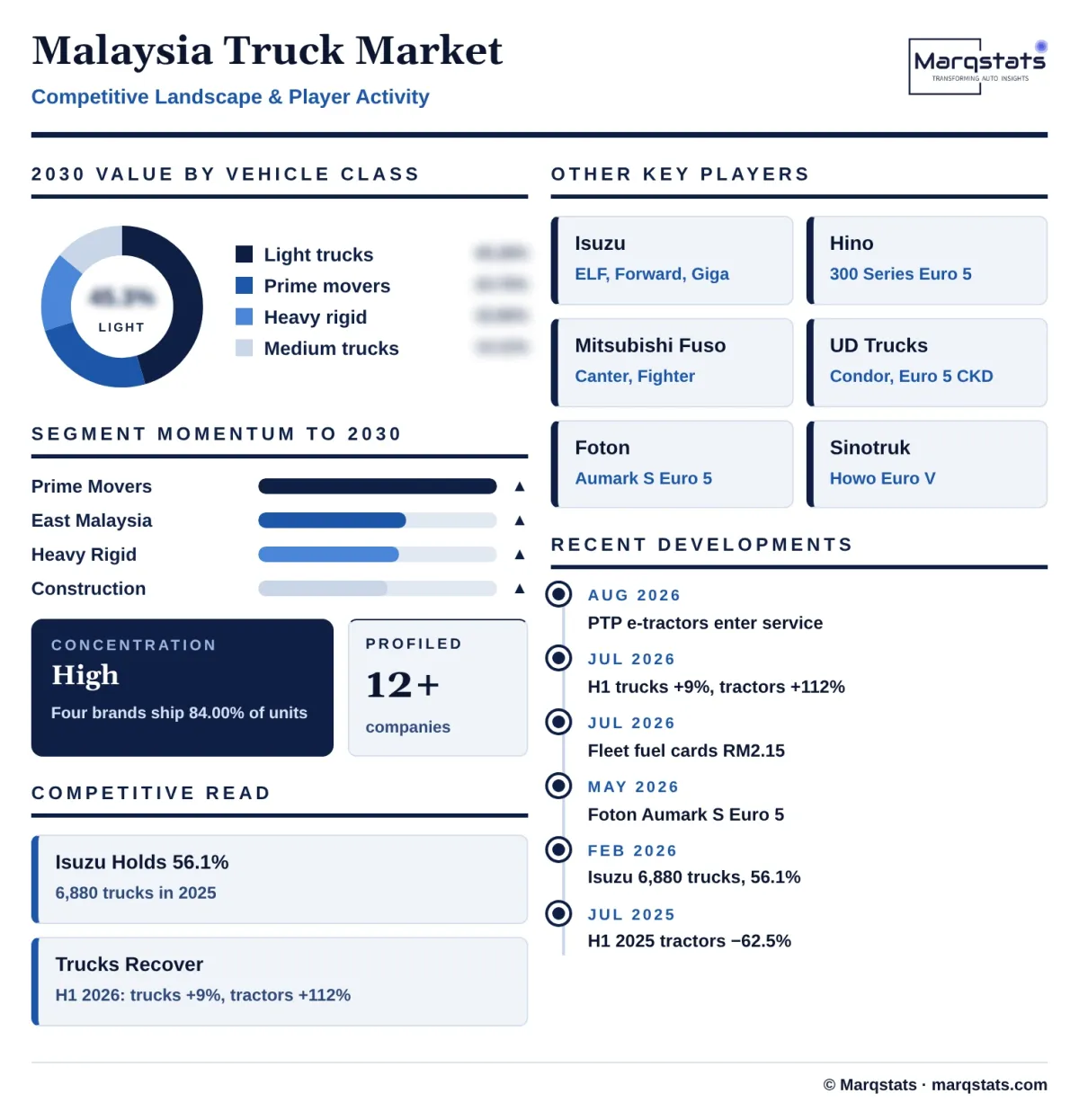
Light trucks of up to 8.5 tonnes account for 55.21% of 2025 value, USD 266.36 million, and grow at 5.03% a year to USD 340.51 million, while their share falls to 45.28% by 2030. They are the volume core of the market, led by the Isuzu ELF, which accounted for 6,362 of Isuzu deliveries in 2025, the Hino 300 Series, the Mitsubishi Fuso Canter and the Foton Aumark, and they serve parcel, grocery, beverage and building-supply distribution.
Medium trucks of 8.5 to 16 tonnes account for 14.41% of 2025 value, USD 69.51 million, and grow at 8.82% a year to USD 106.09 million and 14.11% by 2030. The Isuzu Forward, which delivered 494 units in 2025, the UD Condor and the Hino 500 Series are the leading nameplates, and the class serves regional distribution, refrigerated food transport and bulk goods.
Heavy rigid trucks above 16 tonnes account for 14.43% of 2025 value, USD 69.61 million, and grow at 11.35% a year to USD 119.18 million and 15.85% by 2030. Tippers, mixers, tankers and cargo trucks of 6x4 and 8x4 configurations are used on road, rail and quarry projects, and orders follow 13th Malaysia Plan construction awards.
Prime movers account for 15.95% of 2025 value, USD 76.98 million, and grow fastest, at 19.33% a year, to USD 186.25 million and 24.76% by 2030. Registrations fell 62.5% in the first half of 2025 and rose about 112% in the first half of 2026. Port container haulage, palm oil and bulk tankers, and heavy-haul construction logistics use tractors of 4x2 and 6x4 types.
Logistics and distribution account for 38.00% of 2025 value, USD 183.33 million, and grow at 9.85% a year to USD 293.29 million and 39.00% by 2030. Parcel, grocery, beverage and factory-to-warehouse fleets operate mostly light and medium trucks and prime movers on fixed replacement cycles.
Construction and quarrying account for 27.00% of 2025 value, USD 130.26 million, and grow fastest among end uses, at 10.47% a year, to USD 214.33 million and 28.50% by 2030, as 13th Malaysia Plan road, rail and port projects award contracts.
Plantation and commodity haulage accounts for 17.00% of 2025 value, USD 82.02 million, and grows at 6.58% a year to USD 112.80 million and 15.00% by 2030. Palm fruit, crude palm oil, timber and rubber hauliers use medium and heavy rigids and tractors, with East Malaysian estates a large part of demand.
Municipal, fuel distribution, food service and other uses account for 18.00% of 2025 value, USD 86.85 million, and grow at 8.67% a year to USD 131.61 million and 17.50% by 2030. Councils, fuel retailers, cold-chain operators and small businesses buy mostly light and medium trucks.
Diesel trucks account for 99.35% of 2025 value, USD 479.31 million, and grow at 8.56% a year to USD 722.73 million, while their share falls to 96.10% by 2030. Euro 5 diesel is sold nationwide, and every leading maker sells diesel engines in all weight classes.
Battery-electric and alternative-fuel trucks account for 0.65% of 2025 value, USD 3.15 million, and grow at 56.21% a year to USD 29.30 million and 3.90% by 2030. Marqstats estimates about 45 such trucks were registered in 2025 and about 380 will be in 2030, at average prices of RM 300,000 and RM 330,000. Terminal tractors working inside ports are excluded.
By Geography
Central
Central Malaysia, covering Selangor, Kuala Lumpur, Putrajaya and Negeri Sembilan, is the largest market, with 41.00% of 2025 value, USD 197.81 million, and grows at 8.47% a year to USD 297.05 million and 39.50% by 2030. Port Klang and the Klang Valley concentrate distribution centres, factories and construction sites, and head offices of the major fleets sit here, so registrations are recorded here even where trucks later run elsewhere.
Southern
Southern Malaysia, covering Johor and Melaka, accounts for 19.50% of 2025 value, USD 94.08 million, and grows at 9.28% a year to USD 146.65 million and 19.50% by 2030. Port of Tanjung Pelepas, which handled a record of more than 14 million twenty-foot equivalent units in 2025, and Johor industrial parks drive prime mover and medium truck demand.
Northern and East Coast
Northern and East Coast Malaysia, covering Penang, Kedah, Perlis, Perak, Pahang, Terengganu and Kelantan, accounts for 24.50% of 2025 value, USD 118.20 million, and grows at 8.83% a year to USD 180.49 million and 24.00% by 2030. Electronics and manufacturing in Penang, agriculture in Kedah and Perak, plantations in Pahang and rail and road projects on the East Coast support steady demand.
East Malaysia
East Malaysia, covering Sabah, Sarawak and Labuan, accounts for 15.00% of 2025 value, USD 72.37 million, and grows fastest, at 12.05% a year, to USD 127.84 million and 17.00% by 2030. Marqstats uses about 15% for 2025 because East Malaysian vehicles were 68,669 of the 464,797 vehicles, 14.8%, registered under the Subsidised Diesel Control System by 18 July 2026. Road building, plantations, logging and the extension of fleet fuel cards to Sabah and Sarawak all support demand.
How Competition Is Evolving
The market is highly concentrated. Marqstats estimates that four brands, Isuzu, Hino, Mitsubishi Fuso and UD Trucks, delivered about 84.00% of the 13,131 new trucks and prime movers sold in 2025, with Foton, Sinotruk, Volvo, Scania, Mercedes-Benz and other makers sharing the rest. Japanese brands dominate light and medium trucks, and European and Chinese brands compete mainly in heavy rigids and prime movers.
Isuzu Malaysia is the clear leader. It delivered 6,880 trucks in 2025, a 56.1% share of the truck segment on its own reporting, the highest it has reported, and has been the number one truck brand in Malaysia for 12 straight years. The 6,880 units are about 52.40% of the 13,131 trucks and prime movers that Marqstats counts, because Marqstats includes prime movers, which Isuzu sells in small volumes. The ELF accounted for 6,362 units and the Forward for 494.
Hino, Mitsubishi Fuso and UD Trucks follow. Marqstats estimates about 1,900 Hino units, about 1,500 Mitsubishi Fuso units and about 750 UD Trucks units in 2025. Hino opened pre-bookings for its Euro 5 300 Series from August 2025 and launched it at Sendayan, and UD Trucks, which is part of Isuzu Group, assembles Euro 5 trucks in Malaysia from 2024. Each maker is strongest in light and medium trucks, with the dealer reach and service networks that fleet buyers value.
Foton and Sinotruk lead the challengers. Foton Aumark S launched with a Euro 5 engine and an automated gearbox at RM 128,800 at the Malaysia Commercial Vehicle Exhibition in May 2026, and Sinotruk widened its Howo range to Euro V in April 2025. Chinese makers price below Japanese rivals, and their share rises when heavy-truck buyers are price sensitive.
Companies Covered
Companies covered in the report include:
Recent Market Activity
Table of Contents
Coverage & Segmentation
The study covers the Malaysia truck market, with 2025 as the base year, 2021 – 2025 as the historical period and 2026 – 2030 as the forecast period. It covers new goods trucks and prime movers sold in Malaysia, segmented by vehicle class, end use, powertrain and region across Central, Southern, Northern and East Coast, and East Malaysia. Values are ex-distributor chassis-cab values in US dollars, converted from Malaysian ringgit at MYR 4.28 per US dollar, the 2025 average rate.
Pick-ups, panel vans, buses and coaches, off-road terminal tractors, special-purpose body fitting after sale, spare parts and servicing, and used trucks are excluded. The Malaysian commercial vehicle total of 61,654 units in 2025 is bridged to this market: Marqstats estimates about 45,426 pick-ups and about 3,097 panel vans and buses, leaving 13,131 trucks and prime movers.