Market Snapshot
Middle bar: base-year value × (1 + CAGR), rounded to two decimals. This is a calculated illustration, not a separately researched annual estimate.
The Indonesia truck market size is estimated at USD 1,829.20 million in 2025 and is projected to reach USD 2,942.52 million by 2030, growing at a CAGR of 9.97% over 2026 – 2030. Wholesale volume rises from 56,754 to 79,000 trucks, a 6.84% annual rate, and the 2026 rebound is carried by about 31,500 state-ordered village cooperative trucks, equal to 55.50% of 2025 volume.
Marqstats defines the market as the ex-factory chassis value of new goods vehicles above 5 tonnes gross vehicle weight wholesaled by manufacturers to dealers in Indonesia, covering light, medium and heavy rigid trucks and tractor heads in the Gaikindo truck category. Value is built bottom-up as wholesale units multiplied by estimated ex-factory chassis prices, before value-added tax, registration taxes, dealer margin and body building, and is converted at IDR 16,476.85 per US dollar, the 2025 average. Marqstats estimates the average chassis price at about USD 32,230, or IDR 531 million, per truck in 2025, and the forecast is most sensitive to the heavy-truck share of volume.
Heavy trucks above 24 tonnes are only 41.76% of 2025 value but 26.40% of units, and they grow fastest, at 12.35% a year. Gaikindo wholesale data show 35,934 trucks in the first half of 2026, up 39.40%, but Marqstats estimates that without the village cooperative programme 2026 volume would be 7.50% below 2025.
Key Takeaways
Market Overview & Analysis
Report Summary
Indonesian truck sales fell for the second year in 2025 and then jumped in 2026 for a reason that has little to do with freight. Truck wholesales reported by the Association of Indonesian Automotive Industries (Gaikindo) dropped 15.31% to 56,754 units in 2025 from 67,015 in 2024, while retail deliveries fell to 59,303 from at least 66,570, a fall of 10.92%. In the first half of 2026 wholesales rose 39.40% to 35,934 units, and Mitsubishi Fuso alone shipped about 5,500 trucks for the village cooperative programme by June.
Marqstats measures the ex-factory chassis value of new goods vehicles above 5 tonnes gross vehicle weight, the Gaikindo truck category, which was 7.06% of national wholesales of 803,687 vehicles in 2025. Value is units multiplied by estimated ex-factory chassis prices, and all dollar figures use IDR 16,476.85 per US dollar. Excluded adjacent markets are pickups, 107,008 units and USD 1,069.86 million, covered by the Indonesia Pickup Truck Market page; passenger cars, 608,687 units, covered by the Indonesia Passenger Car Market page; buses, vans and minibuses within the remaining 31,238 commercial vehicles; electric commercial vehicles, USD 32.04 million; and bodies fitted by body builders.
The analysis is built for four groups. Truck makers and distributors can use it to set capacity and price by weight class. Leasing and multi-finance companies can size residual-value and credit exposure to logistics, mining and plantation fleets. Component and body suppliers can plan axle, suspension, fuel-system and body content as overload rules tighten. Investors and policy teams can test how weighbridge enforcement, biodiesel and state procurement change demand in a market where three Japanese brands dominate.
Indonesia Truck Market Size and Forecast
The Indonesia truck market grows from USD 1,829.20 million in 2025, or IDR 30.14 trillion, to USD 2,942.52 million in 2030, a CAGR of 9.97%. Volume is the primary series and price the derived one: wholesale units rise at 6.84% a year, from 56,754 to 79,000, and the average chassis value rises at 2.94% a year, from about USD 32,230 to USD 37,247, because prices rise in every class and heavy trucks take a larger share of units.
The 2025 base is built bottom-up from Gaikindo data. Gaikindo reported 56,754 truck wholesales in 2025 and 59,303 retail deliveries, which means dealers drew down about 2,549 units of stock, 4.30% of retail. Marqstats uses wholesales because they are the factory-gate series, and splits them by the retail class mix Gaikindo published, 38,999 trucks of 5 to 10 tonnes, 4,647 of 10 to 24 tonnes and 15,657 above 24 tonnes, giving 37,321 light, 4,450 medium and 14,983 heavy trucks. Ex-factory chassis prices are estimated at IDR 400 million, IDR 590 million and IDR 840 million, equal to USD 24,276, USD 35,808 and USD 50,981.
The price estimates start from on-the-road list prices in Jakarta, which include value-added tax, registration taxes and dealer margin, and Marqstats takes about 80% of them as the ex-factory chassis value. Isuzu Elf NMR is listed at IDR 506 to 528 million and Elf NLR at IDR 428 to 445 million, and the Mitsubishi Canter FE 74 at IDR 512 million, which supports IDR 400 million for light trucks. Isuzu Giga FTR at IDR 705 to 717 million, FRR at IDR 633 million and FVR at IDR 786 to 811 million support IDR 590 million for medium trucks. Isuzu Giga FVM at IDR 928 million to 1.009 billion, FVZ at IDR 1.158 to 1.184 billion, GXZ at IDR 826 million to 1.345 billion and the Hino Ranger FG 260 tractor head at about IDR 1.02 billion support IDR 840 million for heavy trucks. Bodies, which body builders add after the chassis is sold, are excluded.
The path to 2030 starts from an inflated 2026. Marqstats estimates 84,000 trucks in 2026: 35,934 wholesaled in the first half and about 48,066 in the second half, 55.17% above the second half of 2025, because village cooperative deliveries run to December. Volume then falls to 64,000 in 2027 as programme deliveries end and regular customers, who waited four to five months for Hino trucks in 2026, take the capacity back, before rising to 69,500 in 2028, 74,500 in 2029 and 79,000 in 2030. Growth after 2027 is 8.59%, 7.19% and 6.04%, and 2030 volume is 17.88% above the 2024 wholesale level.
The value rate exceeds the volume rate through price and mix. Marqstats assumes chassis prices rise 2.00% a year for light, 2.20% for medium and 2.50% for heavy trucks, taking 2030 prices to IDR 442 million, IDR 658 million and IDR 950 million. Heavy trucks rise from 26.40% to 30.00% of units as overload enforcement favours multi-axle chassis, which lifts the average price by 2.94% a year.
The market ladder shows where trucks sit. National wholesales were 803,687 vehicles in 2025, of which 608,687 were passenger cars and 195,000 commercial vehicles. Of the commercial vehicles, 107,008 were pickups, 56,754 trucks, 29.10% of commercial vehicles and 7.06% of the national total, and 31,238 buses, vans and minibuses. Pickups outsell trucks by 1.89 times in units, yet trucks are worth about 1.71 times pickups, USD 1,829.20 million against USD 1,069.86 million, because the average truck chassis is worth more than three times the average pickup. The two markets are disjoint, together 163,762 units.
Marqstats tracks four indicators to monitor the forecast: monthly Gaikindo truck wholesales by weight class, deliveries under the village cooperative programme, enforcement actions at weighbridges after January 2027, and the volume of Chinese trucks sold outside the Gaikindo series.
Market Dynamics
Key Drivers
Five forces keep demand for goods vehicles above 5 tonnes resilient even after the 2025 slump.
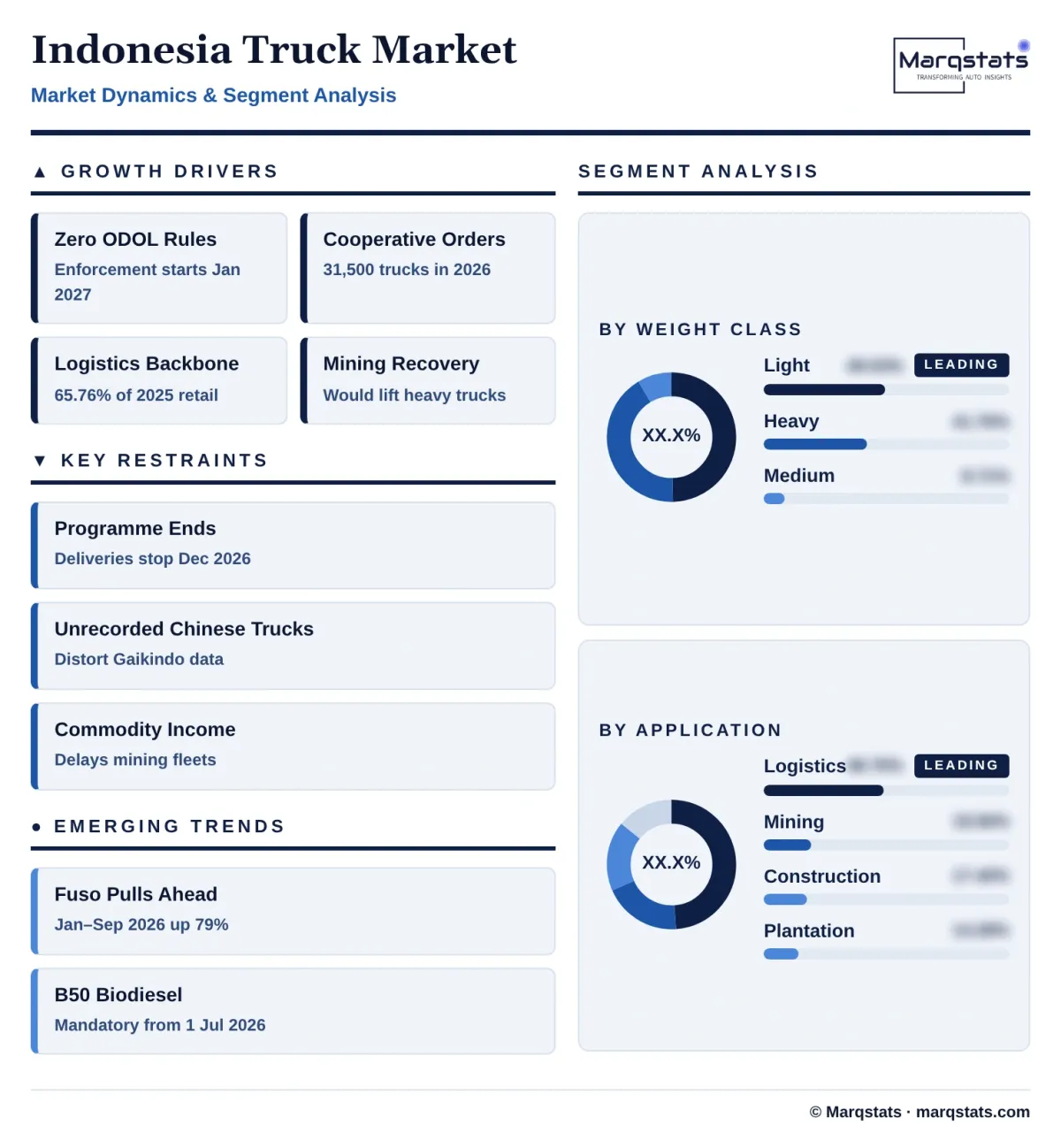
- Zero ODOL enforcement forces fleet renewal. The Ministry of Transportation (Kemenhub) kept the start of Zero over-dimension and overload enforcement at January 2027, reported data integration of 98% on 3 September 2026, and recorded 98,983 cargo-vehicle violations in a limited trial to 11 May 2026, which pushes operators toward multi-axle chassis that carry their rated load.
- Village cooperative orders lift 2026 volume. PT Agrinas Pangan Nusantara allocated 20,600 light trucks to Mitsubishi Fuso, 10,000 to Hino and 900 to Isuzu, staged through December 2026, and Fuso shipped about 5,500 to dealers by June.
- Logistics demand anchors the light class. Mitsubishi Fuso's sales director called logistics the backbone of its sales in July 2025, and trucks of 5 to 10 tonnes were 65.76% of 2025 retail deliveries, 38,999 units.
- Mining recovery would restore heavy volume. Heavy trucks above 24 tonnes fell to 15,657 retail units in 2025, and Gaikindo's first chairman said in July 2025 that vehicle sales will follow if mining recovers, so a recovery returns heavy trucks to 46.45% of 2030 value.
- Local assembly keeps chassis prices stable. Mitsubishi Fuso, Isuzu and Hino build their trucks in Indonesia, so a weak rupiah, at IDR 16,476.85 per dollar in 2025, raises costs less than it would for imported trucks.
Key Restraints
Four constraints could slow the recovery or move volume out of the factory-to-dealer channel.
- Programme volume ends in December 2026. The 31,500 village cooperative trucks equal 55.50% of 2025 wholesales, so 2027 volume of 64,000 is 23.81% below 2026 once deliveries stop.
- Chinese trucks sold outside Gaikindo data distort the series. Katadata reported in January 2026 that the large number of unrecorded Chinese trucks was the most significant factor in the 2025 decline, and Gaikindo is drafting rules with the Directorate General of Land Transportation and the Ministry of Industry.
- Weak commodity income delays fleet purchases. Falling global commodity prices led mining companies to delay purchases in 2025, and heavy trucks above 24 tonnes, 41.76% of 2025 value, are the class most exposed.
- Enforcement could slip again. Operators questioned the technical guidance for Zero ODOL in May 2026, and a delay beyond January 2027 would defer the replacement of overloaded 4x2 chassis that Marqstats builds into 2027 to 2030 volume.
Key Trends
Four shifts are changing what Indonesian fleets buy, who supplies it and how it is checked.
- Fuso is pulling ahead of Isuzu and Hino. Mitsubishi Fuso wholesaled 32,111 vehicles in January to September 2026, up 79%, with September up 94.8% at 4,725, while Hino retail grew only 2.6% in the first half of 2026 against 54.4% for Fuso.
- Biodiesel moves to B50. Pertamina distributed B50 through Biosolar and Dexlite from 1 July 2026, and UD Trucks launched a 2026 Quester described as ready for B50, so engine and fuel-system warranty terms become a purchase criterion.
- Digital weighing replaces roadside checks. Kemenhub piloted electronic evidence recording and weigh-in-motion at three weighing stations in 2026, and a team is revising Law 22 of 2009 to strengthen the legal basis.
- Quality campaigns reach the largest fleet. Mitsubishi Fuso announced on 24 September 2026 a recall of 111,195 Canter Euro 4 trucks built from April 2022 to May 2026 for a brake-light switch, showing how large the installed light-truck base has become.
Strategic Implications
- For truck makers, 2027 is a capacity problem, not a demand problem. Marqstats expects volume to fall 23.81% from 2026 as 31,500 programme trucks stop, so makers that hired shifts and dealer stock for 2026 should plan the cut before the order book thins, and keep regular customers served, as Hino waiting times of four to five months show they were crowded out.
- For heavy-truck specialists, enforcement is the opportunity. Heavy trucks are 41.76% of value and 12.35% a year growth, and multi-axle 6x2 and 6x4 chassis, priced from about IDR 928 million for the Isuzu Giga FVM, are what an overload-compliant fleet buys.
- For leasing and finance companies, the 2026 volume is not a basis for residual values. Programme trucks are fitted with cooperative bodies and used in village logistics, so their resale pattern differs from commercial fleet trucks, and credit models should treat 2026 as one-off.
- For component and body suppliers, light-truck content wins volume and heavy-truck content wins value. Axles, suspension, weighing sensors and fuel filters suited to B50 gain from compliance, while body builders face a falling light-truck chassis market after 2026.
- For policy teams, dates matter more than averages. Zero ODOL in January 2027, B50 from July 2026 and the revision of Law 22 of 2009 each change the cost of operating a diesel truck, and tracking them is part of forecasting demand.
Market Segmentation
Light trucks of 5 to 10 tonnes gross vehicle weight account for 49.53% of 2025 value, USD 906.02 million, and 37,321 units. They grow 7.35% a year to USD 1,291.65 million and 48,190 units, and their share falls to 43.90% by 2030. The Mitsubishi Canter FE 74, Isuzu Elf NMR and NLR and Hino light-duty trucks serve distribution, retail and cooperative logistics, and the class is the one most inflated in 2026, when it reaches 78.60% of units.
Heavy trucks above 24 tonnes, including tractor heads, account for 41.76% of 2025 value, USD 763.84 million, and 14,983 units. They grow fastest, at 12.35% a year, to USD 1,367.01 million and 23,700 units, and rise to 46.45% of value by 2030. The Isuzu Giga FVM, FVZ and GXZ, the Mitsubishi Fighter, the Hino Ranger tractor head, UD Trucks Quester and Scania serve mining, construction, port and long-haul work, where overload rules force multi-axle chassis.
Medium trucks of 10 to 24 tonnes account for 8.71% of 2025 value, USD 159.34 million, and 4,450 units. They grow 12.24% a year to USD 283.86 million and 7,110 units, and their share rises to 9.65% by 2030. The Isuzu Giga FTR, FRR and FVR and the Hino Ranger serve plantation, bulk food and regional distribution work, and the class is small because the Indonesian fleet jumps from light rigid to heavy multi-axle chassis.
Logistics and distribution account for 48.76% of 2025 value, USD 892.09 million, and grow 10.03% a year to USD 1,438.98 million and 48.90% by 2030. Parcel, food, retail and cooperative freight buy light box trucks, and long-haul container and general freight buy tractor heads, so the segment spans all three classes. Mitsubishi Fuso called logistics its sales backbone in July 2025.
Mining and heavy industry account for 19.56% of 2025 value, USD 357.71 million, and grow 9.85% a year to USD 572.18 million and 19.45% by 2030. The segment is concentrated in heavy tippers and dump trucks, and it contracted in 2025 when falling commodity prices led mining companies to delay fleet purchases.
Construction and infrastructure account for 17.40% of 2025 value, USD 318.22 million, and grow fastest among applications, at 10.74% a year, to USD 529.95 million and 18.01% by 2030. Tippers, mixers and flatbeds serve toll roads, ports and housing, and heavy chassis for multi-axle loads gain as overload rules close the option of overloading a smaller truck.
Plantation and agriculture account for 14.28% of 2025 value, USD 261.18 million, and grow 8.98% a year to USD 401.41 million and 13.64% by 2030. Palm oil, rubber and food-crop haulage buy medium trucks and light deck bodies, and the segment is slowest because mining and plantation orders were weak in 2025, as Mitsubishi Fuso reported in July 2025.
By Geography
Java
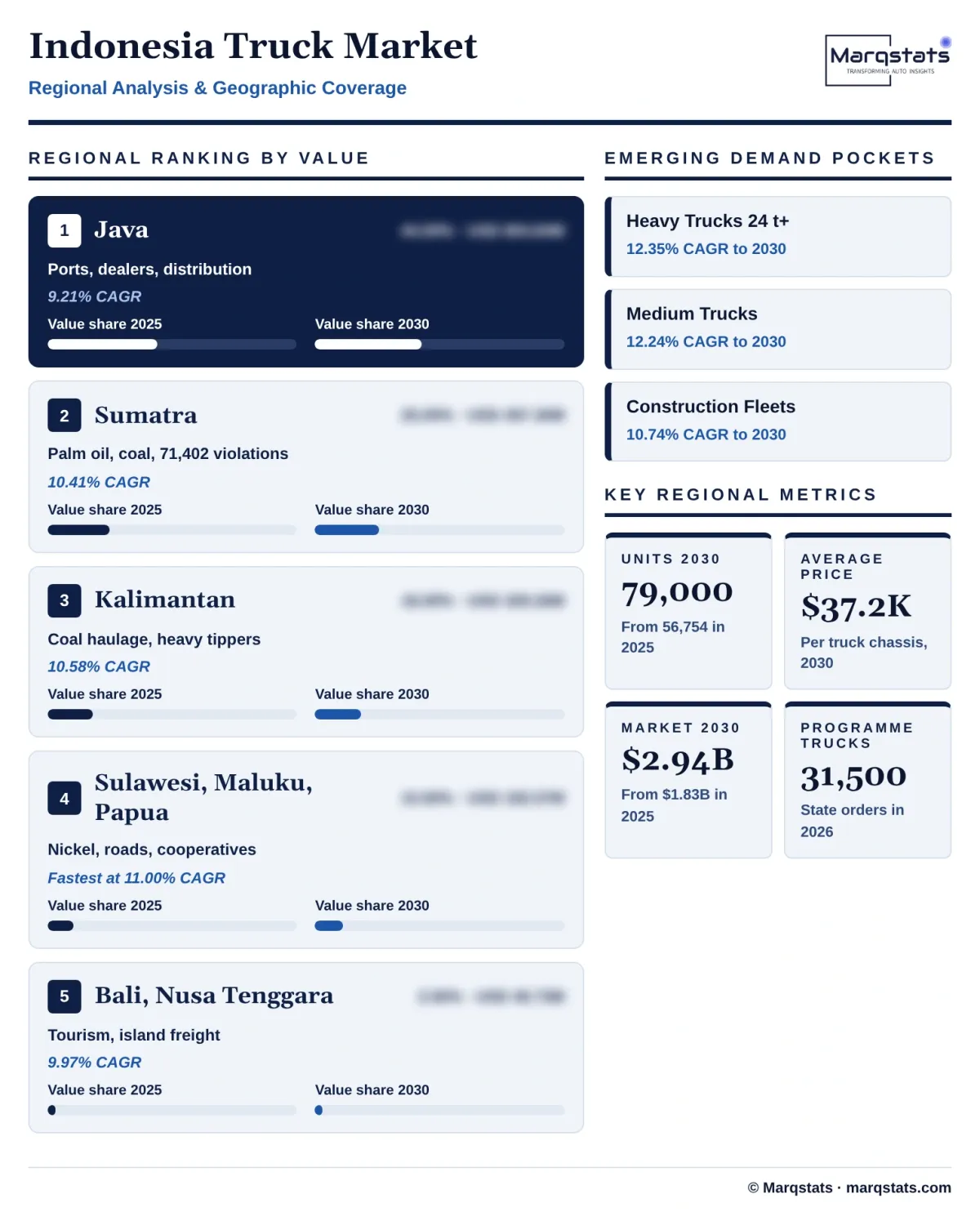
Java is the largest region, with 44.00% of 2025 value, USD 804.84 million, and grows an estimated 9.21% a year to USD 1,250.57 million and 42.50% by 2030. Jakarta, West Java and East Java hold the densest dealer networks, the container ports and the distribution centres of food and retail companies, so light box trucks and tractor heads register there, and Kemenhub recorded 10,347 trial violations in West Java and 6,199 in Greater Jakarta.
Sumatra
Sumatra accounts for 25.00% of 2025 value, USD 457.30 million, and grows an estimated 10.41% a year to USD 750.34 million and 25.50% by 2030. Palm oil, rubber, coal and the Trans-Sumatra freight corridor make it the second market, and South Sumatra alone accounted for 71,402 of the 98,983 violations Kemenhub recorded in its 2026 trial, which signals where enforcement will first change purchases.
Kalimantan
Kalimantan accounts for 18.00% of 2025 value, USD 329.26 million, and grows an estimated 10.58% a year to USD 544.37 million and 18.50% by 2030. Coal and plantation haulage make it the main market for heavy tippers and dump trucks, and its value is the most sensitive to mining income, which led companies to delay fleet purchases in 2025.
Sulawesi, Maluku and Papua
Sulawesi, Maluku and Papua account for 10.50% of 2025 value, USD 192.07 million, and grow fastest, at an estimated 11.00% a year, to USD 323.68 million and 11.00% by 2030. Nickel mining, road building and village cooperative deliveries lift demand for light and heavy trucks outside the Java network.
Bali and Nusa Tenggara
Bali and Nusa Tenggara account for 2.50% of 2025 value, USD 45.73 million, and grow an estimated 9.97% a year to USD 73.56 million and 2.50% by 2030. Tourism supply, construction and ferry-linked inter-island freight drive demand for light trucks, and the region holds its share because island roads suit light box trucks.
How Competition Is Evolving
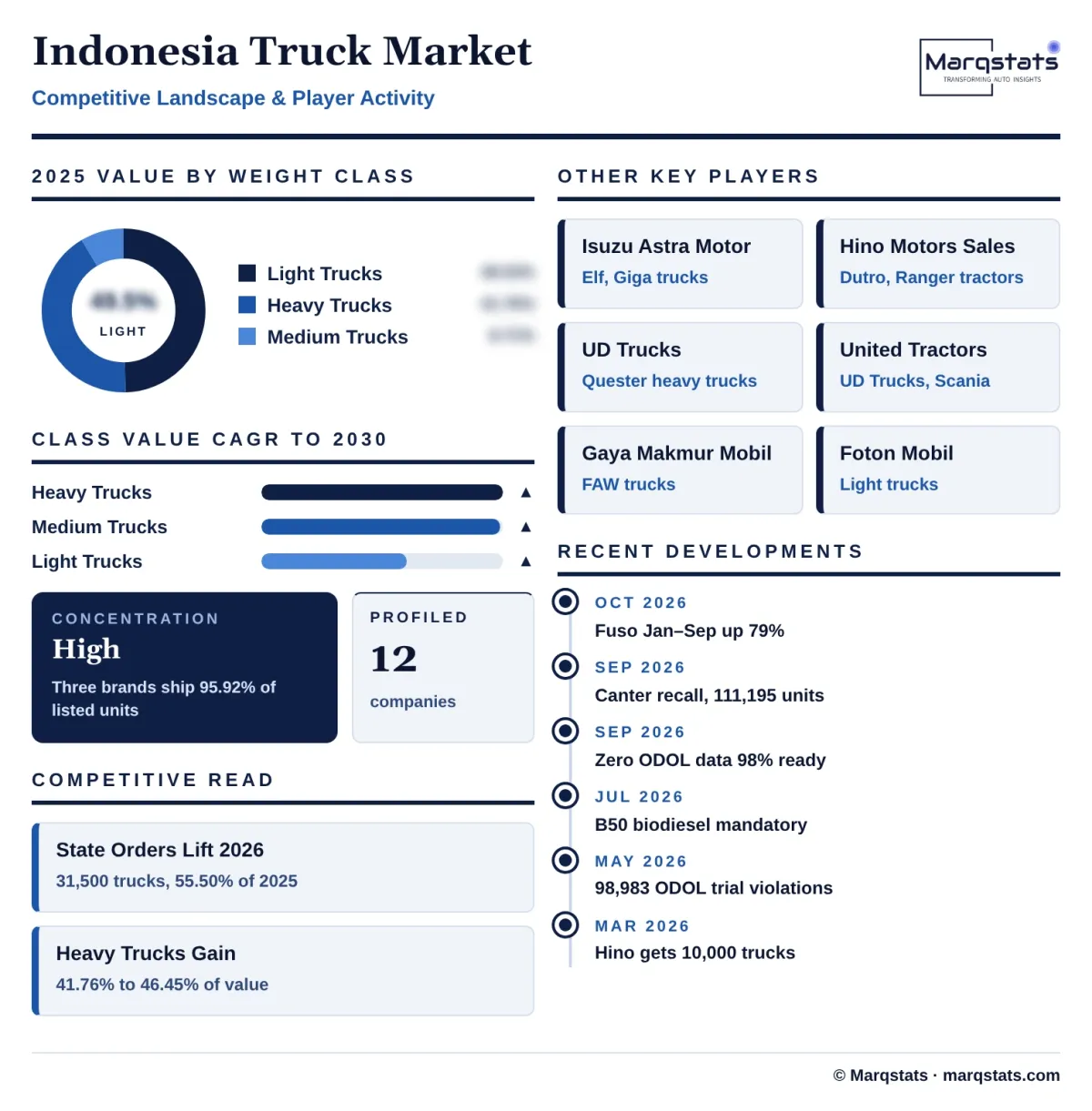
The market is highly concentrated in three Japanese brands. Gaikindo reported January to September 2025 retail sales of 17,908 for Mitsubishi Fuso, 17,508 for Isuzu and 14,934 for Hino, together 95.92% of the 52,494 units reported for the six truck brands it lists, with UD Trucks at 1,021, FAW at 768 and Scania at 355. Brand totals are as reported by Gaikindo and are not additive to the category total. The order is moving: Fuso retail rose 54.4% in the first half of 2026 against 18.9% for Isuzu and 2.6% for Hino.
Competition is on availability, service coverage and fleet terms rather than product features. Fleet buyers compare delivery waiting time, which stretched to four to five months for regular Hino customers in 2026, parts cost, financing, resale value and the nearest authorised workshop. Heavy-truck buyers weigh axle configuration, engine power and the ability to meet overload limits, and warranty terms for B50 fuel are now part of the comparison.
Local assembly and distribution decide position. Mitsubishi Fuso, Isuzu and Hino build trucks in Indonesian plants and sell through national dealer networks that new entrants cannot copy quickly. Chinese makers compete with lower prices, and Katadata reported in January 2026 that unrecorded Chinese trucks were the most significant factor in the 2025 decline, which is why Gaikindo is drafting registration rules with the Directorate General of Land Transportation and the Ministry of Industry.
Companies Covered
Companies covered in the report include:
Recent Market Activity
Table of Contents
Coverage & Segmentation
The study covers the Indonesia truck market, with 2025 as the base year, 2021 – 2025 as the historical period and 2026 – 2030 as the forecast period. It covers new goods vehicles above 5 tonnes gross vehicle weight wholesaled by manufacturers to dealers in Indonesia, segmented by weight class, application and region across Java, Sumatra, Kalimantan, Sulawesi, Maluku and Papua, and Bali and Nusa Tenggara. Values are ex-factory chassis values in US dollars, converted from rupiah at IDR 16,476.85 per US dollar, the 2025 average, and held constant through the forecast.
Pickups of up to 5 tonnes, passenger cars, buses, vans and minibuses, used trucks, trucks imported by state buyers outside the Gaikindo series, bodies and aftermarket equipment are excluded. The Indonesia Pickup Truck Market covers pickups, the Indonesia Passenger Car Market covers passenger cars, and the Indonesia Electric Commercial Vehicle Market counts ten electric trucks in 2025 that also sit inside this market, so these pages should not be added to this one.