Market Snapshot
Middle bar: base-year value × (1 + CAGR), rounded to two decimals. This is a calculated illustration, not a separately researched annual estimate.
The global direct vision truck cab market size is estimated at USD 3,021.10 million in 2025 and is projected to reach USD 4,923.75 million by 2030, growing at a CAGR of 10.26% over 2026 – 2030. Annual deliveries rise from about 16,220 to 22,500 trucks, a 6.76% annual rate, while the average value per truck climbs from about USD 186,260 to USD 218,830 as battery-electric versions take a larger share of orders.
Marqstats defines the market as the ex-works value of new medium- and heavy-duty trucks built with a purpose-designed low-entry or low-cab-forward cab that places the driver close to street level behind large glazed areas, such as the Mercedes-Benz Econic, Dennis Eagle Elite, Volvo FE and FM Low Entry, Scania L-series, Renault Trucks D Access, Mack LR, Autocar ACX, Peterbilt 520 and Chinese low-entry sanitation trucks. Value is counted at cab-chassis level. Refuse and other bodies, retrofitted cameras and sensors, conventional high-cab trucks that reach three stars only with fitted safety systems, and used trucks are excluded.
Refuse collection accounts for 66.00% of 2025 value, diesel and gas trucks for 76.61% and three-axle trucks of 19 to 26 tonnes for 52.00%. Europe accounts for 47.47% of value and is also the fastest-growing region, at 12.38% a year, as London enforcement, European type-approval rules and electric refuse fleets lift demand.
Key Takeaways
Market Overview & Analysis
Report Summary
Marqstats sizes the direct vision truck cab market as the ex-works value of new trucks with a low-entry or low-cab-forward cab designed so the driver can see pedestrians and cyclists next to and in front of the truck without relying on mirrors or cameras. The market is valued at cab-chassis level and counts both diesel or gas trucks and battery-electric trucks.
Blind spots are the safety problem the market answers. In a conventional heavy truck the driver sits about two and a half metres above the road, so a person standing close to the front or nearside of the cab can be hidden. In London between 2018 and 2020, heavy goods vehicles drove about 3% of miles but were involved in 41% of fatal collisions with people cycling and 19% with people walking, according to TfL. A low-entry cab drops the driver toward eye level with people on the street and adds glass in the door and below the windscreen.
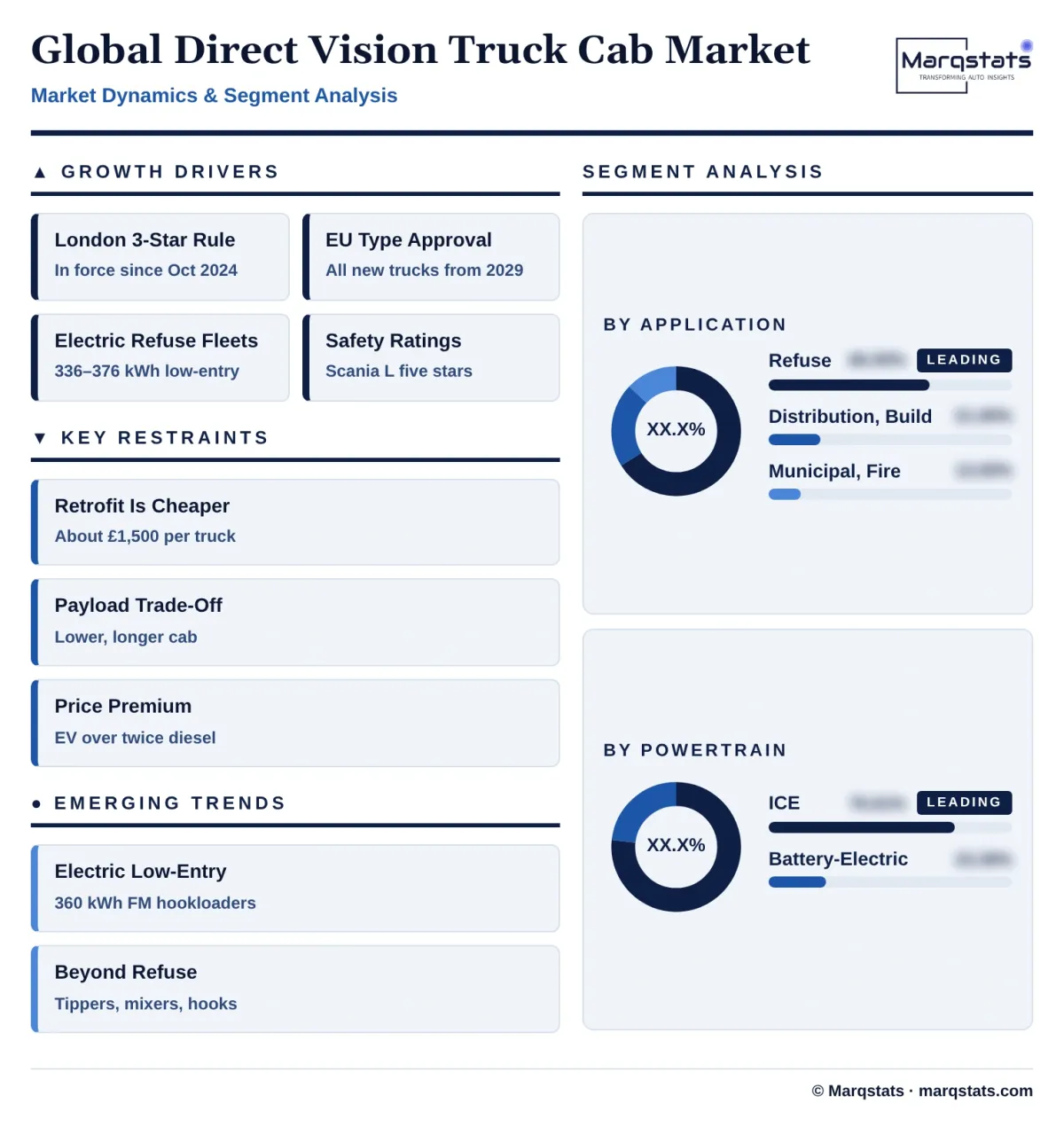
London turned direct vision into a rule. Since March 2021, trucks over 12 tonnes need a safety permit to enter Greater London, based on a zero- to five-star Direct Vision Standard rating. From 28 October 2024 the minimum rose from one star to three stars, and trucks below three stars must fit a progressive safe system with cameras, sensors and warnings. TfL estimated the median cost of that system at about GBP 1,500 per truck, which is why most operators retrofitted existing trucks rather than replacing them.
Europe is now writing direct vision into type approval. UN Regulation No 167 sets direct vision requirements for buses and trucks of categories M2, M3, N2 and N3. Regulation (EU) 2025/1122, in force from 1 September 2025, brings it into the EU General Safety Regulation framework, and the 01 series of amendments was published in the Official Journal on 16 February 2026. Truck makers expect the requirement to apply to new truck types from 2026 and to all new trucks from 2029.
The market grew from an estimated USD 2,350.00 million in 2021, when about 14,000 low-entry trucks were delivered, to USD 2,760.00 million in 2023 and USD 3,021.10 million in 2025. Growth slowed in 2025 as EU truck registrations fell 6.2%, but low-entry refuse trucks held up better than long-haul tractors because municipal replacement cycles and electric refuse tenders kept orders moving.
Global Direct Vision Truck Cab Market Size and Forecast
The global direct vision truck cab market grows from USD 3,021.10 million in 2025 to USD 4,923.75 million in 2030, a CAGR of 10.26%. Marqstats expects volume and price to contribute in roughly equal measure: deliveries grow at 6.76% a year, from about 16,220 to 22,500 trucks, and the average value per truck rises at 3.28% a year, from about USD 186,260 to USD 218,830, as battery-electric versions take a larger share of the mix.
The 2025 value is built bottom-up from regions, powertrains and prices. Marqstats estimates about 7,300 low-entry trucks in Europe, of which about 900 were battery-electric; about 5,200 in North America, of which about 200 were electric; about 3,000 in Asia-Pacific, half of them electric Chinese sanitation trucks; and about 720 in the rest of the world. Average cab-chassis prices are estimated at about USD 165,000 for a European diesel or gas truck and USD 420,000 for a European electric truck, USD 205,000 and USD 480,000 in North America, USD 95,000 and USD 150,000 in Asia-Pacific, and USD 130,000 and USD 380,000 elsewhere.
The base is checked against model families. In Europe, Marqstats estimates about 2,600 Mercedes-Benz Econic and eEconic trucks, about 1,300 Dennis Eagle Elite and eCollect chassis, about 1,100 Scania L-series trucks, about 900 Volvo FE and FM Low Entry trucks, about 600 Renault Trucks D Access trucks and about 800 other low-entry trucks. In North America it estimates about 2,000 Mack LR trucks, about 1,700 Autocar ACX trucks, about 1,000 Peterbilt 520 trucks, about 250 Battle Motors LET trucks and about 250 Freightliner Econic SD trucks. Daimler Truck says about 28,000 Econic trucks had been built by 2023, with about 85% used for waste collection.
Battery-electric trucks drive most of the value gain. Marqstats expects the electric share of European low-entry deliveries to rise from about 12.33% in 2025 to about 37.98% in 2030 and the North American share from about 3.85% to about 15.08%. Electric truck prices fall by roughly 14% to 15% in Europe and North America over the period as battery costs decline, but because each electric truck still costs more than twice a diesel truck, the shift lifts average value per truck.
Marqstats tracks four indicators to monitor the forecast: the final EU application dates for UN Regulation No 167 and how many conventional cabs pass without redesign, the number of TfL permits issued to three- to five-star trucks, quarterly ACEA registrations of electrically chargeable trucks, and municipal refuse tenders that require zero-emission and low-entry chassis.
Market Dynamics
Key Drivers
Five forces are moving city fleets toward low-entry trucks that let drivers see people around the cab directly.
- London permits set a minimum rating. From 28 October 2024, trucks over 12 tonnes need at least three Direct Vision Standard stars, or a full progressive safe system, to enter Greater London. Fleets that run many city routes increasingly choose a five-star low-entry chassis at replacement time instead of adding systems to a zero-star truck.
- Type approval brings direct vision to every new truck. UN Regulation No 167 covers trucks of categories N2 and N3, and the EU has brought it into the General Safety Regulation. Once it applies to all new trucks from 2029, every cab sold in Europe must meet a minimum visibility level, which lifts the value of cabs that already exceed it by a wide margin.
- Electric refuse trucks favour low-entry chassis. Refuse trucks stop hundreds of times a day on fixed routes and return to the depot each night, so cities that buy electric refuse trucks often buy low-entry chassis such as the eEconic, the Dennis Eagle eCollect and the Mack LR Electric, which pair battery packs of 336 to 376 kWh with a cab designed for crews who climb in and out all day.
- Safety ratings reward visibility. Euro NCAP awarded the electric Scania L-series refuse truck five stars and a CitySafe award in January 2026, with 87% for safe driving and 92% for crash avoidance, citing the low-mounted cab. Ratings like these give fleet buyers and city procurement teams a simple way to rank chassis.
- Crew safety and access matter for collection work. Low-entry cabs with one or two steps and flat floors reduce slips and falls for crews who get in and out many times a shift, and let them leave the cab on the side away from traffic.
Key Restraints
Four constraints keep low-entry direct vision cabs a specialist segment of the truck market.
- Retrofit is cheaper than a new cab. TfL estimated the median cost of a progressive safe system at about GBP 1,500 per truck, far less than the price premium of a low-entry chassis, so most operators of conventional trucks meet London rules by fitting cameras and sensors.
- Payload and range trade-offs. Low-entry cabs sit lower and further forward and often carry extra structure, which reduces payload, ground clearance and space for fuel or batteries compared with a conventional cab. This limits their use in off-road construction and long regional routes.
- Higher purchase prices. A low-entry chassis costs more than a conventional rigid of the same weight class, and an electric version can cost more than twice as much as a diesel version, which strains municipal and contractor budgets.
- Weak demand outside rule-making cities. Outside London, a few other European cities and some North American refuse fleets, few buyers are required to buy direct vision cabs, so the product stays concentrated in refuse collection and city construction.
Key Trends
Four shifts are changing how direct vision cabs are designed, powered and bought.
- Electric versions of low-entry chassis. Mercedes-Benz, Volvo, Scania, Renault Trucks, Dennis Eagle and Mack now offer battery-electric low-entry trucks, and Volvo delivered its first FM Low Entry electric hookloaders in the UK in June 2026 with 360 kWh of batteries.
- Low-entry cabs move beyond refuse trucks. Makers now offer low-entry cabs for hookloaders, tippers, mixers and distribution rigids, so builders and waste-transfer operators can send five-star trucks into city centres.
- Camera monitors replace mirrors. Many new low-entry trucks combine their large windows with camera monitoring systems that remove mirror blind spots, and Euro NCAP credits these systems in its truck ratings.
- Direct vision becomes a type-approval test. With UN Regulation No 167 measuring the volume of space a driver can see directly, makers are redesigning conventional cabs with lower windows and glazed doors, narrowing the gap between standard and low-entry cabs.
Strategic Implications
- For truck makers, the five-star rating is a selling point that must be kept as cabs go electric. Battery packs and electric drives should be placed so that they do not raise the cab or block glazed doors, since buyers in London and other strict cities choose on the star rating.
- For refuse fleets and councils, buying low-entry chassis at replacement time avoids repeat retrofit costs. A fleet that replaces zero-star trucks with five-star trucks no longer needs to maintain cameras and sensors fitted only to meet permit rules.
- For construction and aggregates operators, low-entry tippers and mixers are worth testing on city contracts. Some large construction clients in London already ask for high star ratings, and the payload loss can be smaller than the cost of losing access to work.
- For North American makers, the London model is a guide to future city rules. Low-cab-forward refuse trucks already give the Mack LR, Autocar ACX and Peterbilt 520 a base to sell into cities that may adopt similar visibility standards.
- For body builders and suppliers, low-entry chassis need their own body and equipment designs. Bin lifts, compactors, hookloader arms and battery boxes must fit a lower, shorter frame without blocking the glazed areas that earn the rating.
Market Segmentation
Refuse collection trucks account for 66.00% of 2025 value, USD 1,993.93 million, and grow at 8.89% a year to USD 3,052.73 million, while their share falls to 62.00% by 2030. Waste collection is the original use of low-entry cabs: crews climb in and out all day, routes run through dense streets with many people on foot and on bikes, and councils can write low-entry and zero-emission chassis into their tenders.
Distribution rigids, hookloaders, tippers and concrete mixers account for 21.00% of 2025 value, USD 634.43 million, and grow fastest, at 15.07% a year, to USD 1,280.17 million and 26.00% by 2030. Construction trucks share city streets with people on foot and on bikes, so some large clients ask for high star ratings, and makers now offer low-entry cabs on 8x4 chassis such as the Volvo FM Low Entry hookloaders delivered to Powerday.
Street-cleaning, gully, fire and airport service trucks account for 13.00% of 2025 value, USD 392.74 million, and grow at 8.51% a year to USD 590.85 million and 12.00% by 2030. Fire services use low-entry chassis for crew cabs that seat several firefighters behind a large windscreen, and airports use them for catering and refuelling trucks.
Diesel, gas and HVO-fuelled trucks account for 76.61% of 2025 value, USD 2,314.50 million, and grow slowly at 2.50% a year to USD 2,619.05 million, while their share falls to 53.19% by 2030. They remain the default in North America, in construction and in regions where electric trucks lack incentives.
Battery-electric trucks account for 23.39% of 2025 value, USD 706.60 million, and grow at 26.67% a year to USD 2,304.70 million and 46.81% by 2030. They are led by the eEconic, Dennis Eagle eCollect, Scania and Volvo electric low-entry trucks, the Mack LR Electric and Chinese electric sanitation trucks, and most charge overnight at the depot.
Two-axle trucks of up to 18 tonnes account for 30.00% of 2025 value, USD 906.33 million, and grow at 10.99% a year to USD 1,526.36 million and 31.00% by 2030. They serve narrow streets, food waste rounds and urban distribution, where compact low-entry cabs such as the Volvo FE Low Entry are common.
Three-axle trucks of 19 to 26 tonnes account for 52.00% of 2025 value, USD 1,570.97 million, and grow at 8.96% a year to USD 2,412.64 million and 49.00% by 2030. The 6x2 rear-steer refuse chassis is the single most common low-entry truck, and Dennis Eagle says about 90% of its production uses that layout.
Four-axle trucks above 26 tonnes account for 18.00% of 2025 value, USD 543.80 million, and grow fastest, at 12.61% a year, to USD 984.75 million and 20.00% by 2030, as hookloaders, tippers and mixers on 8x4 low-entry chassis enter city construction work.
By Geography
Europe
Europe is the largest market, with 47.47% of 2025 value, USD 1,434.00 million, and grows fastest, at an estimated 12.38% a year, to USD 2,570.10 million and 52.20% by 2030. Marqstats estimates about 7,300 low-entry trucks were sold in Europe in 2025, led by the Mercedes-Benz Econic, the Dennis Eagle Elite in the UK, the Scania L-series and the Volvo FE and FM Low Entry. London permit rules, the EU direct vision requirement for all new trucks from 2029 and municipal zero-emission tenders all support demand. EU truck registrations fell 6.2% to 307,460 in 2025 but rose 9.8% to 171,933 in the first half of 2026, with electrically chargeable trucks reaching 4.8% of the total.
North America
North America accounts for 37.11% of 2025 value, USD 1,121.00 million, and grows at an estimated 7.28% a year to USD 1,593.25 million and 32.36% by 2030. Low-cab-forward refuse trucks such as the Mack LR, Autocar ACX, Peterbilt 520 and Battle Motors LET dominate, and their high value per truck makes the region the second largest even with fewer units than Europe. Electric adoption is slower and depends on state incentives such as the New York Truck Voucher Incentive Program, which funded three Mack LR Electric trucks for Royal Waste Services in 2026.
Asia-Pacific
Asia-Pacific accounts for 12.16% of 2025 value, USD 367.50 million, and grows at an estimated 10.21% a year to USD 597.60 million and 12.14% by 2030. Chinese electric sanitation trucks with low-entry cabs make up most units at low prices, while Australia and Japan import low-entry European chassis for refuse collection. The electric share of regional deliveries rises from about half to about 70%.
Rest of World
The rest of the world accounts for 3.26% of 2025 value, USD 98.60 million, and grows at an estimated 10.55% a year to USD 162.80 million and 3.30% by 2030. Gulf cities, Latin American capitals and South Africa buy imported low-entry refuse and fire chassis, mostly with diesel engines.

How Competition Is Evolving
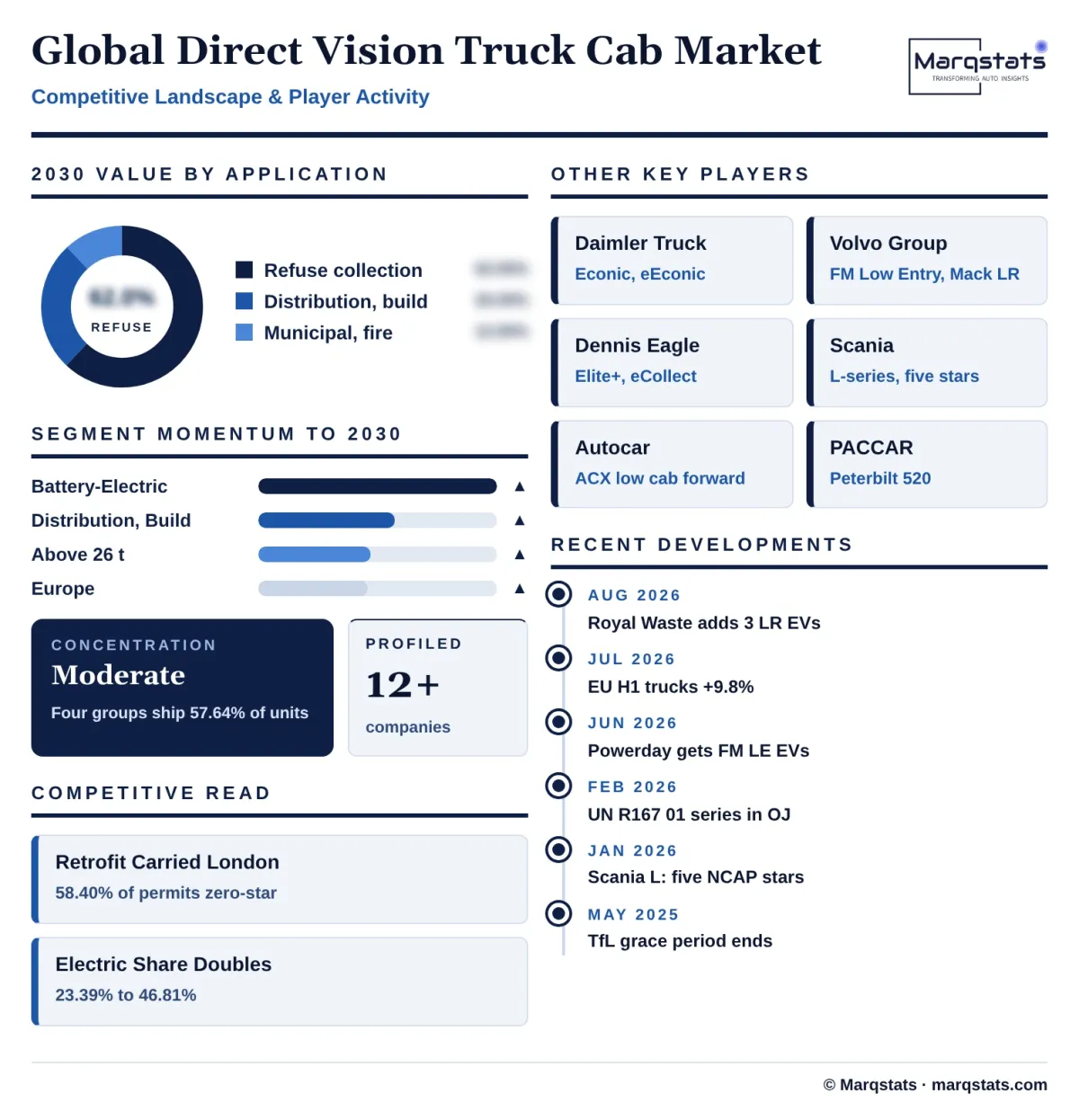
The market is moderately concentrated. Marqstats estimates that four groups, Volvo Group, Daimler Truck, Autocar and Dennis Eagle, delivered about 57.64% of low-entry trucks in 2025, with Scania, PACCAR, Battle Motors and Chinese sanitation-truck makers sharing most of the rest. Each leading maker is strongest in its home region, so few compete head-to-head in every market.
Volvo Group is the largest supplier by units. Marqstats estimates about 3,500 low-entry trucks across the Mack LR in North America, the Volvo FE and FM Low Entry and the Renault Trucks D Access in Europe, about 21.58% of the market. Volvo delivered the first electric FM Low Entry hookloaders to Powerday in June 2026, and Mack sells the LR Electric with a 376 kWh battery.
Daimler Truck leads Europe with the Mercedes-Benz Econic, built at Wörth since 2003 and sold mainly for waste collection, and the battery-electric eEconic with 336 kWh of batteries. Freightliner sells the Econic SD in North America using cab shells from Wörth.
Dennis Eagle dominates the UK refuse market. Its Elite chassis holds about 70% of UK low-entry refuse cabs and has a five-star TfL rating, and its eCollect electric version uses the same 6x2 rear-steer layout. Scania entered the five-star class with the L-series, which Euro NCAP rated five stars in January 2026.
Companies Covered
Companies covered in the report include:
Recent Market Activity
Table of Contents
Coverage & Segmentation
The study covers the global direct vision truck cab market, with 2025 as the base year, 2021 – 2025 as the historical period and 2026 – 2030 as the forecast period. It covers new medium- and heavy-duty trucks with purpose-built low-entry or low-cab-forward cabs, both diesel or gas and battery-electric, segmented by application, powertrain, gross vehicle weight and region across Europe, North America, Asia-Pacific and the rest of the world. Values are ex-works cab-chassis values in US dollars, and euro figures are converted at EUR 1 to USD 1.13.
Refuse, tipper, mixer and other bodies, retrofitted cameras, sensors and progressive safe systems, conventional high-cab trucks, buses and coaches, light commercial vehicles and used trucks are excluded.