Market Snapshot
Middle bar: base-year value × (1 + CAGR), rounded to two decimals. This is a calculated illustration, not a separately researched annual estimate.
The Egypt truck market size is estimated at USD 756.75 million in 2025 and is projected to reach USD 1,352.90 million by 2030, growing at a CAGR of 12.32% over 2026 – 2030. Unit sales rise from 28,447 to 43,700 trucks, an 8.97% annual rate, while the average value per truck rises from about USD 26,602 to USD 30,959.
Marqstats defines the market as new trucks sold in Egypt under the category published by the Automotive Marketing Information Council (AMIC) as trucks. That category covers one-tonne pickups, mini pickups and vans, light and light-medium trucks, medium trucks and heavy trucks, such as the Chevrolet TFR, NPR and NQR, Toyota Hilux, JMC, Mitsubishi Canter and Mercedes-Benz Arocs and Actros ranges. Value is the list price paid by the first buyer in US dollars. Buses, passenger cars, used trucks and trailers are excluded.
Pickup-type vehicles are shown as their own line because Egypt registers them as transport vehicles: they account for 69.86% of 2025 units (19,872) and 54.72% of value, leaving a pickup-excluded truck market of 8,575 units and USD 342.62 million. Greater Cairo holds 42.50% of value, and medium and heavy trucks grow fastest at 16.34% a year.
Key Takeaways
Market Overview & Analysis
Report Summary
Marqstats sizes the Egypt truck market as the value of new trucks sold each year under the AMIC trucks category, at the list price paid by the first buyer. It follows the category as AMIC and the Central Agency for Public Mobilization and Statistics (CAPMAS) publish it, because Egyptian law registers one-tonne pickups as transport vehicles and no separate pickup series exists. For that reason the study counts 69.86% of 2025 units as pickup-type and shows them on their own line, with a pickup-excluded view of 8,575 units and USD 342.62 million.
The wider automotive market sets the frame. AMIC reported 173,763 new vehicles in 2025, up 69.9%, made up of 133,973 passenger cars, 11,343 buses and 28,447 trucks. Trucks are therefore 16.37% of units, and together with buses they form a commercial market of 39,790 vehicles, or 22.90% of the total. Completely knocked-down kits assembled in Egypt supplied 99,598 vehicles and completely built-up imports 74,165, so the truck market is far more locally assembled than the car market.
The fleet is large and ages slowly because new trucks are expensive. CAPMAS recorded 11.05 million licensed vehicles on 31 December 2025, up 6.1% from 10.41 million, of which trucks and trailers numbered about 1.4 million, with 107,700 trailers. New sales of 28,447 trucks equal about 2.03% of that fleet, which shows how much renewal demand has been held back since 2022.
The cycle has been severe. AMIC trucks sold 49,957 units in 2021, 33,570 in 2022, 12,723 in 2023 and 13,387 in 2024, a 74.53% fall in two years. In March 2024 the Central Bank of Egypt raised rates by 600 basis points and moved to a flexible exchange rate, which cleared the backlog of import orders and let sales recover 112.50% to 28,447 units in 2025. In February 2026 it cut rates by 100 basis points to an overnight deposit rate of 19%.
Marqstats values the 2025 market at USD 756.75 million, equal to about EGP 37.27 billion at the 2025 average rate of EGP 49.25 per US dollar. Monthly AMIC data for 2026 point to continued growth with uneven months: trucks sold 2,278 units in January, up 25.03%, about 3,300 in July and about 2,600 in August, down 15.9% from August 2025.
Egypt Truck Market Size and Forecast
The Egypt truck market grows from USD 756.75 million in 2025 to USD 1,352.90 million in 2030, a CAGR of 12.32%. Volume supplies most of the growth: unit sales rise 8.97% a year from 28,447 to 43,700 trucks, and the average value per truck rises 3.08% a year from about USD 26,602 to USD 30,959, as medium and heavy trucks and light-medium trucks gain share. Marqstats estimates 2026 at 33,400 trucks, up 17.41%, and USD 915.92 million.
The 2025 value is built bottom-up from AMIC units and list prices. Marqstats applies the January to November 2025 AMIC category mix to the full-year total of 28,447 trucks, which gives about 18,829 pickups, 7,668 light and light-medium trucks, 1,043 mini pickups and vans and 907 medium and heavy trucks. Estimated 2025 average prices are EGP 1,050,000 for a pickup, EGP 1,550,000 for a light or light-medium truck, EGP 600,000 for a mini pickup or van and EGP 5,500,000 for a medium or heavy truck, or USD 21,320, USD 31,472, USD 12,183 and USD 111,675 at EGP 49.25 per US dollar.
Prices are checked against listings. In October 2026 the Chevrolet TFR was listed at EGP 1,125,000 to EGP 1,250,000, the NPR at EGP 1,645,000 and the NQR at EGP 1,890,000 to EGP 1,950,000 for the 2027 model year, and Marqstats treats a blended 2025 pickup price of EGP 1,050,000 as consistent with TFR single cabs near EGP 950,000, double cabs and Toyota Hilux models above it, and a lower 2025 price level than the 2026 lists. Marqstats estimates a heavy Mercedes-Benz Arocs or Actros chassis at about EGP 6,000,000, so the medium and heavy average of EGP 5,500,000 includes a few medium trucks.
The ladder from the whole market to the pickup-excluded market is explicit. In 2025 the AMIC market of 173,763 vehicles contains 39,790 commercial vehicles; the 28,447 trucks contain 19,872 pickup-type vehicles worth USD 414.13 million, 54.72% of value, and 8,575 other trucks worth USD 342.62 million. By 2030 the pickup-type line is 29,400 units and USD 689.70 million, growing 10.74% a year, while the pickup-excluded line reaches 14,300 units and USD 663.20 million, growing 14.12% a year.
Prior years show the shape of the cycle. AMIC trucks sold 49,957 units in 2021, 33,570 in 2022, 12,723 in 2023 and 13,387 in 2024. The 2025 level of 28,447 is 43.06% below 2021, and the 2030 forecast of 43,700 units is 12.52% below the 2021 peak, because Marqstats expects interest rates, the cost of imported kits and the price of a new pickup to cap how far fleets can renew. Press coverage quotes 108.4% for 2025 truck growth; the unit counts reported by AMIC and the Japan External Trade Organization (JETRO) give 112.50%, which Marqstats uses.
Marqstats tracks four indicators to monitor the forecast: AMIC monthly truck sales by category, the Central Bank of Egypt policy rate and the pound against the dollar, the price lists of Chevrolet, Toyota, Mitsubishi and Mercedes-Benz, and tender and fleet announcements for dry ports, Ain Sokhna and the New Administrative Capital that feed the heavy-truck segment.
Market Dynamics
Key Drivers
Five forces are lifting demand for new trucks in Egypt as credit eases and fleets renew.
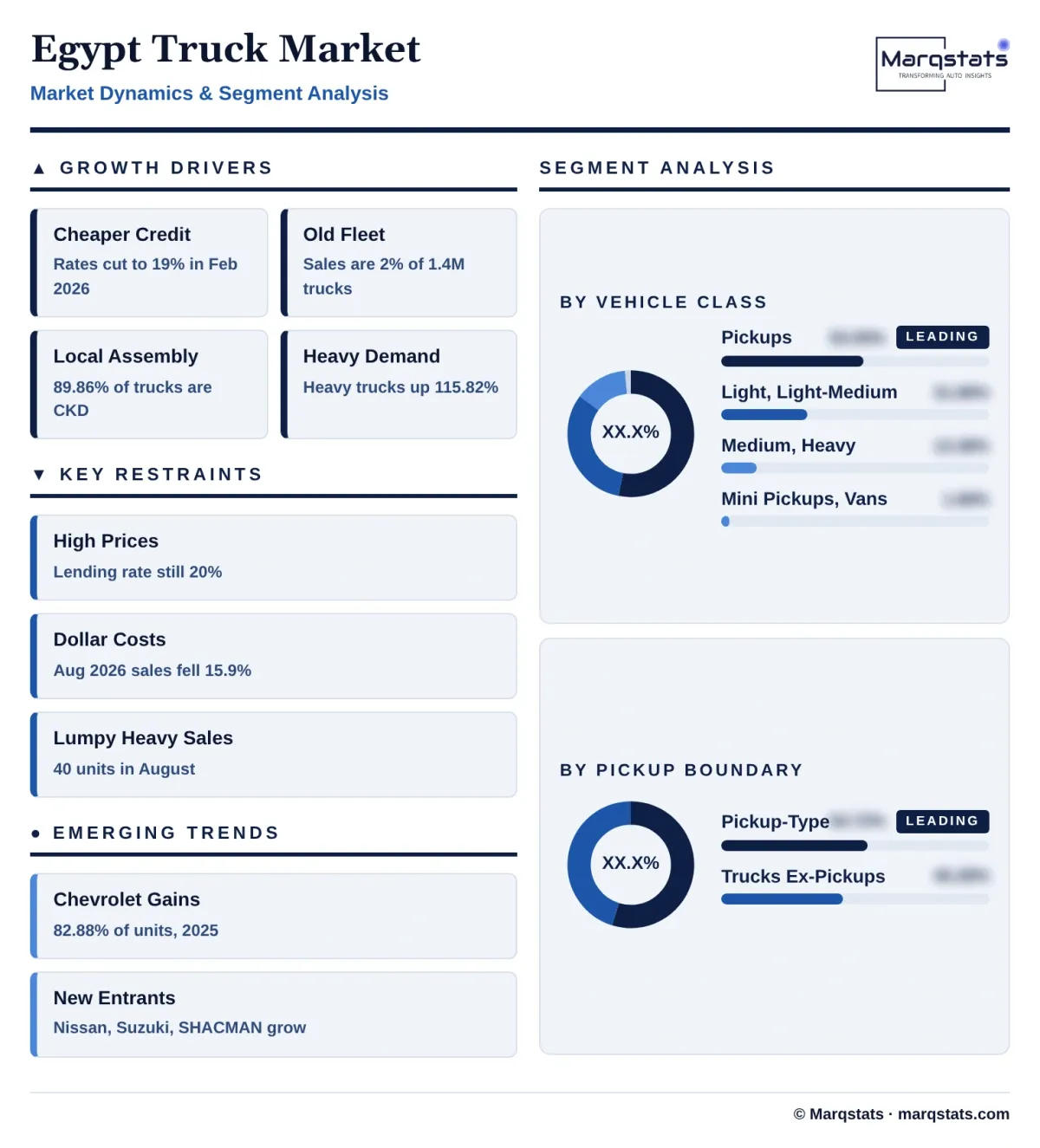
- Cheaper credit is reopening fleet purchases. The Central Bank of Egypt raised rates by 600 basis points in March 2024 and then reversed course, cutting its key rates by 100 basis points on 12 February 2026 to an overnight deposit rate of 19% and a lending rate of 20%, with core inflation at 11.2% in January 2026. Trucks are bought on credit, so each point of lower borrowing cost brings forward replacement orders that were deferred in 2022 and 2023.
- The fleet is old and renewal has barely started. CAPMAS counted about 1.4 million licensed trucks and trailers on 31 December 2025, and AMIC sales of 28,447 trucks in 2025 equal only about 2.03% of that fleet. Even after a 112.50% rebound, sales are 43.06% below the 49,957 trucks sold in 2021, which leaves a backlog of replacement demand for pickups and light-medium trucks.
- Local assembly shields most volume from the import cycle. AMIC shows 89.86% of trucks sold from January to November 2025 as locally assembled kits, led by the Chevrolet TFR, NPR and NQR, while Mercedes-Benz trucks are assembled by Manufacturing Commercial Vehicles (MCV). Under the Automotive Industry Development Programme, which sets a minimum of 10,000 units a year for conventional vehicles, assemblers plan output around kit supply instead of waiting for import approvals.
- Pickups meet the demand of small businesses. Between January and November 2025 AMIC recorded 16,754 pickups against 8,112 a year earlier, a 106.54% rise, and 928 mini pickups and vans against 239. Pickup-type vehicles serve shop owners, farms, contractors and last-mile distributors that cannot afford a 7.5 tonne truck, and they were about 65% of truck volume in July 2026, with 2,200 units.
- Ports, industrial zones and construction create demand for heavy trucks. AMIC counted 723 heavy trucks from January to November 2025 against 335 a year earlier, a 115.82% rise, and 111 in July 2026, up 113.50% on July 2025. Orders from developers, quarry and cement operators and port hauliers around Ain Sokhna, Alexandria and the New Administrative Capital drive this segment.
Key Restraints
Four constraints keep the market below its 2021 volume and make monthly sales uneven.
- High prices and financing costs still limit buyers. Even after the February 2026 cut, a lending rate of 20% is well above its pre-2022 level, and the 2027 model year Chevrolet TFR was listed at EGP 1,125,000 to EGP 1,250,000 in October 2026. A small business that earns in pounds must carry both the price and the interest, so many keep older trucks longer.
- Dollar-linked costs make buyers hold back. AMIC truck sales fell 15.9% year on year in August 2026 to about 2,600 units and 22.7% from July, and the analyst Maged El Tawil told EnterpriseAM that businesses were holding back as FX and USD-linked costs stay high. Kits, steel and chassis are imported, so any move in the pound passes into list prices within weeks.
- Volumes are lumpy in the heavy segment. AMIC counted 212 heavy trucks in June 2026, 111 in July and 40 in August, a 47.6% fall in July and a 64.0% fall in August from the month before, which analysts tied to single fleet orders. A forecast built on a few hundred heavy trucks a year is more sensitive to one tender than the pickup segment is.
- Measurement leaves part of the market outside the count. AMIC collects data from its member distributors and assemblers, and EnterpriseAM notes that its coverage excludes several importers, including German brands. Marqstats uses AMIC as published and does not add unreported imports, so the market is the AMIC truck category, and registrations at CAPMAS, which count by licensing directorate, can show different regional totals.
Key Trends
Four shifts are changing which trucks Egyptian buyers choose and who supplies them.
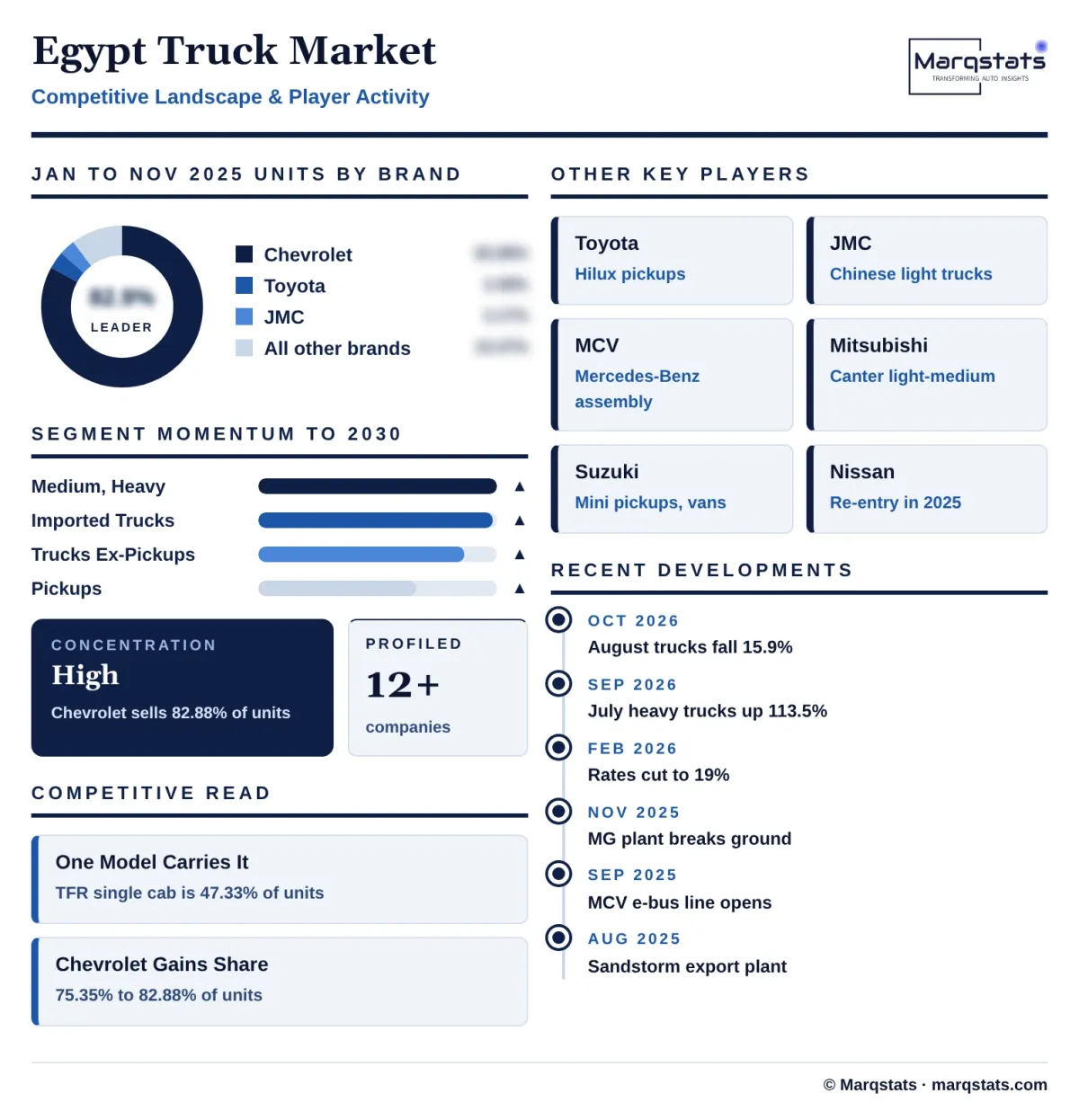
- One brand is consolidating the pickup segment. Chevrolet's share of AMIC truck units rose from 75.35% to 82.88% between the first eleven months of 2024 and 2025, and the TFR single cab alone sold 11,980 units. Rivals now compete on price and financing against a model that sets the resale benchmark.
- New entrants are building small positions. Nissan sold 318 trucks from January to November 2025 after none a year earlier, Suzuki sold 530 against 50, MCV with Mercedes-Benz sold 793 against 348 and SHACMAN sold 61 against 12. Together they show that buyers are willing to try brands outside the Chevrolet and Toyota pair when supply is steady.
- Light-medium trucks are moving up. AMIC counted 6,334 light-medium trucks from January to November 2025 against 3,070, a 106.32% rise, led by the Chevrolet NPR and NQR and the Mitsubishi Canter, and light trucks almost tripled from 171 to 489. Distributors of food, beverages and parcels are moving from pickups to box bodies.
- Export-oriented assembly is arriving. Abou Ghali Auto is building a USD 26 million plant near the Gulf of Suez to assemble the Sandstorm S24 pickup from the second quarter of 2026, with 100% of output for export, while Mansour Group broke ground in November 2025 on a USD 150 million MG plant for 50,000 cars a year. Neither adds trucks to the AMIC count yet, but both deepen the local supplier base.
Strategic Implications
- For truck makers, the practical route into Egypt is a kit supply or contract assembly deal. Fully built trucks hold only about one tenth of units, so a maker that wants volume needs a local assembler that can qualify under the Automotive Industry Development Programme, and a maker that already sells heavy trucks can add medium models on the same chassis lines.
- For Chevrolet distributors and their rivals, the choice is between defending a pickup franchise and building the next layer. The pickup-excluded market is 8,575 units today and grows faster than pickups, so assemblers that add light-medium and heavy trucks open a segment worth USD 342.62 million in 2025 and USD 663.20 million in 2030.
- For fleet buyers and lessors, timing decides cost. Rates of 19% to 20% are lower than in 2024 but still high, and list prices rise with the pound, so buyers that order before the next price list and use operating leases from non-bank lenders protect their margins while keeping vehicles young.
- For financiers, the heavy-truck segment is the underserved one. Heavy and medium trucks are about 3% of units but 13.38% of value, and a single order can move a month of sales, so lenders that finance by order book and secure against the chassis can price risk better than lenders that rely on fleet size.
- For parts, tyre and service suppliers, a fleet of about 1.4 million trucks and trailers that renews at about 2% a year keeps demand for repair and replacement parts strong. Suppliers should plan on a long tail of old pickups and light-medium trucks, and on the NPR, NQR and TFR platforms that dominate workshops.
Market Segmentation
One-tonne pickups account for 53.05% of 2025 value, USD 401.42 million, and grow at 10.78% a year to USD 669.60 million. Marqstats estimates about 18,829 units in 2025, led by the Chevrolet TFR single cab with 11,980 units from January to November, followed by the Chevrolet RT95 with 2,933 and the Toyota Hilux with 812. Buyers are small businesses, farms and contractors.
Light and light-medium trucks account for 31.89% of 2025 value, USD 241.33 million, and grow at 13.14% a year to USD 447.30 million. About 7,668 units were sold in 2025, led by the Chevrolet NPR with 3,515 units and NQR with 1,326 from January to November, and the Mitsubishi Canter with 496, for food, beverage, parcel and building-material distribution.
Mini pickups and vans account for 1.68% of 2025 value, USD 12.71 million, and grow at 9.60% a year to USD 20.10 million. About 1,043 units were sold in 2025, up from 239 to 928 between the first eleven months of 2024 and 2025, typically Suzuki, Renault and Fiat models used for urban delivery.
Medium and heavy trucks account for 13.38% of 2025 value, USD 101.29 million, and grow fastest, at 16.34% a year, to USD 215.90 million and 15.96% of the market. About 907 units were sold in 2025, mainly Mercedes-Benz Arocs and Actros models, led by the Arocs 4048 K with 141 and the new Actros 2140S with 109 from January to November, for tipper, mixer and tractor work.
Pickup-type vehicles, pickups plus mini pickups and vans, account for 54.72% of 2025 value, USD 414.13 million, and 69.86% of units, 19,872. They grow at 10.74% a year to USD 689.70 million, and their share of value falls to 50.98% in 2030. Egypt registers them as transport vehicles, so AMIC counts them as trucks.
Trucks excluding pickup-type vehicles, meaning light, light-medium, medium and heavy trucks, account for 45.28% of 2025 value, USD 342.62 million, and 30.14% of units, 8,575. They grow at 14.12% a year to USD 663.20 million and 49.02% of the market in 2030, which is the figure to use when a buyer wants goods trucks only.
Locally assembled trucks account for 89.86% of 2025 units, 25,562, and 85.94% of value, USD 650.32 million. They grow at 11.68% a year to USD 1,129.56 million. AMIC counted 22,745 completely knocked-down trucks from January to November 2025 against 10,340 a year earlier, a 119.96% rise.
Imported trucks account for 10.14% of 2025 units, 2,885, and 14.06% of value, USD 106.43 million. They grow faster, at 15.98% a year, to USD 223.34 million, as Chinese, European and Japanese heavy trucks enter fully built. AMIC counted 2,567 imported trucks from January to November 2025 against 1,637, a 56.81% rise.
By Geography
Greater Cairo
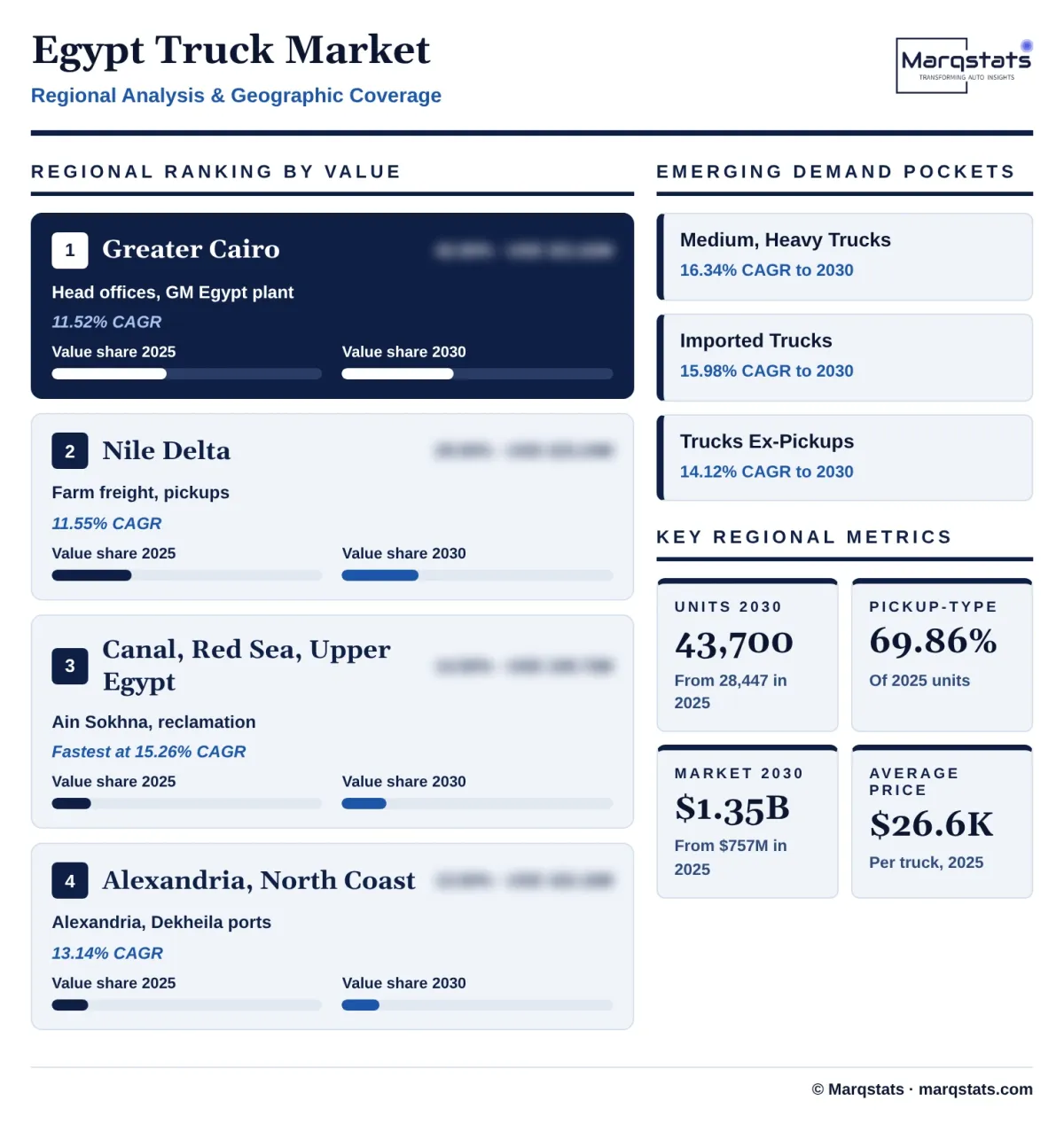
Greater Cairo, meaning Cairo, Giza and Qalyubia, accounts for 42.50% of 2025 value, USD 321.62 million, and grows at 11.52% a year to USD 554.68 million and 41.00% by 2030. Marqstats estimates the region at this level because head offices, fleet lessors and the General Motors Egypt assembly base around 6th of October City register or deliver there. The regional share is an allocation by buyer location and overstates local operations.
Nile Delta
The Nile Delta accounts for 29.50% of 2025 value, USD 223.24 million, and grows at 11.55% a year to USD 385.58 million. Sharqia, Gharbia, Dakahlia and Beheira buy single-cab pickups and light-medium trucks to move vegetables, poultry, grain and food products between farms, mills and the Cairo wholesale markets.
Alexandria and North Coast
Alexandria and the North Coast account for 13.50% of 2025 value, USD 102.16 million, and grow at 13.14% a year to USD 189.41 million. The ports of Alexandria and Dekheila handle much of Egypt's containerised trade, so the region buys tractor units, medium trucks and haulage chassis for the road to Cairo.
Canal, Red Sea and Upper Egypt
The Canal, Red Sea and Upper Egypt group accounts for 14.50% of 2025 value, USD 109.73 million, and grows fastest, at 15.26% a year, to USD 223.23 million and 16.50% by 2030. Ain Sokhna and the Suez Canal Economic Zone create demand for tippers and tractors, while land reclamation and farm freight in Minya, Asyut and the Western Desert add pickups and light-medium trucks.
How Competition Is Evolving
The market is highly concentrated and one assembler leads. AMIC recorded 20,978 Chevrolet trucks from January to November 2025, 82.88% of the 25,312 trucks sold, against 9,025 and 75.35% a year earlier. The next three brands, Toyota with 3.48%, JMC with 3.17% and MCV with Mercedes-Benz with 3.13%, together hold 9.79%. These are AMIC unit shares for the first eleven months of 2025, not value shares.
Chevrolet wins on a complete range. General Motors Egypt and its distributor Al Mansour Automotive sell the TFR single cab, the RT95, the NPR and the NQR, which together cover pickups, light-medium trucks and distribution chassis. The NPR alone accounted for 3,515 of the 6,334 light-medium trucks counted from January to November 2025, and the TFR single cab for 11,980 of 16,754 pickups.
Japanese brands hold the second tier by service and resale value. Toyota sold 881 trucks, led by the Hilux with 812, Mitsubishi sold 591 led by the Canter with 496, Suzuki sold 530 and Nissan sold 318. Japanese brands together hold 9.17% of units, down from 15.86% a year earlier, because Toyota and Mitsubishi lost volume while Chevrolet gained.
Chinese and European brands are small but growing. JMC sold 803 trucks, up 37.74%, and SHACMAN sold 61 against 12, together 3.41% of units. MCV with Mercedes-Benz sold 793, up 127.87%, and the Arocs and Actros lead heavy trucks. European brands, including Fiat, Renault and Volvo, hold 4.25% of units.
Competition is shifting from price to supply and finance. Chevrolet, Toyota and Mitsubishi list prices rise with the pound, so buyers compare delivery times, instalment plans and resale value. New entrants such as Abou Ghali Auto with the Sandstorm S24, priced at about EGP 2 million, aim at the premium pickup buyer and at exports instead of the TFR buyer.
Companies Covered
Companies covered in the report include:
Recent Market Activity
Table of Contents
Coverage & Segmentation
The study covers the Egypt truck market, with 2025 as the base year, 2021 – 2025 as the historical period and 2026 – 2030 as the forecast period. It covers new trucks sold under the AMIC trucks category, which includes one-tonne pickups, mini pickups and vans, light and light-medium trucks, medium trucks and heavy trucks, whether assembled in Egypt from kits or imported fully built, segmented by vehicle class, pickup boundary, assembly origin and region. Values are list prices paid by the first buyer in US dollars, and pound figures use the 2025 average of EGP 49.25 per US dollar.
Buses and minibuses, passenger cars, used trucks, trailers and bodies sold separately, agricultural tractors and off-road mining machines are excluded. Pickup-type vehicles are included because Egypt registers them as transport vehicles, and they are shown as their own line so that a pickup-excluded figure of 8,575 units and USD 342.62 million is visible. The live Marqstats reports on Egypt automotive manufacturing and localization and on Africa Chinese commercial vehicles are broader or different in scope, and their figures should not be added to this market.