Market Snapshot
Middle bar: base-year value × (1 + CAGR), rounded to two decimals. This is a calculated illustration, not a separately researched annual estimate.
The Ethiopia truck market size is estimated at USD 269.38 million in 2025 and is projected to reach USD 388.17 million by 2030, growing at a CAGR of 7.58% over 2026 – 2030. Annual additions rise from about 6,800 to 9,100 trucks, a 6.00% annual rate, while the average value per truck climbs from about USD 39,615 to USD 42,656 as gas and electric trucks enter the mix.
Marqstats defines the market as the wholesale value of new goods trucks above 3.5 tonnes gross weight entering Ethiopia, whether imported fully built or assembled locally from kits, such as the Sinotruk HOWO and Sitrak, SHACMAN, Isuzu, Hino, FAW, Dongfeng and Foton ranges. Value is counted at the importer or assembler gate in US dollars, before customs duties, taxes and dealer margins. Pickups, vans, buses, used trucks, trailers and off-road mining equipment are excluded.
Heavy rigid trucks account for 34.75% of 2025 value, diesel trucks for 98.40% and freight and container logistics for 42.17%. Addis Ababa and Sheger City account for 49.00% of value, while Oromia, which holds the dry ports and assembly plants on the Djibouti route, grows fastest at 8.84% a year.
Key Takeaways
Market Overview & Analysis
Report Summary
Marqstats sizes the Ethiopia truck market as the wholesale value of new goods trucks above 3.5 tonnes gross vehicle weight that enter the national fleet each year. It counts light cab-over trucks of 3.5 to 7.5 tonnes, medium trucks of 7.5 to 16 tonnes, heavy rigid trucks above 16 tonnes and tractor heads, whether delivered fully built or assembled in Ethiopia from semi-knocked-down and completely knocked-down kits. Pickups and vans below 3.5 tonnes are excluded, as are buses and used vehicles.
Trucks are the working core of Ethiopian trade. Ethiopia has no seaport, and ministry data for the first half of the 2023/24 fiscal year showed more than 95% of cargo moving through Djibouti, with about 8.7 million tonnes imported against about 500,000 tonnes exported. The 877 kilometre road from Addis Ababa to the Djibouti border at Galafi therefore sets the pace for demand. In July 2026 the railway reported that trucks still carried 84% of corridor cargo and rail 14%, although rail volume rose 78% to 3.2 million tonnes in 2025.
The fleet is large but old and uneven. Federal Transport Authority records for the year to July 2020 listed 1,200,110 registered vehicles, of which 220,060, or 18.33%, were dry cargo vehicles. In January 2022 a Maritime Authority director put registered heavy trucks at about 25,000, of which only about 13,000 were operating, and in October 2024 the Ministry of Transport and Logistics counted about 12,500 freight vehicles in more than 100 associations, with a directive to retire cross-border trucks over 30 years old.
Policy changed sharply in 2025. On 2 October 2025 the Prime Minister announced that imports of fuel-powered trucks were prohibited, building on the January 2024 ban on fuel-powered passenger cars, and said private investors importing gas-powered trucks would be eligible for support including duty-free incentives. The June 2025 Ministry of Industry notice that extended the ban to assembly kits named passenger vehicles and motorcycles, not trucks, which is why Marqstats expects locally assembled trucks to carry more of the market.
The market grew from an estimated USD 308.31 million in 2021, when about 8,100 trucks were added, to USD 337.49 million in 2022, then fell to USD 287.37 million in 2023 and USD 255.60 million in 2024 after the birr was floated in July 2024 and dollar supply tightened. It recovered 5.39% to USD 269.38 million in 2025, equal to about ETB 37.55 billion at the 2025 average rate of ETB 139.38 per US dollar.
Ethiopia Truck Market Size and Forecast
The Ethiopia truck market grows from USD 269.38 million in 2025 to USD 388.17 million in 2030, a CAGR of 7.58%. Volume contributes most of the growth: additions rise at 6.00% a year, from about 6,800 to 9,100 trucks, and the average value per truck rises at 1.49% a year, from about USD 39,615 to USD 42,656, as tractor heads, gas trucks and electric trucks take a larger share.
The 2025 value is built bottom-up from classes and prices. Marqstats estimates about 1,900 light trucks at about USD 26,500 each, 2,150 medium trucks at USD 40,000, 1,800 heavy rigid trucks at USD 52,000 and 950 tractor heads at USD 41,500. Prices are importer or assembler gate values, before customs duties and taxes. A tractor head price of about USD 41,500 is consistent with Ethiopian Shipping and Logistics paying ETB 750 million for 100 tractors with three-axle 40 tonne semi-trailers, about ETB 7.5 million or USD 53,810 per set at the 2025 average rate.
The base is checked against customs and plant data. Ethiopian imports of goods vehicles under HS 8704 were USD 416.62 million in 2021, USD 456.07 million in 2022 and USD 388.34 million in 2023, and Marqstats estimates that trucks above 3.5 tonnes make up about 74% of that value, with the rest in pickups, vans and light chassis. Applied to those years, this gives USD 308.31 million, USD 337.49 million and USD 287.37 million. Belayneh Kinde Metal Engineering was reported to have built 500 trucks in six months against a capacity of 700 heavy trucks, and Marqstats estimates local assembly at about 28% of 2025 additions.
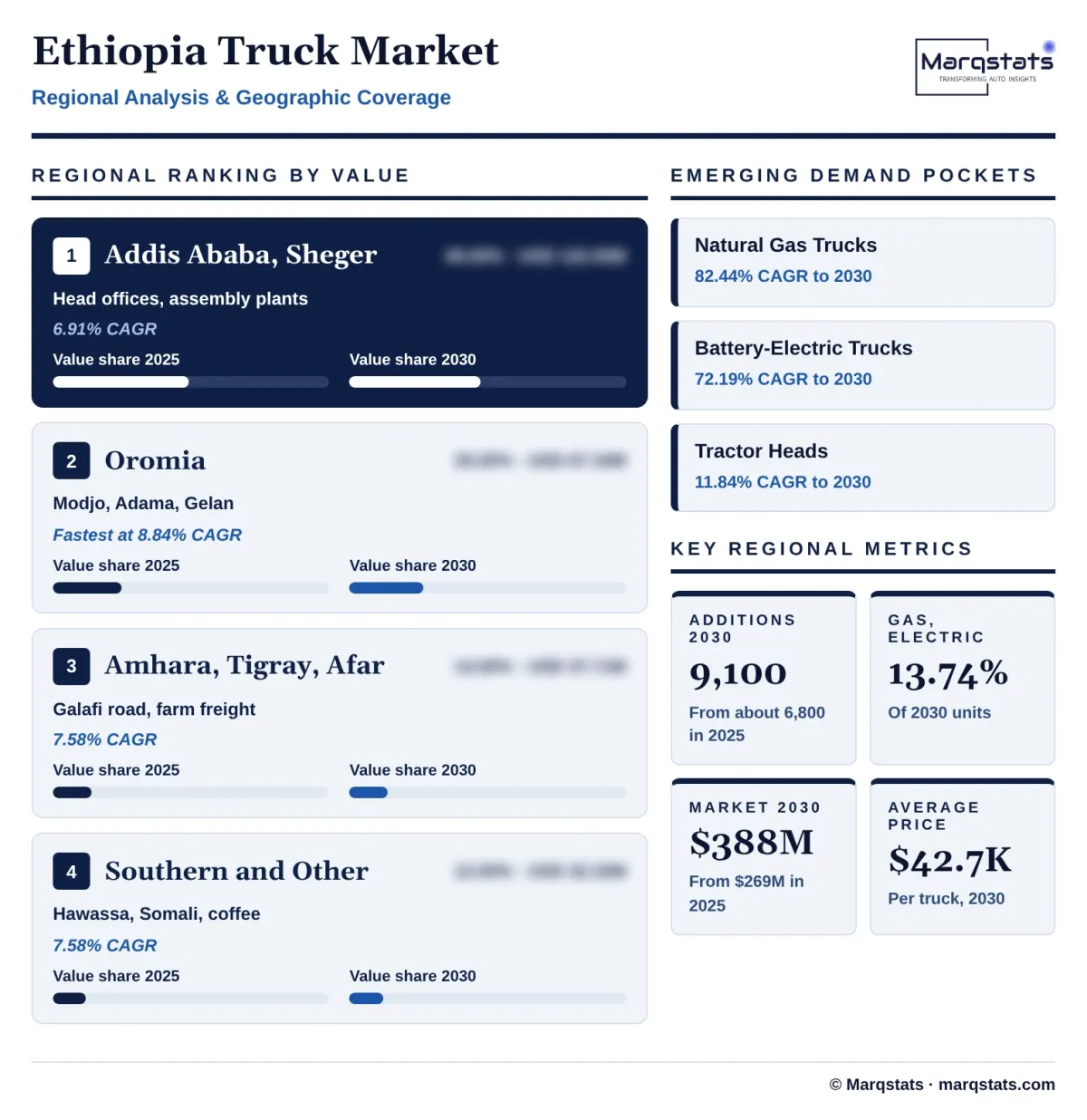
Gas and electric trucks add value faster than volume. Marqstats expects gas trucks to rise from 40 units in 2025 to 800 in 2030 and battery-electric trucks from 30 to 450, so their combined share of units grows from 1.03% to 13.74%. Gas trucks are priced at about 1.30 times and electric trucks at about 1.90 times a diesel truck of the same class, which lifts their share of value to 19.44% in 2030.
Marqstats tracks four indicators to monitor the forecast: customs clearances of goods vehicles by fuel type after the 2 October 2025 ban, the pace of the Ogaden LNG second phase and of CNG and LNG filling stations along the Djibouti route, the birr rate against the dollar after the July 2024 float, and tenders from Ethiopian Shipping and Logistics and the road, dam and industrial park programmes that buy tippers and tractors.
Market Dynamics
Key Drivers
Five forces are lifting demand for new trucks in Ethiopia even as the rules for buying them change.
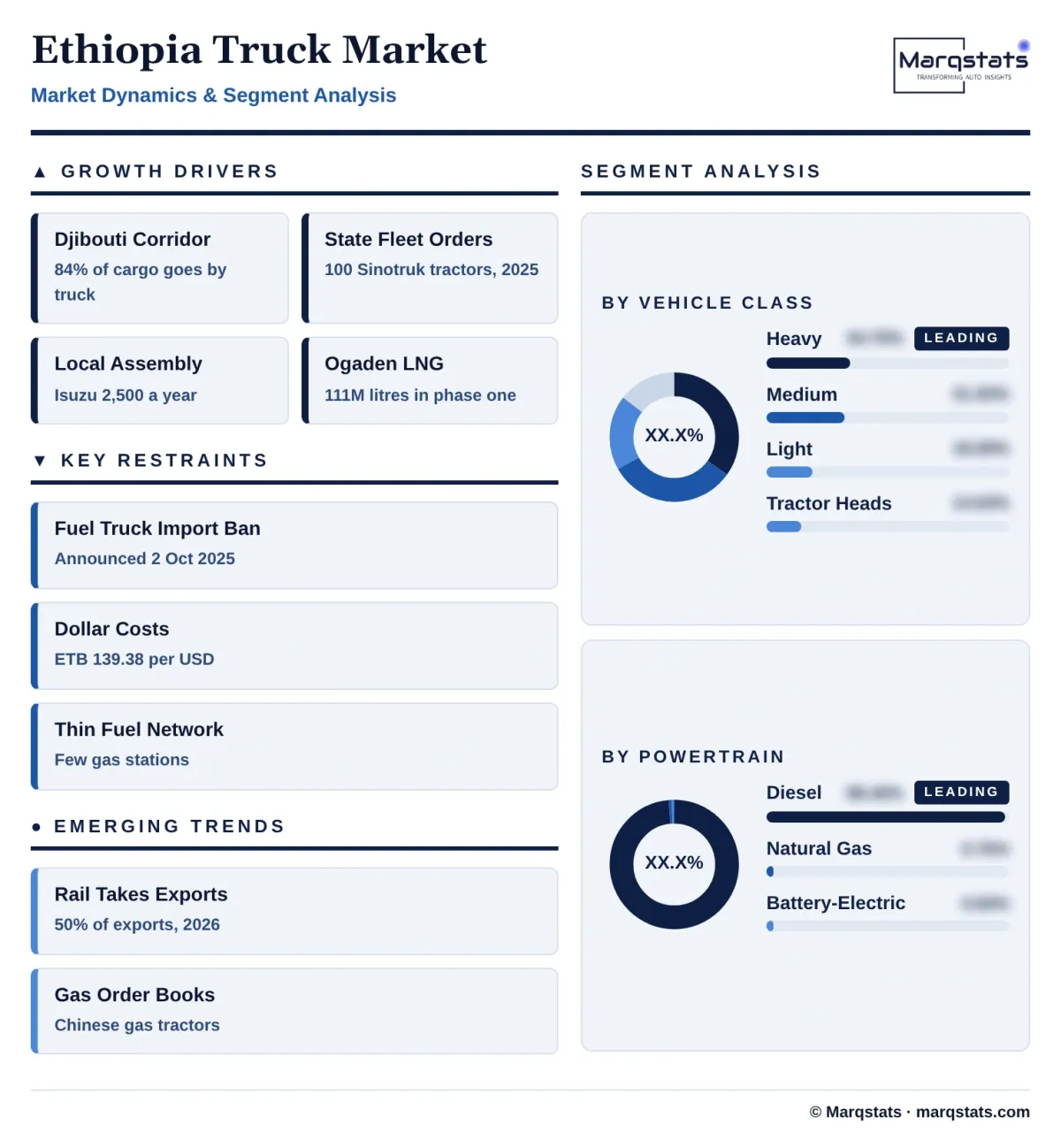
- The Djibouti corridor creates steady demand. More than 95% of Ethiopian cargo moved through Djibouti in the first half of the 2023/24 fiscal year, and trucks carried about 84% of corridor cargo in 2025. Every tonne that reaches Addis Ababa, Modjo or Adama by road needs heavy tractors and trailers, which keeps replacement demand high on a fleet that includes trucks more than 30 years old.
- State buyers place large orders. Ethiopian Shipping and Logistics ordered 100 Sinotruk 6x4 tractors with 40 tonne semi-trailers for ETB 750 million in March 2025, runs more than 600 trucks and plans 1,000 within two years, with a tender for 150 more expected. One order of that size equals about one tenth of a year of Ethiopian tractor-head additions.
- Local assembly keeps trucks flowing. The June 2025 notice that closed the kit route for fuel-powered cars and motorcycles did not name trucks, so assemblers are building truck capacity: Kaki Motors opened an Isuzu plant at Alemgena with a capacity of 2,500 trucks a year, Belayneh Kinde assembles Sinotruk models, and SHACMAN commissioned a knocked-down plant in November 2025 reporting about 40% local content.
- A domestic gas source is coming on stream. The Ogaden LNG plant at Kallub, opened on 2 October 2025 with an initial 111 million litres a year and a planned 1.33 billion litres in phase two, gives long-haul hauliers a home-grown fuel and the Ministry of Finance a reason to offer duty-free treatment for gas vehicles.
- Infrastructure and industry need trucks. Road building, cement and mining, industrial parks and the move of fertiliser, grain and fuel from Djibouti keep tippers, mixers and tractors in demand, and the government approved the purchase of 3,200 additional trucks on supplier credit in January 2022 to ease port congestion.
Key Restraints
Four constraints keep the market below its earlier peak and slow the shift to cleaner trucks.
- The import ban narrows choice. The Prime Minister stated on 2 October 2025 that the import of any fuel-powered truck is prohibited, and the Trade Minister said in May 2026 that the government may revisit fuel vehicle import limits within its WTO accession, but trucks were not named. Until rules are clear, importers hold back orders for diesel trucks.
- Dollar costs are high. The birr was floated in July 2024 and averaged 139.38 per US dollar in 2025, against about 57 before the float. Trucks are bought with dollars, so every owner-operator pays far more in birr, and bank lending rates stay high, which holds back private fleet renewal.
- Charging and gas stations are thin. The E-Mobility Strategy launched on 25 May 2026 plans about 2,230 charging centres by 2030 and a fast charger every 120 kilometres on highways for buses and trucks, but heavy electric tractors cannot yet complete the Addis Ababa to Djibouti run, and gas filling points outside the Ogaden basin are few.
- Reliable fleet data is thin. Yearly truck registrations by weight class are not released in a single series, and fleet counts range from about 12,500 cross-border vehicles to 25,000 registered heavy trucks, so buyers and lenders rely on tenders and customs entries to judge demand.
Key Trends
Four shifts are changing which trucks are built, fuelled and bought in Ethiopia.
- Rail takes the export load. Rail carried 50% of exports through Djibouti in 2026, up from 9% two years earlier, and 24% of imports, so trucks lose some return loads on a corridor where exports are a small fraction of imports.
- Gas trucks move from pilot to order book. Chinese makers supply gas tractors and dump trucks, and the duty-free treatment for gas vehicles gives importers a lane around the ban.
- State logistics firms build their own fleets. Ethiopian Shipping and Logistics grew from about 475 trucks in 2022 to more than 600 in 2025 and aims for 1,000, shifting some corridor haulage from private associations to a state buyer.
- Heavy-truck assembly moves inland. SHACMAN, Sinotruk partners and Isuzu assembly sit around Addis Ababa, Adama and Alemgena, close to the dry ports at Modjo, and aim to cut delivery times against fully built imports.
Strategic Implications
- For truck makers, the practical route into Ethiopia is a kit supply deal with a local assembler. Fully built diesel trucks face the ban, while knocked-down kits and gas or electric models do not carry the same restriction, so offering an assembler a kit with local content wins orders that imports cannot.
- For hauliers and state logistics buyers, tractor renewal is the main spending decision. Replacing trucks older than 30 years with new Sinotruk or SHACMAN tractors at about USD 41,500 each, before duty, lowers breakdowns, and fleet buyers that tender early lock in kit supply before the ban rules settle.
- For gas and LNG suppliers, the first-phase plant covers only about 1,611 long-haul trucks on Marqstats assumptions. Filling stations at Adama, Modjo and the Awash route, and second-phase supply, decide whether gas can move beyond a few hundred trucks a year.
- For financiers, the birr float lifted the local cost of every truck, and lenders that offer dollar-linked equipment finance or supplier credit, as the government used in 2022, can reach hauliers that banks turn away.
- For parts and service providers, a fleet with many trucks over 30 years old and a ban on new fuel-powered imports means strong demand for rebuilt axles, brake and tyre supply and workshops along the Djibouti route.
Market Segmentation
Light cab-over trucks of 3.5 to 7.5 tonnes account for 18.69% of 2025 value, USD 50.35 million, and grow at 7.27% a year to USD 71.50 million. Marqstats estimates about 1,900 units in 2025, led by Isuzu and Hino models and by Foton and JAC trucks sold to distributors, food and beverage companies and city delivery operators in Addis Ababa.
Medium trucks of 7.5 to 16 tonnes account for 31.93% of 2025 value, USD 86.00 million, and grow at 6.19% a year to USD 116.10 million. About 2,150 units were added in 2025, mainly Isuzu F-series, Hino 500 and FAW trucks used for regional distribution of grain, beverages, cement bags and cash crops between Oromia and the main cities.
Heavy rigid trucks above 16 tonnes account for 34.75% of 2025 value, USD 93.61 million, and grow at 7.05% a year to USD 131.60 million. About 1,800 units were added in 2025, mostly six-wheel and eight-wheel tippers, mixers and cargo trucks from Sinotruk, SHACMAN, FAW and Dongfeng bought by contractors, cement firms and quarry operators.
Tractor heads for semi-trailers account for 14.63% of 2025 value, USD 39.42 million, and grow fastest, at 11.84% a year, to USD 68.97 million and 17.77% of the market. About 950 units were added in 2025, mainly 6x4 Sinotruk and SHACMAN tractors for container and bulk haulage on the Djibouti route, where state and private hauliers renew ageing fleets.
Diesel trucks account for 98.40% of 2025 value, USD 265.08 million, and grow slowly, at 3.36% a year, to USD 312.68 million, while their share falls to 80.56%. Nearly all trucks in the fleet run on diesel, and orders placed before the October 2025 ban and kit-built trucks keep this segment large.
Gas trucks account for 0.76% of 2025 value, USD 2.05 million, and grow at 82.44% a year to USD 41.43 million and 10.67% of the market. Marqstats expects about 800 gas trucks a year by 2030, mostly tractors and tippers supplied by Chinese makers and fuelled from the Ogaden LNG plant, with growth limited by filling stations along the Djibouti route.
Battery-electric trucks account for 0.84% of 2025 value, USD 2.25 million, and grow at 72.19% a year to USD 34.06 million and 8.77% of the market. They are light and medium trucks for depot-based delivery in Addis Ababa, charged from a grid that is over 90% renewable, and the 2026 E-Mobility Strategy plans a fast charger every 120 kilometres on highways for buses and trucks.
Freight and container haulage accounts for 42.17% of 2025 value, USD 113.61 million, and grows at 8.53% a year to USD 171.06 million and 44.06% of the market. It covers corridor tractors, dry-port transfers and general cargo, and includes the fleets of Ethiopian Shipping and Logistics and the private associations.
Construction, mining and infrastructure account for 40.01% of 2025 value, USD 107.77 million, and grow at 5.83% a year to USD 143.08 million. Tippers and mixers serve road building, cement and quarrying, and this is the slowest-growing end use because public works budgets are tight.
Agriculture and food distribution account for 11.36% of 2025 value, USD 30.60 million, and grow at 8.71% a year to USD 46.45 million. Medium trucks move grain, sugar, coffee, fertiliser and processed food between farm areas, mills and cities.
Manufacturing, retail and municipal use accounts for 6.46% of 2025 value, USD 17.40 million, and grows fastest among end uses, at 9.65% a year, to USD 27.58 million. Industrial parks at Hawassa, Bole Lemi and Adama, beverage and consumer goods firms and city services buy light and medium trucks, including most of the early electric models.
By Geography
Addis Ababa and Sheger City
Addis Ababa and Sheger City account for 49.00% of 2025 value, USD 132.00 million, and grow at 6.91% a year to USD 184.38 million and 47.50% by 2030. Registration shares overstate the capital because lessors, banks and corporate buyers register trucks at head offices, while the trucks themselves spend most of their time on the Djibouti route. Marqstats allocates value by registration, as buyers and lenders do.
Oromia
Oromia accounts for 25.00% of 2025 value, USD 67.34 million, and grows fastest, at 8.84% a year, to USD 102.87 million and 26.50% by 2030. Modjo dry port, Adama, Alemgena, Gelan and the Awash route sit in or beside the region, and assembly plants, cement works and farm freight draw trucks there.
Amhara, Tigray and Afar
Amhara, Tigray and Afar account for 14.00% of 2025 value, USD 37.71 million, and grow at 7.58% a year to USD 54.34 million. Afar holds the Galafi border post and the road to Djibouti, while Amhara and Tigray buy trucks for farm freight, cement and rebuilding after the war in the north.
Southern, Sidama, Somali and Other
Southern, Sidama, Somali and other regions account for 12.00% of 2025 value, USD 32.33 million, and grow at 7.58% a year to USD 46.58 million. Hawassa industrial park, coffee and fruit freight, and the Ogaden gas fields in Somali Region create steady demand, mostly for light and medium trucks.
How Competition Is Evolving
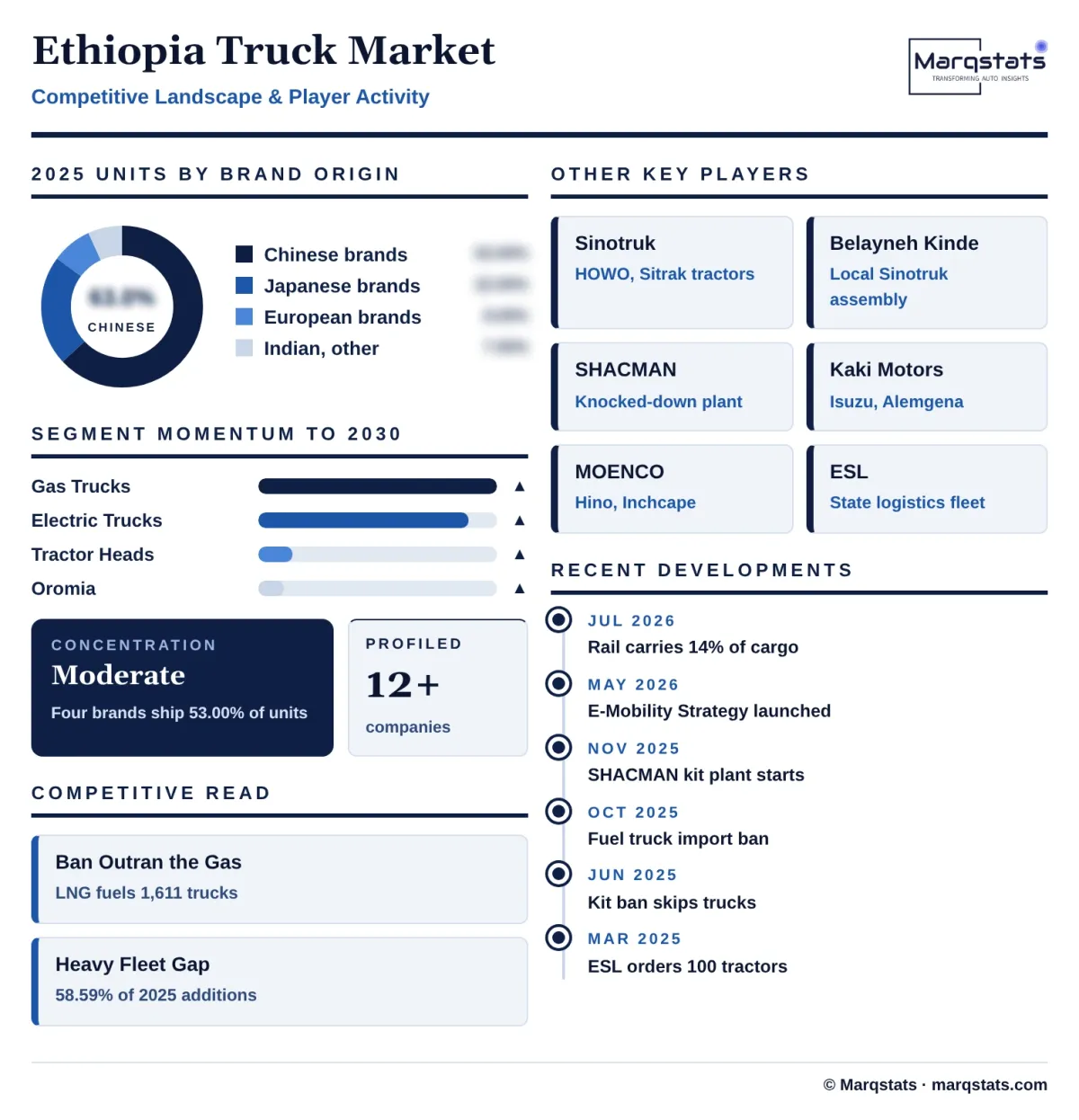
The market is moderately concentrated and led by Chinese brands. Marqstats estimates that Sinotruk, Isuzu, SHACMAN and Hino delivered about 53.00% of 2025 units, and that Chinese brands as a group held about 63.00%, Japanese brands about 22.00%, European brands about 8.00% and Indian and other brands about 7.00%. Chinese makers sell the most heavy tippers and tractors, while Japanese makers lead among light and medium trucks that buyers keep for many years.
Sinotruk is the largest truck brand, with about 25.00% of 2025 units. Its HOWO and Sitrak models are assembled by Belayneh Kinde Metal Engineering and imported by dealers, and Ethiopian Shipping and Logistics chose Sinotruk over European bids for its 100-tractor order in March 2025. SHACMAN follows with about 9.00%, and in February 2023 BEAEKA and SHACMAN announced plans to assemble 1,500 heavy trucks a year in a first phase and 3,000 in a second, and SHACMAN commissioned a knocked-down plant in November 2025.
Japanese brands hold the service-sensitive end of the market. Kaki Motors assembles Isuzu trucks at Alemgena with a stated capacity of 2,500 trucks a year, and MOENCO, a subsidiary of Inchcape founded in 1959, sells Hino trucks and buses. Marqstats estimates Isuzu at about 11.50% and Hino at about 7.50% of 2025 units.
Competition is shifting from price to access. Importers face the ban on fully built fuel-powered trucks, so assemblers with kit supply, financing and workshops win orders, and entrants such as Equatorial Business Group, which planned BG-branded trucks in April 2024, and the Defense Engineering Industry Group, which took over Bishoftu Automotive in March 2025, show that state-linked firms want a share of vehicle assembly.
Companies Covered
Companies covered in the report include:
Recent Market Activity
Table of Contents
Coverage & Segmentation
The study covers the Ethiopia truck market, with 2025 as the base year, 2021 – 2025 as the historical period and 2026 – 2030 as the forecast period. It covers new goods trucks above 3.5 tonnes gross vehicle weight, imported fully built or assembled locally from kits, segmented by vehicle class, powertrain, end use and region. Values are wholesale values at the importer or assembler gate in US dollars, before customs duties, taxes and dealer margins, and birr figures use the 2025 average of ETB 139.38 per US dollar.
Pickups and vans below 3.5 tonnes, buses and minibuses, used trucks, trailers and bodies sold separately, agricultural tractors, forklifts and off-road mining machines are excluded. Segment and regional splits are Marqstats estimates built on customs values, plant disclosures, tender awards and price benchmarks. Live Marqstats reports on Africa Chinese commercial vehicles and Africa electric commercial vehicles are broader parents, and their figures should not be added to this market.