Market Snapshot
Middle bar: base-year value × (1 + CAGR), rounded to two decimals. This is a calculated illustration, not a separately researched annual estimate.
The UAE heavy truck market size is estimated at USD 476.81 million in 2025 and is projected to reach USD 638.58 million by 2030, growing at a CAGR of 6.02% over 2026 – 2030. New heavy trucks added each year rise from about 5,400 to 6,830, a 4.81% annual rate.
Marqstats defines the market as the wholesale value of new goods trucks above 16 tonnes gross vehicle weight sold in the UAE: heavy rigid tippers, mixers, tankers and cargo trucks, and tractor heads. Value is counted at the importer gate in US dollars at the fixed rate of AED 3.6725 per dollar, before registration fees, VAT and dealer margins. Pickups, light and medium trucks, buses, used trucks, trailers and trucks in transit to other countries are excluded.
Tractor heads account for 41.03% of 2025 value, Class 8 trucks above 25 tonnes for 78.99% and diesel for 99.12%. Dubai holds 38.00% of value, while Abu Dhabi grows fastest among emirates at 7.27% a year as rail-linked industry, ports and energy projects draw trucks west.
Key Takeaways
Market Overview & Analysis
Report Summary
Marqstats sizes the UAE heavy truck market as the wholesale value of new goods trucks above 16 tonnes gross vehicle weight that enter the national fleet each year. It counts heavy rigid trucks of 16 to 25 tonnes and above 25 tonnes, in tipper, mixer, tanker, cargo and specialised bodies, and tractor heads of 4x2 and 6x4 layout that pull semi-trailers. Pickups and light trucks below 3.5 tonnes, medium trucks of 3.5 to 16 tonnes, buses and used vehicles are excluded.
Heavy trucks sit at the centre of a fast-growing logistics sector. On 18 February 2026 the Roads and Transport Authority (RTA) reported that licensed commercial transport companies in Dubai rose from 12,100 in 2024 to 16,917 in 2025, that registered commercial transport vehicles passed 500,000, up about 25%, and that the sector contributes more than AED 8.4 billion, about USD 2,287.27 million, a year to the economy. In September 2025 the RTA put the heavy vehicles in its logistics fleet at 61,290, ranging from 3.5 to 65 tonnes.
Customs data show how large goods-vehicle trade is and how much of it is not heavy. UAE imports of goods vehicles under HS 8704 rose from USD 1,584.50 million in 2021 to USD 1,794.81 million in 2022 and USD 2,353.83 million in 2023, a gain of 48.55% in two years, while exports of the same category reached USD 1,785.26 million in 2023 because the country re-exports pickups and light trucks across the region. UN Comtrade data put imports of motor vehicles for the transport of goods from Japan alone at USD 950.46 million in 2024, and Marqstats expects most of it to be pickups and light and medium models, which is why it counts only the heavy layer.
Rules, not weight enforcement, set the pace. Federal Decree No. 12 of 2023 and Cabinet Resolution No. 138 of 2023 fix maximum gross weights of 21 tonnes on two axles, 34 on three, 45 on four, 56 on five and 65 on six, with length limits of 12.5 metres for a rigid truck and 21 metres for a tractor and semi-trailer, and a height of 4.6 metres. The Ministry of Energy and Infrastructure (MOEI) said in September 2023 that the rule would apply from the first quarter of 2024 after 24 smart electronic gates were installed, but the Cabinet postponed it on 18 February 2024.
Marqstats estimates that about 5,400 heavy trucks were added in 2025, with tractor heads at 2,150, tippers and dump trucks at 1,500, concrete mixers at 520 and tankers, cargo and specialised trucks at 1,230. At an average of about USD 88,298, or about AED 324,275, per truck, this gives USD 476.81 million. European and Japanese importers hold the premium end, Chinese brands compete on price, and fewer than 25 zero-emission heavy trucks entered service in 2025.
UAE Heavy Truck Market Size and Forecast
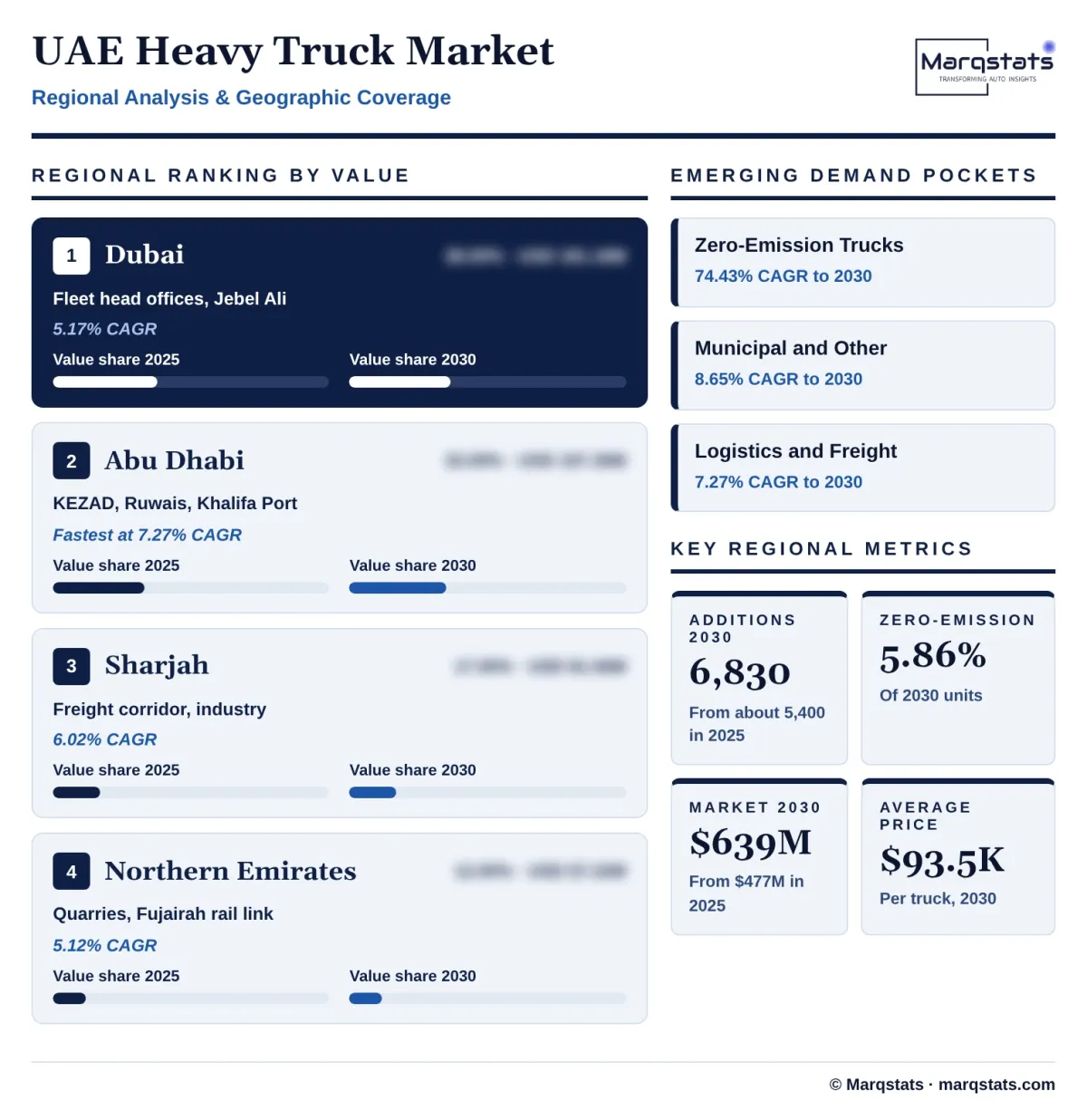
The UAE heavy truck market grows from USD 476.81 million in 2025 to USD 638.58 million in 2030, a CAGR of 6.02%. Volume contributes most of the growth: additions rise at 4.81% a year, from about 5,400 to 6,830 trucks, and the average value per truck rises at 1.15% a year, from about USD 88,298 to USD 93,496, as tractor heads, specialised bodies and zero-emission trucks take a larger share.
The 2025 value is built bottom-up from configurations and prices. Marqstats estimates 2,150 tractor heads at about USD 91,000 each, 1,500 tippers and dump trucks at USD 82,000, 520 concrete mixers at USD 96,000 and 1,230 tankers, cargo and specialised trucks at USD 88,000. Prices are importer gate values in US dollars before registration, VAT and dealer margins, and blend European, Japanese and Chinese chassis.
The base is checked against customs and fleet data. UAE goods-vehicle imports under HS 8704 were USD 2,353.83 million in 2023, the latest full year in the published series, and Marqstats estimates that trucks above 16 tonnes make up about 20% of that value, or USD 470.77 million, which is within 1.27% of the 2025 estimate. On the fleet side, the RTA counts 61,290 heavy vehicles in Dubai logistics alone, so annual additions of about 5,400 trucks across the country are consistent with a replacement-led market.
Zero-emission trucks add value faster than volume. Marqstats expects battery-electric and hydrogen trucks to rise from 25 units in 2025 to 400 in 2030, taking their share of units from 0.46% to 5.86%. At about 1.90 times the price of a diesel truck of the same class, their share of value rises to 10.57%. The 2030 figure of 400 trucks sits within the 500 heavy-duty electric trucks that the live Marqstats UAE Electric Vehicle Market report projects for 2030, and the two figures describe the same vehicles, so they should not be added.
Marqstats tracks four indicators to monitor the forecast: the Cabinet decision on a new start date for the weights and dimensions rule, the effect of Dubai's movement restrictions on depot locations and fleet size from 1 October 2026, the growth of Etihad Rail freight toward its target of about 60 million tonnes a year by 2030, and the number of hydrogen and battery-electric heavy trucks registered after the pilots announced in 2025.
Market Dynamics
Key Drivers
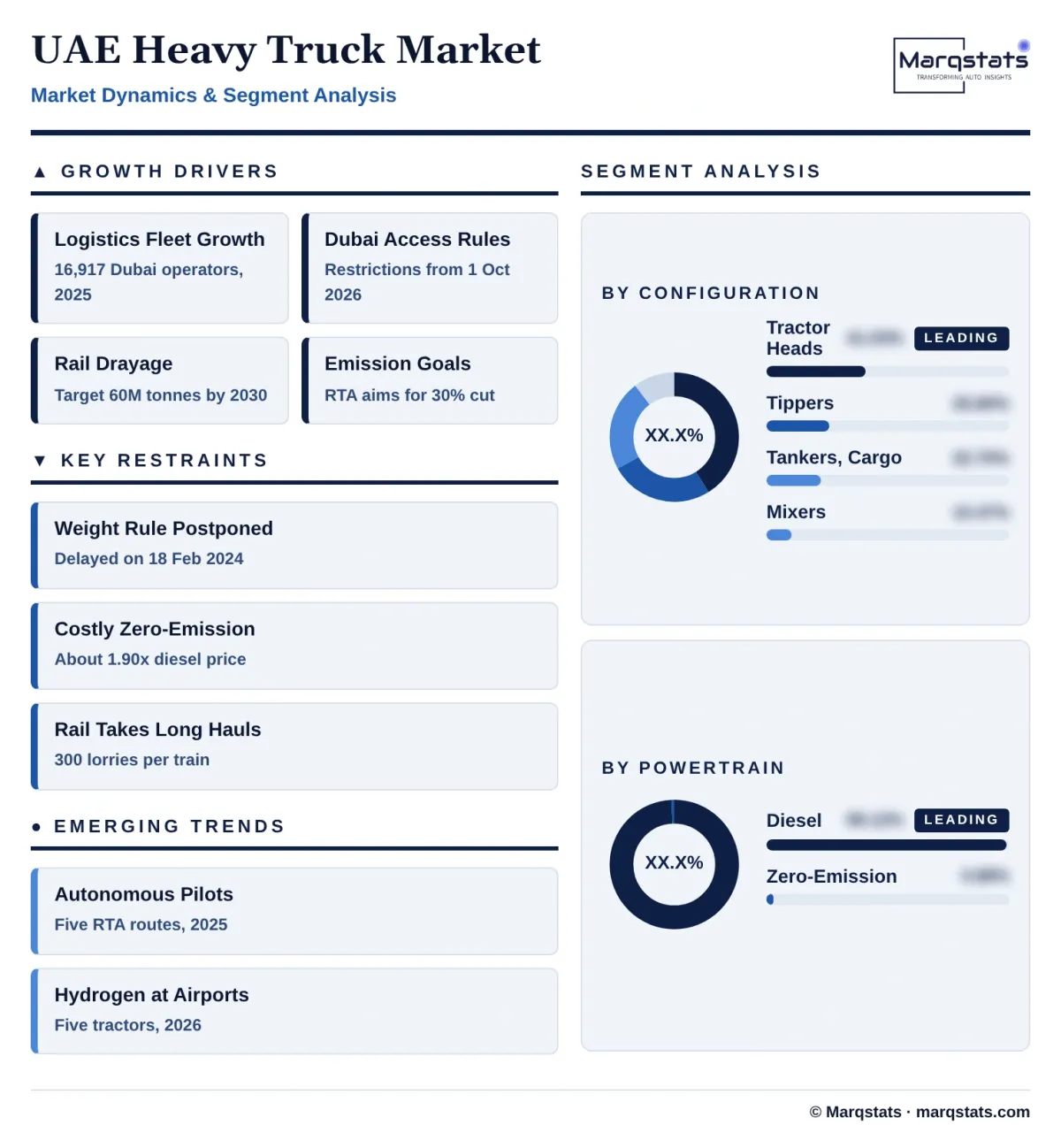
Five forces are lifting demand for heavy trucks in the UAE, even though the federal weight rule that was meant to drive renewal has not yet come into force.
- Logistics fleets are expanding fast. Licensed commercial transport companies in Dubai rose from 12,100 in 2024 to 16,917 in 2025, and registered commercial transport vehicles passed 500,000, up about 25%, according to the RTA on 18 February 2026. More operators mean more first-time orders for tractor heads and rigid trucks, and each new fleet starts with new chassis.
- Dubai's access rules reward newer, better-managed fleets. From 1 October 2026 trucks are barred for 24 hours a day from Al Qudra Street, Meydan Street, all marine bridges and the Airport Tunnel, and for 16 hours from 6am to 10pm on Sheikh Zayed Road and Beirut Street, unless a Right of Way Services permit is obtained. Operators that need access renew and re-route fleets, and permits favour fleets with telematics and reliable schedules.
- Rail creates new truck work even as it removes some. Etihad Rail targets about 60 million tonnes of cargo a year by 2030, and a bonded corridor between Khalifa Port and Fujairah was due to start pilot operations in the final months of 2025. Every train can take up to 300 lorries off the road, but the first and last kilometres from ports, terminals and quarries to railheads still need heavy tractors and tippers.
- Fleet renewal follows age and emission rules. The RTA's Commercial and Logistics Land Transport Strategy 2030 aims to cut sector emissions by 30%, raise operating efficiency by 10% and double the sector's direct contribution to AED 16.8 billion, about USD 4,574.54 million. Fleets that plan for these goals replace older diesel trucks with newer Euro-compliant models and test zero-emission ones.
- Autonomous and hydrogen pilots give importers a reason to bring new platforms. The RTA approved a framework for self-driving heavy vehicles on 28 September 2025, with five initial pilot routes including Jebel Ali Port and Al Maktoum International Airport, and Emirates SkyCargo announced five hydrogen tractor units on 17 April 2025, which draws OEM attention and financing to the UAE.
Key Restraints
Four constraints hold back growth and slow the shift to zero-emission trucks.
- The federal weight rule has been postponed. Cabinet Resolution No. 138 of 2023 was due in the first quarter of 2024, but the Cabinet postponed it on 18 February 2024 and asked MOEI to review the reasoning behind it. Until a new date is set, operators have little reason to retire overloaded older rigid trucks in favour of compliant six-axle combinations, and the fine of up to AED 15,000, about USD 4,084.41, per trip stays unused.
- Zero-emission trucks cost far more and have few places to refuel. Marqstats assumes a price about 1.90 times that of a diesel truck, and the Emirates SkyCargo hydrogen trucks rely on two Dubai hydrogen stations, at Expo City and Al Qudra. Until depot charging and hydrogen filling spread, fleets order zero-emission trucks only for fixed routes such as airports, ports and waste collection.
- Rail takes volume from long road hauls. Etihad Rail declared its UAE-wide freight network fully operational in 2023 and its aggregate line already runs at full capacity, with up to 60,000 tonnes a day. Each tonne moved on rail removes truck-kilometres on the longest corridors, so road demand shifts toward short-haul drayage and away from long-haul tractors.
- Reliable demand data are thin and trade flows are noisy. Public registration counts group trucks as one heavy-truck type without a split by weight class, body or fuel, and HS 8704 exports of USD 1,785.26 million in 2023 show how much of the goods-vehicle trade is re-exported to other markets, so buyers and lenders rely on dealer deliveries and tenders to judge demand.
Key Trends
Four shifts are changing how heavy trucks are operated, powered and bought in the Emirates.
- Autonomous heavy vehicles move from rules to routes. The RTA framework of 28 September 2025 covers licensing, trial operation, vehicle technology and safety, and the first pilot routes link Jebel Ali Port, Al Maktoum International Airport, the Jebel Ali Port Rail Freight Terminal, Dubai Investments Park and Ibn Battuta Mall, some with safety drivers and others fully driverless.
- Hydrogen starts at airports. Emirates SkyCargo announced five hydrogen tractor units with Allied Transport Company on 17 April 2025, able to carry up to 28 tonnes and travel up to 700 kilometres, and Darwish Bin Ahmed & Sons, MAN Truck & Bus SE and Emirates agreed the same week to use a hydrogen-driven truck at an airport.
- Fleets plan around time windows. Dubai's October 2026 restrictions push operators to run night and off-peak shifts, to use truck rest areas and to keep depots outside the restricted corridors, which favours tractor heads with flexible trailers and fleet management software over single-purpose rigid trucks.
- Logistics owners consolidate. Aegis Logistics agreed to buy Dubai-based energy logistics group Tristar for USD 1.5 billion, reported on 19 October 2026, and licensed operators in Dubai grew more than 40% in 2025, so larger buyers will place bigger framework orders with fewer importers.
Strategic Implications
- For truck makers and importers, the practical plan is to sell on access and uptime rather than on a weight rule that has been postponed. Offering tractor heads with telematics, service contracts and finance for operators who need Right of Way Services permits wins fleet orders, while a six-axle compliance pitch waits for the Cabinet to set a new date.
- For logistics operators, the Dubai restrictions of 1 October 2026 make depot location and shift planning a purchasing decision. Operators that place depots near Emirates Road, which is exempt, or near railheads can run fewer, better-used tractor heads, and those that rely on Sheikh Zayed Road need permits or off-peak schedules.
- For zero-emission suppliers, airport, port and waste duty cycles are the entry point. Fixed routes allow depot charging or one hydrogen station to serve a small fleet, and the 2030 level of about 400 trucks gives suppliers a target for charger and hydrogen supply that fits the RTA goal of a 30% emission cut.
- For financiers and lessors, the fleet growth in Dubai, with more than 16,900 licensed operators, creates demand for equipment finance on tractor heads and tippers that last 8 to 10 years. Residual risk is lower on European and Japanese chassis with strong importers, and higher on early electric models with unproven resale values.
- For rail operators and developers, the gap between road and rail is a chance to build drayage fleets. Truck operators serving the Khalifa Port and Jebel Ali Port rail links can win contracts for short, repeat moves that rail cannot replace, and rail growth to about 60 million tonnes a year by 2030 will raise that demand.
Market Segmentation
Tractor heads of 4x2 and 6x4 layout account for 41.03% of 2025 value, USD 195.65 million, and grow fastest, at 7.05% a year, to USD 275.02 million and 43.07% of the market. Marqstats estimates 2,150 units in 2025, rising to 2,850 in 2030, bought by container hauliers, port and free-zone operators, fuel and chemical carriers and groups that serve Jebel Ali, Khalifa Port and Etihad Rail railheads.
Tippers and dump trucks account for 25.80% of 2025 value, USD 123.00 million, and grow at 4.83% a year to USD 155.70 million. About 1,500 units were added in 2025, mostly six-wheel and eight-wheel models used by contractors, quarry operators and earthmoving fleets, and growth is the slowest of the four configurations because construction demand is tied to project cycles and rail now moves aggregates.
Concrete mixers account for 10.47% of 2025 value, USD 49.92 million, and grow at 5.30% a year to USD 64.64 million. About 520 units were added in 2025 on heavy rigid chassis of 8x4 and 6x4 layout for ready-mix plants in Dubai, Abu Dhabi and Sharjah, with mixer bodies fitted by specialist body builders.
Tankers, cargo and specialised trucks account for 22.70% of 2025 value, USD 108.24 million, and grow at 5.76% a year to USD 143.22 million. The group includes liquid and gas tankers, heavy cargo trucks, car carriers built to the 4.75 metre height limit for vehicle-carrying combinations, refuse trucks and crane chassis, and its growth follows energy logistics and municipal fleet renewal.
Heavy rigid trucks of 16 to 25 tonnes account for 21.01% of 2025 value, USD 100.16 million, and grow at 3.91% a year to USD 121.35 million. About 1,600 units were added in 2025, used for urban and regional distribution, municipal work and light construction where two-axle and three-axle limits of 21 and 34 tonnes apply.
Trucks above 25 tonnes account for 78.99% of 2025 value, USD 376.65 million, and grow at 6.55% a year to USD 517.23 million and 81.00% of the market. About 3,800 units were added in 2025 across tractor heads, six-wheel and eight-wheel tippers and mixers, and heavy haulage rigs that operate at gross weights up to the 65 tonne limit.
Diesel trucks account for 99.12% of 2025 value, USD 472.63 million, and grow at 3.86% a year to USD 571.08 million, while their share falls to 89.43%. Nearly every heavy truck in the fleet runs on diesel, supplied by Volvo, Scania, MAN, Mercedes-Benz, UD Trucks and Chinese makers, and the postponed weight rule keeps replacement of older diesel trucks voluntary.
Zero-emission trucks account for 0.88% of 2025 value, USD 4.18 million, and grow at 74.43% a year to USD 67.50 million and 10.57% of the market. Marqstats estimates 25 trucks in 2025 and 400 in 2030, including battery-electric models such as the Volvo FH Electric launched by FAMCO in 2023 with a gross combination weight of 44 tonnes and a range of up to 300 kilometres, and hydrogen tractors for airport freight.
Construction and infrastructure account for 37.07% of 2025 value, USD 176.78 million, and grow at 3.94% a year to USD 214.43 million. Tippers, mixers and heavy haulage rigs serve road, rail, real estate and utility projects in Dubai, Abu Dhabi and Sharjah, and this end use has the slowest growth of the four as rail takes over aggregate haulage.
Logistics and freight account for 36.47% of 2025 value, USD 173.88 million, and grow at 7.27% a year to USD 246.92 million and 38.67% of the market, overtaking construction by 2030. It covers container tractors, port and free-zone transfers, general cargo and the 16,917 licensed commercial transport companies counted in Dubai in 2025.
Oil, gas and industrial use accounts for 15.06% of 2025 value, USD 71.81 million, and grows at 5.75% a year to USD 94.97 million. Tankers, heavy haulage rigs and bulk carriers serve fuel distribution, petrochemicals, cement and steel from Abu Dhabi's industrial zones and the Ruwais corridor, and MAN Truck & Bus SE calls itself the number one truck brand in the oil and gas segment.
Municipal and other uses account for 11.40% of 2025 value, USD 54.34 million, and grow fastest among end uses, at 8.65% a year, to USD 82.26 million. Refuse trucks, airport ground and catering support, port services and public works fleets lead early zero-emission trials, including the electric aircraft catering truck that Emirates Flight Catering expected to start in summer 2026.
By Geography
Dubai
Dubai accounts for 38.00% of 2025 value, USD 181.18 million, about 2,052 trucks, and grows at 5.17% a year to USD 233.08 million and 36.50% by 2030. Marqstats allocates value by registration, which can overstate local use because national operators register fleets at head offices in Dubai while trucks spend time on routes to Abu Dhabi and the northern emirates. Dubai's October 2026 movement restrictions add a cost to inner-city runs but not to Emirates Road.
Abu Dhabi
Abu Dhabi accounts for 33.00% of 2025 value, USD 157.35 million, about 1,782 trucks, and grows fastest among emirates, at 7.27% a year, to USD 223.50 million and 35.00% by 2030. Industrial zones at KEZAD and Ruwais, Khalifa Port, oil and gas logistics and the Etihad Rail aggregate and sulphur lines keep heavy rigid and tanker demand high.
Sharjah
Sharjah accounts for 17.00% of 2025 value, USD 81.06 million, about 918 trucks, and grows at 6.02% a year to USD 108.56 million. It is the freight corridor between Dubai and the northern emirates, with industrial areas, warehouses and quarry traffic that use tippers and tractors.
Northern Emirates
The Northern Emirates of Ras Al Khaimah, Ajman, Fujairah and Umm Al Quwain account for 12.00% of 2025 value, USD 57.22 million, about 648 trucks, and grow at 5.12% a year to USD 73.44 million. Aggregate quarries in Ras Al Khaimah and Fujairah and the planned rail link to Fujairah support heavy tippers and haulage rigs, although fleet registrations in these emirates are small.
How Competition Is Evolving
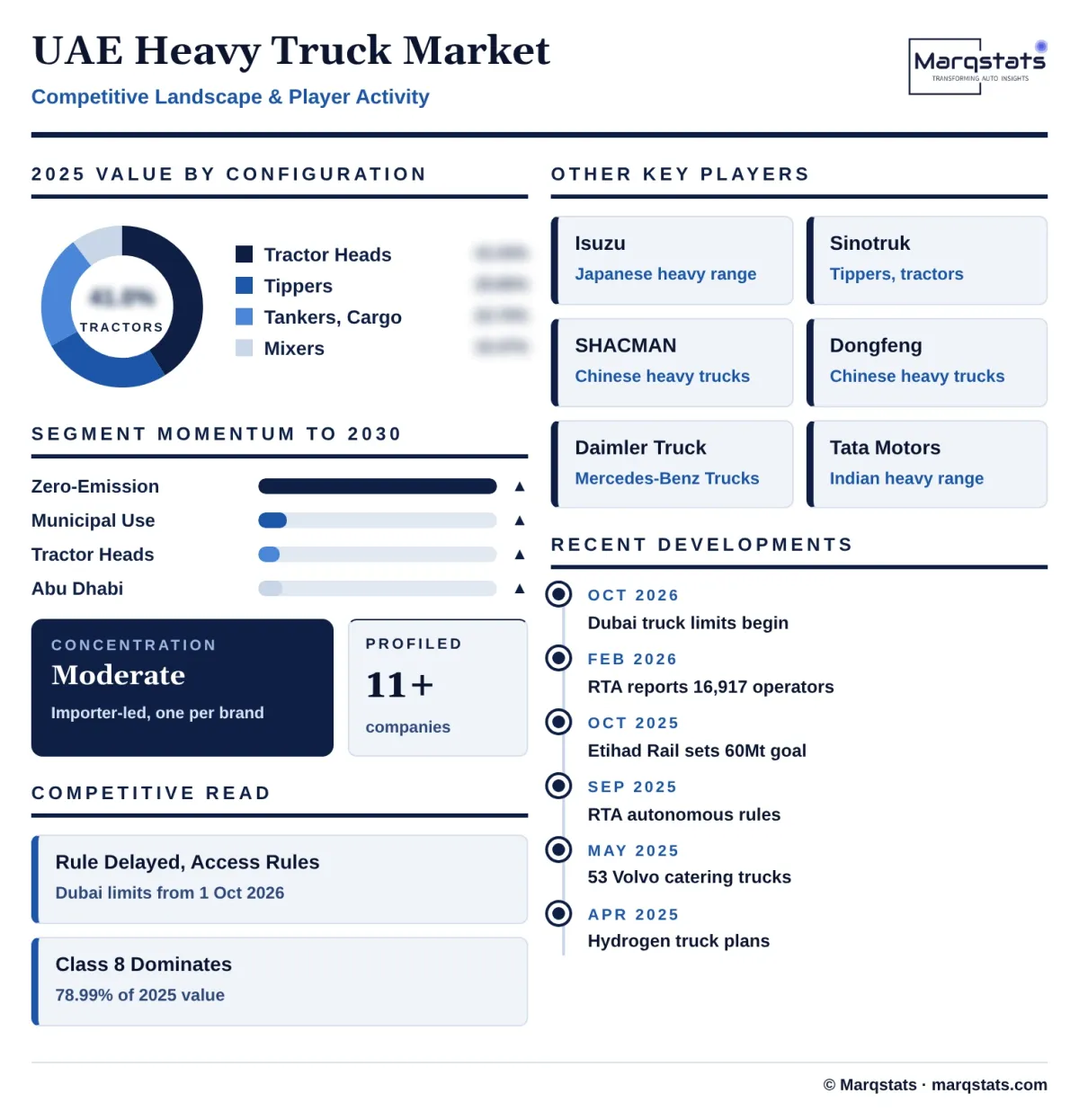
The market is moderately concentrated and led by importers that each represent one brand. FAMCO, the Al-Futtaim Auto and Machinery Company, sells Volvo trucks, Darwish Bin Ahmed & Sons represents MAN Truck & Bus SE, Al Shirawi Enterprises LLC is the UAE distributor of Scania, and Al Masaood Commercial Vehicles and Equipment sells UD Trucks. Marqstats describes competition by importer and named action rather than by share, because importers keep delivery counts to themselves.
European brands hold the long-haul and premium end. Volvo, Scania and MAN supply most tractor heads, which account for 41.03% of value, and FAMCO launched the Volvo FH Electric in 2023 as the first heavy-duty electric truck range in the region, with a gross combination weight of 44 tonnes. MAN and Darwish Bin Ahmed & Sons marked 30 years of partnership in April 2025 and agreed a hydrogen truck plan with Emirates.
Japanese and Chinese brands compete on price and uptime in rigid and construction trucks. UD Trucks, part of Isuzu Motors Limited, serves construction and waste fleets through Al Masaood, while Isuzu, Hino and Mitsubishi Fuso brands cover the lower end of the heavy range and Chinese makers such as Sinotruk, SHACMAN and Dongfeng sell tippers and tractors at lower prices. Marqstats expects Chinese brands to gain share in tippers and mixers where buyers weigh price against service.
Competition is moving from price to service, finance and zero-emission readiness. Importers offer deferred payment, telematics and workshop networks, and the RTA pilot routes for autonomous heavy vehicles and hydrogen tractors show that the next contest is for fleet partnerships. Mallaghan and FAMCO supplying 53 Volvo catering trucks to Emirates Flight Catering from May 2025 shows how specialist body builders and importers win together.
Companies Covered
Companies covered in the report include:
Recent Market Activity
Table of Contents
Coverage & Segmentation
The study covers the UAE heavy truck market, with 2025 as the base year, 2021 – 2025 as the historical period and 2026 – 2030 as the forecast period. It covers new goods trucks above 16 tonnes gross vehicle weight, segmented by vehicle configuration, GVW class, powertrain, end use and emirate. Values are wholesale values at the importer gate in US dollars, before registration fees, VAT and dealer margins, converted at the fixed rate of AED 3.6725 per US dollar.
Pickups and light trucks below 3.5 tonnes, medium trucks of 3.5 to 16 tonnes, buses and coaches, used trucks, trailers sold separately, off-highway dumpers that never enter public roads, and units moved in transit or re-exported to other markets are excluded. Segment and regional splits are Marqstats estimates built on customs values, fleet statements and importer disclosures. The live Marqstats UAE Electric Vehicle Market report includes electric heavy-duty trucks as a small subset, the GCC Autonomous Commercial Vehicle Market report covers self-driving trucks, and neither should be added to this market.