Market Snapshot
Middle bar: base-year value × (1 + CAGR), rounded to two decimals. This is a calculated illustration, not a separately researched annual estimate.
The India commercial electric two-wheeler market — covering battery electric scooters, mopeds, and motorcycles deployed for paid commercial use in food delivery, grocery and quick commerce, parcel logistics, pharmaceutical delivery, and bike-taxi services — was valued at USD 0.48 billion in 2025 and is projected to reach USD 1.98 billion by 2030, expanding at a CAGR of 32.73% during the 2026–2030 forecast period. This market is distinct from India's broader electric two-wheeler market — which spans consumer purchases, personal mobility, and commercial use — by focusing exclusively on the commercial fleet application layer where vehicle procurement decisions are driven by platform commitments, fleet TCO calculations, and institutional demand rather than individual consumer preference.
The commercial EV two-wheeler fleet in India stood at an estimated 140,000–160,000 units in 2025 — representing approximately 12% of the active delivery two-wheeler fleet — and is forecast to reach 1.2 million units by 2030 under the base scenario, and up to 1.92 million under an aggressive scenario characterised by stronger regulatory push in metros and high-uptime battery-swap network density. The demand anchors are unmistakable: Zomato reported 51,000+ active EV delivery partners across 400+ cities by January 2025 with 8% of food delivery orders delivered by EVs in FY24; Swiggy disclosed EV delivery partners growing 7× year-on-year in FY2024–25 against a 100% low-carbon fleet target by 2030; Amazon India deployed 10,000 EVs across 500+ cities by October 2024; Flipkart deployed 10,000+ EVs and installed chargers at 2,900 last-mile hubs; and BigBasket reports approximately one in three fleet vehicles is now electric, with 7,431 EVs in active deployment.
Annual electric two-wheeler registrations in India accelerated from 0.63 million in 2022 to 1.14 million in 2024 and approximately 1.28 million units in calendar year 2025, with commercial applications — delivery fleets, FaaS operators, platform partnerships — absorbing an estimated 10–15% of annual EV 2W supply. The TCO case for EVs in high-utilisation commercial contexts is compelling: at 100 km/day duty cycles, an EV delivery scooter costs approximately INR 1.53 per km versus INR 3.44 per km for an ICE equivalent — a saving of INR 1.9 per km primarily from energy cost differential. Policy through PM E-DRIVE (October 2024–March 2026), FAME-II's subsidy legacy, and active state-level incentives in Delhi, Maharashtra, Uttar Pradesh, and Tamil Nadu are accelerating the commercial EV transition, though subsidy discontinuity remains the sector's highest-risk planning variable.
Key Takeaways
Market Overview & Analysis
Report Summary
The India commercial electric two-wheeler market covers all battery electric scooters, mopeds, and motorcycles used for paid last-mile delivery and commercial mobility in India. The study period is 2021–2030, with 2025 as the base year. The market is defined to include three vehicle access models: (i) rider-owned EVs purchased or financed for delivery use; (ii) fleet operator-owned EVs rented or leased to gig delivery workers (fleet-as-a-service / FaaS model); and (iii) shared or battery-swap EVs deployed via platform partnerships (e.g., Yulu-Zepto, Indofast Energy-e-Sprinto). The low-speed electric two-wheeler category — vehicles with motor power capped at 250W and speed at 25 km/h, exempted from registration requirements — is included as a distinct sub-segment given its growing commercial deployment in hyperlocal delivery use cases, estimated at approximately 1.6 lakh units in active use growing at 21% CAGR.
India's commercial EV two-wheeler market is at a structural inflection point. As recently as FY2022–23, EV delivery was largely limited to platform pilots and small fleet operator experiments. By FY2025–26, major platforms have published statutory EV KPIs (Swiggy's BRSR disclosures, Zomato's Climate Conscious Deliveries PDF), fleet operators have established recurring commercial EV procurement, OEMs have signed formal platform MoUs (TVS-Swiggy, TVS-Zomato), and battery-swap infrastructure has graduated from concept to city-scale deployment. The market is simultaneously supply-side expanding (1.28 million e-2W annual registrations, new purpose-built fleet models entering) and demand-side being pulled by platform commitments, fleet TCO advantages, and government incentives.
The primary constraint on commercial EV two-wheeler penetration is not vehicle availability or consumer willingness — it is the reliability and density of charging and swapping access in the operating geographies. Platforms explicitly acknowledge this: Zomato and Swiggy both cite lack of reliable charging access as a binding barrier alongside limited delivery-suitable models and financing constraints. The battery-swap model directly addresses this constraint for quick-commerce high-utilisation use cases, while hub-charging at dark stores and delivery stations addresses it for food delivery and parcel logistics. The market's 2026–2030 trajectory is therefore most sensitive to three variables: (a) whether PM E-DRIVE subsidies are continued or replaced post-March 2026, (b) how rapidly battery-swap networks achieve city-wide density in Tier-1 and Tier-2 delivery markets, and (c) whether purpose-built commercial EV models achieving 150+ km range with 100+ kg payload at sub-INR 1,00,000 price points enter production scale.
Market Dynamics
Key Drivers
- Platform EV fleet commitments creating institutional demand pull: Zomato (EV100 member since 2021, 100% EV by 2030), Swiggy (100% low-carbon fleet by 2030), Flipkart (100% EV last-mile by 2030), and BigBasket (60% EV fleet by 2030) have embedded EV fleet targets in statutory sustainability filings (BRSR, annual reports). These are not aspirational targets — they are corporate governance commitments with publicly disclosed progress KPIs. Fleet operators and OEMs supplying these platforms have visibility into multi-year EV procurement demand that does not exist for general consumer EV markets.
- TCO advantage of INR 1.9/km at high delivery utilisation: A delivery rider at 100 km/day generates cumulative distance of approximately 93,600 km over three years. The INR 1.9/km EV advantage translates to approximately INR 1,78,000 in savings over this period versus an ICE scooter — equivalent to nearly 1.6x the vehicle purchase price for the average delivery EV. This TCO advantage compounds with higher utilisation, making the commercial use case structurally more favourable than consumer EV adoption where utilisation is lower and the savings case weaker. Fleet operators like Chartered Bikes report EV operating costs of INR 1.5–2/km versus INR 4/km for petrol fleets, confirming the TCO advantage at fleet scale.
- PM E-DRIVE and FAME-II subsidy legacy reducing acquisition cost barriers: India's government allocated INR 36.79 billion in PM E-DRIVE subsidies specifically for electric two-wheelers (2024–2026). The scheme's support for advanced battery technology EVs directly benefits the delivery-grade high-speed EV category. State-level incentives in Maharashtra (100% MV tax waiver, INR 10,000 subsidy), Tamil Nadu (INR 10,000/kWh up to INR 30,000), and Uttar Pradesh (15% ex-factory cost up to INR 5,000, claimable by fleet operators on up to 10 vehicles) significantly reduce net acquisition cost for commercial fleet buyers.
- Battery-swap ecosystem enabling quick-turnaround high-utilisation commercial deployment: The Yulu-Zepto partnership (20,000 shared DeX EVs across Bengaluru, Mumbai, Navi Mumbai, Delhi, Gurugram), Indofast Energy-e-Sprinto programme (20,000 EVs, 2,750 swap stations, 10,000 swap points across 40+ cities within 3 years), and government enablement of EV registration without batteries directly support the quick-commerce delivery use case where per-delivery turnaround time is critical and charging downtime of 3–5 hours is operationally unacceptable.
- Quick commerce dark-store expansion creating dense, concentrated fleet demand: Quick commerce platforms collectively operate 1,200+ dark stores across 100+ cities in India, with Blinkit guiding toward 2,000 stores by December 2026 and Swiggy Instamart exceeding 1,100 stores across 100+ cities. Each dark store is a concentrated fleet deployment point requiring a cluster of 10–50 EVs for 10–30 minute deliveries within a 2–3 km service radius. This concentration of demand enables charging hub investment (BigBasket deployed 4,000+ charging points at 773 locations via Kazam), creating the infrastructure density needed to make commercial EV deployment viable at hub level even where public charging is absent.
Key Restraints
- Subsidy discontinuity risk after PM E-DRIVE sunset in March 2026: India's EV incentive architecture has transitioned multiple times in rapid succession — FAME-II tightened the subsidy cap from 40% to 15% of ex-factory price in 2023, EMPS-2024 provided a short bridge, and PM E-DRIVE runs until March 2026. As of April 2026 no successor scheme had been confirmed for electric two-wheelers. Each subsidy transition has affected net vehicle prices, payback calculations, and fleet operator procurement decisions. Fleet aggregators planning multi-year EV commitments face material planning risk from incentive discontinuity.
- Limited EV models genuinely suited for full-day, high-payload delivery duty cycles: Both Zomato and Swiggy explicitly state in platform disclosures that limited EV models well-suited for full-day delivery is a binding constraint on fleet electrification. Current commercial delivery requires 80–120 km/day range under load, fast charging under 45 minutes, payload of 100–200 kg, and uptime reliability comparable to ICE equivalents. Most consumer-grade EVs adapted for delivery use fall short on one or more of these dimensions — range under payload, long charging times (3–5 hours for most high-speed e-2Ws at home chargers), or battery degradation under commercial duty cycles. Purpose-built models (Quantum Bziness EMO, Yulu DeX) are entering but are not yet at volume production scale.
- Charging infrastructure fragmentation at delivery hubs and residential buildings: Charging access in commercial contexts is more complex than consumer home-charging. Delivery hubs in urban areas — dark stores, fulfilment centres, residential apartment buildings where riders live — often lack dedicated EV charging connections due to building permission issues, electrical capacity constraints, and lack of landlord cooperation. This creates operational downtime for commercial EV fleets that erodes the TCO advantage when charging queues, range anxiety on second trips, and charging dwell time are properly accounted for.
- Rider financing barriers making EV purchase inaccessible for gig workers: With India's delivery workforce predominantly comprising low-income, often first-generation urban migrants without formal credit histories, acquiring an EV at INR 90,000–1,30,000 through conventional NBFC financing involves down payments and EMI commitments that strain monthly gig earnings. Platform disclosures note this as a key barrier, explaining why rental and FaaS models — which require zero upfront capital from riders — are essential enablers rather than optional complements to EV adoption.
Key Trends
- Fleet-as-a-Service economics are making commercial EV adoption capital-light: The FaaS model — where fleet operators buy EVs and rent them to delivery workers at daily, weekly, or monthly rates — is growing rapidly precisely because it decouples EV adoption from individual rider capital commitment. Zypp Electric's Zomato partnership targets deployment of 1 lakh (100,000) e-scooters; Chartered Bikes reports quick commerce contributing 50% of revenue and 20% fleet growth; and platforms have embedded FaaS partner discovery directly into rider apps. The FaaS market for commercial EVs is projected to grow faster than the outright ownership segment through 2030 as platforms preference partners who can supply ready-to-deploy EV fleets.
- Low-speed E2W category is an undercounted but rapidly scaling commercial segment: Vehicles capped at 250W motor power and 25 km/h speed — exempt from registration, insurance, and driving licence requirements under current norms — are growing at approximately 21% CAGR with an estimated 1.6 lakh units currently in active commercial use. Industry analyses identify these vehicles as particularly relevant for quick commerce intra-zone and pharmaceutical hyperlocal delivery where ride distances are short (1–3 km), weight is low, and cost efficiency is paramount. This segment is structurally distinct from the high-speed registered EV market and often undercounted in official VAHAN registration statistics.
- OEM shift from consumer adaptation to purpose-built commercial EV platforms: The TVS-Swiggy MoU (January 2022, testing of need-specific vehicles), TVS-Zomato plan (10,000+ scooters over 2 years), and the entry of purpose-built models (Quantum Bziness EMO with 200 kg payload and 20-minute fast charge, Hero Electric NYX HX with 150 kg payload) signal a structural OEM strategy shift from selling consumer-grade EVs that happen to be used in delivery, toward engineering fleet-specific platforms with commercial-grade payload, durability, charging speed, and telematics. This shift, as it matures, will significantly expand the addressable commercial EV two-wheeler market.
- Battery safety standards creating fleet procurement discipline: AIS-156 (L-category EV battery requirements) implemented from March 2023 and PM E-DRIVE's requirement for advanced battery technology (as a subsidy eligibility condition) have progressively raised the quality floor for commercially deployed EVs. Post the 2022–23 battery fire incidents that damaged consumer confidence, fleet operators now apply more rigorous battery certification and warranty requirements — with extended warranties (up to 8 years/80,000 km for Ather, 8 years/1,25,000 km for Ola) becoming a commercial differentiator rather than just a marketing claim.
Market Segmentation
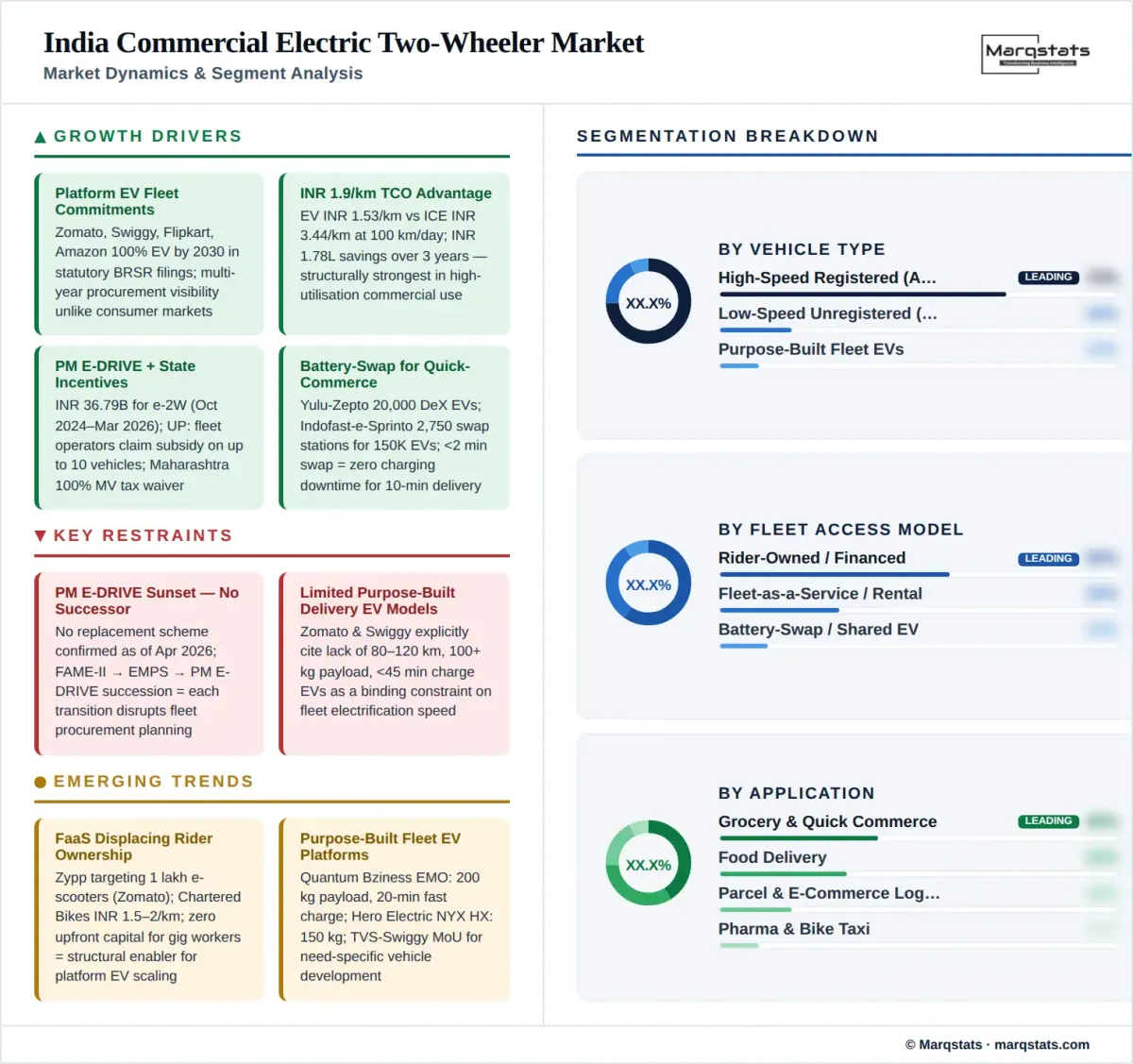
High-speed electric two-wheelers — requiring VAHAN registration, insurance, and a valid driving licence — constitute the primary and most commercially significant segment. Annual registrations reached approximately 1.28 million units in CY2025, with commercial/delivery applications absorbing an estimated 10–15% of supply. The dominant delivery-suitable models include the TVS iQube (2.2–5.3 kWh variants, 94–212 km claimed range, multiple battery sizes enabling duty-cycle matching, used in TVS-Swiggy and TVS-Zomato programmes), Bajaj Chetak 3001/350x (127–153 km, 3–3.5 kWh, valued for service network reliability), Ather 450 (corporate fleet programme with telematics, extended warranty up to 8 years/80,000 km), Ola S1X Gen3 (up to 242 km IDC range, warranty extensions up to 8 years/1,25,000 km), and Hero Electric NYX HX (165 km claimed range, 150 kg stated payload, explicitly utility-oriented). This segment benefits most directly from PM E-DRIVE subsidies and state-level incentives, which reduce net acquisition cost by INR 5,000–30,000 depending on state.
Low-speed EVs are a distinct and rapidly growing commercial sub-segment, particularly in quick commerce hyperlocal delivery and pharmaceutical last-mile applications where delivery distances are short (1–3 km), payloads are light, and the absence of registration, insurance, and licence requirements reduces operational complexity for fleet operators. Industry analyses indicate approximately 1.6 lakh units currently in active commercial use, growing at approximately 21% CAGR — a pace reflecting the aggressive dark-store expansion of quick commerce platforms that creates concentrated, short-radius delivery demand ideally suited to low-speed EVs. The Yulu DeX — a battery-swap model with approximately 60 km range per charge and a 10 kg rear carrier payload — is the most commercially deployed purpose-built low-speed delivery EV, operated via Yulu's platform partnership with Zepto. This category is structurally distinct from the registered EV market and requires separate policy treatment as it scales.
A nascent but strategically important segment is purpose-built commercial delivery EVs engineered specifically for fleet, high-utilisation, and payload requirements rather than adapted from consumer commuter platforms. The Quantum Bziness EMO — with a 2 kWh ZenPac battery, 20-minute fast charge, up to 200 kg payload capacity, and approximately 80 km real-world range — represents the clearest example of this category, targeting logistics operators that need fast turnaround, heavy-duty payload, and low per-km cost simultaneously. Hero Electric NYX HX (150 kg payload, utility orientation) and ongoing OEM development programmes for delivery-specific platforms (referenced in TVS-Swiggy MoU for need-specific vehicles) are building toward a more developed purpose-fleet EV segment. As this category matures and reaches production scale, it is expected to command premium pricing (INR 1,10,000–1,50,000) while delivering superior delivery economics versus adapted consumer EVs.
Rider-owned EVs — where the delivery partner purchases or finances an EV independently — remain the largest access model by number of vehicles but face the highest barriers to EV adoption. The upfront cost differential (EV at INR 90,000–1,30,000 versus ICE at INR 60,000–85,000) and limited NBFC financing for gig workers without formal credit histories create a real affordability gap. Platform programmes like Zomato's 'Rent an EV' in-app feature, Swiggy's financing tie-ups with NBFCs, and government schemes reducing net cost through subsidies are all designed to lower this barrier. Despite the TCO advantage (INR 1.9/km savings at 100 km/day), the payback period for the upfront cost premium (~3–6 months of fuel savings) is only financially viable if the rider has access to financing on commercially reasonable terms.
The FaaS/rental model — where a fleet operator procures EVs and rents them to gig workers at daily/weekly/monthly rates — is the fastest-growing access model and the structural enabler of platform-level EV fleet scaling. Key FaaS operators include Zypp Electric (targeting 1 lakh e-scooters with Zomato partnership), Chartered Bikes (quick commerce at 50% of revenue, 20% fleet growth YoY, operating costs INR 1.5–2/km), and informal neighbourhood-level fleet holders who rent bikes daily or weekly. The FaaS model addresses the rider capital barrier by removing upfront purchase requirements, manages battery health centrally rather than relying on individual rider behaviour, and scales fleet deployment faster than organic rider-own EV adoption. Platforms incentivise FaaS adoption by integrating fleet partner discovery into rider apps.
The battery-swap model — where EVs are sold without batteries, and riders subscribe to a battery swap service — is structurally ideal for quick commerce and high-frequency, short-range delivery applications. The Yulu-Zepto deployment (20,000 shared DeX EVs across 5 cities) is the most scaled real-world battery-swap commercial EV programme in India. Indofast Energy's partnership with e-Sprinto targets 20,000 EVs with 2,750 swap stations and plans to expand to 10,000 swap points covering 150,000 vehicles. Government policy has enabled this model through advisories permitting EV registration without batteries, enabling battery-as-a-service commercial models. The swap turnaround time (under 2 minutes versus 3–5 hours for home charging) makes this the highest-uptime EV access model for commercial deployment, though it requires a dense swap station network to be operationally practical.
By Geography
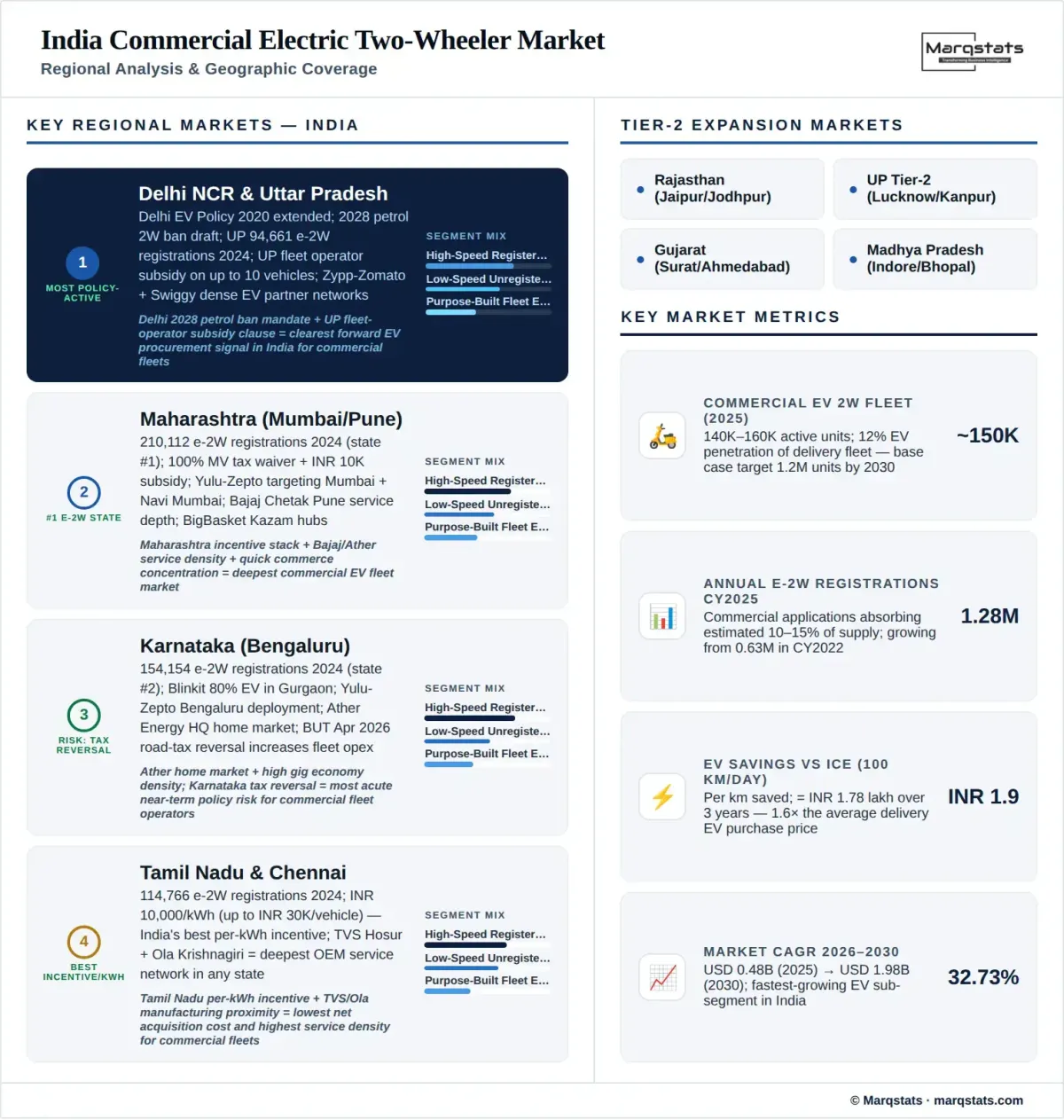
Delhi NCR and Uttar Pradesh
Delhi NCR is India's most policy-active commercial EV two-wheeler market. Delhi's proposed petrol two-wheeler registration ban from 2028 — included in the draft EV Policy 2.0 — would structurally mandate commercial fleet electrification in India's largest delivery market on a defined timeline, creating the clearest forward demand signal of any Indian state for commercial EV OEMs and fleet operators. Delhi's EV policy (extended to March 2026) provides incentives and tax relief that reduce commercial EV acquisition costs. Uttar Pradesh's EV policy is particularly significant for fleet aggregators: it explicitly allows aggregator and fleet operator buyers to claim purchase subsidies on up to 10 commercial vehicles, a provision unavailable in most other states. VAHAN data records 94,661 e-2W registrations in UP in 2024 — indicating significant EV fleet activity across the NCR-UP delivery corridor. Zomato and Swiggy both operate dense delivery networks across Delhi, Gurugram, Noida, and Lucknow, with EV partner programmes active across all these cities.
Maharashtra and Mumbai
Maharashtra is India's highest e-2W registration state with 210,112 registrations in 2024. The Maharashtra EV policy (April 2025–March 2030) provides 100% motor vehicle tax waiver and 10% of ex-factory cost up to INR 10,000 per electric two-wheeler — among the most generous state-level commercial EV incentives in India. The Yulu-Zepto shared EV deployment specifically targets Mumbai and Navi Mumbai as two of its five priority cities, validating Maharashtra's position as a top-tier commercial EV market. Bajaj Auto's headquarters in Pune and its strong Chetak EV dealer network provide commercial fleet operators in Maharashtra with better service coverage than most Indian states. BigBasket's 50-city EV deployment with Kazam charging infrastructure likely has heavy Maharashtra concentration given the state's quick commerce density.
Karnataka and Bengaluru
Karnataka recorded 154,154 e-2W registrations in 2024 — second nationally — with Bengaluru as the primary market. Blinkit has reported 80% EV penetration in its Gurgaon delivery fleet, and independent analyses suggest Bengaluru has comparably high EV fleet density given its tech-worker gig economy concentration and Ather Energy's home market presence. Karnataka's commercial EV risk is policy reversal: April 2026 reporting indicates the state planned road tax on EVs under an Amendment Act, which would directly increase commercial fleet operating costs and potentially delay EV conversion decisions by fleet operators. Ather Energy's Bengaluru headquarters and dense service network give the state a distinct commercial EV service advantage — critical for fleet operators who need rapid turnaround on vehicle downtime.
Tamil Nadu and Chennai
Tamil Nadu's EV policy 2023 provides INR 10,000/kWh incentive for electric two-wheelers up to INR 30,000 per vehicle — the most generous per-kWh incentive structure in India. Tamil Nadu recorded 114,766 e-2W registrations in 2024. TVS Motor Company's manufacturing base in Hosur (Tamil Nadu) and Ola Electric's Krishnagiri plant give commercial fleet operators in Tamil Nadu the deepest OEM service infrastructure of any Indian state. Chennai is a significant food delivery and e-commerce logistics market, with Swiggy, Zomato, Amazon, and Flipkart all operating major delivery fleets. The combination of strong state incentives and best-in-class OEM service makes Tamil Nadu a high-potential commercial EV fleet market.
Tier-2 Cities — The Next Growth Frontier
Tier-2 cities — Lucknow, Jaipur, Coimbatore, Surat, Indore, Patna, Bhopal, Agra, Nagpur — are the fastest-growing segment for commercial EV two-wheeler deployment, driven by quick commerce dark-store expansion and e-commerce platform penetration. Blinkit is targeting 2,000+ stores by December 2026, with a significant portion of new stores in Tier-2 cities. Zepto has expanded to 60+ cities including multiple Tier-2 markets. In these cities, the commercial EV infrastructure (public charging, swap stations, service centres) is significantly less mature than in Tier-1 metros — making ICE fleet the near-term default and EV the medium-term aspiration as infrastructure follows platform expansion. The state policies of Uttar Pradesh and Rajasthan (76,735 e-2W registrations in 2024) are specifically relevant for Tier-2 commercial EV fleet operators in these states.
How Competition Is Evolving
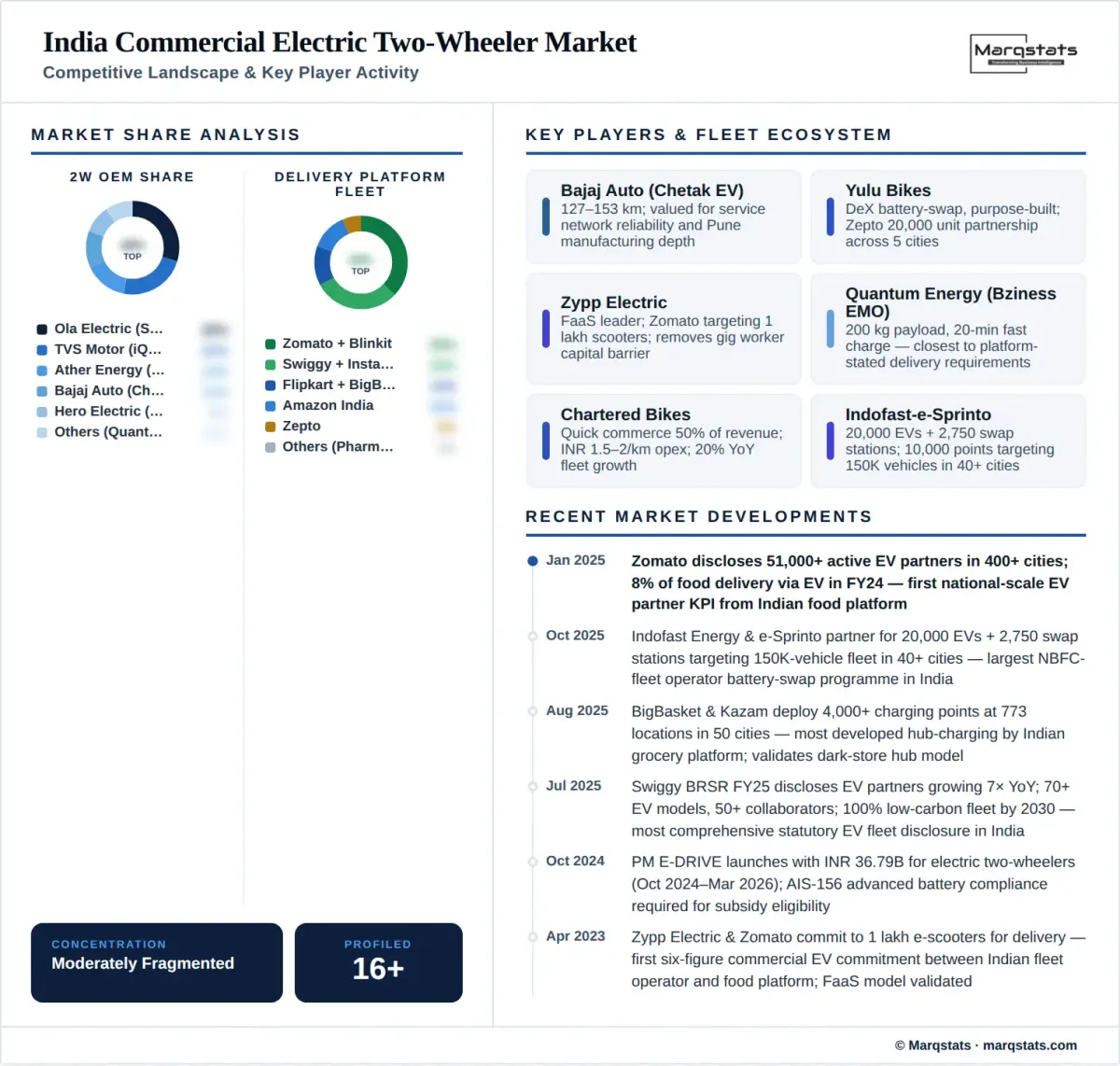
The India commercial electric two-wheeler market is structured around three interacting competitive layers: OEMs supplying delivery-suitable EV models, fleet operators and FaaS companies enabling capital-light EV access for gig workers, and platforms driving EV fleet demand through commitments, in-app enablement, and partner ecosystem development. Unlike consumer EV markets, commercial EV two-wheeler competition is not primarily determined by retail brand preference — it is determined by OEM-platform partnerships, fleet operator service reliability, battery technology (charging speed, payload, durability), and ecosystem infrastructure (swap network density, hub charging access, NBFC financing integration).
At the OEM level, TVS Motor holds the strongest commercial EV partnership track record — having signed formal MoUs with both Swiggy (January 2022, delivery EV testing and need-specific vehicle development) and Zomato (10,000+ scooter deployment plan, June 2023). Ola Electric commands the highest volume in the addressable EV segment with the S1X Gen3 but has faced quality and service network concerns that commercial fleet operators weight heavily. Ather Energy, while premium-priced, offers the strongest corporate fleet programme with telematics, extended warranties, and service infrastructure. Hero Electric, Bajaj, and Quantum Energy serve different points of the commercial EV price-feature spectrum. Among FaaS operators, Zypp Electric and Yulu Bikes are the scale leaders by fleet size and platform partnership depth. Independent assessments of the competitive landscape consistently identify charging infrastructure reliability — not vehicle price — as the primary commercial EV fleet retention driver, favouring OEMs and FaaS operators with hub charging and swap partnerships over those relying solely on home-charging models.
The platform layer — Zomato (including Blinkit), Swiggy (including Instamart), Zepto, Amazon India, and Flipkart — exercises significant structural power over the commercial EV two-wheeler market: platform EV fleet commitments determine the forward demand schedule, platform in-app features (EV rental discovery, charging discovery, NBFC financing links) determine rider access pathways, and platform procurement partnerships determine which OEMs and fleet operators gain volume scale. Industry analyses indicate the competitive advantage in this market will ultimately accrue to OEMs and fleet operators that can combine delivery-grade vehicle performance with platform-integrated rider support (financing, charging, swap) and institutional-quality service SLAs — a combination no single player has fully achieved as of 2025.
Companies Covered
Companies covered in the report include:
Recent Market Activity
Table of Contents
Coverage & Segmentation
This report covers the India commercial electric two-wheeler market over the 2021–2030 study period, with 2025 as base year. It encompasses all battery electric scooters, mopeds, and motorcycles — both high-speed registered (above 250W, requiring VAHAN registration) and low-speed unregistered (up to 250W, 25 km/h) — deployed in paid commercial delivery and mobility applications. Three vehicle access models are covered: rider-owned and financed EVs, fleet-as-a-service rental EVs, and battery-swap shared EVs. Applications covered include food delivery, grocery and quick commerce, parcel and e-commerce logistics, pharmaceutical delivery, and bike-taxi. Geographic coverage spans Delhi NCR, Maharashtra, Karnataka, Tamil Nadu, and Tier-2 city expansion markets. Policy analysis is centred on PM E-DRIVE, FAME-II, state EV policies (Delhi, UP, Maharashtra, Karnataka, Tamil Nadu), AIS-156 battery standards, and PM E-DRIVE charging infrastructure guidelines (EVCI-2024). Three forecast scenarios (conservative, base, aggressive) with explicitly stated assumptions are provided for the 2026–2030 period. Primary research includes 40+ interviews with fleet operators, OEM commercial fleet teams, platform EV programme managers, NBFC fleet financing executives, and government officials.