Market Snapshot
Key Takeaways
Market Overview & Analysis
Report Summary
The India electric two-wheeler portable charger market comprises charging hardware supplied with, or sold for, high-speed electric two-wheelers. The category includes original-equipment plug-and-play portable chargers, fixed-cum-portable home units, off-board socket chargers and public direct-current fast chargers rated for two-wheelers. Onboard chargers integrated within the vehicle powertrain, battery-swap cabinets and four-wheeler charging hardware fall outside the defined scope.
India recorded electric two-wheeler sales rising from 39,845 units in FY2020-21 to 11.5 lakh units in FY2024-25, a near thirty-fold increase across the historical period, per Society of Indian Automobile Manufacturers data. Electric two-wheelers accounted for close to 58% of total electric vehicle registrations in FY2024-25 and crossed 6% penetration of the overall two-wheeler market. Each high-speed unit ships with a portable charger, which links charger volume directly to vehicle shipments. Calendar-year 2025 retails were higher still at approximately 1.28 million units.
The 2025 market is estimated at USD 82 million across approximately 1.55 million charger units. Original-equipment bundled chargers represent the largest share by value, followed by fixed home chargers and public fast chargers. Demand is increasing owing to vehicle base expansion, government incentive support and a maturing public charging network. Forecast value reaches USD 258 million by 2030 as the installed two-wheeler base crosses 22 million units and the product mix shifts toward higher-wattage home and fast-charging hardware.
Charger attach economics define the market structure. TVS Motor Company Limited supplies a 650 W or 950 W plug-and-play portable charger with the iQube, plugged into a standard 15 A domestic socket, with the charger included in the vehicle cost. Ather Energy Limited sells the 700 W Duo charger, usable as a fixed or portable unit, at ₹9,999. Ola Electric Mobility Limited ships a 700 W portable charger that plugs into a 5 A socket and offers a Home Hypercharger positioned as 76% faster at ₹31,499. Bajaj Auto Limited specifies 750 W to 950 W onboard chargers across Chetak variants, Hero MotoCorp Limited supplies a 5 A portable charger with the Vida V2, and Greaves Electric Mobility Limited ships a 7.4 A portable charger with the Ampere Magnus Neo. These specifications confirm a near-universal attach rate for high-speed electric two-wheelers.
The value chain spans cell and power-electronics suppliers, charger assemblers, vehicle manufacturers and public network operators. Power-electronics suppliers such as IPEC India Private Limited, Uno Minda Limited and Exicom Tele-Systems Limited convert designs into manufactured chargers, vehicle manufacturers integrate and bundle the units, and network operators deploy public fast-charging hardware. Localization across this chain is deepening as suppliers scale domestic manufacturing capacity.
Regulatory and Standards Framework
The PM E-DRIVE scheme, approved with a ₹10,900 crore outlay for 1 October 2024 to 31 March 2026, provides demand incentives for electric two-wheelers and a ₹2,000 crore charging-infrastructure allocation. The scheme extended electric two-wheeler eligibility until 31 July 2026 and supported 19.19 lakh units as of January 2026. The infrastructure allocation targets 48,400 fast chargers for two- and three-wheelers, alongside 22,100 for four-wheelers and 1,800 for buses.
The IS 17017 series, published by the Bureau of Indian Standards, defines India’s conductive charging requirements. The IS 17017 Type-6 connector covers direct-current charging for light electric vehicles up to 120 V, while the IS 17017 Type-7 LECCS connector, approved in October 2023, provides a combined alternating-current and direct-current interface. The AIS-138 framework, administered by the Automotive Research Association of India, governs charging-interface safety. Adoption of the Type-7 connector spans Ather Energy Limited, Hero MotoCorp Limited and Bolt EV India Private Limited, supporting interoperability across more than 90% of electric two-wheelers.
Market Dynamics
Key Drivers
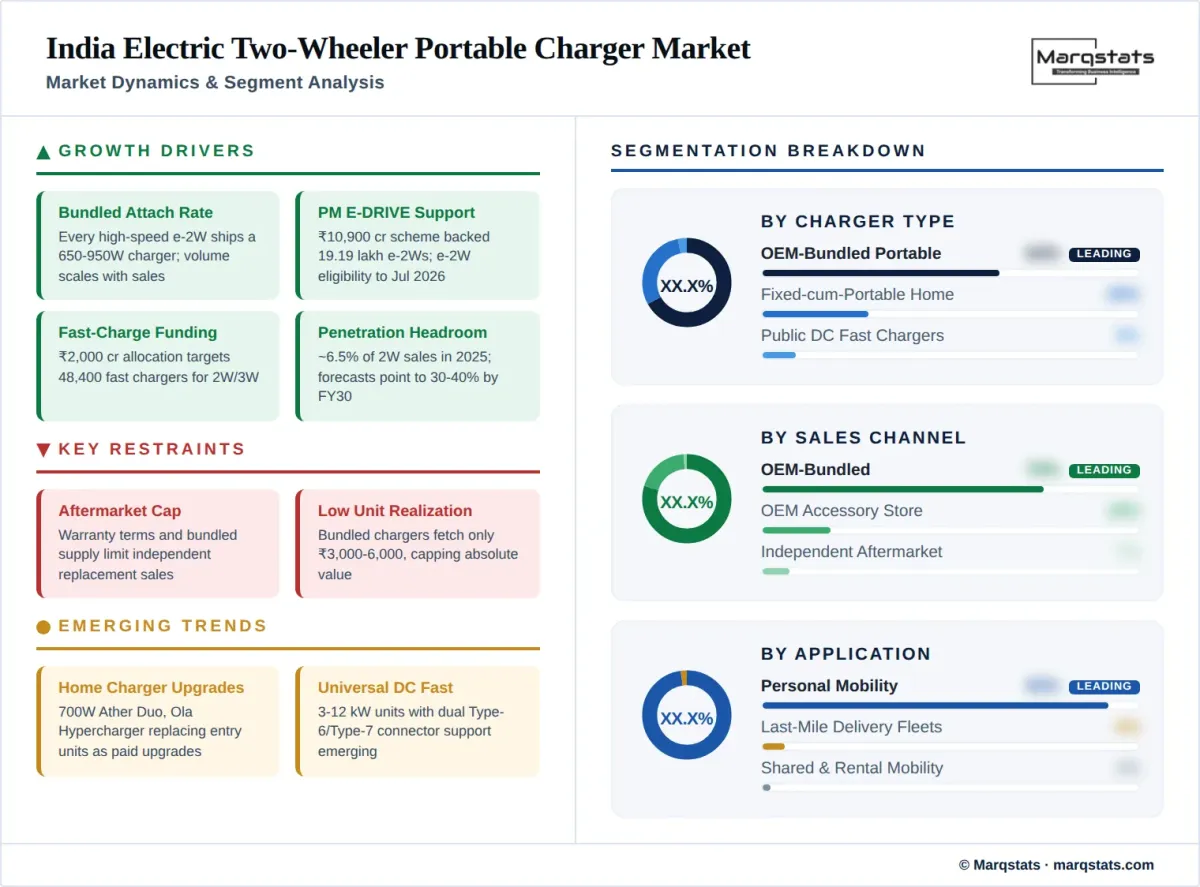
- Electric two-wheeler sales increased from 39,845 units in FY2020-21 to 11.5 lakh units in FY2024-25, with each high-speed unit shipping a bundled portable charger that scales charger demand with vehicle volume.
- The PM E-DRIVE scheme, with a ₹10,900 crore outlay, supported 19.19 lakh electric two-wheelers as of January 2026 and extended e-2W eligibility until 31 July 2026 under the Ministry of Heavy Industries.
- A dedicated ₹2,000 crore allocation funds 48,400 fast chargers for two- and three-wheelers, expanding the public charging base and seeding direct-current hardware demand.
- Electric two-wheelers held close to 6.5% penetration of total two-wheeler sales in 2025, leaving substantial headroom as central forecasts indicate 30% to 40% penetration by FY2029-30.
- Component localization is accelerating, with Ola Electric Mobility Limited approving a ₹20 billion investment in electric-vehicle and cell-technology units and Uno Minda Limited acquiring full control of its charger subsidiary.
- Public charging deployment reached 27,737 cumulative chargers by April 2026, broadening access and supporting demand for compatible home and portable chargers.
Key Restraints
- Bundled supply caps the independent aftermarket, as manufacturers include the charger within the vehicle cost and recommend approved chargers to preserve warranty cover.
- Per-unit realization for bundled chargers remains low at approximately ₹3,000 to ₹6,000, which constrains absolute market value despite high shipment volumes.
- The PM E-DRIVE demand incentive was reduced to ₹2,500 per kWh, capped at ₹5,000 per vehicle, from 1 April 2025, moderating subsidy support during the forecast period.
- Historical fragmentation across more than ten two-wheeler charging interfaces limited interoperability before the IS 17017 Type-7 standard was approved.
- Battery-swap services in the delivery-fleet segment reduce home-charging requirements for a share of commercial users, moderating charger demand in that channel.
Key Trends
- Higher-wattage home chargers, including the 700 W Ather Duo and the Ola Home Hypercharger, are replacing entry-level portable units as paid upgrades.
- Universal direct-current fast chargers for two- and three-wheelers, rated 3 kW to 12 kW, are entering the market with dual Type-6 and Type-7 connector support.
- Connected, application-managed chargers with over-the-air updates and scheduled charging windows are gaining adoption across home and public installations.
- Charger demand is broadening into tier-2 and tier-3 cities as public networks expand beyond metropolitan corridors.
- Manufacturer consolidation of charger sourcing, including Uno Minda Limited’s full acquisition of its charger subsidiary, is strengthening domestic supply and standardization.
Market Segmentation
These off-board plug-and-play units, rated 650 W to 950 W, ship with every high-speed electric two-wheeler and connect to standard 5 A and 15 A domestic sockets. The segment holds approximately 63% of market value in 2025 on a base of about 1.28 million units. TVS Motor Company Limited, Ola Electric Mobility Limited and Hero MotoCorp Limited anchor this segment, mirroring concentration within the India electric scooter and motorcycle market. Realization per bundled unit remains modest, which keeps segment value below its volume share. The TVS iQube ships a 650 W or 950 W charger, the Ola S1 a 700 W portable unit, and the Bajaj Chetak onboard chargers rated 750 W to 950 W.
Premium home units, such as the 700 W Ather Duo and the Ola Home Hypercharger, function as wall-mounted or portable chargers and command higher realization at ₹9,999 to ₹31,499. The segment accounts for close to 28% of value and is increasing owing to upgrade demand among existing owners. The Ather Duo operates as both a fixed and portable charger, while the Ola Home Hypercharger delivers up to 50 km of range in 23 minutes. Faster charging speed and connected features support a paid upgrade path beyond the bundled entry charger.
Direct-current units rated 3 kW to 12 kW serve public and semi-public sites and represent the fastest-growing segment. These chargers account for approximately 9% of value, supported by network expansion from Ather Grid, Bolt.Earth and the Ola Hypercharger network. The Bolt.Earth Blaze DC range supports both Type-6 and Type-7 connectors, making it compatible with most electric two-wheelers. Government infrastructure funding under PM E-DRIVE further accelerates deployment of two- and three-wheeler fast chargers.
Entry-level portable chargers rated up to 750 W represent close to 58% of unit volume, reflecting their standard inclusion with mass-market scooters. The TVS iQube 650 W charger and the Ola 700 W portable unit typify this band.
Premium home and fast home chargers in this band hold about 32% of volume, growing as manufacturers offer faster home charging. The 1,500 W TVS home fast charger and the Ola Home Hypercharger illustrate the upgrade tier within this range.
High-power direct-current units form roughly 2% of volume yet a disproportionately high share of value, owing to higher unit prices. The Bolt.Earth Blaze DC range spans 3 kW residential to 12 kW commercial installations.
Factory-fitted chargers included within the vehicle price account for approximately 75% of volume, forming the structural core of the market. This channel scales directly with electric two-wheeler shipments.
Manufacturer accessory channels, including the Ather and Ola stores, supply replacement and upgrade chargers and hold close to 18% of volume. This channel captures higher-value home charger sales and growing replacement demand from the expanding installed base.
Third-party and e-commerce channels represent about 5% of volume, constrained by warranty terms and bundled supply. Replacement units and lower-cost portable chargers form the bulk of this channel.
Personal commuting accounts for approximately 92% of charger demand, aligned with the dominant use case for electric two-wheelers across urban and semi-urban India. Home charging using the bundled portable unit serves most of this demand.
Last-mile delivery and e-commerce fleets represent close to 6% of demand, with operators favoring faster home and public charging for higher daily uptime. Fleet adoption supports demand for higher-wattage chargers.
Shared and rental mobility services account for about 2% of demand, concentrated in metropolitan markets where public fast charging supports high daily utilization.
By Geography
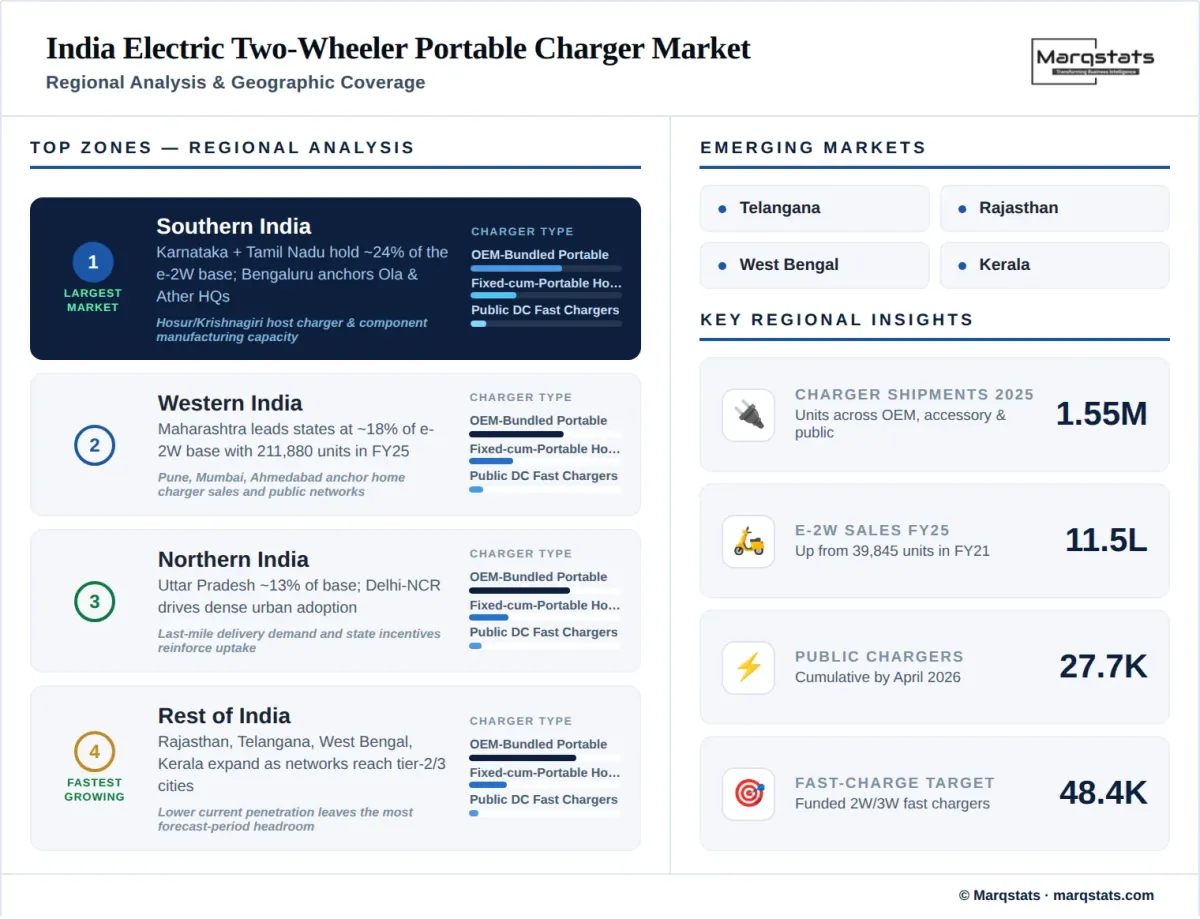
Western India
Maharashtra holds the largest state share at approximately 18% of the electric two-wheeler base, with 211,880 units registered in FY2024-25. Gujarat adds further demand, supported by manufacturing clusters and urban adoption across Pune, Mumbai and Ahmedabad. The region anchors both home charger sales and public network deployment.
Southern India
Karnataka and Tamil Nadu together account for close to 24% of the electric two-wheeler base. Bengaluru anchors charger demand as the headquarters of Ola Electric Mobility Limited and Ather Energy Limited, while Tamil Nadu hosts charger and component manufacturing capacity at Hosur and Krishnagiri. Southern states record among the fastest charger uptake nationally.
Northern India
Uttar Pradesh holds approximately 13% of the electric two-wheeler base, supported by last-mile delivery demand and state incentives. Delhi-NCR contributes dense urban adoption and an expanding public charging footprint, reinforcing demand for both home and fast chargers.
Rest of India
Rajasthan, Telangana, West Bengal and Kerala form the remaining demand, with charger uptake increasing owing to public network expansion into tier-2 and tier-3 cities. Eastern and central states record lower penetration today, leaving headroom for forecast-period growth.
How Competition Is Evolving
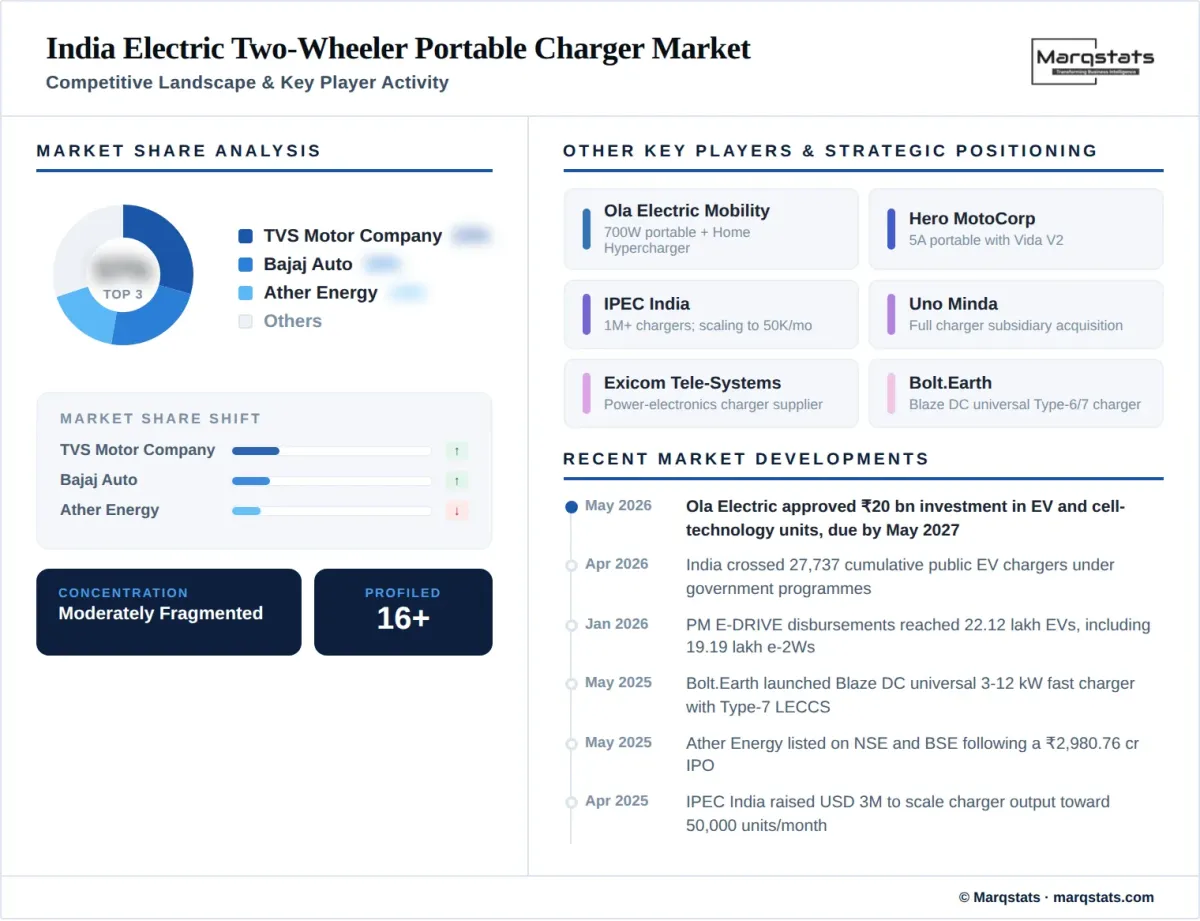
The market is moderately fragmented and stratifies into four layers. Original-equipment manufacturers control bundled charger supply, a tier of power-electronics suppliers serves manufacturing and accessory channels, public network operators deploy fast-charging hardware, and a thin independent aftermarket addresses replacement demand. The top original-equipment manufacturers account for close to 80% of electric two-wheeler shipments, which concentrates bundled charger supply within a small group of vehicle makers.
TVS Motor Company Limited held the largest electric two-wheeler share at 24.36% in FY2025-26, followed by Bajaj Auto Limited, Ather Energy Limited and Ola Electric Mobility Limited. Each manufacturer specifies its own portable charger, sourced from suppliers such as IPEC India Private Limited, Uno Minda Limited and Exicom Tele-Systems Limited. Competition among suppliers centers on cost, manufacturing scale and standards compliance, with several scaling capacity toward 50,000 units per month and beyond.
Public charging operators compete on network coverage and connector compatibility. Ather Grid operates more than 5,000 fast chargers across 395 cities, Bolt.Earth runs over 100,000 chargers across 1,900 cities, and the Ola Hypercharger network operates 288 stations. Strategic activity includes Ather Energy Limited’s market listing in May 2025 and Bolt.Earth’s launch of a universal direct-current fast charger supporting both Type-6 and Type-7 connectors. Supplier consolidation, exemplified by Uno Minda Limited’s full acquisition of its charger subsidiary, signals deepening localization.
The supplier tier is expanding capacity to serve bundled and aftermarket demand. IPEC India Private Limited has shipped more than 1 million chargers and is scaling toward 50,000 units per month, supplying Ather, Bajaj and Ampere. Exicom Tele-Systems Limited targets a higher revenue contribution from electric-vehicle chargers by 2030, and Servotech Renewable Power Systems Limited is expanding power-module capacity. The independent aftermarket remains thin, with manufacturer accessory stores capturing most replacement and upgrade sales, which concentrates higher-value charger revenue within original-equipment channels.
Companies Covered
The report profiles 16++ companies with full strategy and financials analysis, including:
Recent Market Activity
Table of Contents
Coverage & Segmentation
This report analyzes the India electric two-wheeler portable charger market across the 2021–2025 historical period, a 2025 base year, and the 2026–2030 forecast period. The study quantifies market size in value and volume, segments demand by charger type, power output, sales channel, application and state, and profiles the original-equipment, supplier and network layers. Market sizing follows a bottom-up approach calibrated to vehicle shipment data and validated against top-down estimates. Forecasts present base, conservative and accelerated scenarios reflecting subsidy continuity, standards adoption and vehicle penetration.
The scope covers portable, home, off-board and public direct-current chargers rated for two-wheelers. Coverage includes regulatory analysis of the PM E-DRIVE scheme, the IS 17017 standards series and the AIS-138 framework. The report excludes integrated onboard chargers, battery-swap infrastructure and four-wheeler charging hardware except where products are dual-rated for two-wheeler use.