Market Snapshot
Key Takeaways
Market Overview & Analysis
Report Summary
This analysis sizes the global vehicle-to-grid micro-transaction settlement engine market as the aggregate software monetization layer clearing financial settlement for bidirectional electric vehicle charging transactions, encompassing recurring per-port subscription fees and variable clearing fees levied per megawatt-hour of flexibility transacted across wholesale, ancillary and local distribution markets. The market is built from three empirical foundations: physical bidirectional charger deployment data from the V2G Hub registry and the European Alternative Fuels Observatory, platform monetization parameters derived from reported financial disclosures of commercial aggregators, and a forecast horizon pegged to statutory enforcement dates including the EU Alternative Fuels Infrastructure Regulation. The market is sized in USD across a 2021-2025 historical period and a 2026-2031 forecast period, with 2025 as the base year.
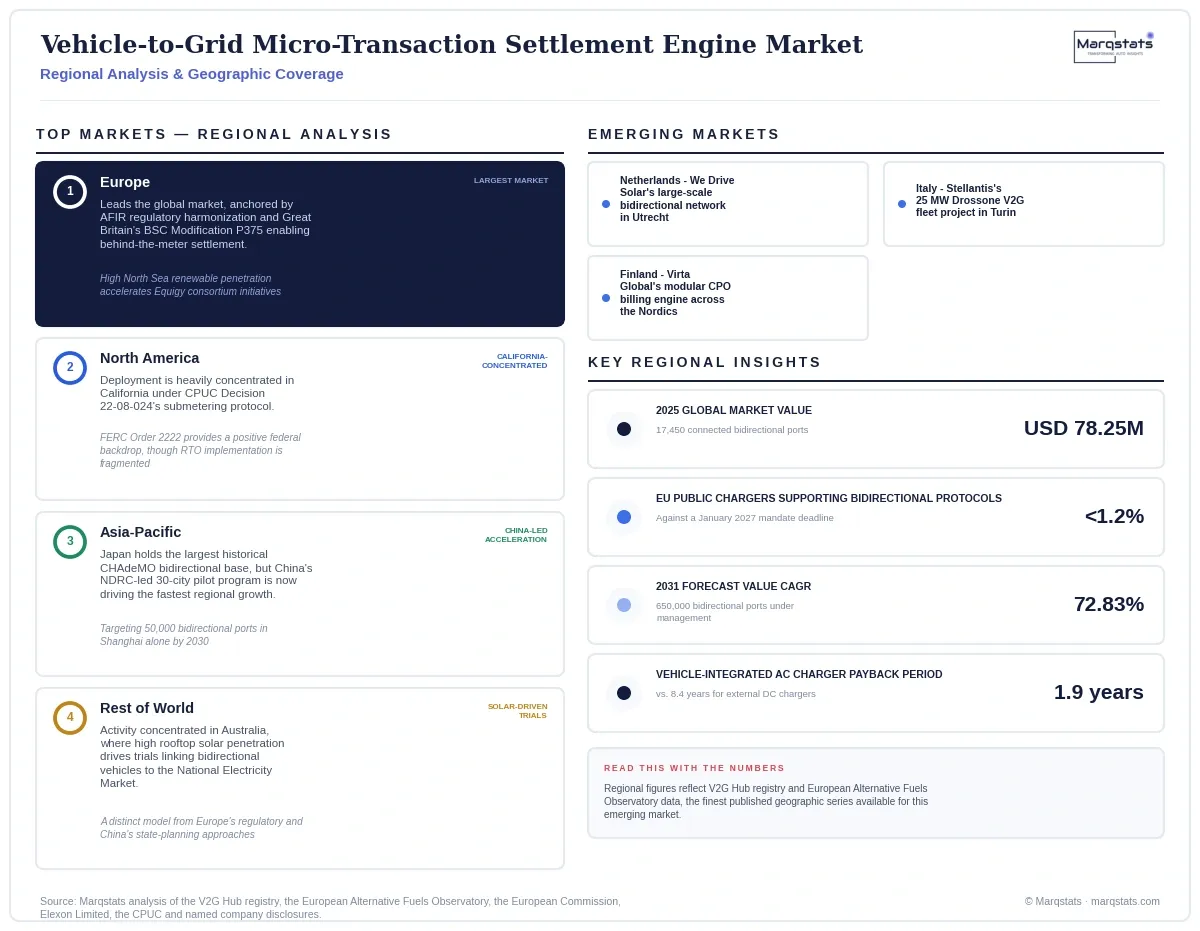
The global V2G settlement engine market grew from USD 14.85 million in 2021 to USD 78.25 million in 2025, a 51.51% compound annual growth rate, and is projected to reach USD 2.085 billion by 2031, a 72.83% compound annual growth rate. This acceleration reflects a genuine inflection point tied to regulatory enforcement dates rather than organic technology adoption alone: connected bidirectional ports expand from 17,450 units in 2025 to 650,000 by 2031, an 82.75% unit compound annual growth rate that outpaces value growth as the average settlement clearing fee compresses under economies of scale from USD 6.80 to USD 5.00 per megawatt-hour.
The base-case 2030 forecast trajectory assumes the European Commission maintains its statutory schedule under Regulation (EU) 2023/1804 enforcing bidirectional capability from January 2027, Great Britain's Market-wide Half-Hourly Settlement reform completes its cloud migration by 2026, and major California utilities complete automated billing integration under CPUC Resolution E-5274 by 2028. The binding upside condition is whether the European Union adopts a binding directive abolishing double taxation on grid re-injection across all member states while the United States mandates bidirectional capability on federally subsidized charging infrastructure; the binding downside condition, now independently corroborated by industry body CharIN's formal submission to the European Commission questioning the technical feasibility of the January 2027 deadline, is whether persistent smart meter rollout delays and unresolved AC conformance test standards compel Brussels to delay the AFIR bidirectional mandate beyond 2029.
Market Dynamics
Key Drivers
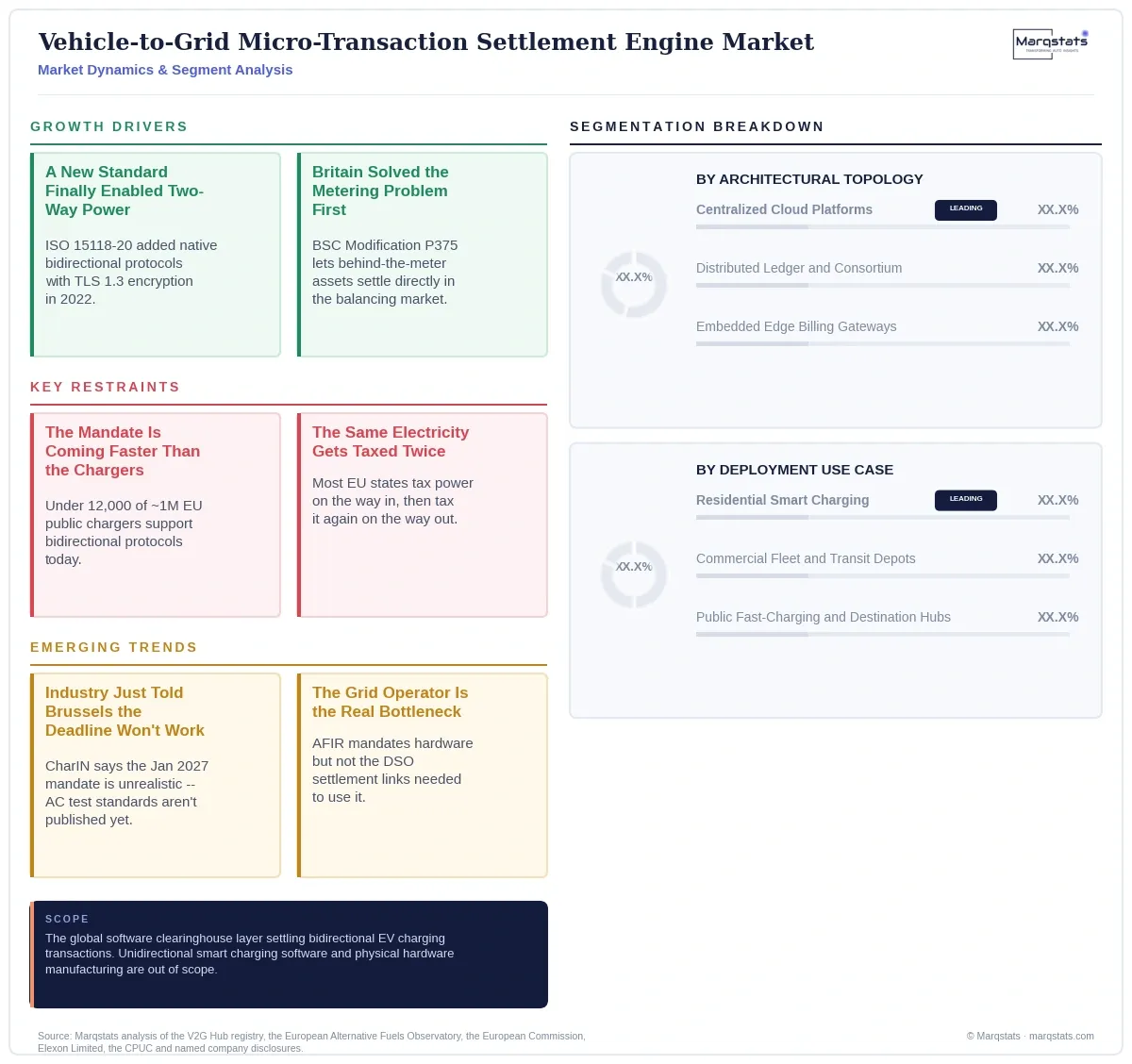
- The maturation of ISO 15118-20, published in 2022, established native protocol definitions for bidirectional power transfer with Transport Layer Security version 1.3 encryption and multi-contract certificate handling, resolving the structural limitation of its predecessor ISO 15118-2 that confined communication to unidirectional power delivery under the Plug & Charge framework.
- Great Britain's Balancing and Settlement Code Modification P375, approved by Ofgem in February 2021 and implemented in June 2022, allows secondary asset metering installed behind a property's primary utility boundary to be recognized directly for wholesale balancing settlement, resolving a demarcation failure that otherwise prevents market operators from distinguishing vehicle-exported energy from a host site's baseline electrical consumption.
- California's CPUC Decision 22-08-024, reinforced by Resolution E-5274 in June 2023, requires the state's three major investor-owned utilities to settle EV charging and discharging sessions using customer-owned submeters embedded directly within charging hardware, eliminating the requirement for an expensive secondary physical utility meter.
- Electrochemical modeling by Sagaria et al. demonstrates that controlled vehicle-to-grid cycling adds only 1% to 3% of incremental battery degradation over a ten-year operational lifetime, since calendar aging governed by ambient temperature and static state of charge accounts for 70% to 85% of total lithium-ion wear, allowing net customer earnings to remain positive after fully depreciating cell wear.
- OpenADR 3.0, released by the OpenADR Alliance in November 2023, replaces the complex XML data models of legacy OpenADR 2.0b with a lightweight RESTful application programming interface using JSON formatting, enabling grid operators to broadcast dynamic pricing curves and grid constraint envelopes to charging station backends with substantially lower software implementation overhead.
Key Restraints
- Regulation (EU) 2023/1804 requires bidirectional hardware capability from newly installed chargers starting January 2027, but establishes no corresponding obligation on distribution system operators to provide automated digital submeter settlement interfaces, creating an estimated 18 to 24 month operational lag during which millions of newly compliant chargers will remain functionally dormant for grid balancing.
- Double taxation on stored electricity persists in many European Union member states, where energy imported into a vehicle battery is classified as final consumption subject to excise duties and value-added tax, and the same electricity is taxed again when discharged back into the distribution network, a barrier only France has fully resolved through coordinated regulatory clarification.
- High-margin fast frequency ancillary grid services require settlement engines to maintain telemetry polling frequencies below four seconds and guarantee high platform availability, technical requirements fewer than a fifth of existing charging networks can physically deliver, confining most operators to lower-margin wholesale spot arbitrage generating only modest annual per-vehicle revenue.
- Germany's persistent delay in revising Section 19 of the Electricity Grid Fee Ordinance and the sluggish national rollout of statutory Smart Meter Gateway infrastructure continue to subject bidirectional charging to double grid fees, preventing commercial mass-market V2G rollout in Europe's largest automotive market despite full technical readiness.
Key Trends
- The gap between AFIR's statutory bidirectional hardware mandate and actual European charging infrastructure capability is a genuinely severe implementation risk rather than a routine compliance lag: fewer than 12,000 of roughly 1,000,000 EU public chargers natively support bidirectional protocols today, and industry body CharIN has formally told the European Commission the January 2027 enforcement date is not technically realistic given that official AC conformance test standards remain unpublished.
- Distribution system operators, not vehicle battery chemistry or charging hardware cost, represent the binding structural constraint on V2G market scaling, since AFIR imposes hardware-level obligations on manufacturers and charge point operators without requiring DSOs to build the corresponding automated submeter settlement interfaces the market needs to actually clear bidirectional transactions.
- National fiscal policy divergence within the European Union, illustrated by France's successful elimination of double taxation on grid re-injection against Germany's unresolved Section 19 Electricity Grid Fee Ordinance, demonstrates that regulatory clarity, not technical readiness, determines which national markets achieve genuine commercial V2G scale first.
- Vehicle-integrated bidirectional AC charging hardware, carrying a 1.9-year simple payback period against 8.4 years for external bidirectional DC chargers, is emerging as the dominant near-term commercialization pathway for mass-market residential deployment, a cost asymmetry automotive OEMs including Renault and Ford have already begun exploiting through bundled retail energy contracts.
- China's National Development and Reform Commission is scaling V2G deployment through a fundamentally different mechanism than Europe's market-based aggregator model, launching 30 city-scale pilot projects directly coordinated by state planning authority and targeting 50,000 bidirectional ports in Shanghai alone by 2030, a pace that could position China as the largest single national V2G market within the forecast horizon.
Strategic Implications
For a software platform developer entering the V2G settlement domain, modular microservice architecture compliant with OpenADR 3.0, OCPP 2.1 and localized asset-metering standards such as Elexon P375 and California's EVSMP is essential, since wholesale balancing codes and distribution tariffs remain fragmented along national and state borders and no single global clearing algorithm can accommodate every jurisdiction without a customized adaptation layer.
For an electric utility or distribution system operator, immediate modernization of meter data management infrastructure is required to move beyond monthly batch processing of primary boundary meters, since millions of high-frequency fractional transactions generated by aggregated vehicle batteries cannot be settled under legacy billing cycles; adopting a consortium distributed ledger model similar to Equigy provides an auditable mechanism to coordinate multi-party balancing without building custom bilateral integrations with every commercial aggregator.
For an automotive original equipment manufacturer, embedding native bidirectional AC hardware and ISO 15118-20 communication into mass-market vehicles, following Renault Group's Mobilize V2G bundle with The Mobility House, allows bundled retail energy contracts that lower total cost of ownership; manufacturers that delay bidirectional power electronics or restrict battery warranties to proprietary closed-loop ecosystems risk losing competitive position to models offering subsidized home charging through automated grid flexibility participation.
Outlook
Base case: USD 2.085 billion by 2031 (72.83% six-year value CAGR), managing 650,000 active bidirectional settlement ports and clearing 10,218.0 gigawatt-hours of annual flexibility. This trajectory assumes the European Commission maintains its statutory AFIR enforcement schedule, Great Britain's Market-wide Half-Hourly Settlement reform completes its cloud migration by 2026, major California utilities complete automated submetering billing integration by 2028, and the global light-duty electric vehicle fleet reaches 180 to 200 million units with bidirectional AC capability standard on at least 15 mass-market nameplates.
Upside case: an accelerated trajectory exceeding the base case, with active bidirectional ports and annual cleared flexibility both surpassing base-case projections. The specific trigger is the European Union adopting a binding directive abolishing double taxation on grid re-injection across all 27 member states by late 2026, replicating France's regulatory framework, combined with United States federal mandates requiring bidirectional capability on federally subsidized charging infrastructure and global standardization of ISO 15118-20 Plug & Charge profiles across both Combined Charging System and NACS connector standards.
Downside case: a materially contracted trajectory managing far fewer active bidirectional endpoints and clearing substantially less flexibility than the base case. The specific trigger, now independently corroborated by industry body CharIN's formal submission questioning the technical feasibility of the January 2027 AFIR deadline, is persistent supply chain bottlenecks and smart meter rollout delays in Germany and Central Europe compelling the European Commission to delay the binding bidirectional mandate beyond 2029, combined with national tax authorities maintaining legacy double taxation structures and major automotive OEMs restricting bidirectional warranties to proprietary closed-ecosystem DC hardware.
Market Segmentation
Centralized cloud platforms account for the majority of 2025 market value, deployed by aggregators including The Mobility House, Kraken Technologies and Kaluza, which concentrate computational logic, market interfaces and financial ledgers within enterprise cloud environments; while providing straightforward integration with wholesale power brokers via OpenADR, this topology incurs higher data egress costs and depends on uninterrupted broadband connectivity for time-critical dispatches.
Distributed ledger and consortium architectures, championed by the Equigy consortium across five European transmission operators, replace centralized third-party data custody with a shared cryptographic state machine, allowing transmission and distribution operators and commercial aggregators to clear device-level flexibility delivery without exposing commercially sensitive customer data to rival market participants.
Embedded edge billing gateways, led by hardware-software providers including IoTecha, execute billing validation, cryptographic signature generation and local energy optimization directly on the charging station microcontroller, eliminating network latency for mission-critical microgrid applications and enabling local sub-second settlement during utility network outages.
Residential applications represent the largest share of active settlement endpoints, characterized by long dwell times frequently exceeding twelve hours overnight, low and stable AC discharge rates, and high price sensitivity; the settlement engine in this setting optimizes rooftop solar self-consumption, executes time-of-use rate arbitrage, and passes automated energy bill credits directly to the homeowner.
Commercial fleet and transit depots comprise a substantial share of managed bidirectional capacity, representing an ideal V2G environment due to standardized vehicle operational duty cycles, high battery capacities, and centralized multi-megawatt grid interconnections; electric school bus fleets managed by providers including Nuvve Holding Corp. present a particularly attractive use case, since large battery packs remain parked during late afternoon hours and summer months coinciding with peak electricity demand.
Public fast-charging and destination hubs deployed in municipal parking plazas, shopping centers and highway corridors make up the remaining share of deployed endpoints, requiring rapid clearing capabilities and instant driver compensation credits via roaming protocols such as the Open Charge Point Interface, allowing roaming drivers to offset public charging costs by injecting power during brief parking periods.
By Geography
Europe
Europe leads the global V2G settlement engine market, anchored by regulatory harmonization under the Alternative Fuels Infrastructure Regulation mandating ISO 15118-20 bidirectional capability by 2027, alongside progressive market codes including Great Britain's Elexon BSC Modification P375, which enables behind-the-meter secondary asset settlement; high renewable penetration across the North Sea grid zone has further accelerated multi-transmission-system-operator consortium initiatives including Equigy to balance volatile wind generation using aggregated vehicle batteries.
North America
North America's deployment is heavily concentrated in California, where CPUC Decision 22-08-024 establishing the Plug-in EV Submetering Protocol has eliminated the requirement for separate physical utility meters, while federal FERC Order 2222 requires regional transmission organizations to open wholesale capacity and ancillary services to distributed energy aggregations, though regional implementation timelines across individual RTOs remain fragmented.
Asia-Pacific
Japan maintains the world's largest historical baseline of bidirectional chargers, with over 10,000 units deployed under the CHAdeMO standard, though the Japanese market has historically focused on vehicle-to-home emergency backup and disaster resilience rather than dynamic wholesale micro-settlement; growth in the region is now led by China, where the National Development and Reform Commission initiated 30 city-level V2G pilot projects across nine metropolitan areas in 2025, targeting 50,000 bidirectional ports in Shanghai alone by 2030.
Rest of World
Rest of World activity is concentrated in Australia, where high residential rooftop solar penetration has driven trials linking bidirectional vehicles to the National Electricity Market to mitigate grid instability and avoid daytime renewable curtailment, a market dynamic distinct from Europe's regulatory-driven and China's state-planning-driven deployment models.
How Competition Is Evolving
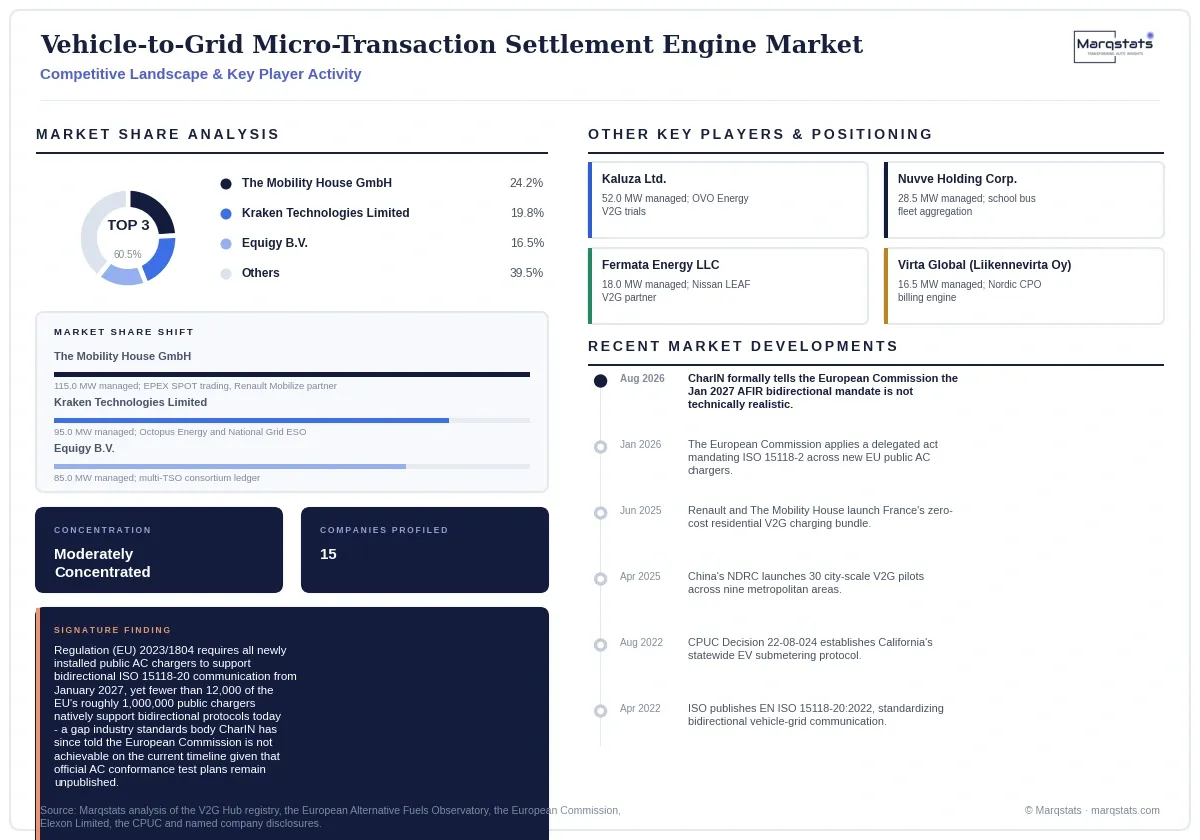
The V2G settlement engine market is moderately concentrated: The Mobility House GmbH leads with 24.2% of 2025 market share, followed by Kraken Technologies Limited at 19.8% and Equigy B.V. at 16.5%, together capturing 60.5% combined share, while the remaining market is split among Kaluza, Nuvve, Fermata Energy, Virta Global, and a collection of proprietary regional engines operated by state utilities in China, Japan and the United States.
Competitors differentiate primarily on architectural topology and market access; centralized cloud platforms including The Mobility House and Kraken compete on multi-market trading sophistication and wholesale exchange integration, the Equigy consortium competes on cross-border TSO-DSO interoperability without exposing proprietary customer data, and fleet-focused aggregators including Nuvve and Fermata Energy compete on depot-specific vertical integration with commercial fleet enterprise resource planning systems.
The most significant recent competitive-landscape development is the consortium expansion of Equigy B.V., founded in December 2020 by TenneT, Swissgrid and Terna and subsequently joined by Austrian Power Grid and TransnetBW in 2022, alongside Renault Group and The Mobility House's June 2025 launch of the Mobilize V2G residential bundle in France, the world's first commercial zero-cost residential charging contract built on automated day-ahead and intraday EPEX SPOT trading.
Companies Covered
The report profiles 15+ companies with full strategy and financials analysis, including:
Recent Market Activity
Table of Contents
Coverage & Segmentation
Coverage spans the global vehicle-to-grid micro-transaction settlement engine market, defined as the software clearinghouse layer bridging onboard vehicle systems, physical charging hardware, distribution system operators, transmission system operators and wholesale power exchanges to execute financial settlement for bidirectional charging transactions. The market is sized in USD across a 2021-2025 historical period and a 2026-2031 forecast period, with 2025 as the base year. Two segmentation dimensions are quantified: architectural topology and deployment use case.
Excluded from scope: unidirectional smart charging management software that does not clear bidirectional financial settlement; physical bidirectional charging hardware manufacturing, covered by separate component-level analysis; and vehicle battery cell manufacturing economics, addressed only insofar as degradation modeling affects settlement engine total-cost-of-ownership calculations. A separate Marqstats study addresses the global second-life EV battery storage market on a comparable basis.