Market Snapshot
The US compact unibody pickup market size is estimated at USD 6,003.51 million in 2025 and is projected to reach USD 7,432.84 million by 2030, growing at a CAGR of 4.36% over 2026 – 2030. Unit sales move from 180,550 to 206,000 pickups, a 2.67% annual rate, while the average sticker price per pickup rises from about USD 33,251 to USD 36,082. The path is not a straight line: volume dips to 167,500 units in 2027, when the Hyundai Santa Cruz leaves the market, and recovers as the Ram Rampage arrives in 2028.
Marqstats defines the market as new pickup trucks with a unitized body built on a passenger-car platform and sold in the United States to retail and fleet buyers, namely the Ford Maverick, the Hyundai Santa Cruz and, from 2028, the Ram Rampage. Value is the manufacturer suggested retail price including destination, weighted by trim mix, before options, dealer adjustments, incentives, taxes and registration fees. Mid-size unibody pickups such as the Honda Ridgeline, body-on-frame mid-size pickups, full-size pickups and imported mini trucks are excluded.
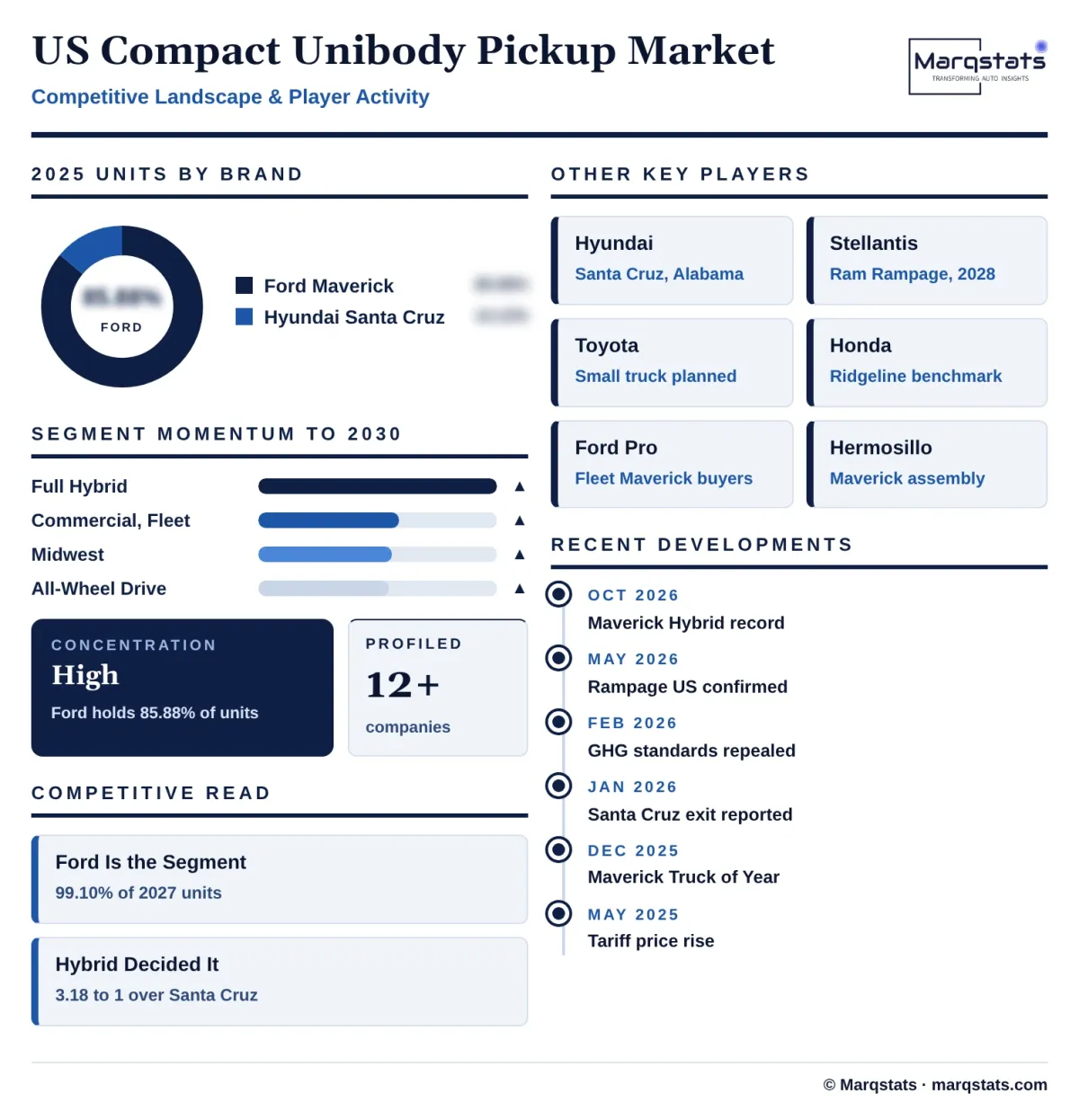
Full hybrid pickups account for 44.88% of 2025 units and 43.21% of value, all-wheel drive for 64.35% of units, and the South for 35.00% of value. Ford sold 155,051 Maverick pickups in 2025, 85.88% of the segment, and by 2030 the full hybrid share of units rises to 55.46%.
Key Takeaways
Market Overview & Analysis
Report Summary
Marqstats sizes the US compact unibody pickup market as the sticker value of new unibody pickups built on passenger-car platforms and sold in the United States. In 2025 the segment delivered 180,550 pickups worth an estimated USD 6,003.51 million at an average of about USD 33,251 per vehicle. The two nameplates in the market are the Ford Maverick, built at the Hermosillo Stamping and Assembly Plant in Sonora, Mexico, and the Hyundai Santa Cruz, built by Hyundai Motor Manufacturing Alabama in Montgomery, Alabama.
The unit base is taken from company sales releases. Ford Motor Company reported 155,051 Maverick sales in the United States in 2025, up from 131,142 in 2024, of which 81,034 were Maverick Hybrid. Hyundai Motor America reported 25,499 Santa Cruz sales, down 20% from 32,033. The segment therefore delivered 180,550 units, up 10.65% from 163,175, and the Maverick took 85.88% of them. The Honda Ridgeline sold 48,448 units in 2025, up 6.7%, but it is a mid-size unibody with a V6 engine and a higher price, so Marqstats keeps it as a benchmark and leaves it out; compact models are 78.84% of the 228,998 unibody pickups sold.
Both nameplates share a simple recipe: a car platform, a four-door cab, a short bed and a price near the entry level of the pickup market. The Maverick sits on the Ford C2 platform shared with the Bronco Sport and Escape, and the Santa Cruz is built on the Tucson platform. Ford offers a 2.5 litre full hybrid as the base powertrain and a 2.0 litre turbocharged EcoBoost petrol engine with all-wheel drive. Hyundai offers petrol engines only, a 2.5 litre naturally aspirated unit and a 281 horsepower turbocharged unit that comes with all-wheel drive on the XRT and Limited trims.
The segment grew from 23,300 units in 2021 to 180,550 in 2025, and Marqstats estimates its value rose from USD 654.20 million in 2021 to USD 3,153.74 million in 2022, USD 3,956.29 million in 2023, USD 5,212.79 million in 2024 and USD 6,003.51 million in 2025. Cumulative sales of more than 467,000 Mavericks and about 140,000 Santa Cruz pickups, reported by Automotive News in January 2026, match the annual series used here. Growth in 2025 came from the Maverick alone, which added 23,909 units while the Santa Cruz lost 6,534.
Demand has two layers. Retail buyers, mostly households looking for a low-priced pickup, choose the Maverick for its entry price and hybrid fuel economy of up to 42 miles per gallon in city driving. Commercial and fleet buyers, including contractors, utilities and delivery firms, favour the XL and XLT trims, and the XL trim grew 15.5% in the third quarter of 2026. Marqstats estimates commercial and fleet buyers at 17.60% of 2025 units and 15.84% of value.
US Compact Unibody Pickup Market Size and Forecast
The US compact unibody pickup market grows from USD 6,003.51 million in 2025 to USD 7,432.84 million in 2030, a CAGR of 4.36%. Volume contributes 2.67% a year, from 180,550 to 206,000 units, and the average sticker price rises 1.65% a year, from about USD 33,251 to USD 36,082. The yearly path is USD 6,112.20 million in 2026, USD 5,689.36 million in 2027, USD 6,132.66 million in 2028 and USD 6,864.59 million in 2029.
The 2025 value is built bottom-up from units and trim prices. Marqstats estimates the Maverick at an average sticker price of about USD 32,749, from a trim mix of 28% XL, 44% XLT, 6% Lobo, 17% Lariat and 5% Tremor and weighted trim prices of USD 29,000, 31,700, 35,000, 38,300 and 41,400 including destination. The 2025 XL Hybrid started at USD 27,890 including a USD 1,595 destination charge, the all-wheel-drive package added USD 2,220, and the Tremor started near USD 41,390. The Santa Cruz averages about USD 36,305, from a mix of 12% SE, 38% SEL, 15% SEL Activity, 15% XRT and 20% Limited, against 2025 list prices of USD 29,895 for the SE, USD 31,595 for the SEL, USD 41,395 for the XRT and USD 43,895 for the Limited, all including a USD 1,395 destination charge.
Maverick volume is the forecast. Marqstats expects Ford to sell 162,000 Mavericks in 2026, 166,000 in 2027 and 168,000 in 2030. The 2026 figure follows from 123,681 sales in the first nine months, up 2.30% from 120,904, plus a fourth quarter close to the 38,000 units that a year-on-year run rate implies. Growth then flattens because the Hermosillo plant also builds the Bronco Sport, the base price has risen with the 2026 XL Hybrid starting at USD 28,145, and the Ram Rampage will take some conquest buyers from 2028.
The Santa Cruz is a declining line. Sales through September 2026 were 14,811 against 20,633 a year earlier, and third-quarter sales were 4,830 against 6,412. Marqstats expects 19,400 units in 2026 and a final 1,500 units of remaining stock in 2027, after which the market has one nameplate until the Rampage arrives. This removes about 23,999 units of annual volume between 2025 and 2027 and explains the trough of USD 5,689.36 million in 2027.
The Ram Rampage restores growth. Stellantis confirmed at its Investor Day on 21 May 2026 that the compact unibody Rampage will be sold in the United States in 2028. Marqstats assumes 12,000 units in 2028, 28,000 in 2029 and 38,000 in 2030, sold at a starting sticker price near USD 36,000, a petrol powertrain with all-wheel drive, and no hybrid before 2031. Toyota has said it intends to build a small truck but has named no year, so no Toyota volume is counted.
Marqstats tracks five indicators to monitor the forecast: monthly Maverick and Santa Cruz sales in Ford and Hyundai releases, Hermosillo output, the tariff treatment of Mexican-built vehicles under Section 232, Hyundai statements on the Santa Cruz production end date, and the Ram Rampage assembly site and powertrain announcements.
Market Dynamics
Key Drivers
Five forces keep Ford Maverick volume high while the segment moves toward a single hybrid-led supplier.
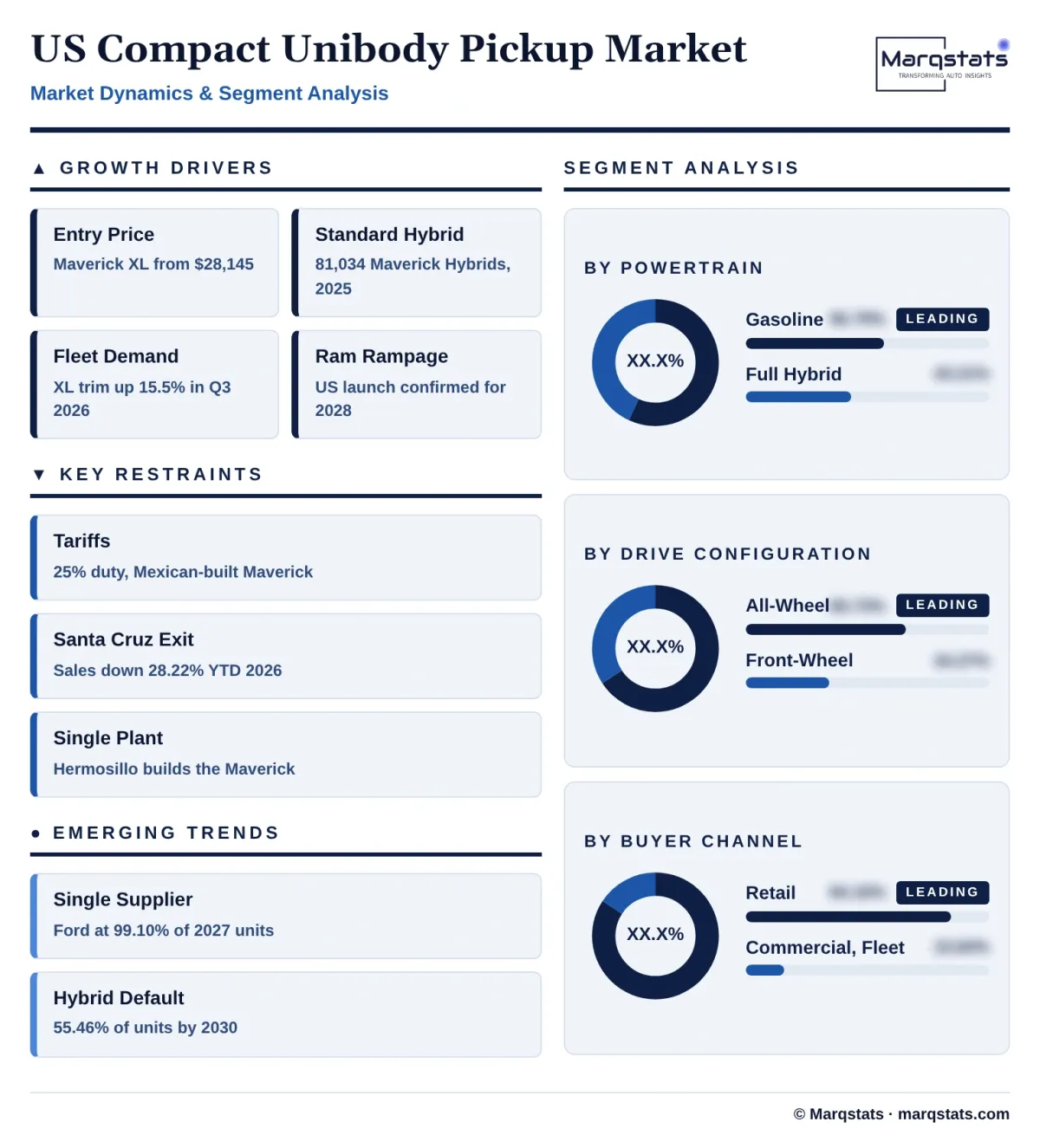
- Entry price brings buyers into the segment. The 2025 Maverick XL Hybrid started at USD 27,890 including destination and the 2026 model at USD 28,145, a price level near USD 28,000, and Ford sold 155,051 Mavericks in 2025, up 18.2% on 2024.
- A standard hybrid powertrain sets the volume. Maverick Hybrid sales were 81,034 units in 2025, 52.26% of Maverick sales, and 74,300 units in the first nine months of 2026, with a third-quarter record of 27,793 units, up 59.6%. Ford sold 228,072 hybrids across all models in 2025, and the Maverick Hybrid is 35.53% of them.
- Commercial and fleet buyers favour the XL trim. The Maverick XL grew 15.5% in the third quarter of 2026, and contractors, landscapers and delivery fleets buy a small pickup that costs less to fuel than a full-size truck. Marqstats estimates commercial and fleet buyers at 17.60% of 2025 units.
- Awards and product refreshes keep the model in the news. MotorTrend named the Maverick its 2026 Pickup Truck of the Year in December 2025, and Hyundai refreshed the Santa Cruz for the 2025 model year with a turbocharged XRT and Limited range, which keeps both nameplates in the shopping set.
- A new entrant arrives in 2028. Stellantis confirmed the Ram Rampage for the United States on 21 May 2026, a compact unibody pickup with all-wheel drive on every trim in South America, and Marqstats expects it to add 12,000 units in 2028 and 38,000 by 2030.
Key Restraints
Four constraints cap near-term growth and make the 2027 trough in volume the main risk to the forecast.
- Tariffs raise the price of a Mexican-built pickup. The United States applied a 25% tariff on imported vehicles from 3 April 2025, with relief for vehicles that qualify under the United States-Mexico-Canada Agreement on the non-US content only, and Ford raised prices on Mexican-built Maverick models built after 2 May 2025, by USD 700 on the XLT all-wheel drive, while saying it had not passed on the full cost.
- The Santa Cruz exit removes volume. Automotive News reported on 29 January 2026 that Hyundai will end production earlier than the second quarter of 2027 it had planned, with dealers holding almost six months of stock at the end of 2025, and Santa Cruz sales through September 2026 are down 28.22%.
- One plant carries the segment. The Maverick is built at Hermosillo, which also builds the Bronco Sport, so a stoppage, a tariff change on Mexican output or a model-year changeover moves the whole segment. Maverick sales averaged 40,301 a quarter in the first three quarters of 2025 and 34,147 in the fourth.
- Fuel-economy and emissions rules no longer force the hybrid mix. The Environmental Protection Agency finalised the repeal of its vehicle greenhouse gas standards on 12 February 2026, effective 20 April 2026, so hybrid volume now depends on buyer fuel savings and Ford strategy, not on a compliance deadline, and the repeal faces court challenges.
Key Trends
Four shifts are changing who sells compact unibody pickups in the United States and what they sell.
- The segment becomes a single-supplier market. Ford holds 85.88% of 2025 units, 99.10% in 2027 on Marqstats estimates, and still 81.55% in 2030 after the Rampage arrives.
- Hybrid becomes the default. Full hybrids rise from 44.88% of 2025 units to 55.46% in 2030 as Maverick Hybrid takes 60.5% of Maverick sales in 2026 and 68% by 2030.
- All-wheel drive spreads. The Maverick hybrid all-wheel-drive option, the EcoBoost engine that is sold only with all-wheel drive and the all-wheel-drive Rampage lift the all-wheel-drive share of units from 64.35% to 66.73%.
- Domestic Detroit competition arrives while Japanese and Korean makers move up-market. Ram enters with a compact truck in 2028, Hyundai plans a mid-size body-on-frame pickup for summer 2029, and Toyota has said it will build a small truck, so the compact class loses one Korean entrant and gains an American one.
Strategic Implications
- For Ram and any entrant, the price ladder is set. A Rampage that starts well above the Maverick XL at about USD 28,000 will compete with the Lariat and Lobo, not with the volume trims, so a hybrid or plug-in option and a sub-USD 33,000 trim decide whether the 38,000-unit estimate is reached.
- For Ford, the 2027 window is worth protecting. With Hyundai gone and Ram not yet selling, Ford is the only seller of new compact unibody pickups for a stretch of 2027, and the question is whether Hermosillo capacity and pricing discipline convert that window into a larger hybrid base before the Rampage lands.
- For Hyundai and dealers, the remaining Santa Cruz stock is a run-off task. About 6,100 units remain to be sold from the fourth quarter of 2026 and 2027, and discounting that stock moves the average sticker price down while Hyundai prepares a larger body-on-frame pickup.
- For suppliers, hybrid transaxles, all-wheel-drive couplings and bed accessories are the growth lines. Full hybrid units rise by about 33,200 units between 2025 and 2030, and truck caps, bed liners, tonneau covers and upfit racks fit the small bed of a unibody pickup.
- For fleet and commercial buyers, the XL trim and its hybrid fuel economy are the buying case. Fleet buyers that lock in Maverick supply for 2027 avoid a period in which the compact class has one seller.
Market Segmentation
Full hybrids account for 43.21% of 2025 value, USD 2,593.82 million, and 44.88% of units, and grow at 9.23% a year to USD 4,033.64 million and 54.27% of value in 2030. The segment is the Ford Maverick Hybrid, whose 2.5 litre system is standard on the XL and XLT trims, and Maverick Hybrid was 52.26% of Maverick sales in 2025 and Marqstats expects 68% by 2030, so units rise from 81,034 to 114,240.
Petrol pickups account for 56.79% of 2025 value, USD 3,409.69 million, and 55.12% of units, and grow at -0.06% a year to USD 3,399.20 million, with a falling share of 45.73% of value. The segment holds the Maverick with the 2.0 litre EcoBoost engine, 74,017 units in 2025, the entire Santa Cruz line of 25,499 units and, from 2028, the Rampage. The Santa Cruz exit cuts petrol volume in 2027 and the Rampage rebuilds it.
All-wheel drive accounts for 65.73% of 2025 value, USD 3,945.97 million, and 64.35% of units, and grows at 5.06% a year to USD 5,051.27 million. Marqstats counts every EcoBoost Maverick, 30% of Maverick Hybrids rising to 40% by 2030, 70% of Santa Cruz units and every Rampage, because Ford sells the EcoBoost engine only with all-wheel drive and the Rampage ships with it on all trims. The all-wheel-drive package adds about USD 2,220 on the Maverick and USD 1,500 on the Santa Cruz.
Front-wheel drive accounts for 34.27% of 2025 value, USD 2,057.54 million, and 35.65% of units, and grows at 2.97% a year to USD 2,381.57 million. It is the Maverick Hybrid XL and XLT base, the lowest sticker price in the market, and it is bought by commuters in the South and West and by fleets that do not need traction.
Retail buyers account for 84.16% of 2025 value, USD 5,052.61 million, and 82.40% of units, and grow at 4.16% a year to USD 6,193.65 million. They buy the XLT, Lariat, Lobo and Tremor trims and add options.
Commercial and fleet buyers account for 15.84% of 2025 value, USD 950.90 million, and 17.60% of units, and grow at 5.44% a year to USD 1,239.19 million. Marqstats assumes that 20% of Maverick units, about two thirds of the XL trim, 3% of Santa Cruz units and 12% of Rampage units go to businesses and government fleets, at a price about 10% below the segment average because the XL is the cheapest trim.
By Geography
South
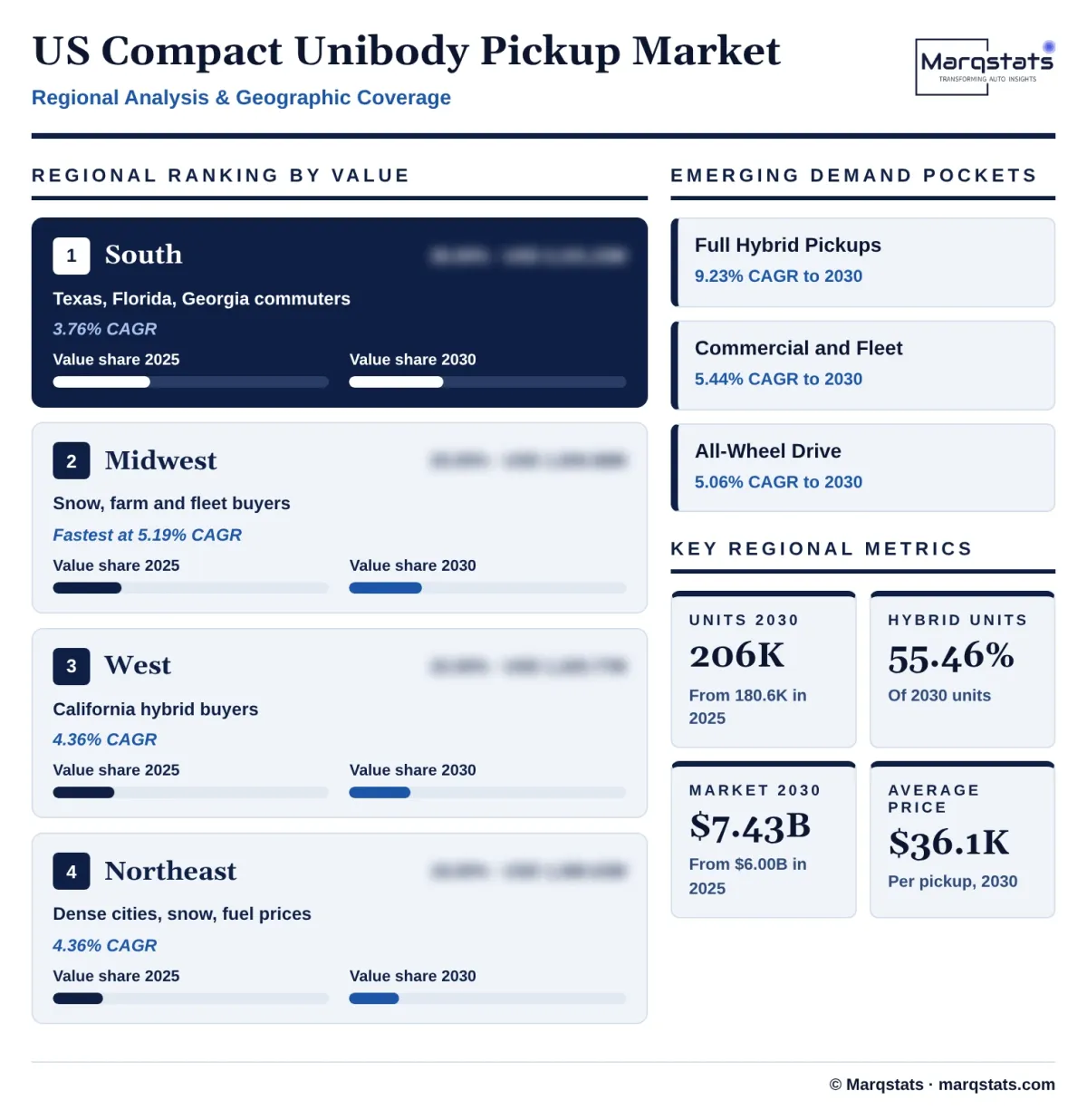
The South accounts for 35.00% of 2025 value, USD 2,101.23 million, and 63,192 units, and grows at 3.76% a year to USD 2,527.17 million and 34.00% by 2030. Texas, Florida and Georgia combine large commuter populations with contractor and trade fleets, and the Maverick Hybrid front-wheel-drive trims sell best here. Fleet registrations booked at head offices can overstate Michigan and understate the Sunbelt, so Marqstats allocates by where vehicles operate.
Midwest
The Midwest accounts for 25.00% of 2025 value, USD 1,500.88 million, and 45,138 units, and grows fastest, at 5.19% a year, to USD 1,932.54 million and 26.00% by 2030. Snow, farm and light industry use favour the all-wheel-drive hybrid Maverick and the all-wheel-drive Rampage, and Detroit-area fleet buyers are close to Ford and Ram.
West
The West accounts for 22.00% of 2025 value, USD 1,320.77 million, and 39,721 units, and grows at 4.36% a year to USD 1,635.22 million. California buyers choose the hybrid for fuel savings, and the region holds its 22.00% share to 2030.
Northeast
The Northeast accounts for 18.00% of 2025 value, USD 1,080.63 million, and 32,499 units, and grows at 4.36% a year to USD 1,337.91 million. Dense cities, snow and high fuel prices favour all-wheel-drive hybrids, but parking and garage limits keep unit sales below the South.
How Competition Is Evolving
The market is highly concentrated and Ford leads it. Marqstats estimates the Herfindahl-Hirschman index of unit shares at 7,575 in 2025 with Ford at 85.88% of units and 84.58% of value, rising above 9,800 in 2027 when Hyundai leaves, and settling near 6,991 in 2030 when Ram holds 18.45% of units. Ford Motor Company sold 155,051 Mavericks in 2025, Hyundai Motor America sold 25,499 Santa Cruz pickups and no other maker sells a compact unibody pickup in the United States.
Ford wins on price, powertrain and plant. The Maverick Hybrid is the only hybrid pickup in the segment, and Ford sold 81,034 of them in 2025 against 25,499 Santa Cruz units in total. Ford raised Maverick prices on vehicles built after 2 May 2025 by up to USD 700 on the XLT all-wheel drive, and Marqstats expects about 162,000 Maverick sales in 2026.
Hyundai is leaving the class. The Santa Cruz sold 25,499 units in 2025, down 20%, and 14,811 in the first nine months of 2026, down 28.22%. Automotive News reported that production ends earlier than planned, Hyundai says its life-cycle plans are unchanged, and the company has told investors it plans a mid-size body-on-frame pickup for summer 2029 that will compete with the Toyota Tacoma, Ford Ranger and Chevrolet Colorado.
Ram is the next entrant. Stellantis N.V. confirmed the Rampage for the United States at its 21 May 2026 Investor Day as part of its FastLane 2030 plan. The South American Rampage uses a 2.0 litre Hurricane turbo petrol engine with 270 horsepower, a nine-speed automatic and all-wheel drive, is built at a Jeep plant in Brazil and sells in several trims including Rebel and R/T, and the 25% duty on imported light trucks, known as the Chicken Tax, points Stellantis toward North American assembly.
Toyota has said it will build a small truck but has not dated it. Cooper Ericksen of Toyota Motor North America told MotorTrend in May 2025 that building a small truck is not a matter of if, and reports point to a TNGA hybrid platform and a price under the Maverick, but no launch year, build site or volume has been announced, so Marqstats counts no Toyota units to 2030. Honda sells the Ridgeline, 48,448 units in 2025, at a higher price and with a V6, and it stays outside the market.
Companies Covered
Companies covered in the report include:
Recent Market Activity
Table of Contents
Coverage & Segmentation
The study covers the US compact unibody pickup market, with 2025 as the base year, 2021 – 2025 as the historical period and 2026 – 2030 as the forecast period. It covers new unibody pickup trucks built on passenger-car platforms and sold in the United States to retail and fleet buyers, segmented by powertrain, drive configuration, buyer channel and region. Values are manufacturer suggested retail prices including destination, weighted by trim mix, in US dollars, before options, dealer adjustments, incentives, taxes and registration fees.
Mid-size unibody pickups such as the Honda Ridgeline, body-on-frame mid-size pickups, full-size and heavy-duty pickups, imported mini trucks, used pickups and pickup accessories sold separately are excluded. Segment, trim and regional splits are Marqstats estimates built on company sales releases, list prices and trim mix assumptions. The live Marqstats United States Hybrid Vehicle Market report is a broader parent whose hybrid pickup volume includes the Maverick Hybrid, so its figures should not be added to this market, and the North America Work Truck Upfitting and Truck Cap and Camper Shell reports cover bodies and accessories, not vehicles.