Market Snapshot
Middle bar: base-year value × (1 + CAGR), rounded to two decimals. This is a calculated illustration, not a separately researched annual estimate.
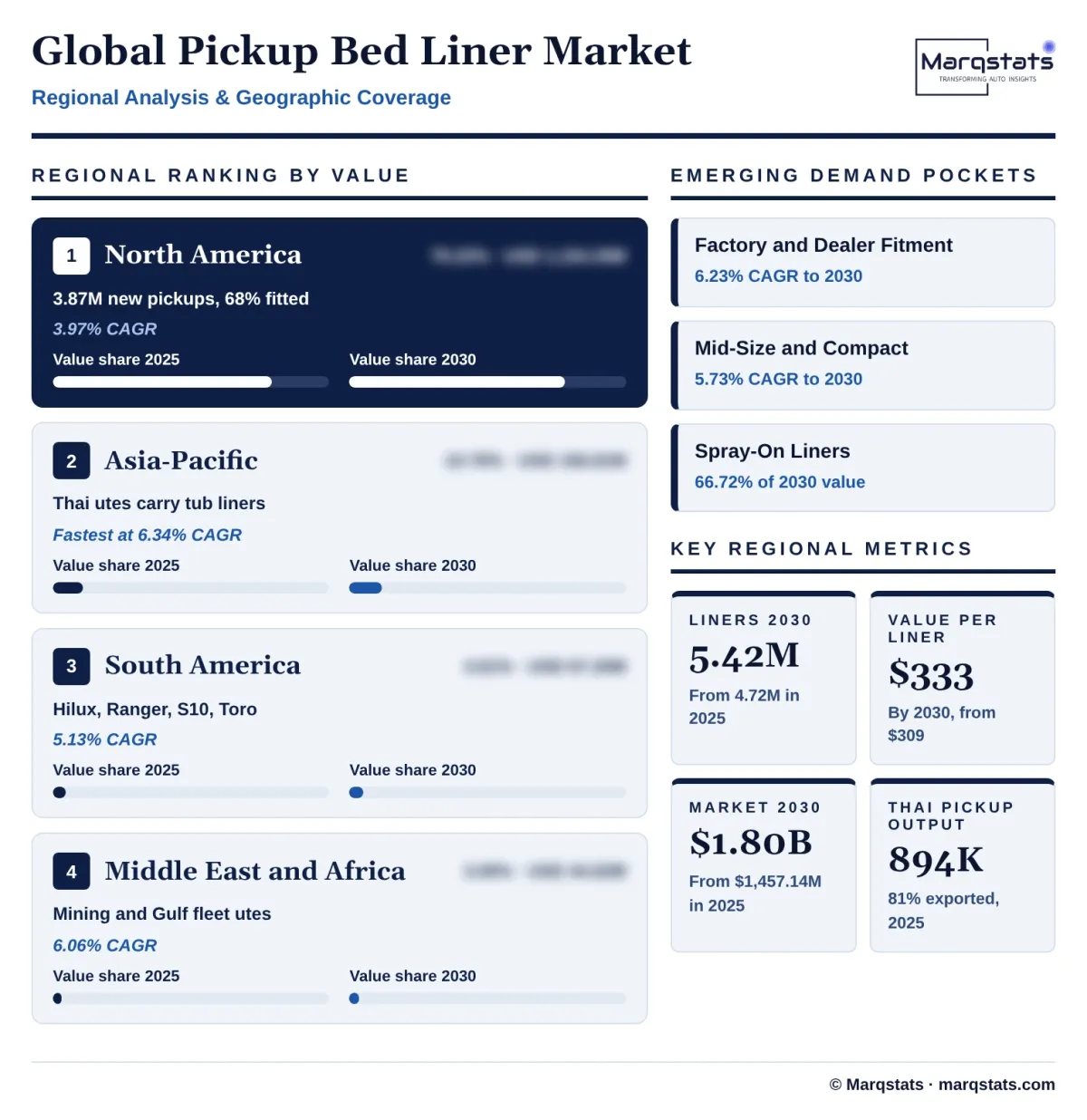
The global pickup bed liner market size is estimated at USD 1,457.14 million in 2025 and is projected to reach USD 1,801.69 million by 2030, growing at a CAGR of 4.34% over 2026 – 2030. Fitted units rise from about 4.72 million to 5.42 million a year, a 2.81% annual rate, while the average value per liner climbs from about USD 309 to USD 333 as buyers move from drop-in shells and mats to sprayed coatings.
Marqstats defines the market as the first-sale value of protective bed liners fitted to light-duty pickup trucks: polyurea and polyurethane spray-on coatings, rigid high-density polyethylene drop-in liners and rubber or elastomer bed mats. Factory and port-installed options and dealer-fitted liners are valued at option or accessory price, and aftermarket liners at installed or retail price. Tonneau covers, truck caps and canopies, toolboxes, bed rails, tailgate seals, roll-on DIY coating kits, industrial coatings and heavy-truck bodies are excluded.
Spray-on liners account for 64.98% of 2025 value and 38.30% of fitted units. North America accounts for 79.22% of value, factory, port and dealer-fitted liners for 34.23%, and full-size pickups for 60.50%. The study segments the market by product type, sales channel, vehicle class and region.
Key Takeaways
Market Overview & Analysis
Report Summary
Marqstats sizes the pickup bed liner market as the value at first sale of protective linings fitted to the cargo beds of light-duty pickup trucks. In 2025 about 4.72 million liners were fitted worldwide, worth an estimated USD 1,457.14 million at an average of about USD 309 each. The figure covers liners fitted to new trucks at the factory, port, dealer or within the first year of ownership, and liners fitted later to used trucks or as replacements.
Three product families compete. Spray-on liners are two-component polyurea or polyurethane coatings sprayed hot at high pressure onto a prepared bed, bonding to the metal and curing in seconds to a textured, seamless skin typically 60 to 125 thousandths of an inch thick. Drop-in liners are rigid shells vacuum-formed or injection-moulded from high-density polyethylene to fit a specific bed. Bed mats are rubber, elastomer or carpet-faced floor mats that protect the floor only. Spray-on liners cost the most and protect best; drop-ins and mats are cheaper, removable and installed in minutes.
Demand follows the pickup. Marqstats estimates about 6.35 million new light-duty pickups were sold worldwide in 2025, of which about 3.87 million in North America. In the United States, Ford sold 828,832 F-Series trucks in 2025, General Motors about 940,000 Chevrolet Silverado and GMC Sierra full-size pickups, and Toyota 274,638 Tacomas. Outside North America, Thailand produced 893,921 one-ton pickups in 2025 and exported 728,219 of them, China sold 589,000 pickups including 300,000 exports, and Australian buyers took about 230,000 utes.
Fitment rates differ sharply by region. Marqstats estimates about 68% of new pickups in North America receive a bed liner of some kind in their first year, against about 40% to 55% elsewhere, because North American owners use pickups as personal vehicles and protect them as long-term assets, and because a dense network of franchised and independent spray-on installers sells liners alongside tonneau covers, steps and lighting.
The market grew from an estimated USD 1,262.40 million in 2021 to USD 1,248.60 million in 2022, when chip and parts shortages cut pickup production, then recovered to USD 1,352.80 million in 2023 and USD 1,410.30 million in 2024. Marqstats expects USD 1,520.17 million in 2026.
Rules and costs shape where each product wins. Spray-on liners use isocyanate chemistry, so applicators need ventilated spray booths and protective equipment under rules such as US OSHA spray finishing standards, and since August 2023 the European Union has required certified training for workers handling diisocyanates under REACH Annex XVII Entry 74. These requirements raise the cost of entry for small spray shops, favour franchise networks and factory or port programmes, and help explain why drop-ins and mats dominate in Europe and many export markets while spray-on liners dominate in the United States.
Product choice also reflects how trucks are used. Drop-in liners are cheap and removable but can trap water and grit against the bed floor, wearing paint and encouraging corrosion. Spray-on liners bond permanently, deaden noise and add grip, but are expensive and cannot be removed. Bed mats protect only the floor and are often fitted over spray-on liners or with tonneau covers. In commercial fleets, spray-on liners are favoured because they survive heavy use and reduce damage and downtime, which is why fleet upfit agreements have become important for spray-on networks.
Global Pickup Bed Liner Market Size and Forecast
The global pickup bed liner market grows from USD 1,457.14 million in 2025 to USD 1,801.69 million in 2030, a CAGR of 4.34%. Marqstats expects USD 1,586.01 million in 2027, USD 1,654.78 million in 2028 and USD 1,726.63 million in 2029. Fitted units rise from 4.72 million to 4.85 million in 2026, 4.98 million in 2027, 5.12 million in 2028, 5.27 million in 2029 and 5.42 million in 2030.
Value grows faster than volume for three reasons. Spray-on liners gain about two percentage points of unit share from drop-ins over the period in most regions, average prices rise about 1.1% to 1.4% a year as polyurea chemicals, labour and booth costs pass through, and factory and dealer options, which sell at list price, take a larger share of fitments. The average value per liner rises from about USD 309 to USD 333.
The model is built bottom-up. For each region Marqstats multiplies new pickup sales by the share fitted with a liner in the first year, adds liners fitted to used trucks and replacements, splits the total between spray-on, drop-in and mat products, and applies a 2025 price for each product and region. In North America that means 3.87 million new pickups, a 68% first-year fitment rate and about 0.55 million used-truck and replacement fitments, giving 3.18 million liners. Spray-on jobs are valued at about USD 560 on average, blending factory spray-in options, dealer-applied liners priced around USD 595 and franchise installations at USD 500 to 650; drop-ins at about USD 260; and mats at about USD 150.
Prices differ widely between regions. Marqstats uses about USD 380 for a spray-on job, USD 170 for a drop-in and USD 70 for a mat in Asia-Pacific; USD 330, 150 and 70 in South America; USD 350, 160 and 70 in the Middle East and Africa; and USD 520, 260 and 120 in Europe, where diisocyanate handling rules raise spray applicator costs.
Marqstats tracks four indicators to monitor the forecast: pickup sales in the United States, Canada and Mexico; Thai one-ton pickup production and exports; the share of factory and dealer-fitted liners on new truck order guides; and polyurea and polyethylene raw material prices, which set the floor for liner pricing.
The regional mix shifts slowly. North America remains dominant but its share falls from 79.22% to 77.84% of value, while Asia-Pacific rises from 10.76% to 11.83%, the Middle East and Africa from 3.06% to 3.32% and South America from 4.61% to 4.79%. Europe slips from 2.35% to 2.21%. Factory, port and dealer fitment rises from 34.23% to 37.45% of value, and mid-size and compact pickups from 39.50% to 42.20%, as the Ranger, Tacoma, Maverick and new-generation Hilux gain buyers.
Volume is sensitive to two assumptions. Each percentage point change in the North American first-year fitment rate moves 2025 volume by about 39,000 liners and value by about USD 14 million, and each USD 10 change in the average North American spray-on price moves value by about USD 15 million. Marqstats holds the North American fitment rate broadly stable over the forecast and assumes growth comes from pickup sales, mix and price.
Market Dynamics
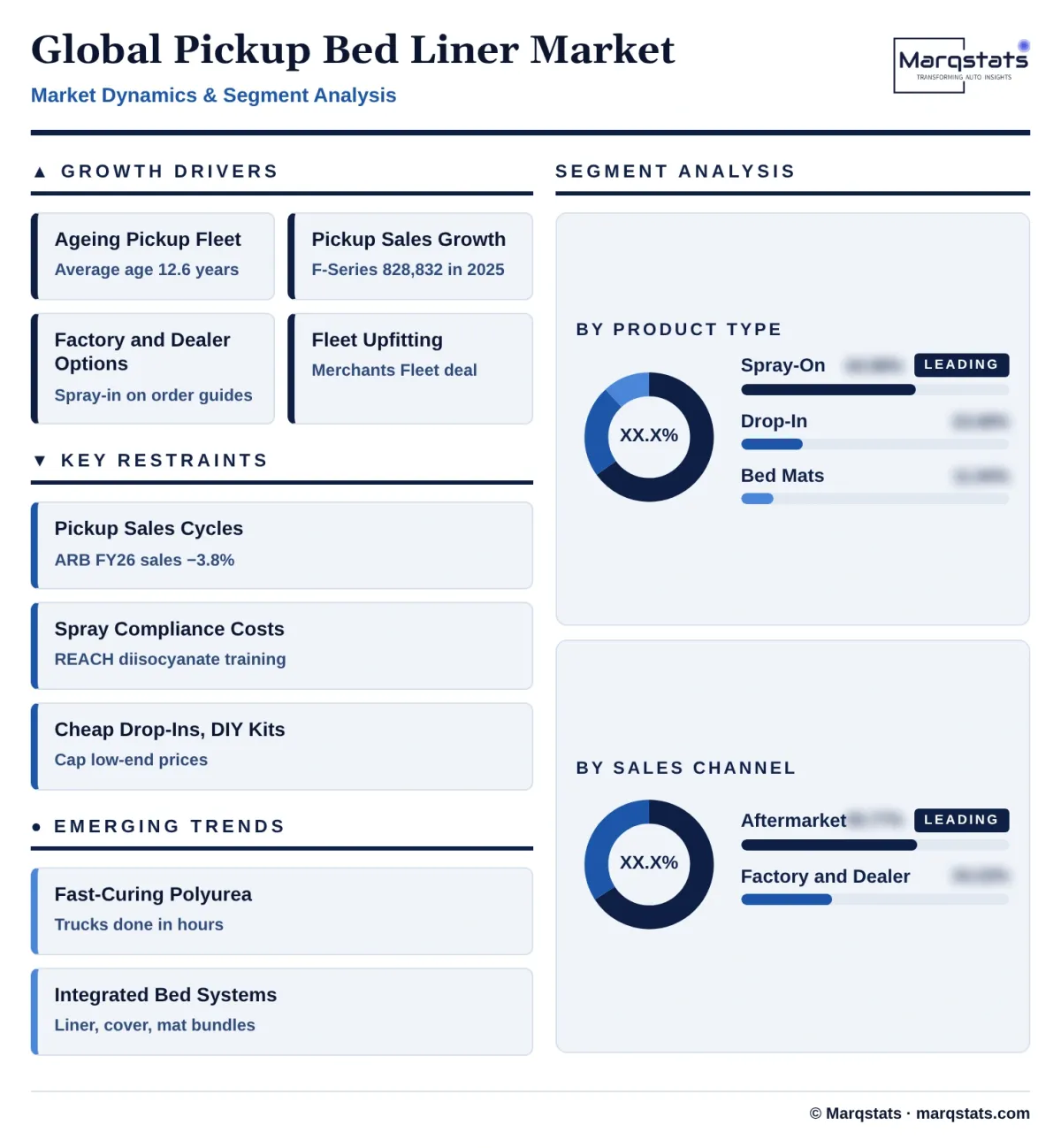
Key Drivers
Five forces keep demand for pickup bed protection rising faster than pickup sales.
- An ageing, high-value pickup fleet. The average age of light vehicles in the United States reached 12.6 years in 2025, and full-size pickups now sell for well over USD 50,000, so owners protect the bed to preserve resale value and avoid corrosion repairs.
- Pickup sales growth. Ford F-Series sales rose 8.3% in 2025, GM full-size pickups about 7%, the Toyota Tacoma 42.4% and the Ford Ranger more than 50%, adding liner demand in the region that pays the most per liner.
- Factory and dealer options. Carmakers sell spray-in liners on the order guide or at the dealership before delivery, so the cost can be added to the truck finance, which raises fitment rates on new trucks and pulls volume towards higher-priced sprayed products.
- Fleet upfitting. Commercial fleets specify spray-on liners on work pickups and vans to cut damage and downtime; LINE-X joined Merchants Fleet's Preferred Upfit Network in July 2025, building on a five-year relationship.
- Thai export utes. Thailand built 893,921 one-ton pickups in 2025 and exported 728,219, and OEM accessory programmes fit moulded tub liners to many of these trucks for Australia, the Middle East, Africa and Latin America.
Key Restraints
Four constraints hold back volume and squeeze installer and supplier margins.
- Pickup sales cycles. Liner demand moves with new-truck sales, and high interest rates, tariffs on imported vehicles and parts and weak commercial spending can quickly cut volumes; ARB Corporation reported a 3.8% fall in FY2026 sales to A$702.0 million as Australian new vehicle demand softened.
- Spray applicator compliance costs. Spray-on liners use isocyanate chemistry that requires ventilated booths, respiratory protection and, in the European Union, certified diisocyanate training under REACH Annex XVII Entry 74 since August 2023, raising costs for small installers.
- Price competition and do-it-yourself products. Low-cost drop-ins, generic mats and roll-on DIY coating kits sold online cap prices at the bottom of the market.
- Leverage among consolidators. RealTruck, the largest truck accessory group, refinanced its debt in April 2026 and extended maturities to 2031, showing how acquisitive accessory platforms carry high debt that can limit price and investment flexibility.
Key Trends
Four shifts are changing how bed liners are specified, fitted and sold.
- Fast-curing polyurea. Two-component pure polyureas cure tack-free in seconds, letting installers finish a truck in a few hours rather than a day and supporting fleet and dealer throughput.
- Integrated bed systems. Liners are increasingly sold with tonneau covers, bed mats, rails and storage as one bed package through dealers and accessory groups such as RealTruck.
- UV-stable and thicker coatings. Premium aliphatic topcoats that resist fading and thicker heavy-duty formulations command higher prices and lift average value per job.
- Electric and hybrid pickups. Electric and plug-in hybrid pickups, including China's 73,000 new-energy pickups sold in 2025, add front trunks and new bed designs that need new liner and mat patterns.
Strategic Implications
- For spray-on franchise networks, fleet and dealer work is the growth path. Agreements with fleet management companies and dealer groups give steadier volume than retail walk-in trade and protect installers against OEM option growth.
- For carmakers, liners are a high-margin option. Listing spray-in liners on order guides and port programmes captures value that would otherwise go to aftermarket installers, and bundling them with bed packages raises transaction prices.
- For drop-in and mat makers, Asia-Pacific and Latin America remain the volume base. Thai and regional moulders supplying OEM accessory programmes for the Hilux, Ranger, D-Max and Triton should secure fitments on new-generation platforms early.
- For chemical suppliers, the shift to sprayed coatings and stricter isocyanate handling rules favours suppliers that can provide training, equipment and lower-emission formulations to applicators.
- For investors, the market is steady but cyclical. Growth tracks pickup sales and product mix, and consolidators with high leverage are exposed when truck sales slow.
- For new entrants, the cheapest route into the market is through moulded mats and drop-ins for new pickup platforms, or through supplying chemicals, equipment and training to independent applicators, rather than building new spray-on franchise networks, which need booths, equipment and royalty-paying franchisees.
Market Segmentation
Polyurea and polyurethane spray-on liners account for 64.98% of 2025 value, USD 946.81 million, and about 1.81 million fitments, 38.30% of units. They grow at 4.89% a year to USD 1,202.09 million and 66.72% of the market by 2030, led by franchise networks such as LINE-X and Rhino Linings, independent applicators and factory spray-in options.
Rigid high-density polyethylene drop-in liners account for 23.08% of 2025 value, USD 336.29 million, and about 1.61 million fitments, 34.09% of units. They grow at 2.99% a year to USD 389.73 million, 21.63% of 2030 value, remaining the main product on Thai-built utes and in price-sensitive markets.
Rubber, elastomer and carpet-faced bed mats account for 11.94% of 2025 value, USD 174.04 million, and about 1.30 million fitments, 27.61% of units. They grow at 3.82% a year to USD 209.87 million, often bought with tonneau covers or over spray-on liners.
Liners fitted by franchise and independent installers or bought through retail and online channels account for 65.77% of 2025 value, USD 958.37 million, and grow at 3.29% a year to USD 1,126.91 million, 62.55% of the market by 2030.
Liners fitted at the factory, at port processing centres or by dealers before delivery account for 34.23% of 2025 value, USD 498.77 million, and grow fastest, at 6.23% a year, to USD 674.78 million and 37.45% of the market by 2030.
Full-size pickups such as the Ford F-Series, Chevrolet Silverado, GMC Sierra, Ram and Toyota Tundra account for 60.50% of 2025 value, USD 881.57 million, and grow at 3.39% a year to USD 1,041.38 million, 57.80% of the market by 2030.
Mid-size and compact pickups, including the Toyota Hilux and Tacoma, Ford Ranger and Maverick, Isuzu D-Max and Mitsubishi Triton, account for 39.50% of 2025 value, USD 575.57 million, and grow at 5.73% a year to USD 760.31 million, 42.20% of the market by 2030.
By Geography
North America
North America is the largest market, with 79.22% of 2025 value, USD 1,154.29 million, and about 3.18 million fitted liners, 67.49% of the world total, rising to USD 1,402.43 million by 2030, a 3.97% CAGR. The United States, Canada and Mexico together sold about 3.87 million new pickups in 2025, and about two-thirds received a liner in their first year. Spray-on liners make up about 46% of fitments and 71% of regional value. Ford, General Motors and Ram offer factory or dealer spray-in liners, while LINE-X, Rhino Linings, Ultimate Linings and many independent shops serve the aftermarket. RealTruck's Husky Liners, WeatherTech and Penda lead drop-ins and mats.
Asia-Pacific
Asia-Pacific accounts for 10.76% of 2025 value, USD 156.81 million, and about 0.84 million fitted liners, and grows fastest, at 6.34% a year, to USD 213.23 million and 11.83% of the market by 2030. Thailand is the region's production hub, building 893,921 one-ton pickups in 2025 and exporting 81.46% of them, with Eastern Polymer Group's Aeroklas and other moulders supplying tub liners and canopies. China sold 589,000 pickups in 2025, Australia about 230,000 utes, and the Philippines, Indonesia, Malaysia and New Zealand add further demand. Drop-ins make up about 62% of fitments.
South America
South America accounts for 4.61% of 2025 value, USD 67.20 million, and grows at 5.13% a year to USD 86.31 million by 2030. Brazil and Argentina build and sell large numbers of Toyota Hilux, Ford Ranger, Chevrolet S10, Volkswagen Amarok, Fiat Toro and Strada pickups, many fitted with dealer-supplied drop-in liners.
Middle East and Africa
The Middle East and Africa account for 3.06% of 2025 value, USD 44.62 million, and grow at 6.06% a year to USD 59.88 million by 2030. South Africa builds the Hilux, Ranger and D-Max, and Gulf, mining and agricultural fleets buy heavily protected work utes.
Europe
Europe accounts for 2.35% of 2025 value, USD 34.22 million, and grows at 3.09% a year to USD 39.84 million by 2030. Pickups are a small share of European sales, and REACH diisocyanate training rules raise costs for spray applicators, so drop-ins and mats make up about three-quarters of fitments.
How Competition Is Evolving
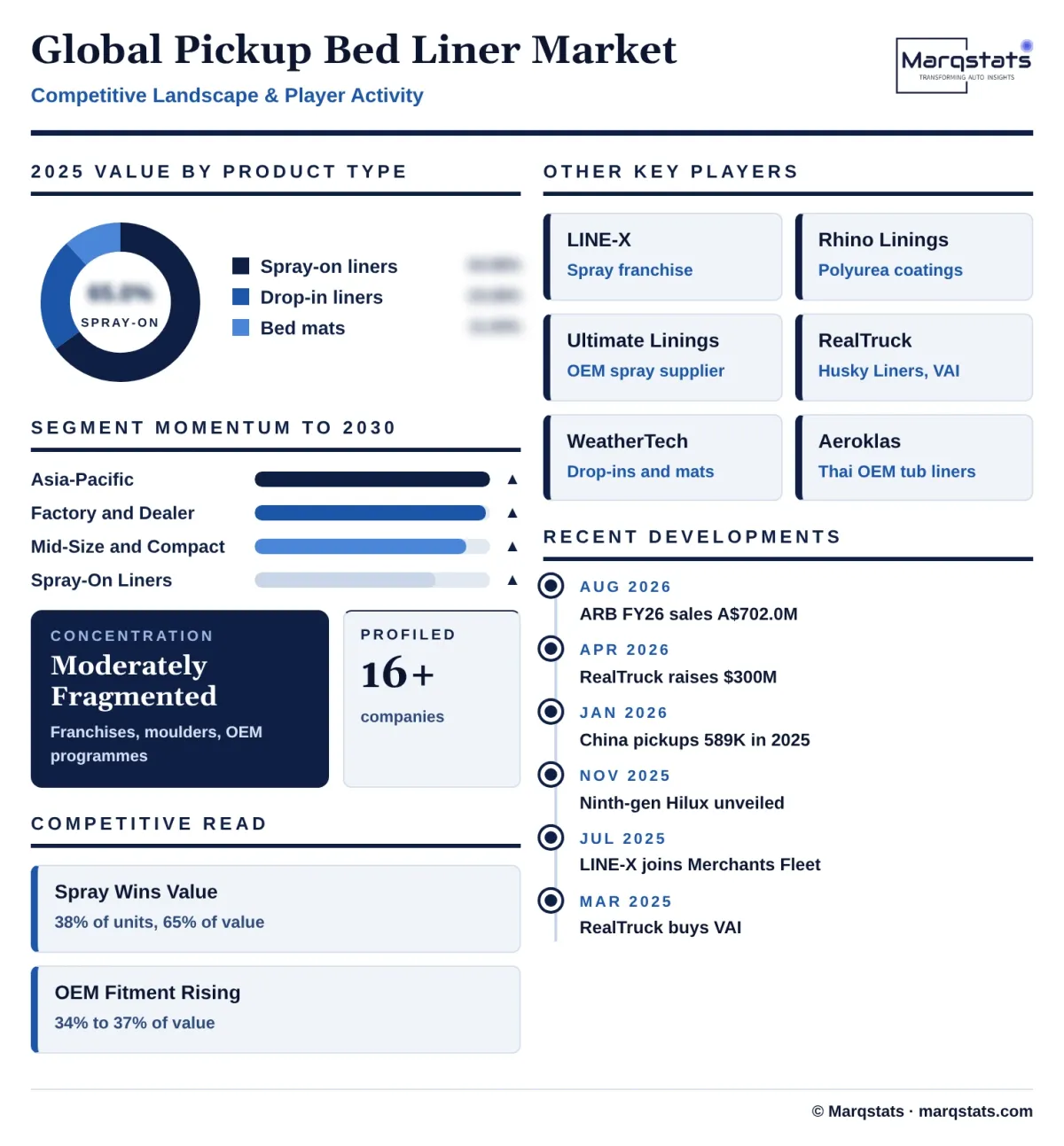
The pickup bed liner market is moderately fragmented. In spray-on liners, franchise networks such as LINE-X and Rhino Linings compete with chemical suppliers such as Ultimate Linings, which supply factory and dealer programmes, and with thousands of independent applicators. In drop-ins and mats, accessory groups such as RealTruck, which owns Husky Liners, compete with WeatherTech, Penda and Thai moulders such as Aeroklas.
Consolidation is reshaping the aftermarket. RealTruck acquired Vehicle Accessories Group in March 2025, its largest acquisition, and in April 2026 secured USD 300 million of new capital from existing lenders and noteholders while extending loan and note maturities to 2031. The group cites more than 1,000 patents, 5,000 associates, 78 facilities across four continents and a network of more than 12,000 dealers.
Carmakers are capturing more of the value. Factory and dealer-fitted spray-in liners from Ford, General Motors and Ram sell at list prices close to aftermarket spray jobs, and OEM accessory programmes on Thai-built utes fit tub liners before export.
In Australia and other ute markets, accessory groups such as ARB Corporation sell liners and canopies alongside bull bars and suspension. ARB's FY2026 sales fell 3.8% to A$702.0 million, with Australian aftermarket sales of A$390.1 million and exports of A$268.4 million, 38.2% of sales.
Competition will be decided by access to new-truck buyers. Suppliers that win factory, port and dealer programmes and fleet upfit contracts will grow faster than those relying on retail walk-in trade.
Product differentiation is narrowing in drop-ins and mats, where moulders compete on fit and price, but remains strong in spray-on liners. Franchise brands sell different formulations, such as standard, UV-stable and heavy-duty coatings, and offer national warranties, while factory programmes promise coverage under the truck warranty. Independent applicators compete on price and speed. Thai moulders compete on cost and OEM approvals, supplying tub liners and canopies that ship fitted to export trucks.
Companies Covered
Companies covered in the report include:
Recent Market Activity
Table of Contents
Coverage & Segmentation
The study covers the global pickup bed liner market, with 2025 as the base year, 2021 – 2025 as the historical period and 2026 – 2030 as the forecast period. Values are in US dollars at first-sale value: option or accessory price for factory, port and dealer-fitted liners, and installed or retail price for aftermarket liners. Volumes are fitted liners. The market is segmented by product type, sales channel, vehicle class and region, with Australian dollar figures converted at AUD 1 = USD 0.6451, the 2025 average.
Tonneau covers, truck caps and canopies, toolboxes, bed rails, tailgate seals, roll-on DIY coating kits, industrial and marine coatings, and liners for heavy trucks and chassis-cab bodies are excluded. Bed liners are a subset of the broader truck and 4x4 accessories markets covered in other Marqstats reports and should not be added to them. Segment and regional splits are Marqstats estimates built on pickup sales and production data, carmaker and supplier disclosures and installed price benchmarks.