Market Snapshot
Middle bar: base-year value × (1 + CAGR), rounded to two decimals. This is a calculated illustration, not a separately researched annual estimate.
The Argentina pickup truck market size is estimated at USD 4,433.80 million in 2025 and is projected to reach USD 5,388.80 million by 2030, growing at a CAGR of 3.98% over 2026 – 2030. Registrations rise from 125,694 to about 135,118 pickups, a 1.46% annual rate.
Marqstats defines the market as the retail transaction value, excluding the 21% value added tax (IVA), of new open-bed pickups registered for the first time in Argentina, measured as 0 km registrations (patentamientos) in the Dirección Nacional de los Registros Nacionales de la Propiedad del Automotor (DNRPA) series published by the Asociación de Concesionarios de Automotores de la República Argentina (ACARA). It covers compact, midsize one-tonne and full-size pickups sold to private buyers, businesses and fleets. Panel vans such as the Renault Kangoo, sport utility vehicles built on pickup platforms such as the Toyota SW4, heavy trucks, used pickups and export production are excluded. Values are converted at the 2025 average of ARS 1,246.49 per US dollar.
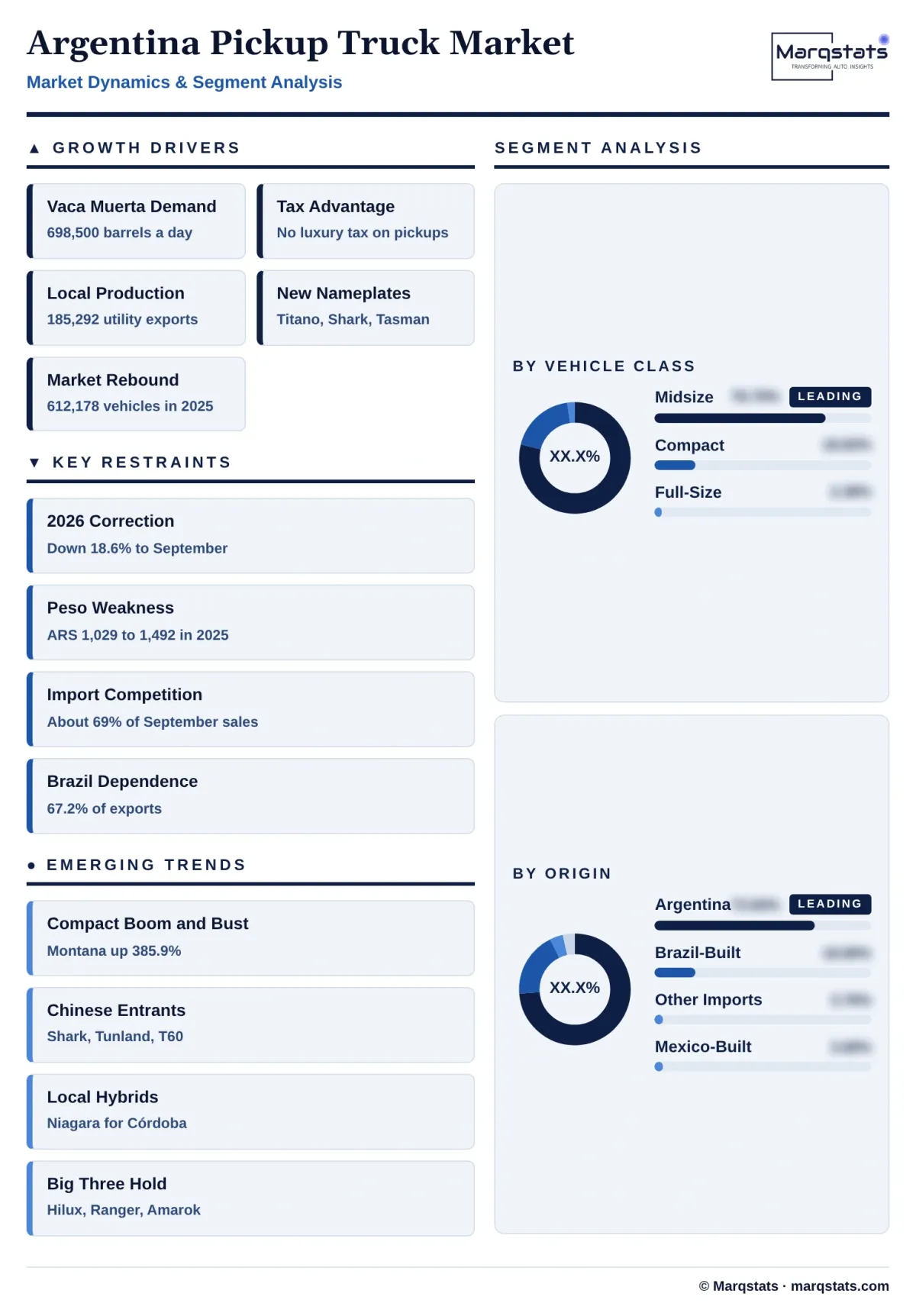
Midsize one-tonne pickups account for an estimated 78.79% of 2025 value and Argentine-built pickups for 73.65%. Toyota, Ford and Volkswagen hold 66.56% of units. The study segments the market by vehicle class, origin and brand group, and by four regions.
Key Takeaways
Market Overview & Analysis
Report Summary
Marqstats sizes the Argentina pickup truck market as the retail transaction value, excluding IVA, of new pickups registered in Argentina. In 2025 125,694 pickups were registered, worth an estimated USD 4,433.80 million at an average price of about USD 35,275 before IVA, equal to about USD 42,683 or ARS 53.2 million including the 21% tax.
The unit base is the 2025 pickup series of 125,694 new registrations compiled from the ACARA and DNRPA statistics, equal to 20.53% of the 612,178 vehicles registered in the year, which was up 47.8% from 414,211 in 2024. The model-level detail comes from the published ACARA ranking: Toyota Hilux 30,768, Ford Ranger 24,976, Volkswagen Amarok 23,612, Fiat Strada 7,821, Fiat Toro 7,754, Nissan Frontier 6,484, Chevrolet S10 5,210, Chevrolet Montana 5,049, Ford Maverick 4,311 and Fiat Titano 1,372. Ram Rampage registrations were 4,597 through November, and Marqstats estimates 5,050 for the year. The remaining 3,287 units are small-volume midsize, full-size and imported nameplates.
The definition matters because Argentine statistics mix pickups with vans. ADEFA reports 288,287 utility vehicles produced in 2025, defined as commercial-use vehicles of up to 1,500 kilograms of payload, and that group includes the Renault Kangoo at 17,303 units, the Peugeot Partner at 3,660, the Citroën Berlingo at 3,297 and the Toyota Hiace at 2,696, while the Toyota SW4 at 35,578 units sits with passenger vehicles. ACARA lists the Kangoo at 11,122 registrations, the Fiat Fiorino at 5,155 and the Mercedes-Benz Sprinter at 5,133 among utilities. Marqstats excludes all of them and sizes only open-bed pickups.
Pickups are about one in five new vehicles. The 2025 pickup share of 20.53% of registrations is lower than in 2024, when Marqstats estimates about 103,000 pickups against 414,211 total registrations, because cars gained from the 28 January 2025 cut in the impuestos internos luxury tax and from the opening of imports. Pickups have never paid that tax because Argentina treats them as work vehicles, which kept their prices stable while car prices fell.
Pickup demand has three layers. The first is field and farm work: grain and oilseed logistics in the Pampas, mining in the north and drilling in Neuquén, where payload, four-wheel drive and a diesel engine decide the purchase. The second is the family and lifestyle buyer of crew-cab midsize pickups such as the Hilux SRX and Ranger Limited. The third is the small business and urban buyer of unibody compacts such as the Fiat Strada and Chevrolet Montana, which list from ARS 25.7 million and ARS 29.9 million at mid-2025 before the version ladder.
Production and trade shape the market from the supply side. ADEFA reports 490,876 vehicles built in 2025, down 3.1%, of which 202,589 were passenger vehicles and 288,287 utilities, up 8.8%, and exports of 280,589 vehicles, 185,292 of them utilities. Brazil took 188,438 vehicles, 67.2% of exports. Pickup plants therefore depend on Brazilian demand far more than on Argentine registrations, and the domestic market is the smaller outlet for the same factories.
Argentina Pickup Truck Market Size and Forecast
The Argentina pickup truck market falls from USD 4,433.80 million in 2025 to USD 3,730.37 million in 2026 and then grows to USD 5,388.80 million in 2030, a CAGR of 3.98% over 2025 to 2030. Marqstats expects value of USD 4,193.46 million in 2027, USD 4,632.50 million in 2028 and USD 5,024.05 million in 2029. Registrations are expected to be 125,694 in 2025, 102,300 in 2026, about 112,500 in 2027, 121,600 in 2028, 128,900 in 2029 and 135,118 in 2030.
The 2026 reset is already visible. January to September 2026 registrations were 83,709, down 18.6% from 102,825, with September at 10,283, up 22.1% on August but 6.6% below September 2025. Marqstats expects 102,300 registrations for 2026, an 18.6% fall for the year, and a value of USD 3,730.37 million, down 15.87%, because compact pickups fall faster than midsize ones.
Recovery is gradual because 2025 was a catch-up year. Registrations grow 10.0% in 2027, 8.0% in 2028, 6.0% in 2029 and 4.8% in 2030 as financing, new models and field demand return, and the 2030 level is only 7.50% above 2025. Average prices before IVA rise about 2.0% to 2.5% a year at constant exchange rates, from about USD 35,275 to USD 39,882, as the mix moves toward four-wheel drive and higher trims. These are Marqstats estimates.
Class mix changes slowly. Midsize pickups rise from 78.79% of value in 2025 to 80.46% in 2030, compact pickups fall from 18.83% to 17.20% and full-size pickups slip from 2.38% to 2.34%. Midsize units fall from 94,209 to 80,000 in 2026 before reaching 103,346 in 2030, while compact units fall from 29,985 to 21,000 and recover to 30,147.
Origin mix shifts toward new entrants. Argentine-built pickups move from 73.65% of value to 74.00%, helped by the Fiat Titano and the Renault Niagara planned for the Santa Isabel plant in Córdoba, while Brazil-built pickups fall from 18.89% to 17.00% and other imports rise from 3.78% to 5.70%. Argentine-built value grows at 4.07% a year, faster than the market as a whole.
Marqstats tracks five indicators to monitor the forecast: monthly ACARA registrations by model, the peso against the dollar and list-price changes, ADEFA export shipments to Brazil, Vaca Muerta drilling and pipeline milestones, and the arrival of electrified pickups from China and Korea.
Market Dynamics
Key Drivers
Five forces are lifting Argentine pickup registrations from the 2026 trough toward the 2030 level.
- Vaca Muerta field demand. Vaca Muerta output reached a record 698,500 barrels a day in September 2026, 71.70% of national production of 973,700 barrels a day and 15.5% above a year earlier, and operators in Neuquén need four-wheel-drive midsize pickups for rig access, pipeline crews and contractor fleets. Marqstats expects Patagonia and the energy basin to grow 6.13% a year in value.
- A durable tax advantage. Pickups have never paid the impuestos internos luxury tax because Argentina treats them as work vehicles, while cars faced rates of 20% and 35% until the 28 January 2025 cut by Economy Minister Luis Caputo removed the 20% rate for cars priced between ARS 41 million and ARS 75 million and lowered the top rate to 18%. Pickups keep an exemption that most cars now share only in part.
- Local production and Brazilian access. Argentina builds the Toyota Hilux at Zárate, the Ford Ranger and Volkswagen Amarok at General Pacheco, the Nissan Frontier and Fiat Titano in Córdoba, and ADEFA reports 185,292 utility exports in 2025. Trade under the Argentina-Brazil automotive agreement (ACE 14) supplies Brazilian compacts and the Chevrolet S10, while the 73.65% value share of Argentine-built pickups sustains dealer, parts and finance networks.
- New nameplates. The Fiat Titano reached 1,372 registrations in 2025 and 3,323 in January to September 2026, the BYD Shark registered 500 units after its arrival, the Kia Tasman 30 units and the Renault Niagara was confirmed on 10 September 2026 for Córdoba with a hybrid four-wheel-drive version to follow. Each launch widens price bands between ARS 45 million and ARS 95 million.
- A recovering vehicle market. ACARA registrations rose 47.8% to 612,178 in 2025, and pickups registered 125,694, up an estimated 22% from about 103,000 in 2024. Midsize pickups kept 63.13% of units in three nameplates, which gives dealers predictable volume.
Key Restraints
Four constraints limit how fast Argentine pickup sales and prices can recover.
- Cyclical correction in 2026. January to September 2026 registrations fell 18.6% to 83,709, and September 2026 was 6.6% below September 2025. Compact pickups fell hardest: the Fiat Strada registered 4,394 units, the Fiat Toro 3,965, the Chevrolet Montana 2,718 and the Ford Maverick 2,143 in nine months, together 15.79% of the period.
- Peso weakness and price resets. The peso moved from about ARS 1,029 per dollar in January 2025 to ARS 1,492 in October 2025, and list prices followed: the Toyota Hilux 4x2 double cab DX rose from ARS 39.0 million in February 2025 to ARS 47.1 million in November 2025. A pickup costing about USD 42,700 including IVA is out of reach for many small businesses without credit.
- Import competition. Imported vehicles reached about 69% of September 2026 registrations across the whole market, and pickups face Brazilian compacts, Mexican Maverick units and Chinese entrants priced from USD 24,730 for the Great Wall Poer Elite 4x2 to USD 59,990 for the BYD Shark.
- Brazil dependence for the plants. Brazil took 188,438 of the 280,589 vehicles Argentina exported in 2025, 67.2%, and Amarok exports fell 65% to 3,589 units. A slowdown in Brazil or a model reallocation would hit plant volumes, supplier volumes and the local price of the same models.
Key Trends
Four shifts are changing which pickups Argentine buyers choose and where they are built.
- Compact pickups boom and bust. The Chevrolet Montana rose 385.9% to 5,049 units in 2025, the Fiat Strada 71.9% to 7,821 and the Fiat Toro 64.4% to 7,754, then all three fell in 2026 as fleets and small businesses paused purchases.
- Chinese and Korean entrants add electrified choices. The BYD Shark plug-in hybrid lists at USD 59,990 and registered 500 units to September 2026, the Kia Tasman lists at USD 57,500 to USD 79,000 with 30 units, and the Foton Tunland, Maxus T60 and JAC T8 and T9 list between USD 28,900 and USD 38,500.
- Local hybrid pickups are planned. Renault Group announced on 10 September 2026 that the Niagara, on the Renault Group Modular Platform, will be built at Santa Isabel in Córdoba, with petrol and flex engines at launch and a hybrid four-wheel-drive version later for Argentina, Brazil and Colombia.
- Three nameplates hold the middle. The Hilux, Ranger and Amarok took 63.13% of 2025 units and 61.73% of January to September 2026 units, and the Fiat Titano is the first new local midsize nameplate in years, with 3,323 units to September 2026.
Strategic Implications
- For established midsize brands, defending volume in 2026 means protecting the Hilux, Ranger and Amarok price ladder while the market falls 18.6%. The Toyota Hilux raised its share to 28.27% of January to September 2026 registrations, 23,667 units, from 24.48% in 2025, while the Volkswagen Amarok fell to 14.71% with 12,310 units from 18.79%.
- For compact pickup makers, the 2026 correction shows that car-derived pickups are the first purchase fleets postpone. Brazil-built Fiat, Chevrolet and Ram nameplates should price against the Ford Maverick and the lowest Hilux trims, and plan for a recovery of only 2.11% a year in value to 2030.
- For entrants from China and Korea, the Argentine opportunity is the midsize price band between USD 25,000 and USD 40,000 and the electrified niche above USD 55,000, where the BYD Shark and Kia Tasman are building registration history. Dealer coverage in Neuquén, Mendoza, Salta and Córdoba matters more than showroom count in Buenos Aires.
- For component suppliers, domestic volume is the smaller part of the business. Plants built about 254,531 units of five pickup nameplates in 2025 and registered 87,212 at home, so tier-one suppliers are exposed to Brazilian demand, and a supplier win on the Niagara or Titano adds volume that does not depend on Argentine retail demand.
- For lenders and fleet buyers, the Vaca Muerta contractor base is the most stable demand pool. Leasing terms should price on observed resale values for four-wheel-drive diesel midsize pickups, which have shown the smallest registration declines in 2026.
Market Segmentation
Midsize one-tonne pickups account for 78.79% of 2025 value, USD 3,493.64 million and 94,209 units, and grow at 4.42% a year to USD 4,336.10 million and 80.46% of the market by 2030. The class covers the Toyota Hilux at 30,768 units, Ford Ranger at 24,976, Volkswagen Amarok at 23,612, Nissan Frontier at 6,484, Chevrolet S10 at 5,210 and Fiat Titano at 1,372, plus small-volume nameplates. It is the center of the market because it serves work buyers and family buyers with the same vehicle.
Compact pickups account for 18.83% of 2025 value, USD 834.80 million and 29,985 units, and grow at 2.11% a year to USD 926.67 million, which reduces their share to 17.20%. The class covers the Fiat Strada, Fiat Toro, Chevrolet Montana, Ford Maverick and Ram Rampage, at an average price of about USD 27,841 before IVA. It grew fastest in 2025 and falls fastest in 2026, with registrations expected near 21,000 before recovering to about 30,147.
Full-size pickups account for 2.38% of 2025 value, USD 105.36 million and 1,500 units, and grow at 3.65% a year to USD 126.03 million. Marqstats sizes the class at 1.2% of units, the share ACARA data showed in September 2026 with 121 of 10,283 registrations: the Ford F-150 at 63, Chevrolet Silverado at 40 and Ram 1500 at 13. The average price is about USD 70,240 before IVA, and the F-150 Lariat and Silverado Z71 listed at ARS 114.7 million and ARS 97.2 million at mid-2025.
Argentine-built pickups account for 73.65% of 2025 value, USD 3,265.90 million and 87,212 units, 69.38% of the market, and grow at 4.07% a year to USD 3,987.71 million. The group covers the Toyota Hilux from Zárate, the Ford Ranger and Volkswagen Amarok from General Pacheco and the Nissan Frontier and Fiat Titano from Córdoba. Their share of units reached 76.8% in September 2026 as Brazilian compacts fell, which Marqstats treats as a temporary mix effect.
Brazil-built pickups account for 18.89% of 2025 value, USD 837.45 million and 30,884 units, and grow at 1.81% a year to USD 916.10 million, with share falling to 17.00%. The group covers the Fiat Strada, Fiat Toro, Chevrolet Montana, Chevrolet S10 and Ram Rampage, all supplied under Mercosur rules. In September 2026 Brazilian-origin pickups were 19.9% of units, or 2,046, and they are the part of the market most exposed to the 2026 correction.
Mexico-built pickups are the Ford Maverick alone, which registered 4,311 units in 2025, up 18.1%, and account for 3.68% of 2025 value, USD 163.06 million. They grow at 1.75% a year to USD 177.83 million, and share falls to 3.30%. Mexican origin covered 131 units, 1.3%, in September 2026.
Other imports, from China, the United States, Thailand, Korea and Japan, account for 3.78% of 2025 value, USD 167.39 million and 3,287 units, and grow fastest of the four origin groups, at 12.91% a year, to USD 307.16 million and 5.70% of the market. The group includes the Great Wall Poer, Foton Tunland, Maxus T60, JAC T8 and T9, BYD Shark, Kia Tasman, Mitsubishi L200, Isuzu D-Max and Jeep Gladiator, and the full-size Ford F-150, Chevrolet Silverado and Ram 1500 built in North America.
Toyota accounts for 24.50% of 2025 value, USD 1,086.53 million, and 30,768 units, 24.47% of the market, all Hilux. Its value share eases to 23.00% by 2030, a 2.67% CAGR, as new entrants take a larger part of growth. The Hilux was the most registered vehicle of any type in Argentina in 2025.
Ford accounts for 23.91% of 2025 value, USD 1,059.97 million, and 29,287 units, the Ranger at 24,976 and the Maverick at 4,311. It grows at 2.73% a year to USD 1,212.48 million. Ford's Ranger production at General Pacheco reached 75,662 units in 2025, up 22%, and 47,745 were exported.
Volkswagen accounts for 22.55% of 2025 value, USD 1,000.03 million, and 23,612 units, all Amarok. It has the highest average price of the big three, about USD 42,352 before IVA, because its October 2026 ladder runs from ARS 52.9 million to ARS 94.2 million with six V6 trims, and grows at 2.99% a year to USD 1,158.59 million.
Stellantis, with Fiat and Ram, accounts for 13.82% of 2025 value, USD 612.75 million, and 21,997 units across the Strada, Toro, Titano and Rampage. It grows fastest of the established groups, at 6.39% a year, to USD 835.26 million and 15.50% of the market, as the Titano scales at the Ferreyra plant.
General Motors accounts for 6.27% of 2025 value, USD 277.79 million, and 10,259 units, the S10 at 5,210 and the Montana at 5,049. It grows at 3.08% a year to USD 323.33 million.
Nissan accounts for 5.17% of 2025 value, USD 229.34 million, and 6,484 units, all Frontier, and grows at 1.57% a year to USD 247.88 million, the slowest of the groups, as Frontier production fell 41% to 9,775 units in 2025.
All other brands, including Renault, BYD, Kia, Foton, Great Wall, JAC, Maxus, Mitsubishi, Isuzu and the full-size importers, account for 3.78% of 2025 value, USD 167.39 million, and 3,287 units, and grow at 17.31% a year to USD 371.83 million and 6.90% of the market by 2030 from a small base.
By Geography
Pampas Core
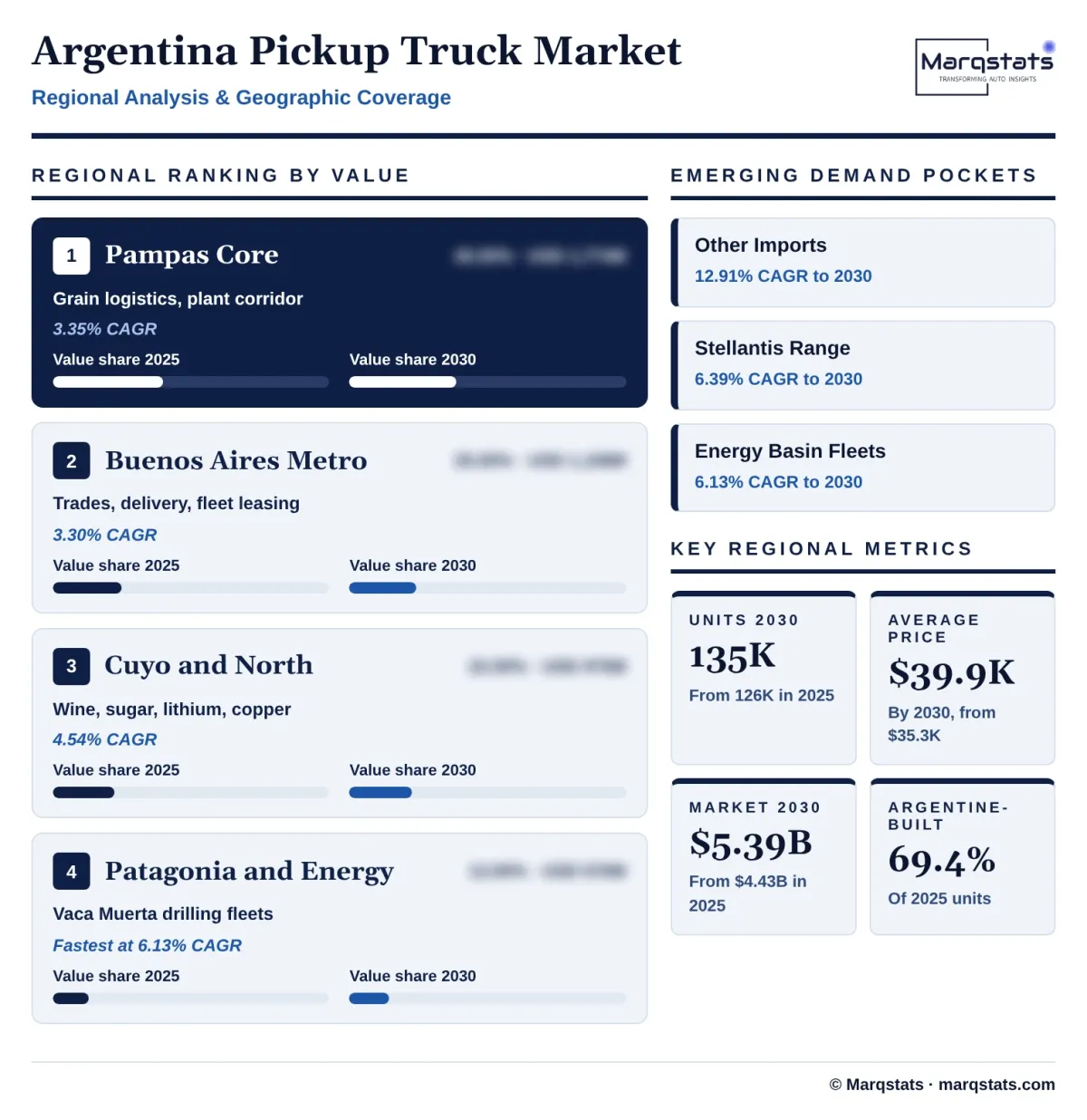
The Pampas core is the largest region, with 40.00% of 2025 value, USD 1,773.52 million, rising to USD 2,090.85 million by 2030, a 3.35% CAGR, while share eases to 38.80%. Buenos Aires province outside the capital area, Santa Fe, Córdoba, Entre Ríos and La Pampa combine grain, oilseed and livestock logistics with the Toyota, Ford and Volkswagen plant corridor, and midsize diesel pickups sell here at the highest rates. These are Marqstats allocations, since provincial registration totals are published for all vehicles and not for pickups, and fleet registration addresses overstate Buenos Aires.
Buenos Aires Metropolitan Area
The Buenos Aires Metropolitan Area accounts for 25.00% of 2025 value, USD 1,108.45 million, rising to USD 1,304.09 million by 2030, a 3.30% CAGR. The city and Greater Buenos Aires combine the largest population with trades, courier and delivery fleets, and compact pickups such as the Fiat Strada and Chevrolet Montana sell best here. Leasing and corporate fleets register vehicles that operate in Neuquén and Mendoza, so Marqstats allocates sales by place of use and not by registration address.
Cuyo and Northern Provinces
Cuyo and the Northern Provinces account for 22.00% of 2025 value, USD 975.44 million, rising to USD 1,217.87 million by 2030, a 4.54% CAGR and 22.60% of the market. Mendoza, San Juan, Salta, Jujuy, Catamarca, Tucumán and the northeast combine wine, sugar, tobacco, lithium and copper projects, and four-wheel-drive midsize pickups are priced against dealer coverage that is thinner than in the Pampas. Jujuy alone registered 7,475 vehicles of all types in 2025.
Patagonia and Energy Basin
Patagonia and the energy basin account for 13.00% of 2025 value, USD 576.39 million, and grow fastest of the four regions, at 6.13% a year, to USD 775.99 million and 14.40% of the market. Neuquén, Río Negro, Chubut, Santa Cruz and Tierra del Fuego host the Vaca Muerta formation, where output of 698,500 barrels a day in September 2026 supports drilling, pipeline and service-contractor fleets. These buyers specify four-wheel-drive diesel pickups, so the Hilux, Ranger and Amarok dominate.
How Competition Is Evolving
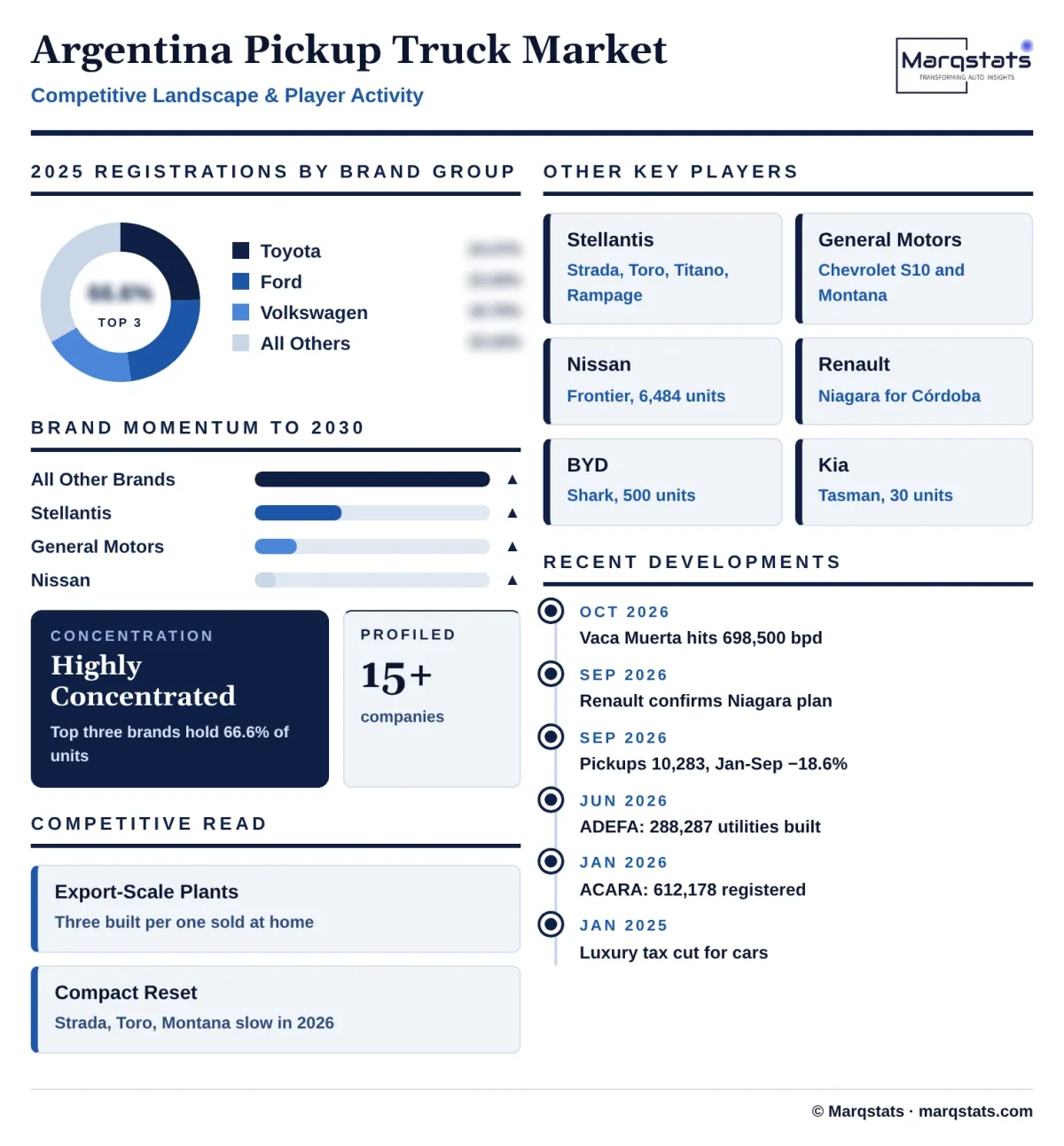
The Argentina pickup truck market is highly concentrated. Toyota holds 24.47% of 2025 registrations with the Hilux, Ford 23.30% with the Ranger and Maverick and Volkswagen 18.79% with the Amarok, so three brands account for 66.56% of units. Stellantis adds 17.50%, General Motors 8.16%, Nissan 5.16% and all other brands 2.62%, so four groups hold 84.06%.
Share movement in 2025 came from the edges, not the center. The Amarok rose 28.4% while the Hilux rose 6.1% and the Ranger 8.6%, Stellantis added the Titano and the Rampage, and General Motors gained 167.7% on the S10 and 385.9% on the Montana from small bases. The Nissan Frontier fell 4.1% and its production fell 41% to 9,775 units, the clearest sign of share loss among local midsize pickups.
The strategic question is whether the three leaders can hold price while new nameplates widen choice. Toyota sustained Hilux production of 142,078 units in 2025, up 6%, with 115,408 Hilux and Hiace units exported, and Ford raised Ranger output 22% to 75,662. For both, domestic registrations are the smaller outlet for export-scale plants.
The signal to watch is the share of Brazil-built compacts and Chinese midsize pickups in 2027 registrations. If compacts return above 24% of units and other imports pass 5% of value, Marqstats expects the leaders to respond with lower-priced work trims, which would slow value growth below the 3.98% forecast.
New entrants keep arriving. The Fiat Titano ramps at Ferreyra, the Renault Niagara follows at Santa Isabel, the BYD Shark and Kia Tasman are building registration history, and the Isuzu D-Max lists at USD 52,400 to USD 53,900. The competitive map therefore changes every year, and a range without a credible midsize diesel and a sub-ARS 50 million entry trim is hard to defend.
Companies Covered
Companies covered in the report include:
Recent Market Activity
Table of Contents
Coverage & Segmentation
The study covers the Argentina pickup truck market, with 2025 as the base year, 2021 – 2025 as the historical period and 2026 – 2030 as the forecast period. Values are in US dollars at retail transaction prices excluding the 21% IVA, converted from pesos at the 2025 average of ARS 1,246.49 per US dollar, and volumes are annual new pickup registrations in Argentina. The market is segmented by vehicle class, origin, brand group and region.
Panel vans and car-derived delivery vans such as the Renault Kangoo, Fiat Fiorino, Peugeot Partner and Mercedes-Benz Sprinter, sport utility vehicles built on pickup platforms such as the Toyota SW4, heavy trucks, used pickups, chassis cabs and export production are excluded. Class, origin, brand and regional splits, the Ram Rampage December estimate, the full-size allowance and the forecast are Marqstats estimates built on ACARA registrations, ADEFA production, dealer list prices and company announcements.