Market Snapshot
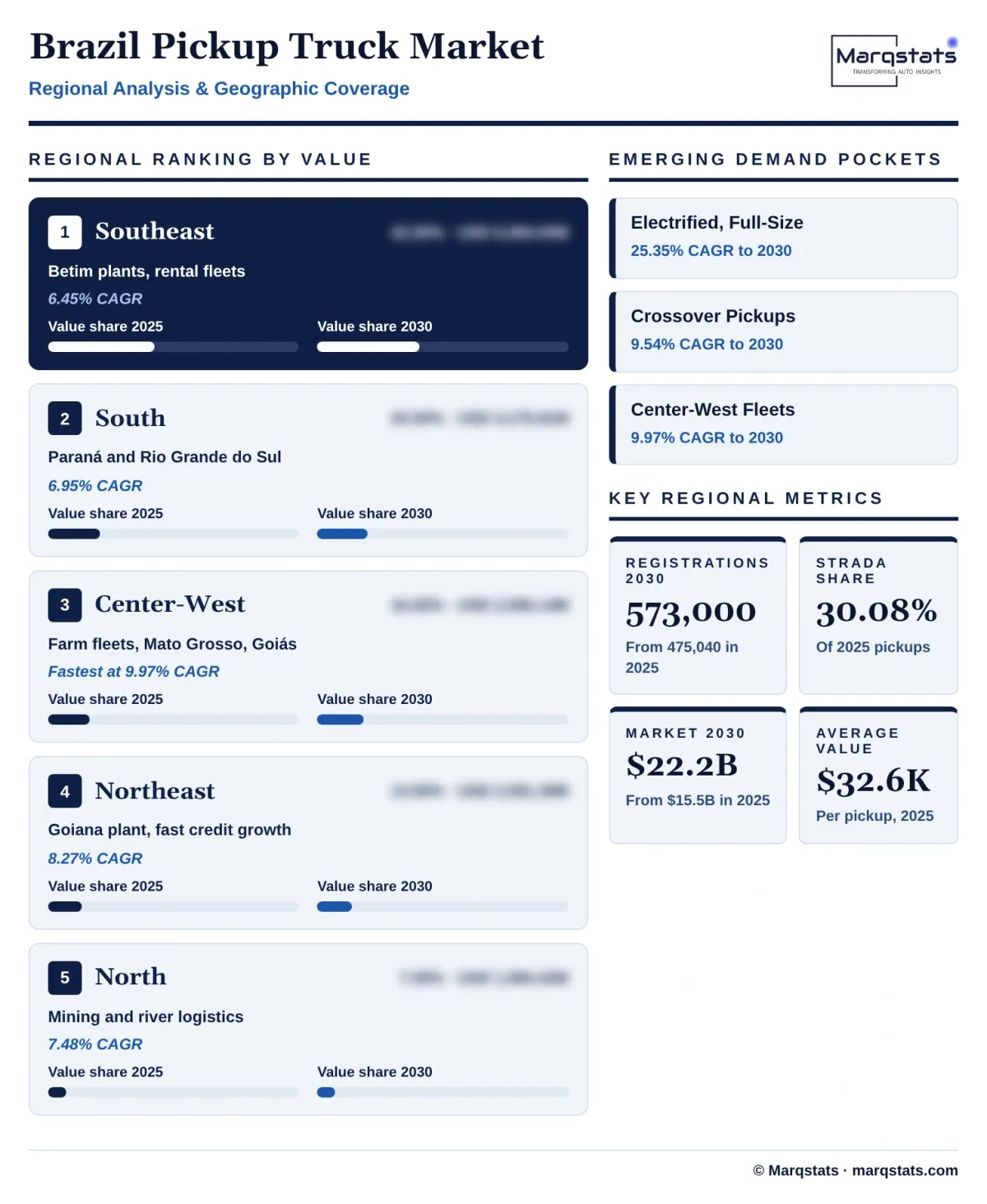
The Brazil pickup truck market size is estimated at USD 15,491.76 million in 2025 and is projected to reach USD 22,224.25 million by 2030, growing at a CAGR of 7.48% over 2026 – 2030. Registrations rise from 475,040 to 573,000 pickups, a 3.82% annual rate, while the average transaction value per pickup climbs from about USD 32,611 to USD 38,786 as buyers move up to crossover, plug-in and diesel models.
Marqstats defines the market as the value of new pickups of up to 3.5 tonnes gross vehicle weight registered in Brazil, from the Fiat Strada and Volkswagen Saveiro to the Toyota Hilux, Ford Ranger and imported full-size models. Value is the registered volume multiplied by a Marqstats estimate of the average transaction price, which is list price less a blended 10.00% discount, with federal and state taxes embedded, converted at BRL 5.57 per US dollar. Vans, trucks, buses, cars, used vehicles and exports are excluded.
Diesel body-on-frame pickups account for 47.69% of 2025 value, individual buyers for 39.02% and the Southeast for 42.50%. Crossover mid-size pickups, led by the Fiat Toro and the Ram Rampage, grow fastest among the large vehicle types at 9.54% a year, and the Center-West grows fastest among regions at 9.97%.
Key Takeaways
Market Overview & Analysis
Report Summary
Marqstats sizes the Brazil pickup truck market as the value of new pickups of up to 3.5 tonnes gross vehicle weight sold in the country each year. It counts compact pickups such as the Fiat Strada and Volkswagen Saveiro, crossover mid-size pickups such as the Fiat Toro and Ram Rampage, diesel body-on-frame pickups such as the Toyota Hilux, Ford Ranger and Chevrolet S10, and electrified and full-size pickups such as the BYD Shark and Ford F-150. Panel vans, trucks above 3.5 tonnes, buses, cars and used vehicles are outside the market.
The pickup is Brazil's most important commercial vehicle. The National Federation of Motor Vehicle Distribution (FENABRAVE) counted 552,931 light commercial vehicles registered in 2025, up 2.91% from 537,295 in 2024, inside a year when cars and light commercial vehicles together reached 2,549,462 units. Named pickup models account for 475,040 of those registrations, 85.91% of the light commercial class and 18.63% of the car and light commercial total, and the Fiat Strada alone registered 142,903 units, the highest of any vehicle in the country for the fifth year in a row.
The 2026 cycle favours cars over pickups. FENABRAVE data show light commercial vehicles at 428,109 registrations from January to September 2026, up 8.02%, against cars at 1,728,390, up 22.49%, so the light commercial share of the combined total fell from 21.69% in 2025 to 19.85%. Among pickups, the eight models that rank in the 50 best-selling vehicles registered 324,625 units in the nine months, led by the Strada at 127,733, the Toro at 42,942 and the Saveiro at 38,721.
Policy changes the mix more than the total. The eighth phase of the national vehicle emissions programme (PROCONVE L8) took effect on 1 January 2025 under CONAMA Resolution 492/2018, with corporate averages of 50 mg/km of NMOG plus NOx in 2025, 40 in 2027 and 30 in 2029. The Green Mobility and Innovation programme (MOVER, Law 14.902/2024) offers R$ 19.3 billion in financial credits between 2024 and 2028, and the import duty on electric vehicles stepped up to 35% in July 2026, which favours pickups built in Brazil and Argentina over Chinese imports.
Marqstats estimates the market at about BRL 86.29 billion in 2025, equal to USD 15,491.76 million at the 2025 average of BRL 5.57 per US dollar, with 475,040 pickups at an average transaction price of about BRL 181,646. The market is 84.50% of the value of the Marqstats Brazil light commercial vehicle analysis, which adds vans, and the two should not be added together.
Brazil Pickup Truck Market Size and Forecast
The Brazil pickup truck market grows from USD 15,491.76 million in 2025 to USD 22,224.25 million in 2030, a CAGR of 7.48%. Volume supplies about half of the growth: registrations rise at 3.82% a year, from 475,040 to 573,000 pickups, and the average transaction value rises at 3.53% a year, from about USD 32,611 to USD 38,786, because prices rise 3.00% a year in reais at constant exchange rates and the mix moves toward mid-size and electrified pickups.
The 2025 value is built bottom-up from model-level registrations and prices. Marqstats applies FENABRAVE registrations for 20 named pickup nameplates, from the Fiat Strada at 142,903 to the GWM Poer at 758, and prices each at a volume-weighted list price built on 2026 entry prices and version ladders, such as the Strada at R$ 113,490, the Toro at R$ 159,490 to R$ 228,490 and the Hilux at R$ 282,390 for the simplest double cab. A blended 10.00% discount is applied for fleet bonuses and dealer offers. Offers on single versions reached about 22% in February 2026, so 10.00% is a market average and not a ceiling.
The 2026 estimate is 507,200 pickups, a 6.77% rise on 2025. FENABRAVE reported 428,109 light commercial registrations from January to September 2026, up 8.02%, and the last quarter is the seasonally strongest, while the Strada alone registered 16,002 units in September. Marqstats expects growth to slow to about 3.10% a year from 2027 to 2030, as the rental fleet renewal that lifted 2026 gives way to normal replacement cycles and as interest costs weigh on private buyers.
Electrified and full-size pickups add value faster than volume. Marqstats expects the group, which includes the BYD Shark, the GWM Poer and the Ford F-150, Ram 1500 and Chevrolet Silverado, to rise from 5,245 pickups in 2025 to 14,000 in 2030, equal to 2.44% of registrations and 5.41% of value. The Poer registered 649 units in September 2026 alone, while the Shark registered 1,133 in 2025 and 373 in 2026 to July, so the forecast is a Marqstats estimate that assumes local assembly of Chinese plug-in pickups.
Marqstats tracks four indicators to monitor the forecast: monthly FENABRAVE registrations of pickups by model, the pace of the import duty on electrified vehicles after July 2026, fleet purchases by rental companies such as Localiza&Co and Movida, and the launch calendar of mid-size pickups, including the Renault Niagara, the Ram Dakota and the Volkswagen Tukan.
Market Dynamics
Key Drivers
Six forces keep demand for new pickups above 475,000 units a year in Brazil.
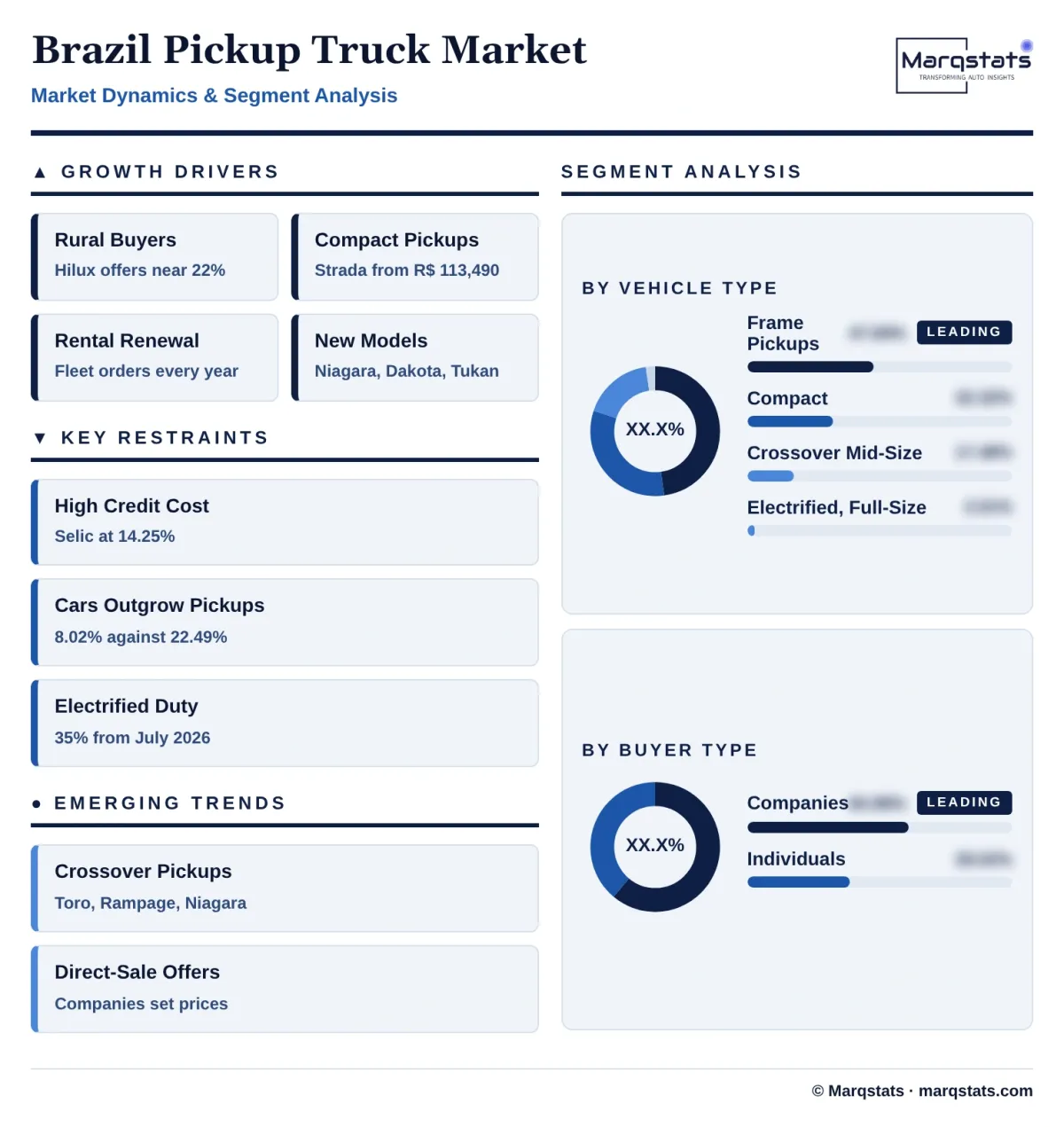
- Farm and rural buyers pay for capability. Toyota offered the Hilux double cab at R$ 220,264 against a list price of R$ 282,390 to rural producers and small fleets in February 2026, a discount of about 22%, and the Hilux, Ranger, Triton and S10 registered 125,654 units in 2025 across just four models. Crop and livestock income in the Center-West and South keeps this demand steady.
- Compact pickups give small businesses a low entry cost. The Fiat Strada starts at R$ 113,490, the Volkswagen Saveiro at R$ 112,690 and the Chevrolet Montana at R$ 131,990, and the Strada alone registered 142,903 units in 2025, 30.08% of all pickups. A pickup at that price replaces a hatchback and a small truck for tradespeople, couriers and farms.
- Fleet renewal by rental companies adds volume. Associação Brasileira das Locadoras de Automóveis (Abla) data for 2022 counted 1,136,517 vehicles owned by rental companies, of which 68.8% were registered in Minas Gerais, where the annual vehicle tax (IPVA) for rental companies is 1%, so Localiza&Co and Movida place steady annual orders for Strada and Saveiro units that retail demand alone would not provide.
- Credit remains available. Brazilians financed 7.3 million vehicles in 2025, up 2% and the best result since 2011, including 2.6 million new vehicles. Instalment finance is how most individual buyers reach the R$ 235,000 to R$ 335,000 entry prices of mid-size pickups such as the Chevrolet S10 and the Volkswagen Amarok.
- New models widen choice. Renault revealed the Niagara in September 2026 for dealers in November, built at Santa Isabel in Cordoba with a stated capacity of 40,000 to 60,000 vehicles a year, Ram unveiled the Dakota in October 2025 with sales from early 2026, the Volkswagen Tukan was announced in February 2026 for production in 2027, and the Fiat Titano registered 6,437 units in 2025, so every mid-size price band has a new entrant.
- The 2026 cycle lifts the whole market. The Brazilian Association of Motor Vehicle Manufacturers (ANFAVEA) forecasts 2026 cars and light commercial vehicles up 16.4%, and pickup registrations stayed strong through September 2026, when the Strada, Toro, Saveiro, Ranger and Hilux together registered 33,154 units.
Key Restraints
Four constraints slow the market even in a record year for total vehicle sales.
- Credit costs stay high. The Central Bank of Brazil held the Selic rate at 15.00% until the first cut of 2026 in March and cut it to 14.25% on 17 June 2026, the third cut of the year, so a buyer of a R$ 259,000 Ranger or a R$ 335,000 Amarok still finances at a policy rate above 14%, which holds back private purchases of mid-size pickups.
- Pickups are growing slower than cars. Light commercial registrations rose 8.02% from January to September 2026 against 22.49% for cars, and the light commercial share of the combined total fell from 21.69% to 19.85%, as buyers who once chose a double-cab pickup for family and work now have Chinese electrified cars and sport utility vehicles at similar prices.
- Mid-size pickups depend on discounts. The Hilux list price of R$ 282,390 and the Ranger entry price of R$ 259,000 sit well above the R$ 113,490 of a Strada, and the 22% offers seen in February 2026 show that factories use price cuts to move volume, which holds back realised value per pickup.
- Electrified pickups face import duty and thin demand. The import duty on electric vehicles rose from 25% to 35% in July 2026, the BYD Shark launched at R$ 379,800 in October 2024 and sold at R$ 344,990 by July 2026, its resale value on the FIPE price table fell R$ 102,000 or 27%, and only 373 units were registered in 2026 to July against 1,133 in 2025.
Key Trends
Four shifts are changing which pickups Brazilian buyers choose.
- Crossover mid-size pickups multiply. The Fiat Toro and Ram Rampage registered 52,133 and 26,140 units in 2025, the Ford Maverick 4,061, and the Renault Niagara and Volkswagen Tukan join in 2026 and 2027, creating a unibody class between the Strada and the Hilux with a 1.3 turbo flex engine as its common choice.
- Turbo flex engines replace diesel in lighter pickups. The Toro, Montana and Niagara use 1.3 or 1.2 turbo flex engines that run on ethanol, while the Hilux, Ranger, S10, Triton, Titano, Frontier, L200 and Amarok remain diesel-only nameplates with 144,797 units in 2025, a segment that the Brazilian diesel rule limits to pickups with 1,000 kilograms of payload or four-wheel drive with low range.
- Direct-sale offers set prices. Toyota offered the Hilux to rural and fleet buyers at about 22% below list in February 2026, and retail data for nine pickups show that individuals took only 33.66% of their registrations, so factory offers to companies, not dealer prices, set the realised price of most pickups.
- New entrants arrive from Cordoba and China. The September 2026 ranking listed 22 nameplates, including the Ram Dakota at 673 units, the GWM Poer at 649, the Foton Tunland at 50 and the Kia Tasman at 12, so Argentine-built and Chinese pickups now fill every price gap, although each new name starts below 1,000 units a month.
Strategic Implications
- For pickup makers, the market rewards a presence in both halves. The Strada, Montana and Saveiro sell 76.06% of their volume to non-retail buyers, while the Hilux, Ranger, Triton and S10 sell 51.79%, so a maker needs a fleet offer for the first group and a dealer and finance offer for the second, and cannot treat them as one customer.
- For Toyota and Ford, the Hilux and Ranger contest is decided in the company channel. Retail buyers split the two models almost evenly, 22,628 against 22,533, so monthly rankings that reflect fleet billing, as in July and September 2026, will keep alternating unless Toyota keeps its rural-producer offers near 22% and Ford builds the same relationships with cooperatives.
- For new entrants with Chinese or imported platforms, the 35% duty on electrified imports from July 2026 makes local assembly or kits the practical route. The Renault Niagara is built in Argentina, Volkswagen plans the Tukan at São José dos Pinhais from 2027, and an entrant that depends on fully built imports faces price cuts like the R$ 34,810 reduction on the BYD Shark within 21 months.
- For finance and leasing companies, the gap between R$ 113,490 and R$ 282,390 entry prices splits the book in two. Small-ticket loans and leasing on compact pickups suit micro-businesses and rental groups, and larger loans with rural income evidence suit mid-size pickups, where residual values hold better than electrified models.
- For parts and service providers, a diesel-only mid-size fleet that grows by 144,797 units a year and a Strada fleet that grows by 142,903 a year define the aftermarket. Diesel emission systems under PROCONVE L8 and turbo flex engines need different parts, training and workshops.
Market Segmentation
Compact pickups account for 32.32% of 2025 value, USD 5,007.47 million, and 51.09% of units, with 242,664 registrations. The Fiat Strada leads at 142,903 units, followed by the Volkswagen Saveiro at 67,753, the Chevrolet Montana at 20,384 and the Renault Oroch at 11,624. The segment grows at 5.61% a year to USD 6,578.57 million as units rise to 275,000, the slowest rate of the pickup groups because buyers trade up to crossover models.
Crossover mid-size pickups account for 17.48% of 2025 value, USD 2,708.54 million, and grow fastest among the large vehicle types, at 9.54% a year, to USD 4,271.31 million and 19.22% of the market. They include the Fiat Toro at 52,133 units, the Ram Rampage at 26,140 and the Ford Maverick at 4,061, and the Renault Niagara and Volkswagen Tukan add choice in 2026 and 2027.
Diesel body-on-frame pickups account for 47.69% of 2025 value, USD 7,387.53 million, and are the largest segment by value although they hold 30.48% of units. The Toyota Hilux registered 49,732 units, the Ford Ranger 34,063 and the Chevrolet S10 31,458, with the Mitsubishi Triton, Fiat Titano, Nissan Frontier, Mitsubishi L200 and Volkswagen Amarok below them. The segment grows at 6.61% a year to USD 10,173.10 million.
Electrified and full-size pickups account for 2.51% of 2025 value, USD 388.22 million, and 1.10% of units, with 5,245 registrations: the Ford F-150 at 1,208, the Ram 1500 at 1,190, the BYD Shark at 1,133, the Chevrolet Silverado at 956 and the GWM Poer at 758. They grow fastest, at 25.35% a year, to USD 1,201.27 million and 5.41% of the market, from a very small base.
Nameplates sold only with flex-fuel petrol and ethanol engines account for 32.32% of 2025 value, USD 5,007.47 million, and 51.08% of units, or 242,664 registrations. They are the Strada, Saveiro, Montana and Oroch, and they grow at 5.61% a year to USD 6,578.57 million. Marqstats classifies by the fuel offer of each nameplate, which the manufacturer range sets.
Nameplates sold only with diesel engines account for 47.69% of 2025 value, USD 7,387.53 million, and 30.48% of units, or 144,797 registrations. They include the Hilux, Ranger, S10, Triton, Titano, Frontier, L200 and Amarok, and they are the largest group by value. They grow at 6.61% a year to USD 10,173.10 million.
Nameplates that offer several fuels, plug-in hybrids and electrified drivetrains account for 19.99% of 2025 value, USD 3,096.76 million, and 87,579 registrations. The group includes the Toro, Rampage, Maverick, Shark, Poer and the full-size petrol pickups, and grows fastest, at 12.06% a year, to USD 5,472.58 million and 24.62% of the market.
Individual buyers, who FENABRAVE reports as retail, account for 39.02% of 2025 value, USD 6,044.74 million, and 34.43% of units, or 163,560 registrations. Marqstats builds the estimate on retail data for nine pickups, which show individuals at 33.66% of their 434,967 registrations, and applies shares of 24.00% to compact pickups, 40.00% to crossover pickups, 48.00% to diesel body-on-frame pickups and 55.00% to electrified and full-size pickups. The group grows at 7.88% a year to USD 8,831.17 million as crossover models gain share.
Companies, rental groups, rural producers and public buyers account for 60.98% of 2025 value, USD 9,447.02 million, and 65.57% of units, or 311,480 registrations, and they buy through direct billing from the factory. The group grows at 7.23% a year to USD 13,393.08 million, and its share of units moves from 65.57% to 64.91% as the compact pickups that fleets prefer keep growing.
By Geography
Southeast
The Southeast accounts for 42.50% of 2025 value, USD 6,584.00 million, and grows at 6.45% a year to USD 9,000.82 million. It holds the factories at Betim in Minas Gerais and the São Paulo market, and it is overstated in registrations because rental companies register fleets there: Abla data for 2022 put 68.8% of 1,136,517 rental-company vehicles in Minas Gerais and 11.5% in São Paulo, where the annual vehicle tax is 1% for rental companies. Marqstats allocates value by registration, as buyers and lenders do.
South
The South accounts for 20.50% of 2025 value, USD 3,175.81 million, and grows at 6.95% a year to USD 4,444.85 million. Paraná and Rio Grande do Sul combine soybean, wheat and livestock income with a dense network of dealers, and the region buys more Hilux and Ranger double cabs than its share of population suggests. Rental companies pay a 1% vehicle tax in Paraná, and the Paraná share of rental-company vehicles was 6.5% in 2022.
Center-West
The Center-West accounts for 16.50% of 2025 value, USD 2,556.14 million, and grows fastest among regions, at 9.97% a year, to USD 4,111.49 million and 18.50% by 2030. Mato Grosso, Mato Grosso do Sul and Goiás run farm fleets that use pickups on unpaved roads, and the region's share of value is higher than its share of units because buyers choose mid-size diesel models.
Northeast
The Northeast accounts for 13.50% of 2025 value, USD 2,091.39 million, and grows at 8.27% a year to USD 3,111.39 million. Financed vehicles in the region grew 12.3% in 2025, the fastest of any region, and Stellantis builds the Toro and Rampage at Goiana in Pernambuco, which keeps supply local.
North
The North accounts for 7.00% of 2025 value, USD 1,084.42 million, and grows at 7.48% a year to USD 1,555.70 million. Financed vehicles grew 9.8% in 2025, and mining, river logistics and infrastructure works buy diesel pickups, although long distances and thin dealer networks cap volume.
How Competition Is Evolving
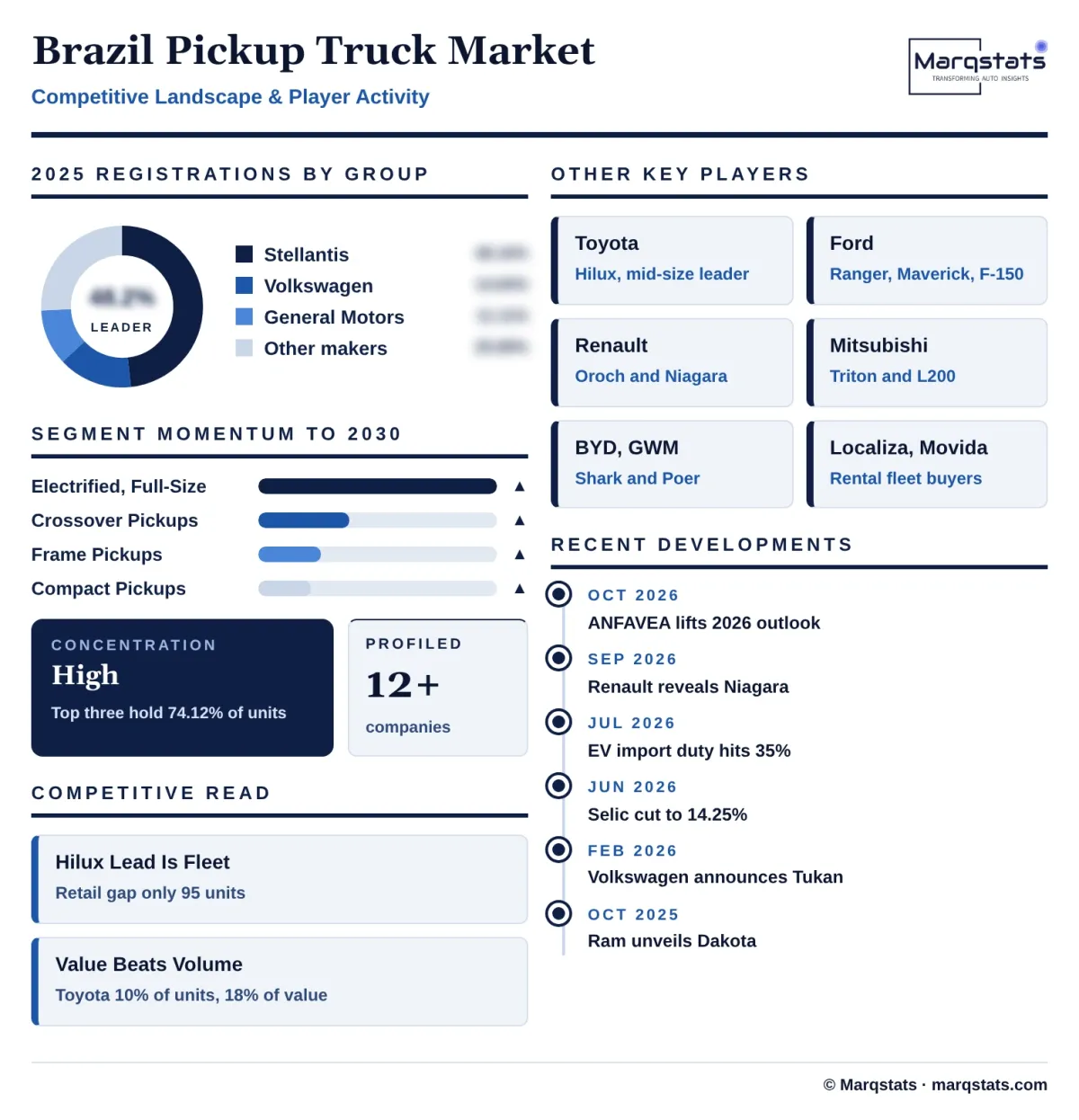
The market is highly concentrated and led by Stellantis. Marqstats counts registrations of named nameplates from FENABRAVE: Stellantis, with the Fiat Strada, Toro and Titano and the Ram Rampage and 1500, registered 228,803 pickups in 2025, 48.16% of the market and 37.84% of value. Volkswagen follows with 70,487 (14.84%) and General Motors with 52,798 (11.11%), so the top three hold 74.12% of units.
Value shares differ from unit shares because mid-size pickups are costly. Toyota, with only the Hilux at 49,732 units, holds 10.47% of units but 17.64% of value, and Ford, with the Ranger, Maverick and F-150 at 39,332 units, holds 8.28% of units and 13.37% of value. Volkswagen, which relies on the Saveiro, holds 9.56% of value against 14.84% of units.
Stellantis defends its lead from the factory. The company stated on 2 January 2026 that it registered more than 750,000 vehicles in Brazil in 2025, about 29.3% of total sales, that the Strada was Brazil's best seller for the fifth consecutive year, and that the Toro ranked first and the Rampage second among compact pickups, and it plans Leapmotor production at Goiana. Renault, Mitsubishi and Nissan hold 6.74% of units, and BYD and GWM hold 0.40%.
Competition is moving from price to platform. The Renault Niagara, built in Argentina, and the Volkswagen Tukan enter the Toro class in late 2026 and 2027, the Ram Dakota, built in Argentina, targets the Hilux now and the new Volkswagen Amarok follows from 2027, rental groups such as Localiza&Co and Movida buy through direct contracts, and Chinese entrants face a 35% duty on electrified imports. In September 2026 the Ranger outsold the Hilux, 3,465 units to 3,310, for the second time in the year.
Companies Covered
Companies covered in the report include:
Recent Market Activity
Table of Contents
Coverage & Segmentation
The study covers the Brazil pickup truck market, with 2025 as the base year, 2021 – 2025 as the historical period and 2026 – 2030 as the forecast period. It covers new pickups of up to 3.5 tonnes gross vehicle weight registered in Brazil, as FENABRAVE and ANFAVEA classify them within light commercial vehicles, segmented by vehicle type, powertrain platform, buyer type and region. Values are Marqstats estimates of the transaction value in US dollars at BRL 5.57 per US dollar, the 2025 average, with federal and state taxes embedded and a blended 10.00% discount applied to list prices.
Panel vans such as the Fiat Fiorino and Renault Master, heavy-duty pickups above 3.5 tonnes such as the Ram 2500 and 3500, trucks, buses, passenger cars including sport utility vehicles, used vehicles, exports and conversions are excluded. Segment and regional splits, nameplate prices and the forecast are Marqstats estimates built on FENABRAVE and ANFAVEA registrations, model rankings and dealer list prices. The Marqstats Brazil light commercial vehicle analysis is the broader parent, and live Marqstats reports on the Brazil Electric Vehicle, Brazil PHEV and Brazil Used Car markets are adjacent, so their figures should not be added to this market.
