Market Snapshot
The Mexico pickup truck market size is estimated at USD 7,154.34 million in 2025 and is projected to reach USD 9,677.61 million by 2030, growing at a CAGR of 6.23% over 2026 – 2030. Unit sales rise from about 241,119 to 288,479 pickups, a 3.65% annual rate, while the average retail price before sales tax rises from about USD 29,671 to USD 33,547 per vehicle at constant 2025 exchange rates.
Marqstats defines the market as the retail transaction value, excluding the 16% value added tax (IVA), of new pickup trucks with a gross vehicle weight of up to 3.5 tonnes (Class 1 to 3) sold to buyers in Mexico. It covers car-derived compact pickups, midsize body-on-frame pickups, full-size pickups and heavy-duty Class 3 pickups, sold to private buyers, businesses and fleets. Pickups built in Mexico for export, used pickups, cab-over mini trucks, chassis cabs of Class 4 and above, and aftermarket conversions are excluded. Values are converted at the 2025 average of MXN 19.20 per US dollar.
Midsize body-on-frame pickups account for an estimated 67.43% of 2025 value and Chinese-platform pickups for 18.85%. Gasoline pickups hold 72.90% of value, diesel 24.60% and electrified models 2.50%. The study segments the market by vehicle class, powertrain, platform origin and region.
Key Takeaways
Market Overview & Analysis
Report Summary
Marqstats sizes the Mexico pickup truck market as the retail transaction value, excluding IVA, of new pickups up to 3.5 tonnes sold in Mexico. In 2025 about 241,119 pickups were sold, worth an estimated USD 7,154.34 million at an average price of about USD 29,671 per vehicle, equal to about MXN 660,800 including IVA.
The unit base is built from the model-level registry of pickup sales compiled by Autocosmos, which lists 64 nameplates and 249,350 pickups for 2025. Marqstats removes cab-over mini trucks such as the Isuzu ELF and Foton Miler and Class 4 and above chassis cabs such as the Ford F-450 and Ram 4000, which are sold as work trucks rather than pickups. That leaves 45 nameplates and 238,719 pickups in scope, up 6.16% from 224,864 in 2024. Marqstats adds an estimated 2,400 units for brands that do not report to the registry, mainly the BYD Shark, to reach 241,119.
Mexico is a large light vehicle market. INEGI reported 1,524,583 light vehicles sold in 2025, up 1.3% from 1,504,322, with December up 4.9% to 154,395. Pickups therefore account for about 15.8% of domestic light vehicle sales, a share that is rising as work-oriented buyers move toward trucks and as Chinese brands add low-priced pickups.
Pickup demand has three layers. The first is work use in construction, agriculture, mining, oil and gas and delivery, where payload, durability and price drive the purchase and the Nissan NP300, Toyota Hilux, Mitsubishi L200 and Chevrolet S10 Max compete. The second is lifestyle and family use of crew-cab midsize and full-size models such as the Toyota Tacoma, Ford Ranger and F-150. The third is small business and urban delivery, served by car-derived compacts such as the Ram 700 and Volkswagen Saveiro that cost 340,000 to 570,000 pesos.
The market has grown steadily. Marqstats estimates sales of about 138,000 pickups in 2021, 167,000 in 2022, 209,000 in 2023 and 226,000 in 2024, a 15.0% annual rate over 2021 – 2025, before the 2025 total of 241,119. Growth in 2025 came almost entirely from Chinese-platform nameplates.
Trade policy shapes the market from two sides. Mexico raised import tariffs of up to 50% on 1,463 tariff lines for goods from countries without trade agreements, including China and South Korea, from 1 January 2026, and Chinese-platform pickups kept growing: the Ram 1200 rose 118.3% to 13,071 units in the first half of 2026. On the export side, the United States applies a 25% tariff to non-US content of compliant vehicles and a 25% tariff on medium and heavy trucks from 1 November 2025, which affects the plants that build the pickups Mexico exports.
Mexico Pickup Truck Market Size and Forecast
The Mexico pickup truck market grows from USD 7,154.34 million in 2025 to USD 9,677.61 million in 2030, a CAGR of 6.23%. Marqstats expects value of USD 7,598.26 million in 2026, USD 8,070.60 million in 2027, USD 8,573.25 million in 2028 and USD 9,108.20 million in 2029. Unit sales are expected to rise from 241,119 in 2025 to about 249,900 in 2026, 258,900 in 2027, 268,400 in 2028, 278,200 in 2029 and 288,500 in 2030.
Volume growth is moderate and price growth is steady. Units grow 3.65% a year, helped by the Volkswagen Tukan in 2027, new Chinese-platform nameplates and a record start to 2026, when January sales rose 3.8% to 20,646 pickups. Average prices before sales tax rise about 2.5% a year at constant exchange rates, from about USD 29,671 to USD 33,547, as list prices follow inflation and the mix moves toward crew cabs, four-wheel drive and diesel. These are Marqstats estimates.
Class mix changes slowly. Midsize body-on-frame pickups stay near two-thirds of value, 67.43% in 2025 and 67.63% in 2030. Car-derived compact pickups rise from 11.34% to 12.70%, full-size pickups fall from 18.46% to 17.05% and heavy-duty Class 3 pickups slip from 2.77% to 2.62%.
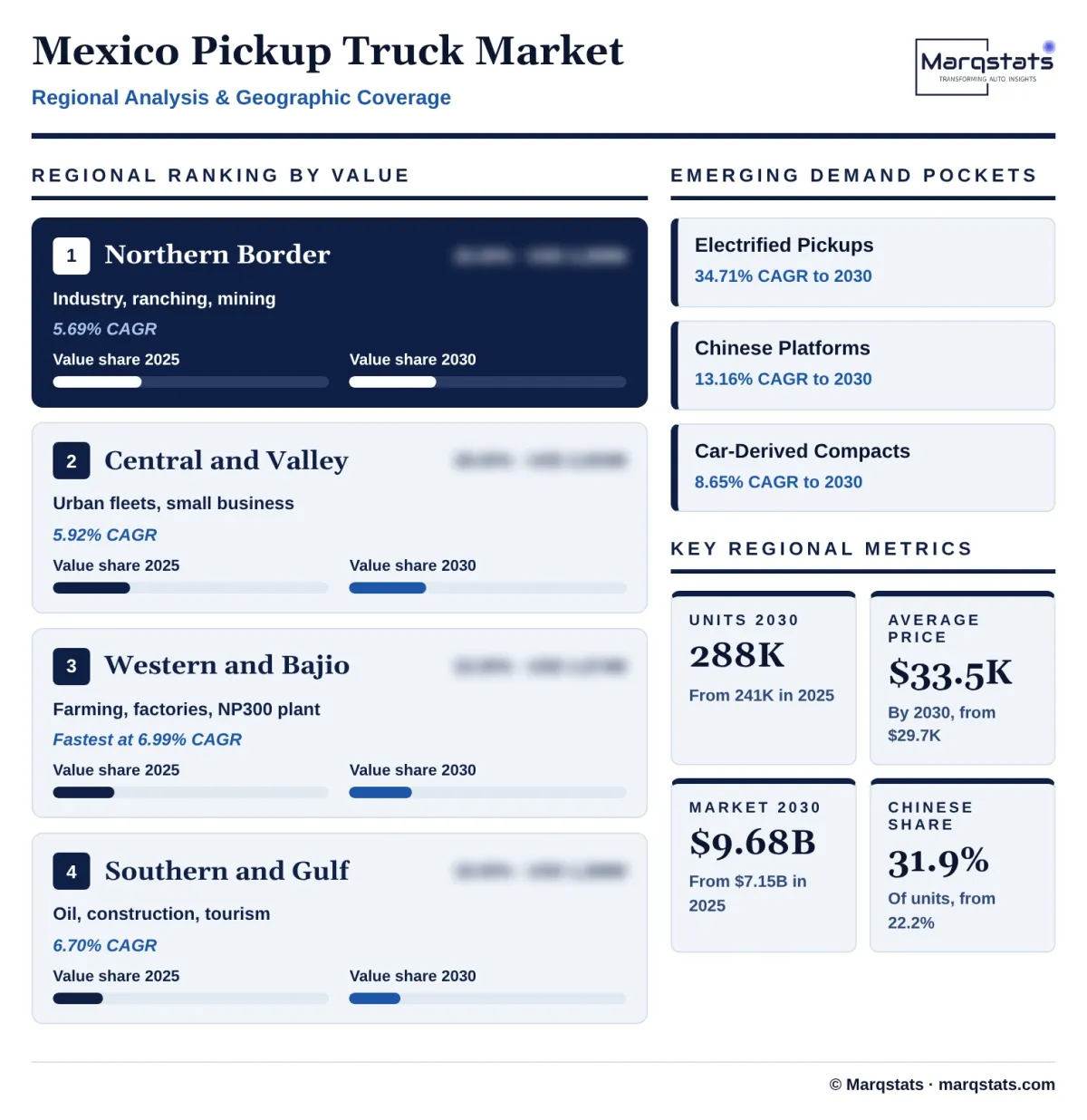
Platform mix changes quickly. Chinese-platform pickups rise from 53,407 units in 2025, 22.15% of the market, to about 92,000 in 2030, 31.89%, while all other platforms grow from 187,712 to 196,479 units, about 0.9% a year. In value terms Chinese platforms grow from USD 1,348.86 million to USD 2,503.15 million, a 13.16% CAGR, lower than their unit growth because Marqstats expects their average price to fall relative to rivals as entry-level models such as the Changan Hunter and JAC Frison scale.
Powertrain mix moves toward electrified models. Gasoline pickups fall from 72.90% of value to 68.40%, diesel from 24.60% to 23.40%, and electrified pickups rise from 2.50% to 8.20%. Diesel holds its share of work use because the Isuzu D-Max, launched in July 2026, the Toyota Hilux and the Mitsubishi L200 sell on fuel economy and towing.
Marqstats tracks five indicators to monitor the forecast: monthly AMDA and INEGI registrations, tariff changes on Asian-built vehicles, the outcome of the USMCA review, peso exchange rates against list-price changes, and production at the Aguascalientes plant that now builds the Nissan NP300.
Market Dynamics
Key Drivers
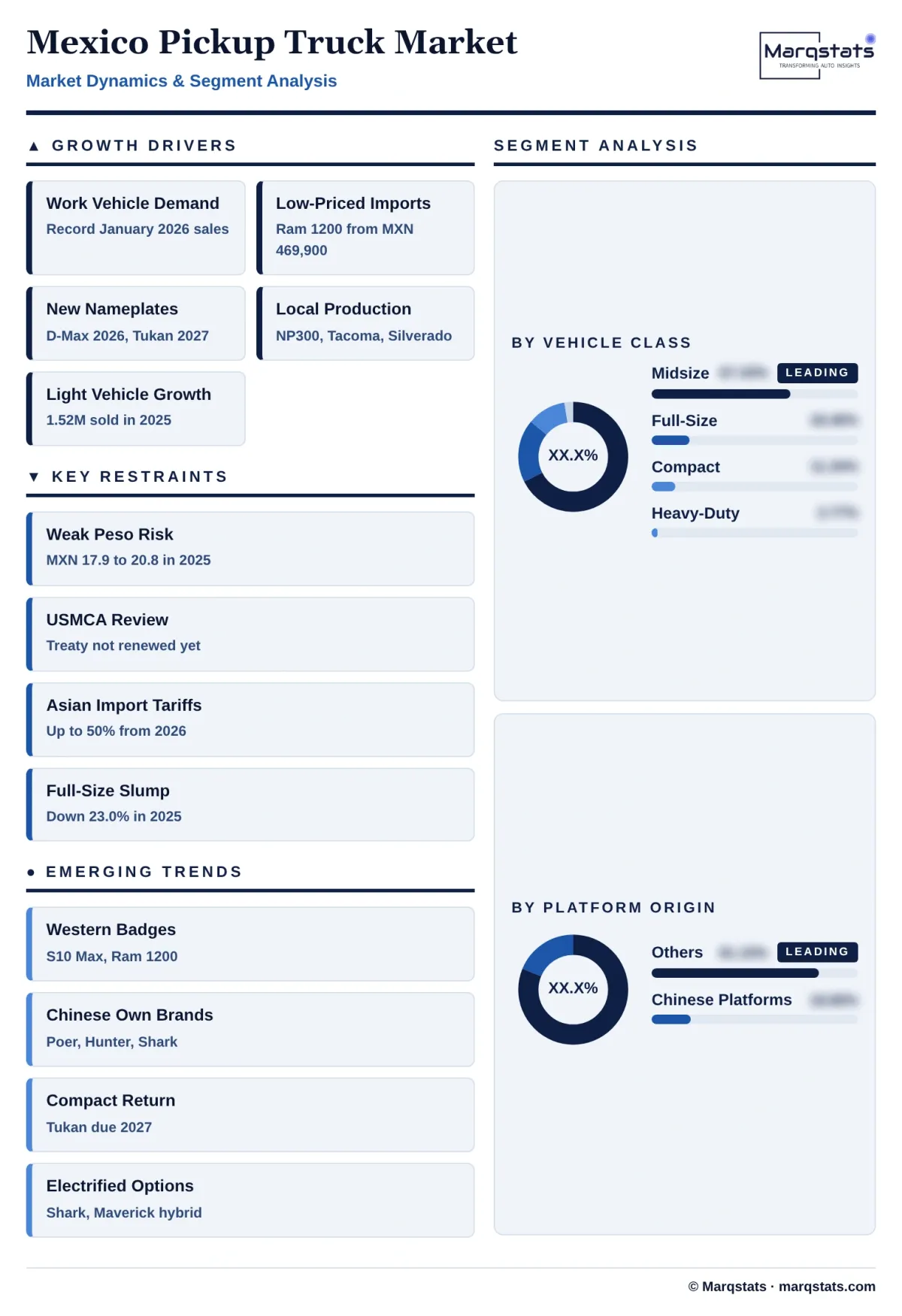
Five forces are lifting Mexican pickup sales and shifting them toward Chinese-built platforms.
- Strong work-vehicle demand. Construction, agriculture, mining, oil and gas, and parcel delivery all rely on pickups, and AMDA reported 20,646 pickups sold in January 2026, up 3.8% and a record for the month. The Nissan NP300 alone sold 58,422 units in 2025.
- Low-priced Chinese-platform pickups. The Ram 1200 from MXN 469,900, the Chevrolet S10 Max from MXN 490,300, the GWM Poer from MXN 455,900 and the JAC Frison from MXN 459,000 undercut established midsize rivals such as the Toyota Hilux at MXN 570,900 and the Ford Ranger at MXN 775,000, pulling new buyers into the segment.
- New nameplates. The Isuzu D-Max launched in July 2026 with a 3.0 litre diesel engine at MXN 550,000 to 792,000, the Volkswagen Tukan is due in 2027 to replace the Saveiro, and the BYD Shark added a 430-horsepower plug-in hybrid option in 2024, widening choice in every price band.
- Local pickup manufacturing. Mexico builds the Nissan NP300 at Aguascalientes, the Toyota Tacoma in Baja California, the Chevrolet Silverado and GMC Sierra at Silao and the Ford Maverick at Hermosillo, which keeps domestic prices stable and supports dealer and parts networks.
- A growing light vehicle market. INEGI reported 1,524,583 light vehicles sold in 2025, up 1.3%, and pickup share of domestic sales is rising as buyers shift from sedans to trucks.
Key Restraints
Four constraints limit how fast Mexican pickup sales and prices can rise.
- Weak peso and rising list prices. Prices are set in pesos but many components and imported models cost dollars, and the peso ranged from 17.907 to 20.846 per dollar in 2025. A weaker peso pushes list prices up quickly in a market where the entry price for many buyers is below MXN 500,000.
- Trade uncertainty. The first joint review of the USMCA on 1 July 2026 ended without a US agreement to renew the treaty in its current form, although it stays in force, and US tariffs on Mexican-built vehicles weigh on the plants that supply both the export and domestic markets.
- Tariffs on Asian imports. Mexico applied tariffs of up to 50% on 1,463 tariff lines for countries without trade agreements from 1 January 2026, raising the cost of Chinese and Korean vehicles. Marqstats expects Chinese brands to respond by assembling or sourcing locally, which takes time and capital.
- Weak full-size demand. Full-size sales fell 23.0% in 2025 as Silverado regular-cab sales collapsed, and average prices above MXN 1.1 million put the class out of reach for many work buyers.
Key Trends
Four shifts are changing which pickups Mexican buyers choose and who builds them.
- Western badges on Chinese platforms. The Chevrolet S10 Max and Ram 1200 are built in China on partner platforms and sold under familiar US badges, and together reached 34,236 units in 2025, 67.12% of Chinese-platform volume.
- Chinese brands adding pickups under their own names. GWM Poer, Changan Hunter, JMC, Foton, JAC and BYD all sell pickups in Mexico, and the Changan Hunter family is offered as a pickup, chassis and work version from MXN 479,900.
- Compact pickups return. The Ram 700, Chevrolet Montana, Renault Oroch, Volkswagen Saveiro and Ford Maverick grew 15.5% together in 2025 to 41,078 units, and the Volkswagen Tukan is planned for 2027.
- Electrified options spread. The BYD Shark plug-in hybrid, Ford Maverick hybrid, JAC E-Frison and Foton Tunland EV give buyers alternatives, and electrified pickups are a small but fast-growing share of value.
Strategic Implications
- For established brands, defending midsize volume means matching the price of Chinese-platform entrants without losing trim and brand value. The Nissan NP300 holds 24.5% of in-scope units but fell 18.3% in the first half of 2026 while the Ram 1200 rose 118.3%.
- For Chinese-platform brands, scale depends on dealer coverage and parts supply rather than vehicle price. Brands that add service points outside the major cities, and that localize assembly or parts to offset the 2026 tariff increases, will hold the volumes they have won.
- For fleet buyers and lenders, residual values are the main uncertainty. New Chinese-platform nameplates have short used-market histories, so leasing companies should price terms on observed resale data rather than on new-vehicle price alone.
- For component suppliers, the overlap between export and domestic production is an advantage. Plants that build about 1.2 million pickups a year, mostly for export, give suppliers volume to serve the domestic range at low cost.
- For investors, the signal to watch is the share of Chinese-platform pickups. If it passes 30% by 2028, Marqstats expects established brands to respond with lower-priced trims and local assembly.
Market Segmentation
Midsize body-on-frame pickups account for 67.43% of 2025 value, USD 4,823.47 million and 171,185 units including the Marqstats allowance, and grow at 6.30% a year to USD 6,545.27 million and 67.63% of the market by 2030. The class includes 25 nameplates from the Nissan NP300, Toyota Hilux, Ram 1200, Chevrolet S10 Max, Mitsubishi L200 and Toyota Tacoma to the Ford Ranger, and registry sales rose 10.2% in 2025. It is the center of the market because it covers both work and lifestyle buyers.
Car-derived compact pickups account for 11.34% of 2025 value, USD 811.53 million and 41,078 units, and grow fastest of the four classes, at 8.65% a year, to USD 1,228.72 million and 12.70% of the market. The Ram 700 sold 17,349 units in 2025, up from 11,758, the Volkswagen Saveiro 14,848, the Chevrolet Montana crew cab 3,423, the Renault Oroch 2,683 and the Ford Maverick 2,775. The Volkswagen Tukan, due in Mexico in 2027, replaces the Saveiro and adds a new model to the segment.
Full-size pickups account for 18.46% of 2025 value, USD 1,321.01 million and 25,584 units, and grow at 4.55% a year to USD 1,649.77 million, which reduces their share to 17.05%. The class has an average price above MXN 1.1 million and includes the Ford F-150 at 5,469 units, Chevrolet Silverado, Ram 1500, GMC Sierra and Toyota Tundra. Registry sales fell 23.0% in 2025 because Silverado regular-cab sales dropped from 9,661 to 734.
Heavy-duty Class 3 pickups, the Ford F-250 and F-350, account for 2.77% of 2025 value, USD 198.33 million and 3,272 units, and grow at 5.06% a year to USD 253.85 million. Registry sales rose 10.7% in 2025. Buyers are typically agricultural and mining operators and fleets that need high payloads, and the class is sensitive to peso moves because the vehicles are priced above MXN 1.3 million.
Gasoline pickups account for 72.90% of 2025 value, USD 5,215.51 million, and grow at 4.88% a year to USD 6,619.49 million, with share falling to 68.40%. The Nissan NP300 gasoline versions, Ram 700, Saveiro and Toyota Hilux gasoline versions supply most of this volume, and gasoline remains the choice of price-sensitive buyers. Powertrain splits are Marqstats estimates.
Diesel pickups account for 24.60% of 2025 value, USD 1,759.97 million, and grow at 5.17% a year to USD 2,264.56 million, with share easing to 23.40%. Diesel serves work buyers who need towing and fuel economy: the Toyota Hilux, Mitsubishi L200, Ford Ranger, Volkswagen Amarok and, since July 2026, the Isuzu D-Max with a 3.0 litre, 188-horsepower engine.
Electrified pickups, covering hybrids, plug-in hybrids and battery-electric models, account for 2.50% of 2025 value, USD 178.86 million, and grow fastest, at 34.71% a year, to USD 793.56 million and 8.20% of the market. The BYD Shark, launched in 2024 with 430 horsepower, supplies about 2,000 units of the Marqstats allowance, and the Ford Maverick hybrid, JAC E-Frison and Foton Tunland EV add small volumes.
Pickups built on non-Chinese platforms, including Japanese, US, German and Brazilian designs, account for 81.15% of 2025 value, USD 5,805.48 million and 187,712 units, and grow at 4.33% a year to USD 7,174.46 million, with share falling to 74.13%. Registry sales of this group grew only 0.08% in 2025, from 187,558 to 187,712 units; at brand level Nissan fell 1.1% and Toyota rose 6.4%.
Pickups on Chinese platforms account for 18.85% of 2025 value, USD 1,348.86 million and 53,407 units, and grow at 13.16% a year to USD 2,503.15 million and 25.87% of the market. The group includes the Chevrolet S10 Max, Ram 1200, JAC Frison, GWM Poer, Changan Hunter, JMC Grand Avenue and Vigus, Foton Tunland and the BYD Shark. In the registry the group reached 51,007 units, 21.37% of in-scope sales, against 37,306 and 16.59% in 2024.
By Geography
Northern Border
The Northern Border states are the largest region, with 32.00% of 2025 value, USD 2,289.39 million, rising to USD 3,019.41 million by 2030, a 5.69% CAGR, while share eases to 31.20%. Nuevo Leon, Chihuahua, Sonora, Coahuila, Tamaulipas and Baja California combine industrial plants, ranching, mining and a culture of US-style trucks, and full-size and heavy-duty pickups sell here at the highest rates. Proximity to the Toyota plant in Baja California and the Ford plant in Hermosillo adds supply, and cross-border price comparison keeps local list prices disciplined. These are Marqstats allocations, since no official state-level pickup series exists.
Central and Valley of Mexico
Central and the Valley of Mexico account for 28.00% of 2025 value, USD 2,003.22 million, rising to USD 2,671.02 million by 2030, a 5.92% CAGR. Mexico City, the State of Mexico, Puebla, Morelos, Hidalgo and Tlaxcala hold the largest urban population, so car-derived compacts, small-business pickups and delivery fleets are most common. Registration data overstate this region because leasing companies and fleets register vehicles in Mexico City and the State of Mexico that operate elsewhere, and Marqstats allocates sales by place of use rather than place of registration.
Western and Bajio
Western and Bajio account for 22.00% of 2025 value, USD 1,573.95 million, and grow fastest of the four regions, at 6.99% a year, to USD 2,206.50 million and 22.80% of the market. Jalisco, Guanajuato, Queretaro, Aguascalientes, San Luis Potosi and Michoacan combine farming, food processing and new manufacturing, and the region hosts the Nissan NP300 plant at Aguascalientes and the GM plant at Silao. Local plants support dealer networks, and the rising number of industrial parks increases demand from business buyers.
Southern and Gulf
Southern and Gulf account for 18.00% of 2025 value, USD 1,287.78 million, rising to USD 1,780.68 million by 2030, a 6.70% CAGR and 18.40% of the market. Veracruz, Tabasco, Oaxaca, Chiapas, Yucatan and the Peninsula combine oil and gas, construction, farming and tourism, and rely on durable diesel midsize pickups. Dealer networks are thinner than in the north, which favors established brands, but low-priced Chinese-platform models are gaining ground where price decides.
How Competition Is Evolving
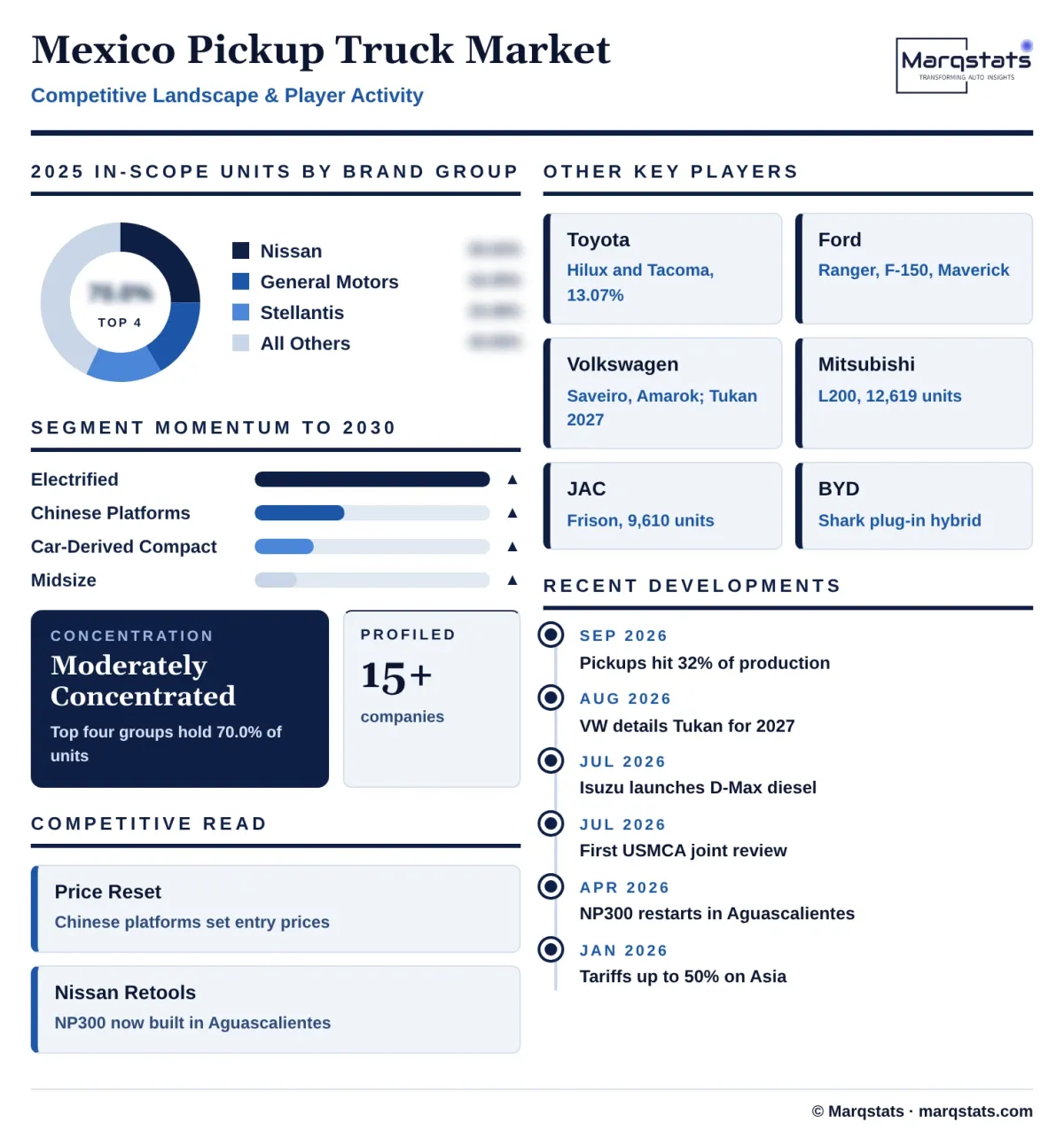
The Mexico pickup truck market is moderately concentrated. Four brand groups account for 70.02% of the 238,719 in-scope registry units: Nissan with 59,739 units and 25.02%, General Motors with 39,268 and 16.45%, Stellantis with 36,946 and 15.48%, and Toyota with 31,191 and 13.07%. Ford holds 9.02%, Volkswagen 7.06%, Mitsubishi 5.29%, JAC 4.05% and Renault 1.12%, and a long tail of Chinese brands and Mazda hold the remaining 3.44%.
Share movement in 2025 came from the edges. Stellantis rose 45.6%, driven by the Ram 1200 and Ram 700, while General Motors fell 9.5% after Silverado regular-cab sales collapsed, Renault fell 18.3% and Nissan fell 1.1%. The Nissan NP300 still sold 58,422 units, but it fell 18.3% in the first half of 2026 to 23,136 units while the Ram 1200 rose 118.3% to 13,071.
The strategic question is whether established brands can hold price while Chinese-platform pickups reset the bottom of the market. Nissan has reinvested, closing its CIVAC plant on 27 March 2026 and restarting NP300 production at Aguascalientes A1 on 15 April 2026 with a USD 96 million investment, a line rate of 17 units an hour and a target of 20. General Motors and Stellantis answer by selling Chinese-built pickups under their own badges, which protects dealer volume but concedes manufacturing.
The signal to watch is dealer count and used-vehicle value of Chinese-platform pickups. If resale values hold, buyers will treat the platforms as equal to Japanese and US rivals, and Marqstats expects the Chinese-platform share of units to reach 31.89% by 2030.
New entrants keep arriving. The Isuzu D-Max launched in July 2026, the Volkswagen Tukan follows in 2027 as a Brazilian-built replacement for the Saveiro, and the BYD Shark and GWM Poer are building volume. The competitive map therefore changes every year, and a pickup range without a model under MXN 500,000 is increasingly hard to defend.
Companies Covered
Companies covered in the report include:
Recent Market Activity
Table of Contents
Coverage & Segmentation
The study covers the Mexico pickup truck market, with 2025 as the base year, 2021 – 2025 as the historical period and 2026 – 2030 as the forecast period. Values are in US dollars at retail transaction prices excluding the 16% IVA, converted from pesos at the 2025 average of MXN 19.20 per US dollar, and volumes are annual new pickup sales in Mexico. The market is segmented by vehicle class, powertrain, platform origin and region.
Pickups built in Mexico for export, used pickups, cab-over mini trucks such as the Isuzu ELF and Foton Miler, Class 4 and above chassis cabs such as the Ford F-450 and Ram 4000, SUVs, vans and aftermarket conversions are excluded. Segment and regional splits, historical volumes before 2024 and the forecast are Marqstats estimates built on the model-level registry, INEGI and AMDA totals, list prices and company disclosures.