Market Snapshot
The Chile pickup truck market size is estimated at USD 1,616.41 million in 2025 and is projected to reach USD 2,057.49 million by 2030, growing at a CAGR of 4.94% over 2026 – 2030. Registrations rise from 63,429 to 72,000 pickups, a 2.57% annual rate, as the average price before VAT climbs from about USD 25,484 to USD 28,576 and electrified pickups grow from 3.17% to 12.08% of units.
Marqstats defines the market as the retail value, before value-added tax, of new pickups (camionetas) registered in Chile, the segment the National Automotive Association of Chile (Asociación Nacional Automotriz de Chile, ANAC) reports under that name. It covers midsize body-on-frame pickups such as the Toyota Hilux, Mitsubishi L200 and GWM Poer, car-based pickups such as the RAM 700, and full-size pickups such as the Ford F-150. Value is built bottom-up as units multiplied by estimated prices before IVA, converted at CLP 953.94 per US dollar, the 2025 average, and the forecast is most sensitive to the mix between midsize and full-size pickups.
Midsize body-on-frame pickups account for 79.67% of 2025 value, diesel for 84.19% and the Santiago Metropolitan Region for 40.82%, but the Northern Mining Regions grow fastest, at 5.61% a year. ANAC counted 47,652 pickups in January to September 2026, up 2.0%, which keeps the segment at 20.09% of light and medium vehicle registrations.
Key Takeaways
Market Overview & Analysis
Report Summary
Chile sells pickups the way other markets sell family cars, and the reason is the tax code. ANAC counted 63,429 pickups in 2025, up 2.8% from 61,682, which was 20.42% of the 310,598 new light and medium vehicles sold, a share almost identical to 20.40% in 2024. Passenger cars fell 11.8% to 54,277 in the same year, SUVs rose 7.6% to 158,700 and commercial vehicles rose 7.8% to 34,192. Pickups have a cyclical shape, with a peak of 87,558 in 2022 and a trough of 61,682 in 2024, but they are the passenger-capable body that businesses can buy with the 19% IVA recovered. In 2026 the segment is flat to slightly up, at 47,652 units in January to September, a 2.0% rise.
Marqstats measures the retail value, before IVA and before the green tax, of new pickups registered in Chile in each calendar year, using the ANAC pickup (camioneta) segment of 63,429 units in 2025. All dollar figures use CLP 953.94 per US dollar, the 2025 average. Excluded adjacent markets are passenger cars, 54,277 units, and SUVs, 158,700 units, which the Chile Passenger Car Market analysis covers; commercial vehicles, 34,192 units, which are vans and other light commercial vehicles; trucks, 14,394 units, and buses, 4,932 units, which sit above the light and medium class; and used pickups.
The analysis is built for four groups. Pickup importers and brand managers can use it to set price and range by class, as the Chinese brands enter at lower price points. Fleet lessors and financiers can size residual-value exposure by class and powertrain, using the 24 month resale rule on the green tax exemption. Mining, forestry and farm procurement teams can benchmark what the average buyer pays and where electric options exist. Investors and policy teams can test the effect of Law 21,850 and any change to VAT treatment on a segment that depends on it.
Chile Pickup Truck Market Size and Forecast
The Chile pickup truck market grows from USD 1,616.41 million in 2025, or CLP 1.542 trillion, to USD 2,057.49 million in 2030, a CAGR of 4.94%. Volume is the primary series and price the derived one: registrations rise at 2.57% a year, from 63,429 to 72,000 pickups, and the average price before IVA rises at 2.32% a year, from about USD 25,484 to USD 28,576, or CLP 24.31 million to CLP 27.26 million, because price increases of 2.20% to 3.00% a year in each class are partly offset by faster volume growth in the cheaper car-based class.
The 2025 base is built bottom-up from ANAC model registrations. Marqstats assigns the 20 pickups that ANAC ranks, 56,068 units, to three classes and estimates the remaining 7,361 units from smaller nameplates, giving 51,186 midsize, 7,207 car-based and 5,036 full-size pickups. Prices before IVA are estimated at CLP 24.0 million, CLP 14.5 million and CLP 41.5 million. For midsize pickups the anchors are Maxus launch prices before IVA of CLP 24.99 to 26.99 million for the T60 Max 4x4 in September 2025 and CLP 17.99 to 22.99 million for the T70 in August 2026, with the premium Japanese and North American models above them. These are Marqstats estimates and the market value moves by about USD 17 million for each CLP 250,000 change in the average price.
The path to 2030 starts from a flat 2026. ANAC counted 47,652 pickups in January to September 2026, 2.0% above the same months of 2025, so Marqstats estimates 64,700 for the full year, then 66,300 in 2027, 68,100 in 2028, 70,000 in 2029 and 72,000 in 2030. Growth of 2.57% a year assumes pickups stay near 20.40% of light and medium registrations as that market recovers toward the 10 year average of about 348,000 units that ANAC cites, and that the 2021 and 2022 fleet purchases, 160,928 pickups, move into replacement. Value rises to USD 1,686.87 million in 2026, 0.86% above 2025.
The value rate exceeds the volume rate through price and mix. The car-based class grows fastest in units, at 5.23% a year, and full-size pickups at 4.25%, while midsize pickups grow 2.00%, so the mix shifts toward both ends of the price range. Marqstats assumes price rises of 2.20% a year for midsize, 2.50% for car-based and 3.00% for full-size pickups, in Chilean pesos, and holds the exchange rate constant at CLP 953.94 so that the dollar series isolates volume and price.
The market ladder shows where pickups sit. ANAC registered 310,598 light and medium vehicles in 2025, of which pickups were 20.42%, SUVs 51.10%, passenger cars 17.48% and commercial vehicles 11.01%. Pickups outsell trucks, 14,394 units, by 4.41 times and buses, 4,932 units, by 12.86 times. Chile has no light vehicle assembly, so every pickup is imported, and 18,988 units, or 29.94%, come from the Chinese brands that ANAC ranks in its top 20.
Marqstats tracks four indicators to monitor the forecast: monthly ANAC pickup registrations and the segment share of light and medium vehicles, the value of the peso against the dollar, the cost of vehicle financing for small businesses, and any change to VAT credit or green tax rules for pickups that the government announces after Law 21,850.
Market Dynamics
Key Drivers
Five forces keep the pickup at about one in five new light and medium vehicles sold in Chile, whatever the cycle does to the rest of the market.
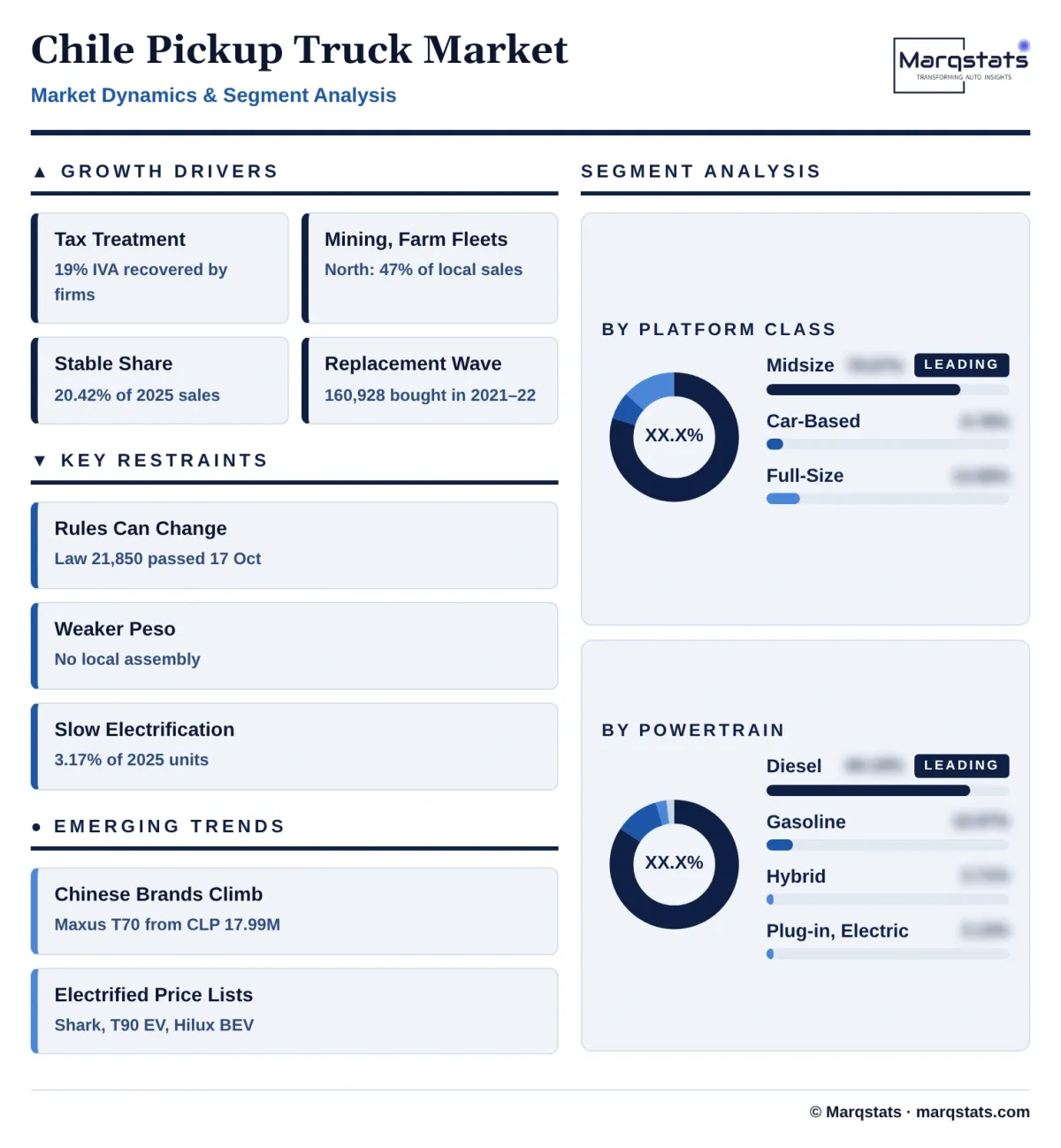
- Tax treatment makes the pickup a business asset. Buyers registered for VAT recover the 19% IVA on a pickup, and under article 3 of Law 20,780 they are exempt from the one-time green tax on pickups of up to 2,000 kilograms of payload held as fixed assets, according to the General Treasury of the Republic. Cars and station wagons do not receive the same treatment, so a business that needs a double-cab vehicle usually buys a pickup.
- Mining, forestry and farm fleets renew on a cycle. Mitsubishi Motors Chile said in July 2026 that corporate and mining fleets buy for renewal, quality and after-sales backing, and ANAC counted 10,623 new light and medium vehicles in Antofagasta in 2025, up 6.8%. Marqstats estimates that 8,600 pickups, 13.56% of the segment, were registered in the four Northern Mining Regions in 2025.
- The segment holds its share while the rest of the market rotates. Pickups were 20.42% of registrations in 2025 and 20.09% in January to September 2026, while SUVs rose 10.1% to 129,576 units in the first nine months of 2026 and passenger cars fell 8.3% to 38,669. Stability in a shifting market is the clearest sign that the demand is structural.
- A replacement wave follows the 2021 and 2022 peak. ANAC counted 73,370 pickups in 2021 and 87,558 in 2022, together 160,928, and Marqstats assumes a four to five year fleet cycle, which places a large share of those vehicles in the 2026 and 2027 replacement window and supports the 66,300 units estimated for 2027.
- Open trade keeps range wide and entry prices low. Trade agreements let importers bring pickups from Argentina, Thailand, China and other partners at low or zero tariff, and ANAC ranks 20 pickup nameplates in a single year. The Maxus T70, launched in August 2026 from CLP 17.99 million before IVA, shows how far entry prices have moved for a diesel double cab.
Key Restraints
Four constraints could slow pickup growth or move volume between buyer groups.
- The tax advantage depends on rules that can change. Law 21,850 for National Reconstruction was published on 17 October 2026 and, as the bill was summarised before promulgation, lowers the first-category corporate tax rate from 27% toward 23%, which reduces the value of deducting pickup operating costs. A change to VAT credit or the green tax exemption would hit the 19.00% price gap that the segment depends on, and an owner who sells an exempt pickup within 24 months must pay the tax that was waived.
- A weaker peso raises prices at once. Chile has no light vehicle assembly, so every pickup is priced from a dollar import cost, and importers reprice list prices when the peso weakens. Marqstats holds the exchange rate at CLP 953.94, so the forecast does not include a currency move, and a 10% weaker peso, if fully passed on, would lift peso prices before IVA by about the same amount.
- Electrification is slow in the places pickups work. Electrified pickups were 2,008 units in 2025, 3.17% of the segment, and battery-electric pickups only 203. Toyota Chile said at Exponor in June 2026 that charging infrastructure, in public networks and inside mines, and range planning for shifts are the main challenges for its first Hilux BEV, so diesel keeps 75.00% of 2030 units in the Marqstats forecast.
- The cycle is deep. Pickups fell 19.27% in 2023 to 70,682 and a further 12.73% in 2024 to 61,682, a 29.55% drop from the 2022 peak, and the 2025 rise of 2.8% has not restored it. A tighter credit market or a pause in mining and forestry investment would move the segment more than its 20.42% share of the market suggests.
Key Trends
Four shifts are changing who supplies Chilean pickups and what powers them.
- Chinese brands climb the range. SAIC Motor's Maxus launched the T60 Max with a ZF eight-speed automatic and 4WD from CLP 24.99 million before IVA in September 2025, debuted the T70 in Chile in August 2026 as its first market outside China, and lists a T90 at CLP 30.99 to 33.99 million before IVA, while JAC sold 1,302 pickups in January to September 2026, up 44.7%.
- Electrified pickups move from pilots to price lists. BYD began selling the Shark plug-in hybrid in April 2025 at CLP 45.99 million before IVA and sold 425 in 2025, Maxus lists a T90 EV at CLP 53.99 to 57.99 million before IVA, and Toyota Chile presented its first Hilux BEV in June 2026, so ANAC data show pickup hybrid registrations up 131.0% for HEV and 388.0% for MHEV in 2025.
- Warranty becomes a selling point. The Maxus T70 comes with a lifetime powertrain warranty, subject to conditions, and JAC announced a lifetime engine and transmission warranty across its pickup and commercial range in 2026, which targets buyers who worry about the service networks of newer brands.
- The Hilux regains the lead in the second half. Toyota delivered 4,005 Hilux in the first half of 2026 against 4,252 for the Mitsubishi L200, then 2,519 against 1,870 in the third quarter, so the Hilux leads the year to September with 6,524 units against 6,122.
Strategic Implications
- For importers, the midsize class decides the contest and price brackets matter more than features. A CLP 1 million price difference is 4.11% of the average CLP 24.31 million price before IVA, and the Maxus T70 range from CLP 17.99 to 22.99 million before IVA shows the Chinese brands will compete on that gap.
- For established Japanese and North American brands, the defence is fleet terms rather than list price. Mining and forestry buyers value service coverage and residual values, so contracts that include maintenance, telematics and buyback commitments protect volume that cheaper entrants cannot yet serve across the northern regions.
- For fleet lessors and financiers, the 24 month resale rule on the green tax exemption sets a floor on holding periods for exempt pickups, and electrified pickups need separate residual-value curves because battery and hybrid system costs are unproven in used markets.
- For electric pickup suppliers, the first volume is in controlled sites. Mining operations above 4,000 metres and municipal fleets can use charging at fixed depots, and Toyota Chile is targeting mining first with the Hilux BEV, so supplier plans should assume 1,300 battery-electric pickups a year by 2030 rather than a mass-market switch.
- For policy teams and investors, any change to VAT credit or the green tax exemption changes the segment more than interest rates do, because the 19.00% price gap is larger than most financing cost differences, and monitoring regulations after Law 21,850 is part of forecasting.
Market Segmentation
Midsize body-on-frame pickups account for 79.67% of 2025 value, USD 1,287.77 million, and 51,186 units, and grow at 4.24% a year to USD 1,584.87 million and 56,500 units, while their share falls to 77.03%. The class covers the Toyota Hilux, Mitsubishi L200, GWM Poer, Ford Ranger, Maxus T60, JMC Grand Avenue and Vigus, KGM Grand Musso, Chevrolet Colorado, Changan Hunter, Foton G7, Mazda BT-50 and GWM Wingle 7, which together sold 45,186 units in 2025, plus an estimated 6,000 units from smaller nameplates. Mining, forestry, construction and farm buyers choose them for the ladder frame, selectable four-wheel drive and payload of about one tonne.
Car-based pickups account for 6.78% of 2025 value, USD 109.55 million, and 7,207 units, and grow fastest by value, at 7.86% a year, to USD 159.94 million and 7.77% of the market. The class covers the RAM 700, Ford Maverick, RAM Rampage, Chevrolet Montana and Volkswagen Saveiro, which sold 6,607 units in 2025, plus an estimated 600 units from other nameplates. Urban trades, parcel delivery and small businesses buy them for lower prices, lower bed height and fuel economy, and Marqstats estimates a price near CLP 14.5 million before IVA.
Full-size pickups account for 13.55% of 2025 value, USD 219.09 million, and 5,036 units, and grow at 7.37% a year to USD 312.68 million and 15.20% of the market. The Ford F-150 sold 2,246 units and the Chevrolet Silverado 2,029 in 2025, and Marqstats estimates 761 more from other full-size imports. Their price near CLP 41.5 million before IVA is the highest of any class, and buyers are executive fleets, large farms and towing users who need over four tonnes of towing capacity.
Diesel pickups account for 84.19% of 2025 value, USD 1,360.87 million, and an estimated 52,521 units, 82.80% of the segment, and grow at 1.81% a year to USD 1,488.54 million while their share of value falls to 72.35%. Every leading midsize model is sold with a turbodiesel, and the Maxus T70 launched in August 2026 with a 2.5 litre Euro 6c diesel of 221 horsepower. Marqstats estimates diesel units from the ANAC model list, as ANAC does not report pickups by fuel.
Gasoline pickups account for 10.97% of 2025 value, USD 177.26 million, and an estimated 8,900 units, 14.03% of the segment, and grow at 3.41% a year to USD 209.60 million. The RAM 700, Volkswagen Saveiro, Chevrolet Montana and petrol versions of the Ford F-150 and Chevrolet Silverado are the main volume, and Marqstats estimates a price near CLP 19.0 million before IVA.
Hybrid pickups without a plug account for 2.71% of 2025 value, USD 43.86 million, and 1,268 units, which is 536 full hybrids and 732 mild hybrids from the ANAC low and zero emission report. They grow at 29.30% a year to USD 158.50 million and 7.70% of value, because these vehicles need no charging at remote sites. ANAC reported mild hybrid pickups up 388.0% and full hybrids up 131.0% in 2025, from small bases.
Plug-in hybrid pickups account for 1.50% of 2025 value, USD 24.21 million, and 537 units, which ANAC reports as 16.6% of all plug-in hybrids sold in Chile. They grow at 42.23% a year to USD 140.89 million and 6.85% of value from a small base. The BYD Shark, with a 29.6 kilowatt-hour battery, 850 kilograms of payload and a list price of CLP 45.99 million before IVA, sold 425 units in 2025 and is the segment's main model.
Battery-electric pickups account for 0.63% of 2025 value, USD 10.21 million, and 203 units, which ANAC reports as 3.7% of battery-electric registrations and 89.7% above 2024. Their value rises to USD 59.96 million and 2.91% of value by 2030, from a base too small for the 42.48% rate to mean more than direction. The Maxus T90 EV, at CLP 53.99 to 57.99 million before IVA with a 430 kilometre WLTP range, and the Toyota Hilux BEV are the models to watch.
By Geography
Santiago Metropolitan Region
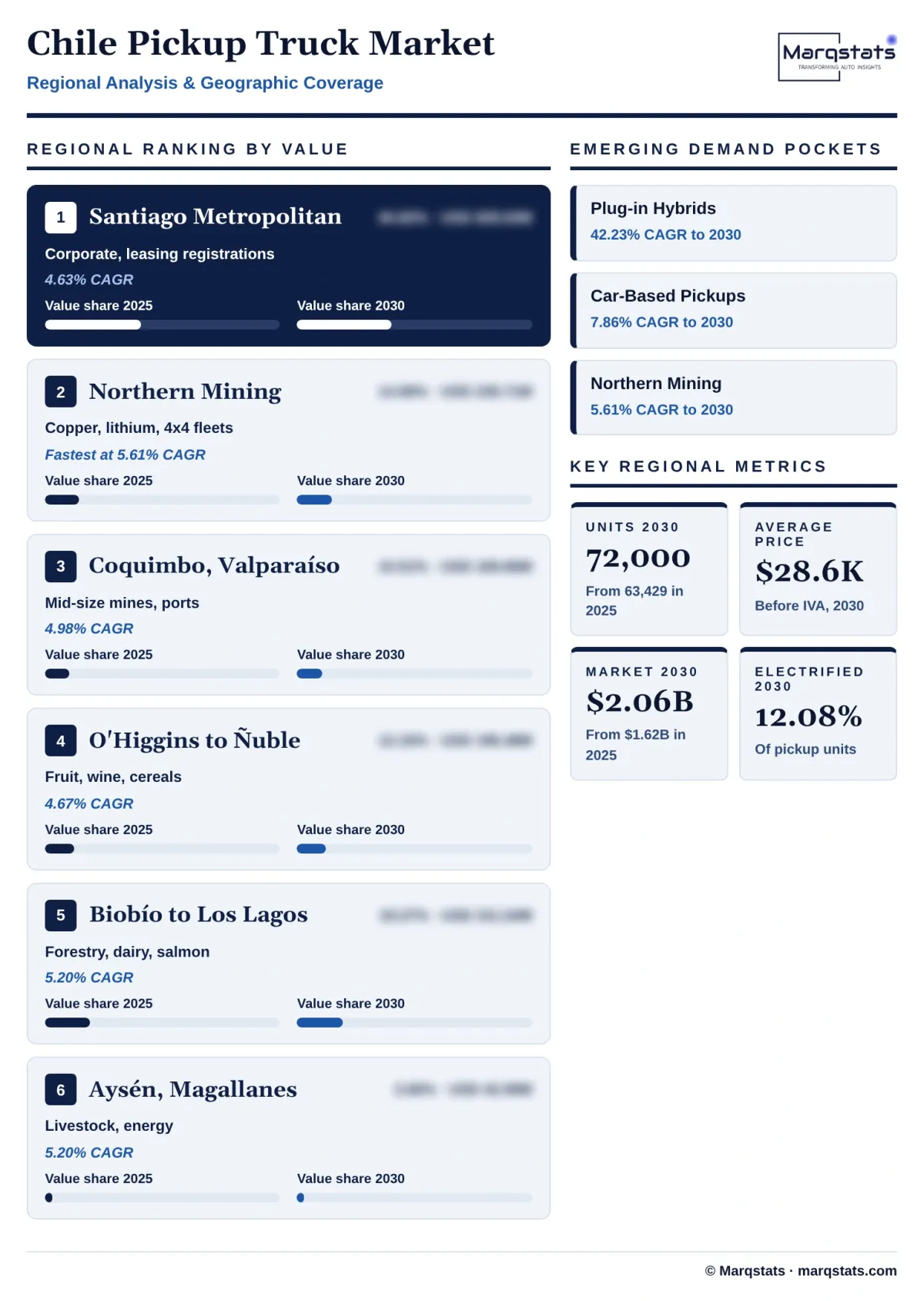
The Santiago Metropolitan Region accounts for 40.82% of 2025 value, USD 659.83 million, and 26,000 units, and grows at 4.63% a year to USD 827.48 million and 40.22% by 2030. ANAC registered 185,296 light and medium vehicles in the region in 2025, 59.66% of the national total and up 6.3%, but pickups are only an estimated 14.03% of them. Marqstats allocates by region of registration, as ANAC does, and Santiago includes corporate and leasing registrations for vehicles that later work in other regions.
Northern Mining Regions
The Northern Mining Regions, Arica y Parinacota, Tarapacá, Antofagasta and Atacama, account for 14.58% of 2025 value, USD 235.71 million, and 8,600 units, and grow fastest, at 5.61% a year, to USD 309.69 million and 15.05% by 2030. ANAC registered 18,294 light and medium vehicles in the four regions in 2025, and Marqstats estimates that 47.01% of them were pickups, the highest intensity in the country, because open-pit copper and lithium operations specify four-wheel drive and high-visibility equipment.
Coquimbo and Valparaíso
Coquimbo and Valparaíso account for 10.51% of 2025 value, USD 169.86 million, and 6,900 units, and grow at 4.98% a year to USD 216.56 million. ANAC registered 36,599 light and medium vehicles in the two regions in 2025, and Marqstats estimates that 18.85% were pickups, mainly for medium-scale mining in Coquimbo, port logistics and the Valparaíso agricultural valleys.
O'Higgins, Maule and Ñuble
O'Higgins, Maule and Ñuble account for 12.16% of 2025 value, USD 196.48 million, and 7,900 units, and grow at 4.67% a year to USD 246.89 million. ANAC registered 25,304 light and medium vehicles in the three regions in 2025, and Marqstats estimates that 31.22% were pickups, because fruit, wine and cereal growers use double-cab pickups on farm tracks and for crop transport.
Biobío, Araucanía, Los Ríos and Los Lagos
Biobío, Araucanía, Los Ríos and Los Lagos account for 19.27% of 2025 value, USD 311.54 million, and 12,400 units, and grow at 5.20% a year to USD 401.49 million. ANAC registered 41,046 light and medium vehicles in the four regions in 2025, and Marqstats estimates that 30.21% were pickups, led by forestry and cellulose operations around Concepción, dairy farms and the salmon industry in Los Lagos.
Aysén and Magallanes
Aysén and Magallanes account for 2.66% of 2025 value, USD 42.99 million, and 1,629 units, and grow at 5.20% a year to USD 55.38 million. ANAC registered 4,059 light and medium vehicles in the two regions in 2025, and Marqstats estimates that 40.13% were pickups, because livestock, energy and long unpaved distances favour four-wheel drive.
How Competition Is Evolving
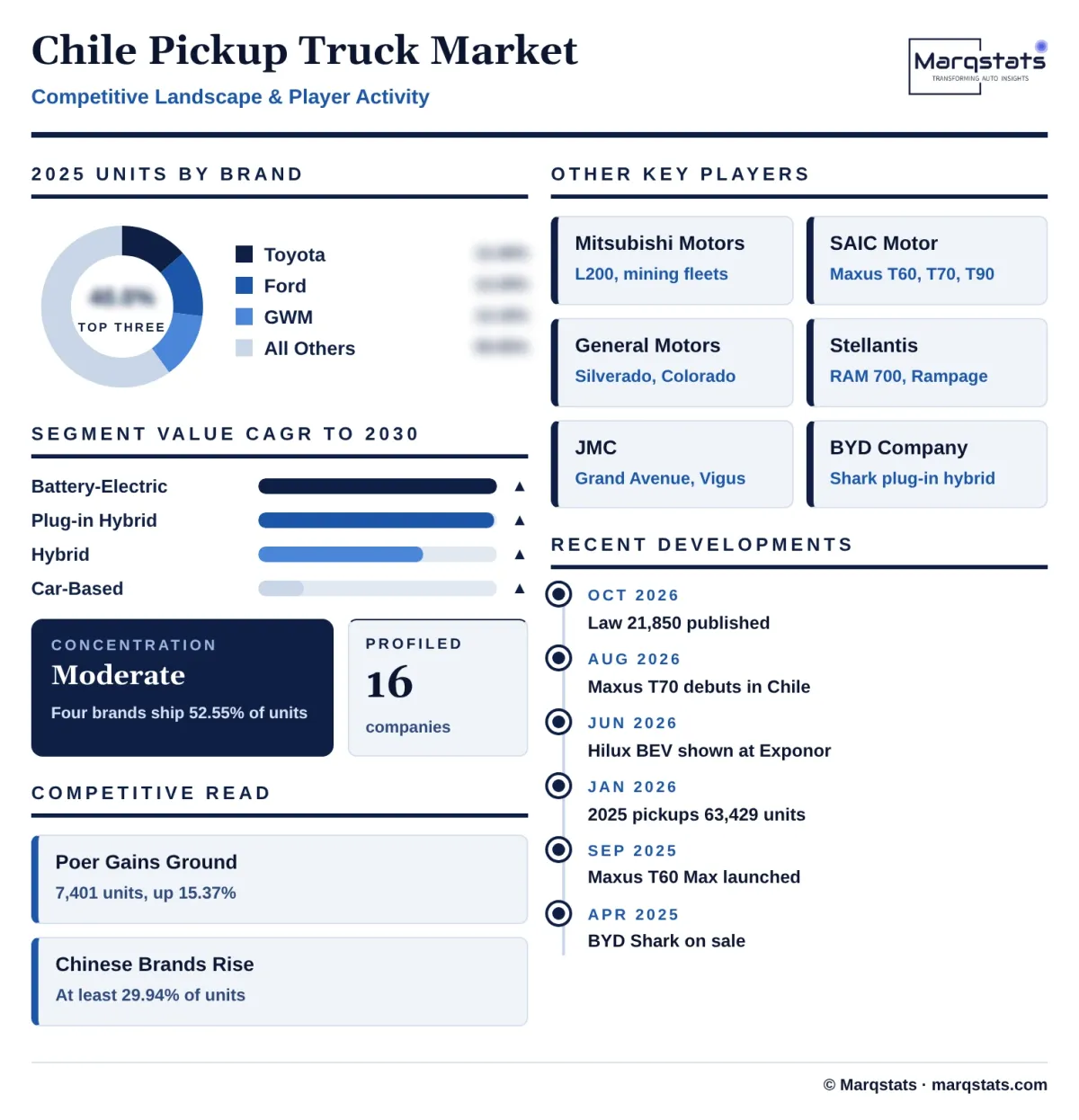
The market is moderately concentrated and the order is moving. Toyota delivered 8,548 pickups in 2025, 13.48% of the segment, Ford 8,496, 13.39%, and GWM 8,359, 13.18%, together 40.05%, with Mitsubishi at 7,926, 12.50%, taking the top four to 52.55%. By model, the Hilux, L200 and Poer sold 23,875 units, 37.64%. GWM is the mover: the Poer rose 15.37% to 7,401 units from 6,415 in 2024, while the Ford Ranger fell 8.45% to 5,178 and the Maxus T60 fell 11.76% to 4,533.
Chinese brands hold at least 29.94% of units. GWM, Maxus, JMC, Changan and Foton sold 18,988 pickups in the 2025 ANAC top 20, and JAC, with 1,302 units in January to September 2026, up 44.7%, and Chery, which entered the 2026 top 20 with the Himla at 508 units, add to the total. In the 2026 ranking to September the Poer sells 5,382 units, 11.29% of pickups, ahead of the Ford Ranger at 4,246 and the Maxus T60 at 3,019.
Competition is about price brackets, fleet terms and warranty rather than product features. Maxus lists pickups from CLP 17.99 million to 57.99 million before IVA, from the T70 to the T90 EV, Toyota and Mitsubishi sell on resale value and mining service networks, and Maxus and JAC advertise lifetime engine and transmission warranties. The corporate buyer compares the price before IVA, because the tax is recovered, while the private buyer compares the price including 19% IVA.
Chile has no light vehicle assembly, so position depends on import sourcing, distributor strength and financing. The Hilux and Ranger come from Argentina, the L200 from Thailand, and the Chinese models from China under trade agreements. Importers such as Gildemeister, which took over JAC representation at the end of 2024, show that distributors are consolidating brands, and fleet lessors and rental companies shape orders of the leading models.
Companies Covered
Companies covered in the report include:
Recent Market Activity
Table of Contents
Coverage & Segmentation
The study covers the Chile pickup truck market, with 2025 as the base year, 2021 – 2025 as the historical period and 2026 – 2030 as the forecast period. It covers new pickups (camionetas) registered in Chile, the ANAC pickup segment, segmented by platform class, powertrain and six regional groups: Santiago Metropolitan Region, the Northern Mining Regions, Coquimbo and Valparaíso, O'Higgins, Maule and Ñuble, Biobío to Los Lagos, and Aysén and Magallanes. Values are retail values before IVA and green tax in US dollars, converted from pesos at CLP 953.94 per US dollar, the 2025 average, and held constant through the forecast. Regions follow the region of registration that ANAC reports, and Marqstats allocates pickups to regions by estimated pickup intensity.
Passenger cars, SUVs, vans and other commercial vehicles, trucks, buses and used pickups are excluded. Passenger cars and SUVs are covered by the Chile Passenger Car Market analysis, which shares the ANAC definitions and the CLP 953.94 rate and does not overlap this market, and should not be added to it. Value is the primary series for pricing and units the primary series for ANAC data, and 16 companies are profiled.