Market Snapshot
Middle bar: base-year value × (1 + CAGR), rounded to two decimals. This is a calculated illustration, not a separately researched annual estimate.
The UK automotive lubricants aftermarket reached £1,053.0 million (USD 1,350.5 million) in 2025, even as the UK Trade Remedies Authority's December 2025 Final Determination under Investigation AD0059 imposed definitive five-year anti-dumping duties of up to 95.36% on Lithuanian engine oil imports and 34.55% on United Arab Emirates imports, repatriating an estimated 18,000 to 22,000 tonnes of annual blending volume to UK domestic producers including Aztec Oils, Exol Lubricants and Morris Lubricants, restoring domestic processing margins from a squeezed 2.5% to 4.0% back to historic norms of 6.5% to 9.0%.
The UK automotive lubricants aftermarket, evaluated at the wholesale-to-trade and distributor-realized tier net of value-added tax, reached 234.60 thousand tonnes valued at £1,053.0 million (USD 1,350.5 million) in 2025. The market is anchored against a UK vehicle parc reaching a record 42,549,649 vehicles in use at year-end 2025, comprising 36,676,185 passenger cars, 5,175,598 light commercial vehicles, 626,566 heavy goods vehicles, and 71,300 buses and coaches, confirmed by the Society of Motor Manufacturers and Traders and the Department for Transport.
The market's defining structural finding is a decisive trade-policy intervention that reshaped domestic blending economics. In December 2025, the UK Trade Remedies Authority delivered its Final Determination under Investigation AD0059, finding that the domestic UK lubricant blending industry had suffered substantial material injury caused by dumped imports from Lithuania and the United Arab Emirates that significantly undercut domestic wholesale prices. The Secretary of State for Business and Trade accepted definitive five-year anti-dumping duties ranging from 34.55% on UAE imports to 95.36% on Lithuanian exporters other than UAB SCT Lubricants, which itself faces an 84.72% rate. Prior to the determination, dumped imports were sold at an estimated 23% to 35% discount beneath UK cost-of-production benchmarks, squeezing domestic blender margins to 2.5% to 4.0%; the tariffs have since repatriated an estimated 18,000 to 22,000 tonnes of annual blending volume to UK producers, restoring margins to historic norms of 6.5% to 9.0%.
Key Takeaways
Market Overview & Analysis
Report Summary
This analysis sizes the UK automotive lubricants aftermarket, encompassing passenger car motor oils, heavy-duty diesel engine oils, automatic and manual transmission fluids, dual-clutch and continuously variable transmission fluids, differential and axle gear oils, brake fluids, and dedicated electric vehicle e-fluids dispensed during routine scheduled maintenance, engine sump flushes, component overhauls and top-up servicing. The market explicitly excludes factory first-fill volumes delivered to domestic OEM assembly facilities, industrial lubricants, marine bunkering lubricants, aviation hydraulic oils, and non-lubricating maintenance chemical consumables. The market is sized in thousand tonnes and GBP/USD million across a 2021-2025 historical period and a 2026-2030 forecast period, with 2025 as the base year.
The UK automotive lubricants aftermarket registered 234.60 thousand tonnes valued at £1,053.0 million (USD 1,350.5 million) in 2025. By 2030, physical volume is projected to contract to 216.45 thousand tonnes, a -1.59% compound annual growth rate, while market value expands to £1,185.6 million, a +2.40% compound annual growth rate. This divergence reflects the structural transition toward premium 0W-XX full synthetic formulations required to meet ACEA C5, C6 and C7 specifications and Stellantis wet-belt compliance requirements, combined with the ageing UK vehicle parc sustaining maintenance demand even as new-vehicle electrification accelerates.
The Baseline Structural Transition Scenario assumes the statutory Zero Emission Vehicle mandate targets are maintained (80% new car BEV share by 2030) and TRA anti-dumping tariffs remain enforced through 2030, with average vehicle age stabilizing at 9.8 years, yielding 216.45 thousand tonnes and £1,185.6 million by 2030. The Accelerated Electrification and Scrappage Scenario, reaching only 196.20 thousand tonnes (-3.51% volume CAGR) and £1,085.0 million (+0.60% value CAGR), is triggered if the government introduces targeted ICE scrappage incentives alongside strict municipal Clean Air Zones implemented across 12 UK cities, pushing operational BEV numbers to 8.5 million by 2030. The Fleet Retention and Prolonged ICE Lifecycle Scenario, reaching 226.50 thousand tonnes (-0.70% volume CAGR) and £1,275.4 million (+3.90% value CAGR), is triggered if economic constraints suppress new car purchases and the government softens ZEV compliance rules, pushing the average car age past 10.5 years with used-car transactions rising above 8.2 million annually.
Market Dynamics
Key Drivers
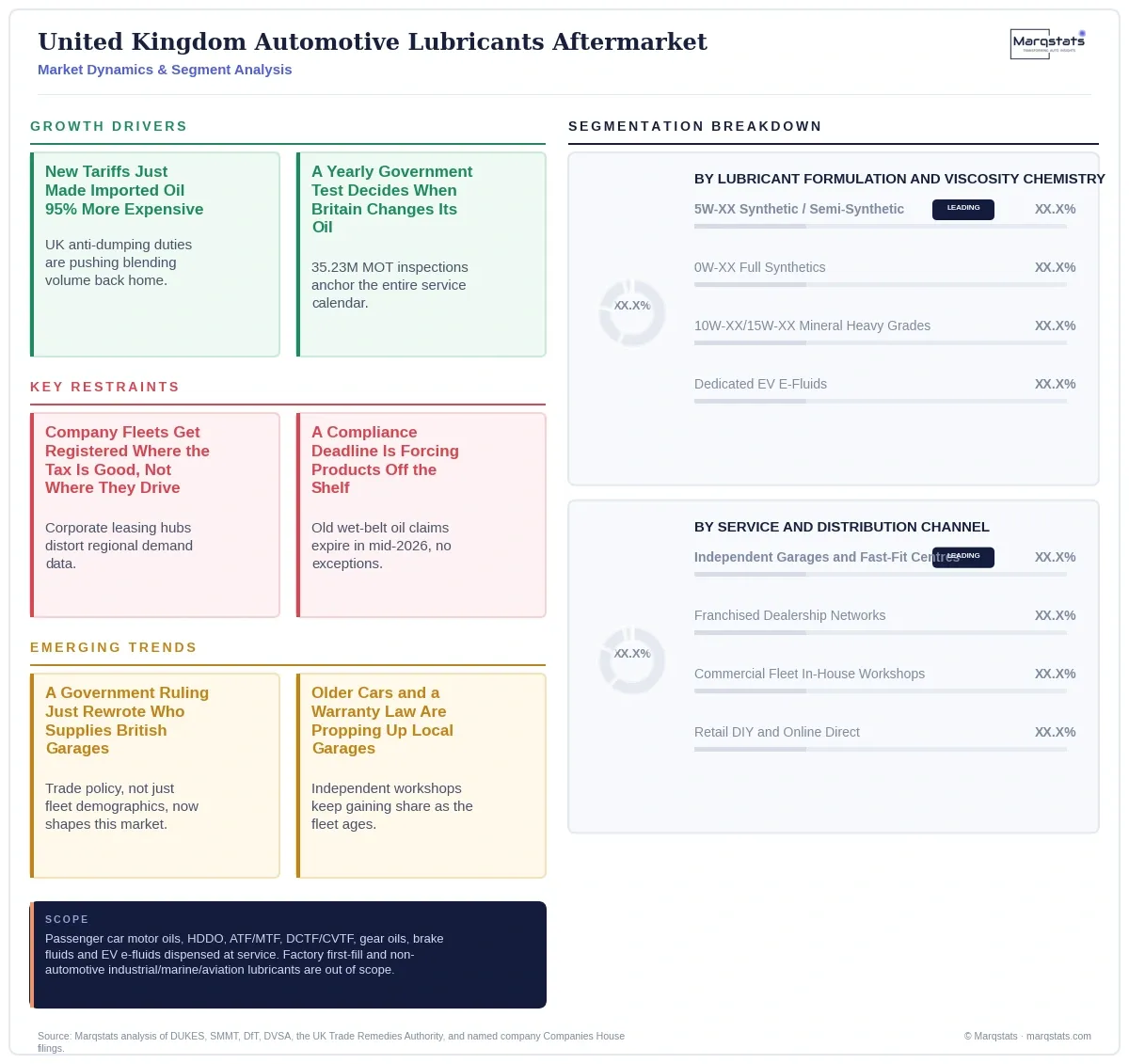
- Trade remedy enforcement is directly restoring domestic blending economics, exemplified by the UK Trade Remedies Authority's December 2025 Final Determination under Investigation AD0059, which imposed definitive five-year anti-dumping duties ranging from 34.55% to 95.36% on Lithuanian and UAE engine oil imports, repatriating an estimated 18,000 to 22,000 tonnes of annual blending volume to domestic producers including Aztec Oils, Exol Lubricants and Morris Lubricants.
- The statutory MOT testing regime functions as the primary structural gateway for routine lubricant servicing, exemplified by the Driver and Vehicle Standards Agency recording 35.23 million MOT inspections during the 2024/25 financial year with a post-rectification failure rate of 22.4%, as British motorists overwhelmingly combine mandatory MOT bookings with interim or full engine oil flushes and driveline maintenance.
- OEM technical specification enforcement is driving premiumization and liability-conscious purchasing behaviour, exemplified by the Verification of Lubricant Specifications investigation into Stellantis FPW9.55535/03 wet-belt compliance, which forced Smith & Allan, SCT-Vertriebs and Ravenol to withdraw or amend marketing claims after examining twelve commercial engine oils across an estimated 2.2 million UK vehicles operating wet-belt timing systems.
- The Motor Vehicle Block Exemption Order sustains independent workshop dominance in vehicle servicing, exemplified by independent garages and fast-fit centres capturing 62.0% of aftermarket volume (145.45 thousand tonnes) and performing over 75% of all post-warranty repairs and servicing, protected from OEM warranty invalidation provided OE-matching quality parts and fluids are used.
- Record fleet ageing is sustaining maintenance demand independent of new-vehicle sales trends, exemplified by the average car age in Great Britain reaching 9.7 years in 2025, with 84.1% of the passenger car parc (30.84 million vehicles) having exited factory warranty protection and requiring 0.8 to 1.5 litres of supplementary top-up oil between annual service flushes due to valve stem seal degradation and piston ring wear.
Key Restraints
- Regional fleet leasing and corporate vehicle registration data exhibits significant company registration clustering, since fleet leasing and corporate vehicle registrations are disproportionately recorded at corporate headquarters and leasing hubs across Greater London, Berkshire, Buckinghamshire and Solihull rather than where vehicles physically operate, complicating accurate regional demand attribution for lubricant suppliers planning distribution infrastructure.
- The phased Stellantis wet-belt specification enforcement, requiring all Version 1 marketing claims to expire by June 2026 in favour of Version 2's rigorous four-test elastomer degradation simulation, creates a genuine compliance transition burden for motor factors and independent blenders who must discontinue non-compliant formulations while managing existing inventory and customer relationships built around legacy product claims.
- UAB SCT Lubricants submitted a formal application for reconsideration in January 2026 challenging the Trade Remedies Authority's cost calculation methodologies underlying the anti-dumping determination, introducing genuine regulatory uncertainty regarding the long-term stability of the tariff regime that domestic blenders have begun rebuilding volume and margin expectations around.
- Because full and plug-in hybrid powertrains retain internal combustion engines experiencing severe thermal cycling and fuel dilution during frequent stop-start city operation, they frequently require specialized ultra-low-viscosity synthetic formulations with elevated qualification costs, creating a genuine technical complexity burden for formulators serving the UK's growing hybrid vehicle segment.
Key Trends
- The direct causal link between the Trade Remedies Authority's December 2025 anti-dumping determination and the repatriation of 18,000 to 22,000 tonnes of annual blending volume to domestic producers demonstrates that UK trade policy, not merely fleet demographics or vehicle electrification, now functions as a primary structural driver of this market's competitive landscape.
- The consistency between the record 9.7-year average vehicle age and independent garages capturing 62.0% of aftermarket volume, rising to a projected 65.0% by 2030, demonstrates that fleet ageing and the Motor Vehicle Block Exemption Order together, not new vehicle sales trends, are the primary structural anchors sustaining this market's independent channel dominance.
- The finding that just 4.9% of the operating passenger car parc is battery-electric despite BEVs capturing 21.9% of new registrations demonstrates that new-vehicle electrification statistics substantially overstate near-term aftermarket lubricant demand contraction, since the operational parc changes far more slowly than point-of-sale registration mix, insulating the operational ICE parc above 30 million vehicles through 2030.
- The Verification of Lubricant Specifications investigation forcing multiple blenders to withdraw or amend Stellantis wet-belt compliance claims demonstrates that OEM technical specification enforcement, not just statutory regulation, is functioning as a genuine, independent driver of premiumization and liability-conscious purchasing behaviour across UK independent workshops.
- The fact that a one-percentage-point adjustment in the 82.5% baseline service adherence coefficient moves total annual aftermarket lubricant demand by 2.84 million litres (£11.22 million in wholesale value) indicates that MOT-linked service compliance behaviour, not vehicle parc size alone, represents the single most sensitive unmeasured variable across this market's entire sizing chain.
Strategic Implications
For a market entrant, competing directly against established domestic blenders in mainstream 5W-30 passenger car formulations presents substantial structural barriers given entrenched motor factor relationships and post-tariff domestic capacity restoration; capital is better directed toward Stellantis Version 2 wet-belt certified formulations, dedicated EV e-fluids and dielectric thermal fluids, or securing direct toll-blending or private-label agreements with major motor factor networks including LKQ Euro Car Parts and Alliance Automotive Group.
For an established lubricant blender or importer, navigating the post-AD0059 tariff environment requires either establishing genuine UK or non-covered-territory blending capacity to avoid the 34.55% to 95.36% duty exposure, or pursuing formal reconsideration channels following UAB SCT Lubricants' January 2026 application; blenders must also complete Stellantis Version 2 wet-belt certification testing ahead of the June 2026 Version 1 claim expiry to retain access to the estimated 2.2 million-vehicle wet-belt-equipped fleet segment.
For a motor factor or independent workshop network operator, capital allocation should prioritize expanding premium 0W-XX full synthetic and OEM-certified wet-belt-compliant product ranges to capture the ageing fleet's shift toward higher-value formulations, while maintaining strict technical documentation and supplier verification processes to avoid the liability exposure the VLS investigation exposed among workshops using generic, non-approved formulations on wet-belt-equipped vehicles.
Outlook
Baseline Structural Transition Scenario: 216.45 thousand tonnes by 2030 (-1.59% five-year volume CAGR) and £1,185.6 million (+2.40% five-year value CAGR). This trajectory assumes the statutory Zero Emission Vehicle mandate operates as planned under SI 2023/1294, lifting zero-emission new car market shares to 80% by 2030 and expanding operational BEVs to roughly 6.2 million units, while the average passenger car age stabilizes at approximately 9.8 years and TRA anti-dumping tariffs of 34.55% to 95.36% remain in place across the full five-year review period.
Accelerated Electrification and Scrappage Scenario: 196.20 thousand tonnes by 2030 (-3.51% five-year volume CAGR) and £1,085.0 million (+0.60% five-year value CAGR). The specific trigger is municipal authorities following London's Ultra Low Emission Zone expansion by establishing zero-emission commercial freight zones across Birmingham, Manchester, Bristol and Edinburgh, combined with enhanced capital allowances and business scrappage schemes accelerating the retirement of older Euro 4 and Euro 5 diesel vans and passenger cars, pushing operational BEV numbers to 8.5 million by 2030.
Fleet Retention and Prolonged ICE Lifecycle Scenario: 226.50 thousand tonnes by 2030 (-0.70% five-year volume CAGR) and £1,275.4 million (+3.90% five-year value CAGR). The specific trigger is ongoing consumer affordability challenges and private charging infrastructure constraints slowing retail EV adoption, prompting the UK government to introduce regulatory flexibilities counting advanced plug-in hybrids toward manufacturer ZEV mandate compliance, pushing the average car age past 10.5 years with annual used-car transactions rising above 8.2 million.
Market Segmentation
0W-XX full synthetics, spanning 0W-20, 0W-16 and 0W-8 grades meeting ACEA C5, C6 and C7 specifications, represent 21.0% of volume (49.27 kt) in 2025, projected to expand 58.1% to 77.92 kt (36.0% share) by 2030, capturing 44.5% of total market value, exemplified by Castrol EDGE Professional 0W-20 and Fuchs TITAN GT1 Flex 5 0W-20.
5W-XX synthetic and semi-synthetic formulations, principally 5W-30 and 5W-40 meeting ACEA C2/C3 and Stellantis FPW9.55535/03 specifications, remain the highest-volume fluid family at 57.0% share (133.72 kt) in 2025, declining to 48.0% share (103.90 kt) by 2030 as vehicles migrate toward ultra-low-viscosity alternatives.
10W-XX and 15W-XX mineral heavy grades contract sharply by 48.7%, from 42.23 kt (18.0% share) to 21.65 kt (10.0% share) between 2025 and 2030 as older vehicles retire from the fleet, while dedicated EV driveline fluids and dielectric thermal fluids expand steadily from 9.38 kt (4.0% share) to 12.98 kt (6.0% share), supported by transmission flushes and thermal battery cooling maintenance across earlier-generation EVs entering out-of-warranty independent workshops.
Passenger Car Motor Oils
Independent garages and fast-fit centres represent the dominant service channel, capturing 62.0% of aftermarket volume (145.45 kt) and £642.3 million in value in 2025, protected by the Motor Vehicle Block Exemption Order, with volume share projected to rise to 65.0% by 2030 (£770.6 million) as an increasing volume of ageing vehicles migrates out of franchised dealer networks.
Franchised dealership networks, focused primarily on cars aged zero to three years using OEM genuine branded oils, account for 20.0% of volume (46.92 kt) and £252.7 million in value in 2025, contracting to 16.0% share (£237.1 million) by 2030 as rapid zero-emission vehicle adoption within new-car registration channels compresses the warranty-service cohort.
Commercial fleet in-house workshops, supplied via bulk intermediate bulk container deliveries for depot maintenance across hauliers, bus depots and utilities, account for 14.0% of volume (32.84 kt) and £115.8 million in value in 2025, projected to reach 15.0% share (£130.4 million) by 2030 as commercial logistics fleets maintain stable diesel-dependent operations.
By Geography
South East (England)
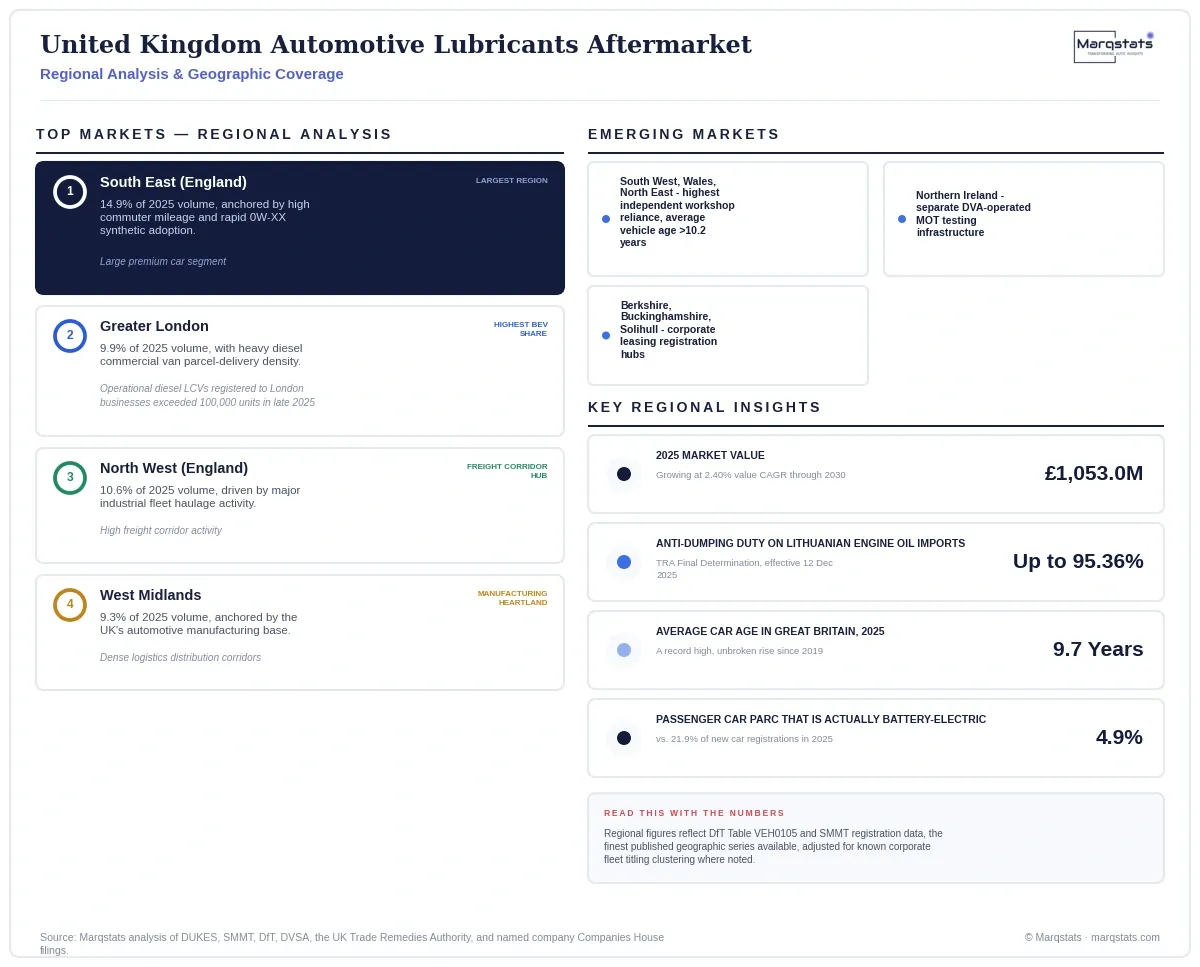
The South East leads all UK regions, generating 34.96 kt (14.9% share) valued at £163.2 million in 2025, anchored by high commuter mileage, a large premium car segment and rapid 0W-XX synthetic adoption across the region's 6.34 million-vehicle active parc.
Greater London
Greater London generated 23.23 kt (9.9% share) valued at £112.7 million in 2025, characterized by the UK's highest battery-electric vehicle share alongside a heavy diesel commercial van parcel-delivery density, with operational diesel light commercial vehicles registered to London businesses reaching a record peak exceeding 100,000 units in late 2025.
North West (England)
The North West generated 24.87 kt (10.6% share) valued at £108.5 million in 2025, driven by high freight corridor activity and a major industrial fleet haulage base sustaining stable heavy commercial vehicle lubricant demand.
West Midlands
The West Midlands generated 21.82 kt (9.3% share) valued at £96.9 million in 2025, anchored by the region's status as the UK's automotive manufacturing heartland alongside dense logistics distribution corridors supporting both passenger and commercial vehicle service demand.
South West, Wales and North East (England)
The South West, Wales and North East collectively demonstrate the UK's highest independent workshop reliance, with average vehicle ages exceeding 10.2 years and a high proportion of DIY and independent service garages, reflecting older regional vehicle demographics and lower regional disposable income relative to the national average.
How Competition Is Evolving
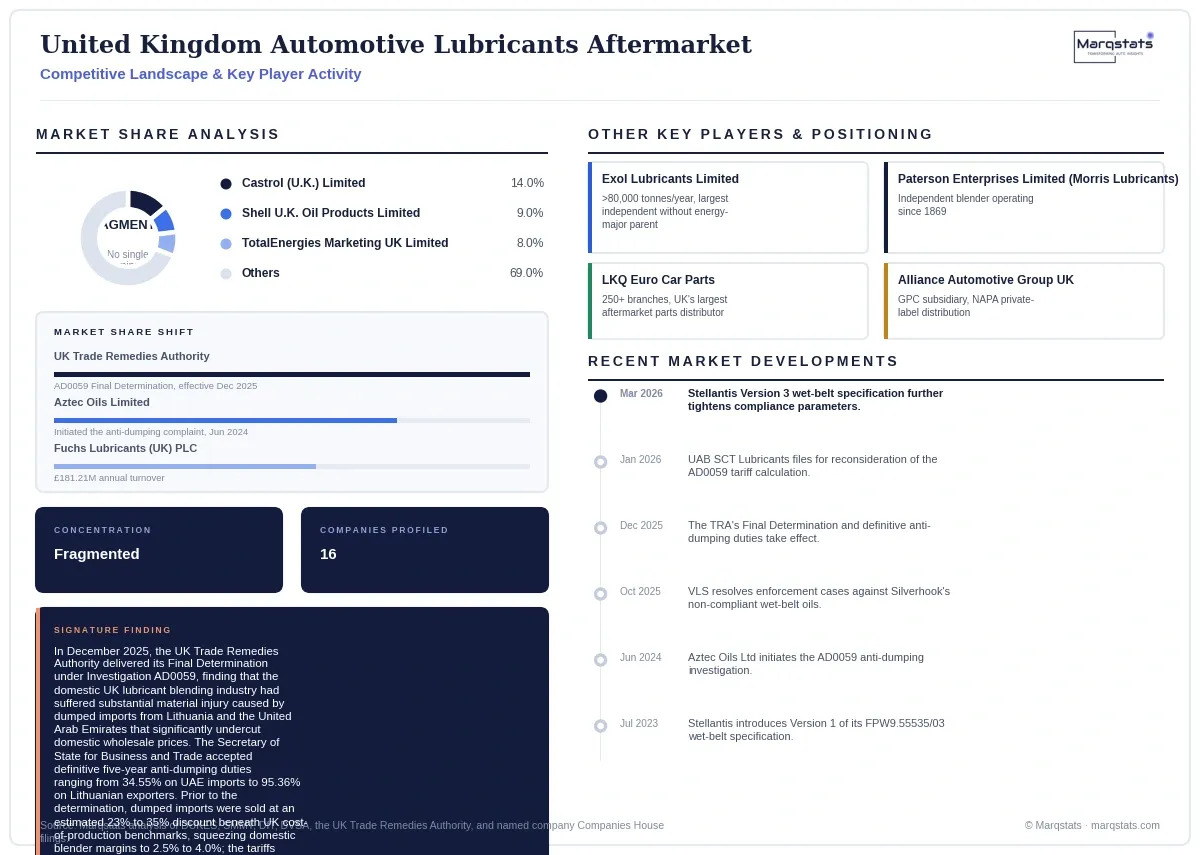
The UK automotive lubricants aftermarket is structured into three operational tiers with no single vendor commanding dominant share; Castrol (U.K.) Limited represents the dominant market share leader in the passenger car segment, while BP Oil UK Limited reported turnover of £18.1 billion in 2024 reflecting broad integrated fuels and lubricant refining operations, and Fuchs Lubricants (UK) PLC reported annual turnover of £181.21 million from one of the largest specialized blending plants in the British Isles.
Firms compete differently by tier: integrated energy majors including Castrol, Shell and TotalEnergies compete on OEM franchised dealership relationships and first-tier approvals, exemplified by TotalEnergies' Quartz Ineo approvals under Stellantis specification FPW9.55535/03, independent blenders including Aztec Oils, Exol Lubricants and Morris Lubricants compete on toll-blending and private-label supply to motor factors following the AD0059 tariff repatriation, and wholesale factor networks including LKQ Euro Car Parts and Alliance Automotive Group compete on branch density and multi-daily delivery capability to independent garages.
The most significant recent competitive-landscape development is the UK Trade Remedies Authority's December 2025 Final Determination under Investigation AD0059, imposing definitive five-year anti-dumping duties of 34.55% to 95.36% on Lithuanian and UAE engine oil imports following a complaint initiated by Aztec Oils Limited in June 2024, though UAB SCT Lubricants submitted a formal application for reconsideration in January 2026 challenging the TRA's cost calculation methodologies.
Companies Covered
Companies covered in the report include:
Recent Market Activity
Table of Contents
Coverage & Segmentation
Coverage spans the UK automotive lubricants aftermarket, encompassing all service-fill lubricants, functional fluids and greases dispensed during routine scheduled maintenance, engine sump flushes, component overhauls and top-up servicing across the operational vehicle parc, evaluated at the wholesale-to-trade and distributor-realized tier net of value-added tax. The market is sized in thousand tonnes and GBP/USD million across a 2021-2025 historical period and a 2026-2030 forecast period, with 2025 as the base year. Three segmentation dimensions are quantified: lubricant formulation and viscosity chemistry, vehicle application category, and service and distribution channel.
Excluded from scope: factory first-fill volumes delivered to domestic OEM vehicle assembly facilities, industrial lubricants, marine bunkering lubricants, aviation hydraulic oils, agricultural off-highway stationary engine oils, and non-lubricating automotive maintenance chemical consumables such as windshield wash and AdBlue. A separate Marqstats study addresses the global automotive lubricants aftermarket on a comparable basis.
