Market Snapshot
Middle bar: base-year value × (1 + CAGR), rounded to two decimals. This is a calculated illustration, not a separately researched annual estimate.
The Japanese automotive lubricants aftermarket reached JPY 1,139.50 billion (USD 7.50 billion) in 2025, even as physical service-fill volume contracts from 934.00 million liters to a projected 881.50 million liters by 2030, a -1.15% compound annual rate of decline, because hybrid-dominant electrification, rather than battery-electric displacement, is reshaping demand: full-hybrid vehicles retain internal combustion engines that cycle on and off repeatedly during urban driving, exacerbating fuel dilution and low-speed pre-ignition risk in ways that necessitate specialized, low-viscosity, high-additive-density formulations commanding higher retail margins.
Total domestic lubricant demand across all industrial and transport applications stood at 1.94 billion liters in 2025, with automotive use accounting for 52.78% of aggregate volume, representing 1,024.00 million liters. Deducting factory-fill volume of 90.00 million liters, consumed across initial crankcase fills, transmission fluids and driveline differentials at Japanese assembly plants that produced 8.23 million four-wheeled motor vehicles in 2024, establishes the domestic automotive lubricants aftermarket (service-fill) baseline at 934.00 million liters, valued at JPY 1,139.50 billion (USD 7.50 billion at 151.93 JPY per USD) in 2025.
The market's defining structural finding is that Japan's electrification pathway diverges structurally from Western trajectories, anchored in full-hybrid electric vehicles rather than battery electric platforms. While BEV registrations have expanded from a modest baseline, their cumulative share of the operating parc remains below 2.0%, with internal combustion engines continuing to power more than 98% of operating passenger vehicles. Hybrid powertrains introduce distinct operating conditions that alter fluid degradation: in an HEV configuration, the internal combustion engine cycles on and off repeatedly during urban driving cycles, preventing the engine crankcase from sustaining optimal operating temperatures for extended periods, exacerbating fuel dilution, accelerating moisture condensation, and aggravating low-speed pre-ignition risks. Rather than eroding lubricant demand, HEVs necessitate specialized, low-viscosity, high-additive-density formulations that command higher retail margins, offsetting minor contractions in annual engine runtime.
Key Takeaways
Market Overview & Analysis
Report Summary
This analysis sizes the Japanese automotive lubricants aftermarket on a service-fill basis, isolating physical fluid demand consumed during routine maintenance, preventative servicing and top-up replacement across the operational four-wheeled and two-wheeled vehicle parc from OEM factory-fill consumption tied to new vehicle assembly. The market explicitly excludes factory-fill volumes delivered at vehicle assembly plants, industrial lubricants, and non-automotive process oils. The market is sized in million liters and JPY/USD billion across a 2021-2025 historical period and a 2026-2030 forecast period, with 2025 as the base year.
The Japanese automotive lubricants aftermarket registered 934.00 million liters valued at JPY 1,139.50 billion (USD 7.50 billion) in 2025, following a period of steady volumetric contraction from 978.50 million liters in 2021. By 2030, physical volume is projected to decline further to 881.50 million liters, a -1.15% compound annual growth rate, while market value expands to JPY 1,196.20 billion, a +0.98% compound annual growth rate. This divergence reflects the ongoing transition away from legacy API Group I and Group II mineral base oils toward API Group III/III+ synthetics and polyalphaolefin blends engineered to meet ultra-low-viscosity specifications governed by JASO GLV-1 and GLV-2 standards, carrying wholesale and retail price premiums of 30% to 55% over legacy mineral products.
Scenario A (Progressive Premiumization Baseline) assumes standard passenger car scrappage ages remain near 13.3 to 13.5 years while kei car lifespans stay around 16.2 years, with new passenger vehicle sales remaining concentrated in full-hybrid powertrains (over 55% of new registrations) and BEV operating parc share remaining below 4% through 2030, yielding 881.50 million liters (-1.15% CAGR) and JPY 1,196.20 billion (+0.98% CAGR). Scenario B (Constrained Mobility and Accelerated Electrification), reaching only 840.10 million liters (-2.10% CAGR) and JPY 1,079.50 billion (-1.08% CAGR), is triggered by accelerated municipal zero-emission vehicle mandates implemented by the Tokyo Metropolitan Government and Kanagawa Prefecture pushing BEV share of new sales past 15% by 2028, combined with structural declines in per-capita vehicle kilometers traveled driven by an aging rural demographic and stricter commercial driver rest-period enforcement under the revised Labor Standards Act.
Market Dynamics
Key Drivers
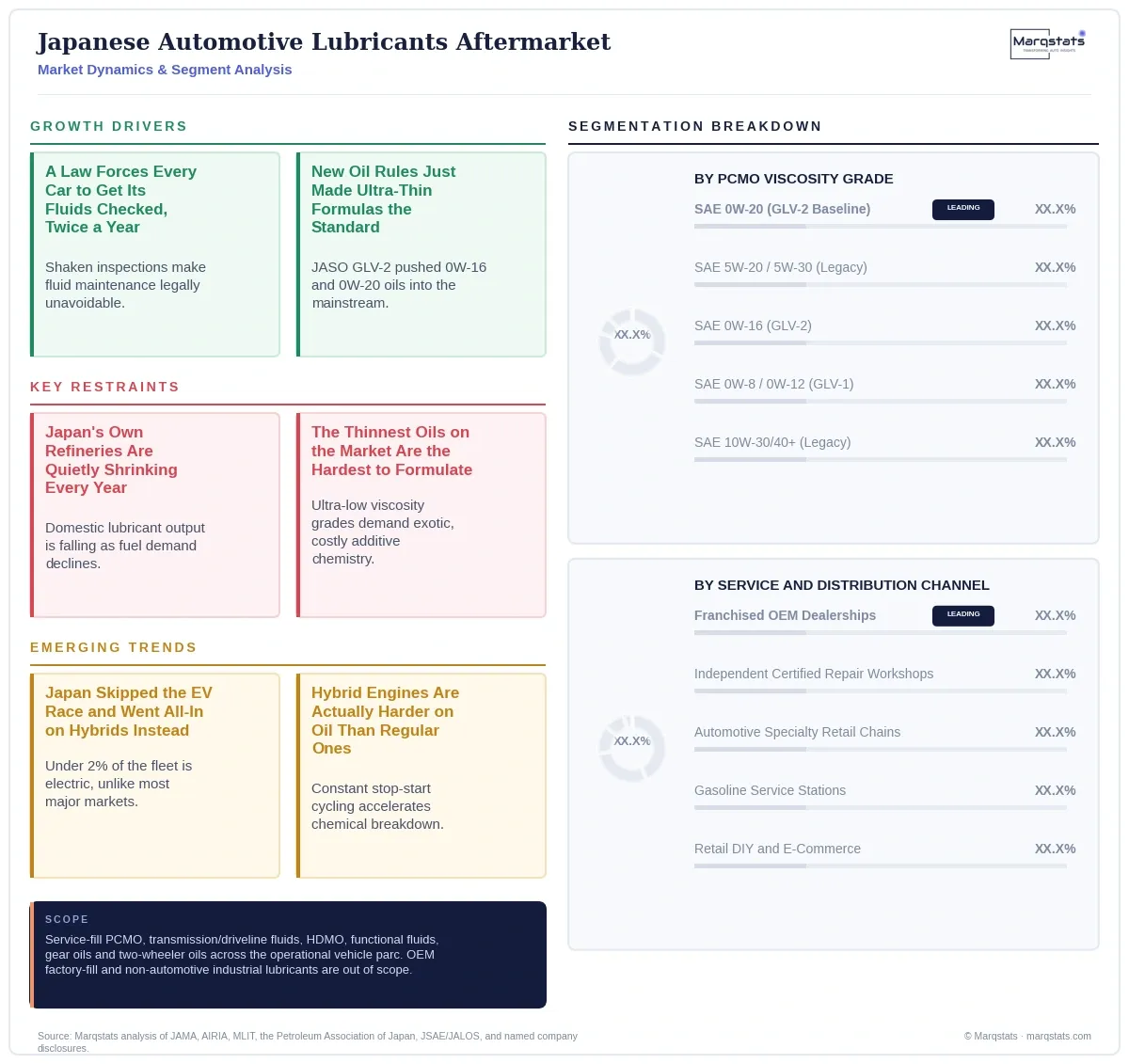
- Statutory Shaken inspections anchor baseline service-fill demand independent of consumer discretionary spending, exemplified by the Road Transport Vehicle Act's biennial inspection cycle administered by the Ministry of Land, Infrastructure, Transport and Tourism, requiring fluid checks and component rectifications across accredited designated and certified workshops that make fluid flushes and preventative replacements standard practice to pass inspection thresholds.
- JASO GLV-1 and GLV-2 regulatory standards are directly driving formulation premiumization, exemplified by JASO M364:2024 introducing the GLV-2 classification and terminating legacy M364:2019 filings on 31 March 2025, requiring 1.1% minimum fuel economy improvement over an SAE 0W-20 reference oil and mandatory Low-Speed Pre-Ignition protection for downsized turbocharged direct-injection engines and hybrid powertrains.
- Commercial refining consolidation is concentrating upstream base oil supply, exemplified by ENEOS Corporation's completion of the statutory absorption-type merger of EMG Lubricants Godo Kaisha effective 1 January 2026, consolidating base oil trading, domestic blending and specialty distribution under unified direct corporate management to reinforce competitive positioning as domestic petroleum refining output contracts from 2.6 million kiloliters in 2023 toward 2.3 million kiloliters by 2030.
- Long-term international base oil supply agreements are securing domestic formulation capacity, exemplified by Idemitsu Kosan Co., Ltd. executing a comprehensive global base oil supply agreement with Saudi Aramco in February 2026, securing long-term Group II and Group III base stock import volumes to mitigate domestic base oil capacity retirements.
- Kei car and hybrid-specific thermal stress is elevating formulation complexity and value density, exemplified by kei engines operating at higher average RPMs than standard passenger vehicles to maintain highway speeds within restricted 660cc displacement limits, requiring shorter oil drain intervals of 2,500 to 3,000 kilometers for turbocharged variants and sustaining service turnover across independent workshops and specialty retail service bays.
Key Restraints
- Domestic petroleum refining capacity faces structural contraction, since the Petroleum Association of Japan projects total domestic lubricant production falling from 2.6 million kiloliters in 2023 to 2.3 million kiloliters by 2030, driven by declining domestic fuel consumption projected to contract by 2% to 2.5% annually, compelling refiners to secure international base oil supply agreements to offset domestic capacity retirements.
- Achieving hydrodynamic wear protection at elevated temperatures with SAE 0W-8 and 0W-16 grades requires High-Temperature High-Shear viscosity limits below 2.0 mPa·s, demanding Group III+ severely hydrocracked base stocks, metallocene polyalphaolefins and organic friction modifiers alongside ester chemistry and soluble organo-molybdenum dithiocarbamate additives, creating genuine formulation complexity that raises qualification costs for blenders competing in the ultra-low viscosity segment.
- Modern Japanese e-axles house high-speed electric drive motors within the transmission casing, exposing lubricants directly to copper motor windings, elevated operating temperatures and electromagnetic fields, requiring low-conductivity, copper-passivated transmission fluids rather than standard automatic transmission fluids, a genuine technical constraint that limits which formulators can compete for hybrid transaxle fluid contracts.
- Commercial freight operators face structural cost pressure from driver shortages and the '2024 Logistics Problem' commercial driver overtime limits, compelling transport operators to transition from standard 10W-30 mineral products toward fuel-saving synthetic diesel engine oils conforming to the JASO DH-2F standard specifically to reduce fleet diesel consumption by 1.5% to 2.5% and offset rising labor costs.
Key Trends
- The finding that Japan's BEV operating parc share remains below 2.0% despite growing BEV registrations, while internal combustion engines continue to power more than 98% of operating passenger vehicles, demonstrates that Japan's hybrid-anchored electrification pathway is structurally distinct from Western battery-electric-dominant trajectories and will not produce comparable near-term aftermarket lubricant volume contraction.
- The consistency between hybrid powertrains' intermittent engine cycling exacerbating fuel dilution and low-speed pre-ignition risk, and the necessity of specialized low-viscosity, high-additive-density formulations commanding higher retail margins, demonstrates that hybrid adoption in Japan functions as a genuine premiumization driver rather than a demand suppressant, a meaningfully different dynamic than pure battery-electric displacement.
- The statutory Shaken inspection framework's role in sustaining counter-cyclical service-fill demand, combined with the record 9.44-year average passenger car age, indicates that Japan's aftermarket lubricant demand is structurally insulated from consumer discretionary spending cycles in a way few other major automotive markets can claim, given the legal compulsion behind maintenance timing.
- The fact that ENEOS Corporation's absorption of EMG Lubricants Godo Kaisha consolidates base oil trading, domestic blending and specialty distribution under unified direct corporate management, reinforcing an already-dominant 42.50% market share, demonstrates that Japan's upstream refining consolidation is accelerating rather than fragmenting, concentrating competitive advantage among fewer, larger domestic players.
- The finding that ultra-low viscosity formulations carry wholesale and retail price premiums of 30% to 55% over legacy 5W-30 and 10W-30 mineral products, more than offsetting a -1.15% annual physical volume contraction to produce +0.98% annual value growth, indicates that formulation premiumization alone, independent of any fleet growth, is sufficient to sustain positive nominal market value expansion in a mature, contracting-volume market.
Strategic Implications
For a market entrant, competing directly against ENEOS's dominant 42.50% share and entrenched service station distribution presents substantial structural barriers; capital is better directed toward specialized JASO GLV-1/GLV-2 ultra-low viscosity formulations, dedicated copper-passivated e-axle fluids for hybrid transaxles, or securing toll-blending and private-label supply agreements with franchised dealer networks and automotive specialty retail chains including Autobacs Seven and Yellow Hat that control the high-margin 0-to-5-year vehicle cohort.
For an established lubricant refiner or blender, managing the structural transition from Group I mineral to Group III/III+ synthetic base stocks requires rationalizing older domestic solvent extraction plants while securing long-term international supply agreements following the model demonstrated by Idemitsu's partnership with Saudi Aramco, while accelerating certified JASO GLV-2, DH-2F and dedicated e-axle product development to compete for factory-fill and franchised dealer private-label contracts ahead of continued domestic refining capacity contraction.
For an independent repair workshop or automotive specialty retail chain, sustaining volume amid an aging vehicle parc requires reconfiguring bulk fluid inventory around multi-viscosity synthetics compliant with JASO M364:2024 GLV-1 and GLV-2, integrating advanced OBD diagnostic capabilities to retain aging vehicles beyond their second Shaken inspection, and expanding convenient pit services to compete against franchised OEM dealerships capturing an expanding volume share through prepaid maintenance packages.
Outlook
Scenario A (Progressive Premiumization Baseline): 881.50 million liters by 2030 (-1.15% five-year volume CAGR) and JPY 1,196.20 billion (+0.98% five-year value CAGR). This trajectory assumes standard passenger car scrappage ages remain near 13.3 to 13.5 years while kei car lifespans stay around 16.2 years, new passenger vehicle sales remain concentrated in full-hybrid powertrains accounting for over 55% of new registrations, and BEV operating parc share remains below 4% through 2030, with JASO GLV-2 and GLV-1 synthetics expanding to command over 73% of PCMO service-fill volume and franchised OEM dealerships capturing an expanding 45.50% volume share through prepaid maintenance packages.
Scenario B (Constrained Mobility and Accelerated Electrification): 840.10 million liters by 2030 (-2.10% five-year volume CAGR) and JPY 1,079.50 billion (-1.08% five-year value CAGR). The specific trigger is accelerated municipal zero-emission vehicle mandates implemented by the Tokyo Metropolitan Government and Kanagawa Prefecture, paired with expanded subsidies, pushing the BEV share of new sales past 15% by 2028 and lifting BEV operating parc share above 6.5% by 2030, combined with structural declines in per-capita vehicle kilometers traveled driven by an aging rural demographic and stricter commercial driver rest-period enforcement under the revised Labor Standards Act, suppressing fluid turnover across commercial logistics fleets while slower synthetic price realization limits average realized price gains to JPY 1,285 per liter.
Market Segmentation
Passenger Car Motor Oil commanded 42.10% of total aftermarket volume (393.21 million liters) in 2025, contracting to 41.50% share (365.82 million liters) by 2030, generating 63.12% of total engine oil demand as regulatory fuel economy mandates requiring a corporate fleet average of 25.4 kilometers per liter by 2030 accelerate the phase-out of higher-viscosity oils.
Transmission and driveline fluids accounted for 24.10% (225.10 million liters) in 2025, expanding to 25.80% share (227.43 million liters) by 2030, driven by the prevalence of Continuously Variable Transmissions across Japan's light vehicle parc and dedicated reduction gearboxes in hybrid transaxles, with copper-passivated e-fluids such as the Toyota e-CVT and Idemitsu e-Fluid series commanding retail prices exceeding JPY 2,200 per liter.
Heavy-Duty Motor Oil held 19.80% share (184.93 million liters) in 2025, contracting slightly to 19.60% share (172.77 million liters) by 2030, governed by domestic JASO DH-2 and DL-1 standards as transport operators transition from standard 10W-30 mineral products toward fuel-saving 5W-30 and 0W-20 DH-2F certified synthetic oils to reduce fleet diesel consumption by 1.5% to 2.5%.
SAE 0W-20 (JASO GLV-2 Baseline)
Franchised OEM dealerships represent the largest distribution channel at 43.20% share (403.49 million liters) in 2025, expanding to 45.50% share (401.08 million liters) by 2030 through prepaid maintenance packages offered across Toyota, Honda, Nissan and Daihatsu authorized service networks, capturing lock-in via digital service records and hybrid-specific maintenance packs.
Independent certified repair workshops (shitei/ninsho kōjō) accounted for 29.50% share (275.53 million liters) in 2025, contracting to 28.00% share (246.82 million liters) by 2030, maintaining service continuity by stocking bulk synthetic drums to retain aging vehicles undergoing recurring Shaken inspections, though facing margin compression as diagnostic tooling expenses rise.
Automotive specialty retail chains, including Autobacs Seven and Yellow Hat pit service centers, captured 13.50% share (126.09 million liters) in 2025, expanding to 13.80% share (121.65 million liters) by 2030, leveraging consolidated wholesale purchasing power and accelerating high-margin private-label synthetic lubricant rollouts.
By Geography
Aichi Prefecture
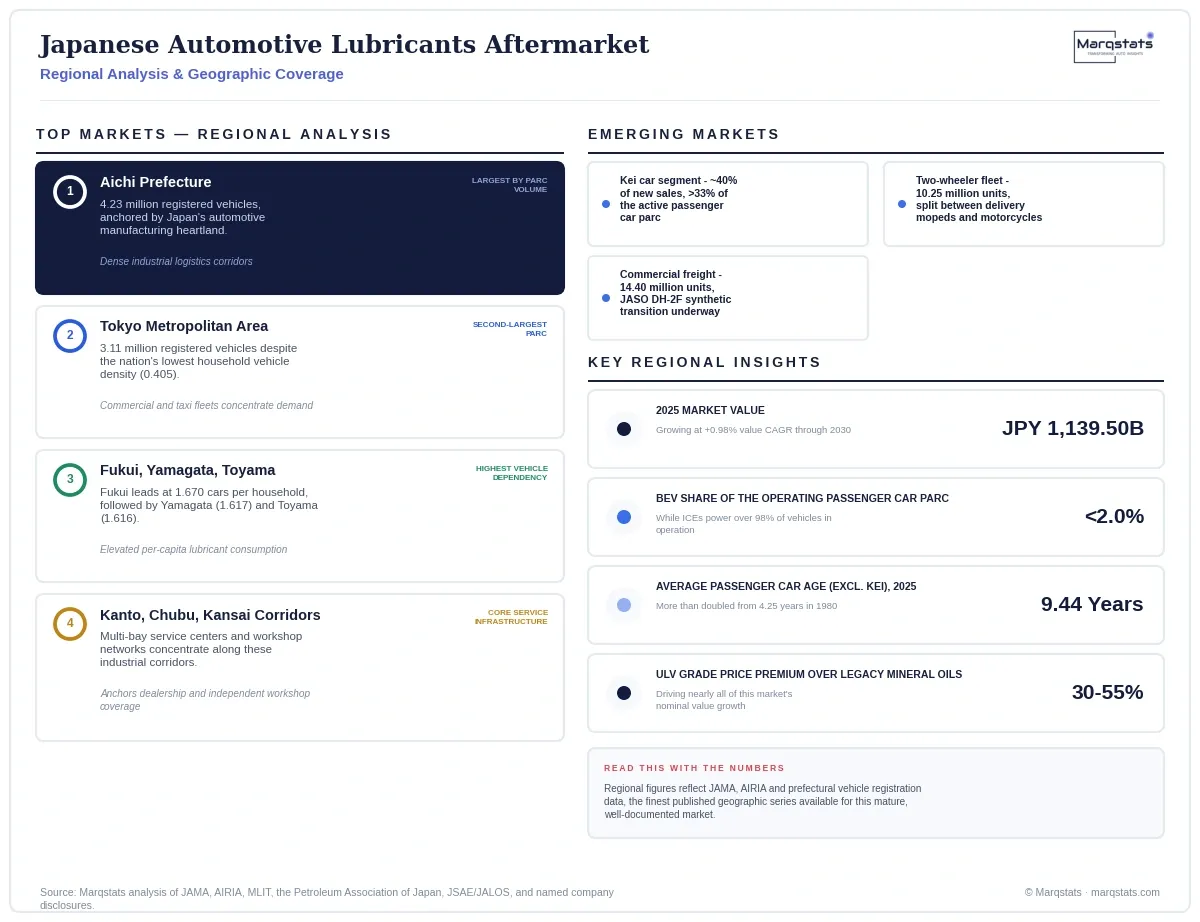
Aichi Prefecture ranks first in absolute parc volume with 4.23 million registered vehicles, anchored by Japan's automotive manufacturing heartland and dense industrial logistics corridors sustaining both passenger and heavy-duty commercial lubricant demand.
Tokyo Metropolitan Area
Tokyo ranks second in absolute parc volume with 3.11 million registered vehicles despite exhibiting the nation's lowest household vehicle density at 0.405 cars per household, reflecting extensive public transit alternatives that concentrate commercial and taxi fleet lubricant demand over private passenger consumption.
Fukui, Toyama and Rural Vehicle-Dependent Prefectures
Rural prefectures show the nation's highest per-household vehicle reliance, led by Fukui at 1.670 cars per household, followed by Yamagata at 1.617 and Toyama at 1.616, sustaining elevated per-capita lubricant consumption despite smaller absolute population bases relative to major metropolitan corridors.
Kanto, Chubu and Kansai Industrial Corridors
Distribution networks concentrate across the Kanto, Chubu and Kansai industrial corridors, where multi-bay automotive service centers and workshop networks match regional vehicle populations, anchoring the nation's core franchised dealership and independent workshop service infrastructure.
How Competition Is Evolving
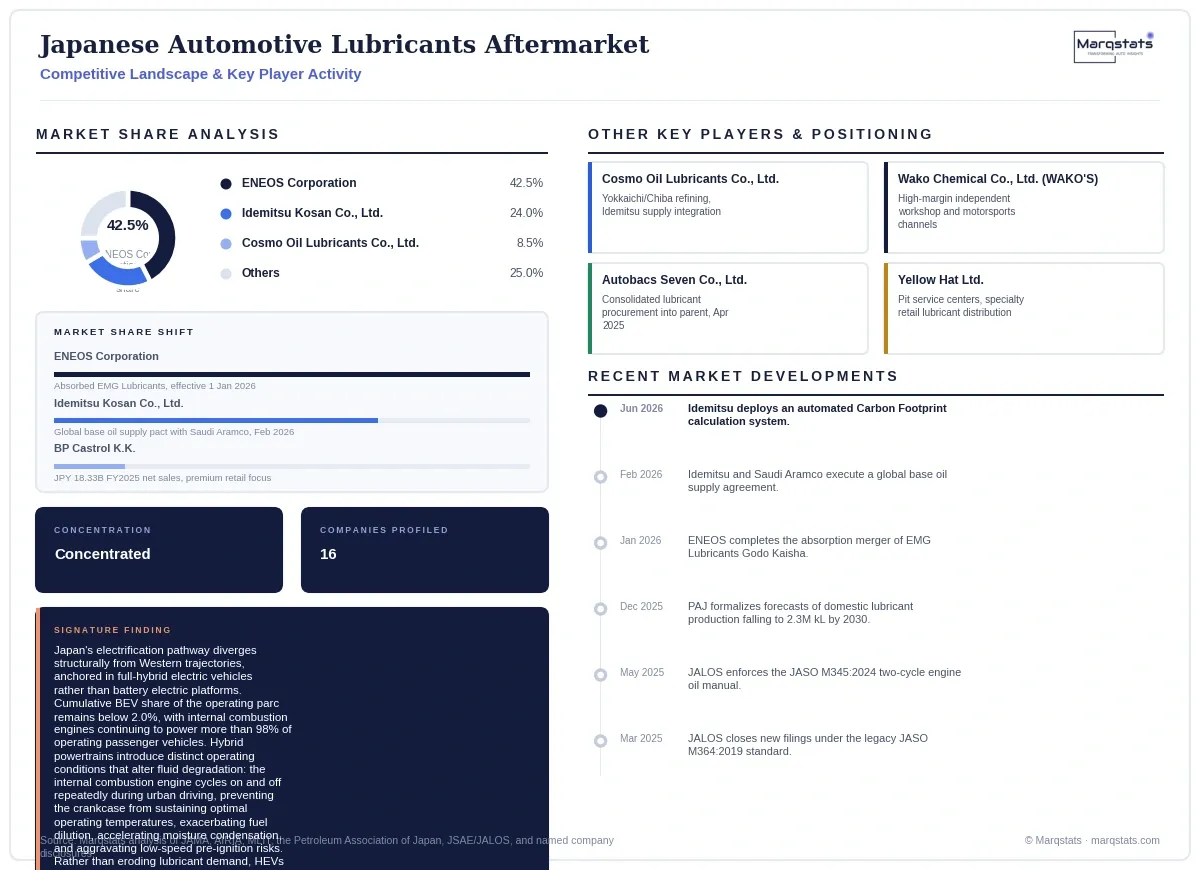
Japan's automotive lubricants aftermarket is concentrated among primary domestic petroleum refiners, supplemented by specialized blenders and international premium brands; ENEOS Corporation leads with an estimated 42.50% volume share, supported by control of approximately 50% of the domestic service station network and roughly 12,000 retail fuel sites, followed by Idemitsu Kosan Co., Ltd. at 24.00% and Cosmo Oil Lubricants Co., Ltd. at 8.50%.
Firms compete differently by tier: domestic refiners including ENEOS and Idemitsu compete on service station network density and upstream base oil integration, foreign specialty marketers including BP Castrol K.K. compete on premium retail specialty share through Autobacs and Yellow Hat channels, and independent specialty blenders including WAKO'S compete on high-margin independent workshop, tuning and motorsports channel penetration.
The most significant recent competitive-landscape development is ENEOS Corporation's completion of the statutory absorption-type merger of EMG Lubricants Godo Kaisha, formerly ExxonMobil's Japanese lubricants business, effective 1 January 2026, consolidating base oil trading, domestic blending and specialty distribution under unified direct corporate management, while Idemitsu Kosan Co., Ltd. executed a comprehensive global base oil supply agreement with Saudi Aramco in February 2026 to secure long-term Group II and Group III base stock import volumes.
Companies Covered
Companies covered in the report include:
Recent Market Activity
Table of Contents
Coverage & Segmentation
Coverage spans the Japanese automotive lubricants aftermarket on a service-fill basis, isolating physical fluid demand consumed during routine maintenance, preventative servicing and top-up replacement across the operational four-wheeled and two-wheeled vehicle parc from OEM factory-fill consumption. The market is sized in million liters and JPY/USD billion across a 2021-2025 historical period and a 2026-2030 forecast period, with 2025 as the base year. Three segmentation dimensions are quantified: product category, PCMO viscosity grade, and service and distribution channel.
Excluded from scope: OEM factory-fill volumes delivered at vehicle assembly plants, industrial lubricants and non-automotive process oils. A separate Marqstats study addresses the global automotive lubricants aftermarket on a comparable basis.
