Market Snapshot
Key Takeaways
Market Overview & Analysis
Report Summary
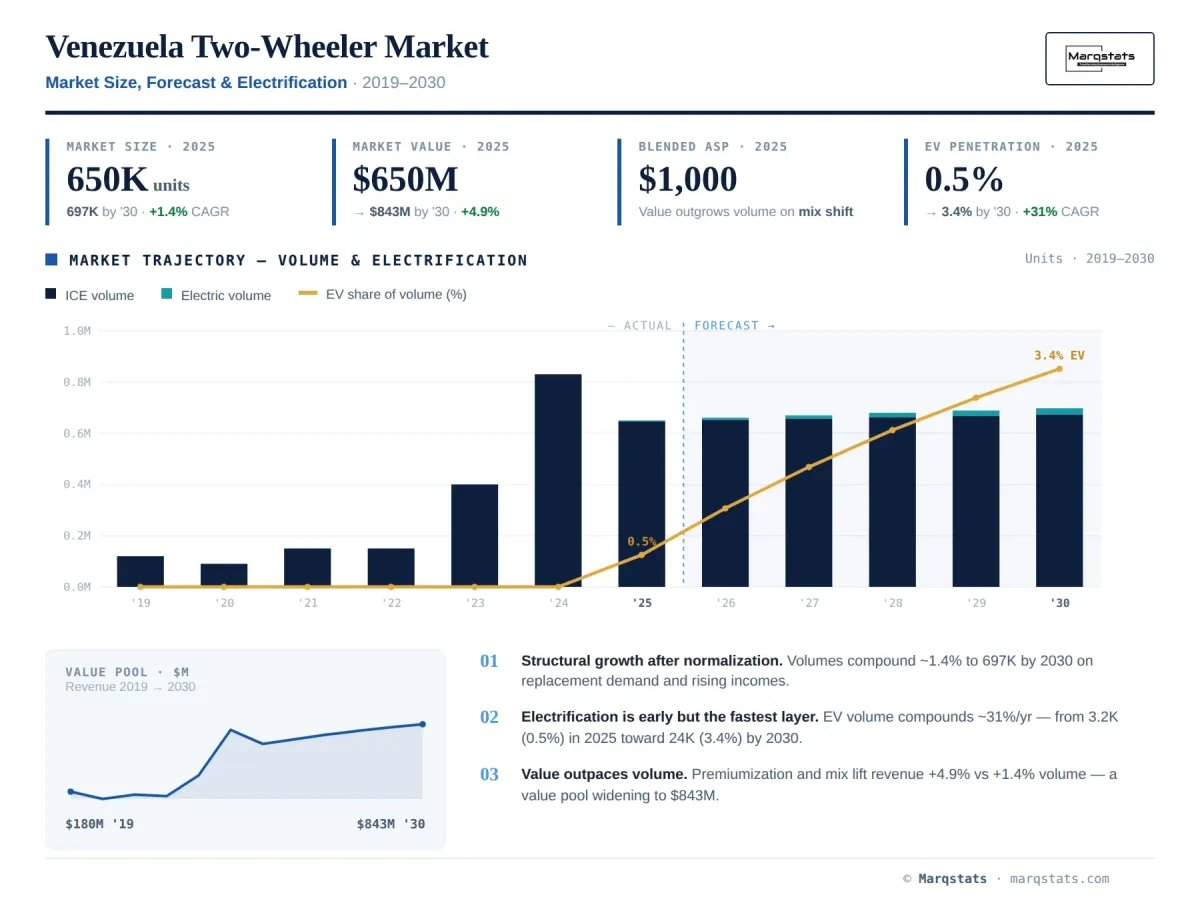
The Venezuela two-wheeler market is a large-volume, affordability-driven market that has moved through an extraordinary cycle. Assembly and sales rose steeply from around 150,000 units in 2021 to a peak in 2024, when industry estimates placed national production as high as several hundred thousand to nearly one million units, before demand eased to about 650,000 units in 2025. The market generated USD 650.0 million in revenue in 2025, and motorcycles function as essential transport, income-generating work vehicles, and an affordable alternative to a strained public-transport system.
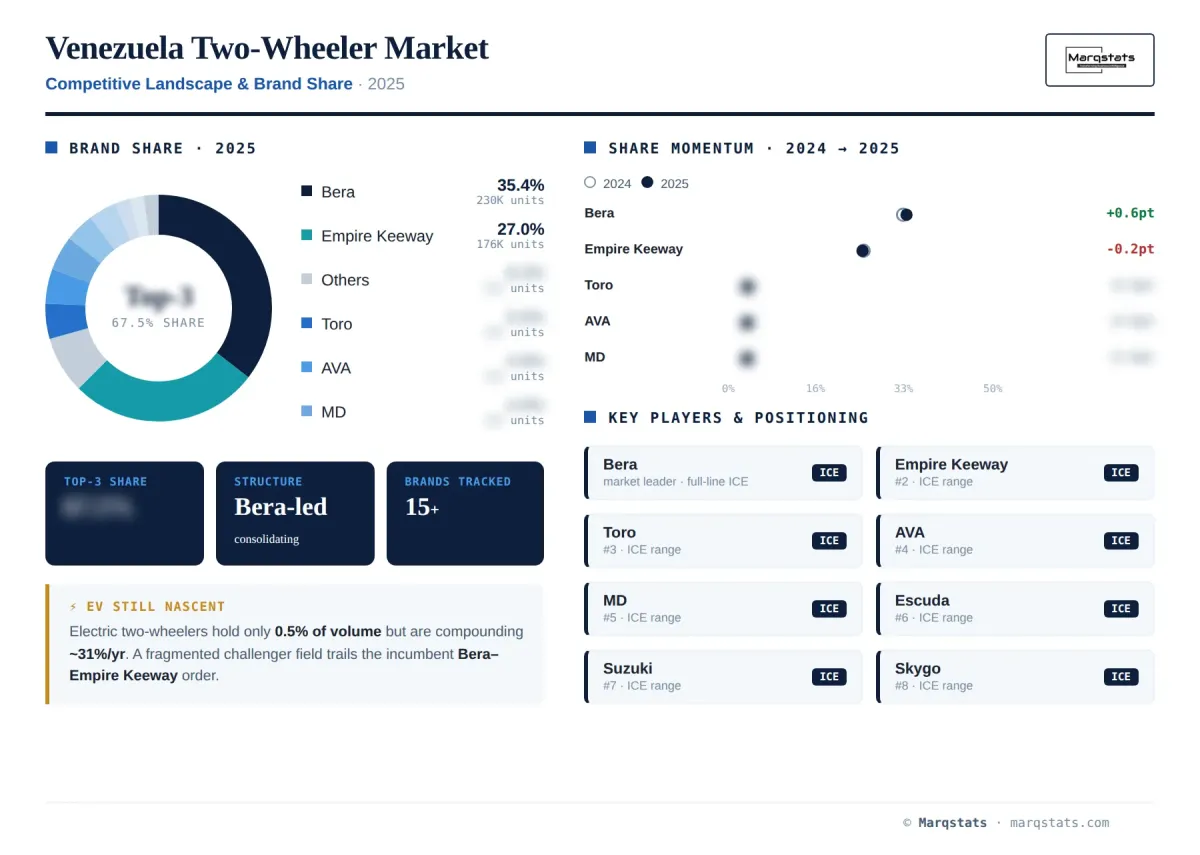
Market structure is defined by national assembly. Two domestic companies dominate: Bera, operated by Corporación Kuri Sam, holds the foremost position at about 35% of revenue, and Empire Keeway follows at roughly 27%, together accounting for close to 62% of the market. Both assemble motorcycles, mostly of Chinese design, at plants in several states and sell through a dealer network of around 600 outlets offering some 50 models. Established international names such as Suzuki hold smaller shares, and additional national assemblers including Toro, AVA, MD, Escuda, and Skygo complete the field.
Assembly and sales are tracked by the national assemblers association, and figures published by the association of motorcycle manufacturers and assemblers documented the sharp 2024 expansion and the subsequent cooling in 2025, when Venezuela stood out as the regional market that contracted. The de facto dollarization of the economy extends to the sector, with motorcycle prices and instalment plans widely denominated in US dollars.
The scale of the recent cycle is central to understanding the market. National assembly rose from little more than a thousand units in 2018 to several hundred thousand by 2023, and the 2024 surge reflected new commercial alliances with Chinese manufacturers, the emergence of national brands, and the reactivation of assembly plants that had been idle. The pullback in 2025, when demand eased from the peak, illustrates how closely two-wheeler sales track wider economic conditions, making volatility a structural feature of the market rather than an exception.
Commercial and informal passenger use is unusually prominent. Motorcycles are widely used to bypass a strained public-transport system, to carry goods, and to provide passenger services, so business and fleet demand forms a larger share of the market than in most regional peers. This work-vehicle role, together with low purchase prices and dealer financing, sustains demand across income groups and helps explain why motorcycles have become so deeply embedded in everyday mobility and livelihoods.
Market Dynamics
Key Drivers
- National assembly lowers costs and widens supply, with two domestic assemblers building mostly Chinese-design machines across several states.
- Motorcycles serve as an affordable alternative to a strained public-transport system, supporting strong everyday demand.
- Commercial and informal passenger use is high, with motorcycles central to delivery and passenger services.
- Dealer financing and instalment plans denominated in US dollars help buyers acquire machines despite economic pressures.
Key Restraints
- Economic volatility and inflation drive sharp swings in demand, as shown by the pullback from the 2024 peak.
- Difficulty importing parts and components constrains assembly and after-sales support.
- Reliance on imported inputs exposes assemblers to currency, freight, and supply-chain fluctuations.
- Road-safety concerns accompany rapid growth in motorcycle use, prompting regulatory attention.
Key Trends
- National assembly deepens, with domestic companies expanding model ranges and assembly capacity.
- Electric two-wheelers grow fastest at a 35.38% CAGR from a base near zero, remaining a small share of the market.
- Online retail expands fastest among channels at a 14.40% CAGR, though physical dealers still handle most value.
- Pricing and financing denominated in US dollars spread across the sector alongside de facto dollarization.
Market Segmentation
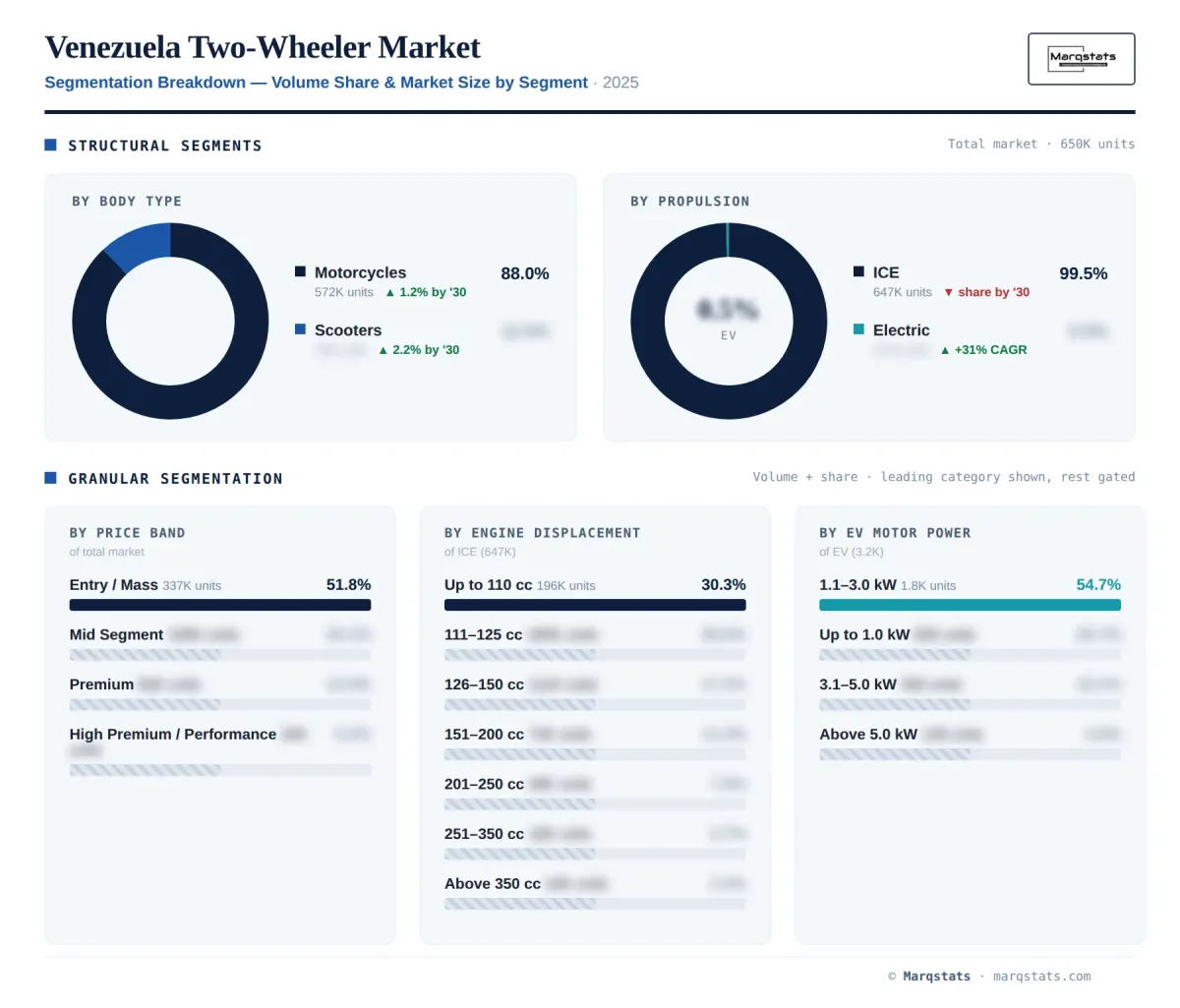
Motorcycles form the dominant vehicle-type segment, generating USD 572.0 million in 2025, about 88% of market revenue, and rising to USD 737.3 million by 2030 at a 4.80% CAGR. The segment is built on affordable commuter, utility, and work machines assembled nationally, spanning synchronous, off-road, and cargo models. National assemblers supply the bulk of this segment, with entry and mid-displacement machines forming the core of demand across personal, delivery, and passenger-service use.
Scooters and mopeds generated USD 78.0 million in 2025, about 12% of revenue, and grow to USD 105.8 million by 2030 at a 5.87% CAGR, the faster-growing vehicle type. The segment serves urban commuting in the larger cities, where light, automatic two-wheelers handle short trips and last-mile movement. Scooter growth outpaces motorcycles in percentage terms as urban buyers adopt automatic models, though motorcycles remain overwhelmingly the larger segment by both value and volume.
The balance between the two vehicle types reflects Venezuela emphasis on utility and work use. Motorcycles dominate because they suit commuting, delivery, and informal passenger services across urban and rural areas, while scooters hold a smaller though growing share in the cities. Both segments rest on affordable, nationally assembled machines, mostly of Chinese design, which keep entry prices low and support demand across income groups. The predominance of motorcycles over scooters reflects the country demand for rugged, utilitarian machines able to serve work and passenger use over varied roads, rather than the lighter urban-scooter mix seen in some other regional markets.
Internal combustion engine models overwhelmingly dominate the Venezuela two-wheeler market, generating USD 646.8 million in 2025, more than 99% of revenue, and growing to USD 814.4 million by 2030 at a 4.35% CAGR. Combustion demand is anchored in affordable, low-displacement commuter and work motorcycles assembled nationally. The combustion share edges down only marginally over the forecast period as electric models begin to appear, remaining the near-entirety of demand throughout.
Electric is the fastest-growing propulsion category, expanding from USD 3.2 million in 2025 to USD 28.7 million by 2030 at a 35.38% CAGR. Electric demand starts from a base near zero, having emerged only in 2025, and mirrors the early electric momentum visible in other electric two-wheeler markets tracked by Marqstats. Growth concentrates in light urban machines, and the higher-power bands expand fastest, though the segment remains a very small share of the market through the forecast period, constrained by cost and charging considerations.
Within combustion models, entry displacements dominate. The up-to-110 cc band is the largest tier by revenue at USD 196.3 million in 2025, followed closely by the 111 to 125 cc band at USD 184.9 million; together these entry classes represent close to 59% of combustion revenue, consistent with a market centred on affordable commuter and work motorcycles. The 126 to 150 cc band adds USD 111.1 million, while larger displacements above 250 cc remain small, reflecting limited demand for premium or high-displacement machines relative to the mass commuter base. This concentration in the smallest classes is a direct result of the market affordability-driven character and the work-vehicle role of most machines, and it means the entry classes will continue to define the volume base well beyond 2030.
Within electric models, demand is led by the 1.1 to 3.0 kW band at USD 1.8 million in 2025, followed by the up-to-1.0 kW band at USD 0.8 million, together covering the light urban machines that account for most early electric adoption. The higher-power bands are smaller yet expand fastest, with the above-5.0 kW band growing at a 46.25% CAGR as more capable machines appear. The electric motor-power mix will broaden gradually, though low-displacement combustion machines continue to define the volume base well beyond 2030.
The entry and mass price band dominates the market, generating USD 336.6 million in 2025, about 52% of revenue, followed by the mid segment at USD 195.8 million; together the two lower tiers account for roughly 82% of the market, underscoring its affordability-driven character. The premium and high-premium bands are smaller yet grow faster, at 5.81% and 8.03% CAGR respectively, as a segment of buyers trades up. The high-premium and performance band, at USD 33.7 million in 2025, is the fastest-expanding price tier, though it remains a minor share of overall demand. As entry demand stays central, revenue growth is driven partly by a gradual shift toward higher price bands as a segment of buyers moves up from first-price machines, and partly by pricing denominated in US dollars across the sector.
The B2C segment is the largest end-user category, generating USD 475.4 million in 2025, about 73% of revenue, and growing at a 4.77% CAGR. Commercial demand is unusually high for the region: the B2B and fleet segment reached USD 174.6 million, close to 27% of revenue, and the delivery and logistics segment USD 87.5 million, growing at 5.36% and 5.83% CAGR respectively. Ride-hail, rental, and passenger-service demand added USD 57.8 million, reflecting the widespread use of motorcycles for informal passenger transport, and government and institutional demand contributed USD 29.2 million. The scale of commercial and passenger-service use underlines the role of two-wheelers as work vehicles and income sources in the Venezuelan economy.
Offline dealers overwhelmingly dominate the channel mix, handling USD 600.5 million of revenue in 2025 and growing at a 3.89% CAGR, owing to the financing, service, and registration support that motorcycle purchases require across a nationwide dealer network of roughly 600 outlets. Online sales, however, expand fastest at a 14.40% CAGR, rising from USD 49.5 million as digital channels gain share. The channel shift is gradual, and physical dealers retain the large majority of value through the forecast period, supported by the importance of dealer financing and after-sales service. Dealers increasingly complement showroom sales with online listings and digital enquiry, extending reach across the country, where a nationwide network of assemblers and points of sale remains essential to serving demand.
By Geography
Capital and Central Region
The capital and central region is the core of the market, combining dense urban demand in the greater Caracas area with the industrial states of Aragua and Carabobo, where several assembly plants operate. This region anchors both production and consumption, and its concentration of dealers, assemblers, and urban riders makes it the central hub of the national two-wheeler market.
Western and Andean States
The western states, including Zulia and Lara, form a further demand centre, supported by large cities and cross-border commerce. Assembly activity in these states complements demand, and motorcycles serve everyday transport and commercial use across the region, reflecting the nationwide spread of two-wheeler ownership beyond the capital. Proximity to border trade adds a further layer of demand for affordable, work-oriented machines.
Interior and Rural Demand
Across the interior and rural areas, motorcycles remain a preferred transport option, valued for affordability and practicality where public transport is limited. Demand in these areas supports durable, low-cost utility machines and sustains steady replacement activity, complementing the concentration of assembly and sales in the central and western regions. In many towns and rural areas, the motorcycle is the most practical and affordable motorised option, and its role in daily transport, small commerce, and passenger services underpins a broad and geographically dispersed base of demand across the country.
How Competition Is Evolving
The Venezuela two-wheeler market is moderately concentrated, dominated by two national assemblers. Bera, operated by Corporación Kuri Sam, holds the foremost position at about 35% of revenue in 2025, and Empire Keeway follows at roughly 27%, together accounting for close to 62% of the market. A group of additional national assemblers, including Toro, AVA, MD, Escuda, and Skygo, and international names such as Suzuki and Bajaj, complete the field, giving the market a distinct domestic-assembly character.
Competition centres on price, model range, dealer reach, and financing. The two front-running assemblers compete through broad model catalogues, extensive dealer networks, and instalment plans denominated in US dollars, and both build the large majority of their ranges on Chinese designs assembled with a mix of imported and national parts. Empire Keeway represents several international brands and has launched a steady stream of new models, while Bera operates multiple assembly lines and a wide dealer footprint across most states.
Because the market is affordability-driven and shaped by national assembly, brand strategy in Venezuela centres on price competitiveness, dealer and financing reach, and a steady flow of models suited to commuting, delivery, and passenger services. The sector has expanded model ranges and assembly capacity in recent years, and both major assemblers have signalled ambitions to raise output. The pace of electrification and the ability to secure imported components are emerging as longer-term determinants of competitive position.
The competitive field is likely to remain concentrated around the two national assemblers through the forecast period, with smaller domestic and international brands competing in specific segments and price tiers. Access to imported parts, financing capacity, and the ability to introduce competitively priced models, including early electric machines, will increasingly shape which brands gain and hold share. Economic conditions will continue to influence the pace and stability of demand across the market.
Companies Covered
The report profiles 16+ companies with full strategy and financials analysis, including:
Recent Market Activity
Table of Contents
Coverage & Segmentation
This report provides a comprehensive analysis of the Venezuela two-wheeler market for the 2021 to 2025 historical period and the 2026 to 2030 forecast period, with 2025 as the base year. The study quantifies market size in revenue terms and in unit volume, and segments the market by vehicle type, propulsion type, engine displacement and motor power, price band, end user, sales channel, and brand. It examines the drivers, restraints, and trends shaping demand, and profiles the competitive structure of the market.
The study focuses on registered and assembled two-wheelers, spanning motorcycles, scooters, mopeds, and electric light vehicles. Coverage addresses the large-volume and volatile character of the Venezuelan market, the dominance of national assembly led by two domestic companies, the widespread use of motorcycles as work vehicles and for informal passenger transport, and the early emergence of electric models. Because the economy is de facto dollarized, values are reported in USD MN, and regional demand is examined across the capital and central region, the western and Andean states, and the interior.