Market Snapshot
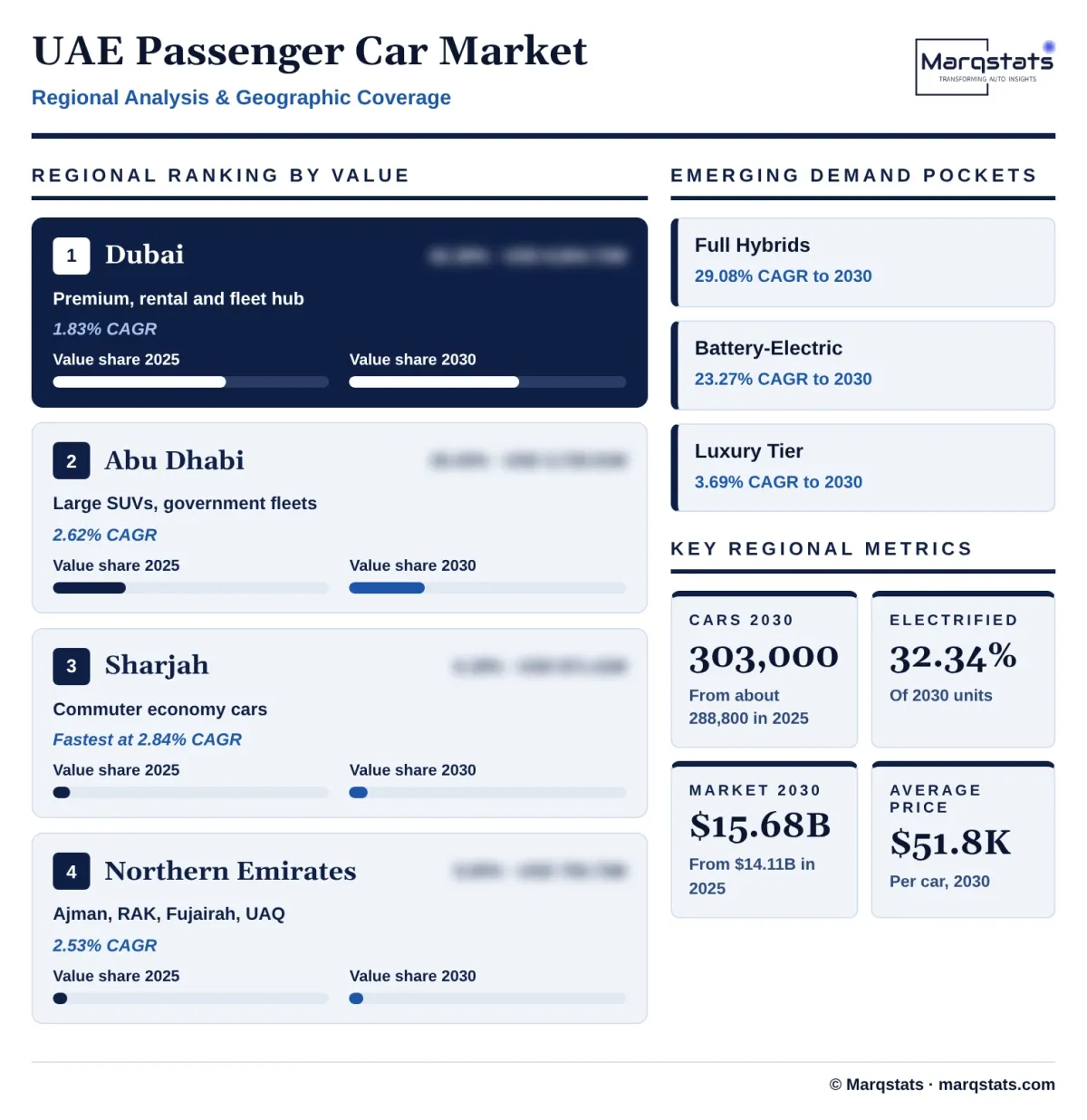
The UAE passenger car market size is estimated at USD 14,111.37 million in 2025 and is projected to reach USD 15,684.14 million by 2030, growing at a CAGR of 2.14% over 2026 – 2030. Annual new car sales rise from about 288,800 to 303,000 cars, a 0.96% annual rate, while the average value per car climbs from about USD 48,862 to USD 51,763 as electrified and premium cars take a larger share.
Marqstats defines the market as the retail value of new passenger cars sold through authorised dealers in the seven emirates, covering sedans, hatchbacks, SUVs and crossovers, MPVs and sports cars in the M1 class. Value is counted at the dealer transaction price in US dollars, before the 5% federal value added tax, converted at the fixed peg of AED 3.6725 per US dollar. Pickups, vans, light trucks, buses, motorcycles, used cars and re-exports are excluded.
SUVs and crossovers account for 72.08% of 2025 value, premium and luxury cars together for 56.42% from only 28.32% of units, and electrified cars for 12.50% of units. Dubai accounts for 62.39% of value, while Abu Dhabi, where government and fleet buyers are concentrated, grows faster than Dubai at 2.62% a year.
Key Takeaways
Market Overview & Analysis
Report Summary
Marqstats sizes the UAE passenger car market as the retail value of new M1 passenger cars sold through authorised dealers and manufacturer showrooms across the seven emirates in a calendar year. It counts sedans, hatchbacks, SUVs and crossovers, MPVs, coupes and sports cars, whether petrol, diesel, hybrid, plug-in hybrid or battery-electric. Pickups, vans, light trucks, buses and motorcycles are excluded, as are used cars and vehicles re-exported to other markets, which Marqstats measures in its UAE used car and used car re-export reports.
The base year is a record. The International Organization of Motor Vehicle Manufacturers (OICA) reported UAE passenger car sales of 156,780 in 2021, 171,414 in 2022, 225,386 in 2023 and 268,876 in 2024, a 19.70% annual rate over three years, with commercial vehicles at 37,403 in 2024. For 2025 the BestSellingCarsBlog tracker recorded 335,772 new vehicle sales, up 5.3%, a figure that includes pickups, vans and, from 2025, BMW and Mini. Marqstats removes an estimated 46,972 pickups, vans and light trucks (13.99% of the tracked total) and arrives at 288,800 passenger cars for 2025.
The UAE is a large and concentrated registration market. The Ministry of Interior counted 801,857 registered vehicles in 2024, of which Dubai held 484,223, Abu Dhabi 213,284 and Sharjah 56,657, and light vehicles accounted for 698,699. New cars arrive by sea, so shipping through the Strait of Hormuz and the Gulf ports sets the pace of deliveries.
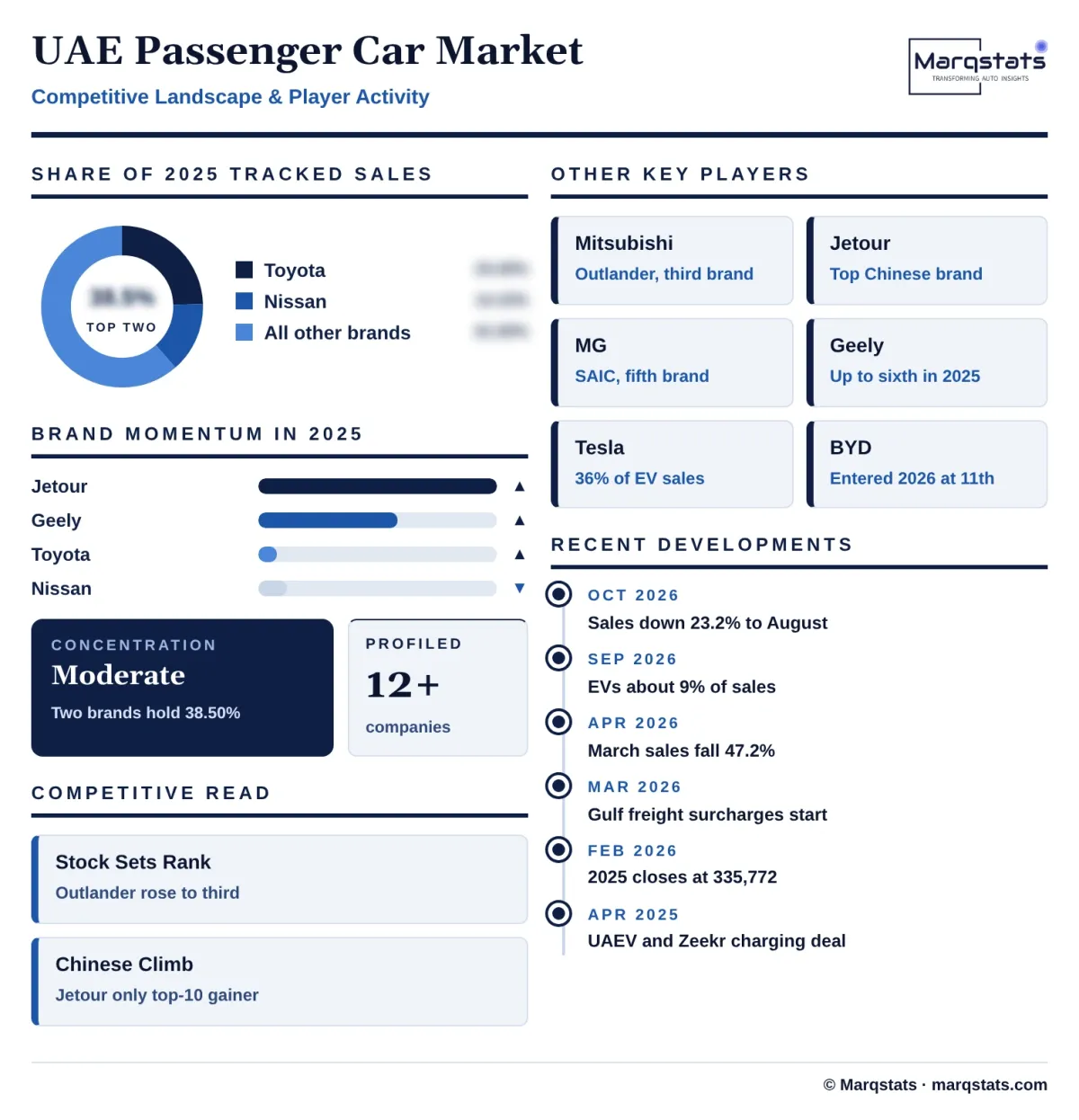
2026 changed the picture. After flat sales in January and February, March 2026 sales fell 47.2% and the shipping lines Maersk and Hapag-Lloyd suspended transits, while CMA CGM introduced emergency conflict surcharges of up to USD 4,000 per container on UAE-bound cargo. Tracked sales reached 160,210 in the eight months to August 2026, down 23.2% from about 208,607 a year earlier, and monthly declines narrowed from 47.2% in March to 15.8% in July and 15.1% in August.
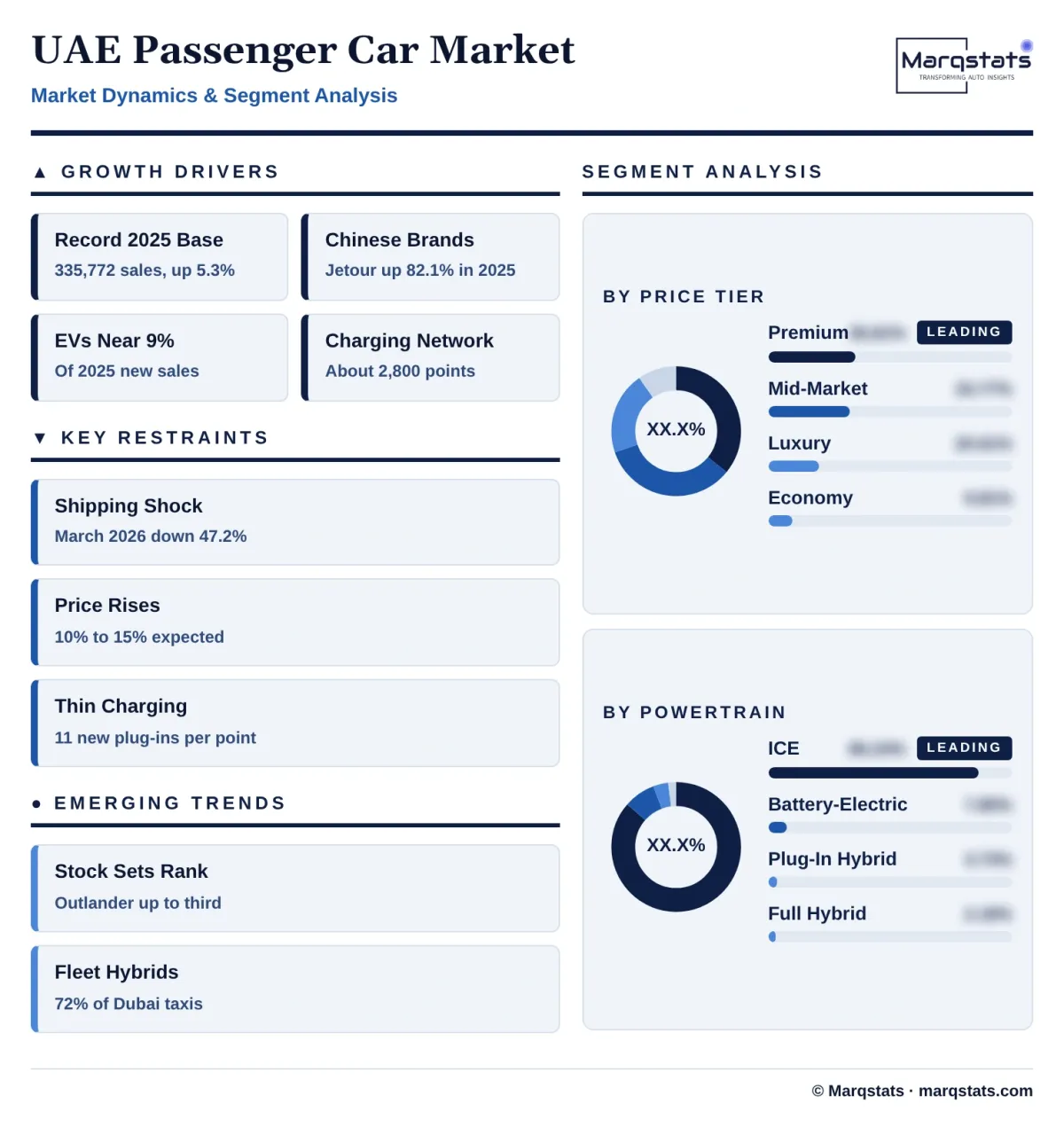
Electrification is the second story. A September 2026 electric mobility readiness index reported by the Emirates News Agency (WAM) put electric vehicles at about 9% of new vehicle sales in 2025, with battery-electric cars at 6% to 8% and plug-in hybrids at about 2.5%, and the UAE ranked first in the Middle East for EV sales for a second year according to the Ministry of Energy and Infrastructure. Marqstats counts 30,300 plug-in cars and 5,800 full hybrids in 2025, together 36,100 cars or 12.50% of passenger car sales.
UAE Passenger Car Market Size and Forecast
The UAE passenger car market grows from USD 14,111.37 million in 2025 to USD 15,684.14 million in 2030, a CAGR of 2.14%. Volume contributes a little under half of the growth: sales rise at 0.96% a year, from about 288,800 to 303,000 cars, and the average value per car rises at 1.16% a year, from about USD 48,862 to USD 51,763, as luxury cars and SUVs take a larger share. The path is not smooth. Marqstats estimates 2026 sales at 234,000 cars and USD 11,566.31 million, down 18.98% and 18.04%, followed by growth of 11.97% in 2027 and 7.25% in 2028 as vehicle carriers return to normal schedules.
The 2025 value is built bottom-up from price tiers. Marqstats estimates 82,000 economy and compact cars at about AED 62,000 each, 125,000 mid-market cars at AED 140,000, 64,000 premium cars at AED 290,000 and 17,800 luxury and ultra-luxury cars at AED 600,000, before the 5% value added tax. That gives AED 51,824 million, or USD 14,111.37 million at AED 3.6725 per US dollar, and an average of AED 179,446 per car. The tiers follow the price bands of the current UAE range, from the Nissan Sunny and Toyota Yaris at the bottom to the Nissan Patrol, Toyota Land Cruiser and German and British premium marques above AED 200,000.
The unit base is checked against two published series. OICA reported 268,876 passenger cars in 2024, and the BestSellingCarsBlog tracker reported 335,772 new vehicle sales in 2025, with the Toyota Hilux at 5.7% and the Nissan Patrol at 5.0% of that total, or about 19,140 and 16,790 units. Because the Hilux alone is a pickup, Marqstats treats the tracked total as a light vehicle series and removes 46,972 non-passenger units, about 40.75% of them the Hilux. The OICA and tracker panels differ, so the move from 268,876 to 288,800 is not a like-for-like growth rate, and Marqstats quotes the tracker growth of 5.3% for the market as a whole.
Electrified cars add value faster than volume. Marqstats expects battery-electric cars to rise from 21,900 units in 2025 to 60,000 in 2030, plug-in hybrids from 8,400 to 18,000 and full hybrids from 5,800 to 20,000, so their combined share of units grows from 12.50% to 32.34% and their value from USD 1,940.71 million to USD 5,424.89 million. The 2025 electrified value is within 5% of the USD 1.85 billion that the live Marqstats UAE Electric Vehicle Market report sizes for all electric vehicle types, and the 2030 value of USD 5,424.89 million compares with USD 5.60 billion there, so the two reports describe the same cars and should not be added.
Marqstats tracks four indicators to monitor the forecast: monthly tracked sales and the share of Gulf-bound vehicle carriers that reach Jebel Ali and Khalifa Port on schedule, dealer order backlogs and waiting times for popular SUVs, the number of public charging points against the plug-in fleet, and the pricing actions of Chinese brands after the 2026 shortage ends.
Market Dynamics
Key Drivers
Five forces keep demand for new cars in the UAE strong even in a year when ships, not buyers, set the sales total.
- A record base keeps replacement and expansion demand high. Tracked new vehicle sales rose 5.3% to 335,772 in 2025, after OICA recorded passenger car sales of 268,876 in 2024, up 19.3% from 225,386 in 2023. Dubai alone registered 484,223 vehicles in 2024, and a fleet that large turns over through corporate, rental and resident purchases every year.
- Chinese brands widen choice and lower the entry price for SUVs. Jetour grew 82.1% in 2025 to become the fourth-ranked brand and the top-selling Chinese brand ahead of MG, Geely rose 47.7% from 12th to 6th, and BYD entered the first-quarter 2026 ranking at 11th with a 2.3% share. UAE imports of Chinese electric and hybrid vehicles reached AED 6.483 billion in 2024, up 60.5% from AED 4.039 billion in 2023, according to the Federal Competitiveness and Statistics Centre.
- Electric cars have moved into the mainstream of private buying. Electric vehicles reached about 9% of new vehicle sales in 2025, EV sales grew 26.4%, the Tesla Model Y rose 97.6% to become the sixth-ranked model, and the Ministry of Energy and Infrastructure reported in May 2026 that the UAE ranked first in the Middle East for EV sales for a second consecutive year.
- The charging network is catching up. The UAE had about 2,800 charging points in September 2026, of which about 1,250 were DC points and about 350 high-power units. Emarat EV Charging Stations Company (UAEV) had 122 operational ports in April 2025 and planned 300 by the end of 2025, national tariffs of AED 1.2 per kWh for DC and AED 0.70 per kWh for AC took effect in January 2025, and Cabinet Resolution No. 175 of 2025 set one technical standard for charging equipment from May 2026.
- Higher fuel prices and fleet policy favour electrified cars. Special 95 petrol rose from an average of AED 2.33 per litre in 2025 to a peak of AED 2.48 in March 2026, up 6.4%, and the Roads and Transport Authority (RTA) reported in October 2026 that hybrids made up more than 72% of Dubai taxi and limousine fleet and electric cars 19%. Fleet buyers that follow RTA targets keep ordering hybrids and EVs in volume.
Key Restraints
Four constraints explain why 2026 is a down year and why the recovery to 2030 is gradual.
- Shipping disruption cuts deliveries. March 2026 sales fell 47.2% to 16,334 when the Maersk and Hapag-Lloyd suspension of transits and a 40% jump in Asia-Gulf freight rates in seven days delayed new-car shipments, and CMA CGM added emergency surcharges of up to USD 4,000 per container. Dealers cannot sell cars that have not landed, so the 2026 total is set by vessel schedules.
- Prices rise and budget buyers are squeezed. On-the-road prices were expected to rise by 10% to 15% and waiting lists of three to five months were forecast for popular SUVs and EVs, while dealers were reported to prioritise high-margin luxury cars over budget sedans. The Nissan Sunny, the country best-selling budget sedan, had already fallen 44.6% in 2025.
- Charging capacity is thin against the pace of plug-in sales. The UAE had about 2,800 charging points in September 2026, while Marqstats estimates that 30,300 plug-in cars were sold in 2025 alone, about 10.8 new plug-in cars for every public charging point in the country. Dubai targets EVs above 15% of its vehicle fleet by 2030, which requires the public network to grow with the fleet.
- The headline growth is flattered by a change of panel. The tracker noted that the 5.3% rise in 2025 was partly due to the addition of BMW and Mini to the figures, and the OICA series has not yet published 2025. Marqstats therefore treats 2025 as a high base rather than a clean growth year, and does not extrapolate 2025 growth.
Key Trends
Four shifts are changing which cars the UAE buys and who gets to sell them.
- Stock decides brand rank. In the first quarter of 2026 the Mitsubishi Outlander rose from 30th to 3rd model with growth of 284.6% and the Toyota Land Cruiser fell 23.4% to 4th, while Toyota volume fell 15.1% but its share rose to 24%. Marqstats reads this as a stock effect: brands with cars already in the country gained ground, and brands waiting on vessels lost it.
- Chinese brands move from entry cars to flagship launches. Jetour grew 30.6% in the first quarter of 2026, the Jetour T1 rose 2,019.4% and the Jetour G700 became the best-selling recent launch in 23rd place, while BYD entered at 11th with the Song Plus at 24th, so Chinese makers are now competing in the AED 150,000 to AED 300,000 SUV range, not only below AED 100,000.
- Hybrids dominate fleets before they dominate showrooms. Hybrids made up more than 72% of the Dubai taxi and limousine fleet in October 2026 and electric cars 19%, which shows that the cost-per-kilometre case is proven in high-mileage use and is moving to private buyers as petrol prices rise.
- Plug-in hybrids and premium EVs gain share. Plug-in hybrids were about 2.5% of new sales in 2025, and Marqstats expects them to grow 13.10% in 2026 against 2.74% for battery-electric cars, as buyers want range for Dubai to Abu Dhabi runs, while Tesla, Zeekr, smart and Chinese premium brands compete for AED 150,000 to AED 300,000 buyers.
Strategic Implications
- For manufacturers, allocation is the strategy for 2026 and 2027. Marqstats reads the first-quarter 2026 rankings as a stock effect, so makers that hold buffer stock in the UAE or keep a second route, such as the bonded road transit from Fujairah that DP World was reported to be exploring in March 2026, protect share while rivals wait, and the Outlander shows that a brand can move from 30th to 3rd model in one quarter.
- For distributors and dealer groups, the shortage favours margin over volume. Premium and luxury cars account for more than half of market value from less than a third of units, so dealers that allocate stock to those tiers during the shortage keep revenue per car high, but they should protect the budget sedan buyer with finance offers because that buyer returns when stock normalises.
- For Chinese brands, the opening is above AED 100,000, not below it. Jetour, Geely and BYD already compete in the mid-market SUV tier that holds a third of value, and the next gain comes from after-sales and warranty promises that match Toyota and Nissan, including service access in Sharjah and the Northern Emirates, where buyers favour economy and mid-market cars.
- For charging and energy companies, the plug-in fleet grows faster than the public network. With about 2,800 points for roughly 30,000 plug-in cars added a year, DC sites along the Dubai to Abu Dhabi corridor and at apartment-heavy districts offer the best returns, and the national tariff of AED 1.2 per kWh gives a clear revenue base.
- For lenders and insurers, volume will rebound before prices ease. Marqstats expects market value to regain its 2025 level in 2028 and unit sales in 2029, while average prices keep rising at about 1.16% a year, so residual value assumptions should rest on the strong used car prices of 2026 and not on a return to 2025 discounts.
Market Segmentation
Economy and compact cars priced below about AED 100,000 account for 9.81% of 2025 value, USD 1,384.34 million, and grow at 0.64% a year to USD 1,429.00 million. Marqstats estimates 82,000 units in 2025, led by the Nissan Sunny, Toyota Yaris and Corolla, Hyundai and Kia compacts, MG and Haval crossovers. This is the tier most exposed to price rises and to Chinese brand pricing, and the Sunny fell 44.6% in 2025.
Mid-market cars priced from about AED 100,000 to AED 200,000 account for 33.77% of 2025 value, USD 4,765.15 million, and grow at 1.82% a year to USD 5,214.98 million. Marqstats estimates 125,000 units in 2025, the largest tier by volume, covering the Mitsubishi Outlander, Nissan X-Trail, Ford Territory, Jetour T2, Geely and Tesla Model Y. It is the tier where Chinese brands and electric cars compete directly with Japanese SUVs.
Premium cars priced from about AED 200,000 to AED 400,000 account for 35.81% of 2025 value, USD 5,053.78 million, the largest tier by value, and grow at 1.91% a year to USD 5,554.80 million. Marqstats estimates 64,000 units in 2025, including the Nissan Patrol, Toyota Land Cruiser and Prado, Lexus, entry and mid-range German marques and Land Rover. The Patrol and Land Cruiser alone are a large part of the tier.
Luxury and ultra-luxury cars priced above about AED 400,000 account for 20.61% of 2025 value, USD 2,908.10 million, from only 6.16% of units, and grow fastest among price tiers, at 3.69% a year, to USD 3,485.36 million. Marqstats estimates 17,800 units in 2025 from Mercedes-Benz, BMW, Porsche, Range Rover, Bentley, Rolls-Royce and Italian supercar makers, bought by resident high-net-worth buyers and visitors.
SUVs and crossovers account for 72.08% of 2025 value, USD 10,171.64 million, and grow at 3.09% a year to USD 11,842.98 million and 75.51% of the market. Marqstats estimates 184,830 units in 2025, about 64.00% of cars, led by the Nissan Patrol, Toyota Land Cruiser, Jetour T2, Mitsubishi Outlander and Tesla Model Y.
Sedans account for 20.62% of 2025 value, USD 2,909.44 million, and decline at 0.94% a year to USD 2,774.58 million and 17.69% of the market. Marqstats estimates 77,980 units in 2025, led by the Toyota Camry and Corolla, Nissan Sunny and Altima, Tesla Model 3 and German executive sedans. Buyers are moving to compact crossovers at similar prices.
Hatchbacks, MPVs, coupes and sports cars account for 7.30% of 2025 value, USD 1,030.29 million, and grow at 0.69% a year to USD 1,066.58 million. Marqstats estimates 25,990 units in 2025, a small group that includes Suzuki and Kia hatchbacks, family MPVs and the sports cars sold by Porsche, Ferrari and Lamborghini.
Internal combustion cars, including 48-volt mild hybrids, account for 86.24% of 2025 value, USD 12,170.66 million, and decline at 3.36% a year to USD 10,259.25 million and 65.41% of the market. Marqstats estimates 252,700 units in 2025, or 87.50% of cars, and 205,000 in 2030. Petrol dominates and the large SUVs that anchor the premium tier remain petrol-powered.
Full hybrids account for 2.18% of 2025 value, USD 307.28 million, and grow fastest, at 29.08% a year, to USD 1,100.99 million and 7.02% of the market. Marqstats estimates 5,800 units in 2025 and 20,000 in 2030, mostly Toyota and Lexus models plus new Chinese full hybrids, as higher petrol prices and fleet policy favour them.
Plug-in hybrids account for 3.73% of 2025 value, USD 525.93 million, and grow at 17.36% a year to USD 1,171.06 million and 7.47% of the market. Marqstats estimates 8,400 units in 2025, about 2.5% of tracked sales as published, and 18,000 in 2030, led by Chinese SUVs and German premium models.
Battery-electric cars account for 7.85% of 2025 value, USD 1,107.50 million, and grow at 23.27% a year to USD 3,152.84 million and 20.10% of the market. Marqstats estimates 21,900 units in 2025, about 6.52% of tracked sales and inside the published 6% to 8% range, and 60,000 in 2030. Tesla held about 36% of EV sales in 2025, and BYD, Zeekr, smart and German premium brands make up most of the rest.
By Geography
Dubai
Dubai accounts for 62.39% of 2025 value, USD 8,804.72 million, from about 174,320 cars, and grows at 1.83% a year to USD 9,638.52 million and 61.45% by 2030. Marqstats allocates cars by the Ministry of Interior registration key, in which Dubai held 484,223 of 802,211 registrations in 2024, and weights value up because Dubai buyers take more premium and luxury cars. Marqstats expects corporate and rental fleet registrations to lift the share.
Abu Dhabi
Abu Dhabi accounts for 26.43% of 2025 value, USD 3,729.51 million, from about 76,790 cars, and grows at 2.62% a year to USD 4,243.85 million and 27.06% by 2030. It registered 213,284 vehicles in 2024, buys large SUVs and government fleet vehicles, and is where Abu Dhabi dealer groups and the ADNOC and TAQA charging ventures add electrified cars.
Sharjah
Sharjah accounts for 6.18% of 2025 value, USD 871.41 million, from about 20,390 cars, and grows fastest, at 2.84% a year, to USD 1,002.30 million. It registered 56,657 vehicles in 2024, and Marqstats attributes its growth to commuters who live there and work in Dubai and buy economy and mid-market cars.
Northern Emirates
Ajman, Ras Al Khaimah, Fujairah and Umm Al Quwain account for 5.00% of 2025 value, USD 705.73 million, from about 17,300 cars, and grow at 2.53% a year to USD 799.47 million. They registered 48,047 vehicles in 2024 between them, led by Ajman with 20,081 and Ras Al Khaimah with 14,992, and Marqstats expects them to buy mostly economy and mid-market cars.
How Competition Is Evolving
The market is moderately concentrated and led by two Japanese brands. The BestSellingCarsBlog tracker shows Toyota with 24.4% of tracked 2025 new vehicle sales and Nissan with 14.1%, together 38.50%, with Mitsubishi third, Jetour fourth, MG fifth and Geely sixth. Toyota rose 6.5% and Nissan fell 10.2% in 2025, and the shares are quoted for the tracked light vehicle total, which includes pickups.
Toyota and Nissan win on two models each. The Toyota Hilux took 5.7% of tracked sales, about 19,140 units, and the Nissan Patrol 5.0%, about 16,790, while the Land Cruiser and Sunny sit in the top five, so the Japanese lead depends on a few pickups and large SUVs. In the first quarter of 2026 Toyota fell 15.1% and Nissan 17.8%, but shares rose to 24% and 15.4% because the whole market fell faster.
Chinese challengers took the growth. Jetour grew 82.1% in 2025 and 30.6% in the first quarter of 2026, Geely grew 47.7% in 2025 and climbed six places to 7th in the first quarter, MG grew 10.5%, and BYD, sold through Al-Futtaim Electric Mobility, entered at 11th with a 2.3% share. Tesla remains the largest EV brand with about 36% of EV sales, and the Model Y grew 97.6% in 2025.
Distribution is as important as product. Al-Futtaim Automotive Group represents Toyota and Lexus, Al Habtoor Motors Mitsubishi, Al Tayer Motors Ford, and Gargash Enterprises Mercedes-Benz in Dubai, while AW Rostamani Group sells Zeekr and smart and signed a charging-credit agreement with UAEV in April 2025. In 2026 the winners are the groups that hold stock in the country.
Companies Covered
Companies covered in the report include:
Recent Market Activity
Table of Contents
Coverage & Segmentation
The study covers the UAE passenger car market, with 2025 as the base year, 2021 – 2025 as the historical period and 2026 – 2030 as the forecast period. It covers new M1 passenger cars sold through authorised dealers and manufacturer showrooms in the seven emirates, segmented by price tier, body type, powertrain and emirate. Values are retail transaction values in US dollars before the 5% value added tax, and dirham figures use the fixed peg of AED 3.6725 per US dollar. Electrified cars are full hybrids, plug-in hybrids and battery-electric cars; 48-volt mild hybrids stay with internal combustion.
Pickups, vans, light trucks, buses, motorcycles, used cars and re-exports are excluded. The tracked 2025 total of 335,772 light vehicles is reduced by an estimated 46,972 non-passenger units to reach the 288,800 passenger cars sized. Segment and regional splits are Marqstats estimates built on tracker data, Ministry of Interior registrations and price benchmarks. The live Marqstats UAE Electric Vehicle Market report covers all electric vehicle types and the UAE Used Car Market and UAE Vehicle Rental and Leasing Market reports cover other layers, so their figures should not be added to this market.