Market Snapshot
The Brazil passenger car market size is estimated at USD 54,284.92 million in 2025 and is projected to reach USD 83,519.86 million by 2030, growing at a CAGR of 9.00% over 2026 – 2030. Registrations rise from 1,996,531 to 2,680,000 cars, a 6.06% annual rate, after an estimated jump to 2,370,000 cars in 2026. Fewer than half of the cars sold, 48.60% of the combined car and light commercial market, go to individual buyers.
Marqstats defines the market as the retail value of new passenger cars (automóveis) registered in Brazil, including hatchbacks, sedans, SUVs, crossovers, station wagons and people carriers, counted at the transaction price with federal and state taxes included. Pickups, vans and other light commercial vehicles of up to 3.5 tonnes, trucks, buses, used cars and exports are excluded. Value is built from registrations of the National Federation of Automotive Vehicle Distribution (Fenabrave) multiplied by price by body style, so prices carry the main uncertainty.
SUVs account for 68.85% of 2025 value, internal combustion cars for 85.12% and retail buyers for 52.34%. Chinese brands hold 13.77% of units and grow fastest of the origin groups, at 21.65% a year, while São Paulo holds 24.00% of value and the average new car costs about BRL 151,446, or USD 27,190, once taxes are included.
Key Takeaways
Market Overview & Analysis
Report Summary
Brazil registered 1,996,531 new passenger cars in 2025, 2.49% more than the 1,948,024 of 2024, in a year that delivered about half of the growth that Fenabrave expected at its start. The analysis sizes the retail value of those cars at USD 54,284.92 million, equal to BRL 302.37 billion at BRL 5.57 per US dollar, and explains why the market then accelerated in 2026, with 1,728,390 registrations in the first nine months, 22.49% more than a year earlier.
Marqstats sizes the retail value of new passenger cars, the Fenabrave category known as automóveis, registered in Brazil by private, corporate, fleet, rental, taxi and public buyers across all powertrains. Value is the transaction price including the Tax on Industrialised Products (IPI), the federal social contribution taxes (PIS and COFINS) and the state tax on circulation of goods and services (ICMS). Pickups, vans and chassis cabs of up to 3.5 tonnes make up the 552,931 comerciais leves of 2025 and sit in separate Marqstats analyses, as do trucks and buses, which add 139,717 registrations to the 2,549,462 light-vehicle total.
The registration ladder shows where this market sits. Fenabrave counted 5,124,544 registrations in 2025 across all segments including motorcycles, 2,689,179 across cars, light commercials, trucks and buses, 2,549,462 across cars and light commercials, and 1,996,531 cars. The National Association of Automotive Vehicle Manufacturers (Anfavea) reported 2,689.6 thousand registrations for the same four vehicle groups, of which 497.8 thousand, 18.51%, were imported, and output of 2,644.1 thousand vehicles, of which 528.8 thousand were exported.
The analysis is written for four decision makers: a manufacturer or importer deciding how much capacity to commit to electrified models under a 35% import duty; a rental company or fleet buyer negotiating direct-sale volume; a lender pricing 27% vehicle credit; and a supplier sizing the hybrid and electric car base that the 2030 forecast implies. Each segment and region below states what a reader should do differently because of it.
Brazil Passenger Car Market Size and Forecast
The Brazil passenger car market grows from USD 54,284.92 million in 2025 to USD 83,519.86 million in 2030, a CAGR of 9.00%. Volume contributes 6.06% a year, from 1,996,531 to 2,680,000 cars, and the average value per car adds the rest, rising at 2.77% a year from about USD 27,190 to USD 31,164 as SUVs and electrified cars take a larger share. Marqstats estimates 2026 at 2,370,000 cars and USD 66,578.27 million, up 22.65% in value, before growth settles at 3.59% in 2027 and about 3% a year to 2030.
The 2025 value is built bottom-up from registrations and prices. Fenabrave recorded 1,095,642 SUVs, and Marqstats estimates 620,000 hatchbacks, 255,000 sedans and 25,889 station wagons, people carriers and other bodies from model-level registrations. Marqstats prices them at about BRL 190,000, BRL 92,000, BRL 132,000 and BRL 135,000 per car at the transaction price including taxes, which gives USD 37,373.79 million, USD 10,240.57 million, USD 6,043.09 million and USD 627.47 million. The units are reported; the splits among hatchbacks, sedans and other bodies and all prices are Marqstats estimates.
The prices are checked against dealer transaction data. A dealer price study of about 700,000 sales operations put the average price paid for a new vehicle at BRL 155,642 in August 2025 and BRL 159,679 in January 2026, against list prices of BRL 167,871 and about BRL 172,800 and an average discount of 7.6% in January 2026. Garagem 360 reported on 25 October 2026 that the real price paid fell 3.5% in the year to June 2026, from BRL 157.7 thousand to BRL 152.1 thousand. Those averages include pickups, which Marqstats prices at about BRL 184,675 in its light commercial analysis, so a car-only average of about BRL 151,446 is consistent: the two groups together give about BRL 158,653 per light vehicle, close to the BRL 157.7 thousand paid in June 2025.
Model prices fix the bottom of the range. Garagem 360 listed the Renault Kwid Zen at about BRL 78,000, the Fiat Mobi Like at about BRL 80,000, the Chevrolet Onix 1.0 from BRL 84,000 and the Hyundai HB20 Sense at about BRL 89,000 in September 2025, while the BYD Atto 2 DM-i Flex was priced from BRL 149,990 in July 2026 and the Jaecoo 5 hybrid from BRL 155,000 in January 2026. A hatchback average of BRL 92,000 sits above the entry models because the Volkswagen Polo, Hyundai HB20 and Chevrolet Onix are sold mainly in higher versions, and the BYD Dolphin Mini and Dolphin are counted as hatchbacks.
Value grows faster than volume because the mix moves up. Marqstats expects SUVs to reach 61.00% of units and electrified cars 36.00%, and applies nominal price growth of 2.20% a year to SUVs, 1.80% to hatchbacks, 1.20% to sedans and 1.50% to other bodies, which keeps real prices falling as competition from new brands has done since mid-2025. The 2026 rise of 18.71% in units is the largest in the series and Marqstats treats it as a step, not a trend.
Marqstats tracks five indicators to monitor the forecast: monthly Fenabrave registrations of cars and their brand split; ABVE electrified registrations; the import duty schedule of the Foreign Trade Chamber (Camex) and its Executive Management Committee (Gecex); BYD output at Camaçari against its stated demand of about 30,000 cars a month; and average vehicle finance rates against the Selic policy rate.
Market Dynamics
Key Drivers
Five forces keep Brazilian car demand growing even though financing costs remain high.
- Competition from new brands is lowering the price of entry to electrified cars. The Chinese brand BYD held 7.37% of car registrations in 2025 and 8.5% in September 2026, when it registered 22,209 vehicles, and the BYD Dolphin Mini sold 32,488 units, the only electric model among the 30 best sellers. Garagem 360 reported that the real price paid for light vehicles fell 3.5% in the year to June 2026, which lowers the cost of choosing a new car over a used one.
- Electrification has a domestic supply base. BYD opened its Camaçari plant on 9 October 2025, built 100,000 vehicles in its first nine months, and is applying for licences to double annual capacity to 600,000 vehicles, with stamping, welding and painting shops in final testing and monthly output planned at 25,000 by the end of 2026. Reuters reported on 23 October 2026 that BYD sees demand of about 30,000 cars a month, so unmet demand rather than weak demand limits its sales.
- Credit and public programmes reach more buyers. The Carro Sustentável programme removed the IPI tax until the end of 2026 on the cheapest versions of six hatchbacks and two compact sedans, and the Move Brasil programme offers up to BRL 30 billion of credit for taxi and ride-hailing drivers to buy new vehicles. Fenabrave recorded 1,728,390 car registrations in the first nine months of 2026, 22.49% more than a year earlier, despite vehicle finance rates above 27% a year.
- Rental companies renew fleets on short cycles. The Brazilian Vehicle Rental Association (Abla) 2026 yearbook counted 4,251 rental companies in Minas Gerais alone, with 495,757 registrations in 2025, 43.09% of the national rental total, and direct sales to rental companies were 74% of car and light commercial sales in that state in December 2025. Direct sales were 51.40% of 2025 registrations, which gives manufacturers a predictable volume channel.
- Emission rules lift content and price per car. The Proconve L8 phase took effect on 1 January 2025 under CONAMA Resolution 492 of 2018, with a corporate average of 50 milligrams per kilometre for non-methane organic gases and nitrogen oxides in 2025, 40 in 2027 and 30 in 2029. The Mover programme under Law 14,902 of 2024 offers BRL 19.3 billion of credits from 2024 to 2028 for local investment, which supports the case for building hybrids in Brazil.
Key Restraints
Four constraints cap how fast new car sales can grow and who can afford to buy them.
- Credit is expensive and income is thin. Autodata reported on 26 January 2026 that vehicle finance rates exceeded 27% a year with the Selic policy rate at 15.00% before three cuts to 14.25% by 17 June 2026, that only households in class A and part of class B can buy a new car and that fewer than 15% of the population can afford one. A new car at an average of BRL 151,446 costs more than a year of income even for a household at the BRL 10,000 monthly level that marks the lower edge of class B, which is why Marqstats expects growth to settle near 3% a year after the 2026 step.
- Import duties rise on the fastest-growing segment. The Gecex decision of 23 June 2026 kept the full tariff schedule: electrified vehicles imported fully built or as semi-knocked-down kits pay 35% from July 2026, and completely knocked-down kits pay 14% until 1 January 2027 and 35% after that, with zero-rate quotas of USD 463 million for knocked-down kits for six months from 1 July 2026. Brands that depend on imports must localise or raise prices.
- Supply, not demand, limits the leader in electrified cars. BYD told Reuters it loses about 5,000 to 6,000 sales a month because output trails demand, and its Camaçari plant has not yet reached the 50% local content that it expects to pass at the start of 2027. Marqstats reads this as a 2026 ceiling on electrified growth until the new shops start, set by shipments and by the zero-rate quota.
- Concentration of registrations hides household demand. Minas Gerais received 756,622 registrations of all vehicle types in 2025, of which Marqstats calculates about 563,305 were cars and light commercial vehicles, and rental companies registered 495,757 vehicles there, 43.09% of the national rental total. Regional demand therefore follows rental company addresses rather than where cars are driven, and any forecast built on state registrations overstates Minas Gerais and understates the rest of the country.
Key Trends
Four shifts are changing which cars Brazil builds, imports and buys.
- SUVs overtake every other body style. SUVs crossed 1 million units for the first time in 2025 at 54.88% of cars, against 48.22% in 2024, and the Volkswagen T-Cross, Hyundai Creta, Jeep Compass, Honda HR-V, Chevrolet Tracker and Toyota Corolla Cross each registered between 59,678 and 92,842 units. Entry SUVs such as the Volkswagen Tera, which sold 48,143 units in 2025, are replacing the compact hatchback as the first new car.
- Plug-in hybrids and battery-electric cars grow together. ABVE recorded 80,178 battery-electric and 101,364 plug-in hybrid light vehicles in 2025, and in September 2026 battery-electric vehicles were 41.9% and plug-in hybrids 38.0% of 53,126 electrified registrations, with total electrified registrations reaching 1,003,310 since 2012. In August 2026 battery-electric registrations reached 27,166, up 256% in twelve months.
- Chinese brands localise to stay inside the tariff wall. BYD plans local content of at least 50% from the start of 2027 and has export orders of 50,000 vehicles each from Mexico and Argentina to fill from 2027, while the Atto 2 DM-i Flex, a hybrid that runs on gasoline or ethanol, is built at Camaçari from the second half of 2026. Brazilian ethanol turns the hybrid into a local product that fully imported electric cars cannot copy.
- Direct sales are shrinking as retail recovers. Direct sales were 51.40% of 2025 registrations of cars and light commercial vehicles and about 48% in 2026 to date, according to data reported on 17 September 2026, so Marqstats expects retail to reach 53.00% of unit sales by 2030. Retail buyers favour higher versions, which lifts value per car.
Strategic Implications
- For manufacturers with local plants, the practical route is to localise the electrified model range quickly. A flex-fuel hybrid built in Brazil avoids the 35% duty on imported vehicles, uses the ethanol network and can be sold at the price points where SUVs now sell, so legacy brands that wait for the market to settle leave those price points to BYD while its capacity doubles.
- For importers, the 2026 duty schedule makes timing a pricing decision. Models that enter as completely knocked-down kits keep a 14% rate until 1 January 2027, and quota volumes expire in December 2026, so stock and assembly commitments made now decide margin for the next two years.
- For rental companies and fleet buyers, direct sales at 51.40% of 2025 registrations make them the price setters for hatchbacks and compact sedans. Buyers that commit volume across a model year can ask for the electrified versions that retail buyers are now choosing, and they should expect published state volumes, which follow rental company addresses, to say little about where cars are driven.
- For lenders and insurers, a fleet that moves from 10.77% to above one third electrified by 2030 changes residual value risk. Battery warranties, charger access and falling new-car prices lower the resale value of earlier models, so lenders with residual curves by powertrain can lend on electrified cars at better terms than competitors that price them as petrol cars.
- For suppliers, an electrified light-vehicle fleet that passed 1 million on 24 September 2026 and the localisation requirement together create demand for Brazilian battery packs, thermal systems and charging equipment. Suppliers that qualify for the Mover programme credits can win content that BYD must source locally to pass its 50% local content target.
Market Segmentation
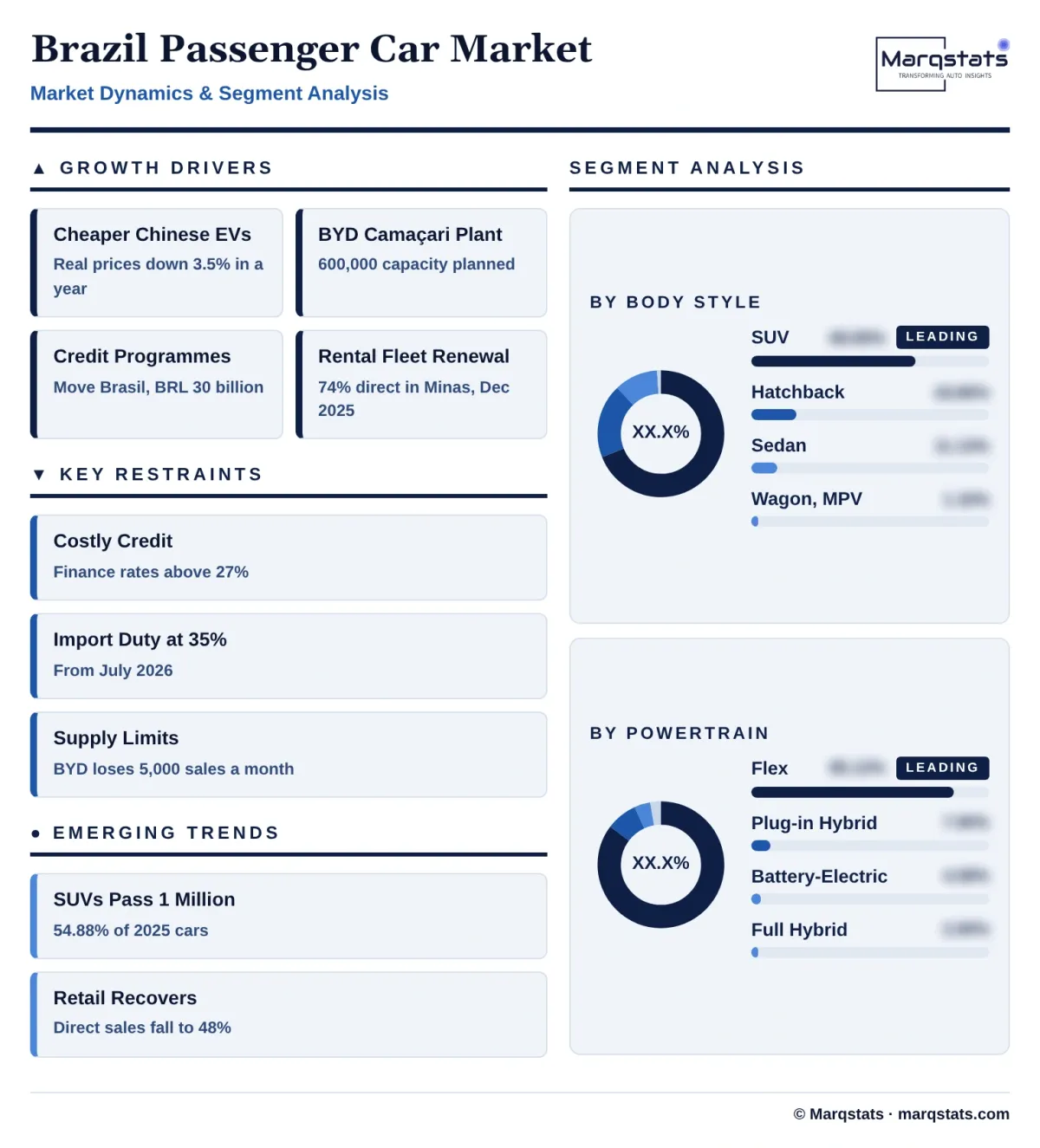
SUVs account for 68.85% of 2025 value, USD 37,373.79 million, and 54.88% of units, 1,095,642 cars, and grow at 10.72% a year to USD 62,175.25 million and 74.45% of value. Fenabrave counted 1,095,642 SUVs in 2025 against 939,279 in 2024, and the 2030 share of 61.00% of units assumes a slower climb than the 6.66 point gain of 2025.
Hatchbacks account for 18.86% of 2025 value, USD 10,240.57 million, and 31.05% of units, an estimated 620,000 cars. Value grows at 4.37% a year to USD 12,679.66 million while the unit share falls to 26.20%. The Volkswagen Polo at 122,677 units, Fiat Argo at 102,639, Hyundai HB20 at 85,035, Chevrolet Onix at 79,895 and Fiat Mobi at 73,013 lead the group, and the BYD Dolphin Mini at 32,488 is its electric entry.
Sedans account for 11.13% of 2025 value, USD 6,043.09 million, and 12.77% of units, an estimated 255,000 cars. Value grows at 4.93% a year to USD 7,685.30 million. The Chevrolet Onix Plus at 52,959, Volkswagen Virtus at 36,980, Hyundai HB20S at 36,948 and Toyota Corolla at 33,252 keep the segment alive in taxi, rental and fleet use, but retail buyers choose the SUV for the same money.
Station wagons, people carriers and other bodies account for 1.16% of 2025 value, USD 627.47 million, and 1.30% of units, 25,889 cars, the balance after SUVs, hatchbacks and sedans. The Chevrolet Spin, a seven-seat people carrier at 22,741 units, is the main model. Value grows at 9.32% a year to USD 979.65 million.
Internal combustion cars, almost all flex-fuel and including mild hybrids that ABVE does not count as electrified, account for 85.12% of 2025 value, USD 46,206.71 million, and 89.23% of units, 1,781,576 cars. Value grows only 0.32% a year to USD 46,941.87 million, and the share falls to 56.20% of value, because every net unit added after 2025 is electrified.
Full hybrids account for 2.90% of 2025 value, USD 1,571.86 million, and 2.04% of units, an estimated 40,675 cars, and grow at 44.30% a year to USD 9,835.79 million. ABVE counts 21,323 flex-fuel and 21,047 gasoline hybrids among 2025 light vehicles, and a hybrid that needs no plug suits buyers who cannot charge at home.
Plug-in hybrids account for 7.90% of 2025 value, USD 4,290.45 million, and 4.87% of units, an estimated 97,309 cars, and grow at 26.17% a year to USD 13,715.83 million and 16.42% of value. ABVE counted 101,364 plug-in hybrids across all light vehicles in 2025, the largest electrified group, and Marqstats removes about 4.00% of them as pickups and vans. The live Marqstats Brazil plug-in hybrid analysis covers all light vehicles at BRL 5.45 per US dollar, so the two must not be added.
Battery-electric cars account for 4.08% of 2025 value, USD 2,215.90 million, and 3.86% of units, an estimated 76,971 cars, and grow fastest, at 42.51% a year, to USD 13,026.37 million and 15.60% of value. ABVE counted 80,178 battery-electric light vehicles in 2025, and the segment is led by the BYD Dolphin Mini at 32,488 units, followed by the Dolphin at 15,238 and the King at 12,412.
Chinese brands account for 14.49% of 2025 value, USD 7,864.65 million, and 13.77% of units, an estimated 275,000 cars, and grow at 21.65% a year to USD 20,954.80 million and 25.09% of value. The estimate adds BYD at about 147,100 cars, the Chery group at 74,920 across Tiggo 7, Tiggo 8, Tiggo 5X and Jaecoo 7, and Great Wall Motor at 40,931, which together with Geely and GAC reach 267,627 named cars.
All other brands account for 85.51% of 2025 value, USD 46,420.27 million, and 86.23% of units, an estimated 1,721,531 cars. Value grows at 6.15% a year to USD 62,565.06 million as Volkswagen, Fiat, Chevrolet, Hyundai, Toyota, Honda, Renault, Jeep and Nissan defend volume with flex-fuel hybrids and entry SUVs, and the group's share of value falls to 74.91%.
Retail sales to individual buyers account for 52.34% of 2025 value, USD 28,410.68 million, and 48.60% of units, 970,314 cars, on the 48.60% retail share that Fenabrave reports for cars and light commercial vehicles together. Value grows at 10.76% a year to USD 47,356.88 million and 56.70% of value. Hyundai Creta at 58,560, Honda HR-V at 48,420 and Volkswagen Polo at 46,562 led retail registrations in 2025.
Direct sales account for 47.66% of 2025 value, USD 25,874.24 million, and 51.40% of units, 1,026,217 cars. They cover rental companies, corporate fleets, taxi and ride-hailing drivers, public bodies and buyers with disabilities who qualify for tax exemption. Value grows at 6.93% a year to USD 36,162.98 million as the unit share falls to 47.00%, and direct buyers pay about 14% less per car than retail buyers on Marqstats weights.
By Geography
São Paulo
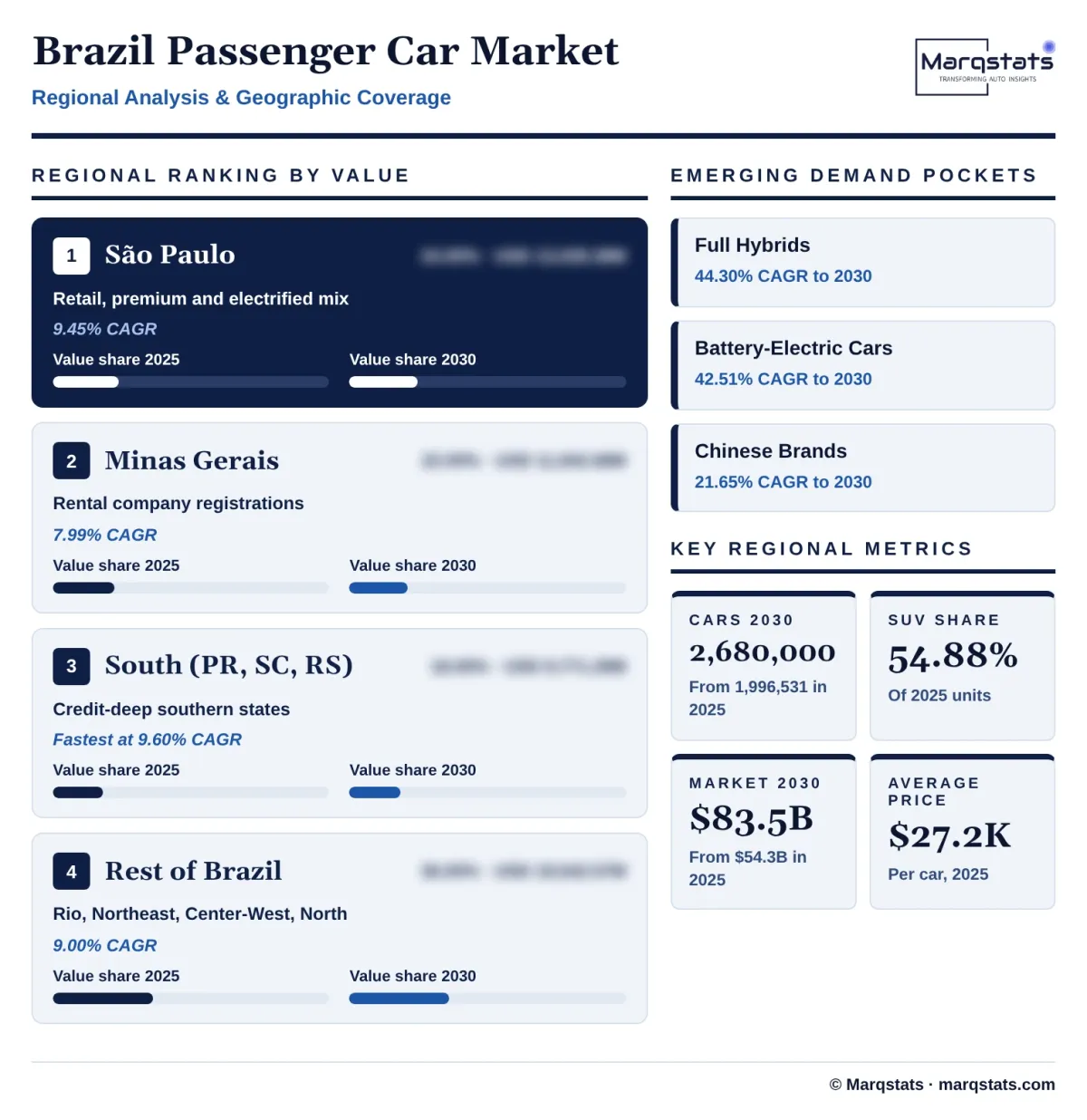
São Paulo accounts for 24.00% of 2025 value, USD 13,028.38 million, and grows at 9.45% a year to USD 20,462.37 million and 24.50% by 2030. The state placed 62,111 cars and light commercial vehicles in September 2026, 23.40% of the national total according to a state ranking published on 3 October 2026, and Marqstats allocates it the largest value share because of its income level and its premium and electrified mix.
Minas Gerais
Minas Gerais accounts for 22.00% of 2025 value, USD 11,942.68 million, and grows at 7.99% a year to USD 17,539.17 million. Fenabrave data reported by Diário do Comércio show 756,622 registrations of all vehicles in the state in 2025, about 563,305 of them cars and light commercial vehicles, or 22.10% of the national total. Abla counts 1.37 million rental vehicles in the state, 40.13% of the national rental fleet, so value here is a rental-registration measure.
Paraná, Santa Catarina and Rio Grande do Sul
Paraná, Santa Catarina and Rio Grande do Sul account for 18.00% of 2025 value, USD 9,771.29 million, and grow fastest, at 9.60% a year, to USD 15,451.17 million and 18.50% by 2030. The three states registered 8.8%, 4.9% and 4.5% of September 2026 volume, together 18.2%, and the South held 20.2% of the 7.3 million vehicles financed in 2025, a credit depth above its value share that supports faster growth.
Rest of Brazil
The rest of Brazil, which includes Rio de Janeiro at 4.3% of September 2026 volume, Bahia at 3.4%, the Federal District at 3.2%, Pernambuco at 3.0% and Goiás at 2.9%, accounts for 36.00% of 2025 value, USD 19,542.57 million, and grows at 9.00% a year to USD 30,067.15 million. The Northeast, Center-West and North held 19.5%, 10.6% and 7.9% of vehicles financed in 2025, so credit depth, not demand, is what holds this group at 36.00% of value.
How Competition Is Evolving
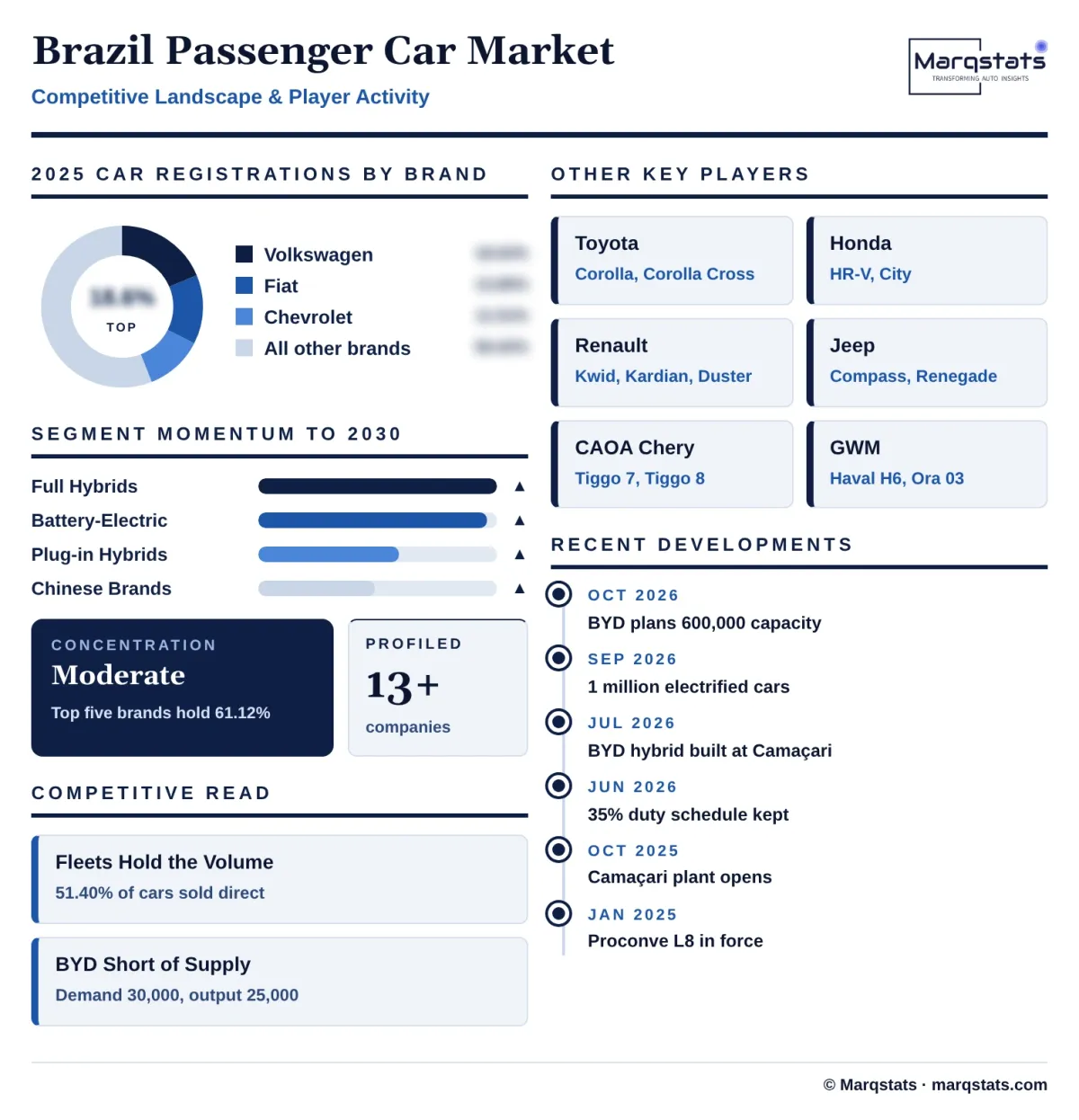
The market is moderately concentrated. Fenabrave reports 2025 car registration shares of 18.62% for Volkswagen, 13.85% for Fiat, 11.51% for Chevrolet, 9.77% for Hyundai and 7.37% for BYD, which together hold 61.12% of the 1,996,531 cars sold, or about 1,220,280 cars. Fiat leads the combined car and light commercial market at 19.97%, but only 13.85% of cars, because pickups and vans such as the Strada supply nearly half of its volume.
Volume is concentrated in a small number of models. The ten best-selling cars, the Volkswagen Polo, Fiat Argo, Volkswagen T-Cross, Hyundai HB20, Chevrolet Onix, Hyundai Creta, Fiat Mobi, Jeep Compass, Honda HR-V and Chevrolet Tracker, registered 815,642 units, 40.85% of the market. Five of the ten are SUVs and five are hatchbacks, but in the retail ranking seven are SUVs, which shows how the fleet channel keeps hatchbacks in the volume table.
BYD is the brand that changes position. It rose to 7.37% of car registrations in 2025 and 8.5% in September 2026, passing Toyota, Honda and Renault in the car ranking, and its Camaçari plant makes the Dolphin Mini, King sedan and Song Pro locally. Reuters reported on 23 October 2026 that BYD aims to be Brazil's largest automaker by sales volume by 2030, a target that matches the 600,000 vehicle capacity for which it is applying.
Legacy brands compete on versions, price and flex-fuel hybrids. Volkswagen sold the Tera, a compact SUV, in 48,143 units in its first year and added it to the Carro Sustentável programme, Fiat sold the Fastback at 57,305 units and the Pulse at 44,434, and Stellantis reported more than 750,000 vehicles sold in Brazil in 2025, about 29.3% of light vehicles, on 2 January 2026. Marqstats expects their defence to be converting volume models to hybrids before the 35% duty reaches knocked-down kits in January 2027.
Companies Covered
Companies covered in the report include:
Recent Market Activity
Table of Contents
Coverage & Segmentation
The study covers the Brazil passenger car market, with 2025 as the base year, 2021 – 2025 as the historical period and 2026 – 2030 as the forecast period. It covers new passenger cars (automóveis in the Fenabrave and Anfavea classification), including SUVs, crossovers, hatchbacks, sedans, station wagons and people carriers, registered in Brazil across all powertrains, segmented by body style, powertrain, brand origin and sales channel, and by four regions. Values are retail transaction values including taxes in US dollars at BRL 5.57 per US dollar, the 2025 average held constant across the forecast, and units follow the Fenabrave registration series.
Pickups, vans and other light commercial vehicles of up to 3.5 tonnes (552,931 in 2025), trucks and buses (139,717), motorcycles, used cars and exports are excluded. The 2,549,462 cars and light commercial vehicles and the 2,689,179 four-group total are the next rungs of the ladder and are not added to this market. The live Marqstats Brazil electric vehicle, plug-in hybrid, used car and connected car analyses cover other products, with other scopes and exchange rates, so their figures must not be added to this market, and the Marqstats Brazil pickup, heavy truck and bus analyses are disjoint from it. Segment and regional splits are Marqstats estimates built on registrations and dated price lists. The analysis profiles 13 companies.