Market Snapshot
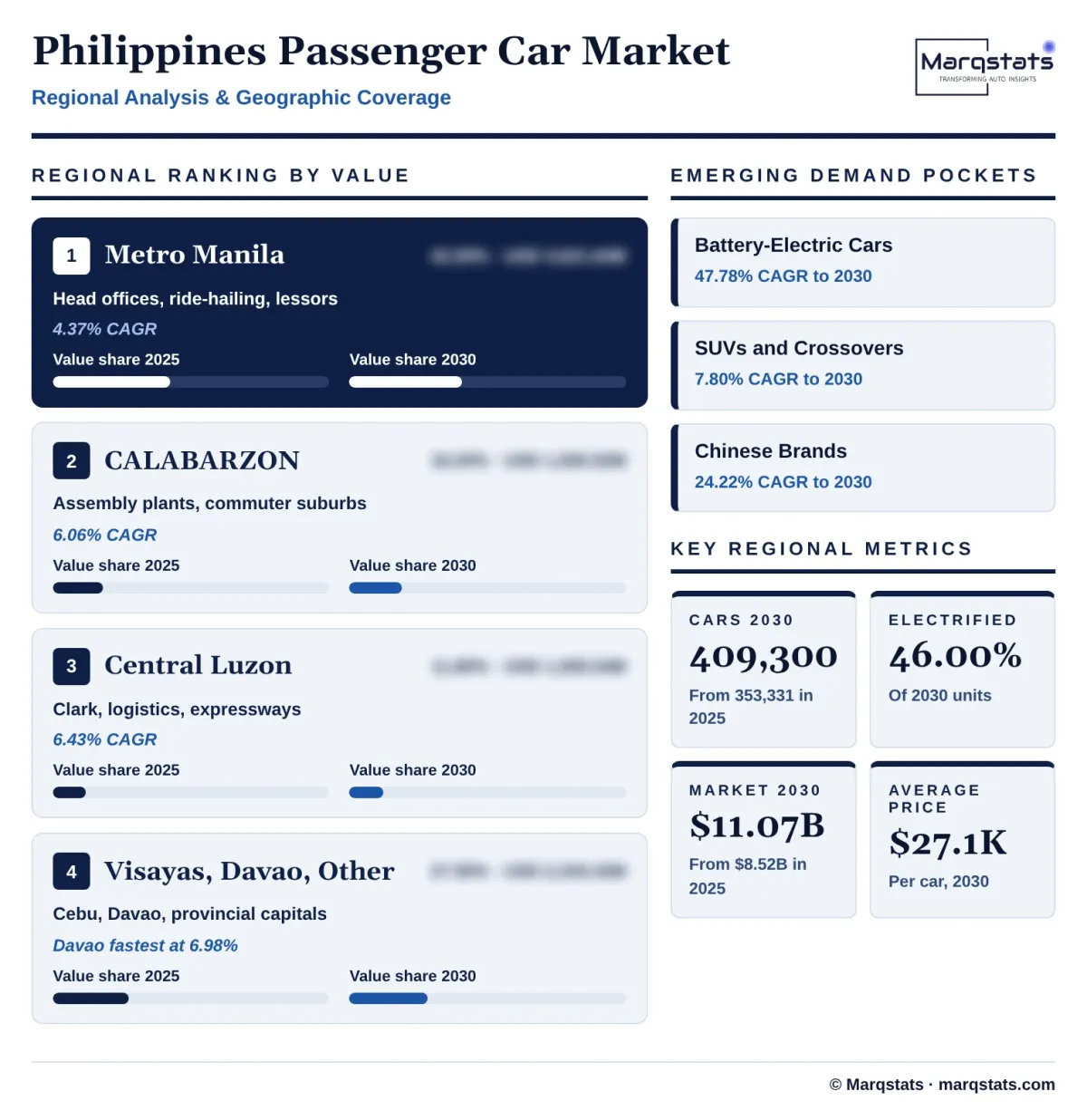
The Philippines passenger car market size is estimated at USD 8,521.52 million in 2025 and is projected to reach USD 11,073.37 million by 2030, growing at a CAGR of 5.38% over 2026 – 2030. Annual deliveries rise from 353,331 to 409,300 cars, a 2.98% annual rate, while the average retail value per car climbs from about USD 24,118 to USD 27,054 as sport utility vehicles and electrified models take a larger share.
Marqstats defines the market as new M1 passenger cars sold in the Philippines: sedans, hatchbacks, coupes, sport utility vehicles, crossovers and multi-purpose vehicles with up to eight seats beside the driver, whether built locally or imported, from members of the Chamber of Automotive Manufacturers of the Philippines, Inc. (CAMPI) and from non-member importers such as BYD. Value is the retail list price including excise tax and 12% value-added tax, converted at PHP 57.50 per US dollar. Pickups, vans, jeepneys, trucks, buses and used cars are excluded.
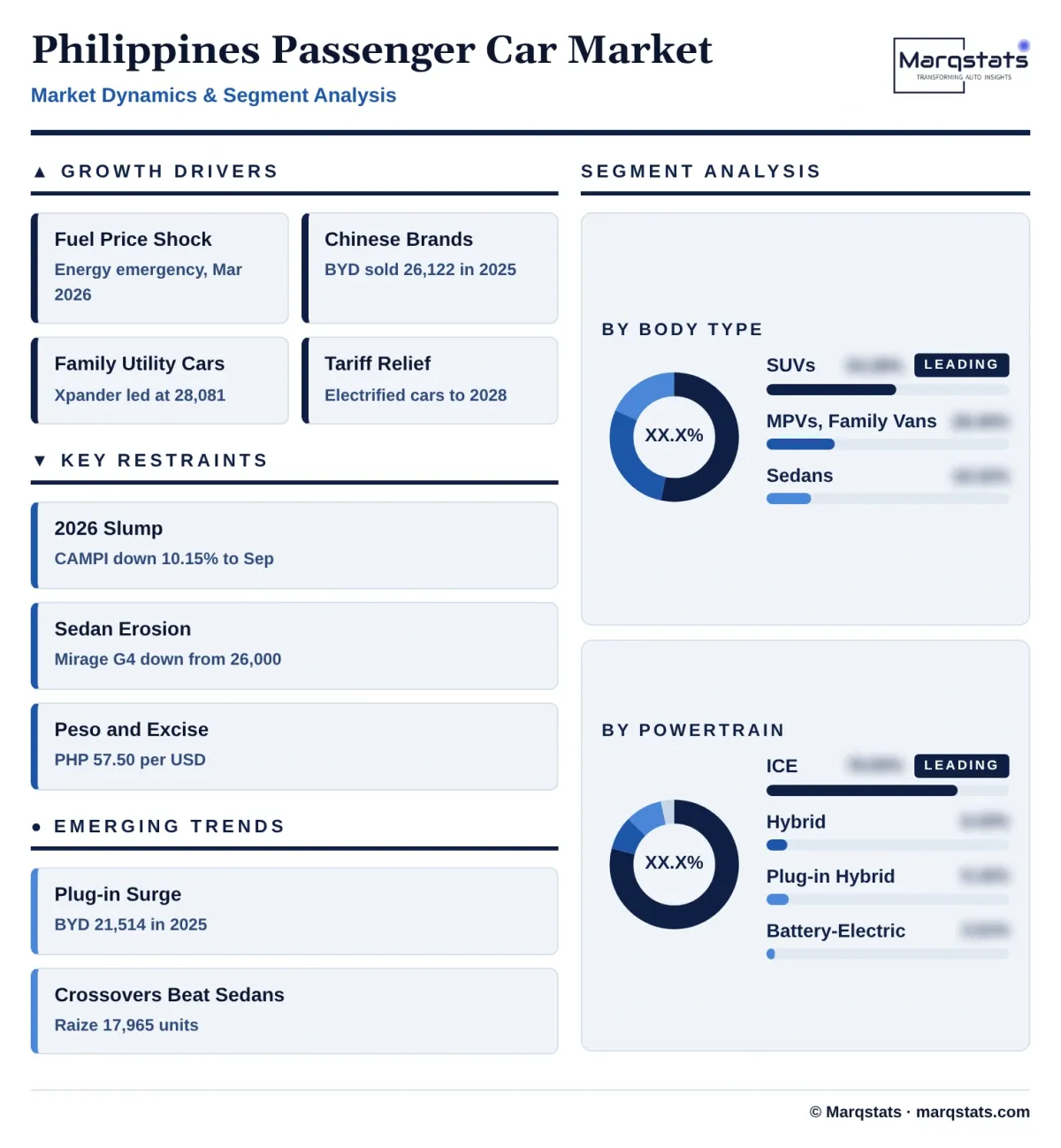
Sport utility vehicles and crossovers account for 53.28% of 2025 value, internal combustion cars for 78.90% and Japanese brands for 74.79%. Metro Manila accounts for 42.50% of value, while battery-electric cars grow fastest, at 47.78% a year, as BYD, Tesla, VinFast and the new Chinese brands widen the choice beyond hybrids.
Key Takeaways
Market Overview & Analysis
Report Summary
Marqstats sizes the Philippines passenger car market as the retail value of new M1 passenger cars sold each year: sedans, hatchbacks and coupes, sport utility vehicles and crossovers, and multi-purpose vehicles and family vans seating up to eight beside the driver. The measure follows the international M1 class used by the Land Transportation Office (LTO) and the Bureau of Philippine Standards, not the narrower passenger-car line in CAMPI reports.
The two differ sharply. CAMPI and the TMA split new vehicles into passenger cars and commercial vehicles, and in 2025 reported 92,924 passenger cars and 370,722 commercial vehicles, a total of 463,646. The commercial line is divided into Category I for Asian utility vehicles and multi-purpose vehicles, 87,731 units, Category II for light commercial vehicles including pickups and sport utility vehicles, 271,630 units, and Categories III to V for trucks and buses, 6,783, about 3,690 and 888 units. Industry sales including non-members such as BYD and Geely were 491,395, up 3.7% from 473,842.
Marqstats removes the vehicles that are not passenger cars to reach the market. Of the 491,395 industry units, about 138,064 are pickups, vans, utility vehicles, trucks and buses, led by the Toyota Hilux at 23,819, Hiace at 20,526 and Tamaraw at 17,542, the Mitsubishi L300 at 14,938 and Triton at 9,170, and the Ford Ranger at 9,658. What remains is 353,331 passenger cars, 71.90% of the industry. Only 92,924 of them, 26.30%, appear in the CAMPI passenger-car line.
Demand moved toward practical, high-riding cars. The Mitsubishi Xpander, at 28,081 units, outsold the Toyota Vios at 27,811 to become the best-selling vehicle of 2025, the Toyota Avanza sold 24,704, the Raize 17,965 and the Innova 16,112, while the Mitsubishi Mirage G4 fell to 17,757 from more than 26,000 in 2024. Nissan's passenger-car line fell 72.8% to 1,466 units and Toyota's 22.2% to 49,015.
Electrification arrived at the same time. Industry sales of electrified vehicles reached 58,905 in 2025, 12.00% of the industry and up 142.5%, of which CAMPI members accounted for 32,489. BYD sold 21,514 plug-in hybrids and 4,608 battery-electric vehicles, Toyota 17,904 hybrids and Tesla 2,424 battery-electric cars. The market is valued at about PHP 489.99 billion, equal to USD 8,521.52 million, at the 2025 average rate of PHP 57.50 per US dollar.
Philippines Passenger Car Market Size and Forecast
The Philippines passenger car market grows from USD 8,521.52 million in 2025 to USD 11,073.37 million in 2030, a CAGR of 5.38%. Value grows faster than volume: deliveries rise at 2.98% a year, from 353,331 to 409,300 cars, and the average value per car rises at 2.32% a year, from about USD 24,118 to USD 27,054, as the mix moves to sport utility vehicles and electrified models. Marqstats holds the exchange rate at PHP 57.50 per US dollar through the forecast.
The 2025 value is built bottom-up from model-level deliveries and list prices. For Toyota Motor Philippines and Mitsubishi Motors Philippines, which delivered 316,255 of 491,395 vehicles, Marqstats uses reported model sales, such as the Vios at 27,811, Avanza at 24,704, Wigo at 19,063, Raize at 17,965, Innova at 16,112, Xpander at 28,081 and Montero Sport at 10,886, and removes the Hilux, Hiace, Tamaraw, Liteace, L300 and Triton, which are not passenger cars. Prices are mid-points of dealer list-price ranges where published, and Marqstats estimates elsewhere, for example PHP 706,000 to 1,055,000 for the Vios, PHP 1,068,000 to 1,198,000 for the Xpander and PHP 1,710,000 to 2,569,000 for the Fortuner. Other brands use reported brand totals with Marqstats estimates of the passenger-car share.
The base is checked against the association's own counts. The 92,924 passenger cars CAMPI reported for 2025 sit inside the 353,331, and Marqstats estimates sedans and hatchbacks at 97,324 including 4,000 BYD and 400 Geely units that no CAMPI line carries. Industry deliveries of 491,395 less an estimated 138,064 non-passenger vehicles give the passenger-car volume, and 82.64% of that deduction rests on named, reported lines.
The forecast starts with a contraction. CAMPI-TMA members delivered 307,060 vehicles in January to September 2026, down 10.15%, passenger cars fell 9.35% to 62,829, and industry sales through September, including non-members, were about 340,790. BYD's growth offsets part of the fall, and Marqstats expects 340,000 passenger cars in 2026, a 3.77% decline in units and 1.57% in value. Volume then grows about 5.50% in 2027, 5.00% in 2028, 4.50% in 2029 and 4.00% in 2030 as financing conditions ease and electrified cars become cheaper.
Electrified cars add value faster than volume. Marqstats expects hybrids to rise from 24,317 units in 2025 to 57,302 in 2030, plug-in hybrids from 23,696 to 65,488 and battery-electric cars from 9,392 to 65,488, lifting electrified cars from 16.25% to 46.00% of units and from 21.10% to 54.16% of value, with hybrids priced at about 1.30 times, plug-in hybrids 1.45 times and battery-electric cars 1.40 times a combustion car in the same mix. Marqstats tracks four indicators: monthly CAMPI-TMA and non-member deliveries, the price of fuel after the March 2026 energy emergency, the tariff relief that ends in 2028, and the peso rate.
Market Dynamics
Key Drivers
Five forces are lifting demand for new passenger cars in the Philippines even as the market contracts in 2026.
- Fuel prices push buyers toward efficient and electrified cars. A national energy emergency was declared in late March 2026, and CAMPI president Jose Maria Atienza said rising oil prices would favour smaller, lower-displacement and electrified vehicles. Electrified deliveries by CAMPI members reached 54,372 in January to September 2026, up 163% and 17.71% of members' sales, with 8,959 in September alone.
- Chinese brands widen the price ladder. BYD Cars Philippines sold 26,122 vehicles in 2025, up 446%, and 28,399 in January to August 2026, while Geely, Omoda and Jaecoo and VinFast ranked sixth, ninth and tenth among CAMPI-TMA brands in September 2026, with 1,023, 972 and 865 units. Their entry prices open the market to buyers who would otherwise choose a used car or a pickup.
- Family demand favours seven-seat and high-riding cars. The Mitsubishi Xpander sold 28,081 units, the Toyota Avanza 24,704, the Raize 17,965 and the Innova 16,112 in 2025, and the Mitsubishi Destinator, launched in November 2025, sold 1,352 units in its first two months. These cars sit mostly outside CAMPI's passenger-car line but inside the M1 market.
- Law and tariffs favour electrification. Republic Act No. 11697, the Electric Vehicle Industry Development Act, created the Comprehensive Roadmap for the Electric Vehicle Industry and green-plate registration and exempted electric vehicles from number-coding, while Executive Order No. 12 of 2023, as modified by Executive Order No. 62 of 2024, cut import tariffs on electrified vehicles for a window that runs to 2028. Under the TRAIN Law, Republic Act No. 10963, excise tax is 4% of net price up to PHP 600,000, which keeps entry cars cheap.
- Domestic assembly protects the entry segment. Toyota Motor Philippines and Mitsubishi Motors Philippines assemble the Vios and Mirage G4 locally under the Comprehensive Automotive Resurgence Strategy (CARS) Program, Executive Order No. 182 of 2015, and the two models sold 27,811 and 17,757 units in 2025, together 12.90% of the passenger cars sized here.
Key Restraints
Four constraints hold back volume and slow the shift to cleaner cars.
- The 2026 slump cuts volume. CAMPI-TMA deliveries fell 10.15% to 307,060 in January to September 2026, passenger cars fell 9.35% to 62,829, and August deliveries of 29,611 were 18.1% lower than a year earlier, which CAMPI linked to natural calamities, high fuel prices, tighter consumer lending and a weak peso.
- Sedans keep losing ground. The Mitsubishi Mirage G4 fell to 17,757 in 2025 from more than 26,000 in 2024, Mitsubishi's passenger-car line fell 33.3% to 18,456, Toyota's fell 22.2% to 49,015 and Nissan's fell 72.8% to 1,466, so the lowest-priced segment shrinks as the market rotates to utility bodies.
- Prices are exposed to the peso and to excise tax. Cars other than the two CARS models are largely imported, so a weak peso lifts list prices, and the TRAIN schedule adds 20% on the net price in excess of PHP 1 million and 50% on the excess over PHP 4 million, which makes every mid-range hybrid or sport utility vehicle dearer than its entry-level rival.
- Charging and service networks lag the new brands. Marqstats counts 1,351 public charging points as of February 2026, concentrated in Metro Manila, Metro Cebu and expressway plazas, and the newest Chinese entrants have thinner dealer and parts networks than Toyota Motor Philippines, which sustains buyer loyalty to hybrids over plug-ins.
Key Trends
Four shifts are changing which cars Filipinos buy and who sells them.
- Plug-in hybrids lead the electric surge. BYD sold 21,514 plug-in hybrids in 2025, and in January to September 2026 CAMPI members reported 10,672 plug-in hybrids led by Jetour at 2,857, Geely at 1,745 and MG at 1,071, so range-extending drivetrains win buyers who fear charging gaps.
- Battery-electric brands scale up. CAMPI members delivered 16,006 battery-electric vehicles in January to September 2026, led by VinFast at 5,417, Tesla at 3,460 and Omoda and Jaecoo at 2,443, 29.44% of members' electrified deliveries.
- Hybrids spread beyond Toyota. CAMPI members delivered 27,694 hybrids in January to September 2026, with Toyota at 17,556, Ford at 3,781 and Omoda and Jaecoo at 1,349 combined, as Ford and Chinese brands join Toyota.
- Compact crossovers replace sedans. The Toyota Raize at 17,965 units and Yaris Cross at 5,950 sell beside the Vios and Wigo, and CAMPI's commercial-vehicle line grew 6.99% in 2025 while its passenger-car line fell 23.06%.
Strategic Implications
- For incumbent manufacturers, the strategic question is how to defend a 46.41% Toyota and 17.74% Mitsubishi unit share when CAMPI reports show members' volume falling. Hybrid trims on the Raize, Yaris Cross, Xpander and Xforce, priced within reach of combustion versions, keep dealer networks and parts supply as the advantage against newcomers.
- For Chinese and other new entrants, the 2028 end of the tariff window is the date to plan around. Brands that have built service points and parts depots outside Metro Manila by then keep volume when tariff relief ends, while brands relying on price alone face the 2026 slump with thin networks.
- For importers and distributors outside CAMPI, reporting matters. BYD's 26,122 units are not in any CAMPI line, so lenders, insurers and fleet buyers that benchmark on CAMPI passenger-car counts understate the market by about 74%, and a distributor that publishes model-level data earns credibility with banks.
- For lenders and lessors, electrified cars need residual-value and battery-warranty products. With electrified cars rising to 46.00% of units by 2030, guaranteed-future-value leases and bundled insurance and charger loans help buyers who worry about battery life and resale.
- For parts and service providers, the shift from sedans to utility bodies and from combustion to electrified drivetrains moves workshop demand toward high-voltage service, brake and tyre fitments for heavier cars and away from exhaust and engine components.
Market Segmentation
Sedans and hatchbacks account for 18.32% of 2025 value, USD 1,561.40 million, and edge up at 0.76% a year to USD 1,621.86 million, while their share falls to 14.65%. This is the segment CAMPI reports as passenger cars, 92,924 members' units led by the Toyota Vios and Wigo, the Mitsubishi Mirage G4, the Suzuki S-Presso and the Honda City, plus about 4,400 BYD and Geely cars. Volume holds near 96,186 cars by 2030, slightly below 2025, because fleets, ride-hailing and first-car buyers keep demand for low prices.
Sport utility vehicles and crossovers account for 53.28% of 2025 value, USD 4,540.29 million, and grow fastest among body types, at 7.80% a year, to USD 6,609.86 million and 59.69% of the market. Marqstats estimates 148,996 units in 2025, led by the Toyota Raize, Fortuner and Yaris Cross, the Mitsubishi Montero Sport, the Ford Everest and Territory and the BYD Atto 3 and Sealion range, rising to 196,464 by 2030 at 5.69% a year.
Multi-purpose vehicles account for 28.40% of 2025 value, USD 2,419.83 million, and grow at 3.27% a year to USD 2,841.65 million. The Mitsubishi Xpander, Toyota Avanza, Veloz and Innova and the Suzuki Ertiga carry 107,011 units in 2025, and the segment grows at 1.74% a year in volume as large households and ride-hailing operators buy seven-seaters, with the Toyota Zenix hybrid and the BYD M6 adding electrified choices.
Combustion cars account for 78.90% of 2025 value, USD 6,723.81 million, and fall at 5.47% a year to USD 5,076.08 million and 45.84% of value by 2030. Marqstats estimates 295,926 units in 2025, 83.75% of volume, declining to 221,022, as petrol and diesel remain the choice outside Metro Manila, but electrified models take most of the growth.
Hybrids account for 8.43% of 2025 value, USD 718.27 million, and grow at 18.96% a year to USD 1,710.83 million. Marqstats estimates 24,317 units in 2025, built on Toyota at 17,904, Honda at 1,821 and Lexus at 1,692, and expects 57,302 by 2030 as Ford, Honda, Suzuki and Chinese brands add hybrid trims, with no plug or charger needed.
Plug-in hybrids account for 9.16% of 2025 value, USD 780.68 million, and grow at 22.81% a year to USD 2,180.83 million. BYD sold 21,514 plug-in hybrids in 2025, including the Shark pickup on sale since 2025, which Marqstats excludes at an estimated 1,500 units, and Jetour and Chery added 993 and 631, so Marqstats counts 23,696 cars and expects 65,488 by 2030.
Battery-electric cars account for 3.51% of 2025 value, USD 298.76 million, and grow fastest, at 47.78% a year, to USD 2,105.63 million and 19.02% of the market. BYD sold 4,608, Tesla 2,424 and Nissan 914 battery-electric vehicles in 2025, and Marqstats counts 9,392 cars, rising to 65,488 by 2030 as VinFast, BYD and Omoda and Jaecoo add models and public charging grows from 1,351 points.
Japanese brands account for 74.79% of 2025 value, USD 6,373.63 million, and grow at 0.21% a year to USD 6,441.40 million, while their share of units falls from 78.64% to 62.00%. Toyota, Mitsubishi, Suzuki, Honda and Nissan carry 277,875 units, helped by local assembly, hybrid leadership and the deepest dealer networks.
Chinese brands account for 12.25% of 2025 value, USD 1,043.75 million, and grow fastest, at 24.22% a year, to USD 3,087.10 million and 27.88% of the market. BYD, MG, GAC, Geely, Jetour, Chery and Omoda and Jaecoo delivered about 42,880 cars in 2025, 12.14% of units, rising to 114,604 by 2030 at 21.73% a year.
Korean brands account for 4.79% of 2025 value, USD 408.08 million, and grow at 6.06% a year to USD 547.76 million. Hyundai, with the Stargazer, Creta and Tucson, and Kia, with the Seltos and Carnival, delivered about 15,185 cars in 2025, and both brands lost share in a market that favoured Japanese value and Chinese price.
American, European and other brands account for 8.17% of 2025 value, USD 696.06 million, and grow at 7.45% a year to USD 997.11 million. Ford, with the Everest and Territory, Tesla, BMW, Mercedes-Benz, VinFast and others delivered about 17,391 cars, a small share of units but a high share of value because of premium prices.
By Geography
Metro Manila (National Capital Region)
Metro Manila accounts for 42.50% of 2025 value, USD 3,621.64 million, and grows at 4.37% a year to USD 4,484.71 million and 40.50% by 2030. Registration shares overstate the capital because leasing companies, banks and ride-hailing fleets register cars at head offices, while the cars operate in nearby provinces. Marqstats allocates value by registration, as lenders do, and these regional splits are Marqstats estimates.
CALABARZON (Region IV-A)
CALABARZON, covering Cavite, Laguna, Batangas, Rizal and Quezon, accounts for 18.20% of 2025 value, USD 1,550.92 million, and grows at 6.06% a year to USD 2,081.79 million. The region houses the Santa Rosa, Laguna assembly plants of Toyota Motor Philippines and Mitsubishi Motors Philippines and commuter suburbs along the South Luzon Expressway.
Central Luzon (Region III)
Central Luzon accounts for 11.80% of 2025 value, USD 1,005.54 million, and grows at 6.43% a year to USD 1,373.10 million and 12.40% by 2030. The Clark Freeport Zone, logistics parks and the North Luzon, Subic-Clark-Tarlac and Tarlac-Pangasinan-La Union expressways support household and fleet demand.
Central Visayas (Region VII)
Central Visayas accounts for 7.60% of 2025 value, USD 647.64 million, and grows at 6.47% a year to USD 885.87 million. Metro Cebu is the second-largest urban market and an early home for public charging, which suits hybrid and electric buyers.
Davao Region (Region XI)
The Davao Region accounts for 5.10% of 2025 value, USD 434.60 million, and grows at 6.98% a year to USD 609.04 million. Davao City is the commercial gateway of Mindanao, and agro-industrial incomes support purchases of utility-bodied cars.
Rest of the Philippines
The rest of the Philippines accounts for 14.80% of 2025 value, USD 1,261.18 million, and grows at 5.38% a year to USD 1,638.86 million. Outside the main corridors, buyers favour pickups and vans, so passenger-car demand is thinner and concentrated in provincial capitals.
How Competition Is Evolving
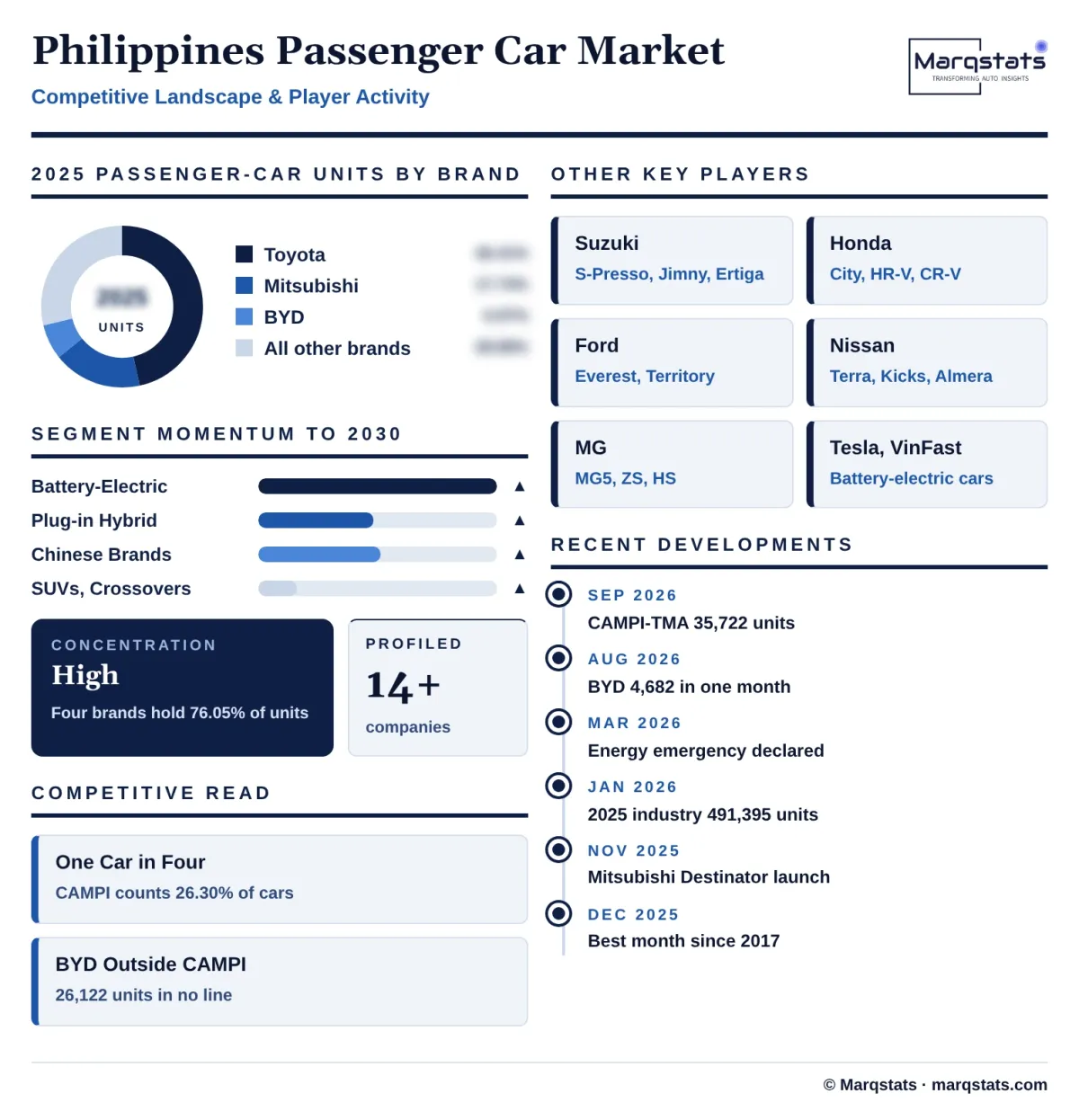
The market is highly concentrated. Marqstats estimates that Toyota delivered 163,993 passenger cars in 2025, 46.41% of units, Mitsubishi 62,670, 17.74%, BYD 24,622, 6.97%, and Suzuki 17,432, 4.93%, so four brands hold 76.05% of the market and the two leaders 64.15%. Honda follows with 16,257, Ford 12,026, Nissan 11,071, MG 8,715, Hyundai 7,675 and Kia 7,510.
Toyota Motor Philippines sold 229,447 vehicles in 2025, 49.49% of CAMPI-TMA volume, and 151,457 in January to September 2026, 49.32%, and its passenger cars are led by the Vios at 27,811, Avanza at 24,704, Wigo at 19,063 and Raize at 17,965. Mitsubishi Motors Philippines sold 86,808, with the Xpander at 28,081 and the Mirage G4 at 17,757, and 50,125 in January to September 2026, 16.32%.
BYD is the disruptor. It sold 26,122 vehicles in 2025, up 446%, ahead of Suzuki, Ford and Nissan in total vehicles, and 4,682 in August 2026 alone, enough to rank second had non-members been counted. Marqstats counts 24,622 of the 2025 units as passenger cars, excluding its Shark pickup, and expects Chinese brands to hold 28.00% of units in 2030.
Competition is shifting from price to access and powertrain. Geely, Omoda and Jaecoo and VinFast joined the CAMPI-TMA top ten in September 2026, Jetour leads plug-in hybrids in members' data, and Toyota Motor Philippines leads hybrids with 17,556 of 27,694 hybrid deliveries. Incumbents answer with locally assembled value models, the widest dealer coverage, and hybrid trims across the Raize, Yaris Cross, Zenix and Corolla Cross.
Companies Covered
Companies covered in the report include:
Recent Market Activity
Table of Contents
Coverage & Segmentation
The study covers the Philippines passenger car market, with 2025 as the base year and 2026 – 2030 as the forecast period. It covers new M1 passenger cars, sedans, hatchbacks, coupes, sport utility vehicles, crossovers and multi-purpose vehicles with up to eight seats beside the driver, sold by CAMPI members and non-member importers, segmented by body type, powertrain, brand origin and region. Values are retail list prices including excise tax and value-added tax in US dollars, converted at PHP 57.50 per US dollar.
Pickups, vans, Asian utility vehicles built on commercial chassis, jeepneys, trucks, buses, motorcycles and used cars are excluded. The CAMPI passenger-car line of 92,924 units sits inside the market as its sedan and hatchback segment, and CAMPI sport utility vehicles and multi-purpose vehicles filed as commercial vehicles are added. Live Marqstats reports on the Philippines electric vehicle market and on Philippine EV charging cover overlapping electrified cars, so their figures should not be added to this market.