Market Snapshot
The Saudi Arabia passenger car market size is estimated at USD 20,850.42 million in 2025 and is projected to reach USD 22,723.97 million by 2030, growing at a CAGR of 1.74% over 2026 – 2030. Deliveries of new cars fall from about 732,515 in 2025 to 522,000 in 2026 and recover to 790,000 by 2030, a 1.52% annual rate over the five years, while the average retail value per car stays near USD 28,464 to USD 28,765 as price cuts offset the move to hybrid and electric models.
Marqstats defines the market as the retail value of new M1 passenger cars (sedans, hatchbacks, SUVs, crossovers and people carriers with up to nine seats) sold in Saudi Arabia through authorised distributors, valued at the transaction price paid by the buyer including 15% value added tax. Pickups, vans, minibuses, light and medium trucks, used cars and direct government procurement are excluded, and the live Marqstats Saudi Arabia Pickup Vehicle Market is a separate, additive layer.
SUVs and crossovers account for 58.08% of 2025 value, petrol and diesel cars for 89.63% and mid-priced cars of SAR 75,000 to 150,000 for 44.52%. The Riyadh Region accounts for 37.00% of value, while the Eastern Province and Riyadh grow fastest as new housing, industry and logistics zones fill.
Key Takeaways
Market Overview & Analysis
Report Summary
Marqstats sizes the Saudi Arabia passenger car market as the retail value of new M1 passenger cars sold each year through authorised distributors. It counts sedans, hatchbacks, sport utility vehicles, crossovers and people carriers with up to nine seats, whether imported fully built or assembled in the Kingdom, at the price paid by the buyer including 15% value added tax. Pickups, vans, minibuses and light and medium trucks, used cars and direct government procurement are excluded.
The 2025 volume is built from the tracked market, not from a customs ratio. Best Selling Cars Blog, which compiles monthly registration and distributor data, put total new light vehicle sales at 857,247 units in 2025, up 3.6% and the best result since 2015. Marqstats removes 70,732 pickups, the volume used in the live Marqstats Saudi Arabia Pickup Vehicle Market, and about 54,000 vans, minibuses and light and medium commercial vehicles, an estimate, leaving about 732,515 passenger cars, or 85.45% of the tracked total.
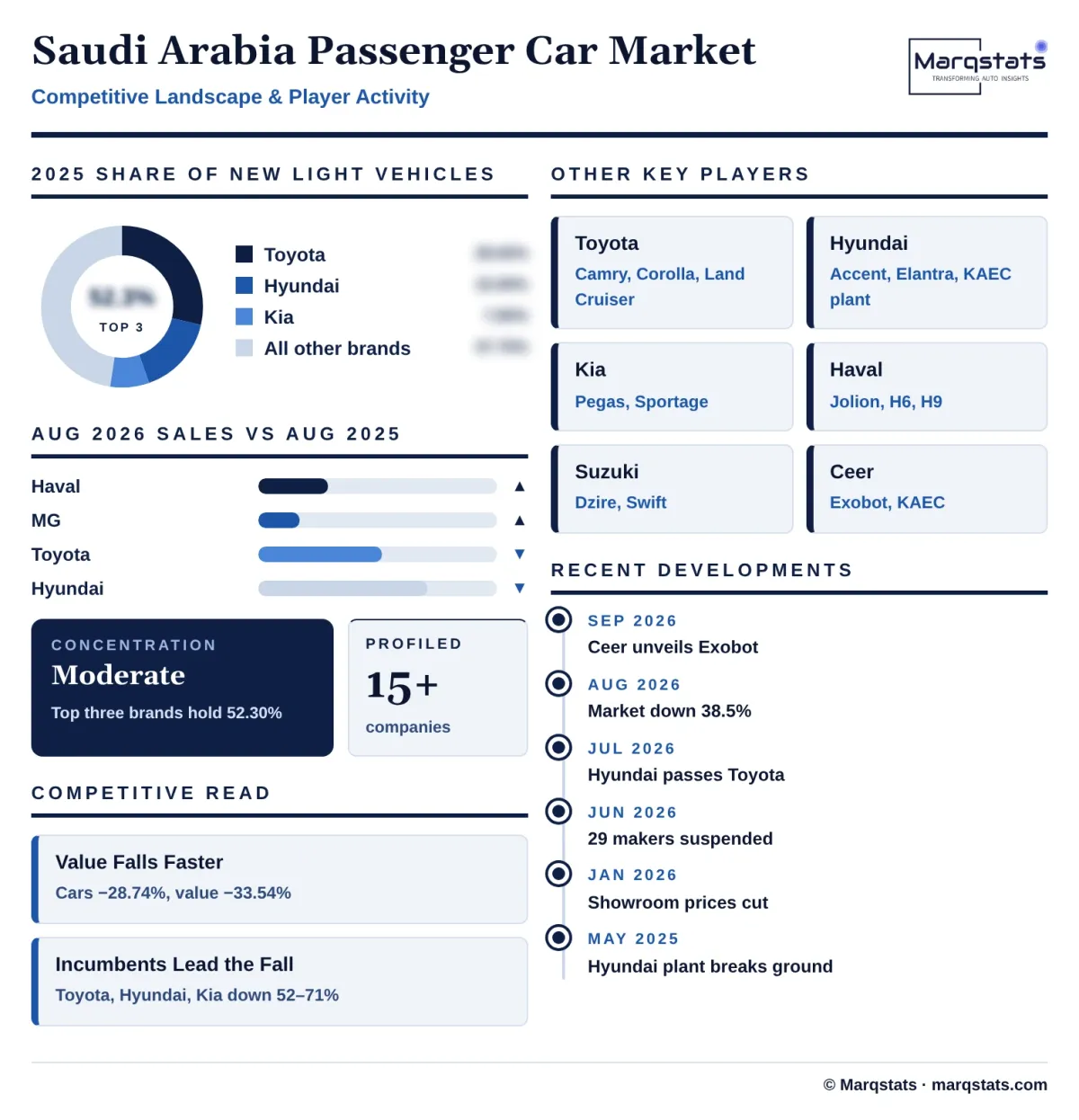
The market grew steadily to a record. Industry tracking showed 729,466 new vehicles in 2023, about 827,000 in 2024 (up 13%, as reported by Arab News on 18 January 2026) and 857,247 in 2025. Toyota held 28.6% of the 2025 market, Hyundai 15.9% and Kia 7.8%, so three brands sold 52.3% of all new light vehicles, and Haval and Jetour grew 64.6% and 45.8%.
Then 2026 turned. Sales were 166,748 units in the first quarter (down 24.3%), 313,458 in the first half (down 23.5%), 41,147 in July (down 34.5%) and 44,423 in August (down 38.5%). Prices fell with volumes: a survey of Riyadh showrooms reported cuts of 10% to 15% at the start of 2026, and in June 2026 the Ministry of Commerce and the Saudi Standards, Metrology and Quality Organization (SASO) suspended light vehicle imports from 29 manufacturers that had not filed 2026 supply plans.
Marqstats values the 2025 passenger car market at USD 20,850.42 million, equal to SAR 78.19 billion at the fixed rate of SAR 3.75 per US dollar, an average of about USD 28,464 (SAR 106,741) per car. The 2025 average rate published for the riyal was 3.7513, which confirms the peg. Value falls to USD 13,856.45 million in 2026 and returns to USD 22,723.97 million by 2030, a 1.74% CAGR.
Saudi Arabia Passenger Car Market Size and Forecast
The Saudi Arabia passenger car market grows from USD 20,850.42 million in 2025 to USD 22,723.97 million in 2030, a CAGR of 1.74%. Volume contributes most of the growth: deliveries rise at 1.52% a year from 732,515 to 790,000 cars, and the average value per car rises at 0.21% a year from about USD 28,464 to USD 28,765. The path is not smooth, with 2026 at 522,000 cars and USD 13,856.45 million before recovery of 18.01% in 2027.
The 2025 value is built bottom-up from body types and prices. Marqstats estimates 344,000 SUVs and crossovers at about SAR 132,000 each, 300,500 sedans at SAR 88,000 and 88,015 hatchbacks and other cars at SAR 72,000, all at retail prices including 15% value added tax. The prices rest on listed starting prices of SAR 50,658 for the MG 5, SAR 67,666 for the Hyundai Accent, SAR 79,350 for the Toyota Corolla, SAR 123,000 for the Toyota RAV4, SAR 262,656 for the Chevrolet Tahoe and SAR 270,899 for the Nissan Patrol, weighted by volume.
The volume is checked against the tracked market. The tracked total of 857,247 units includes pickups and commercial vehicles, so Marqstats deducts 70,732 pickups and 54,000 vans and light and medium commercial vehicles to reach 732,515 cars. The ladder runs from the 879,704-unit record of 2015 that 2025 almost matched, through 857,247 tracked light vehicles, to 732,515 cars. Alternative retail tallies of 2025 run above the tracked total, and Marqstats does not use them because their brand lines do not add up to their own total.
Electrified cars add value faster than volume. Marqstats expects battery-electric cars to rise from 14,000 units in 2025 to 47,400 in 2030 and hybrids and plug-in hybrids from 46,000 to 102,700, so their combined share of units grows from 8.19% to 19.00%. Hybrids are priced at about 1.25 times and electric cars at about 1.45 times a petrol or diesel car of similar size, which lifts their combined share of value to 23.55% in 2030.
Marqstats tracks four indicators to monitor the forecast: monthly registrations by brand after the 2026 supply-plan suspension is lifted, showroom prices against the 10% to 15% cuts of early 2026, the start of passenger car output at Hyundai Motor Manufacturing Middle East in the fourth quarter of 2026 and of Ceer production in January 2027, and the monthly gap between the market leaders and the Chinese brands Haval, Jetour and MG.
Market Dynamics
Key Drivers
Five forces support Saudi demand for new passenger cars even as 2026 volumes fall.
- Demand sits on a record base. New light vehicle sales reached 857,247 units in 2025, up 3.6% and the highest since 2015, after growth of 13% in 2024 and 16.9% in 2023. Saudi cities are low-density and car-dependent, so a replacement cycle that repeats every few years keeps cars the default household purchase.
- Entry prices are falling. The Hyundai Accent starts at SAR 67,666, the Toyota Yaris at SAR 63,825, the Kia Pegas at SAR 52,500, the Suzuki Dzire at SAR 51,650 and the MG 5 at SAR 50,658, and a survey of Riyadh showrooms reported cuts of 10% to 15% at the start of 2026. Lower prices pull first-time and second-car buyers into the market.
- Chinese and Indian-built brands widen the choice. Haval grew 64.6% and Jetour 45.8% in 2025, and Haval grew 48% in the first half of 2026, with the Haval Jolion at SAR 73,485 and the Jetour X70 at SAR 72,990 priced below the Toyota RAV4 at SAR 123,000.
- Local assembly is being built. Hyundai Motor Manufacturing Middle East, owned 70% by the Public Investment Fund (PIF) and 30% by Hyundai Motor Company, broke ground on 14 May 2025 at the King Salman Automotive Cluster in King Abdullah Economic City for 50,000 vehicles a year, with the first vehicle due in the fourth quarter of 2026, and Ceer plans production in January 2027.
- Hybrids sell without subsidy. The Toyota Camry hybrid grew 21.4% in 2025 and, counted with the petrol Camry, passed 48,000 units, which shows that buyers pay for fuel savings in a country where petrol is cheap but car use is high.
Key Restraints
Four constraints explain why 2026 is a reset year and why value falls faster than units.
- Supply is being rationed. The Ministry of Commerce and SASO suspended light vehicle imports from 29 manufacturers in June 2026 because they missed the deadline to file 2026 supply plans, and although the named brands are small, the move shows how import approval can interrupt a market that is 100% dependent on imported and kit-built cars.
- The incumbents are volatile. Toyota fell 60.6% in July 2026 and 51.7% in August, Hyundai fell 70.7% in August after leading July, and Kia fell 53.1% and 52.0% in the same months. Swings of that size across the largest distributors cut volumes faster than the market and make quarterly planning hard.
- Price deflation shrinks value. A Gulf price index of 68 models from 17 brands placed Saudi Arabia lowest at 91.05 against a Gulf average of 100 in November 2025, and showroom cuts of 10% to 15% followed. Every riyal taken off a car is taken from the value of the market.
- Buyers are cautious. Industry outlooks published in March 2026 linked lower Saudi car demand to a more cautious consumer environment and regional tensions, and monthly results show no single cause: the market fell 21.9% in April, 31.7% in May, 34.5% in July and 38.5% in August, so confidence has to return before volume does.
Key Trends
Four shifts are changing which brands, bodies and powertrains Saudi buyers choose.
- Share moves to Chinese and Indian-built brands. Haval and Jetour were the only gainers in the top ten in the first half of 2026, MG grew 41.5% in April and 63.6% in July, and Suzuki reached a 9.1% share in August 2026, so the SAR 50,000 to 75,000 price band now has more than ten credible brands.
- Compact crossovers replace sedans at the entry. Models such as the Toyota Raize at SAR 67,045, Nissan Magnite at SAR 69,899, Suzuki Fronx at SAR 71,430 and Geely Coolray at SAR 71,754 sit in the same price band as the Accent and Yaris sedans, which pushes SUVs and crossovers toward half of unit sales.
- Electrification starts at the top and the bottom. The International Energy Agency reported about 75,000 electric cars sold in the Middle East in 2025, up 40%, with Saudi Arabia and Qatar together about 45%, and local brands Ceer and Hyundai Motor Manufacturing Middle East are scheduled to add Saudi-built electric and petrol cars from late 2026.
- Competitors race for new franchises. Zeekr and Lotus opened showrooms through Wallan, iCAUR entered the brand table in August 2026 and Jaecoo moved up six places in July, so distributors are adding Chinese franchises while the incumbents fight for volume.
Strategic Implications
- For global and Chinese car makers, the opening is the SAR 50,000 to 100,000 band, where Haval, Jetour, MG, Changan and Suzuki are gaining share while the three leaders lose it. Entering through a distributor that already files supply plans, and pricing the compact crossover below SAR 75,000, matters more than adding a premium model in a year when premium cars are the smallest and slowest layer.
- For Toyota, Hyundai and Kia, the 2026 data says that holding 52.3% of 2025 volume is not the same as holding the market. Toyota still regained first place in August with a 23.8% share, but only by falling less than the others, so defending price positions in the Accent, Yaris, Camry and Corolla bands and clearing stock cleanly is the first task.
- For distributors and dealer groups, the combination of 10% to 15% showroom cuts and the June 2026 import suspension makes inventory the central risk. Dealers that hold fewer days of stock, add a second Chinese or Indian franchise and keep supply plans filed early are better placed than those carrying one brand at the old price.
- For financiers and rental companies, falling prices lower the collateral value of cars already on the books while cheaper cars raise the number of buyers who can finance one. Lenders that price residual values on 2026 transaction prices, not 2025 list prices, avoid writing loans against values that no longer exist.
- For suppliers and investors in local manufacturing, the 50,000-car Hyundai plant and Ceer production from 2027 create the first Saudi demand for stamped parts, batteries and seats, but their volume is small against a market of more than 700,000 cars, so supplier plans should assume gradual local content and not a sudden switch from imports.
Market Segmentation
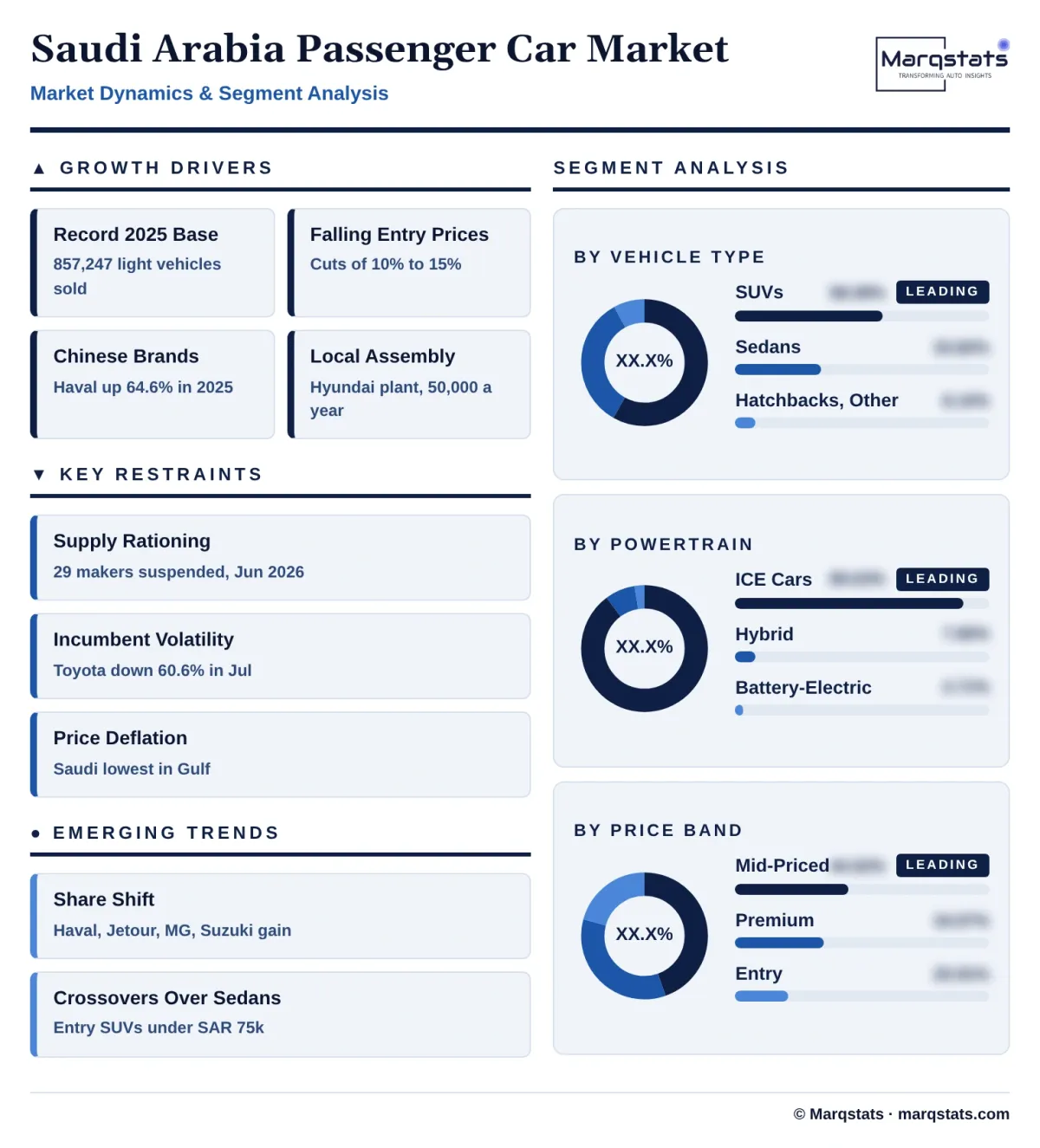
SUVs and crossovers account for 58.08% of 2025 value, USD 12,108.80 million, and grow at 3.15% a year to USD 14,136.59 million and 62.21% of the market. Marqstats estimates about 344,000 units in 2025, from the SAR 70,000 Haval Jolion and MG ZS to the Toyota Land Cruiser, Nissan Patrol and Chevrolet Tahoe at SAR 262,656 and above, which makes the body type both the largest and the widest in price.
Sedans account for 33.82% of 2025 value, USD 7,051.73 million, and decline at 1.08% a year to USD 6,679.11 million as their share falls to 29.39%. The Hyundai Accent, which held a 5.4% share of all new light vehicles in 2025, the Toyota Yaris, Camry and Corolla and the Kia Pegas keep sedans central to rental fleets, taxis and first-time buyers, but compact crossovers now price against them.
Hatchbacks, coupes and people carriers account for 8.10% of 2025 value, USD 1,689.89 million, and grow at 2.46% a year to USD 1,908.27 million. The Hyundai i10 at SAR 52,254, Suzuki Swift at SAR 57,285 and Kia Picanto at SAR 55,639 set the entry price, and the Hyundai i10 grew 72.7% in 2025.
Petrol and diesel cars account for 89.63% of 2025 value, USD 18,688.45 million, and decline at 1.45% a year to USD 17,372.74 million, while their share of value falls to 76.45%. Marqstats estimates 672,515 units in 2025, or 91.81% of cars, because fuel is inexpensive and hybrid models are still a small part of most brand line-ups.
Hybrids and plug-in hybrids account for 7.66% of 2025 value, USD 1,597.86 million, and grow at 16.88% a year to USD 3,485.27 million and 15.34% of the market. Marqstats estimates 46,000 units in 2025, led by the Toyota Camry hybrid, and 102,700 in 2030 as Hyundai, Kia and Chinese brands add hybrid trims.
Battery-electric cars account for 2.71% of 2025 value, USD 564.11 million, and grow fastest, at 27.03% a year, to USD 1,865.96 million and 8.21% of the market. Marqstats estimates 14,000 units in 2025, consistent with the International Energy Agency figure of about 75,000 electric cars across the Middle East, of which Saudi Arabia and Qatar together took about 45%, and 47,400 in 2030.
Entry cars priced below SAR 75,000 account for 20.91% of 2025 value, USD 4,359.92 million, and grow at 2.39% a year to USD 4,906.59 million. Marqstats estimates 263,705 units in 2025, covering the Accent, Yaris, Pegas, Dzire, MG 5, i10 and the Chinese compact crossovers, and this band gains share through 2030.
Mid-priced cars account for 44.52% of 2025 value, USD 9,282.44 million, and grow at 1.01% a year to USD 9,760.68 million. Marqstats estimates 322,307 units in 2025, including the Corolla, Elantra, Camry, Sportage, Tucson, RAV4 and Haval H6, and the band is the largest by value.
Premium and luxury cars account for 34.57% of 2025 value, USD 7,208.06 million, and grow at 2.25% a year to USD 8,056.70 million. Marqstats estimates 146,503 units in 2025 at an implied average of about SAR 184,503, led by the Toyota Land Cruiser and Prado, Nissan Patrol, Chevrolet Tahoe and European premium brands.
By Geography
Riyadh Region
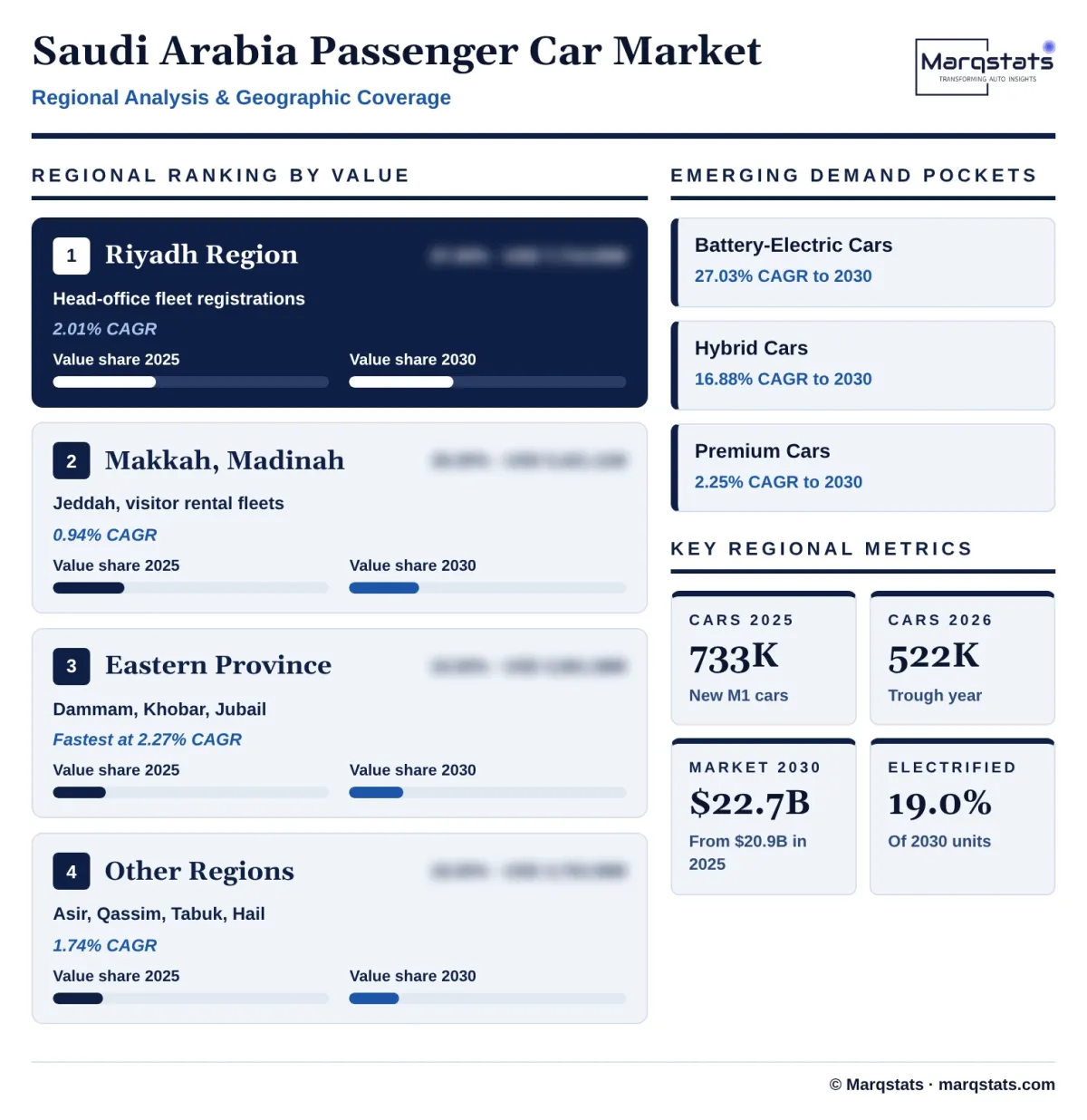
The Riyadh Region accounts for 37.00% of 2025 value, USD 7,714.65 million, and grows at 2.01% a year to USD 8,521.50 million and 37.50% by 2030. Marqstats allocates sales by place of registration, which overstates the capital because rental companies, lessors and corporate buyers register fleets at their head offices, while the cars are used across the Kingdom.
Makkah and Madinah (Western)
Makkah and Madinah account for 26.00% of 2025 value, USD 5,421.11 million, and grow at 0.94% a year to USD 5,680.99 million. Jeddah is the second commercial centre, and pilgrimage and visitor traffic supports rental registrations, but its share slips as the Riyadh and Eastern economies expand faster.
Eastern Province
The Eastern Province accounts for 19.00% of 2025 value, USD 3,961.58 million, and grows fastest, at 2.27% a year, to USD 4,431.17 million and 19.50% by 2030. Dammam, Khobar, Dhahran and Jubail combine high household incomes with energy-sector employment, and buyers lean toward larger SUVs.
Other Regions
The other regions, including Asir, Qassim, Jazan, Tabuk, Hail and Najran, account for 18.00% of 2025 value, USD 3,753.08 million, and grow at 1.74% a year to USD 4,090.31 million. Buyers there favour durable Japanese and Korean models and compact crossovers priced under SAR 100,000.
How Competition Is Evolving
The market is moderately concentrated and led by three brands. Best Selling Cars Blog put Toyota at 28.6% of 2025 new light vehicle sales, Hyundai at 15.9% and Kia at 7.8%, so the top three held 52.30% and all other brands 47.70%. Ford overtook Nissan for fourth place with growth of 12.5%, while Nissan fell 1.1%, and Mazda, Haval and Jetour grew 17.5%, 64.6% and 45.8%.
Toyota is the anchor. It is distributed by Abdul Latif Jameel Motors, sold the Camry, Corolla, Yaris, RAV4, Land Cruiser and Hilux, and in the first half of 2026 lifted its share to 28.8% from 26.7% by falling 17.4% in a market that fell 23.5%. In July 2026 it fell 60.6% and Hyundai led the month with 19.8%, but in August Toyota regained first place at 23.8%.
The challengers are Chinese and Indian-built brands. Haval ranked eighth in the first half of 2026 with growth of 48%, Jetour tenth with 22.6%, MG recorded growth of 41.5% in April and 63.6% in July, and the Suzuki Swift Dzire reached second place among models in August 2026. BYD held about 1% of the first-half market and ranked eighteenth.
Competition is moving from brand to price and supply. Distributors must file supply plans with the Ministry of Commerce and SASO, as the June 2026 suspension of 29 manufacturers showed, so the brands with deep stock, a filed plan and a SAR 50,000 to 75,000 product are positioned to take share from the incumbents through the recovery.
Companies Covered
Companies covered in the report include:
Recent Market Activity
Table of Contents
Coverage & Segmentation
The study covers the Saudi Arabia passenger car market, with 2025 as the base year, 2022 – 2025 as the historical period and 2026 – 2030 as the forecast period. It covers new M1 passenger cars of up to nine seats (sedans, hatchbacks, SUVs, crossovers and people carriers), imported or assembled in the Kingdom and sold through authorised distributors, segmented by vehicle type, powertrain, price band and region. Values are retail transaction values including 15% value added tax, converted at the fixed rate of SAR 3.75 per US dollar.
Pickups, vans, minibuses, light and medium commercial vehicles and heavy trucks, used cars and direct government procurement are excluded. The live Marqstats Saudi Arabia Pickup Vehicle Market (70,732 units, USD 2,395.00 million) is a separate layer and must not be added to this market, and the Saudi Arabia Heavy Truck report covers goods trucks above 16 tonnes. Segment and regional splits are Marqstats estimates built on tracked registrations, listed prices and distributor disclosures.