Market Snapshot
Middle bar: base-year value × (1 + CAGR), rounded to two decimals. This is a calculated illustration, not a separately researched annual estimate.
The Vietnam passenger car market size is estimated at USD 11,390.57 million in 2025 and is projected to reach USD 18,513.30 million by 2030, growing at a CAGR of 10.20% over 2026 – 2030. Annual sales rise from about 470,946 cars to 756,000, a 9.93% annual rate, and the average retail price moves from about USD 24,187 to USD 24,488 per car.
Marqstats defines the market as the retail value of new passenger cars (vehicle category M1, up to nine seats) sold to buyers in Vietnam, covering sedans, sport utility vehicles and crossovers, multi-purpose vehicles and hatchbacks, whether battery electric, hybrid, plug-in hybrid or petrol and diesel, and whether built locally or imported. Pickup trucks, trucks, buses and vans, used cars, parts and aftersales services are excluded. Values are in US dollars at VND 26,009 per US dollar, the 2025 average rate, and are measured at ex-showroom list prices including value added tax and special consumption tax, before registration fees.
Battery electric cars account for an estimated 38.33% of 2025 units and 31.69% of value, and sport utility vehicles and crossovers for 62.98% of value. The Northern Region accounts for 41.00% of 2025 value. The study segments the market by powertrain, body style, sourcing and region.
Key Takeaways
Market Overview & Analysis
Report Summary
Marqstats sizes the Vietnam passenger car market as the retail value of new category M1 cars with up to nine seats. In 2025 about 470,946 cars were sold, worth an estimated USD 11,390.57 million at an average ex-showroom price of about USD 24,187, or about VND 629 million, using the 2025 average rate of VND 26,009 per US dollar.
Marqstats built the 2025 base from the bottom up because published totals mix vehicle types. The tracked 2025 automobile market was 604,064 vehicles, up 22.2% from 494,300 in 2024. It combines 375,736 sales by members of the Vietnam Automobile Manufacturers Association (VAMA), up 10.5%, with 175,099 VinFast deliveries and 53,229 Hyundai Thanh Cong sales, and excludes Chinese brands that do not report monthly. VAMA reports pickups, vans and trucks within its totals, and VinFast and Hyundai report all vehicle types together.
To isolate passenger cars, Marqstats removed 27,093 pickups, an estimated 110,143 trucks, buses, vans and special-purpose vehicles from VAMA members and 12,882 Hyundai Thanh Cong commercial vehicles, and added an estimated 17,000 cars from Chinese brands that do not disclose sales. That leaves about 470,946 passenger cars: 238,500 from VAMA members, 175,099 from VinFast, 40,347 from Hyundai Thanh Cong and 17,000 from other Chinese brands.
The market has changed fast. VinFast launched the VF 3 at VND 240 million and the VF 5 at VND 468 million, which sold 44,585 and 43,913 units in 2025, and built a taxi and ride-hailing base with Limo Green and Herio Green. Japanese brands remain strong in multi-purpose vehicles and hybrids, with the Mitsubishi Xpander at 19,891 units, the Thaco Mazda CX-5 at 17,262 and the Honda City at 10,899. Korean brands sold 27,176 Kia vehicles and about 40,347 Hyundai passenger cars, and Chinese brands are adding dealers and models.
Vietnam is one of the most electrified passenger car markets in Southeast Asia. Marqstats estimates battery electric cars at about 180,500 units in 2025, 38.33% of passenger car sales, and all electrified cars, including hybrids and plug-in hybrids, at about 197,000 units. Marqstats expects about 553,000 cars worth USD 13,270.28 million in 2026, supported by VinFast deliveries of 154,073 cars in the first eight months and VAMA sales of 220,107 vehicles in the first nine months, up 7%.
Regulation shapes demand. Decree 51/2025/ND-CP kept the registration fee for battery electric cars at 0% until 28 February 2027, and Decree 202/2026/ND-CP extends the 0% rate from 1 March 2027 to 31 December 2030. Special consumption tax on electric cars is currently 1–3% and is scheduled to rise to 4–11% from 1 March 2027, while petrol and diesel cars face higher rates tied to engine size. Circular 61/2026/TT-BCT allows shared use of public charging stations from 1 July 2027.
Vietnam Passenger Car Market Size and Forecast
The Vietnam passenger car market grows from USD 11,390.57 million in 2025 to USD 18,513.30 million in 2030, a CAGR of 10.20%. Marqstats expects sales of about 553,000 cars worth USD 13,270.28 million in 2026, 604,000 worth USD 14,512.76 million in 2027, 655,000 worth USD 15,796.22 million in 2028 and 706,000 worth USD 17,147.52 million in 2029, before reaching 756,000 cars in 2030.
Growth is fastest in 2026 and slows afterwards. Unit sales rise 17.42% in 2026 as VinFast deliveries run at about 20,000 a month, then 9.22%, 8.44%, 7.79% and 7.08% a year as the first wave of urban buyers is served and the special consumption tax on electric cars steps up. Units grow at 9.93% a year and value at 10.20%, because the average price edges up from USD 24,187 to USD 24,488 as buyers move from entry hatchbacks to sport utility vehicles and family vehicles.
The powertrain mix drives the forecast. Marqstats expects battery electric cars to grow from about 180,500 to 365,000 units, a 15.12% annual rate, hybrids from 15,200 to 60,000 and plug-in hybrids from 1,300 to 25,000, while petrol and diesel cars grow from 273,946 to 306,000, a 2.24% annual rate. Average prices by powertrain are estimated at about USD 20,000 for battery electric cars, USD 33,000 for hybrids, USD 36,000 for plug-in hybrids and USD 26,400 for petrol and diesel cars in 2025.
Price anchors support the estimate. The VinFast VF 3 lists at VND 240 million, about USD 9,228, the VF 5 at VND 468 million, about USD 17,994, and the VF MPV 7, launched in January 2026 with seven seats, a 60.13 kWh lithium iron phosphate battery and 450 km of range on the NEDC cycle, at VND 819 million, about USD 31,490. Japanese and Korean petrol models cluster between VND 450 million and VND 1 billion, and imported premium models are priced well above that.
Marqstats tracks four indicators to monitor the forecast: monthly VAMA, VinFast and Hyundai Thanh Cong sales, the schedule of special consumption tax and registration fee changes, the number of public fast-charging points, and new model launches and dealer openings by Chinese brands. A change to the special consumption tax schedule is the single largest swing factor for the 2027 to 2029 electric forecast.
Market Dynamics
Key Drivers
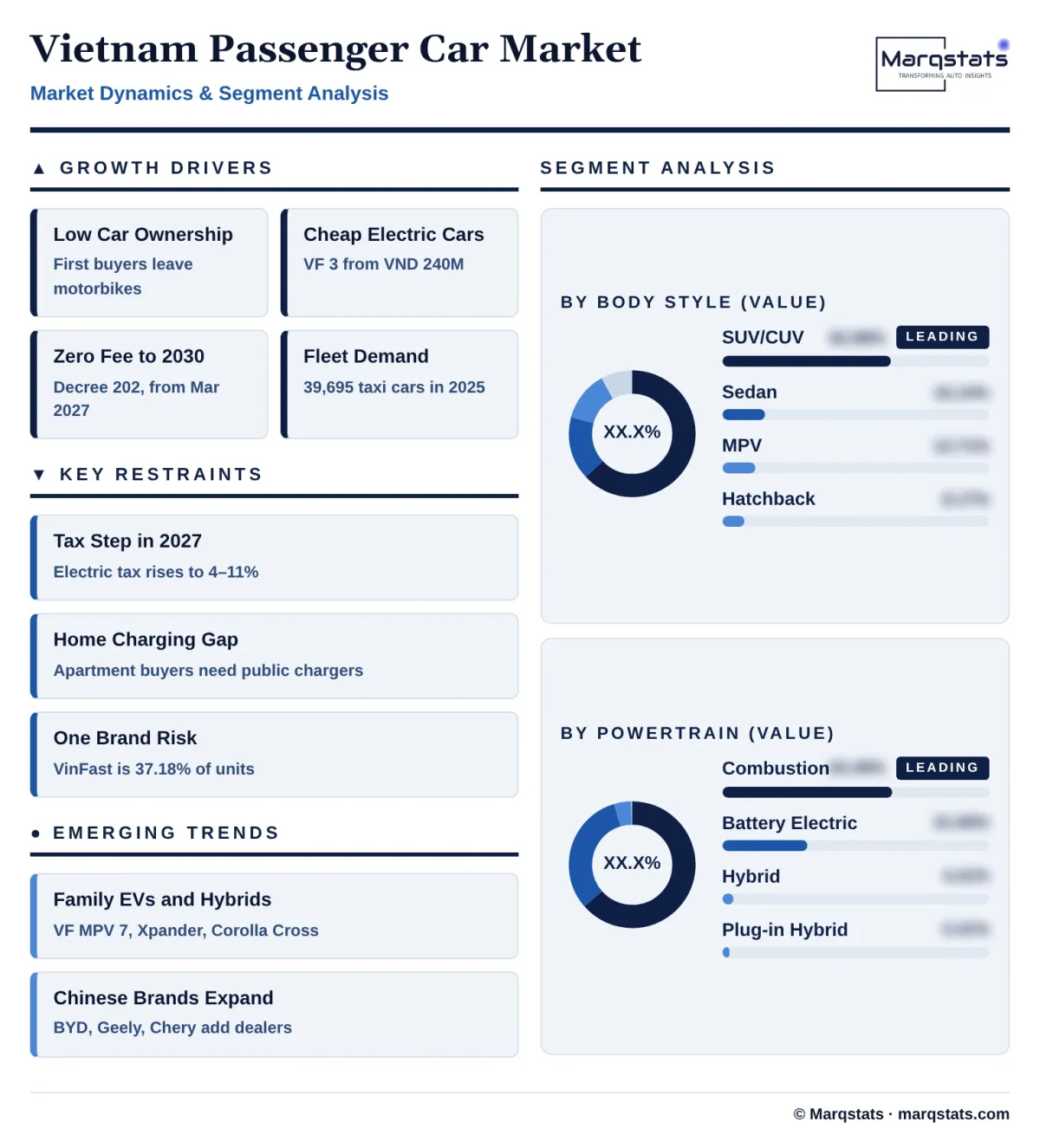
Five forces are lifting Vietnam passenger car demand and moving it toward electric models.
- Rising household income and low car ownership. Vietnam has about 100 million people and far fewer cars per household than Thailand or Malaysia, so first-time buyers moving up from motorcycles are the largest source of new demand.
- Affordable electric cars. The VinFast VF 3 at VND 240 million and VF 5 at VND 468 million brought electric cars into the price range of petrol hatchbacks and compact sedans, and VinFast has led monthly sales for 24 consecutive months to August 2026.
- Registration fee and tax incentives. Battery electric cars pay a 0% registration fee until 28 February 2027 under Decree 51/2025/ND-CP, and Decree 202/2026/ND-CP keeps that rate from 1 March 2027 to 31 December 2030.
- Fleet and ride-hailing demand. Taxi and ride-hailing operators bought 39,695 VinFast Limo Green and Herio Green cars in 2025, and fleet orders give electric models a steady base of volume that does not depend on retail sentiment.
- Wider model choice and local production. VinFast builds in Hai Phong, Hyundai Thanh Cong in Ninh Binh and Toyota, Mitsubishi, Thaco, Honda and Ford assemble locally, while Chinese brands including BYD, Geely and Chery add electric, hybrid and plug-in hybrid models.
Key Restraints
Four constraints limit how quickly Vietnam passenger car sales can grow.
- Tax changes from 2027. Special consumption tax on electric cars is scheduled to rise from 1–3% to 4–11% from 1 March 2027, which would raise prices of electric models by several percent unless the Ministry of Finance proposal of April 2026 to extend current rates to 2030 is adopted.
- Charging coverage and apartment living. Many buyers in Hanoi and Ho Chi Minh City live in apartments or terraced houses without a private charger, so growth depends on public charging, and Circular 61/2026/TT-BCT allows shared use of public chargers only from 1 July 2027.
- Urban traffic and registration limits. Congestion, parking costs and local restrictions in the two largest cities limit car use, and motorcycles remain the cheaper alternative for daily travel.
- Dependence on one brand. VinFast supplies an estimated 37.18% of passenger car units, so changes in its pricing, battery rental terms or delivery schedule move the whole market, and fleet orders can be uneven from month to month.
Key Trends
Four shifts are changing what Vietnamese buyers choose and how cars are made and sold.
- Electric hatchbacks and compact sport utility vehicles. Entry electric models have moved the average buyer from petrol sedans and hatchbacks to electric city cars and crossovers, and the VF 3 was the best-selling passenger car in Vietnam in 2025.
- Family electric and hybrid models. Seven-seat electric models such as the VinFast VF MPV 7 and hybrid versions of the Toyota Corolla Cross and Honda CR-V compete with the Mitsubishi Xpander for family buyers.
- Chinese brand expansion. BYD, Geely, Chery and other brands are opening dealers and launching battery electric and plug-in hybrid models at prices that undercut established brands, a segment that Marqstats estimates at about 17,000 cars in 2025.
- Battery rental, financing and charging bundles. Battery rental, low-interest loans and bundled charging, home charger and warranty offers lower the upfront cost and are changing how electric cars are sold.
Strategic Implications
- For carmakers, price positions matter more than specifications. Entry buyers compare electric models with petrol hatchbacks, so brands that can match monthly payments and running costs, through local assembly and financing, will keep volume as the registration fee and tax regime changes.
- For Japanese and Korean brands, hybrids and family vehicles are the defence. Hybrid models and seven-seat vehicles keep a price advantage over electric rivals and can use existing dealer networks, but need competitive prices against the VF 5, VF 6 and VF MPV 7.
- For Chinese brands, local assembly is the next step. Import-based models carry duty and logistics costs, and building or contracting local assembly would lower prices and improve eligibility for local content incentives.
- For charging and energy companies, shared infrastructure is the opening. Circular 61/2026/TT-BCT and the growth of the electric fleet create demand for fast chargers along highways and at apartment complexes.
- For lenders and insurers, residual values are the key risk. Falling prices for new electric cars and battery rental structures make used values hard to forecast, and financing terms will decide how many first-time buyers convert.
Market Segmentation
Battery electric cars are led by VinFast, whose VF 3, VF 5, VF 6, VF 7, Limo Green and Herio Green made up almost all 2025 volume. Chinese brands including BYD and Geely add the rest. About 22.67% of VinFast volume is taxi and ride-hailing models. The segment accounts for 31.69% of 2025 value, USD 3,610.00 million and about 180,500 cars, and reaches USD 7,482.50 million and about 365,000 cars by 2030, a 15.69% CAGR, taking 40.42% of the market.
Hybrid cars from Toyota, Honda and Hyundai grew from VAMA members reporting more than 14,100 hybrids in 2025, up 44%, and 2,168 hybrids in September 2026 alone, up 58.1%. They suit buyers without home charging. The segment accounts for 4.41% of 2025 value, USD 501.60 million and about 15,200 cars, and reaches USD 1,980.00 million and about 60,000 cars by 2030, a 31.60% CAGR, taking 10.69% of the market.
Plug-in hybrid cars are a small but fastest-growing group, led by Chinese brands that offer long range without charging anxiety. The segment accounts for 0.41% of 2025 value, USD 46.80 million and about 1,300 cars, and reaches USD 850.00 million and about 25,000 cars by 2030, a 78.58% CAGR, taking 4.59% of the market.
Petrol and diesel cars remain the largest group because Toyota, Mitsubishi, Mazda, Kia, Hyundai, Honda and Ford sell the Xpander, Vios, City, CX-5, Seltos and similar models across all price points. The segment accounts for 63.49% of 2025 value, USD 7,232.17 million and about 273,946 cars, and reaches USD 8,200.80 million and about 306,000 cars by 2030, a 2.55% CAGR, taking 44.30% of the market.
Sport utility vehicles and crossovers dominate with the VinFast VF 5, VF 6 and VF 7, the Mazda CX-5, the Kia Seltos and the Toyota Corolla Cross. The segment accounts for 62.98% of 2025 value, USD 7,173.78 million and about 257,946 cars, and reaches USD 12,413.17 million and about 446,040 cars by 2030, a 11.59% CAGR, taking 67.05% of the market.
Sedans such as the Toyota Vios, Honda City, Hyundai Accent and Mazda3 are shrinking in share as buyers move to higher seating positions. The segment accounts for 16.14% of 2025 value, USD 1,838.44 million and about 80,000 cars, and reaches USD 2,171.61 million and about 94,500 cars by 2030, a 3.39% CAGR, taking 11.73% of the market.
Multi-purpose vehicles are led by the Mitsubishi Xpander with 19,891 units, the VinFast Limo Green with 27,127 units and the VF MPV 7. The segment accounts for 12.71% of 2025 value, USD 1,447.74 million and about 63,000 cars, and reaches USD 2,519.66 million and about 109,620 cars by 2030, a 11.72% CAGR, taking 13.61% of the market.
Hatchbacks and city cars are led by the VinFast VF 3, which sold 44,585 units in 2025, along with Hyundai and Kia small cars. The segment accounts for 8.17% of 2025 value, USD 930.61 million and about 70,000 cars, and reaches USD 1,408.86 million and about 105,840 cars by 2030, a 8.65% CAGR, taking 7.61% of the market.
Locally built cars include all VinFast cars, Hyundai Thanh Cong cars and the locally assembled models of Toyota, Mitsubishi, Thaco, Honda and Ford, about 48% of VAMA member sales being locally assembled kits. The segment accounts for 65.62% of 2025 value, USD 7,474.49 million and about 331,246 cars, and reaches USD 12,483.52 million and about 544,320 cars by 2030, a 10.80% CAGR, taking 67.43% of the market.
Imported cars come mostly from Thailand and Indonesia, which enter duty-free under ASEAN trade rules, and from China, Japan, Korea and Europe, covering entry models, premium cars and new Chinese brands. The segment accounts for 34.38% of 2025 value, USD 3,916.08 million and about 139,700 cars, and reaches USD 6,029.78 million and about 211,680 cars by 2030, a 9.02% CAGR, taking 32.57% of the market.
By Geography
Northern Region
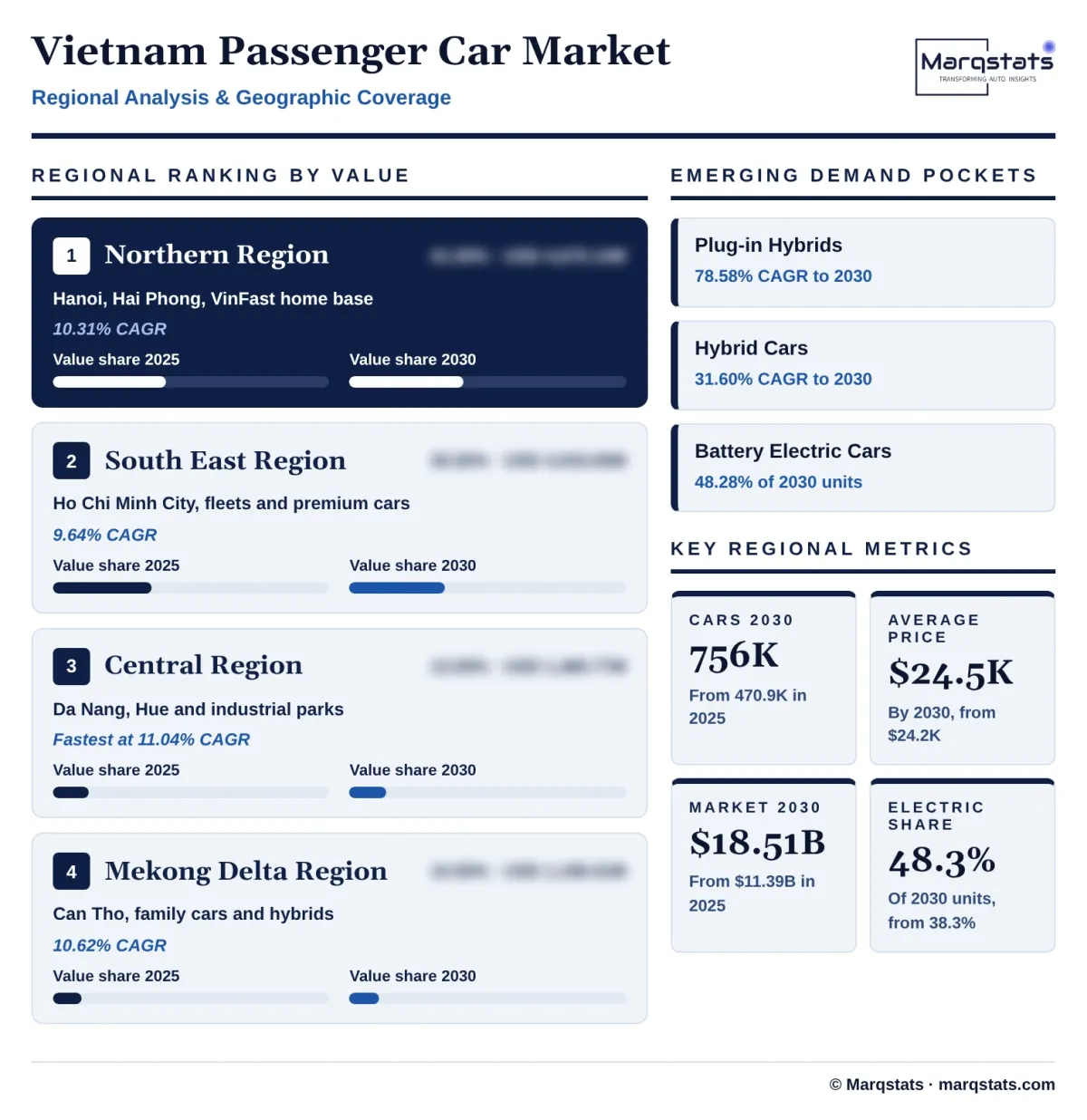
The Northern Region covers Hanoi, Hai Phong and the Red River Delta and is the largest market because Hanoi is one of the two biggest car markets and VinFast builds its cars in Hai Phong, close to its largest customer base, with dense dealer and charging coverage around the capital. The region accounts for 41.00% of 2025 value, USD 4,670.14 million and about 193,088 cars, and reaches USD 7,627.48 million and about 311,472 cars by 2030, a 10.31% CAGR, with 41.20% of the market.
South East Region
The South East Region covers Ho Chi Minh City, Dong Nai, Binh Duong and Ba Ria-Vung Tau and is the second-largest market, with the highest income and the largest concentration of taxi and ride-hailing fleets. Toyota, Honda, Ford and Mercedes-Benz sales are strong, and Chinese brands are opening dealers. The region accounts for 35.50% of 2025 value, USD 4,043.65 million and about 167,186 cars, and reaches USD 6,405.60 million and about 261,576 cars by 2030, a 9.64% CAGR, with 34.60% of the market.
Central Region
The Central Region covers Da Nang, Hue, Nghe An and the central coast and highlands and grows fastest, supported by tourism, industrial parks and growing dealer networks from Thaco, Toyota and VinFast. The region accounts for 13.00% of 2025 value, USD 1,480.77 million and about 61,223 cars, and reaches USD 2,499.30 million and about 102,060 cars by 2030, a 11.04% CAGR, with 13.50% of the market.
Mekong Delta Region
The Mekong Delta Region covers Can Tho and the southwestern provinces, where farm incomes, pickups and family cars compete and charging coverage is thinner, so hybrid and petrol multi-purpose vehicles hold a larger share. The region accounts for 10.50% of 2025 value, USD 1,196.01 million and about 49,449 cars, and reaches USD 1,980.92 million and about 80,892 cars by 2030, a 10.62% CAGR, with 10.70% of the market.
How Competition Is Evolving
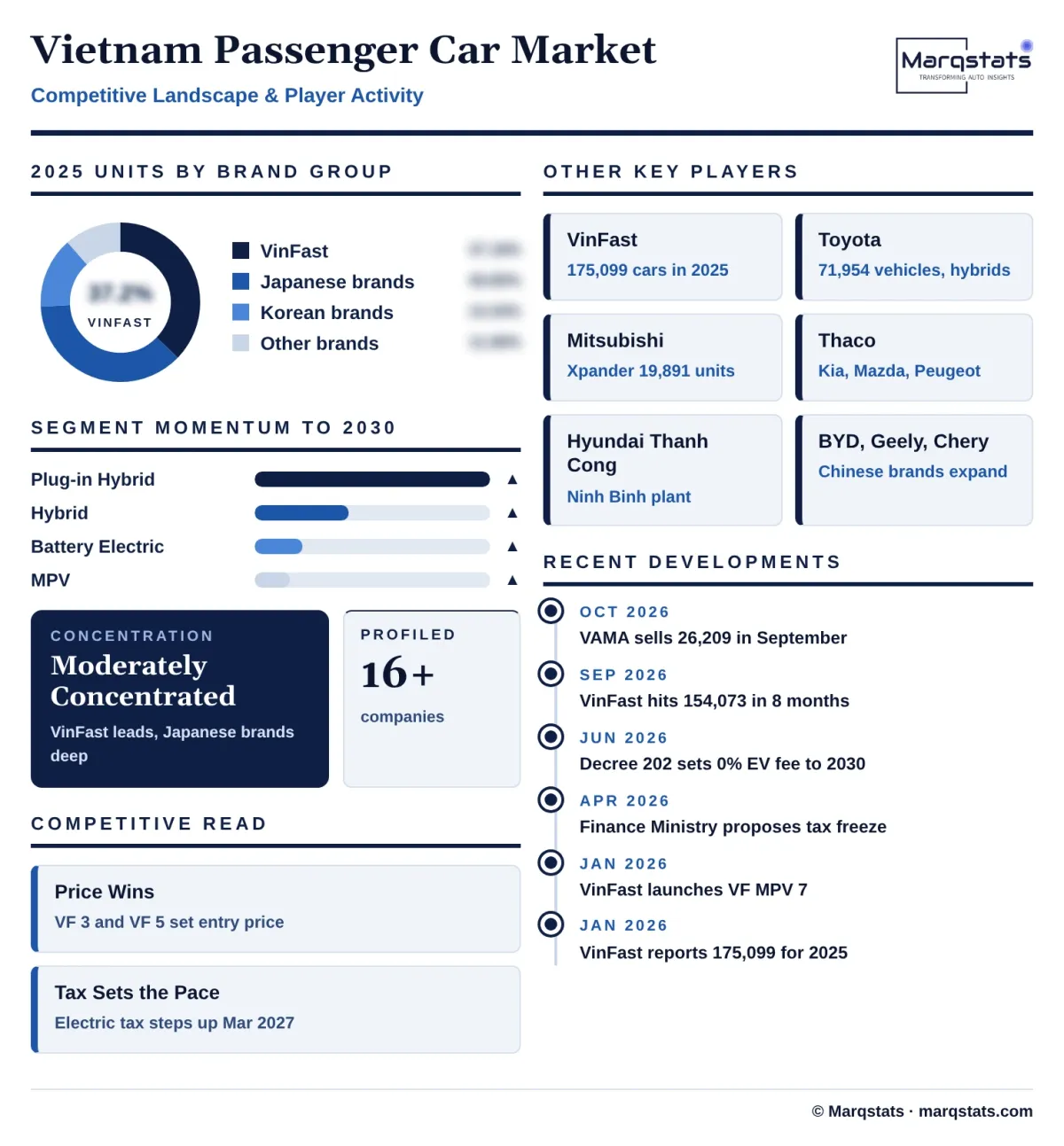
The Vietnam passenger car market is moderately concentrated. VinFast accounts for an estimated 37.18% of 2025 passenger car units, Japanese brands (Toyota, Mitsubishi, Honda, Mazda and Suzuki) for 36.80%, Korean brands (Hyundai and Kia) for 14.34%, and other brands, including Ford, European and Chinese cars, for 11.68%.
Three business models compete. VinFast is a vertically integrated electric carmaker with its own plant, battery supply, charging network through V-Green and fleet customer in GSM. Japanese and Korean brands use local assembly, long dealer networks and hybrids to defend share. Chinese brands import or assemble cars and compete on price and features in the electric and plug-in hybrid segments.
Model strength explains position. In 2025 the VinFast VF 3 sold 44,585 units and the VF 5 43,913, the Mitsubishi Xpander 19,891, the Mazda CX-5 17,262, the Honda City 10,899 and the Kia Seltos 6,577. Toyota sold 71,954 vehicles in total, Ford 50,450, Mitsubishi 44,107, Thaco Mazda 32,455, Honda about 28,700 and Thaco Kia 27,176 across all vehicle types, of which a share are pickups, vans and commercial vehicles.
Competition will be decided by price, financing, charging and tax treatment. Brands that combine local production, hybrid and electric choices, strong financing and wide service networks will gain share as the special consumption tax schedule changes in 2027.
Capacity and launches continue. VinFast launched the VF MPV 7 in January 2026 and delivered 20,161 cars in August 2026 alone, VAMA members sold 26,209 vehicles in September 2026, and Chinese brands are expanding showrooms and models.
Companies Covered
Companies covered in the report include:
Recent Market Activity
Table of Contents
Coverage & Segmentation
The study covers the Vietnam passenger car market, with 2025 as the base year, 2021 – 2025 as the historical period and 2026 – 2030 as the forecast period. Passenger cars are new category M1 vehicles with up to nine seats. Values are in US dollars at retail ex-showroom list prices including value added tax and special consumption tax, converted at VND 26,009 per US dollar, the 2025 average, and volumes are annual unit sales. The market is segmented by powertrain, body style, sourcing and region.
Pickup trucks (27,093 units in 2025, which VAMA reports within passenger vehicles), trucks, buses over nine seats, vans, used cars, parts and aftersales services are excluded, and pickups and trucks are covered in the Vietnam Truck Market report. The Vietnam Electric Vehicle Market Report 2026 – 2030 measures all electric and hybrid vehicles, including commercial vehicles and two-wheelers, on its own value basis, so its values should not be added to the values here. Battery electric passenger car volume here, about 180,500 cars, sits within the 183,000 to 190,000 battery electric vehicles of all types in that report. Segment and regional splits are Marqstats estimates built on VAMA, VinFast and Hyundai Thanh Cong disclosures, model-level sales, list prices and vehicle registration patterns.
