Market Snapshot
Middle bar: base-year value × (1 + CAGR), rounded to two decimals. This is a calculated illustration, not a separately researched annual estimate.
The Morocco passenger car market size is estimated at USD 5,541.62 million in 2025 and is projected to reach USD 7,822.69 million by 2030, growing at a CAGR of 7.14% over 2026 – 2030. Registrations rise from 208,848 to 259,000 cars, a 4.40% annual rate, while the average price of a new car climbs from about USD 26,534 to USD 30,203 as SUVs, hybrids and plug-in models take a larger share. In 2026 the growth comes from electrified and Chinese cars, not from diesel.
Marqstats defines the market as the retail value of new M1 passenger cars registered in Morocco, counted as the Association des Importateurs de Véhicules au Maroc (AIVAM) reports them under the Voitures Particulières category, at the price the buyer pays including 20% value-added tax, import duties and registration charges. Light commercial vehicles, pickups and vans, used imports and cars built in Tangier or Kénitra for export are excluded. Values use one 2025 average rate of MAD 9.34 per US dollar.
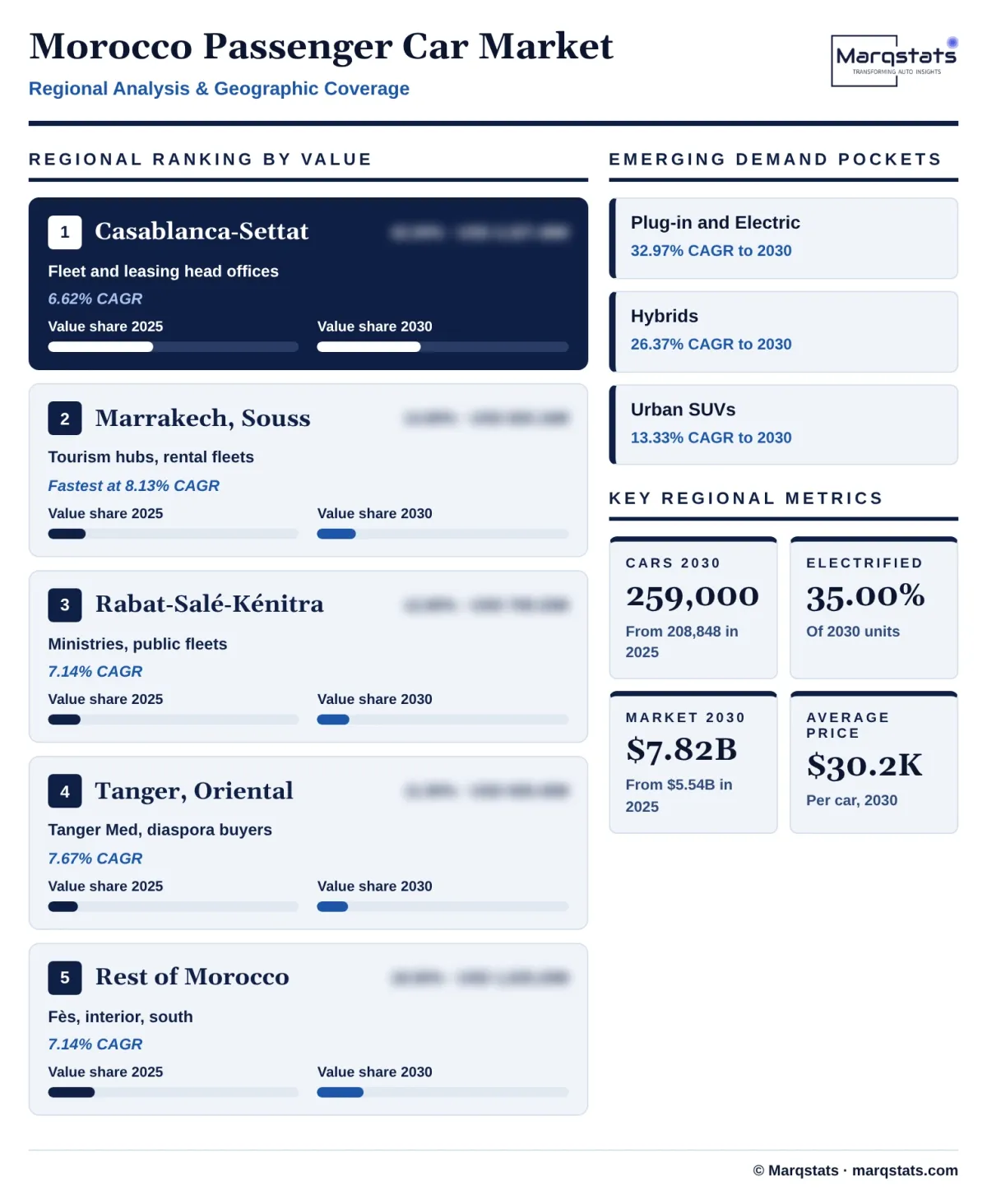
City cars and hatchbacks hold 32.10% of 2025 value, diesel cars 67.54% and private buyers 70.30%. Casablanca-Settat accounts for 42.00% of value, while Marrakech-Safi and Souss-Massa grow fastest among regions at 8.13% a year. Plug-in, range-extender and electric cars grow fastest among powertrains, at 32.97% a year from a small base.
Key Takeaways
Market Overview & Analysis
Report Summary
Marqstats sizes the Morocco passenger car market as the retail value of new M1 passenger cars registered each year, from the compact hatchbacks that rental companies buy by the hundred to the premium SUVs of the Casablanca boardroom. The thesis is simple: 2025 was a reset, not a peak. AIVAM counted 208,848 passenger cars, up 32.91% from 157,139 in 2024, and 2026 has kept growing, with 165,764 registrations from January to September, up 12%. The mix is moving even faster than the volume, so value should outgrow units through 2030.
The measure is the AIVAM passenger car category, Voitures Particulières, valued at the price the buyer pays: list price less typical dealer and fleet discounts, with 20% value-added tax, customs duties and registration charges included. The 26,524 light commercial vehicles (VUL) registered in 2025, including pickups and vans, sit outside the market, as do 17,547 used passenger cars cleared by the Administration des Douanes et Impôts Indirects (ADII) in 2025 and the vehicles built in Morocco for export. Renault Group alone exported 327,552 of the 394,474 vehicles it made in Morocco in 2025, so output and domestic demand are different markets.
The analysis is written for four readers: importers and distributors choosing which brands and powertrains to bring in, vehicle makers deciding whether to assemble locally, lenders and leasing companies pricing fleet and retail credit, and investors in charging, battery and service networks that depend on the electrified car parc.
Morocco Passenger Car Market Size and Forecast
The Morocco passenger car market grows from USD 5,541.62 million in 2025 to USD 7,822.69 million in 2030, a CAGR of 7.14%. Volume contributes 4.40 points of annual growth, from 208,848 to 259,000 cars, and price and mix contribute the rest, with the average value per car rising 2.62% a year from about USD 26,534 to USD 30,203. In dirhams the market moves from MAD 51.76 billion to MAD 73.06 billion at the 2025 average rate of MAD 9.34 per US dollar.
The 2025 value is built bottom-up from segments and prices. Marqstats estimates 89,805 city cars and hatchbacks at about MAD 185,000 each, 41,770 urban and compact SUVs at MAD 300,000, 18,462 premium and luxury brand cars at MAD 540,000 and 58,811 sedans, minivans and other cars at MAD 215,000. Prices include 20% value-added tax and duties and sit below list price where rental fleets and promotions cut the transaction price. They are anchored on published list prices, such as MAD 132,000 for the Dacia Sandero, MAD 139,000 for the Dacia Logan, MAD 226,900 for the Dacia Duster, MAD 348,000 for the Hyundai Tucson and MAD 409,000 for the Volkswagen Tiguan.
The unit base is AIVAM data and the segment shares come from it. AIVAM reported city cars at 43% and urban SUVs at 20% of registrations, and put the premium segment at 18,462 cars, up 11%, equal to 8.84% of passenger cars. Marqstats holds these shares and allocates the remaining 28.16% to sedans, minivans and other cars. Powertrain splits follow AIVAM: 70% diesel, about 17.5% petrol and 12.5% electrified in 2025, of which plug-in hybrids were 2.66%, with Marqstats dividing the rest between hybrids (8.24%) and range-extender and electric cars (4.26%).
Customs data confirm the import-heavy supply chain behind the base. ADII recorded 188,420 new vehicles imported in 2025, up 37% from 137,166, at a customs value of MAD 40.78 billion, and the Office des Changes recorded passenger car imports of MAD 23.161 billion in January to July 2026, up 10.8%. Renault Group's Moroccan plants shipped 66,922 vehicles into the domestic channel after exports, which Marqstats calculates as 75.25% of the group's 88,937 registrations, so imports and local assembly each carry a large share of the market.
The forecast uses AIVAM's January to September 2026 data as its first anchor. Registrations reach 226,000 cars in 2026, up 8.21%, then slow to 3.98% in 2027 and 2.98% in 2030 as the fleet renewal of 2025 and 2026 works through. Marqstats tracks four indicators: monthly AIVAM registrations by powertrain, rental-fleet purchases ahead of the 2030 FIFA World Cup, the 2027 Finance Bill luxury tax, and the dirham price of European and Chinese imports.
Market Dynamics
Key Drivers
Five forces are lifting registrations of new passenger cars in Morocco, and most of them also raise the price of the average car.
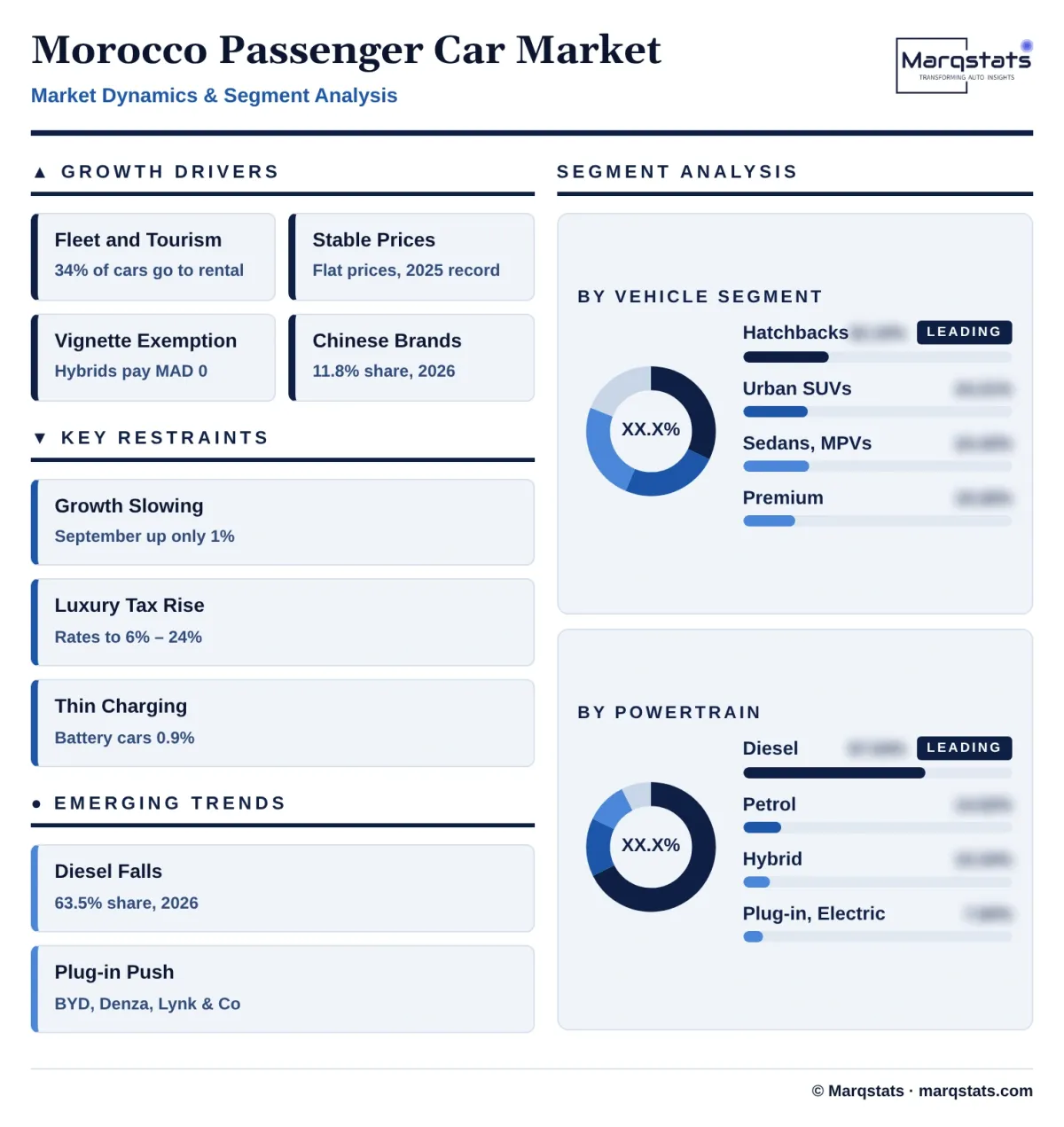
- Fleet renewal and tourism demand lift volume. Rental and tourism companies took about 34% of 2025 registrations, in a year when Morocco welcomed 19.8 million visitors, and the 2030 FIFA World Cup, which Morocco co-hosts, gives operators a reason to refresh fleets before 2030. A third of the market therefore follows tourism flows, not household income.
- Stable prices after three years of increases reopened the market. AIVAM reported prices flat or lower in several segments in 2025 with inflation near 1%, and registrations rose 32.91% to 208,848, the first year above 200,000 vehicles in total.
- The tax code rewards electrified cars. Hybrid and electric cars are exempt from the annual vignette under Article 260 of the Code Général des Impôts, while a diesel car of 8 to 10 CV pays MAD 1,500 a year and one of 15 CV or more pays MAD 20,000, which has cut diesel from about 90% of sales in 2021 to 70% in 2025 and 63.5% in January to September 2026.
- Chinese brands widen choice at lower entry prices. Brands active in Morocco rose from 36 in 2023 to 51 in 2025, 17 of them Chinese, and Chinese brands grew from 3.3% to 7.7% of registrations in 2025 and to 11.8% in the first nine months of 2026 with 19,635 cars.
- Financing and local assembly support affordability. Stellantis Salaf, the finance arm created from AXA Crédit Maroc and announced on 18 August 2026, offers car loans with insurance and maintenance for Peugeot, Citroën, Opel, Fiat and Jeep, and Renault Group builds Dacia and Renault models at Tangier and SOMACA Casablanca, which keeps its best sellers free of import duty.
Key Restraints
Four constraints keep growth below the pace of 2025 and slow the shift to the cleanest powertrains.
- Growth is normalising from a record base. September 2026 passenger car registrations rose only 1% to 18,161 and August fell 2.2%, the first monthly decline of the year, so the 12% gain in January to September 2026 is slowing toward the low single digits Marqstats forecasts for 2027 onward.
- The 2027 Finance Bill raises the luxury stamp tax. It lifts the four rates from 5%, 10%, 15% and 20% to 6%, 12%, 18% and 24% on cars priced above MAD 400,000 before VAT, from 1 January 2027 if adopted, and the rate applies to the full value, so a MAD 700,000 car pays MAD 84,000 instead of MAD 70,000. Electric and hybrid cars are excluded, but petrol and diesel premium cars are not.
- Charging and credit limit the cleanest cars. Battery-electric cars were only about 0.9% of passenger car registrations in 2025 and 2026, with 1,497 units in January to September 2026, because public fast charging is only now being built, with the first 1,500 kW Flash Charging network launched in July 2026, and financing for electrified cars is still looking for a model.
- Import dependence exposes buyers to currency and duty costs. ADII cleared 188,420 new vehicles in 2025 and cars from China, which has no preferential trade agreement with Morocco, pay the common-regime duty, so a weaker dirham or a change in duty feeds directly into the shelf price of the cars gaining share.
Key Trends
Four shifts are changing which cars Moroccans buy, who sells them and how they are paid for.
- Diesel gives way to hybrids and plug-ins. Electrified cars rose from 12.5% of 2025 registrations to 17.8% in January to September 2026, 29,522 cars, with diesel at 59.6% in September alone, plug-in hybrids up 120.3% to 9,438 and hybrids at 11,821.
- Chinese brands lead on plug-in and range-extender models. BYD registered 3,702 cars in 2025, up 428%, and its Seal U plug-in hybrid was the best-selling electrified car at over 3,200 units, while Changan, Great Wall Motor, Geely and Chery added between 989 and 1,898 cars each.
- Premium brands move upmarket in electrified form. Auto Nejma launched Denza on 14 July 2026 with plug-in models from MAD 629,900 to MAD 1,119,000 and 1,500 kW Flash Charging, and Lynk & Co 08 won Car of the Year Morocco 2026, the first win for a Chinese brand.
- Makers build captive finance and dealer networks. Stellantis Salaf joins Renault Group and Auto Nejma in offering bundled loans, insurance and servicing, and retail brands rose to 51 in 2025, so network quality, not only price, now decides who wins the fleet and private buyer.
Strategic Implications
- For importers and distributors, the entry point is the MAD 200,000 to 350,000 band where urban SUVs and Chinese plug-ins compete. Marqstats expects urban and compact SUVs to grow at 13.33% a year, so brands that arrive with a hybrid or range-extender model and a service network outside Casablanca capture growth that diesel hatchbacks no longer supply.
- For vehicle makers, local assembly is the lever that protects price. Renault Group sells about three of every four cars from its Moroccan plants, and the Stellantis plant at Kénitra and the Gotion battery cell plant, whose commissioning started on 20 October 2026, show how local hybrid and electric content can cut duty and logistics cost for the home market as well as for export.
- For lenders and leasing companies, the 34% rental share makes the fleet cycle the key credit risk. Residual values for hybrids and plug-ins will be set by the vignette exemption and by the 2027 luxury tax, and captive finance arms such as Stellantis Salaf give makers a way to hold fleet volume through a slowdown.
- For charging and battery investors, hybrids account for most electrified volume, so demand for public fast charging grows more slowly than registrations suggest. Plug-in, range-extender and electric cars reach 14.00% of units in 2030, which makes corridor charging between Tanger, Rabat, Casablanca, Marrakech and Agadir a 2028 to 2030 build, not a 2026 build.
- For premium sellers, the luxury tax decides the product plan. A premium car at the MAD 540,000 average price is about MAD 450,000 before VAT and already sits in the tax band, so plug-in versions that avoid the stamp tax avoid a stamp tax of 6% to 24% of the pre-VAT value that petrol and diesel equivalents pay from 2027.
Market Segmentation
City cars and hatchbacks account for 32.10% of 2025 value, USD 1,778.78 million, and grow at 3.45% a year to USD 2,107.49 million and 26.94% of the market. Marqstats estimates 89,805 units in 2025, rising to 98,420. The Dacia Sandero with 17,572 registrations, the Renault Clio with 13,349 and the Peugeot 208 anchor the segment, which AIVAM reports at 43% of registrations and which rental companies and first-time buyers favour for fuel economy and low entry prices.
Urban and compact SUVs account for 24.21% of 2025 value, USD 1,341.65 million, and grow fastest among vehicle segments, at 13.33% a year, to USD 2,508.20 million and 32.06% of the market. Marqstats estimates 41,770 units in 2025 and 69,930 in 2030. The Dacia Duster with 8,130 units, the Hyundai Tucson, the Dacia Bigster and Chinese crossovers from BYD, Chery and MG lead, and AIVAM puts urban SUVs at 20% of 2025 registrations.
Premium and luxury brands account for 19.26% of 2025 value, USD 1,067.40 million, from 18,462 cars that AIVAM counts in the premium segment, and grow at 8.17% a year to USD 1,580.62 million. BMW registered 5,070 cars in 2025, Audi 5,055 and Mercedes-Benz 3,255, and the segment holds 8.84% of units but 19.26% of value because its average price is about MAD 540,000. The 2027 luxury stamp tax is aimed at this segment.
Sedans, minivans and other cars account for 24.43% of 2025 value, USD 1,353.79 million, and grow at 3.74% a year to USD 1,626.38 million. The Dacia Logan, the market's best seller with 18,282 units, the Dacia Jogger with 3,311, nine-seat people carriers and compact family cars make up 58,811 units, with sedans losing share to crossovers but supported by rental and taxi fleets.
Diesel cars account for 67.54% of 2025 value, USD 3,742.79 million, from 146,194 units or 70.00% of registrations. They shrink at 3.22% a year in value to USD 3,178.31 million and 40.63% of the market as the vignette, which charges MAD 700 to MAD 20,000 a year by engine power, pushes private buyers to petrol and electrified cars. Diesel still dominates 2030 volume, at 47.00% of units.
Petrol cars account for 14.52% of 2025 value, USD 804.69 million, and grow at 5.40% a year to USD 1,046.81 million and 13.38% of the market. They gained 5,132 units in January to August 2026, 29.23% of the market's gain, because Dacia, Renault and Hyundai petrol models are cheaper than diesel and now carry a smaller vignette.
Full and mild hybrids account for 10.34% of 2025 value, USD 572.75 million, from 17,209 units, and grow at 26.37% a year to USD 1,846.12 million and 23.60% of the market. Toyota, Hyundai, Renault and Dacia sell most of them, and January to September 2026 registrations of 11,821 full hybrids show the segment already running ahead of the 2025 pace.
Plug-in, range-extender and electric cars account for 7.60% of 2025 value, USD 421.39 million, from 8,897 units, and grow fastest, at 32.97% a year, to USD 1,751.45 million and 22.39% of the market. Plug-in hybrids and range-extenders from BYD, Lynk & Co, Denza and Chery lead, with 9,438 plug-ins and 1,917 range-extenders registered from January to September 2026, while battery-electric cars stay near 0.9% of units.
Private buyers, including individuals, companies and public bodies that register cars for their own use, account for 70.30% of 2025 value, USD 3,895.91 million, from 137,840 units or 66.00% of registrations. They grow at 7.42% a year to USD 5,572.19 million and 71.23% of the market, and they buy the SUVs, hybrids and premium cars that lift the average price.
Rental and tourism fleets account for 29.70% of 2025 value, USD 1,645.71 million, from 71,008 units or 34% of registrations as AIVAM reports them. They grow at 6.46% a year to USD 2,250.50 million. Fleets buy cheaper diesel and petrol hatchbacks and sedans at fleet discounts, so their share of value is lower than their share of units, and their orders peak ahead of summer and the 2030 FIFA World Cup.
By Geography
Casablanca-Settat
Casablanca-Settat accounts for 42.00% of 2025 value, USD 2,327.48 million, and grows at 6.62% a year to USD 3,207.30 million and 41.00% by 2030. AIVAM reports that the region takes 40.4% of national volume, but registration overstates local use because leasing companies, rental groups and corporate fleets register cars at Casablanca head offices before they work across the country. Marqstats allocates value by registration, as buyers and lenders do.
Rabat-Salé-Kénitra
Rabat-Salé-Kénitra accounts for 12.80% of 2025 value, USD 709.33 million, and grows at 7.14% a year to USD 1,001.30 million. The administrative capital buys through ministries, public bodies and senior civil servants, and the Stellantis plant at Kénitra and the battery plant being commissioned there add skilled-worker demand. Rabat and Tanger together with Casablanca account for close to 60% of registrations by city.
Marrakech-Safi and Souss-Massa
Marrakech-Safi and Souss-Massa account for 14.80% of 2025 value, USD 820.16 million, and grow fastest among regions, at 8.13% a year, to USD 1,212.52 million and 15.50% by 2030. Marrakech and Agadir are the tourism hubs where rental companies register fleets, and Denza and other brands are adding showrooms in both cities.
Tanger-Tétouan-Al Hoceïma and Oriental
Tanger-Tétouan-Al Hoceïma and the Oriental account for 11.90% of 2025 value, USD 659.45 million, and grow at 7.67% a year to USD 954.37 million. Tanger Med and the Renault plant at Tangier create industrial demand, while Oujda and Nador add cross-border and diaspora purchases that peak in summer.
Rest of Morocco
The rest of Morocco, which covers Fès-Meknès, Béni Mellal-Khénifra, Drâa-Tafilalet and the Southern Provinces, accounts for 18.50% of 2025 value, USD 1,025.20 million, and grows at 7.14% a year to USD 1,447.20 million. AIVAM recorded double-digit gains in Taza, Dakhla, Safi and Kénitra in 2025 and declines in Settat and Béni Mellal, where drought cut rural household income.
How Competition Is Evolving
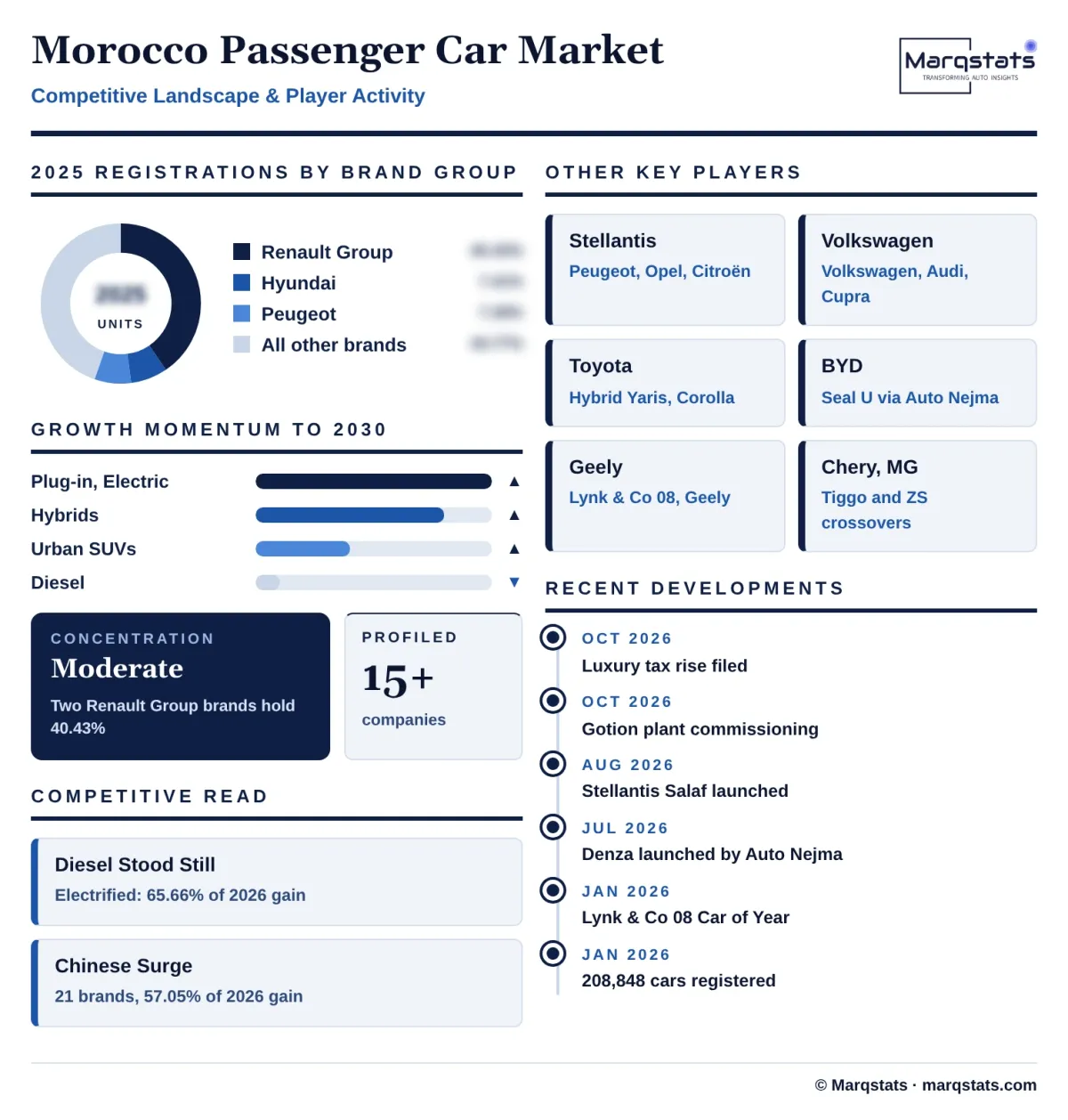
The market is moderately concentrated and led by one group. Dacia registered 47,887 passenger cars in 2025, 22.93% of the total, and Renault 36,557, 17.50%, so Renault Group held 40.43% together, ahead of Hyundai at 7.41%, Peugeot at 7.39% and Volkswagen at 6.74%. The order at the top is settled, but the gap behind it is closing: Chinese brands as a group held 7.70% of 2025 registrations and 11.8% from January to September 2026.
Competition runs on price, powertrain and network. Dacia and Renault win on price and local assembly, with Logan, Sandero and Duster as the volume core. Stellantis Maroc, with 42,901 vehicles and 18.2% of all registrations in 2025, wins on Peugeot, Opel and Citroën models and a new captive financier. Chinese brands win on hybrid and range-extender models at prices close to European petrol cars, while Hyundai's 10,725 cars from January to September 2026 trailed Peugeot's 11,085.
Footprint and channel explain who can hold price. Renault Group made 394,474 vehicles in Morocco in 2025, 299,395 at Tangier and 95,079 at SOMACA Casablanca, and exported 327,552, leaving 66,922 for the home channel. Importers of European, Korean and Chinese cars depend on the Association Agreement with the European Union and on exchange rates, while Auto Nejma, the distributor of BYD and Denza, shows how a distributor can build a brand from nothing, with BYD up 428% to 3,702 cars in 2025.
Companies Covered
Companies covered in the report include:
Recent Market Activity
Table of Contents
Coverage & Segmentation
The study covers the Morocco passenger car market, with 2025 as the base year, 2021 – 2025 as the historical period and 2026 – 2030 as the forecast period. It covers new M1 passenger cars registered under the AIVAM Voitures Particulières category, segmented by vehicle segment, powertrain, buyer type and region. Values are retail transaction values in US dollars including 20% value-added tax, duties and registration charges, and dirham figures use the 2025 average of MAD 9.34 per US dollar. Regional values follow the place of registration.
Light commercial vehicles, pickups and vans (26,524 registrations in 2025), used passenger cars, vehicles built in Morocco for export and quadricycles are excluded. Segment, powertrain, buyer and regional splits are Marqstats estimates built on AIVAM registrations, customs data, list prices and company disclosures. The live Marqstats reports on Morocco automotive components and Morocco EV battery manufacturing measure supplier and battery value chains, and their figures should not be added to this market. The study profiles 15 companies, and the value series is primary while units are derived from AIVAM registrations.