Market Snapshot
Middle bar: base-year value × (1 + CAGR), rounded to two decimals. This is a calculated illustration, not a separately researched annual estimate.
The Colombia passenger car market size is estimated at USD 7,274.39 million in 2025 and is projected to reach USD 13,778.49 million by 2030, growing at a CAGR of 13.63% over 2026 – 2030. Registrations of new cars rise from 221,534 to 358,000, a 10.07% annual rate, after an estimated jump to 310,000 cars in 2026, and electrified cars grow from 38.59% of 2025 units to 68.44% by 2030.
Marqstats defines the market as the retail value of new M1 passenger cars first registered in Colombia, covering hatchbacks, sedans, SUVs, crossovers, large four-wheel-drive wagons and taxis, at list price including value-added tax (IVA) and the national consumption tax. Pickups, vans, cargo vehicles, commercial passenger vehicles, used cars and motorcycles are excluded. Value is built from Asociación Nacional de Empresarios de Colombia (ANDI) and Federación Nacional de Comerciantes (Fenalco) registrations, drawn from the Registro Único Nacional de Tránsito (RUNT), multiplied by model list prices.
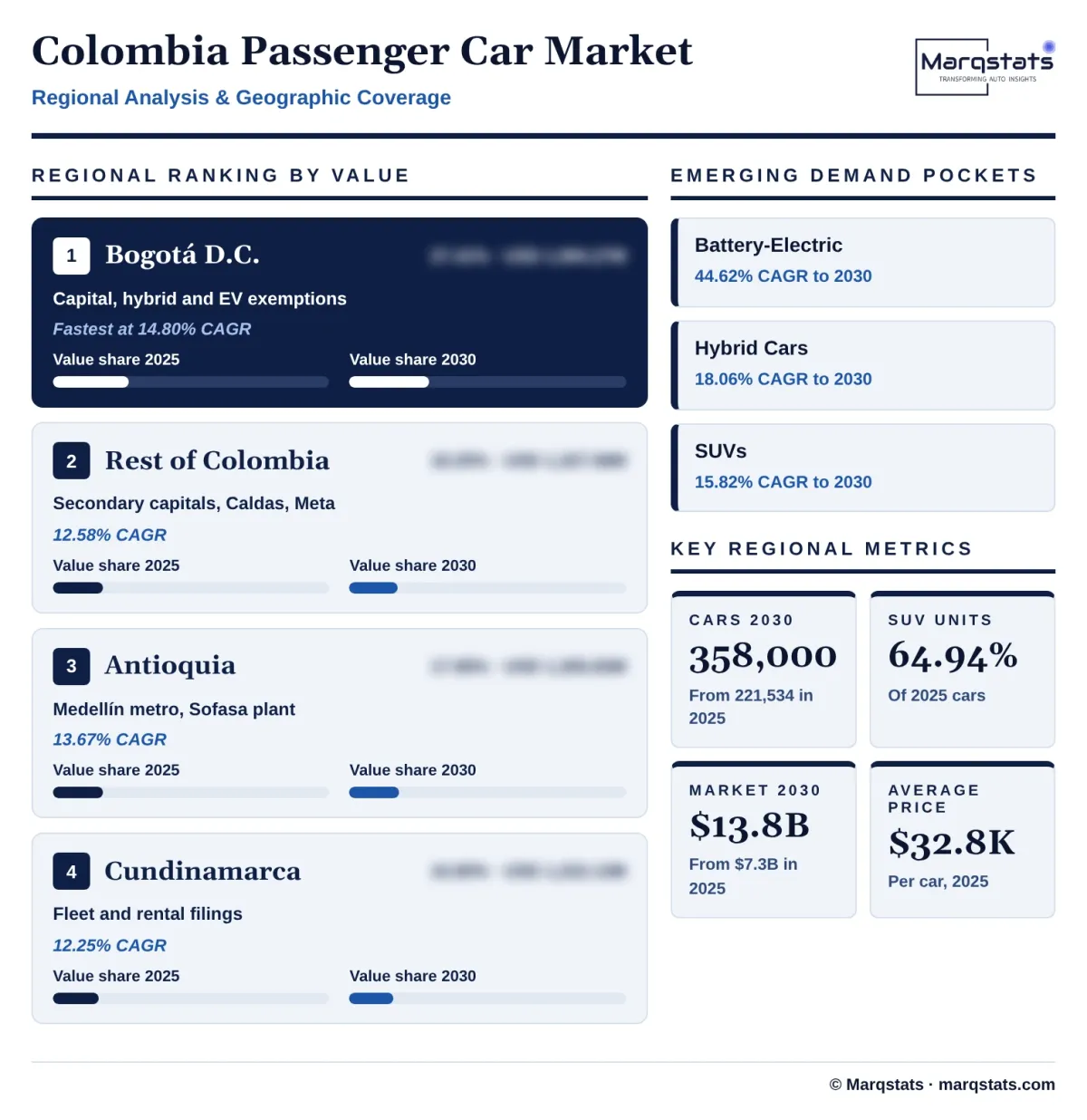
SUVs and crossovers account for 70.72% of 2025 value, hybrids for 33.69% and the Upper-Mid price tier for 40.19%. Bogotá D.C. holds 27.41% of value, and battery-electric cars grow fastest, at 44.62% a year, from a base of 8.85% of units. The average new car costs about USD 32,836 at retail, equal to about COP 133.0 million at COP 4,051.51 per US dollar.
Key Takeaways
Market Overview & Analysis
Report Summary
Colombia registered 254,205 new vehicles in 2025, 26.5% more than in 2024, and 221,534 of them were passenger cars. The analysis separates the cars from the pickups, vans and cargo vehicles that the headline total includes, and then asks why the market kept accelerating in 2026: 247,212 vehicles were registered from January to September, up 41.2%, and September alone reached 33,835, the highest monthly figure since 2014.
Marqstats builds the car market as a ladder from the ANDI and Fenalco total. Of the 254,205 registrations, pickups account for 17,006, cargo vehicles for 12,403, commercial passenger vehicles for 2,414, vans for 697 and quadricycles for 151, which leaves 221,534 cars: 143,875 SUVs, 63,223 hatchbacks and sedans, 9,743 large wagons classed as camionetas and 4,693 taxis. The camionetas line is 4.40% of units, so a different reading of it cannot move the unit base by more than that.
The 2025 result was a recovery of volume, not a record. Cars grew 27.37% from 173,923 in 2024, with SUVs up 33.4%, hatchbacks and sedans up 15.7%, camionetas up 57.9% and taxis down 11.1%. The all-vehicle total of 254,205 stayed 3.10% below the 262,338 registered in 2022, after 250,272 in 2021, 186,222 in 2023 and 200,953 in 2024, and the dollar fell 17.12% against the peso between 9 April and 29 December 2025, which made imported cars cheaper in the second half.
Policy now steers the mix. Decreto 1432 of 2025 raised the import duty on combustion cars from 35% to 40% on thirteen subheadings of tariff heading 8703, battery-electric cars stay duty-free and pay 5% IVA under Law 1964 of 2019, and Bogotá exempts hybrids from pico y placa until 31 December 2027. On the demand side, the Banco de la República holds the policy rate at 12.0% and inflation was 6.1% in June 2026, so cheaper electrified lanes carry the growth.
The analysis is written for five decision makers: an importer or distributor sizing allocations for a market that has changed supplier mix in a year; an assembler such as Renault-Sofasa weighing home sales against exports; a lender pricing vehicle loans at an average of 18.37% effective annual rate; a charging or service operator sizing the electrified base; and an investor assessing whether Colombia can hold 358,000 cars a year by 2030.
Colombia Passenger Car Market Size and Forecast
The Colombia passenger car market grows from USD 7,274.39 million in 2025 to USD 13,778.49 million in 2030, a CAGR of 13.63%. Volume contributes 10.07% a year, from 221,534 to 358,000 cars, and the average retail value per car adds the rest, rising at 3.23% a year from about USD 32,836 to USD 38,487 as SUVs and large wagons take a larger share. Marqstats estimates 2026 at 310,000 cars and USD 10,358.02 million, 42.39% above 2025, before value grows 7.61% in 2027 and between 6.88% and 7.78% a year to 2030.
The 2025 value is built bottom-up from registrations and prices. ANDI and Fenalco recorded 143,875 SUVs, 63,223 hatchbacks and sedans, 9,743 large wagons and 4,693 taxis. Marqstats prices them at about COP 144.9 million, COP 84.0 million, COP 311.0 million and COP 62.3 million, equal to USD 35,756, USD 20,721, USD 76,753 and USD 15,383 at COP 4,051.51, which gives USD 5,144.33 million, USD 1,310.06 million, USD 747.81 million and USD 72.19 million. The registrations are published; the prices are Marqstats estimates.
The prices rest on published list ranges and brand price ladders. 18 best-selling models with dated price ranges, among them the Kia K3 at COP 80.99 to 105.99 million, the Renault Duster at COP 93.19 to 113.79 million, the Mazda CX-30 at COP 117.5 to 153.95 million, the Toyota Corolla Cross at COP 135.9 to 154.9 million and the Toyota Land Cruiser at COP 299 to 509.9 million, cover 99,251 cars, 44.80% of units, at a weighted midpoint of COP 118.0 million. Another 58 named models are priced from brand ladders and 39,124 cars from smaller nameplates are priced at tier averages, so about 37.54% of units and 17.66% rest on Marqstats estimates.
The value basis is the list price including IVA and the consumption tax, before registration fees, mandatory insurance and finance charges. Dealer discounts are not deducted, so the figure describes what buyers are quoted and is a Marqstats construction. A 1% change in average price moves 2025 value by USD 72.74 million, a 1% change in registrations moves it by 2,215 cars, and a COP 100 weaker peso lowers the dollar value by 2.41%, because every dollar figure uses one 2025 average rate.
Value grows faster than volume because the mix moves toward SUVs and large wagons while peso list prices rise 1.50% in 2026 and 3.00% a year after. Marqstats expects SUVs to reach 73.32% of units, electrified cars 68.44%, and battery-electric cars to be priced at 0.86 times the combustion average by 2030 as sub-COP 100 million Chinese models scale. Marqstats tracks five indicators: monthly ANDI and Fenalco registrations by body line, electrified registrations by fuel, Banco de la República rate decisions and vehicle loan disbursements, Tesla and Chinese brand deliveries, and any change to the IVA and import duty schedule.
Market Dynamics
Key Drivers
Five forces lift Colombian car demand even with credit still expensive.
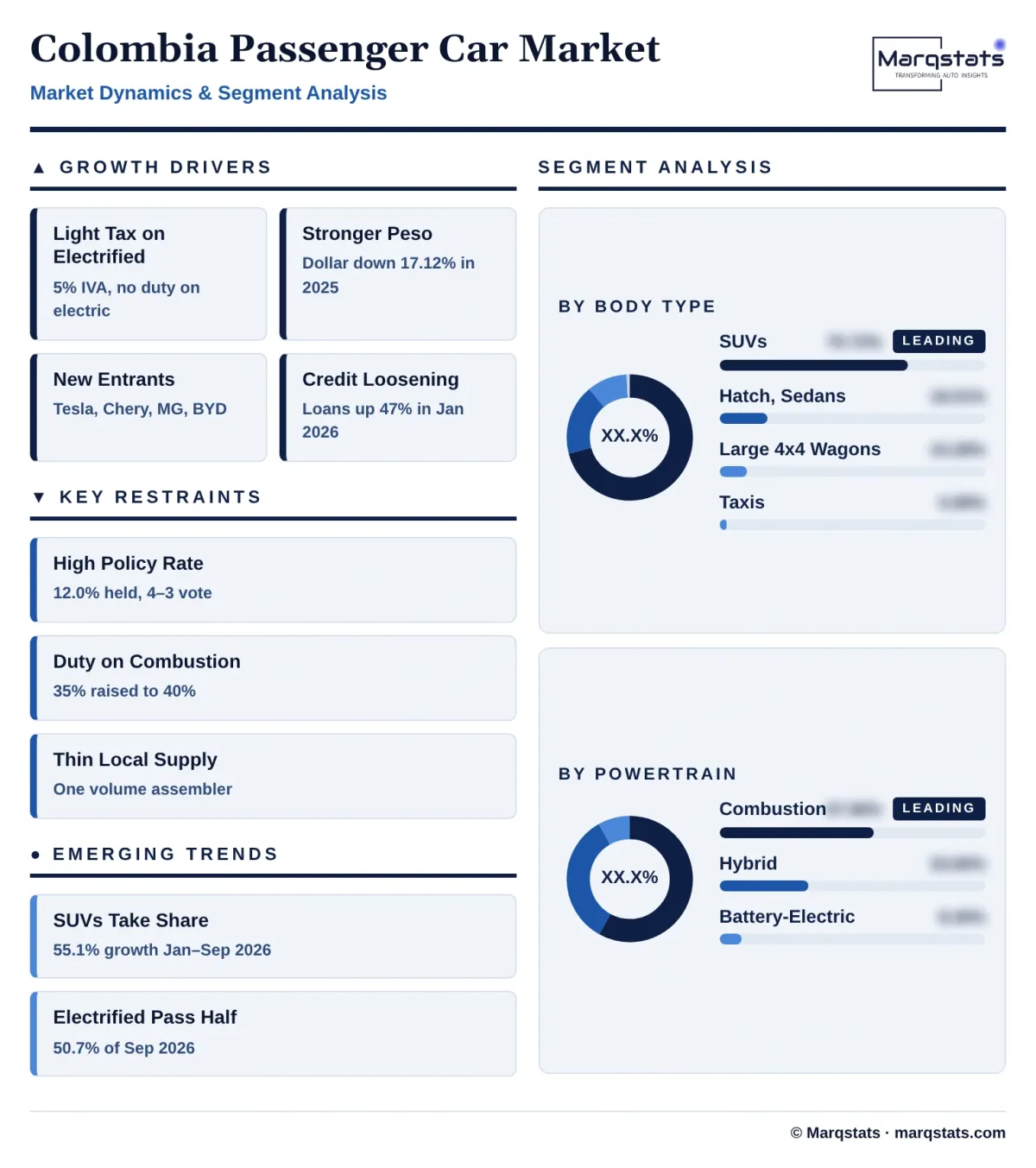
- The electrified lane is taxed lightly and keeps growing. Battery-electric cars pay no import duty and 5% IVA against 19%, and Law 1964 of 2019 exempts them from local driving restrictions, while Bogotá exempts hybrids from pico y placa until 31 December 2027. ANDI and Fenalco counted 19,724 electric and 67,899 hybrid vehicles in 2025, up 115% and 59%, and 39,784 and 74,471 from January to September 2026.
- A stronger peso cut import prices in 2025. The peso averaged COP 4,051.51 per US dollar but moved from COP 4,458.58 on 9 April to COP 3,695.30 on 29 December, a 17.12% fall in the dollar. Because Colombia assembles only a few models, about 91.49% of cars sold are imported or built from imported kits, and importers could hold list prices or cut them while volumes rose 27.37%.
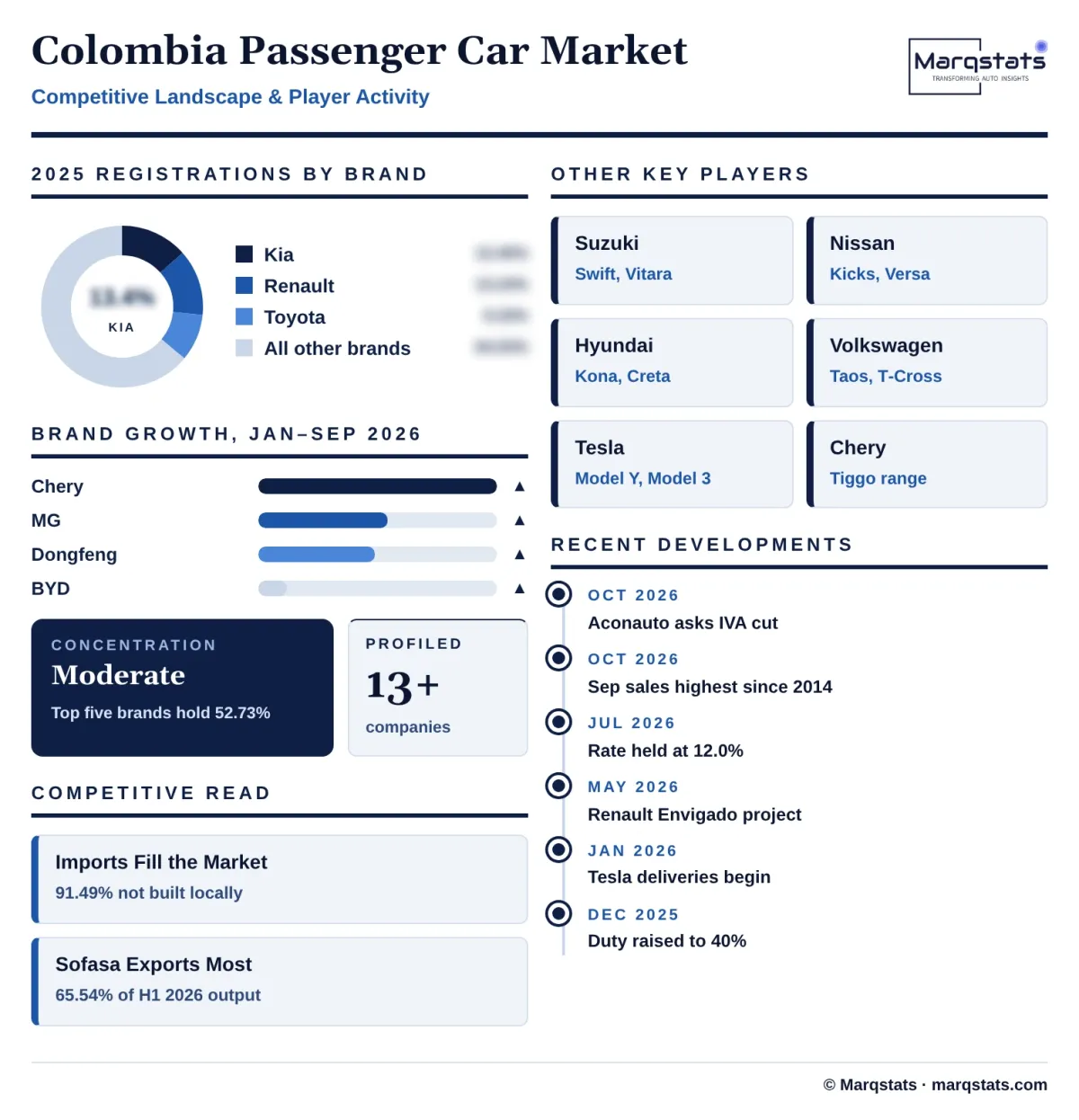
- New entrants add supply at new price points. Tesla launched in November 2025, delivered from late January 2026 and sold 16,542 cars by September, while BYD sold 10,884 vehicles in 2025, up 137.2%, and Chery 2,104, up 428.6%. In 2026 Chery, MG, Dongfeng and BYD grew 284.0%, 152.3%, 139.9% and 34.4% in nine months.
- Vehicle credit is loosening from a low base. Disbursements for vehicles reached COP 1.19 trillion in January 2026 across 15,316 loans, against COP 811 billion across 11,383 loans in January 2025, a rise of about 47%, at an average of 18.37% effective annual rate, and electric-car offers start from 0.60%. Credit finances the cars that the tax lanes make cheapest.
- Demand is broadening beyond the capital. Registrations grew 99.6% in Caldas, 44.3% in Santander and 32.8% in Meta in 2025, against 36.2% in Bogotá, and September 2026 growth reached 111.0% in Sincelejo, 49.9% in Cartagena and 48.2% in Cúcuta. More dealers and delivery points in secondary cities extend the buyer base beyond the three largest metropolitan areas.
Key Restraints
Four constraints explain why the 2026 surge needs a tax and rate backdrop to last.
- Rates and inflation hold back price-sensitive buyers. The Banco de la República kept the policy rate at 12.0% on 31 July 2026 by four votes to three, with three directors proposing a 50 basis point rise, and inflation reached 6.1% in June with analysts expecting 6.6% for December 2026. A vehicle loan at 18.37% costs a Picanto buyer more in interest than in the tax lane saved.
- Duty on combustion cars rose in a market that is mostly imported. Decreto 1432 of 2025 lifted the duty on thirteen combustion subheadings of heading 8703 from 35% to 40%, takes effect fifteen days after publication, sets no end date and applies without prejudice to trade agreements, so cars from origins without an agreement bear the full rise. Combustion registrations still grew 14.31% in nine months, but the tariff narrows the cheap-petrol option.
- Local supply cannot cushion shocks. General Motors Colmotores closed its Bogotá assembly in April 2024, leaving Renault-Sofasa as the one volume assembler, and Sofasa sold only 7,543 of 21,891 vehicles, 34.46%, at home in the first half of 2026 because it exports 65.54% of output. A peso fall or a port delay therefore reaches shelf prices quickly.
- Delivery and policy risk concentrate in the electrified lane. The Superintendencia de Industria y Comercio ordered Tesla Motors Colombia S.A.S. on 14 May 2026 to correct its practices after more than 1,800 cars due in February and March were still pending in April, and the Bogotá hybrid exemption lapses on 31 December 2027 unless the next administration extends it. The 5% IVA and local-restriction exemptions sit in law and decree, so a change in either moves the mix.
Key Trends
Four shifts are changing which cars Colombians buy and who supplies them.
- SUVs keep taking share of every showroom. They held 64.94% of cars in 2025 and about 70% from January to September 2026, with SUVs at 153,239 units, up 55.1%, while September cars grew only 11.5% to 7,337. Buyers choose a higher body at similar monthly cost, and the tax schedule does not penalise it.
- Electrified cars passed half of monthly sales. Battery-electric and hybrid vehicles reached 17,156 units, 50.7% of September 2026, the first month above half, with battery-electric registrations at 5,895, up 217.3%, and hybrids at 11,261, up 58.6%.
- Chinese and American brands now fill the top of the table. Tesla ranked sixth by units with 16,542 cars from January to September 2026, BYD eleventh with 9,275, and Chery, Dongfeng and MG joined the top twenty with 3,982, 2,896 and 2,866 units. The top five brands' share fell from 52.73% to 46.34%.
- Assemblers are turning Colombia into an export base. Renault-Sofasa exported 14,348 vehicles in the first half of 2026, mainly to Mexico, and on 22 May 2026 Renault Group announced a firm intention to invest in a new assembly project at Envigado for a new-technology vehicle, after about USD 100 million spent on the Kwid between 2023 and 2025.
Strategic Implications
- For importers and distributors, the practical task is to allocate between tax lanes. Battery-electric and hybrid cars face lighter duty and IVA, combustion cars face a 40% duty on thirteen subheadings, and a distributor that holds combustion stock at 2025 volumes carries more risk than one that shifts allocation to hybrids and electric cars.
- For Chinese and American entrants, the opening is price points between COP 80 million and COP 190 million where incumbents sell the K3, Duster, Kardian and CX-30. Tesla showed that a new brand can reach a 6.69% share in nine months, but the Superintendencia de Industria y Comercio order shows that delivery dates and warranty terms must be met.
- For assemblers and component suppliers, the home market is the smaller outlet. Renault-Sofasa sells about a third of its output in Colombia, so a supplier that depends on local assembly depends on Mexican and Andean export orders, and the new Envigado project, not home demand, is the capacity signal.
- For lenders and insurers, the loan book is shifting to electrified cars with uncertain residual values. At an average 18.37% rate, a lender that offers longer terms on electric cars, as electric offers from 0.60% suggest, needs residual value data that the market has not yet built for a fleet that did not exist in 2022.
- For charging, service and software providers, the electrified base is the planning number. Marqstats estimates 85,500 electrified cars sold in 2025 and 163,500 in 2026, and the Colombia Electric Vehicle analysis counts 118,000 battery-electric vehicles by 2030, so Bogotá, Medellín and Cali charging density sets how much of that volume can be used.
Market Segmentation
SUVs and crossovers account for 70.72% of 2025 value, USD 5,144.33 million, and 64.94% of units, 143,875 cars, and grow at 15.82% a year to USD 10,722.30 million and 77.82% of value. ANDI and Fenalco recorded 33.4% growth in 2025 and 55.1% in the first nine months of 2026, led by the Renault Duster, Mazda CX-30, Toyota Corolla Cross, BYD Yuan Up and Renault Kardian, so the 73.32% unit share in 2030 assumes a continued but slower climb.
Hatchbacks and sedans account for 18.01% of 2025 value, USD 1,310.06 million, and 28.54% of units, 63,223 cars. Value grows at 6.69% a year to USD 1,810.88 million while unit share falls to 21.37%. The Kia K3 at 9,728 units, Picanto at 7,379, Chevrolet Onix at 6,256 and Mazda 2 at 5,700 lead a segment that grew 15.7% in 2025 but only 11.5% in September 2026.
Large four-wheel-drive wagons, which ANDI and Fenalco list as camionetas, account for 10.28% of 2025 value, USD 747.81 million, from 4.40% of units, 9,743 cars. Value grows at 8.80% a year to USD 1,139.87 million. The Toyota Land Cruiser sold 4,093 units at COP 299 to 509.9 million and the Fortuner 2,189, so the line is a Marqstats price estimate of about USD 76,753 per car and the most price-sensitive input to total value.
Taxis account for 0.99% of 2025 value, USD 72.19 million, and 2.12% of units, 4,693 cars. Registrations fell 11.1% in 2025, and value grows at 7.87% a year to USD 105.44 million. Entry cars such as the Kia Soluto and Hyundai Grand Metro dominate the line, which is the lowest-priced and the one most exposed to electric taxi programmes in the large cities.
Gasoline and diesel cars account for 57.96% of 2025 value, USD 4,216.05 million, and 61.40% of units, 136,034 cars. Value is nearly flat, at 0.47% a year, to USD 4,315.09 million and 31.32% of the total, as units fall 3.64% a year to 113,000. Combustion registrations still rose 14.31% in the first nine months of 2026, so Marqstats expects 2026 to be the peak year.
Hybrid cars, covering mild, full and plug-in hybrids as counted by ANDI and Fenalco, account for 33.69% of 2025 value, USD 2,450.89 million, and 29.75% of units, 65,900 cars. Value grows at 18.06% a year to USD 5,621.06 million and 40.79%, making hybrids the largest segment by 2030. ANDI and Fenalco counted 67,899 hybrid vehicles of all types in 2025, and Marqstats removes about 2,000 mild-hybrid pickups to reach the car figure.
Battery-electric cars account for 8.35% of 2025 value, USD 607.45 million, and 8.85% of units, 19,600 cars. Value grows fastest, at 44.62% a year, to USD 3,842.34 million and 27.89% of the total. ANDI and Fenalco counted 19,724 electric vehicles of all types in 2025, and Marqstats places 99.37% of them in cars. The live Marqstats Colombia Electric Vehicle analysis sizes all electric vehicles at USD 749.50 million in 2025, a broader scope priced from a higher blended average, and the two should not be added.
Entry cars, priced below COP 80 million, account for 6.08% of 2025 value, USD 442.21 million, and 12.23% of units, 27,086 cars, and grow at 6.04% a year to USD 592.85 million. The Kia Picanto, Renault Logan and Kwid, and the taxi models sit here, and list prices that rise 3.00% a year move cars across the COP 80 million line, which is why the tier loses unit share to 9.00%.
Mid-Market cars, priced from COP 80 million to COP 130 million, account for 33.70% of 2025 value, USD 2,451.58 million, and 45.49% of units, 100,784 cars, the largest tier by volume. Value grows at 11.99% a year to USD 4,318.47 million. The Kia K3, Renault Duster, Chevrolet Onix, Mazda 2, Renault Kardian and BYD Yuan Up are the volume models.
Upper-Mid cars, priced from COP 130 million to COP 200 million, account for 40.19% of 2025 value, USD 2,923.39 million, the largest tier by value, and 34.62% of units, 76,704 cars. Value grows at 15.16% a year to USD 5,920.45 million and 42.97% of the total. The Mazda CX-30 and CX-5, Toyota Corolla Cross, Nissan Kicks and Hyundai Kona sit here, and Tesla and larger Chinese electric SUVs are moving into it.
Premium and Luxury cars, priced above COP 200 million, account for 20.03% of 2025 value, USD 1,457.21 million, from only 7.66% of units, 16,960 cars. Value grows at 15.12% a year to USD 2,946.72 million. The Toyota Land Cruiser and Fortuner, Mercedes-Benz at 3,352 units and BMW at 2,660 units across all body types are the anchors, and the tier carries high-value, low-volume sales that a 5% price change moves most.
By Geography
Bogotá D.C.
Bogotá D.C. accounts for 27.41% of 2025 value, USD 1,994.27 million, and grows fastest, at 14.80% a year, to USD 3,975.85 million and 28.86% by 2030. ANDI and Fenalco recorded 59,676 registrations of all vehicle types in 2025, up 36.2%, and Marqstats estimates 53,518 cars. September 2026 registrations in the capital rose 87.4% to 9,945, and the city's pico y placa exemption for hybrids runs to 31 December 2027.
Cundinamarca
Cundinamarca accounts for 16.80% of 2025 value, USD 1,222.13 million, and grows at 12.25% a year to USD 2,178.36 million, losing share to 15.81%. The department registered 48,033 vehicles of all types, of which 5,940 were cargo vehicles, so Marqstats counts 38,263 cars. Funza registered 22,258, Chía 8,117, down 26.9%, and Mosquera 7,224, up 40.7%, because fleet and rental companies file there for tax reasons, so the department overstates local consumption.
Antioquia
Antioquia accounts for 17.95% of 2025 value, USD 1,305.83 million, and grows at 13.67% a year to USD 2,477.95 million. The department registered 44,869 vehicles of all types, up 27.3%, with 42,160 in the Valle de Aburrá metropolitan area, and Marqstats counts 39,248 cars. Medellín is also home to Renault-Sofasa at Envigado and to a Tesla experience centre at El Tesoro.
Valle del Cauca
Valle del Cauca accounts for 9.06% of 2025 value, USD 658.76 million, and grows at 14.02% a year to USD 1,269.32 million. The department registered 22,761 vehicles of all types, up 24.7%, with 20,783 in Cali, up 27.8%, and Marqstats counts 20,412 cars. Cali grew 36.9% in September 2026, and the department has the highest share of compact-car buyers outside Bogotá and Medellín.
Santander, Atlántico and Norte de Santander
Santander, Atlántico and Norte de Santander account for 10.53% of 2025 value, USD 765.82 million, and grow at 14.02% a year to USD 1,475.91 million. Santander registered 11,390 vehicles, up 44.3%, Atlántico 9,908, up 32.4%, and Norte de Santander 7,008, up 22.7%, with Bucaramanga at 10,687, Barranquilla at 9,341 and Cúcuta at 6,782, and Marqstats counts 24,750 cars across the three.
Rest of Colombia
The rest of Colombia accounts for 18.25% of 2025 value, USD 1,327.58 million, and grows at 12.58% a year to USD 2,401.10 million. It includes Caldas at 6,247 registrations, up 99.6%, with Manizales at 6,099, Meta at 5,310 and Boyacá at 4,324, and Marqstats counts 45,343 cars. Sincelejo grew 111.0% and Villavicencio 46.2% in September 2026, so secondary capitals add volume faster than the national average.
How Competition Is Evolving
The market is moderately concentrated and becoming less so. Kia led 2025 with 34,063 registrations of all vehicle types, 13.40%, followed by Renault at 33,658, 13.24%, Toyota at 23,711, Mazda at 21,565 and Chevrolet at 21,038, which together held 52.73%, and the top ten brands held 76.81%. From January to September 2026 the top five held 46.34%, with Tesla in sixth place at 16,542 units. These brand totals include some pickups, vans and trucks, so they describe brand reach and not an exact car share.
Competition runs on the tax lane. A buyer compares duty and IVA, loan terms and delivery dates as much as badges, so Toyota and Mazda defend the Upper-Mid tier with hybrids and crossovers, Kia and Renault hold the Mid-Market with the K3, Picanto, Duster and Kardian, and BYD, Tesla and Chery compete on electric range and equipment. BYD sold 10,884 vehicles in 2025, up 137.2%, and Chery 2,104, up 428.6%.
Footprint decides who can price flexibly. Renault Group's Sociedad de Fabricación de Automotores S.A. assembles the Logan, Sandero, Stepway, Duster and Kwid at Envigado, a plant with more than 1.7 million vehicles built, while Kia, Toyota, Mazda, Chevrolet, Suzuki, Nissan and Hyundai import. Marqstats estimates Sofasa supplied about 18,858 cars at home in 2025, 8.51%, and Renault Group reported 15,820 registrations and an 11.1% share in the first half of 2026.
Chinese brands are the entrants that change the price ladder. From January to September 2026 Chery grew 284.0%, MG 152.3%, Dongfeng 139.9% and BYD 34.4%, and Geely entered the monthly top twenty with 266 units in September. The risk for incumbents is that Chinese brands have to hold delivery and service standards while Colombia raises the duty on combustion cars, as the Tesla order of May 2026 shows.
Companies Covered
Companies covered in the report include:
Recent Market Activity
Table of Contents
Coverage & Segmentation
The study covers the Colombia passenger car market, with 2025 as the base year, 2021 – 2025 as the historical period and 2026 – 2030 as the forecast period. It covers new M1 passenger cars first registered in Colombia, including SUVs, crossovers, large four-wheel-drive wagons and taxis, segmented by body type, powertrain, price tier and six regions. Values are retail list values including IVA and the national consumption tax in US dollars at COP 4,051.51 per US dollar, the 2025 average held constant across the forecast, and units follow the ANDI and Fenalco series built on RUNT.
Pickups at 17,006 units, cargo vehicles at 12,403, commercial passenger vehicles at 2,414, vans at 697, quadricycles at 151, used cars, motorcycles and exports are excluded, and the 254,205 vehicle total is the top rung of the ladder, not the market. The live Marqstats Colombia Electric Vehicle Market analysis, which sizes all electric vehicles at USD 749.50 million in 2025, the Colombia EV Maintenance Market analysis and the Latin America used-car and rental analyses overlap in part, so their figures must not be added to this market. Segment and regional splits are Marqstats estimates built on ANDI and Fenalco lines and dated price lists. The analysis profiles 13 companies.