Market Snapshot
Middle bar: base-year value × (1 + CAGR), rounded to two decimals. This is a calculated illustration, not a separately researched annual estimate.
The Chile passenger car market size is estimated at USD 4,446.60 million in 2025 and is projected to reach USD 5,611.55 million by 2030, growing at a CAGR of 4.76% over 2026 – 2030. New registrations rise from 212,977 to 236,500 cars and SUVs, a 2.12% annual rate, while the average retail value per vehicle climbs from about USD 20,878 to USD 23,727 as hybrids, plug-in vehicles and larger SUVs take a bigger share.
Marqstats defines the market as the retail value of new passenger cars and SUVs registered in Chile, using the two categories of the Asociación Nacional Automotriz de Chile (ANAC) that serve private mobility: Vehículos de Pasajeros, meaning hatchbacks, sedans and wagons, and SUVs, which include crossovers. Value is counted at retail list price including 19% value added tax (IVA) and the green tax on emissions, converted at CLP 953.94 per US dollar. Pickups (camionetas), commercial vans, trucks, buses and used cars are excluded.
Compact SUVs account for 33.75% of 2025 value, internal combustion vehicles for 81.21% and Chinese brands for 26.97%. The Región Metropolitana of Santiago accounts for 59.66% of value, while plug-in hybrids grow fastest of any powertrain at 46.46% a year as Changan, BYD and other Chinese brands bring plug-in SUVs to Chilean showrooms.
Key Takeaways
Market Overview & Analysis
Report Summary
Marqstats sizes the Chile passenger car market as the retail value of new cars and SUVs registered each year for private and company use. ANAC reports Chile's light and medium vehicle market, meaning road vehicles up to 3,860 kilograms, in four categories: Vehículos de Pasajeros, SUV, Camioneta and Vehículo Comercial. The analysis counts the first two, which sold 54,277 and 158,700 units in 2025, a total of 212,977, and leaves the 63,429 pickups and 34,192 commercial vans to other studies.
The definition matters because the statutory category is now the smaller part of passenger mobility. Vehículos de Pasajeros fell from 121,372 units in 2021 to 54,277 in 2025, and fell from 34.7% of the light and medium market in 2020 to 17.5% in 2025, according to ANAC. SUVs passed half of the market for the first time in 2025, with 158,700 units and 51.1%. A study limited to the statutory category would size 25.48% of the cars Chileans actually buy.
Chile has no domestic car assembly, so every new vehicle is imported, mostly under free trade agreements that cut the 6% general tariff to zero. China-built vehicles were 41.4% of light and medium registrations in the months to November 2025, up from 39.6% in 2024, ahead of India at 9.8%, Japan at 7.7%, Brazil at 6.6% and Korea at 6.2%. By brand origin, ANAC puts Chinese brands at 32.4%, Japanese at 26.3%, Korean at 14.0%, American at 13.2%, French at 7.4% and German at 5.2%.
Policy in 2025 and 2026 pushes importers toward electrification. Decree No. 14, published on 23 August 2024 and in force from 23 September 2024, sets energy efficiency standards for new motorised vehicles and fines importers up to 0.2 UF for each tenth of a kilometre per litre of gasoline equivalent below the standard, with the Ministry of Transport verifying performance each year and the Superintendencia de Electricidad y Combustibles imposing sanctions. Euro 6b applied to new registrations from March 2023 and Euro 6c from September 2024. Chile's Energy Efficiency Law of 2021 sets the goal that all new light and medium vehicles sold from 2035 are zero-emission.
The market fell hard after the 2021 and 2022 peak and has since stabilised. Passenger cars and SUVs together sold 295,650 units in 2021 and 294,659 in 2022, then 210,326 in 2023 and 208,979 in 2024, before recovering 1.91% to 212,977 in 2025. At Marqstats estimates of retail value, that is USD 5,051.78 million in 2021 falling to USD 4,184.22 million in 2024, and USD 4,446.60 million in 2025, about CLP 4.24 trillion at the 2025 average rate of CLP 953.94 per US dollar.
Chile Passenger Car Market Size and Forecast
The Chile passenger car market grows from USD 4,446.60 million in 2025 to USD 5,611.55 million in 2030, a CAGR of 4.76%. Volume contributes about half of the growth: registrations rise at 2.12% a year, from 212,977 to 236,500 vehicles, and the average value per vehicle rises at 2.59% a year, from about USD 20,878 to USD 23,727, as SUVs, hybrids and plug-in vehicles take a larger share of a smaller number of cars.
The 2025 value is built bottom-up from classes and prices. ANAC reported 54,277 Vehículos de Pasajeros and 158,700 SUVs, and Marqstats splits the SUVs into about 66,654 subcompact, 65,067 compact and 26,979 midsize and large vehicles. Average retail prices including IVA are about CLP 14.1 million for citycars and sedans, CLP 15.3 million for subcompact SUVs, CLP 22.0 million for compact SUVs and CLP 38.0 million for midsize and large SUVs, which gives an overall average of about CLP 19.9 million per vehicle, or USD 20,878.
The price points are checked against list prices. The Chery Tiggo 2, the top-selling SUV with 6,245 units in 2025, lists in its Pro version at CLP 12.49 million. The list-price ranges published in 2024 for the five best-selling cars were CLP 10.41 to 11.63 million for the Kia Soluto, CLP 12.89 to 17.09 million for the Suzuki Swift, CLP 13.69 to 17.39 million for the Suzuki Baleno, CLP 9.19 to 12.39 million for the Hyundai Grand i10 and CLP 9.99 to 13.09 million for the Chevrolet Sail, which averages about CLP 12.8 million at the midpoints, weighted by 2025 volumes. Sedans from premium brands and electric cars lift the class average to CLP 14.1 million.
The history is anchored on ANAC registrations. Cars and SUVs sold 295,650, 294,659, 210,326 and 208,979 units in 2021 to 2024, and Marqstats estimates their retail value at USD 5,051.78 million, USD 5,312.84 million, USD 4,078.91 million and USD 4,184.22 million at a constant 2025 exchange rate. The 2025 value is 6.27% above 2024, split between 1.91% more units and a richer mix of SUVs and electrified vehicles.
Electrification adds value faster than volume. Marqstats expects hybrid and plug-in vehicles to rise from 32,976 units in 2025 to 96,965 in 2030, and plug-in vehicles from 7,555 to 42,570. Mild hybrids are priced at about 1.07 times, full hybrids at 1.30 times, battery-electric vehicles at 1.55 times and plug-in hybrids at 1.75 times a combustion vehicle of similar size, which lifts the share of non-combustion vehicles in value from 18.79% to 48.74%.
Marqstats tracks four indicators to monitor the forecast: monthly ANAC registrations of Vehículos de Pasajeros and SUVs, ANAC zero and low-emission registrations by powertrain, the peso price of petrol and diesel, and the first compliance reports under Decree No. 14. The 2026 estimate of 223,300 vehicles rests on January to September 2026 registrations of 38,669 cars and 129,576 SUVs, a combined 168,245, which is about 5.3% above the same months of 2025.
Market Dynamics
Key Drivers
Five forces are lifting spending on new passenger cars in Chile even as the traditional car shrinks.
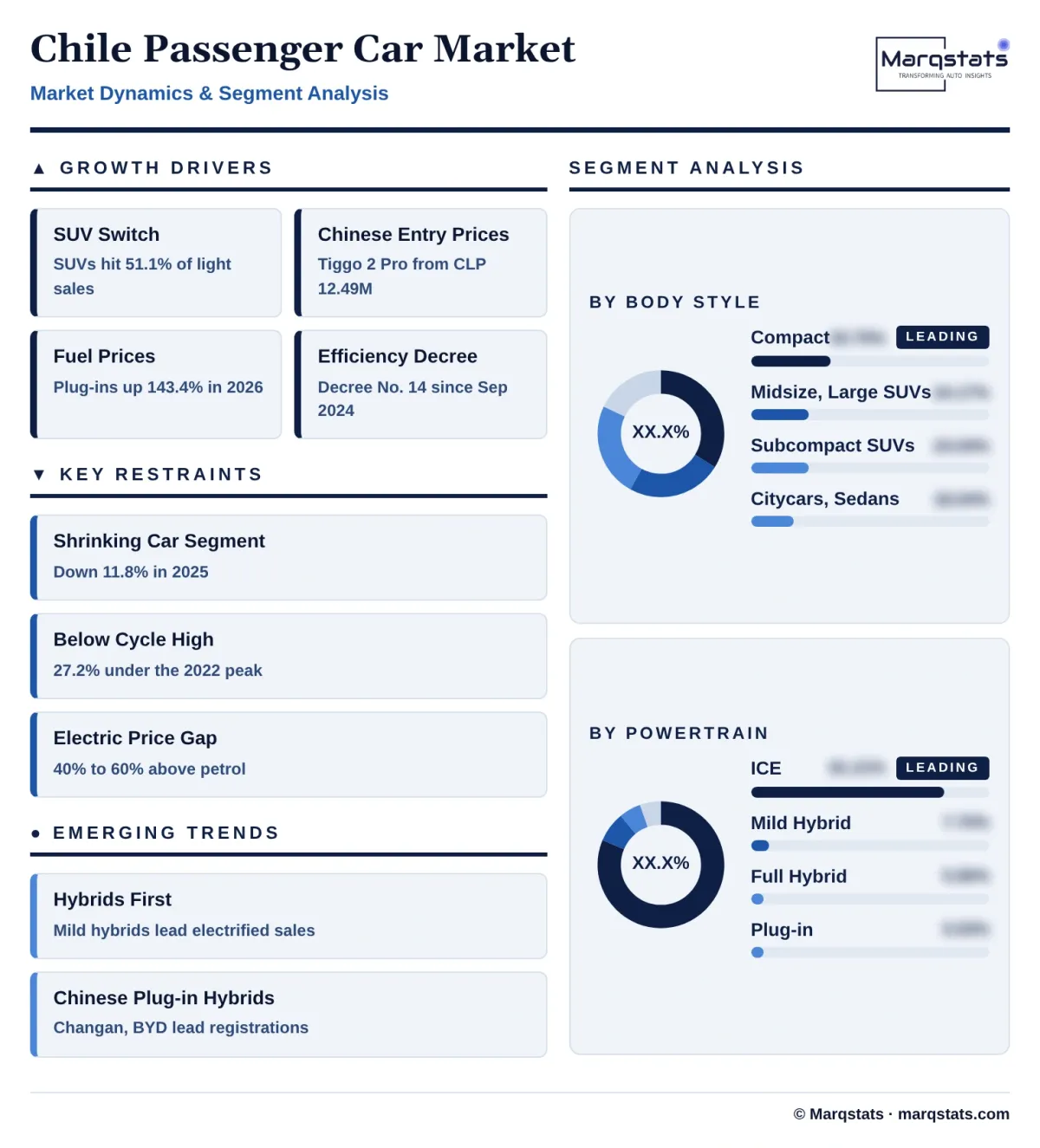
- SUVs keep winning the household purchase. ANAC counted 158,700 SUV registrations in 2025, up 7.6%, and 129,576 in January to September 2026, up 10.1%, taking the SUV share of the light and medium market from 48.8% in 2024 to 51.1% in 2025 and 54.63% by September 2026. A compact SUV sells for about CLP 22.0 million on Marqstats estimates against CLP 14.1 million for a citycar or sedan, so each buyer who moves up adds value.
- Chinese brands widen the price ladder. China-built vehicles were 41.4% of light and medium registrations in 2025, against 39.6% in 2024, and the Chery Tiggo 2 Pro lists at CLP 12.49 million. Free trade agreements cut the 6% general tariff to zero, so Chery, Changan, GWM, MG, Omoda | Jaecoo and BYD can price directly against Japanese and Korean rivals.
- Electrified models gain from fuel prices and supply. Plug-in registrations reached 12,702 units in January to August 2026, up 143.4% and 6.2% of the light and medium market, and 9,978 in January to June, up 165.4%. The Clinic reported on 21 April 2026 that higher petrol prices, not incentives, lifted electric car sales, and a BYD vessel brought 1,918 electric and plug-in hybrid vehicles to San Antonio in August 2026.
- The market is still below its cycle. The 310,598 light and medium vehicles sold in 2025 compare with 426,777 in 2022 and a ten-year average of about 348,000, and ANAC points to demand from trucks, electric vehicles and plug-in hybrids in 2026. The gap to the cycle leaves room for replacement demand as the 2022 peak purchases age.
- Efficiency and emissions rules reshape every range. Decree No. 14 has been in force since 23 September 2024 and ANAC reported that 2025 vehicles averaged 16.9 kilometres per litre in the mixed cycle, 9.2% better than the prior ten-year average. Importers answer with mild hybrids, which reached 16,675 registrations in 2025 and 16,897 in the first eight months of 2026.
Key Restraints
Four constraints hold volume below earlier peaks and slow the shift to plug-in vehicles.
- The statutory car is losing buyers. Vehículos de Pasajeros fell 11.8% to 54,277 units in 2025 and a further 8.3% to 38,669 in January to September 2026, as buyers who once chose a Chevrolet Sail, listed from CLP 9.99 million in 2024, move to a subcompact SUV such as the Chery Tiggo 2 Pro at CLP 12.49 million. That drag removes about 14,000 units from the segment by 2030.
- Volume has not recovered the cycle high. Light and medium sales of 310,598 in 2025 remain 27.2% below the 426,777 of 2022, and ANAC described 2025 as below the average of the last decade. With volume still well under the cycle high, Marqstats holds registration growth to about 1.4% to 1.5% a year from 2027.
- Plug-in vehicles still cost more. Autocosmos reported in February 2026 that an electric car costs 40% to 60% more than a combustion equivalent, with entry urban models at about CLP 15 to 20 million and mid-range models rarely below CLP 25 million. Chile offers no scrappage scheme or personal tax credit, plug-ins pay 25% of the circulation permit until 31 January 2027, and non-plug-in hybrids pay it in full.
- Charging is thin outside Santiago. The Superintendencia de Electricidad y Combustibles counted 2,088 public charging points at the end of 2025, with 700 added in the year and 363 fast chargers above 50 kilowatts in total, and more than half sit in the Región Metropolitana. Fast CCS Type 2 points on Ruta 5 Sur reached only 86, which limits long-distance use of plug-in cars.
Key Trends
Four shifts are changing which passenger cars Chilean buyers choose and how they are powered.
- Hybrids come before plug-ins. Mild hybrids were 47.05% of the 35,443 zero and low-emission registrations of 2025, led by Suzuki with 55.8% of the category, and full hybrids were 28.25%, led by Toyota with 55.7%. Models such as the Suzuki Fronx and Swift and the Toyota Corolla Cross and Yaris Cross give importers efficiency credit without charging infrastructure.
- Plug-ins move from niche to volume. Tesla, BYD and Volvo led 2025 battery-electric sales, and in January to August 2026 Tesla reached 1,992 units, 28.9% of battery-electric registrations, with the Model Y at 1,082 and the Model 3 at 909. Undersecretary of Energy Hugo Briones said in August 2026 that electromobility is ceasing to be a niche technology.
- Chinese plug-in hybrids spread. Changan led plug-in hybrid and range-extender registrations in January to August 2026 with 1,539 units, 26.5%, ahead of BYD with 1,185, Riddara with 425, Chery with 309 and Omoda | Jaecoo with 288, and plug-in range-extended models reached 845 units, up 1,590%.
- The entry SUV is replacing the entry car. A September 2026 ranking based on ANAC data places the Suzuki Fronx first among SUVs with 5,038 units and the MG ZX second with 4,238, while the best-selling cars, the Kia Soluto at 4,096 and Suzuki Swift at 4,074, trail the top SUVs.
Strategic Implications
- For importers and brand owners, the product plan has to start from the subcompact and compact SUV and treat the citycar as a halo for entry prices. A brand that sells only hatchbacks and sedans is selling into a category that fell 11.8% in 2025, while a Chinese brand with a plug-in hybrid SUV at a price near CLP 20 million can reach the fastest-growing part of the market.
- For manufacturers of electric cars, the first buyers of cars are the buyers to defend. Battery-electric vehicles are 3.90% of statutory cars against 1.72% of SUVs, so city hatchbacks and sedans from Tesla, BYD and Renault have the best fit now, and a compact electric SUV is the gap that decides volume after 2027.
- For distributors and dealers, hybrids are the lowest-risk way to meet the efficiency decree. Mild hybrids reached 16,675 units in 2025 and full hybrids 10,014, and each plug-in sold earns extra weight in fleet averages, so multi-brand groups can balance higher-emission SUVs against electrified ones without waiting for charging networks.
- For lenders and leasing companies, residual values are the open question. With plug-ins at 3.55% of in-scope units in 2025 and 18.00% by 2030, financiers that price used electric cars from observed resale data, as they now do for combustion cars, can win the market that grows fastest.
- For charging and service providers, the demand map starts in Santiago and follows Ruta 5. The capital holds 59.66% of value and more than half of public chargers, so networks that add fast chargers between Santiago, Valparaíso and Biobío, and in the northern mining regions, reach the plug-in buyers who travel long distances.
Market Segmentation
ANAC's Vehículos de Pasajeros account for 18.04% of 2025 value, USD 802.26 million, and shrink at 4.50% a year to USD 637.36 million by 2030. Units fall from 54,277 to 40,000. The five leaders, the Suzuki Baleno hatchback at 5,837 units, Kia Soluto at 5,748, Hyundai Grand i10 at 4,392, Chevrolet Sail at 3,570 and Suzuki Swift at 3,124, sold 22,671 units, 41.77% of the category.
Subcompact SUVs account for 24.04% of 2025 value, USD 1,069.05 million, and grow at 4.92% a year to USD 1,359.52 million. Marqstats estimates about 66,654 units in 2025, led by the Chery Tiggo 2 at 6,245 units and the Chevrolet Groove at 5,230, with the Suzuki Fronx rising in 2026. They are the entry point for first-time buyers leaving citycars.
Compact SUVs are the largest class, with 33.75% of 2025 value, USD 1,500.59 million, and grow at 6.02% a year to USD 2,010.03 million and 35.81% of the market. About 65,067 units were sold in 2025, including the GWM Jolion at 4,853, Omoda C5 at 4,758 and Mazda CX-5 at 4,752, and the class includes hybrids such as the Toyota Corolla Cross and Hyundai Tucson.
Midsize and large SUVs account for 24.17% of 2025 value, USD 1,074.70 million, and grow fastest, at 8.35% a year, to USD 1,604.64 million and 28.60% of the market. About 26,979 units were sold in 2025, from the Toyota RAV4 and Volvo XC60 to the Tesla Model Y and German premium SUVs, and electrified models make up a growing part of the class.
Petrol and diesel vehicles account for 81.21% of 2025 value, USD 3,611.36 million, and fall at 4.45% a year to USD 2,876.96 million and 51.26% of the market. Units fall from 180,001, 84.51% of the total, to 139,535, as ANAC data put combustion at 88.6% of the whole light and medium market in 2025 against 93.7% in 2024.
Mild hybrids with 12-volt and 48-volt systems account for 7.70% of 2025 value, USD 342.25 million, and grow at 16.37% a year to USD 730.46 million. In-scope units rise from 15,943 to 33,110, led by Suzuki, which sold 4,325 Fronx and 2,833 Swift hybrids in 2025, and by Peugeot's 3008 and 2008.
Full hybrids and extended-range hybrids account for 5.56% of 2025 value, USD 247.20 million, and grow at 18.21% a year to USD 570.52 million. Units rise from 9,478 to 21,285, with Toyota's Corolla Cross at 2,329, Yaris Cross at 1,711 and RAV4 at 1,348, and the Hyundai Kona at 1,395, the volume leaders.
Plug-in hybrids, including plug-in range extenders, account for 2.14% of 2025 value, USD 94.97 million, and grow fastest, at 46.46% a year, to USD 640.02 million and 11.41% of the market. In-scope units rise from 2,705 to 17,738, led by the Changan CS55 Plus IDD at 542 units in 2025, BYD's Song models and the Volvo XC60 at 378.
Battery-electric vehicles account for 3.39% of 2025 value, USD 150.82 million, and grow at 39.39% a year to USD 793.59 million and 14.14% of the market. In-scope units rise from 4,850 to 24,832, and the 2025 leaders were the Volvo EX30 at 677, Tesla Model Y at 553 and Model 3 at 431, the Renault Kwid E-Tech at 283 and the BYD Dolphin Mini at 269.
Chinese brands account for 26.97% of 2025 value, USD 1,199.43 million, and grow fastest, at 10.04% a year, to USD 1,935.44 million and 34.49% of the market. Marqstats estimates 30.58% of 2025 units, 65,128, rising to 38.50% in 2030, led by Chery, Changan, GWM, MG and Omoda | Jaecoo.
Japanese brands account for 26.29% of 2025 value, USD 1,168.95 million, and grow at 2.93% a year to USD 1,350.77 million. Toyota, Suzuki, Mazda, Mitsubishi and Subaru hold an estimated 26.62% of 2025 units, and their hybrids keep the group's value share near 24.07% in 2030.
Korean brands account for 16.55% of 2025 value, USD 735.76 million, and grow at 3.09% a year to USD 856.80 million. Hyundai and Kia, with the Soluto, Grand i10, Kona and Sonet, hold an estimated 17.61% of 2025 units and ease to 16.00% by 2030.
European, American and other brands account for 30.19% of 2025 value, USD 1,342.46 million, and grow at 1.81% a year to USD 1,468.54 million. Peugeot, Citroën, Volkswagen, Volvo, Chevrolet, Ford, Jeep and Tesla hold an estimated 25.19% of 2025 units, and the group has the highest average price of the four.
By Geography
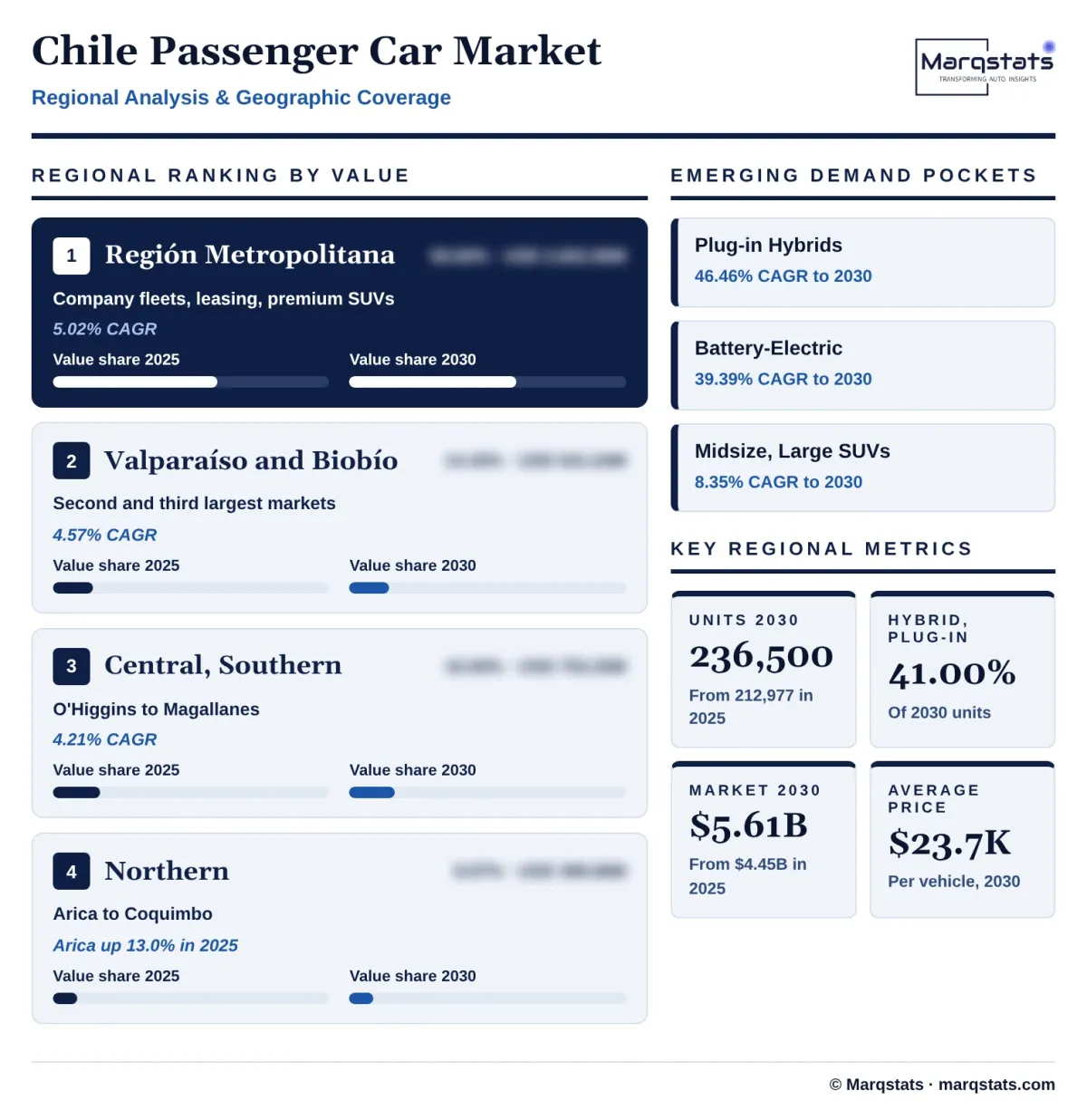
Región Metropolitana
The Región Metropolitana accounts for 59.66% of 2025 value, USD 2,652.85 million, and grows at 5.02% a year to USD 3,389.37 million and 60.40% by 2030. ANAC counted 185,296 light and medium registrations in the region, up 6.3%, while the national total rose 2.7%. ANAC reports registrations by place of registration, so vehicles bought by Santiago-based companies and leasing firms may be registered in the capital and driven elsewhere, and Marqstats allocates value by registration.
Valparaíso and Biobío
Valparaíso and Biobío account for 14.43% of 2025 value, USD 641.64 million, and grow at 4.57% a year to USD 802.45 million. ANAC counted 27,045 registrations in Valparaíso, down 0.3%, and 17,787 in Biobío, down 5.6%, and together they form the second and third largest regional markets.
Central and Southern Regions
The Central and Southern Regions account for 16.94% of 2025 value, USD 753.25 million, and grow at 4.21% a year to USD 925.91 million. O'Higgins, Maule, Ñuble, Araucanía, Los Ríos, Los Lagos, Aysén and Magallanes registered 52,622 light and medium vehicles in 2025, and seven of the eight fell, led by Los Ríos at 10.0% and Aysén at 8.0%.
Northern Regions
The Northern Regions account for 8.97% of 2025 value, USD 398.86 million, and grow at 4.36% a year to USD 493.82 million. Arica y Parinacota, Tarapacá, Antofagasta, Atacama and Coquimbo registered 27,848 vehicles, with Arica up 13.0%, Tarapacá up 8.3% and Antofagasta up 6.8%, a pattern ANAC highlighted for the extreme regions, while Coquimbo fell 4.1% and Atacama 1.2%.
How Competition Is Evolving
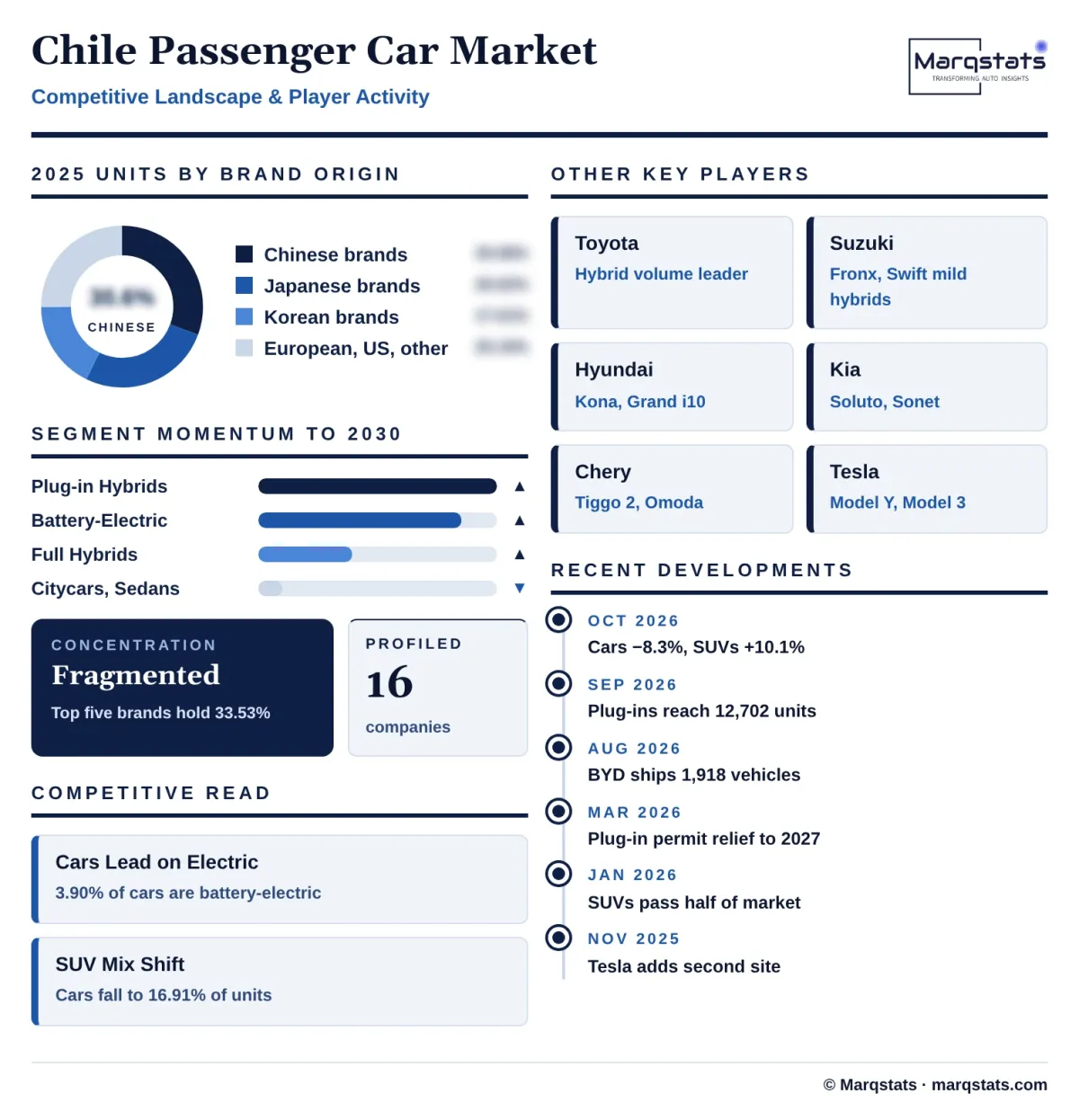
The market is fragmented. ANAC reported that Toyota (24,281 units), Hyundai (21,637), Suzuki (21,521), Kia (18,807) and Chevrolet (17,893) together sold 104,139 light and medium vehicles in 2025, 33.53% of the total, and no brand holds more than 7.8%. Ford (16,069), GWM (15,361), Peugeot (15,259), Changan (12,468), Mitsubishi (11,367), Mazda (9,760), MG (9,562) and Chery (9,336) follow, and these totals include pickups and vans, so passenger car and SUV shares are lower for brands such as GWM, whose Poer pickup sold 7,401 units.
By brand origin, Marqstats estimates Chinese brands at 30.58% of 2025 passenger car and SUV units, Japanese brands at 26.62%, Korean brands at 17.61% and European, American and other brands at 25.19%. The estimate starts from ANAC's brand-origin shares for all light and medium vehicles, 32.4% Chinese, 26.3% Japanese, 14.0% Korean, 13.2% American, 7.4% French and 5.2% German, and removes the pickups and vans where American and Chinese brands are strongest.
Japanese and Korean brands defend volume with hybrids and price. Toyota sold 5,582 full hybrids in 2025, 55.7% of the category, and Hyundai 2,231, 22.3%, while Suzuki sold 9,300 mild hybrids, 55.8%, and Peugeot 4,081, 24.5%. Chinese brands answer with price and plug-in hybrids: Changan sold 772 plug-in vehicles in 2025 and in January to August 2026 led plug-in hybrid and range-extender registrations with 1,539 units, while BYD registered 743 battery-electric and 1,185 plug-in hybrid vehicles in the same eight months.
Tesla is the plug-in benchmark. It sold 986 battery-electric vehicles in 2025, 17.9% of the category, and 1,992 in January to August 2026, 28.9%, while BYD held 10.8% and Volvo 7.0%. Competition is shifting from price to powertrain mix, because Decree No. 14 measures each importer's certified fleet, so a surplus on efficient models offsets a deficit on others, and brands that can offer a hybrid or plug-in in every size class have more room than brands with one electrified model.
Companies Covered
Companies covered in the report include:
Recent Market Activity
Table of Contents
Coverage & Segmentation
The study covers the Chile passenger car market, with 2025 as the base year, 2021 – 2025 as the historical period and 2026 – 2030 as the forecast period. It covers new Vehículos de Pasajeros and SUVs registered in Chile, segmented by body style and size, powertrain, brand origin and region. Values are retail prices including 19% IVA and the green tax, in US dollars at CLP 953.94 per US dollar, and registrations follow ANAC and the Registro Civil.
Pickups (camionetas, 63,429 units in 2025), commercial vans (34,192), trucks, buses, motorcycles and used cars are excluded. ANAC's light and medium total of 310,598 units equals 212,977 passenger cars and SUVs plus 63,429 pickups and 34,192 commercial vans. Segment and regional splits are Marqstats estimates built on ANAC registrations, price lists and powertrain counts. Live Marqstats reports on Chile EV maintenance and Chile software-defined vehicles measure services and software, and their figures should not be added to this market.