Market Snapshot
Middle bar: base-year value × (1 + CAGR), rounded to two decimals. This is a calculated illustration, not a separately researched annual estimate.
The Argentina passenger car market size is estimated at USD 10,027.82 million in 2025 and is projected to reach USD 11,751.66 million by 2030, growing at a CAGR of 3.22% over 2026 – 2030. Registrations of new cars rise from 410,057 in 2025 to 448,000 in 2030, a 1.79% annual rate, and the average price before value added tax rises from about USD 24,455 to USD 26,231 as sport utility vehicles and electrified cars take a larger share.
Marqstats defines the market as the retail transaction value, excluding the 21% value added tax (IVA), of new passenger cars registered for the first time in Argentina, measured as 0 km registrations of the autos category in the Dirección Nacional de los Registros Nacionales de la Propiedad del Automotor (DNRPA) series published by the Asociación de Concesionarios de Automotores de la República Argentina (ACARA). It covers hatchbacks, sedans, sport utility vehicles and crossovers of all fuel types. Pickups, vans, light commercial vehicles, heavy trucks, used cars and motorcycles are excluded.
Sport utility vehicles and crossovers account for 49.18% of 2025 value, petrol and diesel cars for 91.20% and cars built in Brazil for 41.46%. Buenos Aires Province, the largest single jurisdiction, accounts for 28.60% of value, while plug-in hybrid and battery-electric cars grow fastest, at 64.65% a year from a base of 4,300 cars.
Key Takeaways
Market Overview & Analysis
Report Summary
Marqstats sizes the Argentina passenger car market as the retail transaction value, excluding the 21% IVA, of new cars registered for the first time in the country. A car here is a vehicle of category M1 registered by ACARA in the autos category, whatever its body style or fuel, from a Fiat Mobi or Renault Kwid at the entry point to a Mercedes-Benz GLC or a BYD plug-in hybrid. Pickups such as the Toyota Hilux and Ford Ranger, and vans such as the Renault Kangoo, are light commercial vehicles in the ACARA series and sit outside this market.
The scope is easiest to see as a ladder. ACARA registered 612,178 four-wheel vehicles in 2025, 47.8% more than the 414,211 of 2024. Removing heavy commercial vehicles and other categories of 32,775 leaves 579,403 light vehicles, and removing 169,346 light commercial vehicles, of which 125,694 are pickups, leaves 410,057 cars. ACARA also recorded more than 650,000 motorcycles in 2025, which are not part of the ladder. The January to November 2025 series shows 394,709 cars against 161,826 light commercial vehicles and 20,175 heavy vehicles, so the 410,057 total implies about 15,348 cars in December.
The market is a rebound market. Cars were 260,840 in 2022 and 274,708 in 2023, fell to about 262,000 in 2024 as the peso and import controls squeezed supply, and then rose 56.51% to 410,057 in 2025. Three forces explain the jump: the January 2025 cut in internal taxes on mid-priced and luxury cars, the April 2025 move from a tightly managed exchange rate to a floating band, and a credit boom in which 47.2% of new vehicles registered from January to April 2025 were financed, against a five-year average of 37%.
The surge did not last. ACARA recorded 435,493 vehicles from January to September 2026, 13% fewer than the 500,497 of the same period of 2025, and 49,814 in September, 11.4% fewer than a year earlier, with imports at 69% of the total. Marqstats estimates 2026 car registrations at 368,000, a 10.26% fall, and value at USD 9,123.70 million, a 9.02% fall, before growth resumes at 4.62% in 2027.
Policy, not only demand, decides the mix. Decreto 49/2025 opened a zero-duty quota of 50,000 hybrid and electric vehicles a year, and Decreto 1128/2026, published on 30 September 2026, lets battery-electric cars with a free-on-board price up to USD 35,000 enter duty-free while hybrids and plug-in hybrids stay capped at USD 18,000 and mild hybrids at USD 16,000. Outside the quota, cars from outside the Mercosur pay the common external tariff of 35%, so Brazilian-built cars and quota imports hold the price advantage.
Argentina Passenger Car Market Size and Forecast
The Argentina passenger car market grows from USD 10,027.82 million in 2025 to USD 11,751.66 million in 2030, a CAGR of 3.22%. Price and mix contribute more than volume: registrations rise at 1.79% a year, from 410,057 to 448,000 cars, and the average value per car rises at 1.41% a year, from about USD 24,455 to USD 26,231 before IVA at constant 2025 exchange rates, as sport utility vehicles and electrified cars take a larger share. In pesos at ARS 1,246.49 per US dollar the 2025 market is about ARS 12.50 trillion before IVA.
The 2025 value is built bottom-up from body styles and models. ACARA-tracked segment counts put sport utility vehicles at 176,095, hatchbacks at 175,408 and sedans at 57,251 of 408,754 car units, which Marqstats scales to the 410,057 cars in the DNRPA series: 176,656 sport utility vehicles, 175,967 hatchbacks and 57,434 sedans. Prices are Marqstats estimates anchored on August 2025 entry lists, such as ARS 27.96 million for the Fiat Cronos, ARS 28.54 million for the Peugeot 208 and ARS 28.32 million for the Toyota Yaris, and on version ladders from January 2026 lists. They give weighted average prices of ARS 32.10 million for hatchbacks, ARS 42.11 million for sport utility vehicles and ARS 35.47 million for sedans including IVA.
The path is a dip and a recovery. Marqstats expects registrations of 368,000 cars in 2026, then 385,000 in 2027, 410,000 in 2028, 430,000 in 2029 and 448,000 in 2030, annual changes of -10.26%, 4.62%, 6.49%, 4.88% and 4.19%. Value follows at -9.02%, 6.08%, 8.00%, 6.38% and 5.69%. The 2030 volume is only 9.25% above 2025, which treats 2025 as a catch-up year and not as a new baseline.
Electrification adds value faster than volume. Electrified cars rise from 25,943 units, 6.33% of 2025 registrations, to 86,000 units, 23.37%, in 2026 and 180,544 units, 40.30%, in 2030. The 2025 base follows the 26,632 electrified vehicles recorded across all light vehicles, 4.6% of the market, less 689 Ford Maverick pickups, and the 2026 figure follows 42,238 electrified registrations in the first half of 2026, 15.2% of cars and light commercial vehicles.
Marqstats tracks four indicators to monitor the forecast: monthly ACARA registrations of the autos category, the allocation rounds for the 50,000-unit duty-free quota, the peso against the dollar inside the widening exchange-rate band, and the share of new vehicles sold with financing. A sustained fall in financed sales below the 37% five-year average would move registrations toward the 2023 level of 274,708, while a larger quota would raise the electrified share above the base forecast.
Market Dynamics
Key Drivers
Five forces are lifting demand for new cars in Argentina even as the market digests the 2025 surge.
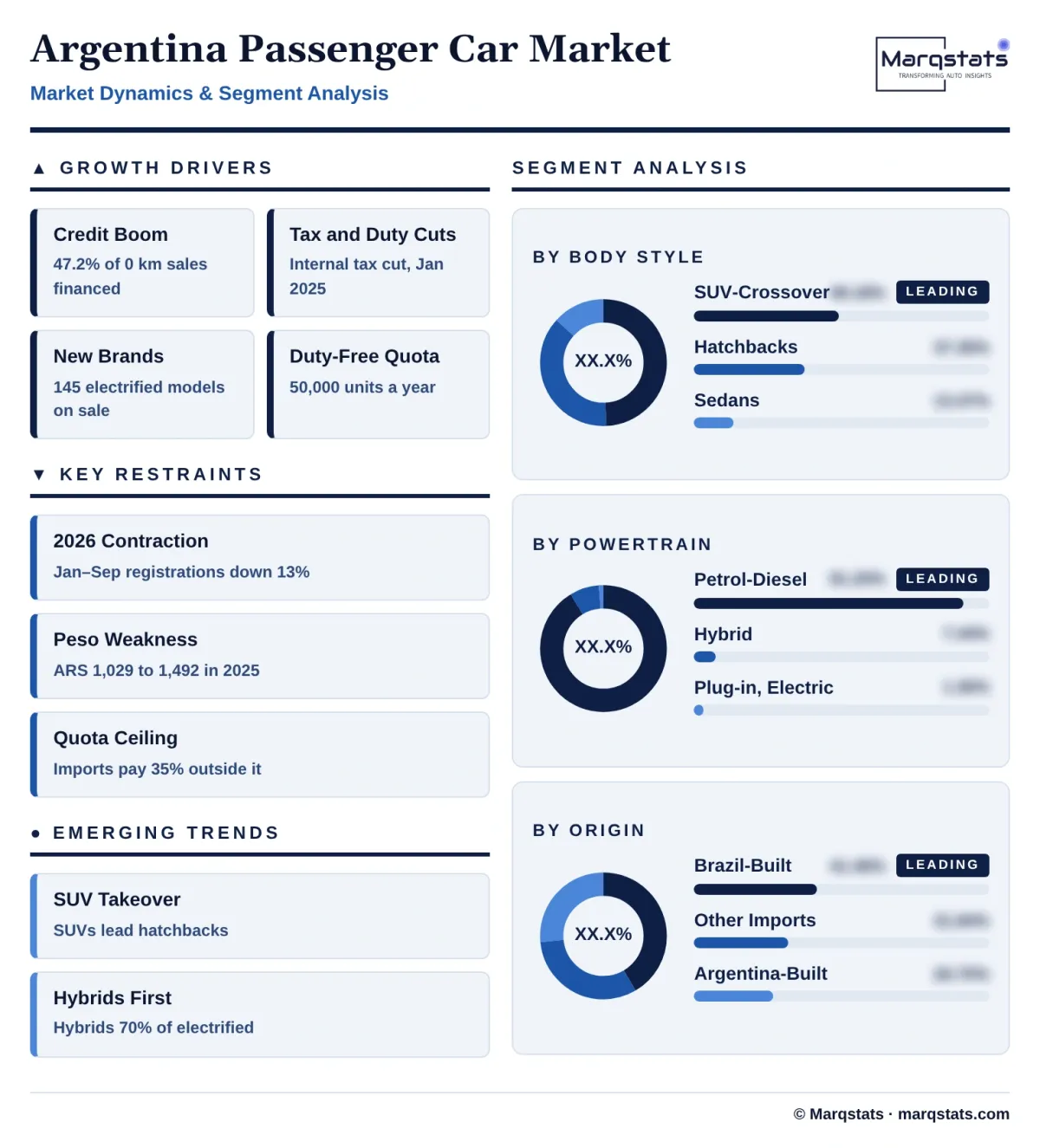
- Credit made 2025. SIOMAA data for April 2025 showed 46.7% of new vehicles registered that month were sold with financing, and 47.2% from January to April against a five-year average of 37%, with 102,319 new-vehicle pledges in four months against 42,630 a year earlier. Manufacturer finance rose from 15% to 39% of the mix, and Fiat, Peugeot, Citroën and Jeep brands financed up to 85% of the price, so cheaper credit pulled forward demand that incomes alone would not have supported.
- Lower taxes and duties widened supply. The government cut internal taxes on cars on 28 January 2025, removing the 20% rate on cars priced between ARS 41 million and ARS 75 million and lowering the top rate above ARS 75 million from 35% to 18%. Imports from outside the Mercosur still pay 35% unless they enter the electrified quota, but the easing of exchange controls in April 2025 let importers restock showrooms that had been thin in 2024.
- Chinese and other new brands add choice. A total of 145 electrified models were on sale in the first half of 2026 against 87 a year earlier, with 50 added in 2026, and 58 models from 29 brands have entered under the duty-free regime so far. BYD, BAIC, Great Wall Motor and Chery bring new nameplates and the first mid-priced alternatives to Brazilian-built hybrids, which widens the choice for new-car buyers.
- A duty-free electrified quota changes the price ladder. Decreto 49/2025 allows 50,000 hybrid and electric vehicles a year at zero duty, three allocation rounds have enabled 100,000 units, and 68,792 had entered by October 2026. Decreto 1128/2026 then raised the price cap for battery-electric cars to USD 35,000, which opens the quota to mid-priced models and to Tesla, whose sales start depends on the 2027 quota allocation.
- Deferred replacement returns. The national parc is about 14.5 million vehicles according to ACARA and SIOMAA in August 2026, while new-car registrations were only about 262,000 in 2024, so replacement demand held back in the years of import controls returns when credit and prices allow it.
Key Restraints
Four constraints keep registrations below the 2025 peak in 2026 and slow the shift to electrified cars.
- The 2026 contraction shows how credit-led demand fades. ACARA recorded 435,493 vehicles from January to September 2026, 13% below the same period of 2025, and September fell 11.4% year on year to 49,814. Dealers cleared stock built up in 2025, and ACARA President Sebastián Beato said imports reached about 70% of units, which leaves local factories exposed to the weaker months.
- Peso weakness resets prices. The peso moved from ARS 1,028.65 per dollar on 2 January 2025 to ARS 1,491.84 on 24 October 2025, and the entry Toyota Yaris XS CVT list rose from ARS 24.02 million in February 2025 to ARS 32.47 million in December 2025, a gain of 35.19%. Imported cars follow the dollar faster than wages, so affordability worsens whenever the band is tested.
- The quota is a ceiling. Zero duty applies to only 50,000 hybrid and electric imports from outside the Mercosur a year, while electrified registrations, including Brazilian-built hybrids that do not use the quota, ran at 42,238 in the first half of 2026 alone. Imports outside the quota pay the 35% common external tariff, and the Disposición and Resolución rules that allocate the quota between assemblers and importers can change each year.
- Charging is thin. About 3.5 charging points existed per 100 electrified vehicles in mid-2026, against 8 in Chile, and only 15% were fast chargers. Plug-in and battery-electric cars therefore sell in Buenos Aires, Córdoba and Mendoza first, and apartment dwellers elsewhere cannot charge at home.
Key Trends
Four shifts are changing which cars Argentines buy, where they are built and how they are powered.
- The sport utility vehicle replaces the hatchback. Ten sport utility vehicles each sold more than 9,700 units in 2025, led by the Toyota Corolla Cross, Chevrolet Tracker and Volkswagen Taos, and registration counts published from ACARA data show sport utility vehicles at 176,095 units, just ahead of hatchbacks at 175,408.
- Hybrids arrive before batteries. Full hybrids were 76% of 2025 electrified sales, the Toyota Corolla Cross alone registered 9,142 hybrids, and in the first half of 2026 hybrids were 55%, mild hybrids 15%, plug-in hybrids 21% and battery-electric cars 9% of 42,238 electrified registrations.
- Chinese brands scale in electrified cars. Chinese brands supplied about 90% of battery-electric and 78% of plug-in hybrid registrations in the first half of 2026, and BYD led battery-electric sales with 565 cars in September 2026 against 300 for the other 19 brands combined.
- Premium and global entrants test the new cap. Tesla is preparing to enter Argentina with the Model 3 and Model Y, and its sale date depends on the 2027 quota allocation, while the USD 35,000 cap now fits mid-priced battery-electric cars from several brands.
Strategic Implications
- For global car makers entering Argentina, the practical route is the electrified quota, not the combustion car. Cars outside the quota carry a 35% common external tariff, while quota imports enter at zero duty up to USD 35,000 for battery-electric models, so an entrant that wins an allocation can price against Brazilian-built cars from day one.
- For incumbents with Argentine plants, the lesson is that export volume cannot replace home-market relevance. With about 47% of car output exported and only about a quarter of registered cars Argentine-built, Stellantis Argentina S.A., Toyota Argentina S.A. and Volkswagen Argentina S.A. gain most by moving local models toward the sport utility vehicle and hybrid segments that grow fastest.
- For dealers and distributors, the 2026 contraction argues for inventory discipline. With imports near 69% to 70% of units and stock cleared during 2026, dealers that hold less imported stock at today's exchange rate, and that price hybrids and sport utility vehicles ahead of hatchbacks, protect margin as registrations recover at 4.62% in 2027.
- For lenders and manufacturer finance arms, the 2025 boom shows that credit sets the market. A financed share near 47% lifted registrations, and a return to the 37% average would lower them, so lenders that lend against used-car values and hybrid residuals can hold volume as rates change.
- For charging and service providers, the opportunity is concentrated. Electrified cars reach about 40% of units by 2030, but charging points per vehicle are low and the first buyers sit in a few provinces, so installers should start with Buenos Aires, Córdoba, Santa Fe and Mendoza.
Market Segmentation
Hatchbacks account for 37.35% of 2025 value, USD 3,745.07 million, and grow only 0.14% a year to USD 3,770.44 million, while their share of value falls to 32.08%. About 175,967 units were registered in 2025, led by the Toyota Yaris at 30,150, the Peugeot 208 at 29,092 and the Volkswagen Polo at 21,324, at a weighted price of about ARS 32.1 million including IVA. Units fall 0.66% a year as buyers move to sport utility vehicles.
Sport utility vehicles and crossovers account for 49.18% of 2025 value, USD 4,932.06 million, and grow 5.90% a year to USD 6,569.99 million and 55.91% of the market. About 176,656 units were registered in 2025, led by the Toyota Corolla Cross at 18,151, Chevrolet Tracker at 17,647, Volkswagen Taos at 16,523, Peugeot 2008 at 15,347 and Ford Territory at 14,063. Hybrids and quota imports concentrate in this body style.
Sedans account for 13.47% of 2025 value, USD 1,350.69 million, and grow 0.88% a year to USD 1,411.23 million, with share easing to 12.01%. About 57,434 units were registered in 2025, anchored by the Fiat Cronos at 29,905, the most-sold Argentine-built car, with the Toyota Corolla, Volkswagen Virtus and Renault Logan behind it. Share holds near 13% because the Cronos gives the body style a high-volume local anchor.
Petrol and diesel cars account for 91.20% of 2025 value, USD 9,144.79 million, and 93.67% of units, and shrink 8.05% a year in value to USD 6,012.27 million and 51.16% of the market. The segment is still the volume base, with 384,114 cars in 2025 and 267,456 in 2030, and it is where Brazilian-built hatchbacks and Argentine-built Cronos and 208 compete.
Hybrid and mild hybrid cars account for 7.44% of 2025 value, USD 746.18 million, and grow 40.49% a year to USD 4,083.54 million and 34.75% of the market. Marqstats estimates 21,643 units in 2025, led by the Toyota Corolla Cross at 9,142, the Toyota Corolla at 3,651, the BAIC BJ30 at 2,246 and the Renault Arkana at 1,165, rising to 125,440 units in 2030.
Plug-in hybrid and battery-electric cars account for 1.36% of 2025 value, USD 136.85 million, and grow fastest, at 64.65% a year, to USD 1,655.85 million and 14.09% of the market. Marqstats estimates 4,300 units in 2025, with 1,117 battery-electric cars registered from January to November, and 55,104 units in 2030 as the USD 35,000 cap and the 50,000-unit quota support BYD and new entrants.
Cars built in Brazil account for 41.46% of 2025 value, USD 4,157.12 million, and 46.34% of units, an estimated 190,000 cars, and grow 2.00% a year to USD 4,589.96 million. They include the Toyota Yaris, Corolla Cross, Volkswagen Polo, Renault Kardian and Jeep Compass, which enter without the 35% external tariff under Mercosur trade.
Cars imported from outside the Mercosur account for 31.84% of 2025 value, USD 3,193.03 million, and 27.81% of units, an estimated 114,057 cars, and grow fastest among origins, at 5.99% a year, to USD 4,271.17 million and 36.35% of the market. Chinese-built cars such as the Ford Territory and BYD models, European premium cars and quota imports from Asia and Mexico are in this group, at the highest average price of about ARS 42.2 million including IVA.
Argentine-built cars account for 26.70% of 2025 value, USD 2,677.67 million, and 25.85% of units, an estimated 106,000 cars, and grow 1.54% a year to USD 2,890.53 million. The Fiat Cronos, Peugeot 208 and 2008, Toyota SW4, Chevrolet Tracker, Volkswagen Taos and Renault Logan and Sandero are built in Argentina, but ADEFA recorded 95,297 car exports in 2025, including 27,571 SW4, 24,772 Cronos, 20,775 Peugeot 208 and 2008, 14,480 Tracker and 7,699 Taos.
By Geography
Buenos Aires Province
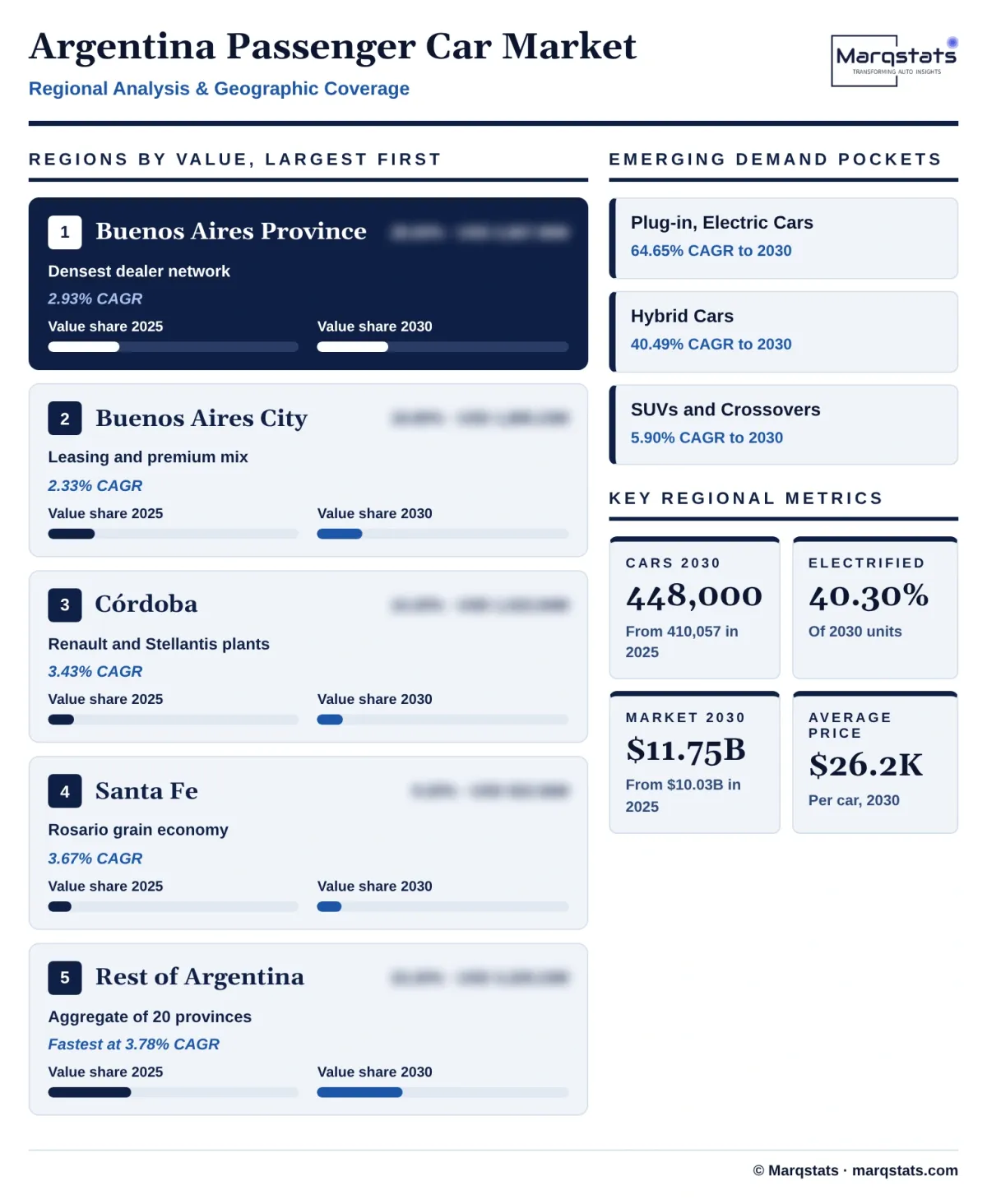
Buenos Aires Province is the largest single jurisdiction, with 28.60% of 2025 value, USD 2,867.96 million and about 117,276 cars, and grows 2.93% a year to USD 3,313.97 million. SIOMAA registration data for January to October 2024 gave the province 96,385 vehicles of all types, 28.6% of the national total, and Marqstats applies that share to cars. The Gran Buenos Aires belt, La Plata, Bahía Blanca and Mar del Plata carry the densest dealer network in the country.
Ciudad Autónoma de Buenos Aires
Ciudad Autónoma de Buenos Aires accounts for 18.80% of 2025 value, USD 1,885.23 million, and grows 2.33% a year to USD 2,115.30 million. The city recorded 63,215 vehicles from January to October 2024, 18.78% of the national total, and its share overstates local demand because leasing and fleet companies register vehicles at head offices. Marqstats allocates by registration, as lenders and dealers do, and the premium, hybrid and battery-electric mix is richest here.
Córdoba
Córdoba accounts for 10.20% of 2025 value, USD 1,022.84 million, and grows 3.43% a year to USD 1,210.42 million. The province registered 34,447 vehicles from January to October 2024, 10.24% of the total, and hosts the Renault and Stellantis plants that build the Sandero, Logan and Cronos, so local supply keeps demand for hatchbacks and compact sport utility vehicles steady.
Santa Fe
Santa Fe accounts for 9.20% of 2025 value, USD 922.56 million, and grows 3.67% a year to USD 1,104.66 million. Registrations were 54,220 vehicles from January to November 2025, 9.23% of the national total and 54.1% above a year earlier, and the Rosario area combines grain exporters, agricultural suppliers and a large middle-income city, which favours sport utility vehicles.
Rest of Argentina
Rest of Argentina accounts for 33.20% of 2025 value, USD 3,329.23 million, and grows fastest, at 3.78% a year, to USD 4,007.31 million and 34.10% of the market. Mendoza, which held 4% of registrations in 2024, Neuquén, Tucumán, Salta and the northeast add volume as credit reaches the interior, while Jujuy alone registered 7,475 vehicles of all types in 2025, 51% more than in 2024.
How Competition Is Evolving
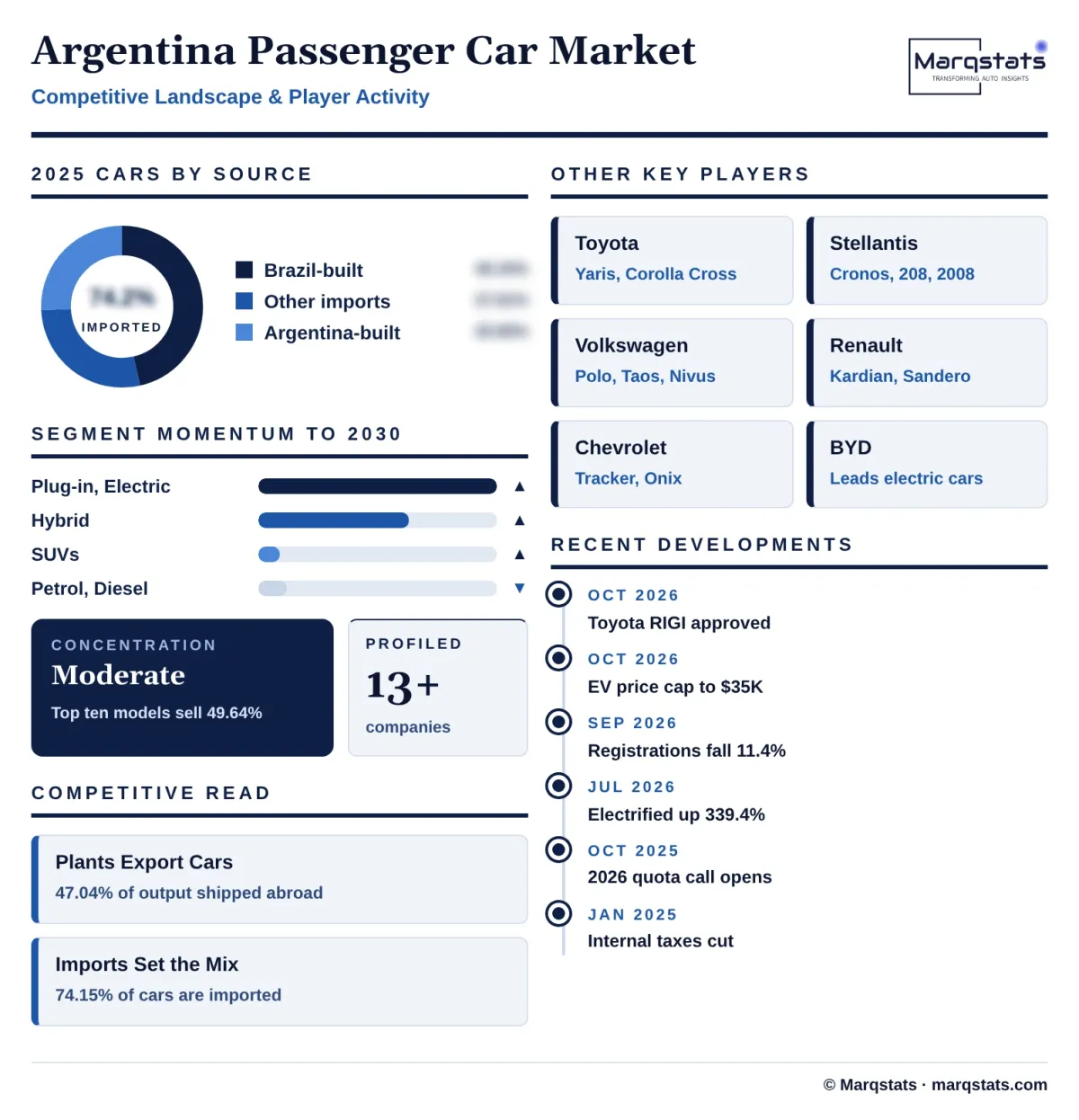
The market is moderately concentrated and led by four manufacturers with Argentine plants. ACARA reported 2025 registrations for all vehicle types of 97,081 for Toyota, 94,436 for Volkswagen, 74,752 for Fiat, 59,001 for Renault, 49,911 for Peugeot, 49,492 for Ford and 46,322 for Chevrolet, and the ten best-selling cars, the Toyota Yaris, Fiat Cronos, Peugeot 208, Volkswagen Polo, Toyota Corolla Cross, Chevrolet Tracker, Volkswagen Taos, Peugeot 2008, Ford Territory and Renault Kardian, delivered 203,545 registrations, 49.64% of the 410,057 cars in 2025.
Toyota Argentina S.A. leads through breadth. The Yaris, at 30,150 registrations, topped the car ranking, the Corolla Cross at 18,151 led the sport utility vehicles and also led hybrids with 9,142 units, and Toyota's approval under the Régimen de Incentivo para Grandes Inversiones (RIGI) on 22 October 2026 for a USD 1,341 million plant at Zárate targets a full-hybrid pickup with a possible sport utility vehicle on the same platform and about USD 1.28 billion of annual exports.
Stellantis Argentina S.A. and Volkswagen Argentina S.A. compete on volume and local content. The Fiat Cronos at 29,905 is built in Córdoba and the Peugeot 208 at 29,092 in El Palomar, and the Volkswagen Taos and Chevrolet Tracker at 16,523 and 17,647 are also built in Argentina, with exports of 7,699 and 14,480 units to the region. Renault Group relies on the Sandero and Logan from Córdoba and the imported Kardian at 11,343 units.
Competition is shifting from price to access. The duty-free quota and the USD 35,000 cap on battery-electric imports reward brands with Chinese supply chains, and BYD, BAIC, Great Wall Motor and Chery are taking share in the electrified segments, while Tesla, Inc. waits for the 2027 allocation. Marqstats expects imported cars outside Brazil to rise from 27.81% to 32.00% of units by 2030.
Companies Covered
Companies covered in the report include:
Recent Market Activity
Table of Contents
Coverage & Segmentation
The study covers the Argentina passenger car market, with 2025 as the base year, 2022 – 2025 as the historical period and 2026 – 2030 as the forecast period. It covers new passenger cars of the ACARA autos category registered for the first time in Argentina, segmented by body style, powertrain, origin and region. Values are retail transaction values excluding the 21% IVA, in US dollars at the 2025 average of ARS 1,246.49 per dollar, held constant across the forecast, and volumes are annual 0 km registrations.
Pickups, vans, light commercial vehicles of 169,346 units, heavy commercial vehicles and other categories of 32,775 units, motorcycles, used cars and exports are excluded. The Argentina pickup truck market, at 125,694 pickups and USD 4,433.80 million, is a separate Marqstats report and should not be added to this one. Segment and regional splits are Marqstats estimates built on ACARA and SIOMAA counts, ADEFA production and export data, and published list prices.
