Market Snapshot
Middle bar: base-year value × (1 + CAGR), rounded to two decimals. This is a calculated illustration, not a separately researched annual estimate.
The UAE Car Subscription market size is estimated at USD 127.63 million in 2025 and is projected to reach USD 325.80 million by 2030, growing at a CAGR of 20.61% over 2026 – 2030. The active subscription fleet grows from 15,500 to 36,500 vehicles, an 18.68% annual rate.
Marqstats defines the UAE Car Subscription market as recurring monthly revenue from all-inclusive car subscriptions that bundle the vehicle, insurance, maintenance, registration and roadside assistance into one fee on flexible terms from one month upward, sold through apps, online platforms, carmaker and distributor programmes and rental company subscription divisions. Daily and weekly spot rentals, multi-year operating leases, car sharing and peer-to-peer rental are excluded, as are tolls and traffic fines passed through to customers. In dirham terms, the market grows from AED 468.72 million to AED 1,196.50 million at 3.6725 dirhams per dollar.
Dubai accounts for an estimated 68.00% of 2025 value, Abu Dhabi 22.00% and the Northern Emirates 10.00%. Crossover and mid-size SUVs generate 41.00% of 2025 value and retail consumers 65.00%. The study segments the market by vehicle category, powertrain, subscription term, customer type and emirate.
Key Takeaways
Market Overview & Analysis
Report Summary
Marqstats sizes the UAE Car Subscription market as recurring revenue from all-inclusive monthly car subscriptions across the seven emirates. A subscription fee covers the vehicle, comprehensive insurance, scheduled maintenance, registration renewal and roadside assistance, usually with a monthly mileage allowance and the option to swap, extend or return the car. In 2025 the market was worth an estimated USD 127.63 million from an active fleet of 15,500 vehicles.
There is no separate licence for car subscriptions in the UAE. Every subscription car runs under the passenger car rental licensing rules of the emirate where it is registered, set in Dubai by the Roads and Transport Authority (RTA) and in Abu Dhabi by the Integrated Transport Centre (ITC). In Dubai, every rental contract, including monthly subscriptions, must be issued through the RTA's digital rental contract system, and each rental vehicle must carry approved tracking equipment.
Subscriptions sit between spot rental and leasing. Spot rental serves tourists, business travellers and drivers who need a car for days or weeks, at counters and airports. Operating leases tie companies and individuals to 24 to 48 month contracts. Subscriptions serve customers who need a car for one to twelve months or longer but do not want a loan, a long contract or a large deposit, and they are bought online with digital identity checks using an Emirates ID or passport.
The market grew more than fivefold between 2021 and 2025. Marqstats estimates the market at USD 24.32 million in 2021 with about 3,200 vehicles, rising to USD 45.47 million in 2022, USD 75.39 million in 2023 and USD 99.84 million in 2024, a 51.36% annual rate. Growth came from population inflows into Dubai and Abu Dhabi, new employment and residence visa routes, higher interest rates on car loans and the launch of dedicated platforms such as Carasti in late 2019 and MOOV by Al-Futtaim in November 2021.
Four provider models compete. Marketplace platforms such as Invygo and Selfdrive list cars owned by dealers and rental companies and earn commissions and service fees. Distributor programmes such as MOOV by Al-Futtaim use new cars from the group's own brands. Digital specialists such as Carasti combine partner fleets with their own delivery and service model. International rental companies such as Sixt, Hertz and Avis offer monthly and long-term plans from their existing fleets and branches.
Growth slows gradually as the market matures. Marqstats expects the fleet to reach 18,850 vehicles in 2026, 22,600 in 2027, 26,750 in 2028, 31,350 in 2029 and 36,500 in 2030. Value grows faster than the fleet because the mix shifts towards SUVs, hybrids, electric cars and longer contracts that include more services.
UAE Car Subscription Market Size and Forecast
The UAE Car Subscription market grows from USD 127.63 million in 2025 to USD 325.80 million in 2030, a CAGR of 20.61%. The fleet grows from 15,500 to 36,500 vehicles, an 18.68% annual rate. In dirhams, the market grows from AED 468.72 million to AED 1,196.50 million.
Marqstats estimates USD 156.45 million in 2026, USD 190.25 million in 2027, USD 229.45 million in 2028 and USD 274.65 million in 2029. Annual growth slows from 22.58% in 2026 to 18.62% in 2030 as the subscriber base widens and the market moves beyond early adopters among newly arrived expatriates.
Revenue per vehicle rises steadily. Average monthly revenue per active vehicle increases from about AED 2,326 in 2021 and AED 2,520 in 2025 to about AED 2,732 in 2030. The increase reflects the shift from small sedans to crossovers and SUVs, the growing share of hybrids and electric cars, and wider uptake of add-ons such as zero-excess insurance cover, rather than higher prices for the same cars.
Unit economics depend on keeping cars on contract. Marqstats estimates that on a typical AED 2,999 monthly plan, vehicle depreciation or wholesale fleet cost absorbs about AED 1,650, insurance about AED 270, maintenance about AED 210, delivery, cleaning and turnaround about AED 95, payment and fraud screening costs about AED 75, and tracking and connectivity about AED 65. That leaves about AED 634, or 21.14%, before overheads. Each week a car sits idle between contracts erodes that margin quickly.
Add-ons lift profitability. Zero-excess collision cover, typically priced at AED 200 to 350 a month, reduces the customer's accident liability to nothing and carries high margins because fleet accident rates are low and telematics data helps price risk. Extra mileage charges of about AED 0.30 to 0.50 per kilometre above the monthly allowance, and administration fees on tolls and fines, add further revenue.
Utilisation is the main advantage over spot rental. Spot rental companies typically need daily utilisation of 68% to 75% to cover airport concessions, counter staff and frequent turnarounds. Subscription contracts last three to nine months on average, so cars spend little time idle. MOOV by Al-Futtaim reported fleet utilisation of 92% after its first year, alongside 49% average monthly growth and more than 4,000 subscribers.
Fleet age rules shape remarketing. The RTA sets maximum ages for rental vehicles by vehicle class, so operators must sell or re-register cars as they age. Subscribe-to-Own plans, which let subscribers apply part of their payments towards buying the car after 24 to 36 months, give operators a built-in exit route for older vehicles and reduce reliance on the used car market.
Market Dynamics
Key Drivers
Five forces are moving UAE drivers from car loans to monthly car subscriptions.
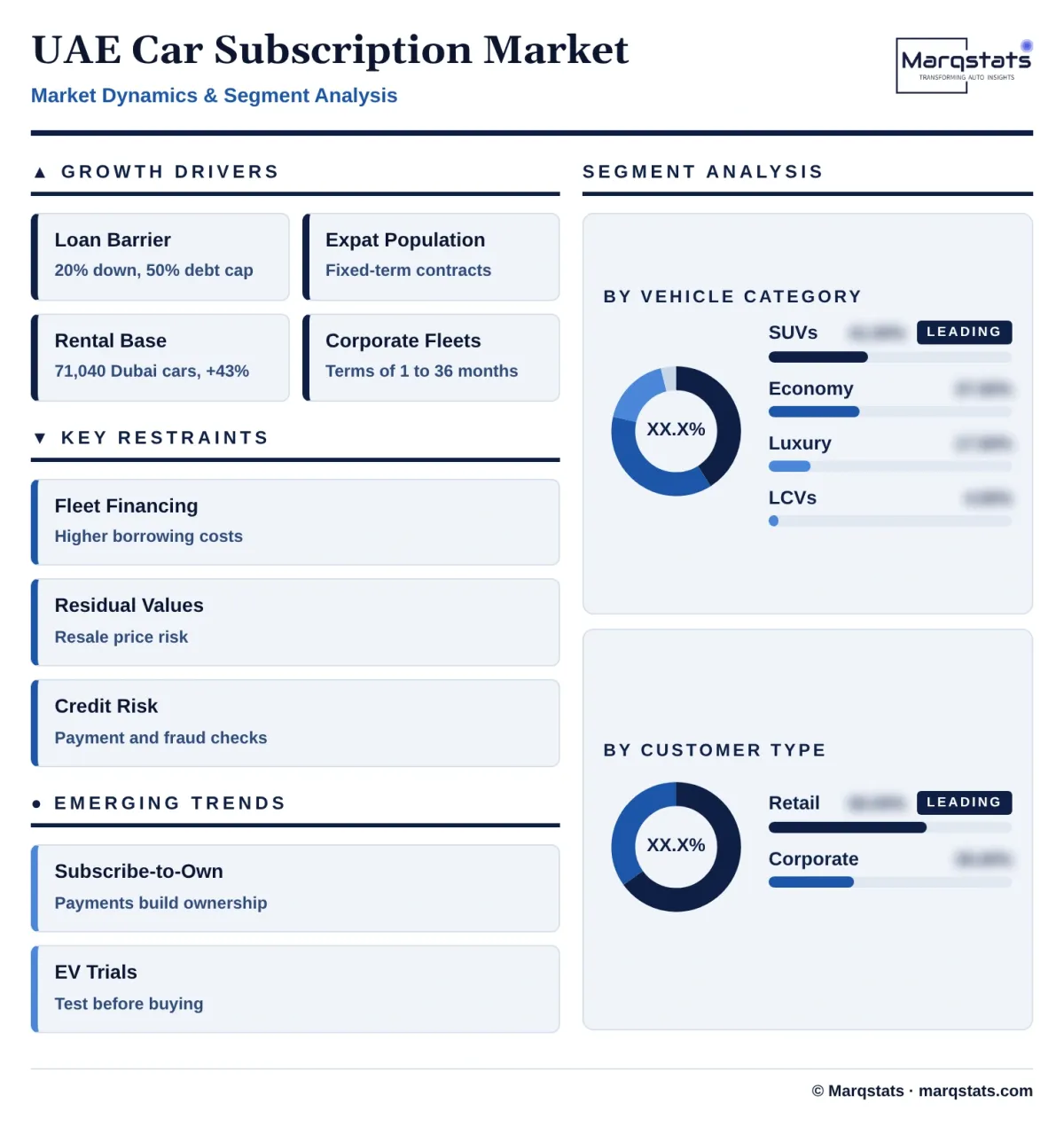
- Car loan rules favour subscriptions. UAE banks require a minimum 20% down payment on vehicle loans and cap total monthly debt repayments at 50% of salary. Newly arrived expatriates also face rent deposits and other set-up costs, so a monthly fee with no down payment and no loan approval is often the easiest way to get a car.
- The resident population keeps growing. Expatriates make up close to nine in ten UAE residents, many on fixed-term contracts, project assignments or probation periods. Three to six month subscriptions match the typical six-month probation period, after which many residents move to longer plans or buy.
- Dubai's rental base is expanding. The RTA reported that rental companies in Dubai rose 33% to 3,494 in 2024 and rental vehicles rose 43% to 71,040, with luxury rentals up 73% and electric rental vehicles up 50%. Marketplace platforms draw on this growing supply.
- Companies want flexible fleets. Corporate and SME customers use subscriptions to equip sales teams and staff without multi-year leases, credit checks or large deposits. Selfdrive's corporate fleet subscription offers terms of 1 to 36 months with no early termination penalty and a standard 3,000 km monthly allowance.
- Bundled costs simplify driving. Tolls, parking and fines are managed through one account. Salik's variable tolls of AED 6 at peak times and AED 4 off-peak in Dubai, and Darb tolls in Abu Dhabi, are charged to the customer's card automatically, avoiding paperwork.
Key Restraints
Four constraints limit how fast UAE subscription fleets can grow profitably.
- Fleet financing is capital intensive. Distributor programmes and rental companies must fund vehicles upfront, and higher interest rates raise the cost of fleet borrowing. Marketplace platforms avoid this but depend on partners' willingness to supply cars at margins that leave room for both parties.
- Residual values carry risk. Subscription cars are sold after two to four years, and falling used car prices, particularly for early electric models, can turn a profitable contract into a loss. Rental vehicle age limits mean operators cannot simply keep cars longer to wait for better prices.
- Credit and fraud risk is real. Subscribers can leave the country or stop payments, and cars can be damaged or taken across borders. Operators rely on card pre-authorisations, digital identity checks, tracking devices and geofencing, which add cost and can slow onboarding.
- Competition from rental and leasing is strong. Thousands of rental companies in Dubai offer monthly rates, banks offer competitive car loans to salaried residents, and many residents buy used cars. Subscription platforms must show that the all-inclusive price and flexibility justify a higher monthly fee.
Key Trends
Four shifts are reshaping how UAE subscription platforms source and price cars.
- Subscribe-to-Own plans are spreading. Invygo's Subscribe-to-Own plan, which converts part of monthly payments into ownership, is its main growth driver, and similar plans help operators remarket older cars directly to subscribers.
- Chinese brands are entering subscription fleets. Selfdrive signed an exclusive partnership with FAW's Bestune brand in early 2025, offering the B70 from AED 1,749 a month and the T77 from AED 1,999 a month on plans of one to twelve months, with a target of 1,500 cars in the UAE.
- Subscriptions serve as electric car trials. MOOV by Al-Futtaim was the first UAE subscription service to offer hybrids and added Polestar electric cars in its first year. Short subscriptions let drivers test charging at home and work before committing to buy.
- Zero-deposit offers are becoming standard. Platforms are replacing security cheques and cash deposits with card pre-authorisations and one-off refundable deposits, and Selfdrive's July 2026 Abu Dhabi expansion offers zero-deposit bookings.
Strategic Implications
- For subscription platforms, utilisation and credit control decide profitability. Platforms that keep cars on contract above 90% of the time, price add-ons well and screen customers digitally without slowing onboarding will reach profitability fastest.
- For car distributors, subscriptions are a sales channel. Distributors can use subscriptions to introduce new models and electric cars, keep customers in their brands and service networks, and turn subscribers into buyers at the end of a contract.
- For rental companies, subscription marketplaces fill idle capacity. Listing cars on marketplaces during low tourist seasons raises fleet utilisation, while a direct monthly product helps rental companies keep their own customer relationships.
- For corporate fleet managers, subscriptions add flexibility. Subscriptions suit project teams, probation hires and fast-growing branches, while long-term leases remain cheaper for stable fleets. A mix of both lowers total fleet cost.
- For lenders and investors, residual value data matters most. Fleet financing for subscription operators depends on reliable resale values, especially for electric cars. Lenders that track used car prices and use telematics data to monitor vehicle condition can price fleet facilities more accurately.
- For regulators, consistent rules help scale. Dubai's digital rental contract system shows how standard contracts protect customers and operators. Similar systems across emirates, and clear rules for cross-emirate subscriptions, would make it easier for platforms to serve customers who live in one emirate and work in another.
Market Segmentation
Economy and compact sedans such as the Nissan Sunny, MG 5, Hyundai Accent and Kia Picanto generate 37.50% of 2025 value, USD 47.86 million, rising to USD 104.26 million by 2030, a 16.85% CAGR, while their share falls to 32.00%. They serve commuters, teachers and sales staff who want the lowest monthly price.
Crossover and mid-size SUVs such as the Toyota RAV4, Nissan X-Trail, Mazda CX-5 and MG ZS are the largest category, with 41.00% of 2025 value, USD 52.33 million, rising to USD 146.61 million and 45.00% of the market by 2030, a 22.88% CAGR. Families and managers value space, safety features and comfort on long commutes between emirates.
Executive and luxury cars such as the BMW 5 Series, Audi Q7 and Nissan Patrol generate 17.50% of 2025 value, USD 22.34 million, rising to USD 61.90 million and 19.00% by 2030, a 22.61% CAGR. Senior executives and affluent seasonal residents drive demand, and Dubai's luxury rental fleet grew 73% in 2024.
Light commercial vans such as the Toyota HiAce and Renault Master generate 4.00% of 2025 value, USD 5.10 million, rising to USD 13.03 million by 2030, a 20.64% CAGR, with a stable 4.00% share. Small businesses use them for deliveries, trades and short-term projects.
Petrol cars generate 78.50% of 2025 value, USD 100.19 million, rising to USD 185.71 million by 2030, a 13.14% CAGR, while their share falls to 57.00%. Low purchase prices, wide model choice and established service networks keep them dominant.
Hybrids and plug-in hybrids generate 16.50% of 2025 value, USD 21.06 million, rising to USD 84.71 million and 26.00% of the market by 2030, a 32.10% CAGR. They avoid range concerns on long highway trips and are supplied in volume by distributor programmes.
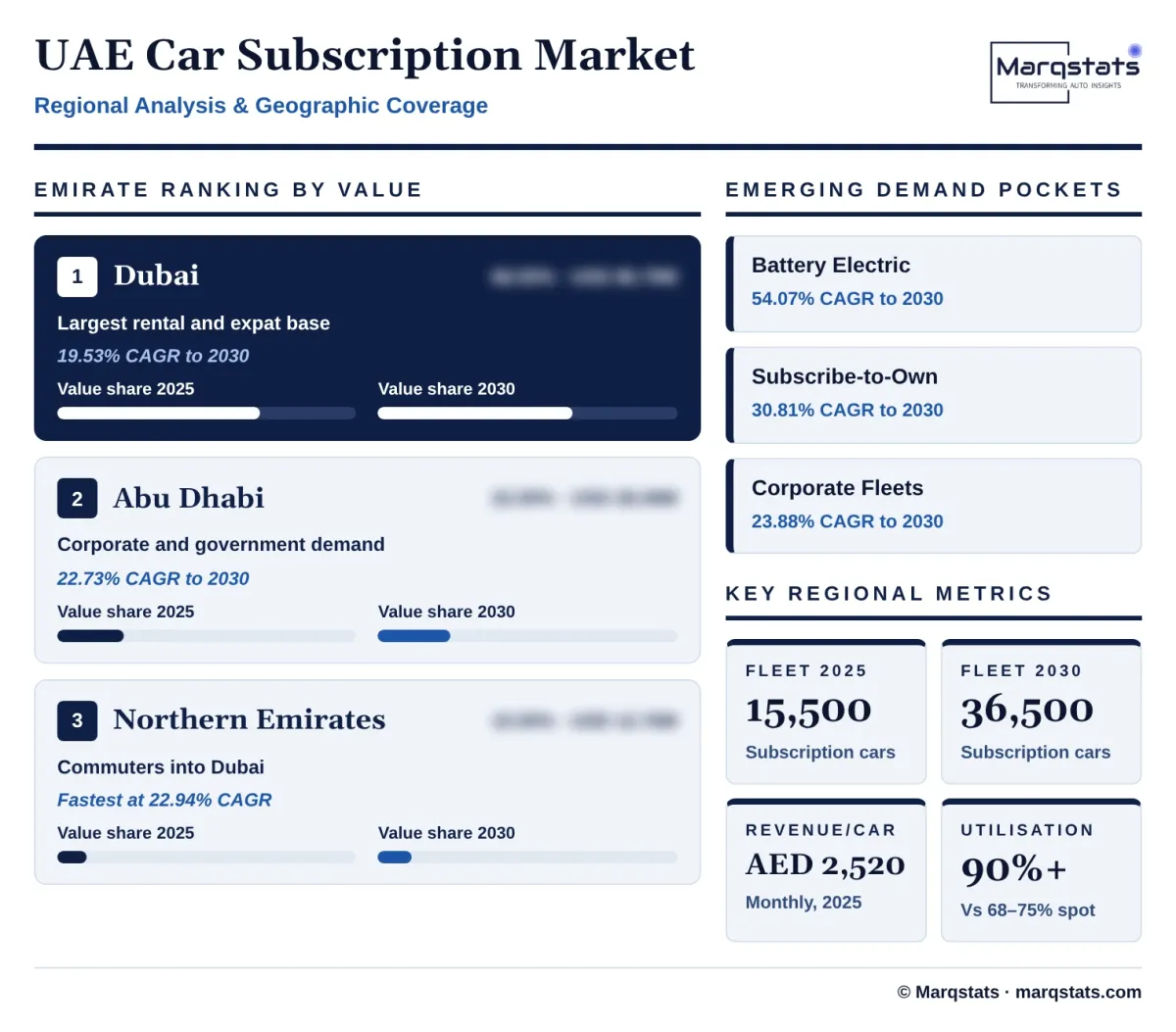
Battery electric cars generate 5.00% of 2025 value, USD 6.38 million, and grow fastest, reaching USD 55.38 million and 17.00% of the market by 2030, a 54.07% CAGR. Corporate sustainability targets, more fast chargers and the wish to trial electric cars without resale risk drive growth.
Short plans of one to three months generate 28.00% of 2025 value, USD 35.74 million, rising to USD 74.93 million by 2030, a 15.96% CAGR, while their share falls to 23.00%. Consultants, seasonal residents and first-time subscribers use them.
Plans of three to six months are the largest term, with 38.00% of 2025 value, USD 48.50 million, rising to USD 114.03 million and 35.00% by 2030, an 18.65% CAGR. They match typical probation periods and temporary assignments.
Plans of six to twelve months generate 24.00% of 2025 value, USD 30.63 million, rising to USD 87.97 million and 27.00% by 2030, a 23.49% CAGR, as settled residents choose fixed monthly costs over ownership.
Plans over twelve months, including Subscribe-to-Own, generate 10.00% of 2025 value, USD 12.76 million, and grow fastest among terms, reaching USD 48.87 million and 15.00% by 2030, a 30.81% CAGR, as part of each payment goes towards buying the car.
Individual residents generate 65.00% of 2025 value, USD 82.96 million, rising to USD 195.48 million by 2030, an 18.70% CAGR, while their share falls to 60.00%. No down payment, included insurance and the option to change cars drive demand.
Companies and SMEs generate 35.00% of 2025 value, USD 44.67 million, rising to USD 130.32 million and 40.00% of the market by 2030, a 23.88% CAGR. Businesses use subscriptions to scale fleets with headcount and avoid long lease commitments.
By Geography
Dubai
Dubai is the largest market, with an estimated 68.00% of 2025 value, USD 86.79 million, and about 10,540 subscription vehicles, rising to USD 211.77 million by 2030, a 19.53% CAGR, while its share eases to 65.00%. Dubai has the highest density of expatriate professionals, the largest rental base with 3,494 companies and 71,040 vehicles in 2024, digital rental contracts and dense Salik toll and paid parking networks that make all-inclusive billing attractive.
Abu Dhabi
Abu Dhabi accounts for an estimated 22.00% of 2025 value, USD 28.08 million, and about 3,410 vehicles, rising to USD 78.19 million and 24.00% of the market by 2030, a 22.73% CAGR. Government contractors, energy companies and industrial firms in Musaffah and KIZAD drive corporate demand, contracts are typically longer with higher mileage allowances for commutes to Dubai, and Selfdrive expanded its Abu Dhabi fleet in July 2026.
Northern Emirates
Sharjah, Ajman, Ras Al Khaimah, Fujairah and Umm Al Quwain account for an estimated 10.00% of 2025 value, USD 12.76 million, and about 1,550 vehicles, and grow fastest, reaching USD 35.84 million and 11.00% of the market by 2030, a 22.94% CAGR. Demand centres on economy sedans and small crossovers for residents who commute daily to Dubai and want predictable monthly costs without a down payment.
How Competition Is Evolving
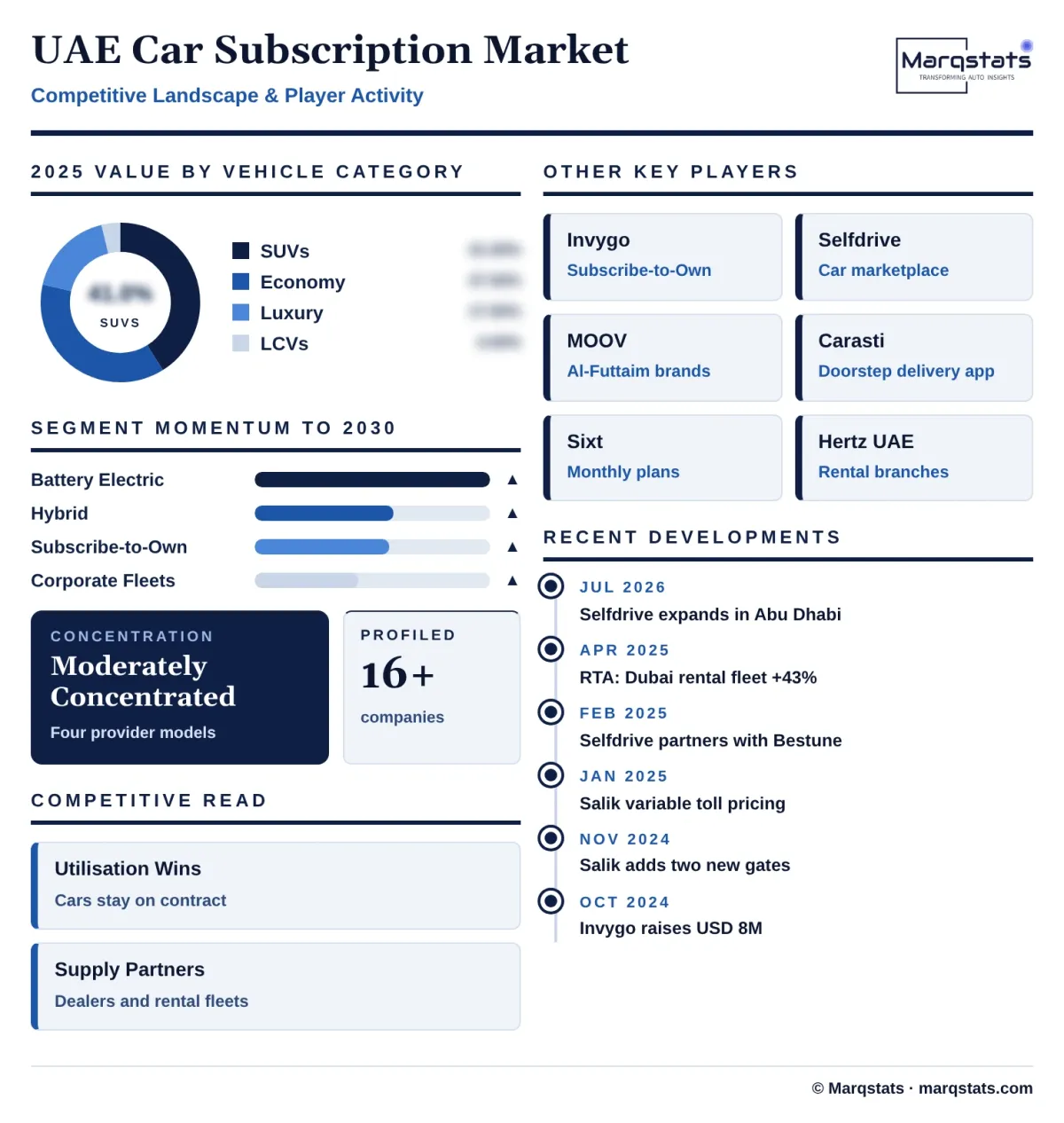
The UAE Car Subscription market is moderately concentrated. A handful of specialist platforms and distributor programmes, led by Invygo, Selfdrive, MOOV by Al-Futtaim and Carasti, account for most dedicated subscription vehicles, while international and local rental companies offer monthly plans from their own fleets.
Marketplace platforms grow without owning cars. Invygo and Selfdrive list vehicles from dealers and rental companies and earn commissions, service fees and add-on revenue. Invygo raised more than USD 22 million in total and reports annualised gross merchandise value above USD 100 million across three countries. Selfdrive reports more than 100 models from over 50 brands and operates in several GCC markets.
Distributor programmes own the supply chain. MOOV by Al-Futtaim draws on the Al-Futtaim group's brands, workshops and financing, launched in November 2021 and reported 92% utilisation and more than 4,000 subscribers after its first year, with terms of one to 18 months.
Digital specialists compete on service. Carasti, launched in late 2019, delivers cars to the customer's door, lets subscribers swap or upgrade through its app and raised USD 3 million in an oversubscribed pre-Series A round led by Net Ventures in April 2021.
Rental companies compete on scale. Sixt, Hertz, Avis, Europcar, Budget, Thrifty and Diamondlease use bulk purchasing, branch networks and in-house workshops to price monthly and long-term plans against platforms, and often supply cars to marketplaces in low seasons.
Carmakers and dealers shape supply. Chinese brands such as Bestune, MG, BYD and Geely offer competitive prices to subscription fleets, and dealers such as Al Khalid Auto supply cars through platform partnerships. Access to affordable new cars and reliable resale channels will separate leaders from smaller operators.
Companies Covered
Companies covered in the report include:
Recent Market Activity
Table of Contents
Coverage & Segmentation
The study covers the UAE Car Subscription market, with 2025 as the base year, 2021 – 2025 as the historical period and 2026 – 2030 as the forecast period. Values are in US dollars, with dirham values converted at 3.6725 dirhams per dollar. The market is defined as recurring revenue from all-inclusive monthly car subscriptions, including add-ons such as collision cover and excess mileage charges. It is segmented by vehicle category, powertrain, subscription term, customer type and emirate.
Daily and weekly spot rental, multi-year operating leases, car sharing, peer-to-peer rental, tolls and traffic fines passed through to customers are excluded. Fleet counts, values, segment and emirate splits are Marqstats estimates built on regulator data, company disclosures, published subscription prices and fleet cost benchmarks.