Market Snapshot
Middle bar: base-year value × (1 + CAGR), rounded to two decimals. This is a calculated illustration, not a separately researched annual estimate.
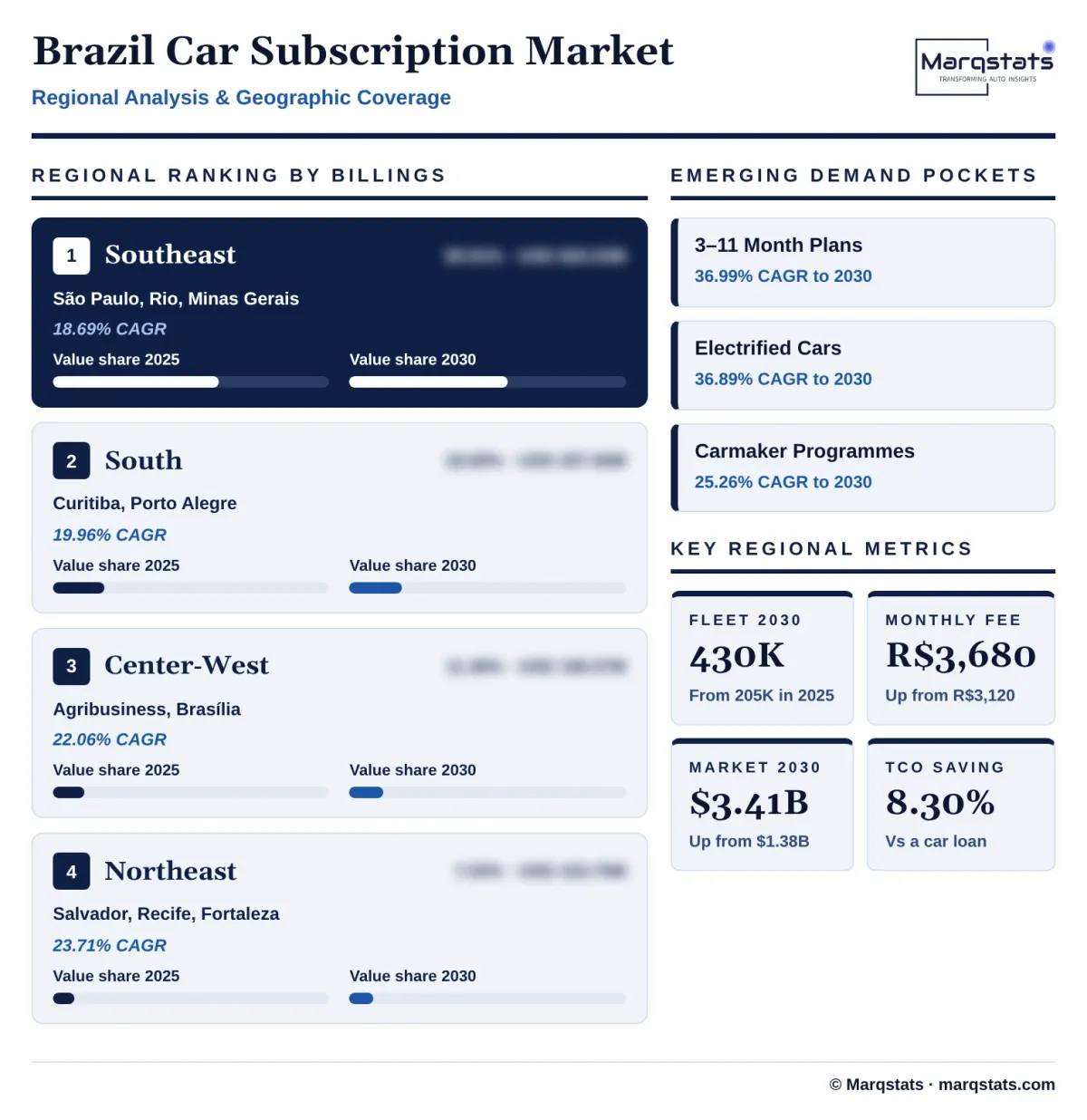
The Brazil car subscription market size is estimated at USD 1,377.92 million in 2025 and is projected to reach USD 3,409.16 million by 2030, growing at a CAGR of 19.86% over 2026 – 2030. In local currency, gross billings rise from R$7.675 billion to R$18.989 billion. The active subscription fleet grows from about 205,000 vehicles to 430,000, a 15.97% annual rate, while the average monthly fee rises from about R$3,120 to R$3,680.
Marqstats defines the market as gross billings from operating-lease car subscriptions (carro por assinatura) for passenger cars and light commercial vehicles, contracted by individuals and small and medium-sized businesses for a fixed term in exchange for an all-inclusive monthly fee. The fee bundles the vehicle, IPVA vehicle tax, licensing, insurance, maintenance and roadside assistance, and the operator keeps ownership of the car. Financial leasing (arrendamento mercantil), bank auto loans (CDC), consortium plans, daily and weekly car rental, ride-hailing driver rentals and large corporate fleet-outsourcing contracts are excluded.
Large rental companies account for an estimated 70.79% of 2025 billings, B-SUVs and mid-size flex utility vehicles for 44.22% and contracts of 36 to 48 months for 51.07%. The Southeast accounts for 59.91% of 2025 billings. The study segments the market by provider type, powertrain and body class, contract length and macro-region. US dollar values are converted at BRL 5.57 per USD for all years.
Key Takeaways
Market Overview & Analysis
Report Summary
Marqstats sizes the Brazil car subscription market as gross billings from all-inclusive operating-lease subscriptions taken by individuals and small businesses. In 2025 the market was worth an estimated R$7.675 billion, or USD 1,377.92 million at BRL 5.57 per USD, from an average active fleet of about 205,000 vehicles paying about R$3,120 a month. Billings include the base monthly fee, extra-mileage charges and optional protection add-ons.
Car subscription in Brazil is an operating lease of movable property under Articles 565 to 578 of the Civil Code (Law 10,406/2002). The subscriber pays for the right to use the car for a set period, and the operator keeps legal ownership and the residual-value risk. This sets subscriptions apart from financial leasing under Law 6,099/1974 and from bank auto loans, which are regulated by the Central Bank of Brazil. The subscriber has no obligation to buy the car at the end of the contract and carries no debt on its balance sheet.
The market grew from about 80,000 vehicles and R$2.064 billion in 2021 to 106,000 vehicles and R$3.027 billion in 2022, 125,000 vehicles and R$3.930 billion in 2023 and 180,000 vehicles and R$6.242 billion in 2024. In US dollars at BRL 5.57 this is USD 370.56 million, USD 543.45 million, USD 705.57 million and USD 1,120.65 million. The jump in 2024 came as rental companies pushed subscriptions to retail customers while bank credit stayed expensive.
Subscriptions sit inside a much larger rental industry. According to the ABLA 2026 yearbook, Brazilian rental companies earned R$61.7 billion in 2025, 16.6% more than in 2024, and ran 1,717,848 vehicles, up 6.2%, with an average fleet age of 16.4 months. They bought 628,970 new vehicles, investing about R$79.3 billion at an average price of about R$126,000, and accounted for 24.6% of the roughly 2.5 million light vehicles registered in Brazil. There were 37,047 rental companies in the country.
Three types of provider compete. Large rental companies such as Localiza, Movida and Unidas use their buying power and used-car networks. Carmaker programmes such as Toyota KINTO, Stellantis Flua! and Fiat por Assinatura, VW Sign & Drive and Renault On Demand sell through dealers. Insurers and digital platforms such as Porto Seguro Carro Fácil and Turbi rely on underwriting skills, apps and flexible terms.
The customer base is changing. Early subscribers were mainly city households and professionals who wanted a new car without a down payment. The market now also includes small businesses replacing owned vehicles, app-based workers on short plans, and families trying hybrid and electric cars before buying one. Operators adapt by offering more models, mileage bands and contract lengths.
Regulation shapes the cost of every car. Each state charges IPVA vehicle tax, at rates of about 1% to 4% of the vehicle value, and some states such as Minas Gerais have offered lower rates to rental companies. Rental companies once registered many cars in low-tax states, which led to disputes with other states. In August 2026 the Federal Supreme Court ruled in ADI 4376 that São Paulo may not charge IPVA again where the tax had already been paid in another state, tying collection to the owner's headquarters or domicile and holding that renters are not liable for the tax. Operators still need clear records of where cars are registered and used.
Tax reform adds another layer. Constitutional Amendment 132/2023 replaces PIS, Cofins, IPI, ICMS and ISS with the federal CBS and the subnational IBS, phased in from 2026 to 2033. Under Binding Precedent 31 of the Federal Supreme Court, the pure rental of movable goods was outside ISS, so rental revenue was taxed mainly through PIS and Cofins. Under the new system, subscriptions pay CBS and IBS but operators can claim credits on car purchases, parts and services, which favours large operators with efficient buying and strong tax teams.
Industrial policy supports newer and cleaner cars. Programa Mover, created by Law 14,902 in June 2024, provides about R$19.3 billion in financial credits from 2024 to 2028 to carmakers that invest in efficiency, safety and local production of new powertrains, including flex-fuel hybrids. Because rental companies buy about a quarter of all new light vehicles, their choice of models has a large influence on how fast these technologies reach the road, and subscriptions give consumers a low-risk way to try them.
Brazil Car Subscription Market Size and Forecast
The Brazil car subscription market grows from USD 1,377.92 million (R$7.675 billion) in 2025 to USD 3,409.16 million (R$18.989 billion) in 2030, a CAGR of 19.86%. Marqstats expects USD 1,675.22 million in 2026, USD 2,020.83 million in 2027, USD 2,422.62 million in 2028 and USD 2,884.20 million in 2029.
Fleet growth drives most of the gain. The active subscription fleet rises from about 205,000 vehicles in 2025 to 240,000 in 2026, 280,000 in 2027, 325,000 in 2028, 375,000 in 2029 and 430,000 in 2030, a 15.97% annual rate. Annual growth slows from about 17% in 2026 to about 15% in 2030 as the base gets bigger.
Fees rise more slowly. Marqstats estimates the average monthly fee rises from about R$3,120 in 2025 to R$3,240 in 2026 and R$3,680 in 2030, a 3.36% annual rate. Higher car prices, more SUVs and electrified models, and higher insurance costs push fees up, while shorter used-car plans and competition from carmakers hold them down.
The market is sensitive to the monthly fee. Each R$100 change in the average monthly fee moves 2025 billings by about R$246 million, or USD 44.17 million, and 2030 billings by about R$516 million, or USD 92.64 million. Each 10,000 extra vehicles in 2030 adds about R$442 million, or USD 79.28 million, of annual billings at the forecast fee.
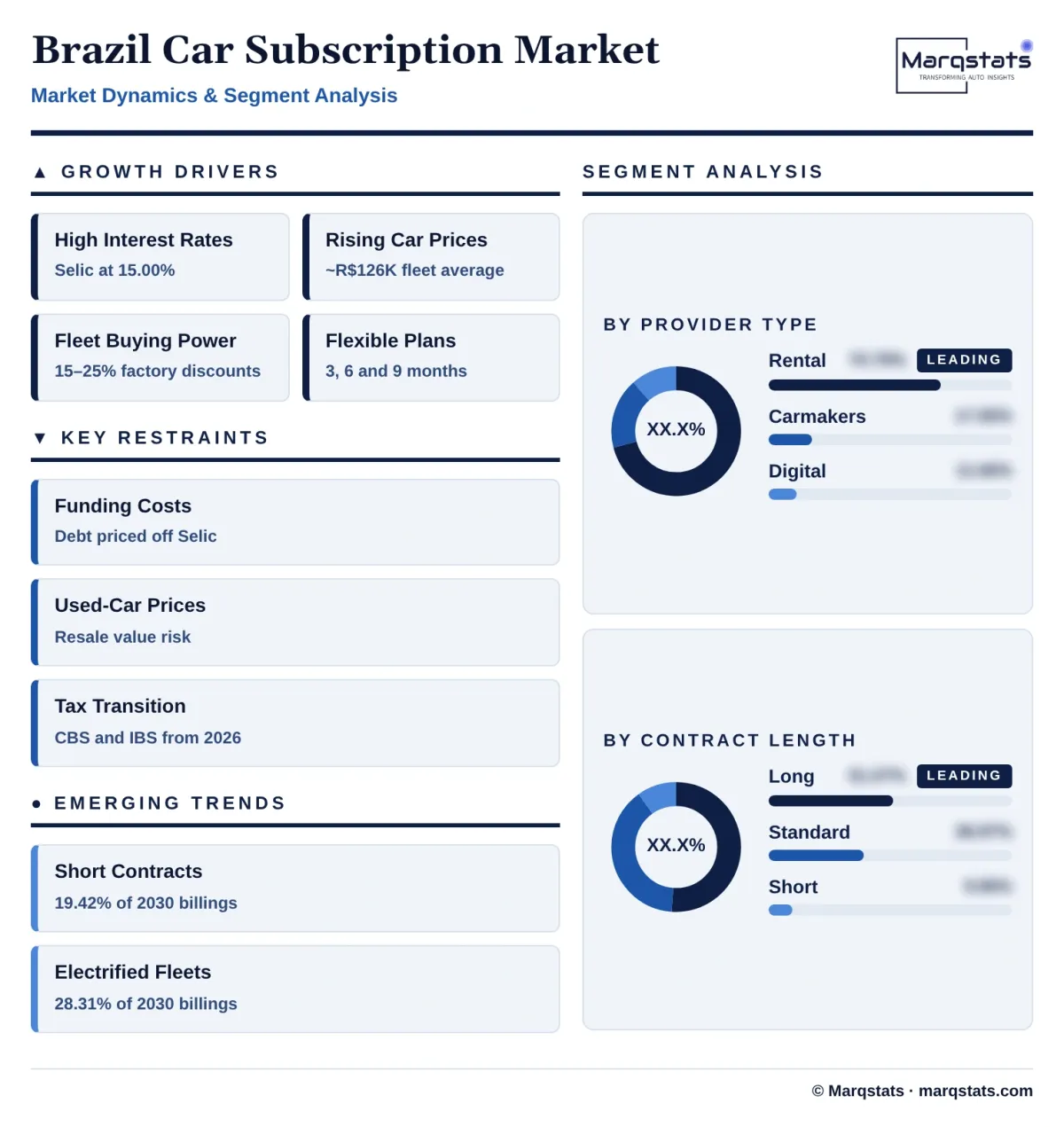
The mix shifts over the forecast. Carmaker programmes rise from 17.55% to 21.87% of billings, electrified vehicles from 14.57% to 28.31% and plans of 3 to 11 months from 9.96% to 19.42%. Large rental companies remain the biggest providers but their share falls from 70.79% to 65.61%.
Currency affects the US dollar figures. All years use the house rate of BRL 5.57 per USD, so dollar growth equals growth in reais. At this rate, a 10% weaker real would lower 2030 dollar billings by about USD 309.92 million, while leaving local billings unchanged.
Each provider type grows at a different pace. Large rental companies add about USD 1,261.23 million of billings between 2025 and 2030, carmaker programmes about USD 503.75 million and insurers and digital platforms about USD 266.26 million. By powertrain, SUVs and utility vehicles add the most, about USD 924.87 million, followed by electrified vehicles at about USD 764.42 million and compact cars at about USD 341.95 million.
Regional growth is broad. The Southeast adds about USD 1,118.95 million of billings to 2030, the South about USD 382.18 million, the Center-West about USD 267.68 million, the Northeast about USD 196.81 million and the North about USD 65.62 million. Marqstats expects the Southeast's share of the fleet to ease from 58% to about 55% as operators open branches in the Northeast, the Center-West and the North.
Market Dynamics
Key Drivers
Five forces are expanding all-inclusive car subscriptions in Brazil.
- High interest rates. The Central Bank of Brazil raised the Selic rate to 15.00% in June 2025 and held it there through the end of 2025 and into 2026. Retail auto loans carry annual costs of roughly 24% to 34% once fees and IOF tax are added, so many buyers find a fixed all-inclusive monthly fee cheaper and simpler than a loan.
- Rising car prices. Rental companies paid an average of about R$126,000 per new vehicle in 2025, according to ABLA, and retail prices are higher still. Subscriptions remove the down payment and the risk of losing money on resale, which matters more as cars become more expensive.
- Fleet buying power and used-car networks. Rental companies buy directly from carmakers at fleet discounts that Marqstats estimates at 15% to 25% and resell used cars through their own stores. These savings let them price subscriptions below what an individual pays to own the same car.
- Shorter and more flexible plans. Localiza added 3, 6 and 9-month plans in September 2026, Turbi offers monthly-renewable plans, and carmaker programmes add used-car subscriptions, bringing in customers who would not sign a three-year contract.
- Carmakers push subscriptions to sell new models. Toyota, Stellantis, Volkswagen and Renault use subscriptions to place hybrids, SUVs and electric cars with customers who want to try them, keeping buyers inside dealer networks and adding recurring revenue.
- Small businesses outsource vehicles. Small and medium-sized companies use subscriptions to avoid tying up working capital in vehicles, to fix monthly costs and to hand off maintenance, insurance and paperwork to the operator, with light commercial vehicle plans from Unidas, Movida and carmakers serving this demand.
Key Restraints
Four constraints limit how fast Brazilian subscription fleets can grow.
- High funding costs for operators. The same high Selic rate that makes loans unattractive raises the cost of debt for rental companies, which finance their fleets largely with debentures and bank credit. Operators must pass these costs into monthly fees or accept lower margins.
- Used-car price risk. Operators earn part of their return when they sell cars at the end of a contract. A fall in used-car prices, for example from a wave of ex-rental cars or cheap imported electric cars, forces higher depreciation and can hurt profits.
- Low awareness and contract concerns. Many consumers still do not understand how subscriptions work, and complaints about mileage limits, damage charges and early-exit fees slow adoption outside large cities.
- Tax transition uncertainty. The move to CBS and IBS from 2026 to 2033 changes how rental revenue is taxed and how input credits on car purchases are recovered. Smaller operators with less tax planning capacity face higher compliance costs and delays in recovering credits.
- Insurance and theft costs. Vehicle theft and robbery rates in large Brazilian cities raise insurance costs, and operators must price these into fees or limit certain models and areas, which can make subscriptions less competitive in high-risk regions.
Key Trends
Four shifts are changing how car subscriptions are designed, priced and sold in Brazil.
- From long contracts to flexible terms. Operators add plans of 3 to 11 months, choice of upfront payment and mileage, and monthly renewal, moving subscriptions closer to long-term rental.
- Electrified fleets. Operators add flex-fuel hybrids, plug-in hybrids and battery-electric cars from BYD, Toyota, GWM and others, and use subscriptions as a low-risk way for customers to try them.
- Digital sales and connected cars. Customers choose and sign contracts in apps, cars are delivered to their homes and connected fleets let operators track usage, mileage and maintenance.
- Used-car subscriptions. Operators and carmakers offer plans on cars already in the fleet, at lower fees, extending the earning life of each vehicle before it is sold.
- Upfront payment options. Localiza now lets subscribers lower their monthly fee by paying an amount upfront, which it says gives a discount above the CDI interest rate, blurring the line between subscription and purchase financing and attracting customers with cash to invest.
Strategic Implications
- For rental companies, flexibility and fleet use matter most. Offering short and medium plans on cars already in the fleet raises use of each vehicle, while long contracts on new cars give stable cash flow. Balancing both through the interest-rate cycle protects returns.
- For carmakers, subscriptions are a showroom for new technology. Hybrid and electric models placed through subscriptions build trust and data on real use, and the cars return to dealers as certified used vehicles that can be sold or subscribed again.
- For insurers and digital platforms, risk pricing is the advantage. Using telematics and claims data to price damage, theft and driver risk lets these players offer competitive fees in niches such as app drivers, small business fleets and premium cars.
- For banks and investors, subscriptions offer steady receivables. Fleet-backed funding, including receivables funds (FIDC) and debentures, can finance growth, but investors must model used-car prices and tax changes carefully.
- For tax planners, registration and credits now matter more. Rules on where IPVA is due and the new CBS and IBS credit system change the cost of each car, so operators need accurate records of where cars are used and what tax was paid on them.
- For dealers, subscriptions bring repeat visits. Delivery, maintenance and return of subscription cars bring customers into dealerships several times during a contract, giving dealers the chance to sell services, accessories and, at the end of the term, a new subscription or a used car.
Market Segmentation
Large rental companies, led by Localiza, Movida and Unidas, account for an estimated 70.79% of 2025 billings, USD 975.40 million, from about 145,550 vehicles, rising to USD 2,236.63 million by 2030, an 18.05% CAGR, while their share falls to 65.61% and their fleet grows to about 283,800 vehicles. Their buying power, branch networks and used-car stores let them offer the widest range of models and contract lengths. Localiza Assinatura reported about 70,000 active subscribers in September 2026.
Carmaker programmes, including Toyota KINTO, Stellantis Flua! and Fiat por Assinatura, VW Sign & Drive and Renault On Demand, account for an estimated 17.55% of 2025 billings, USD 241.79 million, from about 32,800 vehicles. They grow fastest among providers, at 25.26% a year, to USD 745.54 million and 21.87% of billings by 2030, with about 86,000 vehicles, as carmakers use subscriptions to place hybrids and SUVs and to keep customers in dealer networks.
Insurers and digital platforms, such as Porto Seguro Carro Fácil and Turbi, account for an estimated 11.66% of 2025 billings, USD 160.73 million, from about 26,650 vehicles, rising to USD 426.99 million by 2030, a 21.58% CAGR, with about 60,200 vehicles. Turbi reported 2025 revenue of R$392 million, up 45%, from a fleet of about 7,000 cars across its car-sharing and subscription products.
Flex-fuel compact hatchbacks and sedans, such as the Chevrolet Onix, Hyundai HB20, Fiat Argo and Mobi and VW Polo Track, account for an estimated 41.21% of 2025 billings, USD 567.79 million, from about half of all subscription vehicles. Their billings grow slowly, at 9.89% a year, to USD 909.74 million by 2030, and their share falls to 26.69% as customers move to SUVs and electrified models.
Flex-fuel compact and mid-size SUVs and utility vehicles, such as the Jeep Renegade, VW T-Cross and Nivus, Hyundai Creta and Fiat Fastback, account for an estimated 44.22% of 2025 billings, USD 609.33 million, the largest share. They grow at 20.28% a year to USD 1,534.20 million and 45.00% of billings by 2030, as their fleet rises from about 82,000 to 189,200 vehicles.
Flex-fuel hybrids, plug-in hybrids and battery-electric cars, such as the BYD Dolphin and Song, Toyota Corolla Cross Hybrid and GWM Haval H6, account for an estimated 14.57% of 2025 billings, USD 200.80 million, from about 20,500 vehicles. They grow at 36.89% a year to USD 965.22 million and 28.31% of billings by 2030, with about 90,300 vehicles, helped by Programa Mover and fleet deals such as the Localiza and BYD agreement.
Plans of 3 to 11 months account for an estimated 9.96% of 2025 billings, USD 137.19 million, from about 16,400 vehicles, and grow fastest, at 36.99% a year, to USD 661.97 million and 19.42% of billings by 2030. They carry higher monthly fees and often use cars already in the fleet, and they attract project workers, app drivers and people trying subscription for the first time.
Plans of 12 to 24 months account for an estimated 38.97% of 2025 billings, USD 536.96 million, from about 77,900 vehicles, rising to USD 1,363.66 million by 2030, a 20.49% CAGR, and 40.00% of billings. City households, professionals and small businesses favour these plans as a balance between fee level and flexibility.
Plans of 36 to 48 months account for an estimated 51.07% of 2025 billings, USD 703.77 million, from about 110,700 vehicles, rising to USD 1,383.53 million by 2030, a 14.48% CAGR, while their share falls to 40.58%. They offer the lowest monthly fees and suit cost-focused drivers and small business fleets, and they give operators the most stable cash flow.
By Geography
Southeast
The Southeast, covering São Paulo, Rio de Janeiro, Minas Gerais and Espírito Santo, is the largest market, with an estimated 59.91% of 2025 billings, USD 825.53 million, from about 118,900 vehicles. Billings rise to USD 1,944.48 million by 2030, an 18.69% CAGR, while the share falls to 57.04%. High car prices, congestion, parking costs and the headquarters of most operators make the region the core of the market, and it has the most premium and electric subscriptions. São Paulo is the single largest state market, and the August 2026 Supreme Court ruling on IPVA reduces the risk that rental vehicles registered elsewhere are taxed twice when they circulate there.
South
The South, covering Paraná, Santa Catarina and Rio Grande do Sul, accounts for an estimated 18.69% of 2025 billings, USD 257.56 million, from about 38,950 vehicles, rising to USD 639.74 million by 2030, a 19.96% CAGR. Higher household incomes in Curitiba, Porto Alegre and Florianópolis support retail subscriptions, and small businesses use light commercial vehicle plans.
Center-West
The Center-West, covering Mato Grosso, Mato Grosso do Sul, Goiás and the Federal District, accounts for an estimated 11.36% of 2025 billings, USD 156.57 million, from about 22,550 vehicles, rising to USD 424.25 million by 2030, a 22.06% CAGR. Agribusiness companies use subscriptions for executive cars, SUVs and pickups, and Brasília adds demand from professionals and public-sector suppliers.
Northeast
The Northeast accounts for an estimated 7.53% of 2025 billings, USD 103.70 million, from about 18,450 vehicles, rising to USD 300.51 million by 2030, a 23.71% CAGR. Growth comes from state capitals such as Salvador, Recife and Fortaleza, where operators are opening branches and small businesses are replacing owned vehicles. Lower average fees reflect a higher share of compact cars.
North
The North accounts for an estimated 2.51% of 2025 billings, USD 34.56 million, from about 6,150 vehicles, rising to USD 100.18 million by 2030, a 23.72% CAGR. Demand centres on Manaus and Belém and on industrial and infrastructure fleets, and the small base means a few new contracts can lift growth sharply.
How Competition Is Evolving
The Brazil car subscription market is moderately concentrated. Large rental companies earn an estimated 70.79% of 2025 billings, and Localiza Assinatura alone had about 70,000 active subscribers in September 2026, making it the largest provider. Movida and Unidas follow among rental companies, while Porto Seguro Carro Fácil, Toyota KINTO and Stellantis lead outside the rental group.
Localiza sets the pace. It renamed Localiza Meoo as Localiza Assinatura in September 2026, added 3, 6 and 9-month plans on cars already in its fleet and let customers lower the monthly fee by paying more upfront. Its fleet of more than 650,000 connected vehicles, its used-car stores and its February 2026 agreement to buy 10,000 BYD hybrid and electric vehicles give it scale that smaller rivals cannot match.
Movida, part of the Simpar group, runs subscriptions through Movida Carro Fácil and reported net profit of R$318 million for 2025, including R$102.3 million in the fourth quarter, 64.5% more than a year earlier. Unidas offers Unidas Livre to individuals and small businesses with light commercial vehicle packages.
Carmakers compete through their own programmes. Toyota's KINTO, which marked five years in Brazil in 2025, focuses on hybrid Corolla and Corolla Cross models and fleet clients, and Stellantis offers Fiat and Jeep subscriptions through Flua! and Fiat por Assinatura. Volkswagen and Renault run subscription offers through their dealers.
Digital players compete on flexibility. Turbi grew 2025 revenue by 45% to R$392 million with an EBITDA margin of about 55%, funded by a R$80 million capital increase in July 2025 and bank credit, and offers keyless app access and plans that renew monthly. Porto Seguro uses its insurance base and repair network to bundle cover and maintenance.
Competition will be decided by funding cost, used-car resale and tax efficiency. Operators that borrow cheaply, resell cars well and recover more tax under CBS and IBS can offer lower fees and win share as the market grows.
Strategies differ by provider type. Rental companies compete on range of models and contract lengths and on the used-car resale that funds lower fees. Carmakers compete on access to new models, hybrid technology and dealer service. Insurers and digital platforms compete on underwriting, app experience and flexible terms. As the market grows, partnerships between these groups, such as carmakers supplying rental fleets and insurers pricing risk for platforms, become more common.

Companies Covered
Companies covered in the report include:
Recent Market Activity
Table of Contents
Coverage & Segmentation
The study covers the Brazil car subscription market, with 2025 as the base year, 2021 – 2025 as the historical period and 2026 – 2030 as the forecast period. Values are gross subscription billings in Brazilian reais, converted to US dollars at BRL 5.57 per USD for all years. The market is segmented by provider type, powertrain and body class, contract length and macro-region.
Financial leasing, bank auto loans, consortium plans, daily and weekly car rental, rentals to ride-hailing drivers on daily or weekly terms, large corporate fleet-outsourcing contracts, heavy vehicles and used-car sales are excluded. Fleet totals and fees follow operator disclosures and industry data, while value splits by provider, powertrain, contract length and region are Marqstats estimates that weight each segment's fleet share by its relative monthly fee.