Market Snapshot
Middle bar: base-year value × (1 + CAGR), rounded to two decimals. This is a calculated illustration, not a separately researched annual estimate.
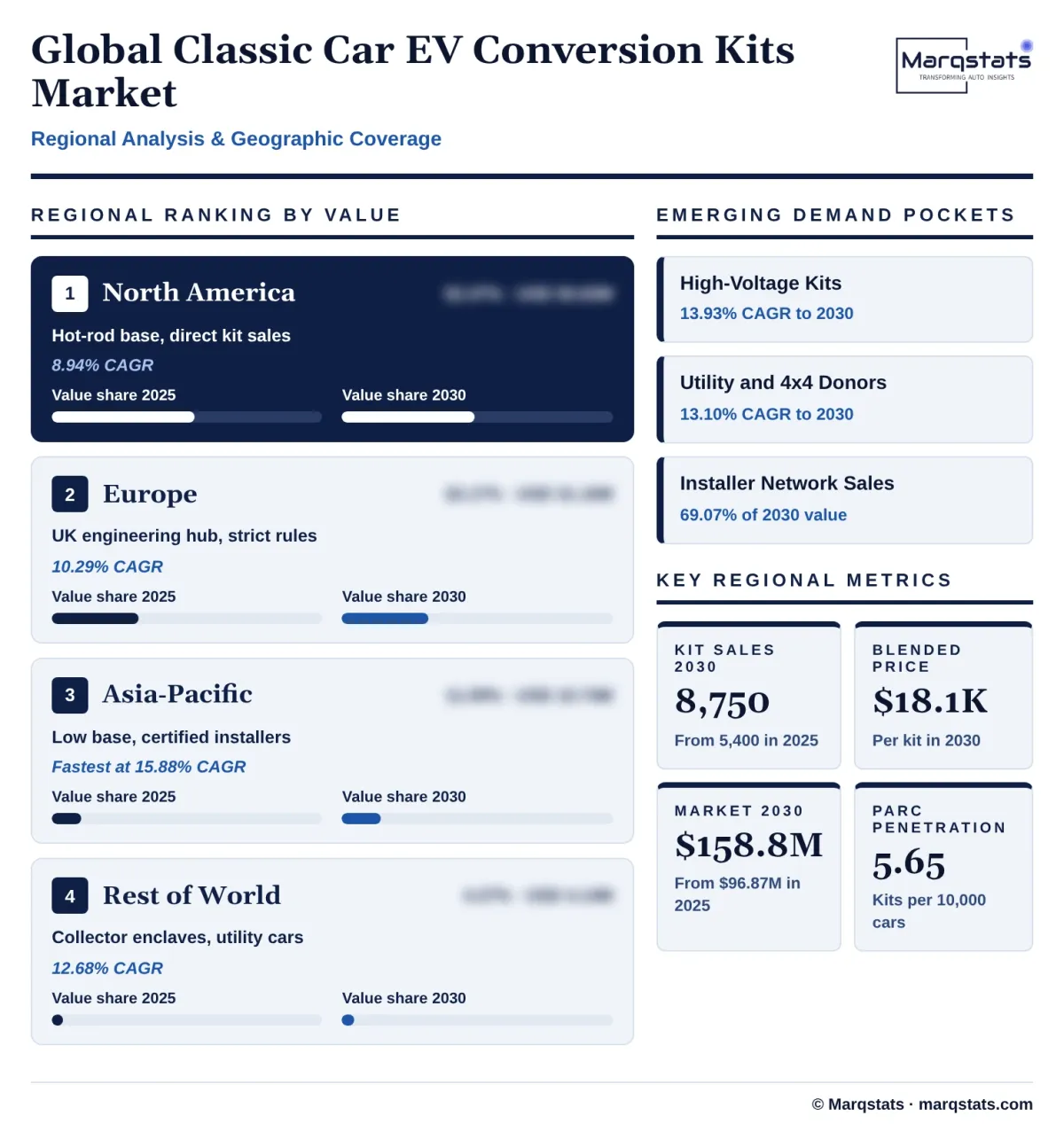
The global classic car EV conversion kits market size is estimated at USD 96.87 million in 2025 and is projected to reach USD 158.80 million by 2030, growing at a CAGR of 10.39% over 2026 – 2030. Kit sales rise from about 5,400 to 8,750 units, while the blended price per kit edges up from USD 17,939 to USD 18,149.
Marqstats defines the market as the manufacturer-level value of electric conversion hardware kits sold for pre-1996 classic and historic cars: traction motor, inverter, traction battery, onboard charger and DC-DC converter, vehicle control unit, mounts and harness. Workshop labour, coachbuilding, the donor car, finished electric cars sold as vehicles, such as factory heritage electric models and Everrati cars, and conversion kits for modern vehicles are excluded.
Vehicle-specific bolt-in kits account for an estimated 19.07% of 2025 units but 36.15% of value, and high-voltage systems for 68.89% of value. North America holds 52.47% of 2025 value and Europe 32.17%. The study segments the market by kit type, voltage topology, donor vehicle, sales channel and region.
Key Takeaways
Market Overview & Analysis
Report Summary
Marqstats sizes the classic car EV conversion kits market as the manufacturer-level value of electric conversion hardware sold for pre-1996 classic and historic cars. In 2025 about 5,400 kits were sold worldwide, worth an estimated USD 96.87 million at a blended price of about USD 17,939 per kit. The figure counts the kit only. A fitted conversion costs more, because the workshop, the donor car and any restoration sit outside the market.
A conversion kit replaces the engine and fuel system of a classic car with an electric drive. A complete kit holds a traction motor, an inverter, a traction battery with a battery management system, an onboard charger and a DC-DC converter, a vehicle control unit with software, thermal parts, mounts or adapter plates and wiring. Three kinds of kit are sold. Vehicle-specific bolt-in kits, such as the Electrogenic packages for the Land Rover Defender, Jaguar E-Type and classic Mini or the Fellten systems for the Porsche 911, are engineered for one model family and fit the original mounts. Complete universal kits, such as the EV West and Canadian Electric Vehicles Volkswagen Beetle kits built around the NetGain Hyper9 motor, supply the drive and battery parts and leave the enclosure and fitting to the builder. Powertrain-only kits, such as the Ford Performance Eluminator crate motor, supply the motor and power electronics and leave the battery to the builder.
List prices show the three tiers. Electrogenic quoted a guide price of GBP 24,000 for its Land Rover Defender kit in July 2022 and GBP 15,000 plus VAT for its classic Mini kit in May 2023, about USD 31,680 and USD 19,800 at GBP 1 = USD 1.32. Fellten priced a complete Porsche 911 964 system at about USD 78,000 in August 2024, and Electric GT listed its e-crate 413 from USD 65,000. Canadian Electric Vehicles lists a Volkswagen Beetle kit with a 144-volt Hyper9 drive and a 31.6 to 46.2 kilowatt-hour battery pack, without battery boxes, at USD 25,053.86. Ford Performance sold its 281 horsepower Eluminator motor for USD 4,095 in April 2022, with the inverter, controller and battery still to buy.
Marqstats builds the market bottom-up from kit units and kit prices, not from the value of the wider classic car restoration trade. For each region Marqstats estimates annual kit sales in three tiers from installer networks, kit-maker catalogues and component distributors, and multiplies them by tier prices anchored on the list prices above. The result is 5,400 kits in 2025, which equals about 3.48 kits for every 10,000 cars in an eligible parc of about 15.5 million pre-1996 cars. A May 2022 Hagerty survey of about 25,000 enthusiasts in the United States, Canada and the United Kingdom found that about 1% had fully or partly converted a classic to electric drive. Many of those builders assembled their own parts from salvaged drive units and never bought a kit, which is why the kit market is smaller than that survey rate implies.
The eligible parc rests on registry counts. The Driver and Vehicle Licensing Agency (DVLA) held 1,934,178 historic vehicles of all types on the United Kingdom register in 2025, according to the Federation of British Historic Vehicle Clubs (FBHVC) National Historic Vehicle Survey, which drew more than 19,900 responses. The Kraftfahrt-Bundesamt (KBA) counted 793,589 vehicles and trailers aged 30 years or more in Germany on 1 January 2023, of which 704,269 were passenger cars. Marqstats scales these anchors to Europe, North America, Asia-Pacific and the rest of the world to reach the 15.5 million estimate.
Global Classic Car EV Conversion Kits Market Size and Forecast
The global classic car EV conversion kits market grows from USD 96.87 million in 2025 to USD 158.80 million in 2030, a CAGR of 10.39%. Marqstats expects kit sales of about 5,930 units worth USD 106.75 million in 2026, 6,522 worth USD 117.75 million in 2027, 7,183 worth USD 129.99 million in 2028 and 7,922 worth USD 143.62 million in 2029, before reaching 8,750 units in 2030. Unit sales grow at 10.13% a year, slightly slower than value.
Value grows faster than units because of mix. The price of each kit tier falls: Marqstats estimates the bolt-in kit at USD 34,000 in 2025 and USD 32,000 in 2030, the complete universal kit at USD 22,000 and USD 20,000, and the powertrain-only kit at USD 8,500 and USD 8,000. Even so, the blended price per kit rises from USD 17,939 to USD 18,149, because bolt-in kits grow from 19.07% to 22.29% of units and complete universal kits from 33.89% to 40.00%, while powertrain-only kits fall from 47.04% to 37.71%.
Three assumptions drive the forecast. First, the share of installers able to fit bolt-in kits keeps rising as Electrogenic and Fellten certify more workshops, which lifts bolt-in and complete kit sales by about 13.6% and 13.8% a year. Second, powertrain-only kits grow at 5.37% a year, held back by the skills needed to design a battery and enclosure from scratch. Third, kit prices drift down by 1.2% to 1.9% a year as battery packs and power electronics get cheaper, but not faster, because the cost of homologation and installer training is spread over small volumes.
The main sensitivity is the regulatory path. Marqstats tracks four indicators: the draft UNECE regulation on conversions, which is expected by 2027; changes to the DVLA treatment of electric conversions of historic vehicles; the approach taken by German technical inspection bodies to the H plate; and new bolt-in kit launches for high-volume models such as the Volkswagen Beetle, Porsche 911 and Land Rover Series. A harmonised regulation that recognises standard kits across countries would shorten approval time for kit makers and widen the number of cars they can serve.
The market stays small in absolute terms because the constraint is the number of cars and installers, not demand for electric power. At 8,750 kits in 2030 the market still equals only 5.65 kits for every 10,000 cars in the eligible parc. That rate is a Marqstats estimate and sets a practical ceiling on volumes, since each kit needs a sound donor car, a trained installer and a home-charging owner.
Market Dynamics
Key Drivers
Five forces are moving classic car owners from one-off electric builds to catalogue kits.
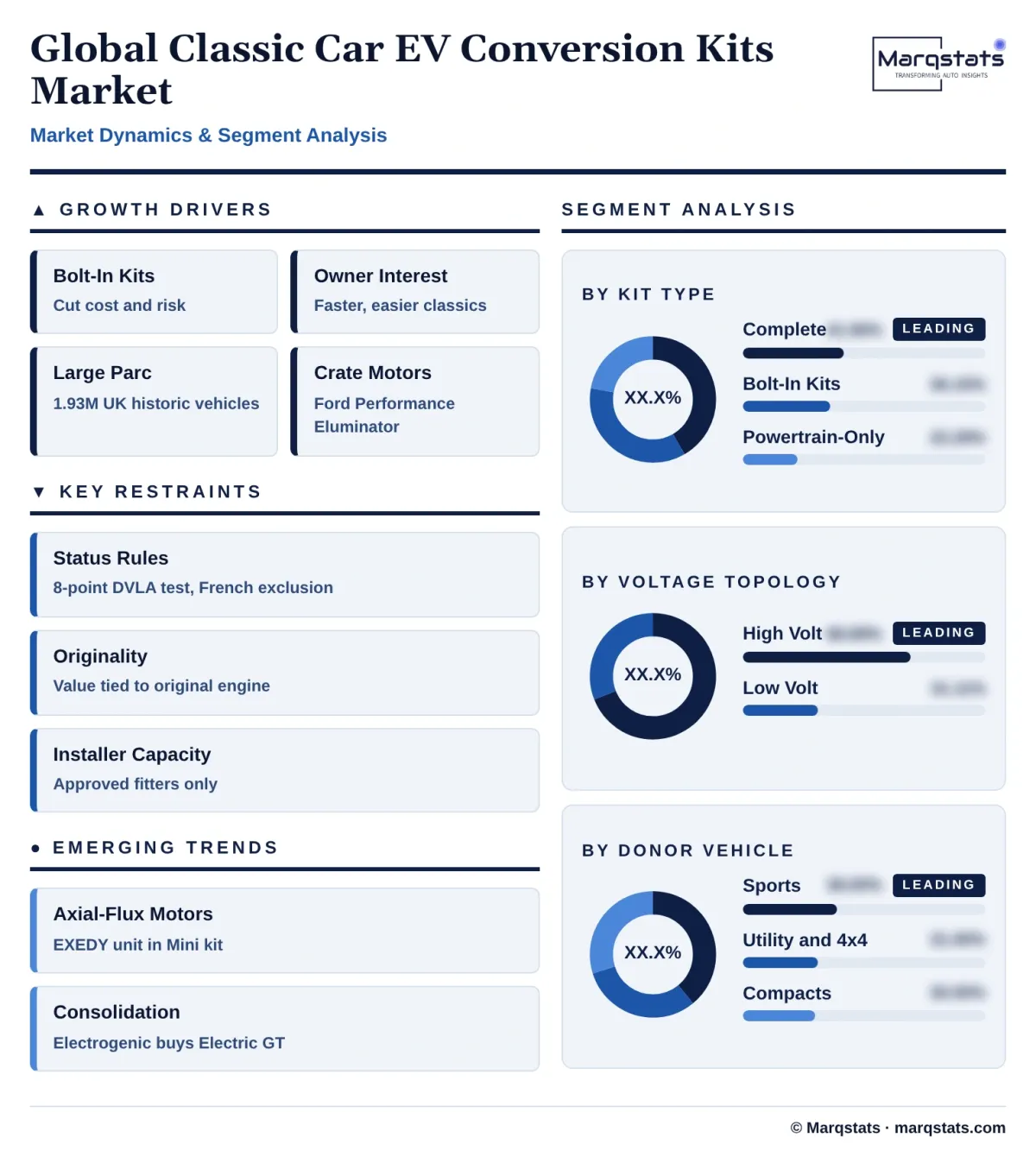
- Bolt-in kits cut cost and risk. Electrogenic priced a classic Mini kit at GBP 15,000 plus VAT in May 2023, against bespoke modifications that, according to Farmers Weekly, can exceed GBP 50,000. Electric GT says its kits install in about 50 hours with basic mechanical skills, which makes conversion a catalogue purchase for a workshop rather than an engineering project.
- Owners already want it. Hagerty found in May 2022 that about 1% of roughly 25,000 enthusiasts in the United States, Canada and the United Kingdom had fully or partly converted a classic to electric drive and about 25% approved of conversions. Top reasons were faster acceleration, an interesting project and environmental concern.
- A large parc of cars to convert. The United Kingdom register held 1,934,178 historic vehicles in 2025 and Germany held 704,269 passenger cars aged 30 years or more in January 2023, and owners spend an average of GBP 4,567 a year on their vehicles, so conversion competes for a budget that already exists.
- Car makers now supply parts. Ford Performance sold out its first batch of Eluminator crate motors within days of launch and relisted the motor at USD 4,095 in April 2022, giving kit makers and builders an automotive-grade motor from a car maker.
- Rules are moving toward standard kits. The UNECE working group on conversions, led by France and Spain with Sweden, Germany, the United Kingdom, Japan and the European Commission, aims for a harmonised regulation by 2027 that sets minimum requirements for conversion kits and recognises standardised kits across the 64 contracting states.
Key Restraints
Four constraints limit how fast classic car conversion kits can be sold and fitted.
- Historic status rules punish irreversible work. The DVLA gives 14 points for original major components, with 5 for the chassis or monocoque and 2 each for suspension, axles, transmission and steering, and a vehicle needs at least 8 points, with 5 from the chassis, to keep its identity. France excludes collection vehicles from its retrofit decree of 13 March 2020, and Germany ties the H plate to historic originality, so kits that cut the body or replace axles put the car outside these frameworks.
- Originality is priced into classic cars. German reporting notes that buyers often value classics by their original condition, so replacing the combustion engine can reduce what a car is worth, which is why reversible conversions are offered.
- Installer capacity is thin. Electrogenic initially required its Defender kits to be fitted by approved mechanics, and the draft UNECE regulation would allow only authorised installers to fit conversions, so growth depends on how fast kit makers can train and certify workshops with high-voltage skills.
- Volumes are small and funding is fragile. Two French conversion firms, Lormauto of Caen and TOLV of Flins, both focused on retrofitting everyday cars and vans rather than collector cars, failed in 2025: Lormauto when EUR 2.5 million of Bpifrance financing did not arrive in May, and TOLV when it entered receivership on 15 October and ceased operations on 9 December. Their experience shows how much capital a homologated conversion business needs before volumes arrive.
Key Trends
Four shifts are changing how conversion kits are engineered, sold and supported.
- Axial-flux motors enter classics. Electrogenic showed a classic Mini kit on 5 September 2025 using the EXEDY AFT140i axial-flux motor and inverter unit, which is far more compact than a radial-flux motor and suits small engine bays.
- Kit makers sell components and licences. In November 2024 Electrogenic began selling its electronics and integration software to United States business customers so they can build their own conversions, and it named Hesp Originals of British Columbia as its first Canadian partner, a model that spreads the kit maker across several brands.
- Kit makers diversify. Fellten, based near Bristol, launched its Charge Qube containerised energy storage and charging unit, with 150 to 450 kilowatt-hours in a 10-foot container, to balance the seasonal classic car trade, a move that shows how small the classic kit business still is.
- Consolidation and a North American base. Electrogenic announced the purchase of the TREMEC Electric GT business in Huntington Beach, California, on 10 August 2026, joining a European kit maker with a United States crate-powertrain maker.
Strategic Implications
- For kit makers, reversibility is the product. Designs that use the original engine mounts, gearbox and body protect the registration, tax status and value of the car, and Marqstats estimates they earn about USD 34,000 per kit, four times the USD 8,500 of a powertrain-only kit.
- For installers and restoration workshops, training is the entry ticket. A workshop certified to fit a bolt-in kit in about 50 hours can quote a fixed price and take more cars a year than one that fabricates each conversion, and a certified workshop is likely to be the only legal installer once the UNECE regulation arrives.
- For component suppliers, the automotive-grade motor is the template. Ford Performance showed that a warranted crate motor at USD 4,095 can anchor a whole kit ecosystem, so suppliers of inverters, battery packs, chargers and control units can sell into many kit makers at once.
- For owners, the choice is between a reversible conversion and a permanent one. A reversible bolt-in conversion keeps the car close to its original identity and resale value, while a cut-and-weld build trades that for freedom of design.
- For regulators and heritage bodies, standard kits are a middle path. Recognising approved kits across countries, as the UNECE draft proposes, would let owners keep historic vehicles in use in zero-emission cities without handing out one-off approvals.
Market Segmentation
Kits engineered for one model family that fit the original mounts account for 19.07% of 2025 units and 36.15% of value, USD 35.02 million and about 1,030 kits at an estimated USD 34,000 each. Value rises to USD 62.40 million by 2030, a 12.25% CAGR, as units grow 13.62% a year to 1,950 and the price eases to USD 32,000. Electrogenic for the Land Rover Defender, Jaguar E-Type, DeLorean DMC-12 and classic Mini, Fellten for the Porsche 911 and Mini, and Electric GT for American V8 platforms lead this segment.
Kits that supply the motor, controller, battery cells, charger and DC-DC converter but leave enclosure and fitting to the builder account for 41.56% of 2025 value, USD 40.26 million and about 1,830 kits at an estimated USD 22,000. Value grows at 11.70% a year to USD 70.00 million and 44.08% of the market in 2030. The Canadian Electric Vehicles Volkswagen Beetle kit with a NetGain Hyper9 144-volt drive, listed at USD 25,053.86, is typical.
Kits that supply a motor, inverter and controls without a traction battery account for 47.04% of 2025 units but only 22.29% of value, USD 21.59 million at an estimated USD 8,500 each. Value grows at 4.10% a year to USD 26.40 million and 16.62% of the market in 2030, the slowest segment. The Ford Performance Eluminator crate motor, relisted at USD 4,095, and NetGain and Cascadia Motion drives serve builders who choose their own battery.
Kits running at 300 volts or more account for 68.89% of 2025 value, USD 66.73 million, and grow at 13.93% a year to USD 128.10 million and 80.67% of the market in 2030. All vehicle-specific bolt-in kits are high-voltage, as are most complete kits sold by Electrogenic, Fellten and Electric GT, because high-voltage packs allow fast charging, smaller wiring and the power output owners now expect.
Kits running at up to 144 volts account for 31.11% of 2025 value, USD 30.14 million, and are nearly flat at 0.37% a year to USD 30.70 million and 19.33% of 2030 value. The NetGain Hyper9 at 96 to 144 volts is the best-known drive. These systems let a workshop install without high-voltage training, but they limit power and cannot use fast charging, so builders move up to high-voltage over time.
Sports cars and roadsters, including the air-cooled Porsche 911, Jaguar E-Type and Mazda MX-5, account for 39.00% of 2025 value, USD 37.78 million, and grow at 9.82% a year to USD 60.34 million and 38.00% of 2030 value. Owners of these valuable cars buy the most expensive kits, such as the Fellten 964 system at about USD 78,000, and need reversibility to protect value.
Land Rover Series and Defender, Toyota Land Cruiser and Ford Bronco-type vehicles account for 31.00% of 2025 value, USD 30.03 million, and grow fastest, at 13.10% a year, to USD 55.58 million and 35.00% of 2030 value. Ladder-frame chassis leave room for large batteries and the Electrogenic Defender kit routes motor torque through the original gearbox, transfer case and axles.
Classic Mini, Volkswagen Beetle, Fiat 500 and similar compact cars account for 30.00% of 2025 value, USD 29.06 million, and grow at 8.09% a year to USD 42.88 million and 27.00% of 2030 value. Small engine bays and low weight limits call for compact motors and smaller batteries, which keeps the price of each kit low.
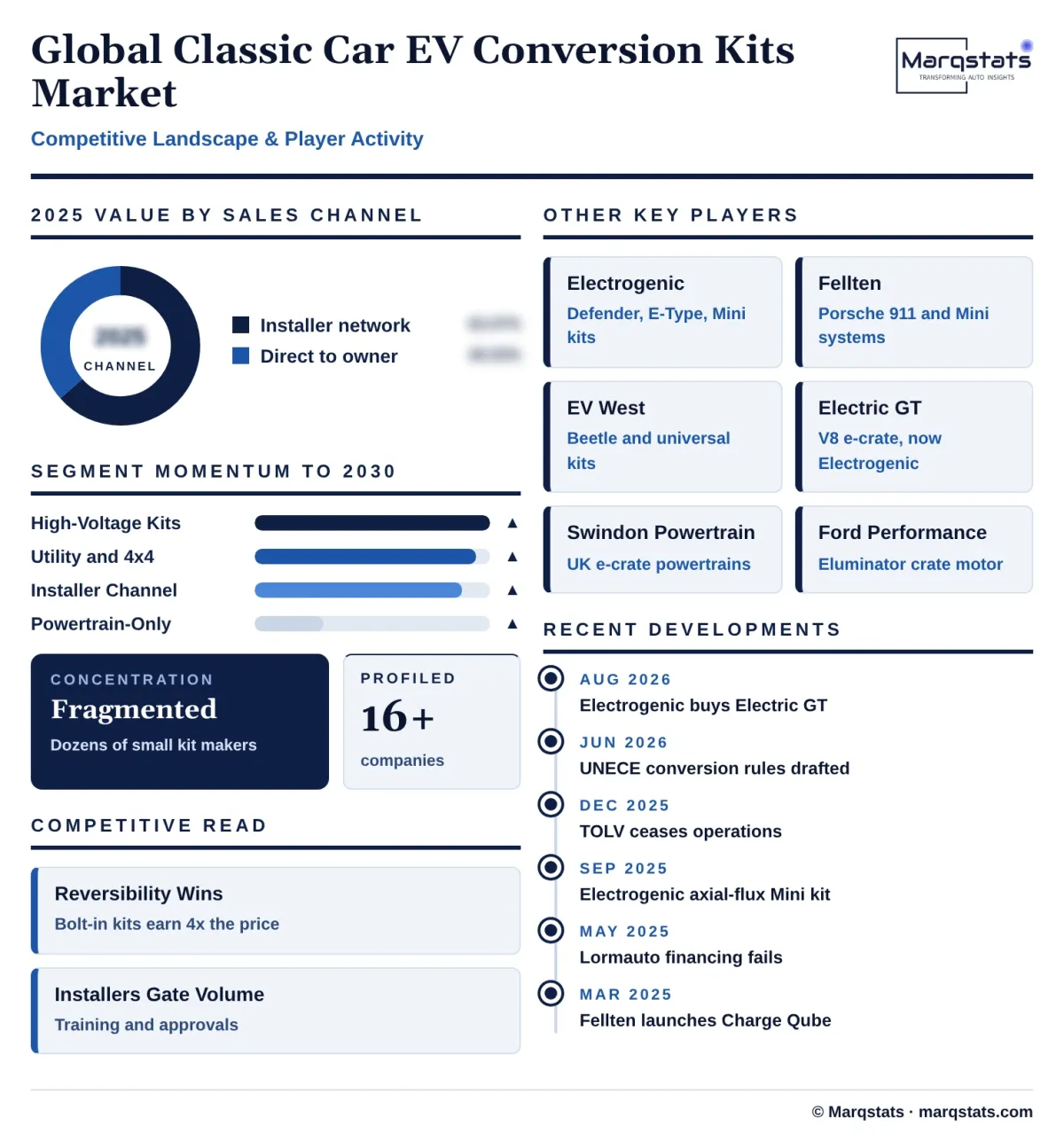
Kits sold through certified installers and restoration workshops account for 63.47% of 2025 value, USD 61.48 million, and grow at 12.27% a year to USD 109.68 million and 69.07% of the market in 2030. This channel carries all bolt-in kits and more than half of complete kits, and it is the channel the draft UNECE rules are likely to favour.
Kits sold directly to owners and builders through online stores and component distributors such as Canadian Electric Vehicles and Legacy EV account for 36.53% of 2025 value, USD 35.39 million, and grow at 6.78% a year to USD 49.12 million and 30.93% of 2030 value, mainly powertrain-only and universal kits.
By Geography
North America
North America is the largest market, with 52.47% of 2025 value, USD 50.83 million and about 2,920 kits, and rises to USD 78.00 million by 2030, an 8.94% CAGR, while its share falls to 49.12%. The region has the deepest base of hot-rod and restomod builders and a direct-to-owner supply chain led by EV West of San Marcos, Canadian Electric Vehicles, Legacy EV of Tempe and Ford Performance. California exempts vehicles of model year 1975 and earlier from its biennial smog inspection, which gives builders room to fit electric drives to the oldest cars. Electrogenic bought the TREMEC Electric GT business in Huntington Beach on 10 August 2026 to serve this market from a United States base.
Europe
Europe accounts for 32.17% of 2025 value, USD 31.16 million and about 1,580 kits, and grows at 10.29% a year to USD 50.84 million and 32.02% of the market by 2030. The United Kingdom is the engineering hub, with Electrogenic near Oxford, Fellten near Bristol and Swindon Powertrain, and it also has the largest historic fleet, 1,934,178 vehicles in 2025. Rules differ by country: the DVLA eight-point scheme and its electric conversion notification in the United Kingdom, the collection vehicle exclusion in the French decree of 13 March 2020, and individual approval under section 21 of the Strassenverkehrs-Zulassungs-Ordnung in Germany, where the H plate depends on historic originality. A harmonised UNECE regulation would remove much of this variation.
Asia-Pacific
Asia-Pacific accounts for 11.09% of 2025 value, USD 10.74 million and about 660 kits, and grows fastest, at 15.88% a year, to USD 22.44 million and 14.13% of the market by 2030. The base is small because periodic inspection regimes such as Japan Shaken and the state engineering rules in Australia make each conversion a case-by-case approval, but growth comes from a low starting point as certified installers are added. Marqstats estimates the region at 2.36 kits per 10,000 eligible cars, the lowest of the four regions.
Rest of World
The Rest of World accounts for 4.27% of 2025 value, USD 4.14 million and about 240 kits, and grows at 12.68% a year to USD 7.52 million and 4.74% of the market by 2030. Marqstats estimates demand comes from collector enclaves in the Gulf and Latin America and from utility vehicles in Africa, where Electrogenic works with partner workshops and offers a lower-cost kit version.
How Competition Is Evolving
The classic car EV conversion kits market is fragmented. Marqstats counts dozens of kit makers worldwide, most of them workshops with a handful of model-specific kits, and no company holds a share large enough to set prices. Competition runs in layers: vehicle-specific kit makers such as Electrogenic, Fellten and Swindon Powertrain; universal kit and crate-motor suppliers such as EV West, Electric GT, Cascadia Motion and NetGain Motors; automotive makers such as Ford Performance that sell motors directly; and distributors such as Canadian Electric Vehicles and Legacy EV that sell kits to owners online.
Two business models compete. Vehicle-specific makers earn the highest price per kit, about four times a powertrain-only kit, but must fund engineering, homologation and installer training for each model. Universal suppliers sell more units at lower prices and push the engineering to the builder. Electrogenic has moved between the two by selling components and software to United States business customers from November 2024, which lets other builders use its electronics while it focuses on vehicle-specific kits.
Scale is arriving through acquisition and partnership, not volume. Electrogenic announced the purchase of the TREMEC Electric GT business on 10 August 2026, EXEDY supplies the axial-flux motor and inverter in the Electrogenic Mini kit, and Fellten supplies packs and systems through a certified installer network. French firms that tried to convert everyday cars and vans without a premium product, Lormauto and TOLV, failed in 2025, which shows how thin volumes are without a collector customer willing to pay.
Competition will be decided by model coverage, installer reach and approval status. Makers that cover the models classic car owners want most, certify enough workshops to install within weeks, and hold recognised approvals in several countries will win the largest share of the 8,750 kits Marqstats expects in 2030.
Companies Covered
Companies covered in the report include:
Recent Market Activity
Table of Contents
Coverage & Segmentation
The study covers the global classic car EV conversion kits market, with 2025 as the base year and 2026 – 2030 as the forecast period. Values are in US dollars at manufacturer selling prices before installation, converted from pounds at GBP 1 = USD 1.32 and from euros at EUR 1 = USD 1.13, the 2025 averages. Volumes are kits sold in the year. The market is segmented by kit type, voltage topology, donor vehicle, sales channel and region.
Kits are hardware packages for pre-1996 classic and historic passenger cars and light utility vehicles: motor, inverter, traction battery, onboard charger and DC-DC converter, vehicle control unit, mounts and harness. Workshop labour, coachbuilding, restoration, the donor car, electric cars built and sold as vehicles such as factory heritage models, Everrati and Lunaz cars, and kits for modern vehicles are excluded. The Marqstats Global Electric LCV Retrofit and Conversion Market covers modern light commercial vehicles, and there is no overlap with it. Splits and regional values are Marqstats estimates built from kit-maker catalogues, installer networks and registry counts.
