Market Snapshot
Middle bar: base-year value × (1 + CAGR), rounded to two decimals. This is a calculated illustration, not a separately researched annual estimate.
The Turkey passenger car market size is estimated at USD 51,382.39 million in 2025 and is projected to reach USD 62,195.63 million by 2030, growing at a CAGR of 3.89% over 2026 – 2030. Unit sales rise from 1,084,496 to 1,150,000 cars, a 1.18% annual rate, after an estimated dip to 915,000 cars in 2026. Imported cars made up 70.20% of 2025 sales even though Turkish plants export most of what they build.
Marqstats defines the market as the retail value of new M1 passenger cars, including SUVs and crossovers, sold to buyers in Turkey, counted at the transaction price including special consumption tax (ÖTV) and 20% value added tax (KDV). Light commercial vehicles, vans, pickups, used cars and exports are excluded. Value is built from Automotive Distributors and Mobility Association (ODMD) unit sales multiplied by retail prices by size class, so the estimate rests on prices, which carry the greatest uncertainty.
SUVs account for 67.30% of 2025 value, electric cars for 20.17% and imported cars for 76.86%. Istanbul holds 27.00% of value, and electric cars grow fastest, at 14.82% a year, while the average car costs about USD 47,379 at retail once ÖTV and KDV are added.
Key Takeaways
Market Overview & Analysis
Report Summary
Turkey sold a record 1,084,496 new passenger cars in 2025, 10.62% more than in 2024, and then began to lose volume in 2026 after a December that alone reached about 146,300 cars. ODMD data show 627,977 cars sold in the first nine months of 2026, 15.45% fewer than a year earlier. The analysis explains why a market that set its record on year-end buying is now limited by credit, and why Marqstats still expects it to return to 1,150,000 cars by 2030.
Marqstats sizes the retail value of new M1 passenger cars sold to buyers in Turkey: private, corporate, fleet and rental customers, all powertrains, SUVs and crossovers included. Value is the transaction price including ÖTV and KDV, converted at TRY 39.57 per US dollar. Light commercial vehicles are excluded: ODMD counted 283,904 in 2025, of which 26,452 were pickups, and together with cars they make the 1,368,400 unit light-vehicle market that Marqstats uses as the next rung of the ladder. Used cars, motorcycles and cars built for export are outside the measure.
The analysis is written for four decision makers: an importer or distributor deciding how many cars to commit to a market whose tax bands move every few months; a Turkish assembler choosing which model lines to keep for the home market against export contracts; a lender or leasing company setting loan-to-value limits; and a supplier of chargers, batteries and software sizing the electric car base that the 2030 forecast implies.
Turkey Passenger Car Market Size and Forecast
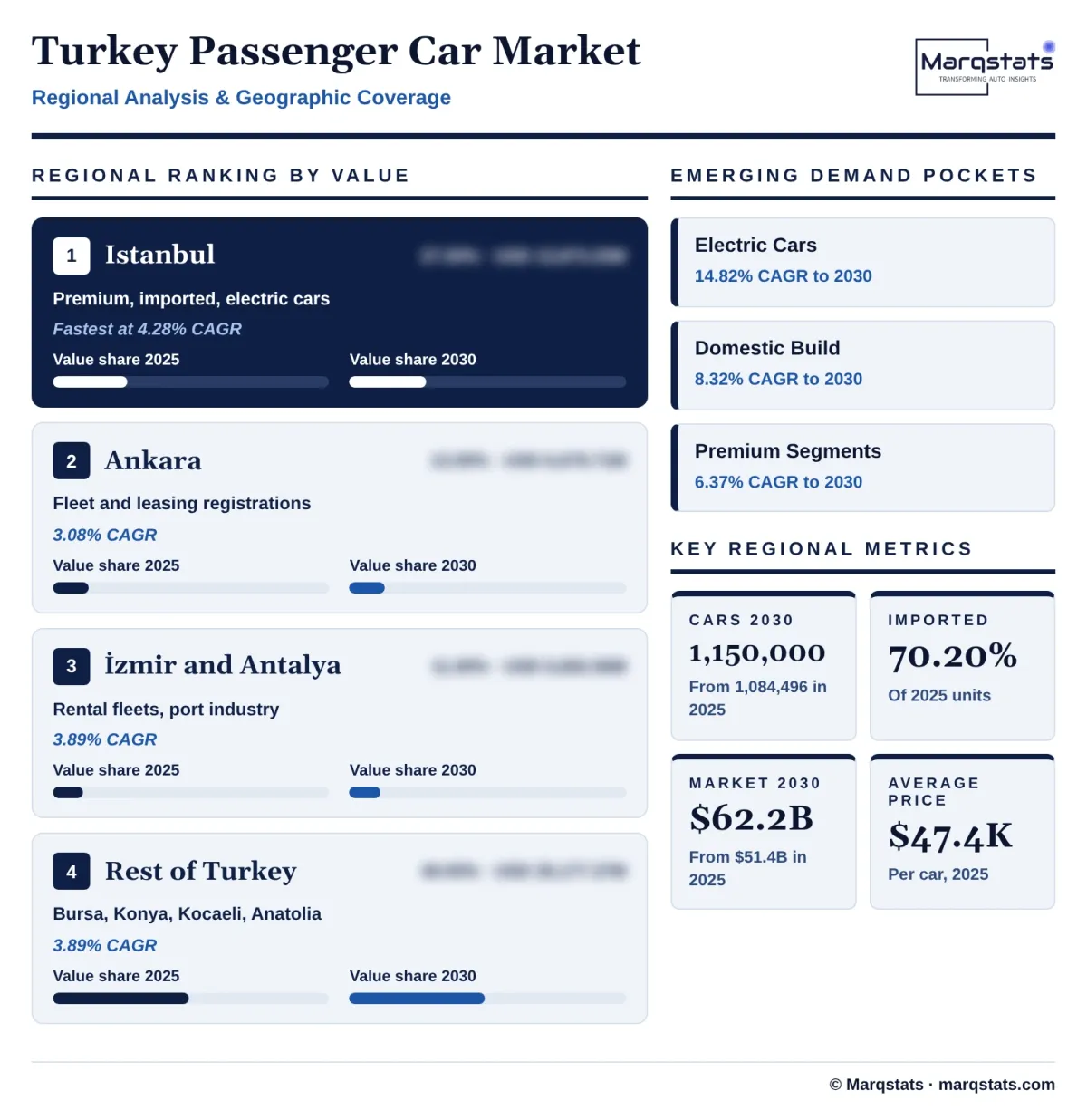
The Turkey passenger car market grows from USD 51,382.39 million in 2025 to USD 62,195.63 million in 2030, a CAGR of 3.89%. Volume contributes 1.18% a year, from 1,084,496 to 1,150,000 cars, and the average retail value per car adds the rest, rising at 2.68% a year from about USD 47,379 to USD 54,083 as SUVs, hybrids and electric cars take a larger share. Marqstats estimates 2026 at 915,000 cars and USD 44,509.93 million, 13.38% below 2025, before value grows 9.41% in 2027.
The 2025 value is built bottom-up from units and prices. ODMD recorded 599,790 C-segment cars, 292,700 B-segment cars and 192,006 cars in the A, D, E and F segments. Marqstats prices them at about USD 43,970, USD 35,380 and USD 76,320 per car, equal to about TRY 1.74 million, TRY 1.40 million and TRY 3.02 million at TRY 39.57, which gives USD 26,372.76 million, USD 10,355.73 million and USD 14,653.90 million. The units are reported; the prices are Marqstats estimates.
The prices rest on published list prices. The eight best-selling models with dated lists, the Renault Clio, Renault Megane Sedan, Fiat Egea Sedan, Toyota Corolla, Tesla Model Y, BYD Seal U, Togg T10X and Toyota C-HR, took 293,248 cars, 27.04% of 2025 sales, and averaged about TRY 1.61 million between their 1 January and 1 December 2025 lists. The Clio list rose from TRY 1,078,000 to TRY 1,536,000, the Corolla from TRY 1,463,000 to TRY 1,750,000 and the Togg T10X from TRY 1,432,600 to TRY 1,862,000. The rest of the market is priced higher because it holds German premium brands, larger SUVs and imported electric cars.
The result is checked against tax collections. At 20% KDV, the 2025 value implies a pre-KDV price pool of about TRY 1.69 trillion. Reports based on Ministry of Treasury and Finance data show ÖTV collections on motor vehicles above TRY 655 billion for January to November 2025, up 46.38% while unit sales rose 9.63%, which puts the ÖTV share of the pre-KDV price at roughly two fifths. A lower average price would require ÖTV rates above the published 70% to 220% bands, so the build cannot be much smaller.
Value grows faster than volume because the mix moves up. Marqstats expects the share of SUVs to rise to 71.00% of units, electric cars to reach 30.00% of units and cars in the A, D, E and F segments to reach 20.00%, and applies price growth of 2.20% a year to C-segment cars, 2.00% to B-segment cars and 2.60% to the premium group in constant 2025 dollars. Marqstats assumes lira depreciation keeps pace with Turkish inflation, so dollar prices rise only with mix and specification.
Marqstats tracks five indicators to monitor the forecast: monthly ODMD car sales and their import and domestic split; Treasury and Finance ÖTV collections per vehicle; the Banking Regulation and Supervision Agency (BDDK) loan limits and bank lending rates; the Presidential Decisions that reset ÖTV matrah thresholds; and the pace of Chinese brand imports under the September 2025 customs duty decrees.
Market Dynamics
Key Drivers
Five forces keep Turkish car demand strong even after the 2026 pause.
- Motorisation is low and the fleet is growing. Turkey had 17,373,581 registered passenger cars at the end of 2025 for a population above 85 million, roughly one car for every five residents, and the Turkish Statistical Institute (TÜİK) counted 18,037,907 in August 2026. Every extra 100,000 cars in the fleet is a replacement and first-car market that the 2026 slowdown delays rather than removes.
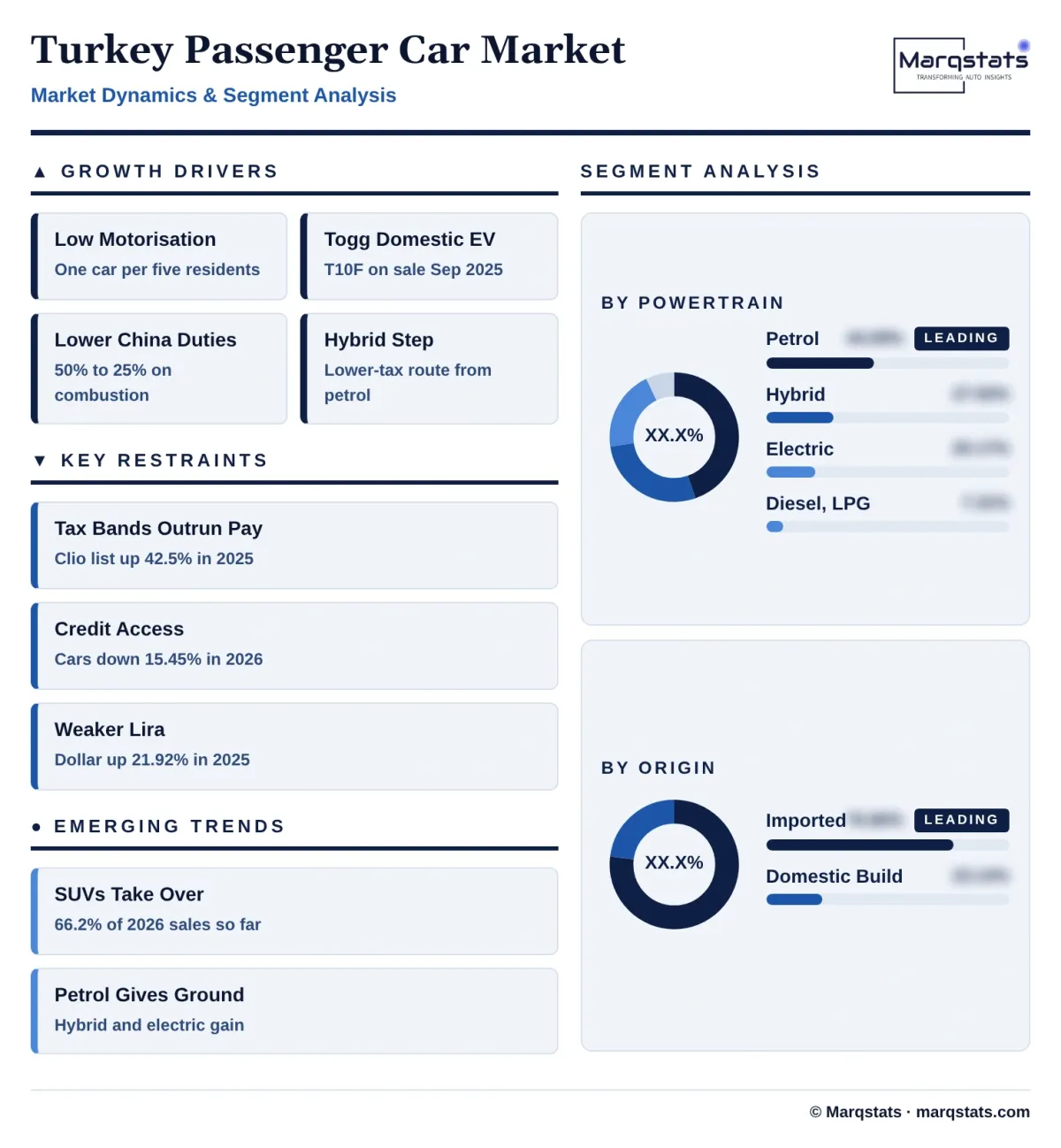
- A national electric brand gives buyers a domestic option. Türkiye'nin Otomobili Girişim Grubu (Togg) delivered 39,020 cars in 2025, 3.60% of the market, and put the T10F sedan on sale on 15 September 2025 from TRY 1,860,000. Electric cars with motors up to 160 kW pay ÖTV of 25% on a base up to TRY 1.65 million, against 70% to 90% for small petrol cars.
- Lower duties on China-origin cars widened choice. The decrees published on 22 September 2025 cut the additional customs duty on Chinese combustion cars from 50% to 25% and on electric cars from 40% to 30%, with floors of USD 6,000 for combustion cars and USD 8,500 for electric cars. BYD sold 45,537 cars in 2025, Chery 28,579 and Jaecoo 8,791.
- Hybrids give buyers a lower-tax step away from petrol. Hybrid cars sold 295,378 units in 2025, 27.24% of the market, with mild hybrids at 174,558, full hybrids at 72,851 and plug-in hybrids at 47,969. Hybrids reached 32.6% of sales from January to September 2026 as buyers moved away from petrol, which fell to 41.2%.
- Turkish plants supply the volume models. Renault Clio sold 51,717 cars, Renault Megane Sedan 48,099, Fiat Egea Sedan 42,838 and Toyota Corolla 35,907, and Decision 10115 of 24 July 2025 cut ÖTV on locally produced cars by 5 and 10 points. That keeps domestic production at 29.80% of units and gives local plants a price edge in the entry segments.
Key Restraints
Four constraints explain why the market contracts in 2026 and why recovery is gradual.
- Prices and tax bands climb faster than incomes. The eight best sellers rose between 6.2% and 42.5% in list price during 2025, led by the Clio at 42.5% and the Togg T10X at 30.0%, while ÖTV thresholds stay fixed in lira until a Presidential Decision resets them. Combustion cars of 1,600 to 2,000 cc pay 150% or 170% and cars above 2,000 cc pay 220%, which closes off larger engines.
- Credit access is the main 2026 brake. ODMD head Hakan Tiftik said in October 2026 that limited access to credit is one of the market's biggest challenges, and the association expects the total car and light commercial market at 1.1 to 1.2 million units. Cars fell 15.45% in the first nine months of 2026 and 27.80% in September, so Marqstats assumes sales stay below the 2025 record until 2030.
- A weaker lira reprices imported cars. The lira averaged 39.57 per US dollar in 2025 but moved from 35.25 on 2 January to 42.98 on 31 December, so the dollar gained 21.92% against the lira in the year. Importers that price in euros or dollars must lift lira lists, which lowers volumes in the 70.20% of the market that is imported.
- High-power electric cars and Chinese supply are exposed to policy. Electric cars above 160 kW pay 65% to 75% ÖTV and fell 59% in January to September 2026, with a 2.3% share. BYD's planned Manisa plant of about USD 1 billion and 150,000 cars a year was halted, and the Ministry of Industry and Technology confirmed in June 2026 that its incentives were suspended.
Key Trends
Four shifts are changing which cars Turkey buys and where they come from.
- SUVs take over the showroom. They held 61.95% of 2025 units and 66.2% from January to September 2026, while sedans fell to 19.9% and hatchbacks to 13.2%. Buyers choose a higher body for the same lira, and the ÖTV bands, which ignore body style, do not penalise it.
- Petrol gives ground every quarter. Petrol fell from 46.95% of 2025 units to 41.2% in January to September 2026, hybrids rose from 27.24% to 32.6% and electric cars from 17.70% to 19.3%. Diesel and LPG together slipped to 6.9%.
- Electric cars move from imports to Turkish plants. Electric cars were 17.70% of 2025 units, Togg sold 37,426 cars from January to September 2026, and the fleet of battery-electric cars grew 53.2% to 472,157 by August 2026. Domestic electric supply is replacing Tesla and BYD imports at the entry price points.
- Used cars absorb the buyers that new cars price out. Marqstats sizes Turkish used-car transfers at 7.57 million in 2025, about 6.98 transfers for each new car, and the live used-car analysis uses a light-vehicle new-car base of about 1.4 million that includes light commercial vehicles. Turkey is a market where one new car feeds seven ownership changes.
Strategic Implications
- For importers and distributors, the practical task is to price against ÖTV thresholds, not against competitors. A car that crosses a matrah band on a lira list change moves 5 to 10 points of tax, so models should be specified, equipped and priced to sit just below a band, and euro costs hedged before lists change.
- For Turkish assemblers, the home market is the smaller and more profitable use of capacity when ÖTV cuts apply to domestic cars. Plants that hold 29.80% of units while building most of their cars for export can add share by moving entry-priced SUV and hybrid lines into the domestic range.
- For lenders and leasing companies, the 2026 contraction shows that credit, not demand, sets the ceiling. Loan terms tied to invoice value, as BDDK applies to domestic electric cars, shape which price points sell, and lenders with residual value expertise can win the corporate and rental buyers that cluster in Ankara and Antalya.
- For charging, battery and software suppliers, the electric base is the planning number. The fleet of battery-electric cars reached 472,157 in August 2026, and Marqstats expects annual electric car sales to reach 345,000 by 2030, which makes home charging and service networks the constraint rather than vehicle supply.
- For investors in new Turkish capacity, the BYD Manisa halt is the warning. An incentive package is repayable if construction does not follow, and the import quota logic that links import rights to local investment means a plant announcement does not add domestic supply until it is built.
Market Segmentation
C-segment cars account for 51.33% of 2025 value, USD 26,372.76 million, and 55.31% of units, 599,790 cars, and grow at 3.29% a year to USD 31,007.84 million. The segment holds the Egea, Megane Sedan, Corolla, Togg T10X and Tesla Model Y, and its prices span TRY 1.0 million to TRY 2.3 million, so it carries the market's volume and most of its price competition.
The A, D, E and F segments account for 28.52% of 2025 value, USD 14,653.90 million, from only 17.70% of units, 192,006 cars. They grow fastest, at 6.37% a year, to USD 19,957.36 million and 32.09% of value. German premium brands, large SUVs and imported electric cars sit here, and the BYD Seal U is classed in the D segment by ODMD.
B-segment cars account for 20.15% of 2025 value, USD 10,355.73 million, and 26.99% of units, 292,700 cars. They grow at 1.63% a year to USD 11,230.43 million as unit share slips to 25.00%. The Renault Clio, the market's best seller at 51,717 cars, leads a segment squeezed by list prices that rose 42.5% in 2025.
SUVs account for 67.30% of 2025 value, USD 34,579.07 million, and 61.95% of units, 671,819 cars, and grow at 6.30% a year to USD 46,941.89 million and 75.47% of value. ODMD put the January to September 2026 share at 66.2%, so the 2030 share of 71.00% of units assumes a continued but slower climb.
Sedans account for 19.88% of 2025 value, USD 10,216.24 million, and 22.78% of units, 247,005 cars. Value falls 3.61% a year to USD 8,500.54 million as the Egea Sedan, Megane Sedan and Corolla lose buyers to SUVs, although Turkish plants keep building them for export.
Hatchbacks account for 11.45% of 2025 value, USD 5,881.64 million, and 14.39% of units, 156,078 cars. Value is almost flat, at -0.25% a year, to USD 5,808.70 million. The Renault Clio, Hyundai i20 and Volkswagen Polo class depend on first-time and price-sensitive buyers, who are the group most exposed to credit limits.
Station wagons, MPVs and other bodies account for 1.37% of 2025 value, USD 705.44 million, and 0.88% of units, 9,594 cars, the balance after the three main body styles in ODMD data. Value grows at 6.01% a year to USD 944.50 million, a premium niche that Marqstats prices at 1.60 times the petrol base.
Petrol cars account for 44.59% of 2025 value, USD 22,908.94 million, and 46.95% of units, 509,217 cars. Value falls 4.31% a year to USD 18,384.08 million and 29.56% of the total. Petrol is still the entry route to ownership at 70% to 90% ÖTV, but its share of units fell to 41.2% in January to September 2026.
Hybrid cars account for 27.93% of 2025 value, USD 14,351.72 million, and 27.24% of units, 295,378 cars, split into 174,558 mild hybrids, 72,851 full hybrids and 47,969 plug-in hybrids. Value grows at 6.71% a year to USD 19,854.80 million and 31.92%, because full hybrids with larger motors pay 70% to 80% ÖTV while plug-in hybrids pay 45% to 85%.
Electric cars account for 20.17% of 2025 value, USD 10,363.21 million, and 17.70% of units, 191,960 cars, of which 189,868 were battery-electric and 2,092 range-extender cars. Value grows fastest, at 14.82% a year, to USD 20,682.09 million and 33.25% of the total. Togg, Tesla and BYD supply most volume, and the 25% ÖTV rate for motors up to 160 kW is the core of the segment's price advantage.
Diesel and LPG cars account for 7.31% of 2025 value, USD 3,758.52 million, and 8.11% of units, 87,941 cars: 80,346 diesel and 7,595 LPG. Value falls 2.72% a year to USD 3,274.66 million. Diesel loses ground to hybrids in the cars Turkish households buy, and its remaining buyers are high-mileage and fleet users.
Imported cars account for 76.86% of 2025 value, USD 39,492.49 million, and 70.20% of units, 761,273 cars. Value grows at 2.40% a year to USD 44,461.54 million while units edge down to 736,000. Volkswagen, Peugeot, Opel, Citroën, BYD, Tesla and German premium brands fill this group, and the lira and the customs duty decrees set its price.
Cars built in Turkey account for 23.14% of 2025 value, USD 11,889.90 million, and 29.80% of units, 323,223 cars. Value grows fastest of the two origins, at 8.32% a year, to USD 17,734.09 million and 28.51% of the total, as Togg ramps up and ÖTV cuts of 5 and 10 points under Decision 10115 favour local cars.
By Geography
Istanbul
Istanbul accounts for 27.00% of 2025 value, USD 13,873.25 million, and grows fastest, at 4.28% a year, to USD 17,103.80 million and 27.50% by 2030. The province held 4,150,697 of 17,786,370 registered cars in May 2026, 23.34% of the fleet, and Marqstats allocates a larger share of value because premium, imported and electric cars sell at higher prices there.
Ankara
Ankara accounts for 13.00% of 2025 value, USD 6,679.71 million, and grows at 3.08% a year to USD 7,774.45 million. The province held 2,225,404 cars in May 2026, 12.51% of the fleet. Marqstats counts value where cars are registered, and lessors and corporate fleets that register at their head offices lift Ankara above its household share.
İzmir and Antalya
İzmir and Antalya account for 11.00% of 2025 value, USD 5,652.06 million, and grow at 3.89% a year to USD 6,841.52 million. The two provinces held 1,111,501 and 773,397 cars in May 2026, 10.60% of the fleet together. Antalya's tourist-season rental fleets and İzmir's port and industrial base keep demand steady.
Rest of Turkey
The rest of Turkey accounts for 49.00% of 2025 value, USD 25,177.37 million, and grows at 3.89% a year to USD 30,475.86 million. It holds 9,525,371 cars, 53.55% of the May 2026 fleet, including Bursa at 737,696, Konya at 479,196 and Kocaeli at 367,772, and its lower value share reflects lower average prices than the three metropolitan areas.
How Competition Is Evolving
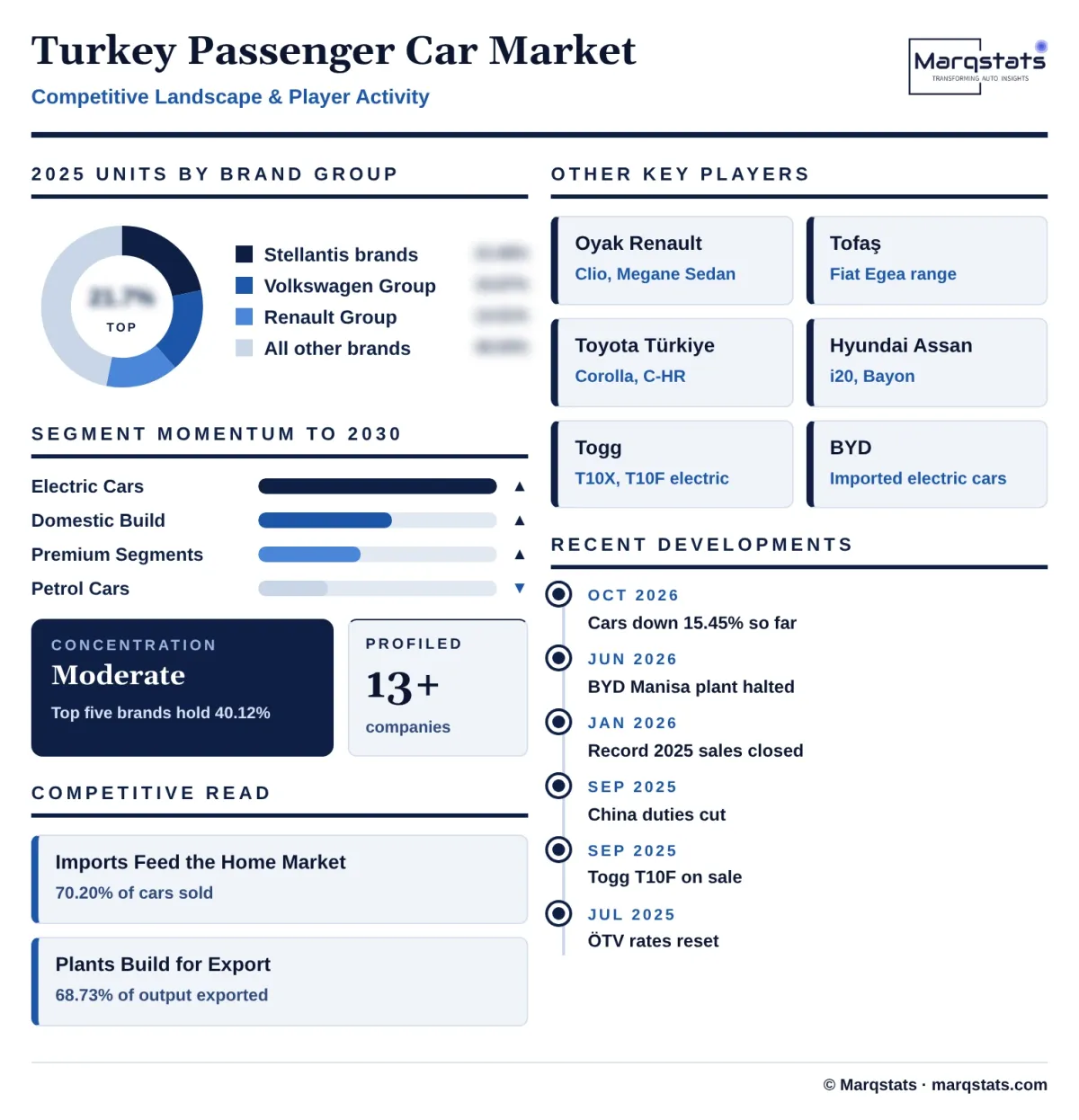
The market is moderately concentrated. Renault leads with 131,764 cars, 12.15% of 2025 units, followed by Volkswagen at 88,682, Toyota at 76,620, Fiat at 71,787 and Hyundai at 66,261, which together hold 40.12%. Grouping ODMD brand lines by ownership, Marqstats counts Stellantis brands at 235,090 cars, 21.68%, the Volkswagen Group at 182,963, 16.87%, and the Renault Group at 157,315, 14.51%.
Competition runs on the tax band, not on the badge. A buyer compares which ÖTV rate a model pays, how much credit the bank allows against its invoice and whether the car is built in Turkey, so entry models from Renault, Fiat, Toyota and Hyundai fight for the same lira price points while BYD, Chery, Togg and Tesla compete on equipment and electric range. Togg sold 39,020 cars and BYD 45,537, a combined 7.80% of the market, from a standing start.
Footprint decides position. Oyak Renault Otomobil Fabrikaları A.Ş. builds the Clio and Megane Sedan at Bursa, Tofaş Türk Otomobil Fabrikası A.Ş. builds the Egea range, Toyota Otomotiv Sanayi Türkiye A.Ş. builds the Corolla and C-HR at Sakarya and Hyundai Assan Otomotiv Sanayi ve Ticaret A.Ş. builds the i20 and Bayon at İzmit. OSD reported 2025 output of 872,538 cars and exports of 599,687, so every plant also faces a European order book that competes for its capacity.
Chinese brands are the entrants that change the price ladder. The decrees of 22 September 2025 cut the additional duty on Chinese combustion cars to 25% and on electric cars to 30%, but BYD's Manisa plant has been halted and its incentives suspended, so growth for Chinese brands depends on import rights rather than local assembly. Chery and Jaecoo sold 37,370 cars together in 2025.
Companies Covered
Companies covered in the report include:
Recent Market Activity
Table of Contents
Coverage & Segmentation
The study covers the Turkey passenger car market, with 2025 as the base year, 2021 – 2025 as the historical period and 2026 – 2030 as the forecast period. It covers new M1 passenger cars, including SUVs and crossovers, sold to buyers in Turkey across all powertrains, segmented by size class, body style, powertrain and origin, and by four regions. Values are retail transaction values including ÖTV and KDV in US dollars at TRY 39.57 per US dollar, the 2025 average held constant across the forecast, and units follow the ODMD sales series.
Light commercial vehicles of 283,904 units, including pickups and vans, used cars, motorcycles and cars built for export are excluded. The 1,368,400 unit light-vehicle market is the next rung of the ladder and is not added to this market. The Marqstats Turkiye Used Car Market analysis covers 7.57 million ownership transfers and uses a new-car base that includes light commercial vehicles, the Turkey EV Maintenance Market covers servicing of the electric fleet and the Turkey Two-Wheeler Market covers 812,240 motorcycles, so their figures must not be added to this market. Segment and regional splits are Marqstats estimates built on ODMD units and dated price lists. The analysis profiles 13 companies.