Market Snapshot
Key Takeaways
Market Overview & Analysis
Report Summary
The India passenger car market covers hatchbacks, sedans, sports utility vehicles, multi-purpose vehicles, and vans sold to retail and institutional buyers across the country. The segment reported its highest-ever annual volume of 4.47 million units in 2025, a 9.7% year-on-year gain, with the Federation of Automobile Dealers Associations confirming sustained demand momentum into early 2026 as inventory days normalised and model-mix availability improved.
Structural shifts now define the market. Sub-4-metre SUVs, mid-size SUVs, and three-row SUVs collectively drive incremental volume, while traditional mini and small car segments continue to contract. Premiumisation is evident across every price band: vehicles priced INR 10–20 lakh are the fastest-growing cohort, while luxury registrations have moved past the 50,000-unit milestone annually. CNG penetration has emerged as a durable affordability lever, and electric adoption is accelerating from a low base with Tata Motors, JSW MG Motor India, and Mahindra & Mahindra leading volume.
OEM product strategy is converging on three pillars: software-defined vehicle architectures, Bharat NCAP-led safety content, and localised electric vehicle platforms. Capacity expansions by Maruti Suzuki India Limited, Hyundai Motor India Limited, and Tata Motors Limited, combined with new entrants such as VinFast and BYD, are adding 1.2 million units of manufacturing headroom through 2028. The passenger vehicle demand outlook in India remains constructive, backed by stable interest rates, a growth-oriented 2026 Union Budget, and rising per-capita income.
The retail vs wholesale car sales India gap narrowed materially through the second half of 2025 as GST 2.0 reforms unlocked pent-up buyer demand and dealerships liquidated model-year 2025 inventory. Retail registrations outpaced wholesale dispatches for four consecutive months from October 2025, with inventory days compressing from 53–55 in October to 28 by March 2026. The channel entered 2026 in a markedly healthier position, with OEM-dealer discount discipline holding firm and captive financing arms capturing a rising share of new-loan originations. India is also among the fastest-growing passenger vehicle export hubs, with shipments crossing 770,000 units in FY 2024-25 and further upside expected as the EU-India Free Trade Agreement reduces tariffs on India-built cars entering European markets.
Market Dynamics
Key Drivers
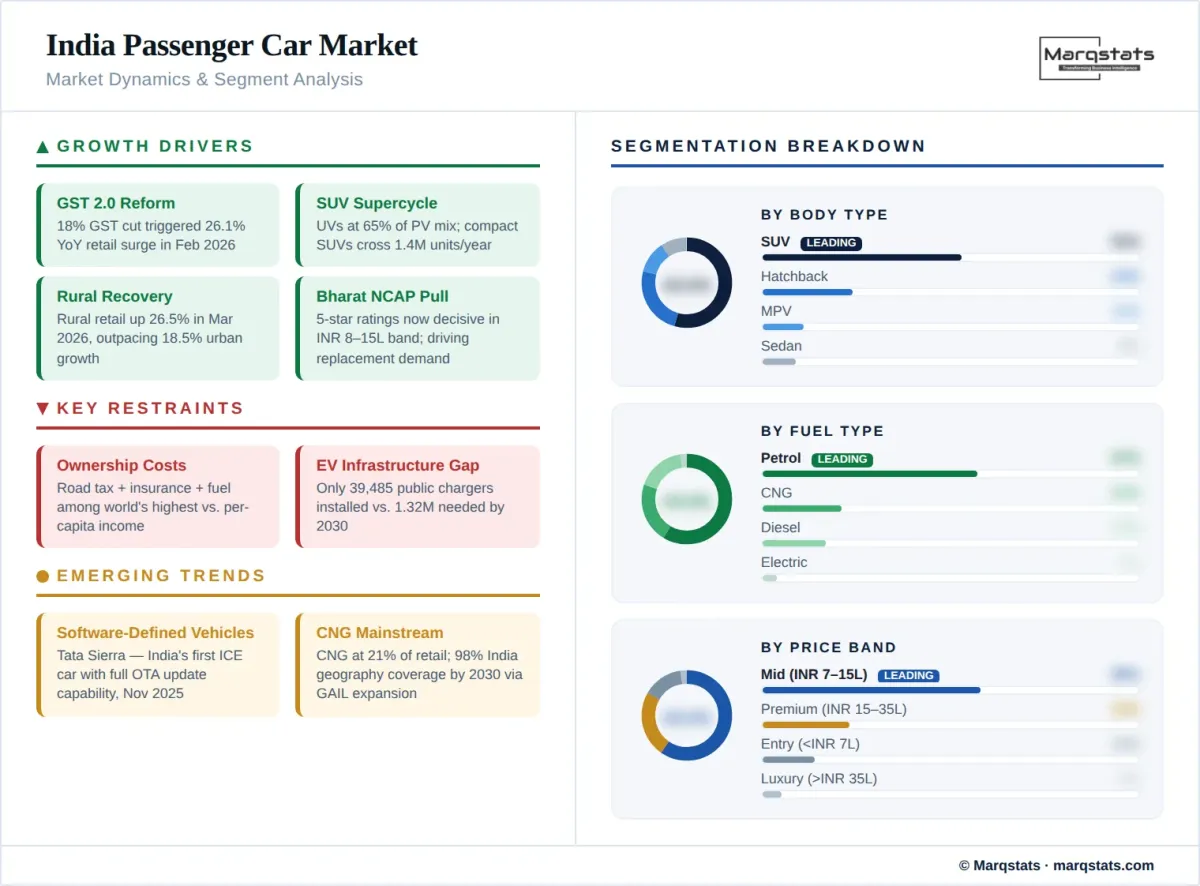
- GST 2.0 cut on all passenger cars to 18% in September 2025 sharply improved affordability, with retail registrations surging 26.1% year-on-year in February 2026.
- SUV-led growth in India is expanding addressable demand, with utility vehicles crossing 65% of passenger vehicle sales and compact SUVs driving entry-level upgrade cycles.
- Rising per-capita income and credit availability have lifted the median on-road price of a new passenger car above INR 11 lakh, supporting volume and value growth simultaneously.
- Rural retail grew 26.5% in March 2026 compared with 18.5% urban growth, signalling a structural recovery in non-metro markets aided by strong monsoons and agricultural incomes.
- Bharat NCAP safety ratings are accelerating replacement demand as buyers upgrade from older 0–2 star vehicles to 4–5 star models, particularly in the INR 8–15 lakh bracket.
Key Restraints
- High total cost of ownership for passenger cars in India—inclusive of road tax, insurance, and fuel—remains among the highest globally relative to per-capita income, limiting first-time buyer conversion.
- Semiconductor supply volatility for advanced driver assistance systems and infotainment modules continues to cause intermittent production disruptions for premium and electric variants.
- Dealer profitability pressure persists, with operating margins compressed by floorplan financing costs, discount-led price wars, and rising working-capital requirements across Tier-2 dealerships.
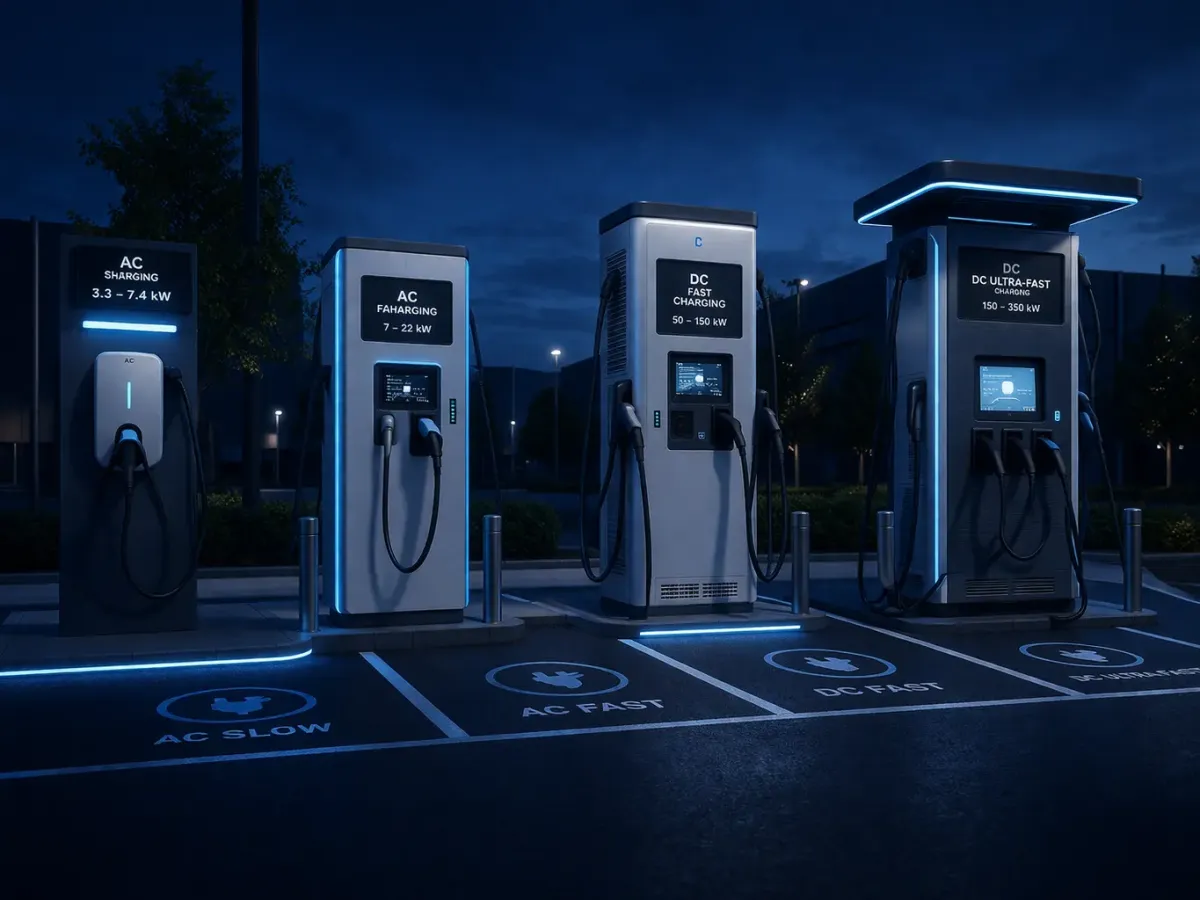
- Fragmented public EV charging infrastructure with only 39,485 public chargers installed under the PM E-Drive scheme lags the estimated 1.32 million chargers needed by 2030.
Key Trends
- Software-defined vehicle architectures are becoming mainstream, with Tata Motors' November 2025 Sierra launch marking the first Indian ICE passenger car engineered for full over-the-air software and firmware updates.
- Bundled retail financing and usage-based insurance are gaining ground, with OEM captive finance arms capturing a rising share of new car loan originations in FY 2025-26.
- CNG cars in India are a strategic affordability lever, with CNG now 21% of passenger vehicle retail and most mass-market OEMs offering factory-fitted CNG across hatchbacks, sedans, and compact SUVs.
- Export-led growth is accelerating, with India passenger vehicle exports crossing 770,000 units in FY 2024-25 at a 14.6% year-on-year growth rate, supported by India-Europe free trade agreement progress.
- Luxury and premium EVs are entering the INR 25–50 lakh window with VinFast, BYD, Kia, and Hyundai introducing India-built or CBU electric SUVs under the reduced 15% import duty framework.
Market Segmentation
Hatchbacks accounted for approximately 24% of 2025 passenger car volumes, continuing a multi-year share decline from over 47% in FY 2018-19. Entry hatchbacks have been most affected as first-time buyers migrate directly to sub-4-metre SUVs with only marginally higher on-road price differentials. Maruti Suzuki Swift, Hyundai Grand i10 Nios, Tata Tiago, Maruti WagonR, and Maruti Alto K10 remain the volume leaders, with GST 2.0 rate cuts and expanded CNG variant availability partially reviving the segment in late 2025 and early 2026. Premium hatchbacks (Maruti Baleno, Tata Altroz, Hyundai i20, Toyota Glanza) retain a loyal buyer base in metro markets where parking constraints and urban congestion favour compact footprints.
Sedans represent around 9% of 2025 passenger car sales and are the smallest mainstream body-type cohort. Compact sedans under four metres (Maruti Dzire, Hyundai Aura, Tata Tigor, Honda Amaze) drive most of the volume, while mid-size sedans (Hyundai Verna, Honda City, Volkswagen Virtus, Skoda Slavia) serve an enthusiast and fleet-oriented buyer base.
SUVs dominate with more than 53% of passenger car volumes in 2025, led by compact SUVs (Tata Nexon, Maruti Brezza, Mahindra XUV 3XO, Hyundai Venue, Kia Sonet) and mid-size SUVs (Hyundai Creta, Kia Seltos, Mahindra Scorpio, Tata Harrier, Maruti Grand Vitara). Three-row SUVs such as the Mahindra XUV 700, Toyota Fortuner, and MG Hector Plus anchor the premium segment above INR 18 lakh. SUV penetration in India is projected to cross 60% of passenger car volumes by 2028 as OEM pipelines skew further toward higher-ride-height, feature-rich platforms. The compact SUV India category alone accounts for over 1.4 million units annually, making it the single largest body-type cohort in the passenger vehicle market and the primary battleground for Bharat NCAP safety ratings, connected features, and ADAS content.
MPVs contribute roughly 11% of 2025 passenger car sales, with Maruti Ertiga, Toyota Innova HyCross, Kia Carens, and Maruti XL6 anchoring the segment. Strong hybrid Innova HyCross has captured incremental demand from corporate and self-drive fleets, while the Ertiga benefits from CNG pricing advantages in metro markets.
Petrol remains the dominant passenger car fuel at approximately 57% of 2025 retail volumes, supported by broad model availability and competitive on-road pricing after GST 2.0. Turbocharged petrol engines are gaining share in the mid-size SUV band as OEMs consolidate diesel lineups for CAFE III compliance.
Diesel share has stabilised at around 17% of passenger car sales, concentrated in mid-size and three-row SUVs above INR 12 lakh where torque and long-distance efficiency remain decisive. Mahindra, Tata, Toyota, and Kia continue to anchor diesel availability, while Maruti and Hyundai have exited small-car diesel entirely.
CNG cars in India have expanded rapidly to 21% of retail passenger vehicle mix in late 2025, driven by lower running costs at sub-INR 2.5 per kilometre, widening city gas distribution networks, and factory-fitted CNG across hatchbacks, sedans, and compact SUVs. Maruti Suzuki leads CNG with over 65% segment share through a portfolio spanning Alto K10, WagonR, Celerio, Dzire, Baleno, Brezza, Ertiga, and Grand Vitara. Tata Motors and Hyundai have matched with CNG variants of the Tiago, Tigor, Punch, Exter, and Aura. City gas distribution coverage is expected to reach 98% of India's geography by 2030 under the ongoing GAIL network expansion, further strengthening the CNG value proposition.
Electric passenger vehicles crossed 4% of new car retail in FY 2025-26, with over 119,000 electric car registrations in the first seven months and a 105% year-on-year volume gain. Tata Motors, JSW MG Motor, and Mahindra & Mahindra account for approximately 88% of electric passenger car sales through the Nexon.ev, Punch.ev, Tigor.ev, Curvv.ev, MG Windsor, MG Comet, MG ZS EV, and Mahindra XUV400. Model roll-outs from Hyundai, Maruti, VinFast, and BYD are widening choice across INR 12–50 lakh. The PM E-Drive scheme, which replaced FAME-II in September 2024, earmarks INR 10,900 crore for FY 2025-26 to support electric two-wheelers, three-wheelers, buses, trucks, and public charging infrastructure. The Scheme for Promotion of Manufacturing of Electric Passenger Cars in India (SPMEPCI) offers concessional import duty of 15% for up to 8,000 CBU electric passenger cars annually in exchange for local manufacturing and value-addition commitments.
Strong hybrid electric vehicles account for roughly 2% of passenger car sales but capture 35% of Toyota's India volumes through the Innova HyCross, Urban Cruiser Hyryder, and Camry. Mild-hybrid 12V and 48V systems are near-universal on Maruti, Mahindra, and Toyota petrol powertrains to meet CAFE III fuel-efficiency norms.
The entry band (best cars under 7 lakh in India) represents approximately 14% of passenger car volumes and is dominated by Maruti Suzuki (Alto K10, S-Presso, WagonR) and Renault Kwid. GST 2.0 has partially revived this cohort after multi-year contraction, particularly in rural and Tier-3 markets.
The best cars under 10 lakh India and best cars under 15 lakh India bands together account for around 58% of passenger car sales and are the strategic core of the market. Compact SUVs, premium hatchbacks, and compact sedans compete intensely, with on-road price, fuel efficiency, connected features, and Bharat NCAP ratings shaping buyer decisions.
The premium band contributes approximately 23% of passenger car volumes and is the fastest-growing value cohort at 7.65% CAGR. Mid-size SUVs, three-row SUVs, and premium MPVs such as the Hyundai Creta, Tata Harrier, Mahindra XUV 700, Toyota Innova HyCross, and Kia Carens anchor this price band.
Luxury passenger cars account for less than 2% of volumes but over 8% of value, with annual registrations crossing 51,000 units. Mercedes-Benz, BMW, Audi, Jaguar Land Rover, Volvo, and Lexus compete alongside electric luxury entrants from Hyundai, Kia, BMW, and Volvo in the INR 40–80 lakh window.
India has over 10,000 passenger car dealerships across roughly 1,200 cities, anchored by large multi-brand groups and standalone franchisees. OEM-appointed dealers capture more than 97% of new passenger car sales, with financing, insurance, accessories, and aftersales service contributing roughly 50% of dealer profitability. Passenger vehicle retail registrations India crossed 4.5 million units in FY 2025-26, supported by improving freight movement, rate stability from the Reserve Bank of India, and a growth-oriented Union Budget.
Digital bookings and online configurators now account for around 35% of new car lead generation, while end-to-end online purchases remain below 5% of transactions. OEM-hosted platforms from Maruti Suzuki, Hyundai, Tata Motors, and Kia, combined with aggregators such as CarDekho, CarWale, and Cars24 new car, are reshaping discovery, comparison, and on-road price transparency. The dealer network India passenger cars ecosystem is evolving to hybrid sales models that combine physical test drives with digital booking, configuration, and financing.
The used passenger car market in India is estimated at around 5 million transactions in 2025, outpacing new car sales by a ratio of 1.1-to-1 and projected to widen to 1.7-to-1 by 2030. Organised platforms (Cars24, Spinny, Mahindra First Choice Wheels, Tata OK, Maruti True Value) are capturing an expanding share of structured used car volumes, while OEM-captive exchange programmes anchor trade-in contributions to new car demand.
By Geography
Western India
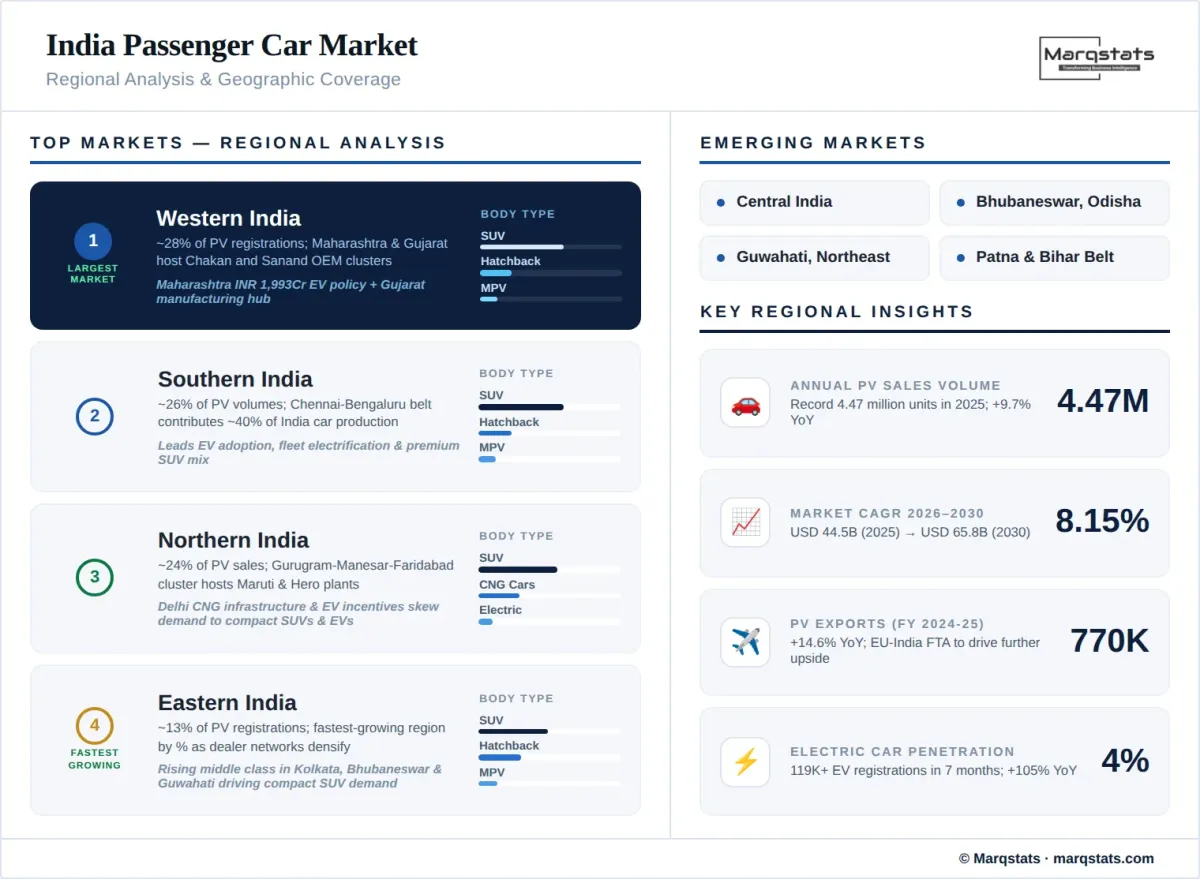
Western India—Maharashtra, Gujarat, Goa, and Madhya Pradesh—contributes approximately 28% of passenger car registrations and hosts two of the three largest OEM clusters at Chakan and Sanand. Maharashtra's draft EV policy 2025–30 with INR 1,993 crore in incentives, combined with Gujarat's established manufacturing ecosystem around Sanand and the Tata–Ford transition plant, anchors regional demand. Urban SUV and luxury penetration is highest in Mumbai, Pune, and Ahmedabad.
Southern India
Southern India—Tamil Nadu, Karnataka, Andhra Pradesh, Telangana, and Kerala—accounts for around 26% of passenger car volumes and is the largest hub for automotive manufacturing, with Chennai, Oragadam, Bengaluru, and Hosur contributing roughly 40% of India's car production. The region leads in electric car adoption, fleet electrification, and premium sedan/SUV mix, supported by higher urbanisation, strong technology-sector employment, and progressive state EV policies.
Northern India
Northern India—Delhi NCR, Punjab, Haryana, Uttar Pradesh, and Uttarakhand—represents approximately 24% of passenger car sales and hosts the Haryana manufacturing cluster at Gurugram, Manesar, and Faridabad. Delhi's aggressive EV incentives, CNG infrastructure maturity, and India's largest used car market concentration drive demand skew toward compact SUVs, CNG variants, and electric SUVs.
Eastern India
Eastern India—West Bengal, Odisha, Jharkhand, Bihar, and the Northeast—contributes roughly 13% of passenger car registrations and is the fastest-growing region in percentage terms. Expanding road infrastructure, rising middle-class formation in Kolkata, Bhubaneswar, and Guwahati, and dealer network densification by Maruti Suzuki, Tata Motors, and Hyundai are opening volume headroom across hatchbacks and compact SUVs.
Central India
Central India—Madhya Pradesh, Chhattisgarh, and parts of Vidarbha—accounts for around 9% of passenger car volumes and is characterised by strong rural and semi-urban demand. Tata Motors, Mahindra, and Maruti dominate the region, with CNG and entry compact SUVs driving the majority of incremental retail. Passenger vehicle retail registrations in the region grew faster than the national average in Q1 2026.
How Competition Is Evolving
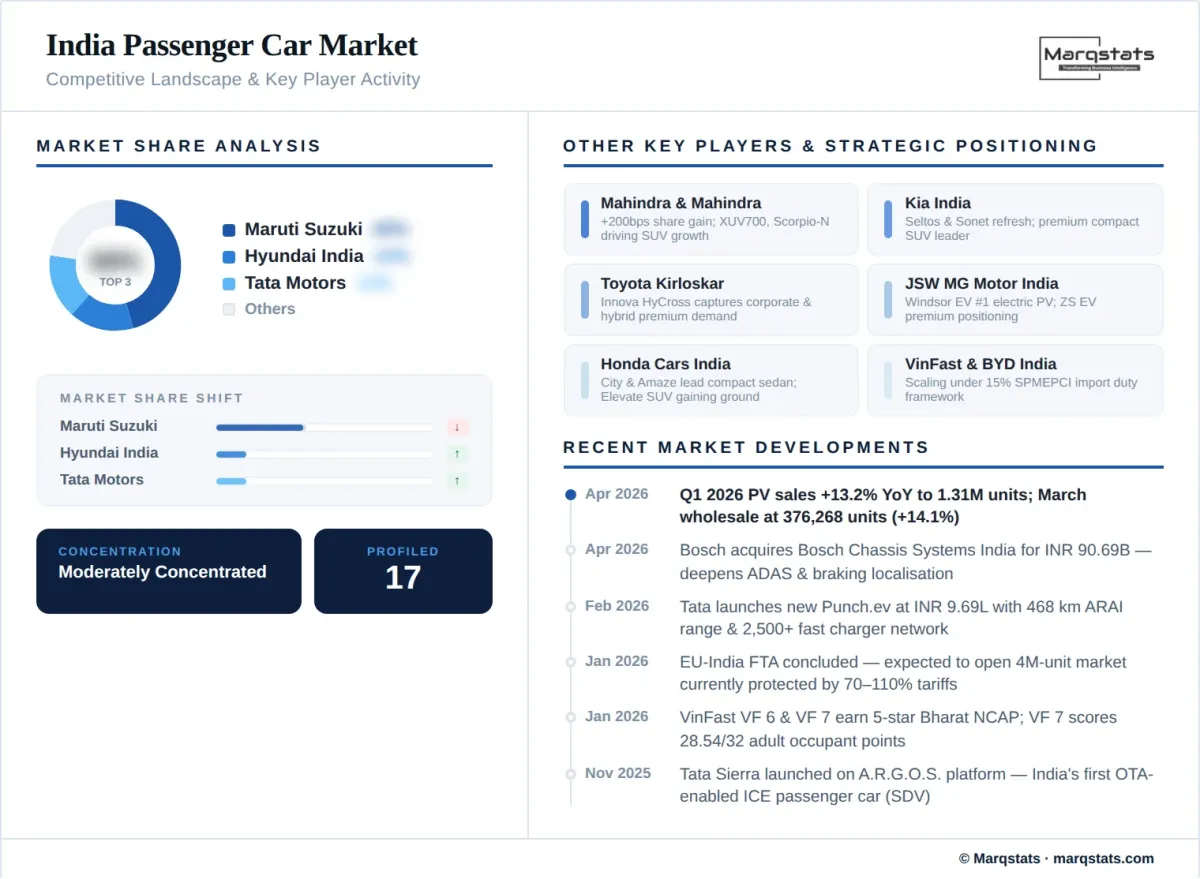
The India passenger car market is moderately concentrated, with the top five original equipment manufacturers—Maruti Suzuki India Limited, Tata Motors Limited, Mahindra & Mahindra Limited, Hyundai Motor India Limited, and Toyota Kirloskar Motor Private Limited—accounting for roughly 83% of 2025 domestic volumes. Maruti Suzuki retained market leadership with over 40% share despite incremental erosion to Korean, domestic, and Japanese competitors. Tata Motors and Mahindra have posted the strongest growth, each gaining 200-plus basis points on the back of successful SUV and EV launches.
Competitive intensity is structured around four battlegrounds. SUV portfolio depth defines the mid-market contest, with Hyundai, Tata, Mahindra, and Kia launching refreshed Creta, Harrier, Scorpio, and Seltos iterations respectively in 2025–26. Electric passenger car share is a second front where Tata Motors leads volume, JSW MG Motor India holds a strong premium EV position, and VinFast, BYD, Hyundai, and Kia are scaling imports under the 15% reduced duty framework. Hybrid positioning is a third axis, dominated by Toyota and Maruti through joint development, while software-defined vehicles and over-the-air update capability are becoming the fourth competitive dimension following Tata Motors' Sierra launch.
Strategic moves across 2025–26 include capacity expansions at Maruti Suzuki's Kharkhoda plant, Tata Motors' Sanand acquisition, Hyundai's new Talegaon facility, and Kia's Anantapur debottlenecking. Foreign OEM entries are accelerating following the January 2026 EU-India Free Trade Agreement, which is expected to gradually lower passenger car tariffs from the current 70–110% band. Tier-1 supplier consolidation is reshaping value chains, with Bosch Limited's April 2026 acquisition of Bosch Chassis Systems India for INR 90.69 billion signalling deeper localisation of braking, ADAS, and chassis electronics.
Companies Covered
The report profiles 17+ companies with full strategy and financials analysis, including:
Recent Market Activity
Table of Contents
Coverage & Segmentation
This report provides a comprehensive analysis of the India passenger car market for the historical period 2021–2025 and forecast window 2026–2030, with 2025 as the base year. Coverage spans hatchbacks, sedans, sports utility vehicles, multi-purpose vehicles, and vans across petrol, diesel, CNG, electric, and hybrid powertrains. The study examines market sizing by units and value, segment-level forecasts, competitive positioning, retail and wholesale channel dynamics, regulatory impact, and OEM strategy.
Primary research included structured interviews with more than 40 industry stakeholders spanning OEM product and strategy leaders, Tier-1 component suppliers, dealership principals, automotive financiers, fleet operators, and senior policy analysts. Secondary research drew on the Society of Indian Automobile Manufacturers, Federation of Automobile Dealers Associations, Ministry of Road Transport and Highways, VAHAN registration data, Ministry of Heavy Industries, Press Information Bureau, RBI, company annual reports, investor presentations, stock exchange disclosures, industry body releases, and internally curated Marqstats Intelligence datasets.