Market Snapshot
Middle bar: base-year value × (1 + CAGR), rounded to two decimals. This is a calculated illustration, not a separately researched annual estimate.
The Ghana passenger car market size is estimated at USD 1,303.41 million in 2025 and is projected to reach USD 1,698.27 million by 2030, growing at a CAGR of 5.44% over 2026 – 2030. Car additions rise from about 100,000 to 113,000 units, a 2.47% annual rate, while the landed value per car rises from about USD 13,034 to USD 15,029. Imported used cars are 88.50% of units and 75.78% of value.
Marqstats defines the market as the landed transaction value of M1 passenger cars, including saloons, hatchbacks, SUVs and crossovers, that enter Ghana each year as imported used cars, imported new cars or locally assembled cars. Value is counted before value added tax and dealer margin, and includes freight, customs duty, levies, over-age penalties and port charges. Pickups, vans, minibuses, motorcycles, trucks and buses are excluded.
SUVs and crossovers account for 62.37% of 2025 value, petrol and diesel cars for 93.01%, and Greater Accra for 62.00%. Plug-in hybrid and battery-electric cars grow fastest, at 37.19% a year from a very small base, and the pre-shipment inspection regime for used cars was suspended on 5 October 2026 within days of its planned start.
Key Takeaways
Market Overview & Analysis
Report Summary
Ghana changed the rules for used cars three times between August and October 2026, and demand kept growing. The Value Added Tax Act, 2025 (Act 1151) took effect on 1 January 2026, the Ghana Standards Authority announced on 14 August 2026 that used vehicles older than 15 years would be barred from 1 October 2026, and on 5 October 2026 it suspended the pre-shipment inspection exercise, with a new date to be communicated. Marqstats sizes a market in which 88.50% of cars arrive used, so these decisions fall on the importer and the buyer, not on the assembler.
Marqstats sizes the Ghana passenger car market as the landed transaction value of M1 cars, meaning vehicles designed to carry no more than eight passengers in addition to the driver, whether bought as imported used cars, imported new cars or cars assembled in Ghana from kits. Value is measured before value added tax and dealer margin and covers the vehicle, freight and insurance, customs duty, levies, over-age penalties and port charges. Pickups, vans and light commercial vehicles are excluded, as are exports and re-exports. The wider West Africa used vehicle flow, which counts passenger and commercial vehicles together across the Economic Community of West African States (ECOWAS), is a separate and broader market.
The analysis is written for four readers. Importers and dealers decide which age and price bands to stock under the 15-year limit and inspection fees. Franchise distributors and assemblers decide whether to order kits or whole cars after the removal of the assembly VAT exemption. Lenders and insurers decide how much credit to extend as lending rates fall. Policy teams in ministries and development agencies decide whether to protect assembly or to improve the used-car channel that supplies 88.50% of cars.
Ghana Passenger Car Market Size and Forecast
The Ghana passenger car market grows from USD 1,303.41 million in 2025 to USD 1,698.27 million in 2030, a CAGR of 5.44%. Volume is the primary series and price is the second driver: car additions rise at 2.47% a year, from about 100,000 to 113,000, and the average landed value per car rises at 2.89% a year, from about USD 13,034 to USD 15,029, because imported new cars and hybrids take a larger share and because used-car prices follow the global used market and the pre-shipment inspection fee.
The 2025 value is built bottom-up from three channels. Marqstats estimates 88,500 imported used cars at a landed value of about USD 11,160 each, 6,000 imported new cars at about USD 32,000 and 5,500 locally assembled cars at about USD 22,500. For a used car, an invoice value of USD 7,800 plus USD 1,500 of freight and insurance gives a cost, insurance and freight value of USD 9,300. Customs duty at a blended 12.00% of that value, other levies at 3.50%, over-age penalties at 2.00% and port and clearing charges at 2.50% lift the landed value to USD 11,160. Value added tax, which is 20% on the duty-inclusive value, and dealer margin sit outside the market.
The used-car base is checked against customs import values. The Ghana Statistical Service reported imports of used vehicles with 1,500 to 3,000 cubic centimetre engines of GH¢9.33 billion in 2025, the third-largest import line in the country, equal to USD 737.32 million at the 2025 average of GHS 12.654 per US dollar. For the fourth quarter of 2025, the same release put 1,500 to 3,000 cubic centimetre imports at GH¢3.1 billion and 1,000 to 1,500 cubic centimetre imports at GH¢1.0 billion. Applying that quarterly ratio, Marqstats estimates 1,000 to 1,500 cubic centimetre imports at about GH¢3.01 billion for the year, giving about GH¢12.34 billion, or USD 975.19 million. Marqstats estimates the cost, insurance and freight value of the 88,500 passenger cars in this market at USD 823.05 million, 84.40% of that total; the balance is pickups, vans and minibuses that the customs lines also contain.
Three adjustments separate this market from the passenger vehicle inflow figures often quoted for Ghana. First, Marqstats removes about 2,100 non-passenger units: about 1,400 assembled pickups and similar non-passenger models, such as the Toyota Hilux and Nissan Navara, and about 700 pickups and vans among franchise imports. Second, Marqstats counts value on a landed basis rather than at retail, because most buyers pay an importer or dealer who adds a thin margin. Third, the live Marqstats West Africa Used Vehicle Market page values every vehicle type across the ECOWAS region at about USD 6,500 per vehicle on an invoice basis; Ghana cars here carry a newer, SUV-heavy mix at about USD 7,800 on invoice, so the two figures should not be added.
Imported new cars add value faster than volume. Marqstats expects new car additions to rise from 6,000 to 8,000, a 5.92% annual rate, and their value to rise at 8.45% a year, while used-car volume grows at 2.27% a year and local assembly at 1.76%. The 2030 used-car landed value of USD 12,730 assumes a cost, insurance and freight value of USD 10,400 and a pre-shipment inspection fee of USD 250, the middle of the USD 200 to USD 300 schedule. A change of USD 500 in the 2025 used-car invoice value would move the 2025 market by about USD 53.10 million, which makes used-car prices the most sensitive input.
The fiscal comparison in the key takeaways is a Marqstats construction. Duties, levies and over-age penalties of USD 1,627.50 per used car, on a cost, insurance and freight value of USD 9,300, give USD 144.03 million across 88,500 cars. The assembly figure applies a 20% value added tax rate to the USD 22,500 assembled value of 5,500 cars, which gives USD 24.75 million, so the ratio of 5.82 to 1 depends on the 20% rate applying to the full assembled value.
At the 2025 average rate of GHS 12.654 per US dollar, the market equals about GH¢16.49 billion. Marqstats tracks four indicators to monitor the forecast: the date the Ghana Standards Authority sets for the resumed pre-shipment inspection, monthly vehicle registrations from the Driver and Vehicle Licensing Authority (DVLA), the cedi against the dollar, and the Ghana Statistical Service quarterly import values for used vehicles.
Market Dynamics
Key Drivers
Five forces are lifting car demand in Ghana even as the rules for importing and assembling cars change.
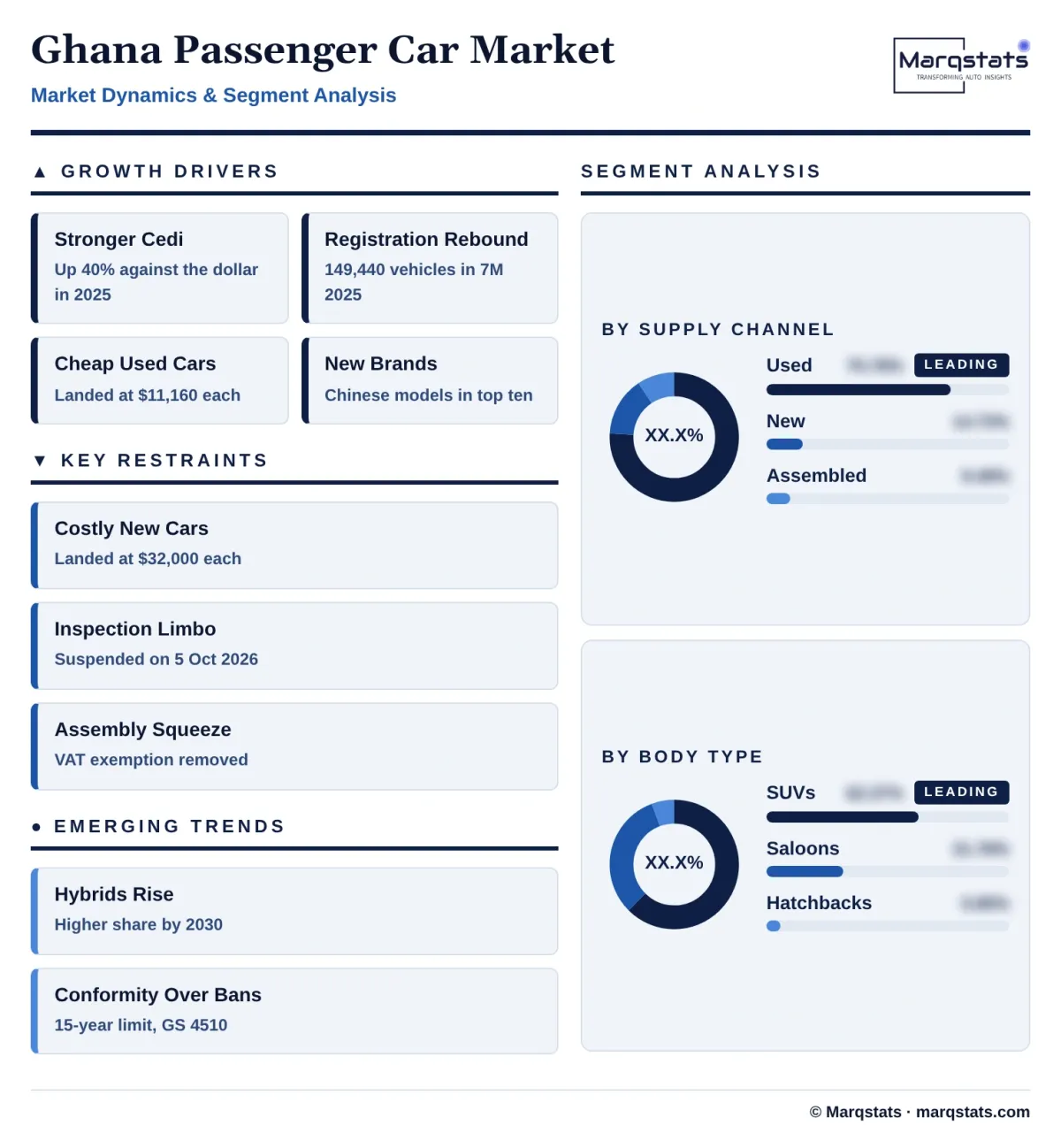
- A stronger cedi and cheaper credit lift demand. The cedi gained more than 40% against the US dollar in 2025, according to IMF data reported on 27 January 2026, and the average lending rate fell from about 32% to roughly 21% to 22% during 2025 as the policy rate was cut by 350 basis points to 18% in November 2025. Every dollar-priced car became cheaper in cedi terms.
- Registrations rebounded. The DVLA registered 149,440 vehicles of all types between January and July 2025, up 34.4% from 111,156 a year earlier, and 21,038 in July 2025 alone, up 41.1%. The DVLA chief executive said in August 2026 that the database holds nearly four million registered vehicles, a large base for replacement demand.
- Used cars keep entry prices low. A used car lands at about USD 11,160 before VAT, against about USD 32,000 for a new import, and Ghana Standards Authority research cited in August 2026 puts used vehicles at more than 90% of vehicle imports. Importers clearing cars at Tema and Takoradi draw on supply in the United States, Canada, Europe, the United Arab Emirates and Japan.
- New brands widen the choice. Five Chinese models, including the Haval Jolion, Geely Coolray, Jetour T2 and MG ZS, reached the 2025 top ten of new light vehicles tracked in Ghana, and on 2 June 2026 the Foreign Affairs Minister announced that a West Africa Hyundai automotive manufacturing plant would be established in Ghana in 2026.
- Credit initiatives target buyers. On 2 July 2025 the Business and Financial Times reported that the United Kingdom would facilitate GBP 50 million of funding to improve automotive credit access, a priority in a market where Marqstats estimates that most used-car purchases are paid for in cash or on informal credit.
Key Restraints
Four constraints hold the market well below the level that the 2025 rebound in registrations implies.
- Affordability caps the move to new cars. A new imported car lands at about USD 32,000 before VAT, 2.87 times a used car, and lending rates of roughly 21% to 22% remain far above those in car-buying markets with deep credit, so most private buyers stay in the used channel.
- Used-car rules add cost and uncertainty. The Ghana Standards Authority set inspection fees of USD 200 for Japan, USD 250 for Asia, the United Arab Emirates and Africa, and USD 300 for Europe, the Americas and the United Kingdom. A flat USD 250 is 2.69% of the cost, insurance and freight value of an average used car and 5.00% of a USD 5,000 car, so the fee hurts the cheapest cars most. The suspension on 5 October 2026 leaves importers without a date.
- The assembly sector is under strain. The 2026 budget removed the value added tax exemption for locally assembled vehicles, and the Automobile Assemblers Association of Ghana warned on 4 May 2026 that members had invested nearly EUR 80 million, that more than 400 skilled jobs were at risk and that seven plants could close. Some global brands have stopped ordering assembly kits.
- Duty bands penalise the cars Ghana says it wants. Standard hybrid and electric passenger cars fall in the 20% duty band, the same as petrol cars above 3,000 cubic centimetres, while many mid-size petrol and diesel cars and SUVs pay 10%. Only an eight-year import duty waiver for electric public transport vehicles, proposed in the 2024 budget, offers relief, and it excludes private cars.
Key Trends
Four shifts are changing which cars Ghanaians buy, where they come from and how they are checked.
- Hybrids move from niche to mainstream. Hybrid cars rise from 4.60% to 9.03% of units between 2025 and 2030, because hybrids offer fuel savings without charging infrastructure, and they are already part of the used-import stream from Japan.
- Chinese brands take new-car share. Haval, Geely, Jetour and MG models entered the 2025 top ten of new light vehicles, and Marqstats expects imported new cars to rise from 6.00% to 7.08% of units as these brands undercut established franchise prices.
- Policy moves from age limits to conformity checks. The 10-year limit in the Ghana Automotive Development Policy has operated as a penalty rather than a ban, the Ghana Standards Authority first proposed a 10-year limit and then set 15 years on 14 August 2026, and the inspection exercise, run under Ghana Standard GS 4510:2022 by approved inspectors, is now suspended. Buyers should expect inspection certificates, not bans, to define the market.
- Assembly looks for regional scale. The announced Hyundai plant, the Volkswagen Ghana plant led by the association president Jeffrey Oppong Peprah, and the plants of Toyota Tsusho Manufacturing Ghana, Japan Motors Trading Company, Rana Motors Ghana and Zonda Tec Ghana depend on volume that the home market alone does not supply.
Strategic Implications
- For importers and dealers, the stock decision is age and price band. With used cars at 75.78% of value and a 15-year ceiling, stock of five to ten years old carries no over-age penalty, and a flat inspection fee favours fewer, better cars over many cheap ones.
- For franchise distributors, the opening is the buyer who can pay about USD 32,000 before VAT. Lower lending rates and Chinese entrants will widen that group, so distributors that arrange credit and parts supply win share from importers that cannot.
- For assemblers, the case for kits rests on policy that is not yet settled. At about USD 22,500 per car and 5.50% of units, local assembly cannot carry a plant on the home market, so kit orders depend on restoring the exemption, a duty differential or exports.
- For lenders and insurers, the used-car channel is a cash market that is ready to switch. Salary-deduction loans and residual-value leases that target five- to eight-year-old SUVs reach buyers who pay about USD 11,160 landed.
- For policy teams, the used-car channel is where revenue and risk sit. A predictable inspection date, a fee that does not weigh on the cheapest cars, and lower duty bands for hybrids would change prices more than assembly incentives affecting 5.50% of cars.
Market Segmentation
SUVs and crossovers account for 62.37% of 2025 value, USD 812.82 million, from 55,000 units, and grow at 5.94% a year to USD 1,084.62 million and 63.87% of the market. The Toyota RAV4, Nissan X-Trail and Kia Sportage hold their value in the used market because of ground clearance and resale prices, and Marqstats estimates SUV units at 55.00% of 2025 volume.
Saloons account for 31.78% of 2025 value, USD 414.28 million, from 36,000 units, and grow at 4.70% a year to USD 521.27 million. The Toyota Corolla, Hyundai Elantra and Volkswagen Passat serve ride-hailing drivers, company pools and urban commuters who value fuel cost over status.
Hatchbacks account for 5.85% of 2025 value, USD 76.31 million, from 9,000 units, and grow at 3.90% a year to USD 92.38 million. The Suzuki Swift and Volkswagen Polo are the main assembled and new models, but status preferences for larger cars keep this class the smallest.
Petrol and diesel cars account for 93.01% of 2025 value, USD 1,212.35 million, from 94,800 units, and grow at 3.46% a year to USD 1,437.22 million, while their share falls to 84.63%. They remain the default for used imports, repair clusters such as Suame Magazine and Abossey Okai, and buyers who need low purchase prices.
Hybrid cars account for 5.87% of 2025 value, USD 76.48 million, from 4,600 units, and grow at 19.99% a year to USD 190.19 million and 11.20% of the market. They deliver fuel savings without charging stations, which matters because intercity fast charging is thin, but they pay the 20% duty band.
Plug-in hybrid and battery-electric cars account for 1.12% of 2025 value, USD 14.58 million, from 600 units, and grow fastest, at 37.19% a year, to USD 70.86 million and 4.17% of the market. Marqstats estimates purchase prices above USD 30,000, and thin intercity fast-charging coverage and commercial electricity tariffs limit adoption; the proposed duty waiver covers public transport vehicles, not private cars.
Imported used cars account for 75.78% of 2025 value, USD 987.66 million, from 88,500 units, 88.50% of volume, and grow at 5.00% a year to USD 1,260.27 million. They pay duty of 5%, 10% or 20% by engine size, over-age penalties above 10 years of age and, from the resumed inspection date, a certificate fee.
Imported new cars account for 14.73% of 2025 value, USD 192.00 million, from 6,000 units, and grow fastest among channels, at 8.45% a year, to USD 288.00 million and 16.96% of the market. Franchise distributors sell to executives, mining logistics firms, government offices and wealthy households.
Locally assembled cars account for 9.49% of 2025 value, USD 123.75 million, from 5,500 units, and grow at 3.92% a year to USD 150.00 million. The channel covers passenger models built from semi-knocked-down and completely knocked-down kits; assembled pickups are outside the market.
By Geography
Greater Accra
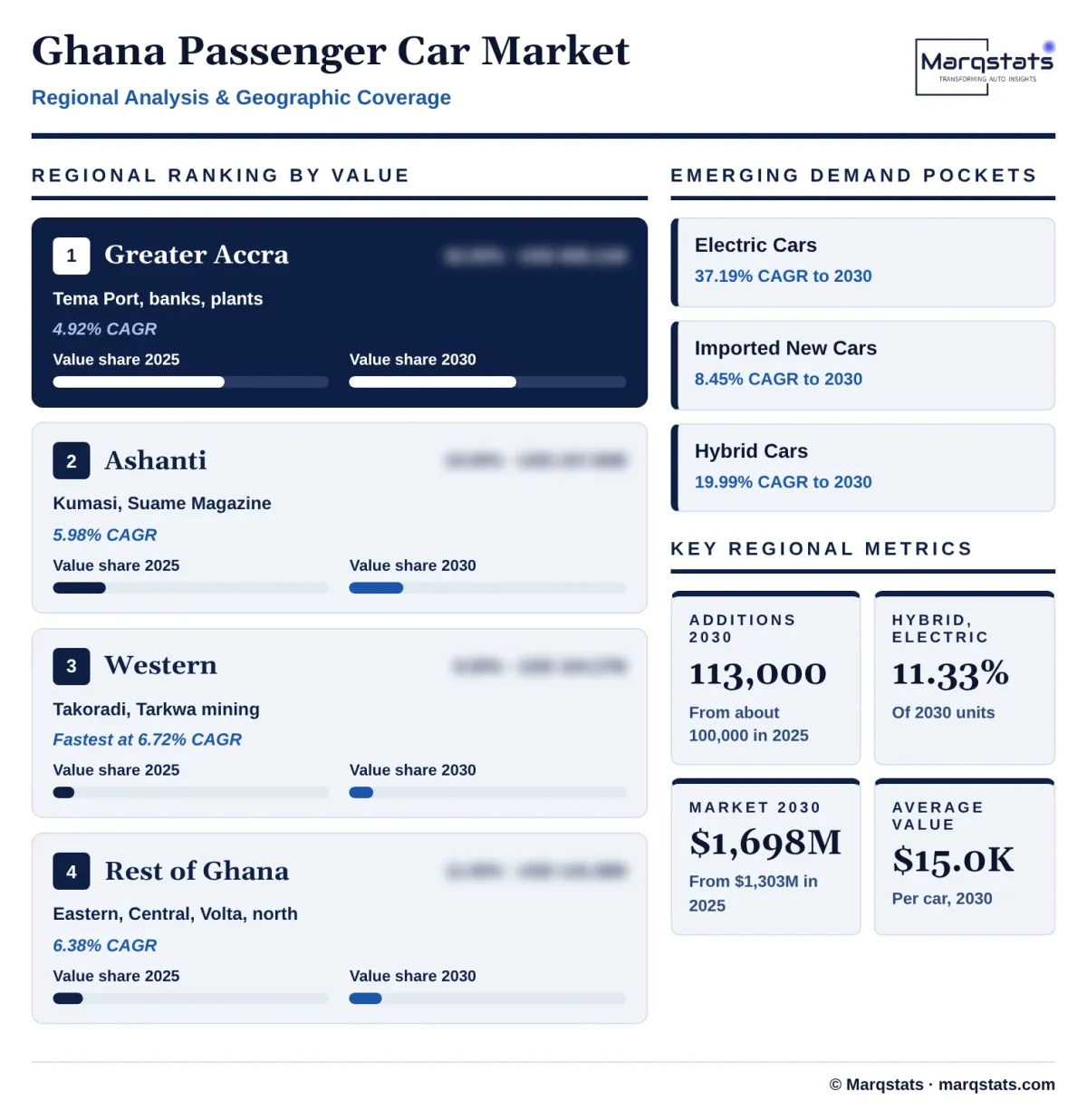
Greater Accra accounts for 62.00% of 2025 value, USD 808.11 million, and grows at 4.92% a year to USD 1,027.46 million and 60.50% by 2030. Registration data overstate the capital because leasing firms, banks and public agencies register vehicles centrally, even when the cars work in mining or farm areas, so Marqstats allocates value by where cars are bought and kept, with Tema Port, the head offices of banks and the assembly plants all in the capital corridor.
Ashanti
Ashanti accounts for 19.00% of 2025 value, USD 247.65 million, and grows at 5.98% a year to USD 331.16 million. Kumasi is the inland trade hub, and the Suame Magazine cluster keeps older used cars running and supplies the parts that make five- to ten-year-old imports practical for private owners and taxi operators.
Western
The Western Region accounts for 8.00% of 2025 value, USD 104.27 million, and grows fastest, at 6.72% a year, to USD 144.35 million and 8.50% by 2030. Sekondi-Takoradi, the Tarkwa mining belt and the offshore oil and gas supply base buy four-wheel-drive SUVs for contractors and company fleets, and Takoradi is the second port of entry for imported cars.
Rest of Ghana
The rest of Ghana, covering the Eastern, Central, Volta, Bono, Northern and other regions, accounts for 11.00% of 2025 value, USD 143.38 million, and grows at 6.38% a year to USD 195.30 million. Commuter saloons, regional administration fleets and the Kantanka assembly base at Gomoa Mpota sit here, while in the north motorcycles and tricycles carry most trips.
How Competition Is Evolving
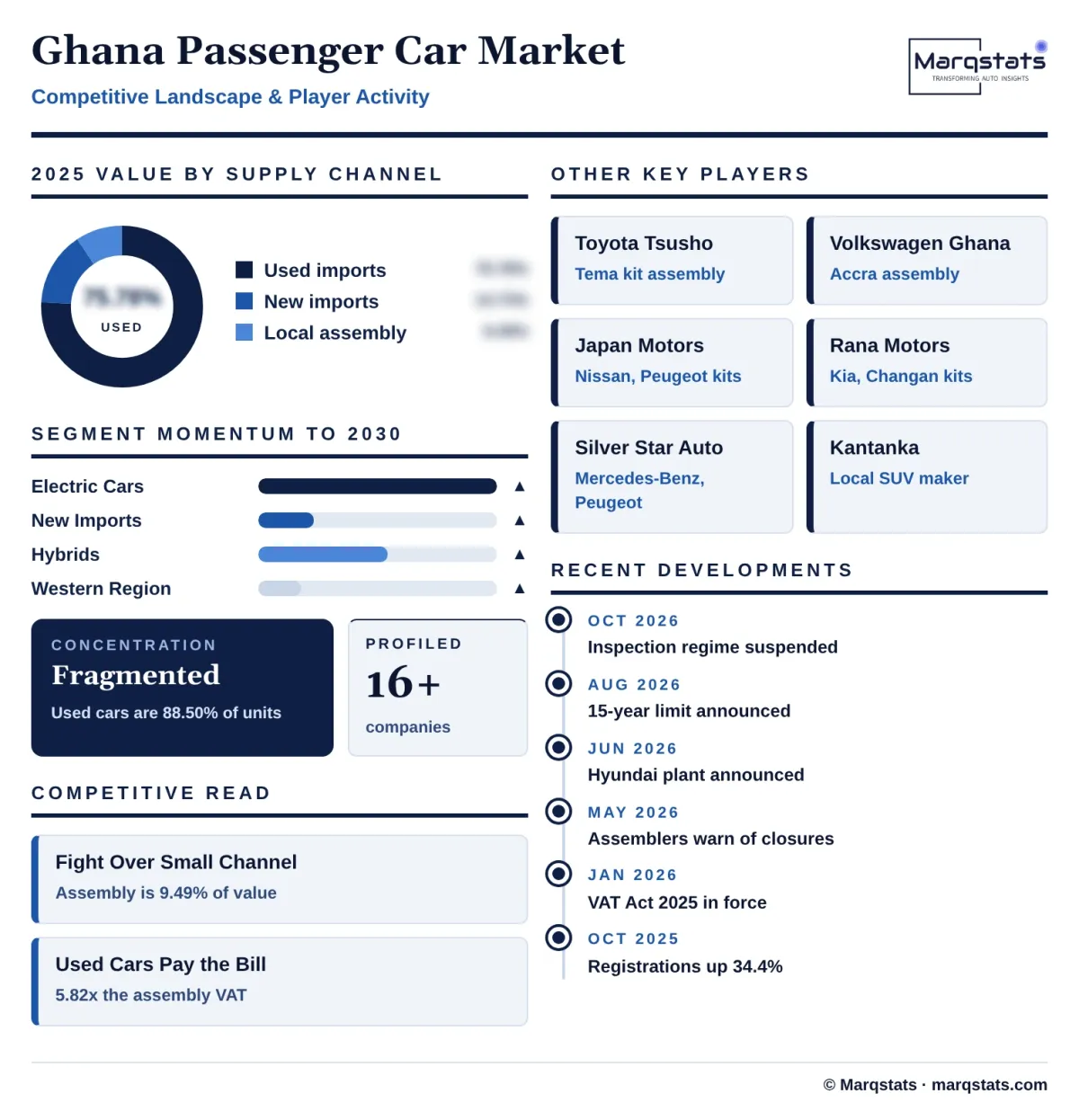
The market is fragmented and competes by layer, not by brand. Imported used cars take 75.78% of 2025 value through many independent importers and dealers, imported new cars take 14.73% through franchise distributors, and local assembly takes 9.49% through the plants of the Automobile Assemblers Association of Ghana. Marqstats expects the new-car layer to gain share, from 14.73% to 16.96% of value by 2030, while the used layer slips from 75.78% to 74.21%.
Buyers compete on landed price, condition and aftersales support. A Ghana Standards Authority officer said in August 2026 that about 90% of imported used vehicles lack aftersales service support, which is the gap that franchise brands and assemblers sell against, and that imports include accident-damaged, flooded, burnt, right-hand-drive and over-aged vehicles. Chinese brands compete on features and price, with five Chinese models in the 2025 top ten of new light vehicles tracked in Ghana.
The assembly footprint is wide but thin. Toyota Tsusho Manufacturing Ghana, Volkswagen Ghana, Japan Motors Trading Company, Rana Motors Ghana, Silver Star Auto, Zonda Tec Ghana and Kantanka Automobile are among the plants and brands that the association represents, yet Japan Motors assembled only about 1,400 vehicles in 2025. Toyota is the most common marque in the used stream and Toyota Ghana Company Limited is its franchise distributor.
Companies Covered
Companies covered in the report include:
Recent Market Activity
Table of Contents
Coverage & Segmentation
The study covers the Ghana passenger car market, with 2025 as the base year, 2021 – 2025 as the historical period and 2026 – 2030 as the forecast period. It covers M1 passenger cars, including SUVs and crossovers, entering the Ghanaian market as imported used cars, imported new cars or locally assembled cars, segmented by body type, powertrain, supply channel and region. Values are landed transaction values in US dollars before value added tax and dealer margin, and cedi figures use the 2025 average of GHS 12.654 per US dollar. Pickups, vans, minibuses, light commercial vehicles, motorcycles, trucks, buses, exports and re-exports are excluded.
The market is the passenger car layer inside broader flows. DVLA registrations of 149,440 vehicles in January to July 2025 count all vehicle types, including motorcycles and commercial vehicles, and are not a car count. The live Marqstats West Africa Used Vehicle Market counts passenger and commercial vehicles together across ECOWAS, and the live Ghana Two-Wheeler Market counts motorcycles and scooters; neither should be added to this market. The study carries three dimensions, nine segments and four regions, treats value as the primary series and units as the supporting series, and profiles 16 companies. All splits are Marqstats estimates.