Market Snapshot
Middle bar: base-year value × (1 + CAGR), rounded to two decimals. This is a calculated illustration, not a separately researched annual estimate.
The Nigeria passenger car market size is estimated at USD 4,770.24 million in 2025 and is projected to reach USD 6,341.75 million by 2030, growing at a CAGR of 5.86% over 2026 – 2030. Marqstats estimates that about 593,000 cars were added in 2025, rising to 720,000 by 2030.
Marqstats defines the market as the value of passenger cars of up to nine seats, including sedans, hatchbacks, sport utility vehicles (SUVs), crossovers and multi-purpose vehicles (MPVs), that enter Nigerian service in a year, whether as foreign-used cars known locally as Tokunbo, new complete cars imported by dealers, or cars assembled in Nigeria from imported kits. Value is the buyer transaction price at first sale in Nigeria, excluding value added tax, financing and registration fees. Pickups, vans, buses, trucks, tricycles, spare parts and conversion kits are excluded. Values use NGN 1,520 per USD, the 2025 average.
Used imports account for 95.45% of 2025 units and 88.87% of value, SUVs and crossovers for 52.68% of value and petrol cars for 90.99%. The South-West is the largest zone, with 40.50% of value, and hybrid and electric cars are the fastest-growing powertrain, at 27.97% a year, as the July 2026 duty cuts and the August 2026 duty and value added tax waiver for electric vehicles lower the cost of newer and cleaner cars.
Key Takeaways
Market Overview & Analysis
Report Summary
Marqstats sizes the Nigeria passenger car market as the value of passenger cars of up to nine seats added to the national fleet in a year. The market is valued at the first point of sale in Nigeria and counts three supply channels: foreign-used cars cleared by importers and traders, new complete cars imported by dealers, and cars assembled in Nigeria by licensed plants from imported kits.
Nigeria buys cars used. Marqstats estimates that about 566,000 used cars entered service in 2025 at an average transaction price of about USD 7,490, mostly Toyota, Honda and Lexus sedans and SUVs shipped from the United States, Canada, Europe and the Gulf. The NBS quarterly releases show the United States as the leading origin, with N197.90 billion of United States-origin used cars in the fourth quarter of 2025 alone, out of an annual passenger car import bill of N1.58 trillion.
New cars remain a thin layer. The chief executive of TIM Motors put the formal new-car segment at fewer than 15,000 units a year in July 2025, and Marqstats estimates about 13,000 new complete cars were imported in 2025 at an average of about USD 26,923, plus about 14,000 cars assembled in Nigeria at about USD 12,921 ex-factory. Licensed assembly plants run at about 5% of capacity, according to the National Automotive Design and Development Council (NADDC) in August 2026.
Policy turned in 2026. From 1 July 2026 Nigeria cut the duty on fully built passenger vehicles from 70% to 40%, the new-vehicle levy from 20% to 10% and the used-vehicle levy from 15% to 5%, according to Channels TV. In April 2026 the government announced a no certification, no entry rule for imported vehicles, and in August 2026 Nigeria Customs Service waived import duty and value added tax for battery-electric and extended-range electric vehicles. On 22 September 2026 the Central Bank of Nigeria cut its policy rate by 350 basis points to 23%.
The market has moved with the naira and the import bill. NBS recorded passenger car imports of N1.47 trillion in 2023, N1.26 trillion in 2024 and N1.58 trillion in 2025, and N1.18 trillion in the first half of 2026 alone, up 145.6% on the N479.26 billion of the first half of 2025. Marqstats estimates 2025 value at USD 4,770.24 million, of which customs statistics record USD 1,039.47 million, 21.79%; the remainder is duties, levies, clearing costs, trader margin, assembled cars and the part of transaction prices that customs declarations do not carry.
Nigeria Passenger Car Market Size and Forecast
The Nigeria passenger car market grows from USD 4,770.24 million in 2025 to USD 6,341.75 million in 2030, a CAGR of 5.86%. Marqstats expects value to outpace volume: car additions grow at 3.96% a year, from about 593,000 to 720,000, while the average value per car rises at 1.83% a year, from about USD 8,044 to USD 8,808, as new, assembled, SUV and hybrid and electric cars take share from used sedans.
The 2025 value is built bottom-up from three channels and nine body and channel cells. Used imports contribute USD 4,239.34 million from 566,000 cars, made up of 311,300 sedans and hatchbacks at USD 6,000, 226,400 SUVs and crossovers at USD 9,600 and 28,300 MPVs at USD 7,000. New imports contribute USD 350.00 million from 13,000 cars and local assembly USD 180.90 million from 14,000 cars.
The used count is reconciled to the live Nigeria used car analysis, which sizes 665,000 used vehicles of every type. Marqstats removes about 49,688 used buses and 18,500 used trucks sized in the Nigeria bus and Nigeria truck analyses, and about 30,812 used pickups, vans and other light commercial vehicles, which leaves 566,000 used passenger cars. The assembled count is reconciled in the same way: of the roughly 30,000 vehicles that NADDC says Nigerian plants produce, about 5,200 are trucks, 1,200 are buses and about 9,600 are pickups, vans and other vehicles, which leaves 14,000 passenger cars. Both car counts are Marqstats constructions and carry the uncertainty of the series they are carved from, so Marqstats applies them consistently across channels and years.
The customs record is a cross-check, not the base. At NGN 1,520 per USD, the N1.58 trillion that NBS recorded for passenger car imports in 2025 is USD 1,039.47 million, 22.65% of the USD 4,589.34 million of imported cars in the Marqstats model. Customs declarations carry the assessed value before duty, levies, port and clearing costs and trader margin, and they cover only declared consignments, so the gap measures how far transaction prices sit above declared values, not an error in either series.
Value grows 7.38% in 2026 to USD 5,122.40 million, the fastest rate of the forecast alongside 7.98% in 2027, then slows to 3.83% by 2030. Front-loading follows the evidence: passenger vehicle imports in the NBS series reached N1.18 trillion in the first half of 2026 against N479.26 billion a year earlier, and the Nigerian Ports Authority handled 103,375 imported vehicles in the first half of 2026, up 42.5%. Marqstats tracks four indicators: monthly port vehicle counts, the naira rate, dealer price lists after the July 2026 cuts and the pace of pre-shipment certification.
Market Dynamics
Key Drivers
Five forces are lifting Nigerian car demand and moving some of it away from the oldest used imports.
- The July 2026 duty and levy cuts lower the cost of every imported car. Duty on fully built passenger vehicles fell from 70% to 40%, the new-vehicle levy from 20% to 10% and the used-vehicle levy from 15% to 5% from 1 July 2026. Stacked on the assessed value, that cuts landed cost by 21.62% for a used car and 21.05% for a new one, and dealers told Legit on 13 July 2026 that shelf prices would follow within two to three months once stock bought at the old rates sells.
- Lower inflation and interest rates improve affordability. Headline inflation was 15.39% in August 2026, and the Central Bank of Nigeria Monetary Policy Committee cut the policy rate by 350 basis points to 23% on 22 September 2026. Car buyers who rely on salary advances, cooperative loans and dealer instalments gain from a lower cost of money, and the naira held within NGN 1,436 to NGN 1,616 per USD during 2025, which steadied import pricing.
- An ageing fleet keeps replacement demand high. Nigeria spent N1.57 trillion on imported vehicle parts and accessories in 2025, up 18.01% on 2024, according to NBS, a sign that owners are repairing old cars. As dealers pass on lower duty, owners of 15-year-old cars move to 2013 and later models that the Nairametrics survey of January 2026 puts at N25 million and above for entry-level SUVs.
- Chinese brands bring new cars into reach. TIM Motors launched in Lagos in July 2025 with an MG HS SUV at USD 38,000 against a Toyota RAV4 at USD 45,700, a five-year warranty and a financing partner, and plans an assembly plant in Abeokuta in 2026. Its chief executive aims to replace 10% to 20% of used-car purchases with new cars, and the model range spans petrol, hybrid and electric options.
- Public programmes favour locally assembled and electric cars. The Bureau of Public Procurement and NADDC signed the Nigeria First vehicle procurement framework in May 2026, under which public buyers purchase only from NADDC-approved assemblers unless they obtain a waiver. NADDC launched a N20 billion consumer credit fund for locally assembled vehicles in December 2024, and signed a memorandum with a South Korean economic development committee in February 2026 for an electric vehicle factory planned at 300,000 vehicles a year.
Key Restraints
Four constraints keep the market tied to cheap used cars and slow the shift to new and locally assembled vehicles.
- Used cars are far cheaper than new ones. An average used car costs about USD 7,490 against about USD 26,923 for a new import, and older sedans of 2003 to 2009 vintage sell for N7 million to N10 million, according to Nairametrics in January 2026. Most buyers cannot stretch to a new car, so used imports keep 95.45% of units.
- Credit is thin and expensive. Marqstats estimates that fewer than 5% of Nigerian car buyers use formal retail credit, and the policy rate of 23% after the September 2026 cut still keeps bank car loans costly. The N20 billion consumer credit scheme covers only locally assembled vehicles, so it does nothing for the used cars that dominate demand.
- Pre-shipment certification adds a step for importers. The government announced a no certification, no entry rule at an Abuja workshop on 1 April 2026, and NADDC and the Standards Organisation of Nigeria launched the Vehicle Conformity Assessment Programme (VehCAP), reported on 3 April 2026. Customs will refuse clearance without a certificate issued in the country of export, which lengthens lead times for the Tokunbo trade even though no fee schedule has been announced.
- Charging, gas and local parts supply are limited. Nigeria had about 48 public electric vehicle charging stations at the end of 2025, electric vehicles are under 1% of vehicles on the road, and plants assemble only about 5% of installed capacity because kits are imported and few buyers can finance new cars. These gaps cap how fast newer powertrains and local cars can replace used petrol sedans.
Key Trends
Four shifts are changing which cars Nigerians buy, how they arrive and what powers them.
- Buyers are moving up to later-model SUVs. SUVs and crossovers rise from 40.83% to 44.21% of units by 2030 in Marqstats estimates, as lower levies make 2013 and later models affordable and as new Chinese crossovers undercut Japanese rivals. The shift raises average value per car by 1.83% a year.
- Hybrid and electric cars scale from a small base. Nearly 4,000 electric vehicles of all types received tax waivers on imports in the first half of 2026, according to Reuters data reported on 13 August 2026, and new energy vehicles are about 2% of TIM Motors sales. Marqstats estimates hybrid and electric cars grow from about 9,500 in 2025 to about 30,000 in 2030.
- Compressed natural gas conversion spreads through the used fleet. The Presidential Initiative on CNG reported more than 120,000 vehicle conversions of all types, more than 90 stations and over USD 2 billion secured by 2 September 2026. Conversions are aftermarket work on cars already sold, so Marqstats excludes them from car value but treats cheaper gas as a reason to keep buying petrol cars.
- Local assembly grows from a small base under public procurement. Nigeria has almost 40 licensed plants with installed capacity above 600,000 vehicles a year, according to NADDC, and output of passenger cars grows from 14,000 to 26,000 in Marqstats estimates, a 14.39% CAGR, as the Nigeria First framework, the consumer credit fund and the TIM Motors Abeokuta plant come on stream.
Strategic Implications
- For used-car importers and traders, the cost advantage persists but the margin moves. Landed cost falls by about a fifth, so competition will pass most of the gain to buyers, and importers who add certified inspection records ahead of the pre-shipment rule will win dealer and fleet contracts.
- For franchised distributors, the used channel is the competitor to price against. A new import costs about 3.59 times a used car, so distributors need instalment plans, warranties and certified pre-owned programmes to reach buyers who now compare a 2013 SUV with an entry-level new crossover.
- For local assemblers, public procurement and the consumer credit fund are the route to scale. Plants approved by NADDC and able to supply sedans and compact SUVs at ex-factory prices near the import price of a new Chinese car can bid for federal orders under the Nigeria First framework.
- For lenders and insurers, the used SUV is the core collateral. Loans that finance 2013 and later models with certified inspection records spread risk better than loans on 15-year-old sedans, and lower policy rates widen the pool of salaried borrowers.
- For policy makers, closing the gap between customs records and transaction values would sharpen planning. Declared values near USD 1,795 a car against transaction prices near USD 7,490 for used cars show where revenue and statistics both lose precision.
Market Segmentation
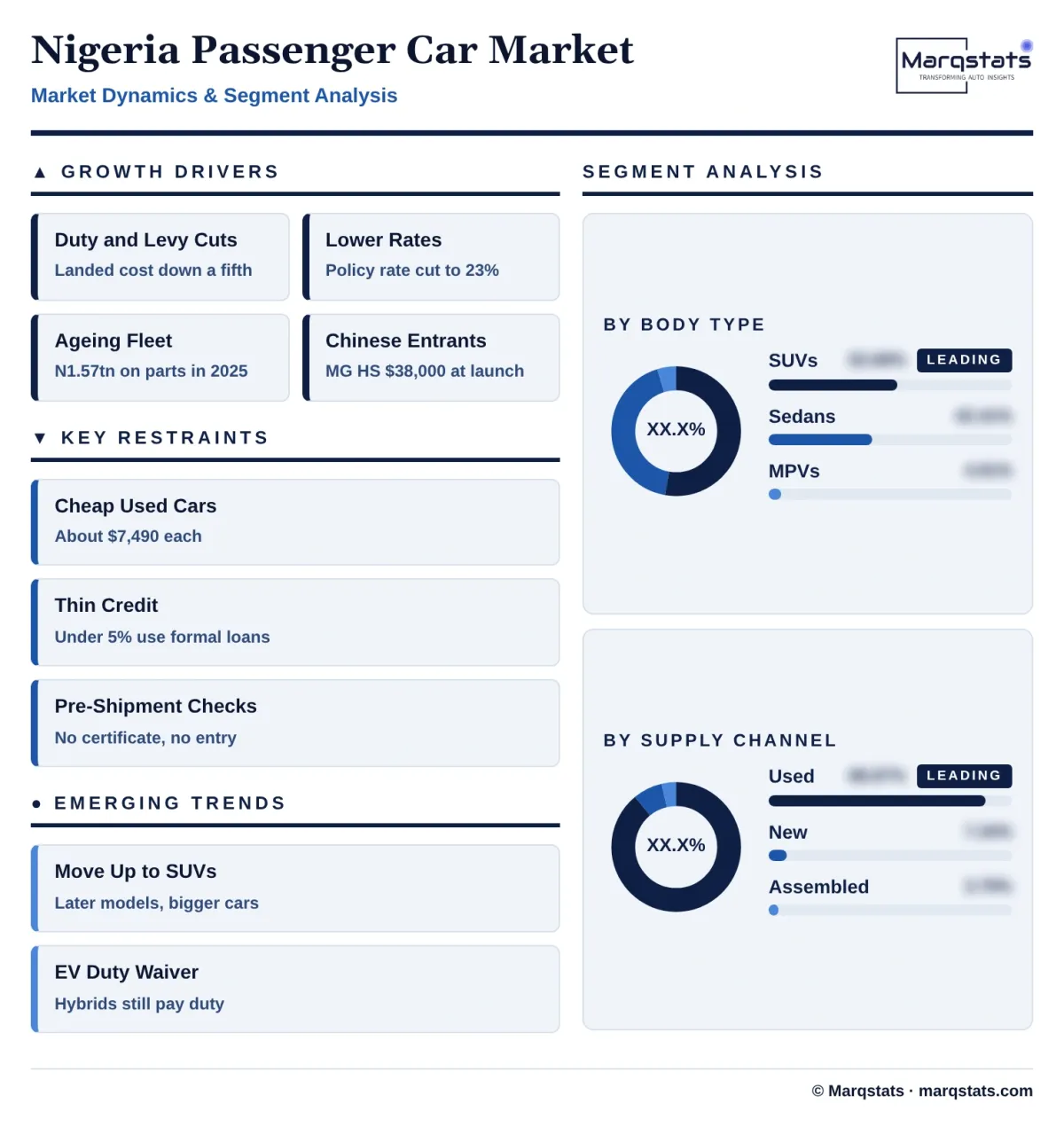
Sedans and hatchbacks account for 42.41% of 2025 value, USD 2,023.00 million, and 54.10% of units, and grow at 3.72% a year to USD 2,428.60 million, while their share of value falls to 38.30% by 2030. The Toyota Camry and Corolla and the Honda Accord and Civic dominate. A used sedan averages about USD 6,000, close to the N7 million to N10 million that Nairametrics reported for 2003 to 2009 models in January 2026, and ride-hailing and taxi drivers keep demand for the type steady.
SUVs and crossovers account for 52.68% of 2025 value, USD 2,513.14 million, from 40.83% of units, and grow fastest of the three body types, at 7.38% a year, to USD 3,588.00 million and 56.58% of value by 2030. Used SUVs average about USD 9,600, and new complete SUVs about USD 28,000. Toyota RAV4 and Highlander, Lexus RX and Chinese crossovers such as the MG HS lead, helped by ground clearance on poor roads.
MPVs and minivans account for 4.91% of 2025 value, USD 234.10 million, and 5.08% of units, and grow at 6.79% a year to USD 325.15 million by 2030. The Toyota Sienna and Honda Odyssey serve large families and executive hire, and Marqstats counts only vehicles built for nine seats or fewer, so 14-seat minibuses fall in the Nigeria bus analysis.
Used imports account for 88.87% of 2025 value, USD 4,239.34 million, and 95.45% of units, and grow at 5.05% a year to USD 5,423.60 million and 85.52% of value by 2030. Cars arrive from the United States first, then Canada, Europe and the Gulf. The July 2026 cut in the used-vehicle levy from 15% to 5% lowers landed cost, while pre-shipment certification adds lead time and favours importers with inspection records.
New complete cars account for 7.34% of 2025 value, USD 350.00 million, and 2.19% of units, and grow at 10.00% a year to USD 563.80 million and 8.89% of value by 2030. Franchised distributors and Chinese-brand entrants sell to corporate fleets, government and higher-income households. The new-vehicle levy fell from 20% to 10% in July 2026, so the stacked charge falls from about 90% to about 50%.
Locally assembled cars account for 3.79% of 2025 value, USD 180.90 million, and 2.36% of units, and grow fastest of the three channels, at 14.39% a year, to USD 354.35 million and 5.59% of value by 2030. Innoson Vehicle Manufacturing Company Limited, Stallion Motors Nigeria Limited and other licensed assemblers build from imported kits. Public procurement under the Nigeria First framework and the N20 billion consumer credit fund support the channel.
Petrol cars account for 90.99% of 2025 value, USD 4,340.59 million, and grow at 5.07% a year to USD 5,557.25 million, while their share falls to 87.63% by 2030. Petrol is the default for used sedans and SUVs. Cheaper gas and conversion to compressed natural gas keep petrol engines attractive, because conversion is aftermarket work on the same car.
Diesel cars account for 6.72% of 2025 value, USD 320.40 million, and grow at 5.03% a year to USD 409.50 million and 6.46% by 2030. They are mainly full-size SUVs such as the Toyota Prado and Land Cruiser, at an average of about USD 18,000 in 2025. NBS recorded United States-origin high-capacity diesel vehicles of N184.21 billion in the third quarter of 2025.
Hybrid and electric cars account for 2.29% of 2025 value, USD 109.25 million, and grow fastest, at 27.97% a year, to USD 375.00 million and 5.91% by 2030. The group covers hybrids, plug-in hybrids, extended-range and battery-electric cars. Nigeria Customs Service waived duty and value added tax on battery-electric and extended-range cars in August 2026, while hybrids still pay both, and the group's 2030 growth rests on that gap.
By Geography
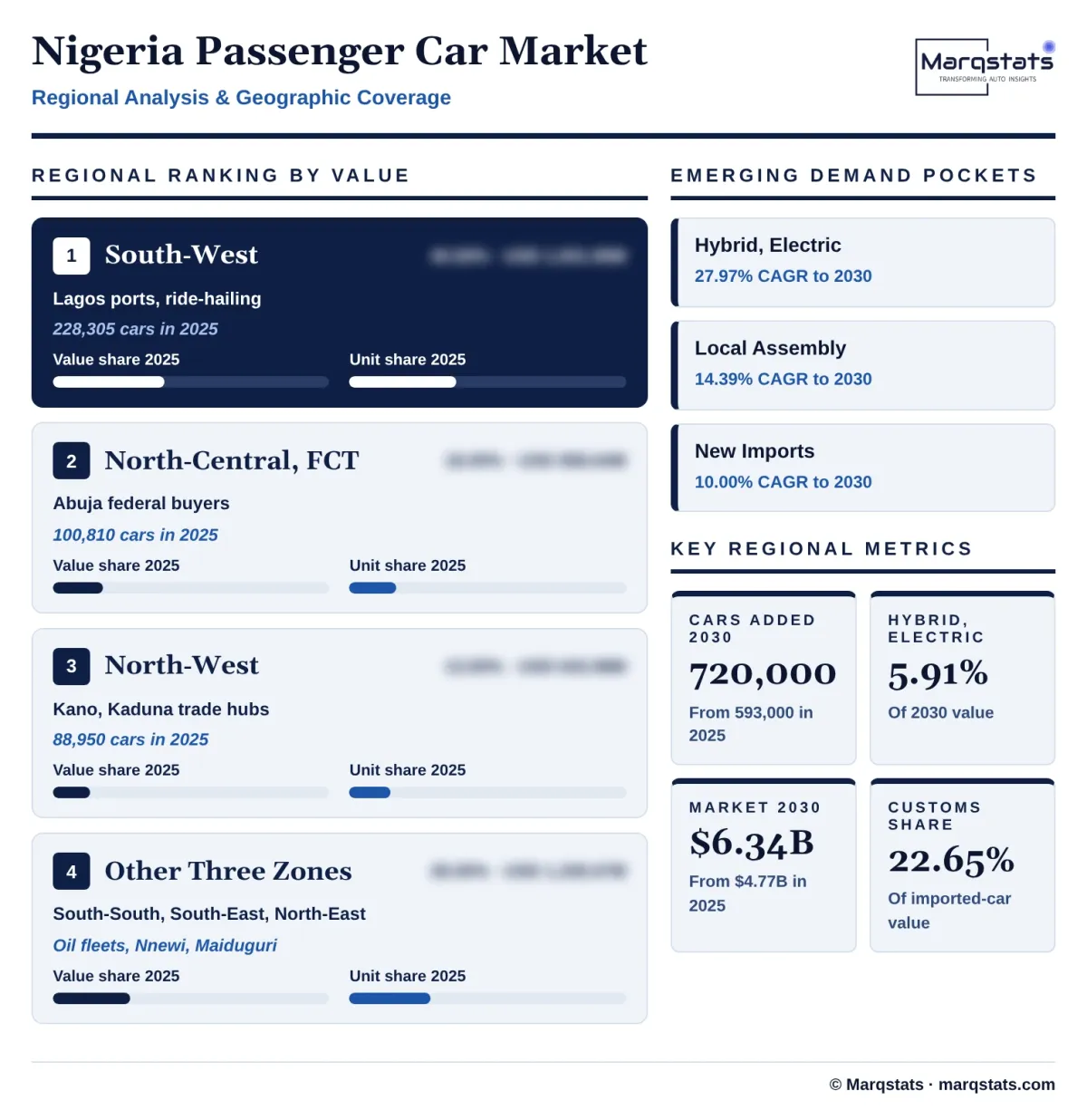
South-West
The South-West is the largest zone, with 40.50% of 2025 value, USD 1,931.95 million, and about 228,305 cars, 38.50% of units. Lagos holds the Apapa and Tin Can ports where most used cars clear, the densest ride-hailing and corporate demand and the head offices of several franchised distributors. Marqstats assigns cars to the zone where they are first registered for use, not where they clear customs.
North-Central and FCT
North-Central and FCT accounts for 18.00% of 2025 value, USD 858.64 million, and about 100,810 cars. Abuja concentrates federal ministries, embassies and the public buyers covered by the Nigeria First framework, which lifts value share above its 17.00% share of units.
North-West
The North-West accounts for 13.50% of 2025 value, USD 643.98 million, and about 88,950 cars, 15.00% of units. Kano and Kaduna are trading hubs that buy durable used sedans and SUVs, mostly cleared at Lagos and moved by road, and unit share exceeds value share because the average car is cheaper.
South-South
The South-South accounts for 11.50% of 2025 value, USD 548.58 million, and about 68,195 cars. Port Harcourt, Warri and Uyo buy through the Onne and Delta ports and through oil-industry fleets that favour diesel SUVs, so value share matches unit share at 11.50%.
South-East
The South-East accounts for 10.50% of 2025 value, USD 500.88 million, and about 68,195 cars. Onitsha and Nnewi run large parts and used-car trade networks, and Innoson Vehicle Manufacturing Company Limited assembles cars at Nnewi in Anambra State, which supports local brand choice despite a lower value per car than the national average.
North-East
The North-East accounts for 6.00% of 2025 value, USD 286.21 million, and about 38,545 cars. Maiduguri, Bauchi and Yola buy mostly older used sedans, and security conditions and lower household incomes keep the zone the smallest by value.
How Competition Is Evolving
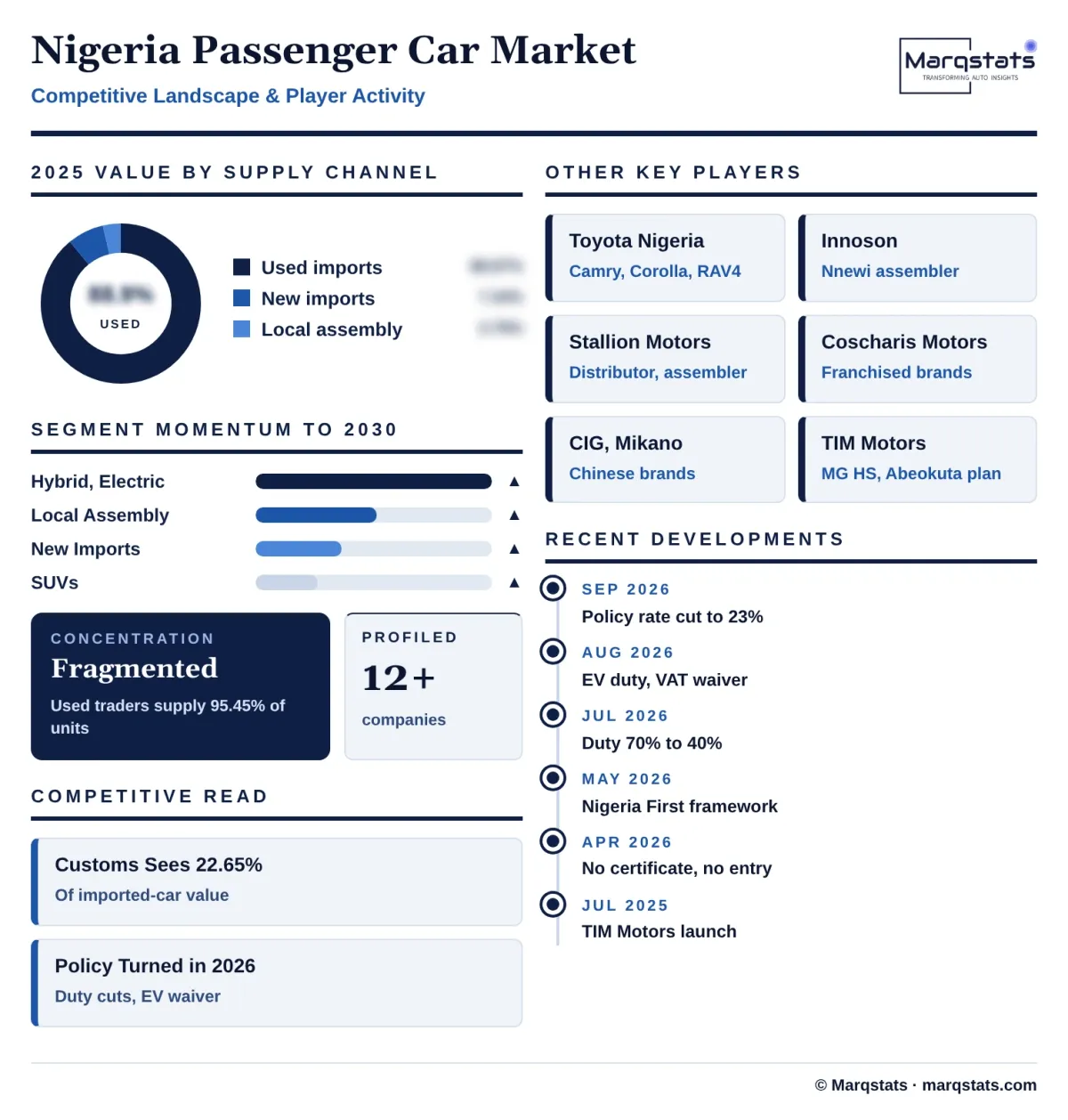
The market is highly fragmented. Marqstats estimates that used imports supply 95.45% of units and 88.87% of value through thousands of independent importers, clearing agents and dealers, so no company holds a double-digit share of units. Nigeria has no published company league table for passenger cars, and Marqstats describes competition by layer and by named, dated actions.
Franchised distributors lead the new-car layer. Toyota Nigeria Limited, part of CFAO Mobility, sells Toyota models, Stallion Motors Nigeria Limited and Coscharis Motors Limited sell other global brands, and CIG Motors Limited and Mikano International Limited sell Chinese-brand cars. This layer holds 7.34% of value in 13,000 cars, so each distributor sells in the low thousands.
Chinese entrants compete on price and equipment. TIM Motors priced the MG HS at USD 38,000 against a Toyota RAV4 at USD 45,700 when it launched in July 2025, offered a five-year warranty and plans assembly in Abeokuta. New complete cars grow from USD 350.00 million to USD 563.80 million in Marqstats estimates, a 10.00% CAGR, mostly at the expense of the dearest used imports.
Assemblers depend on policy more than on price. Innoson Vehicle Manufacturing Company Limited is the leading Nigerian-owned maker, and about 14,000 cars were assembled in 2025 at about USD 12,921. Locally assembled cars grow from USD 180.90 million to USD 354.35 million, a 14.39% CAGR, if public procurement and the consumer credit fund direct orders to approved plants. A group-level league table is built in the delivered analysis.
Companies Covered
Companies covered in the report include:
Recent Market Activity
Table of Contents
Coverage & Segmentation
The study covers the Nigeria passenger car market, with 2025 as the base year, 2021 – 2025 as the historical period and 2026 – 2030 as the forecast period. It covers passenger cars of up to nine seats, including sedans, hatchbacks, SUVs, crossovers and MPVs, entering service as used imports, new complete imports or locally assembled units, segmented by body type, supply channel, powertrain and geopolitical zone across the South-West, North-Central and FCT, North-West, South-South, South-East and North-East. Values are in US dollars at NGN 1,520 per USD, the 2025 average, at buyer transaction prices before value added tax.
Pickups, vans, buses and minibuses of ten seats or more, trucks, tricycles, spare parts, financing and compressed natural gas conversion kits are excluded. The market is a passenger car deep-dive that sits inside, and must not be added to, the Nigeria used car market, which sizes used vehicles of every type, or the Nigeria bus, Nigeria truck and Nigeria vehicle financing analyses. Twelve companies and institutions are profiled, and the used-car count is reconciled to the Nigeria used car market in the Study Assumptions chapter.