Market Snapshot
Middle bar: base-year value × (1 + CAGR), rounded to two decimals. This is a calculated illustration, not a separately researched annual estimate.
The Mexico passenger car market size is estimated at USD 29,452.16 million in 2025 and is projected to reach USD 37,847.16 million by 2030, growing at a CAGR of 5.14% over 2026 – 2030. Unit sales rise from about 1,356,472 to 1,516,157 cars, a 2.25% annual rate, while the average price before sales tax climbs from about USD 21,712 to USD 24,963.
Marqstats defines the market as the retail transaction value, excluding the 16% IVA sales tax, of new passenger cars sold in Mexico, meaning cars, hatchbacks, sport utility vehicles, crossovers and minivans in the M1 class, up to nine seats. Pickups, vans, light commercial vehicles, buses, used cars and exports of Mexican-built cars are excluded. Sales made by brands that do not report to the national registry, such as BYD and Tesla, are included.
SUVs and minivans account for 58.88% of 2025 value, combustion cars for 81.10%, and brands inside the INEGI registry for 90.92%. The Valley of Mexico holds 35.00% of value and grows fastest, at 5.50% a year. Hybrids and plug-ins together rise from 15.43% of units in 2025 to 27.82% in 2030.
Key Takeaways
Market Overview & Analysis
Report Summary
Marqstats sizes the Mexico passenger car market as the retail value, before the 16% IVA sales tax, of new M1 passenger cars sold in the country each year. It covers subcompact and compact cars, sport utility vehicles and minivans, and luxury and sports cars, sold through dealers and direct channels by brands that report to the INEGI registry and by brands that do not. Pickups, vans, light commercial vehicles, buses, used cars and cars built in Mexico for export are excluded.
The registry is the starting point, and it is also the first problem. The National Institute of Statistics and Geography (INEGI) reported 1,524,583 light vehicles sold in 2025, up 1.3% from 1,504,322 in 2024, after 1,361,433 in 2023 and 1,086,058 in 2022. Of the 2025 total, 264,935 were light trucks, mainly pickups and vans, and 1,776 were heavy trucks, leaving 1,257,872 cars. Registry cars grew an estimated 1.06% in 2025, much less than the 2.7% growth of light trucks.
Brands outside the registry add a further 98,600 cars on Marqstats estimates. AMDA, which adds estimates for non-reporting brands, put the all-brand market at about 1.63 million light vehicles in 2025, about 101,000 more than the registry. Marqstats deducts 2,400 pickups, which belong to the companion pickup study, and allocates the remaining 98,600 cars to the four body styles, giving 1,356,472 cars. The Chirey group stopped reporting to the registry in May 2025, and BYD, Zeekr, GAC and Tesla do not report fully.
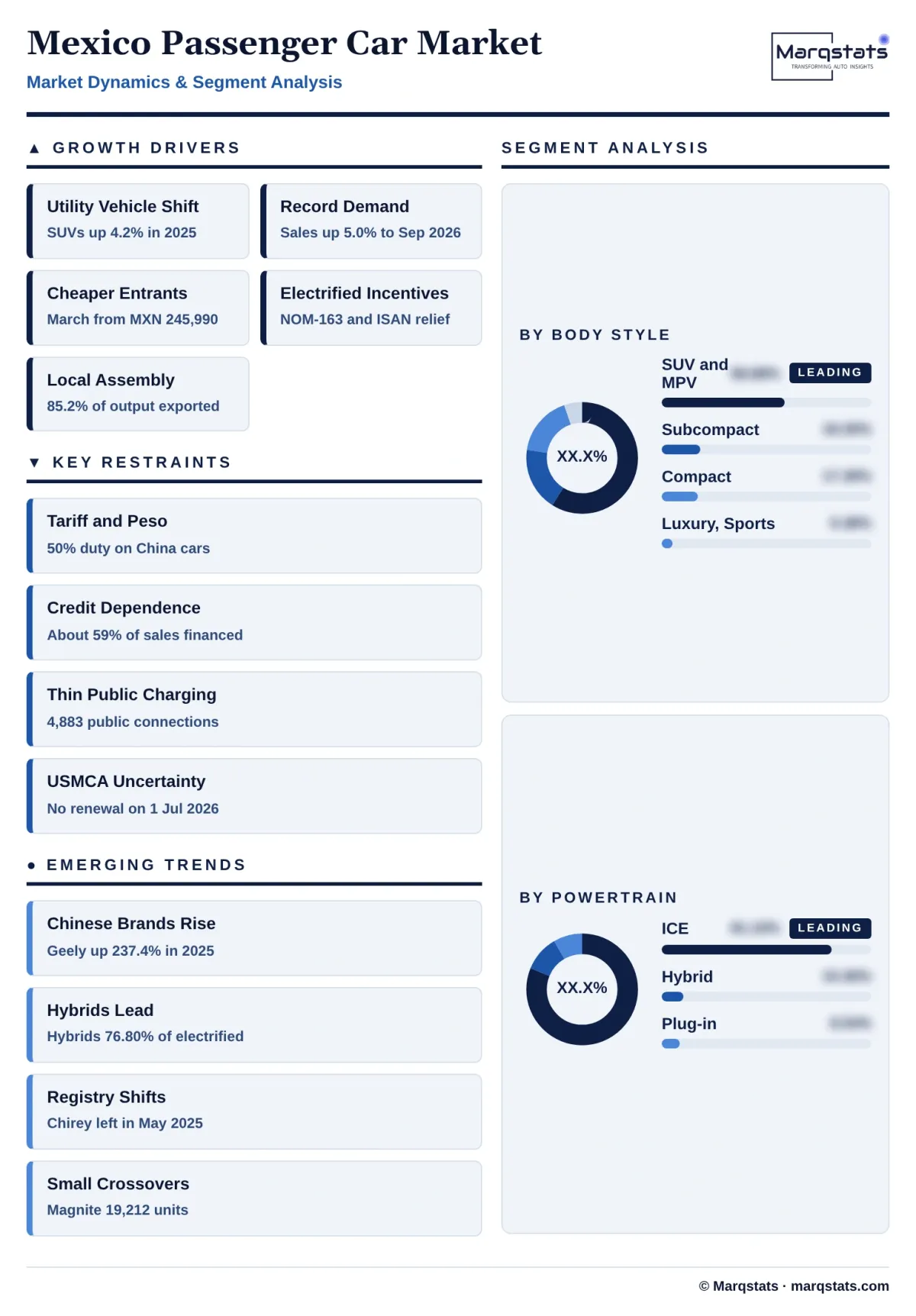
Demand is shifting toward utility vehicles and cheaper imports. The registry showed multipurpose vehicles, the INEGI term for SUVs and minivans, up 4.2% to 635,879 units, while compact cars fell 7.6% to 256,845. Geely sold 22,258 vehicles in 2025, up 237.4%, Changan 19,308, up 184.4%, and BYD 75,157, up 18.6%, according to AMDA, while the registry brand MG Motor fell 18.9% to 48,816.
Trade policy now matters as much as demand. Mexico applied tariffs of 5% to 50% on 1,463 tariff lines for imports from countries without a trade agreement from 1 January 2026, including a 50% rate on cars from China, up from 20%. The first joint review of the United States-Mexico-Canada Agreement (USMCA) on 1 July 2026 ended without a United States agreement to renew it in its current form, so annual reviews follow, and Marqstats treats trade friction as the main risk to domestic prices.
Mexico Passenger Car Market Size and Forecast
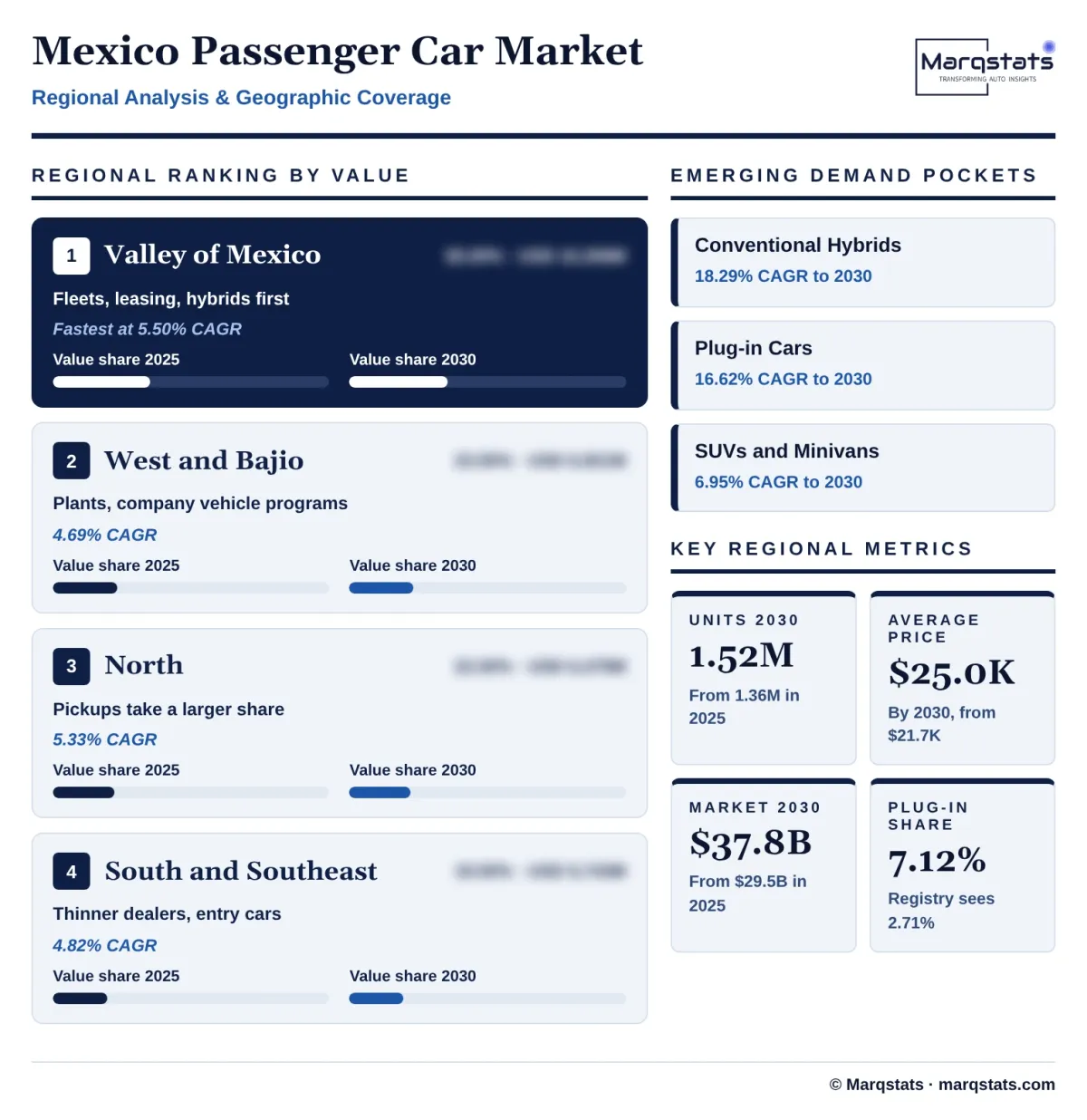
The Mexico passenger car market grows from USD 29,452.16 million in 2025 to USD 37,847.16 million in 2030, a CAGR of 5.14%. Marqstats expects USD 31,330.94 million in 2026, USD 32,981.54 million in 2027, USD 34,608.17 million in 2028 and USD 36,229.33 million in 2029. Unit sales are expected to rise from 1,356,472 in 2025 to about 1,402,670 in 2026, 1,435,662 in 2027, 1,465,020 in 2028, 1,491,753 in 2029 and 1,516,157 in 2030.
Price growth does more of the work than volume. Units grow 2.25% a year, while the average price before sales tax rises 2.83% a year at constant 2025 exchange rates, from about USD 21,712 to USD 24,963, equal to about MXN 483,600 and MXN 556,000 including IVA. The rise reflects list prices that follow inflation, a mix that moves toward SUVs, and the share of hybrids and plug-ins, which Marqstats prices 25% to 30% above a combustion car of the same body style.
The 2025 value is built bottom-up from body styles and brand coverage. Marqstats multiplies 635,879 registry SUVs and minivans by about MXN 545,000 including IVA, 327,934 subcompacts by MXN 350,000, 256,845 compacts by MXN 410,000 and 37,214 luxury and sports cars by MXN 800,000, then adds 98,600 cars from brands outside the registry at prices of MXN 330,000 to MXN 1,100,000. The total is divided by 1.16 to remove IVA and by 19.20 to convert at the 2025 average rate. Entry list prices in 2026 range from MXN 245,990 for the Nissan March to MXN 585,900 for the top Mazda CX-30.
The unit forecast sits inside published outlooks. INEGI recorded 1,144,002 light vehicles in January to September 2026, up 5.0%, and AMDA raised its 2026 outlook on 8 September 2026 to more than 1,684,000 vehicles including non-reporting brands, up 3.6%, and about 1,568,000 for reporting brands, up 2.9%. Marqstats expects passenger cars to grow 3.41% in 2026, slower than the registry year to date because pickups and vans are gaining share, then to slow from 2.35% in 2027 to 1.64% in 2030 as credit and tariffs cap affordability.
Hybrids and plug-ins add value faster than volume. Marqstats expects conventional hybrids to grow at 15.78% a year in units and plug-in cars at 14.15%, lifting their combined share of units from 15.43% to 27.82% and of value from 18.90% to 32.99%. Marqstats tracks five indicators to monitor the forecast: monthly INEGI and AMDA sales, tariff and customs data on cars from China, the peso against the dollar, the share of sales financed, and the Electro Movilidad Asociación barometer.
Market Dynamics
Key Drivers
Five forces are lifting demand for passenger cars in Mexico even as prices and trade rules change.
- Buyers are moving to utility vehicles. Multipurpose vehicles reached 635,879 units in the 2025 registry, up 4.2% and 41.71% of registry light vehicle sales, led by the Mazda CX-30 at 29,898, the Nissan Kicks at 26,276, the Hyundai Creta at 21,547 and the Volkswagen Taos at 21,189. Every unit that replaces a sedan carries a higher price, which is the main source of value growth.
- Demand and credit are both strong. INEGI recorded 1,144,002 light vehicles in January to September 2026, up 5.0% and a record for the period, and AMDA reported 952,317 new vehicles bought on credit in 2025, up 6.8%, equal to about 59% of all-brand sales. Loans with terms of 36, 48, 60 and 72 months made up 79.2% of placements, which keeps monthly payments within reach as prices rise.
- Low-priced entrants widen the buyer base. The Nissan March starts at MXN 245,990, the MG5 at MXN 299,900 and the Hyundai Grand i10 at MXN 286,600, and Chinese brands such as Geely and Changan more than tripled sales in 2025. Cheaper cars bring first-time buyers and used-car owners into the new-car market, which is why units still grow while average household income grows slowly.
- Electrification is supported by rules and incentives. NOM-163-SEMARNAT-SCFI-2023, which sets fleet carbon dioxide targets for new vehicles from 400 to 3,857 kilograms, entered into force on 2 July 2024, and electrified cars benefit from an exemption from the ISAN new-vehicle tax and a 10-year exemption from emissions verification. Plug-in sales counted by the Electro Movilidad Asociación (EMA) rose 38.5% to 96,636 in 2025.
- Mexican plants and dealer networks keep supply close. Mexico built 3,709,533 light vehicles in January to November 2025 and exported 3,160,741, or 85.2%, so about one in seven cars built stays at home, and Nissan, General Motors, Volkswagen, Kia and Mazda all sell models assembled in Mexico alongside imports. Local assembly cushions buyers from tariff changes that hit imports from Asia.
Key Restraints
Four constraints slow unit growth and shape which cars buyers can afford.
- Tariffs and the peso raise prices. Mexico raised the tariff on cars from China to 50% on 1 January 2026, from 20%, and the peso moved between 17.907 and 20.846 per US dollar in 2025. BYD limited price rises to about MXN 15,000 a car, but any brand that imports vehicles or components in dollars passes part of a weaker peso to buyers whose average price before tax is already about MXN 483,600 including IVA.
- Affordability depends on credit. About 59% of all-brand sales were financed in 2025, so a rise in interest rates or a tightening by lenders cuts demand quickly. Analysts quoted by Expansión put the upfront price of electric cars 50% to 70% above a comparable gasoline car, which is why incentives matter more than fuel savings for most buyers.
- Charging is a bottleneck for plug-ins. EMA counted 62,883 charging connections in September 2026, of which about 58,000 were private and only 4,883 were public, against 291,986 plug-in vehicles in circulation, or about 60 vehicles for each public connection. Buyers without a garage choose hybrids, which is why Marqstats expects conventional hybrids to outsell plug-ins in 2030.
- Trade uncertainty clouds investment. The first joint review of the USMCA on 1 July 2026 ended without a United States agreement to renew, and Mexico exported 85.2% of the light vehicles it built in January to November 2025, so a tariff shock on exports would reach the plants that supply local buyers. Marqstats expects this to delay new capacity for local models rather than cut sales in the forecast period.
Key Trends
Four shifts are changing who sells cars in Mexico and what powers them.
- Chinese brands move into the mainstream. Geely sold 4,306 vehicles in September 2026 and ranked ninth among all brands, ahead of Hyundai at 4,273, and Chinese brands together sold 14,759 vehicles, 11.4% of the month. Their share of the registry is rising even though the 50% tariff makes imported cars more costly.
- Hybrids lead electrification. Conventional hybrids were 76.80% of electrified cars in 2025 and light vehicles with a plug, a battery or a hybrid system reached 129,359 units in January to August 2026, up 46.1% and 12.8% of sales. BYD sold 33,969 vehicles in the first half of 2026, about 35.7% of the 95,037 electrified vehicles sold in the period.
- The reporting perimeter keeps shifting. The Chirey group stopped reporting to the INEGI registry in May 2025 and its registered volume fell 79.3% to 5,559 units, while Leapmotor, sold through Stellantis, and Jetour-Soueast appear in the registry. A growing share of sales is therefore reclassified from outside to inside the registry, which Marqstats removes by sizing all brands.
- Small crossovers replace sedans. The Nissan Magnite sold 19,212 units in 2025 and 16,097 in the first half of 2026 from MXN 364,990, and the Kia K3, Hyundai Creta and Nissan Kicks sit near it, so buyers get the ride height of an SUV at a price close to a compact sedan.
Strategic Implications
- For entrants, the choice is between importing at a 50% tariff and assembling or contracting production in North America. Brands that rely on cars from China should price in the full tariff or limit models to the segments where they can absorb it, while brands that sell hybrids and plug-in hybrids with financing, as BYD does from 7.9%, win buyers who do not have a home charger.
- For incumbents, defending the compact sedan is a lower priority than building small crossovers and hybrids at Mexican plants. The Nissan Versa sold 90,223 units in 2025, but compact cars shrank 7.6%, and every sale that moves to a Magnite, Kicks or Creta keeps the customer if the brand has a competitive crossover at the same price.
- For parts and component suppliers, the market rewards hybrid content. Conventional hybrids more than double their unit sales by 2030 on Marqstats estimates, which lifts demand for batteries, power electronics and electric drive units, and suppliers that qualify under the USMCA rules of origin can serve both domestic and export programs.
- For lenders and insurers, the exposure is credit-driven demand. About 59% of sales are financed, and a larger share of cars from new brands means less used-car price history, so lenders that price residual values on observed resale data rather than on new-car price alone will price risk better.
- For charging investors, the signal is the gap between private and public points. With about 60 plug-in vehicles per public connection, public fast chargers on highways and in the Valley of Mexico serve buyers who cannot install a home charger, and that is where Marqstats expects the next plug-in growth to come from.
Market Segmentation
SUVs, crossovers and minivans account for 58.88% of 2025 value, USD 17,341.68 million, and grow at 6.95% a year to USD 24,260.38 million and 64.10% of the market in 2030. Marqstats counts 697,879 units in 2025, 635,879 in the registry and 62,000 from brands outside it, rising to 853,337 in 2030 at 4.10% a year. The registry shows the Mazda CX-30, Nissan Kicks, Hyundai Creta, Volkswagen Taos, Volkswagen Tiguan and Nissan Magnite as the best sellers, and BYD, GAC and Chirey add most of the unrecorded volume.
Subcompact cars account for 18.35% of 2025 value, USD 5,405.30 million, and grow at 2.72% a year to USD 6,182.63 million. Marqstats counts 344,934 units in 2025. The registry segment grew 3.0% to 327,934 on the Chevrolet Aveo at 61,066, the Kia K3 at 56,575 and the Nissan March at 31,401, and low entry prices from MXN 245,990 keep it large, but growth is slow because buyers trade up to crossovers.
Compact cars account for 17.39% of 2025 value, USD 5,121.52 million, and grow at 1.04% a year to USD 5,392.89 million, while units fall at -1.05% a year from 271,445 to 257,493. The registry segment fell 7.6% to 256,845 from 278,095, and the Nissan Versa at 90,223 units, the Nissan Sentra at 21,929, the MG5 at 21,132 and the Volkswagen Jetta at 20,820 all face competition from small crossovers. Value holds because remaining buyers choose higher trims.
Luxury and sports cars account for 5.38% of 2025 value, USD 1,583.66 million, and grow at 4.90% a year to USD 2,011.26 million. Marqstats counts 42,214 units in 2025, including the registry luxury segment of 27,969 and sports segment of 9,246, and BMW Group, Mercedes-Benz and Audi sold 18,953, 10,663 and 9,232 vehicles in 2025 across all body types. Hybrids such as the Toyota Prius, which led the luxury segment with 5,465 units, also sit here.
Combustion cars account for 81.10% of 2025 value, USD 23,886.65 million, and grow at 1.20% a year to USD 25,358.86 million, while their share of units falls from 84.57% to 72.18%. Units decline from 1,147,153 to 1,094,382 as hybrids take share, but the segment still sets the market because the Nissan Versa, Chevrolet Aveo and Kia K3 are all gasoline cars.
Conventional hybrids account for 10.36% of 2025 value, USD 3,050.25 million, and grow at 18.29% a year to USD 7,063.28 million and 18.66% of the market. Units rise from 112,683 to 234,478, 15.47% of 2030 sales. Hybrids need no charger, which suits the 58,000 private and 4,883 public charging connections of the country, and the Toyota Prius, Camry and Corolla hybrids are the best-known models.
Plug-in cars account for 8.54% of 2025 value, USD 2,515.26 million, and grow at 16.62% a year to USD 5,425.02 million and 14.33% of the market. Units rise from 96,636 to 187,297. EMA reported a mix of 39.03% battery-electric, 60.23% plug-in hybrid and 0.74% extended-range cars in January to September 2026, and BYD supplied the largest share of the volume.
Brands reporting to the INEGI registry account for 90.92% of 2025 value, USD 26,778.40 million, and 1,257,872 cars, 92.73% of units. They grow at 5.01% a year to USD 34,188.44 million. This group includes Nissan, General Motors, Volkswagen, Toyota, Kia, Mazda, Stellantis, Hyundai, Ford, MG Motor, Geely and Changan.
Brands outside the registry account for 9.08% of 2025 value, USD 2,673.76 million, from 98,600 cars, 7.84% of registry units. They grow faster, at 6.47% a year to USD 3,658.72 million, even after the 50% tariff, because plug-in cars are 63.48% of this group on Marqstats estimates. The group includes BYD, Tesla, GAC and Zeekr and the Chirey volume that left the registry in May 2025.
By Geography
Valley of Mexico
The Valley of Mexico, made up of Mexico City and the State of Mexico, accounts for 35.00% of 2025 value, USD 10,308.25 million, and grows fastest, at 5.50% a year, to USD 13,473.59 million and 35.60% by 2030. It combines the largest urban population with corporate leasing headquarters, and Mexico City driving restrictions exempt electric cars, so hybrids and plug-ins sell here first. Registration location overstates the region, because fleets register where they are headquartered, and Marqstats allocates value by registration, as lenders do.
North
The North, covering Nuevo Leon, Coahuila, Chihuahua, Sonora, Baja California and Tamaulipas, accounts for 22.00% of 2025 value, USD 6,479.48 million, and grows at 5.33% a year to USD 8,402.07 million. Pickups take a larger share of light vehicle sales in the northern states than in the center of the country, so the region holds less of passenger car value than of total light vehicle sales, and its buyers favor SUVs and sedans from brands that also sell pickups.
West and Bajio
West and Bajio, covering Jalisco, Guanajuato, Queretaro, Aguascalientes and Michoacan, accounts for 23.50% of 2025 value, USD 6,921.26 million, and grows at 4.69% a year to USD 8,704.85 million, with share easing to 23.00%. Nissan builds cars at Aguascalientes, General Motors at Silao and Honda at Celaya, so the region combines manufacturing employment with company vehicle programs, and Guadalajara adds a large urban market.
South and Southeast
South and Southeast, covering Puebla, Veracruz, Yucatan, Oaxaca, Chiapas and neighboring states, accounts for 19.50% of 2025 value, USD 5,743.17 million, and grows at 4.82% a year to USD 7,266.65 million. Dealer and credit coverage are thinner than in the center and north, so buyers favor established brands with service coverage, and the lowest-priced cars from MXN 245,990 matter most here.
How Competition Is Evolving
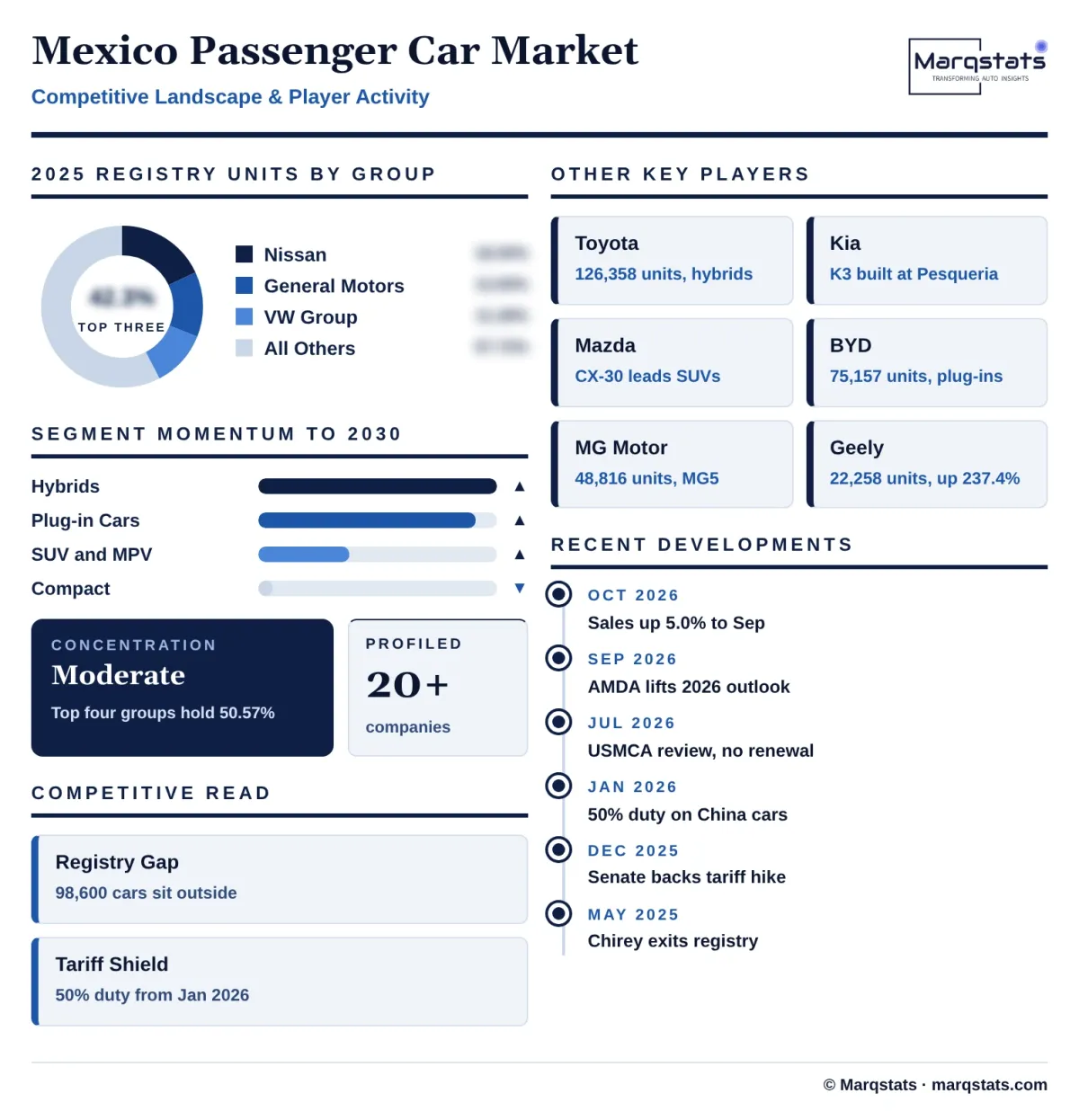
The market is moderately concentrated and led by Japanese and United States groups. In the 2025 registry Nissan sold 274,461 light vehicles, 18.00% of the total, General Motors 198,153, or 13.00%, the Volkswagen group 172,008, or 11.28%, and Toyota 126,358, or 8.29%, so the top three groups hold 42.28% of registry sales and the top four 50.57%. These rankings cover all light vehicle body types, because the registry does not split brand sales between cars and pickups.
Nissan leads on volume because it owns the two best-selling cars. The Versa sold 90,223 units and the March 31,401 in 2025, and Nissan also sells the Kicks, Sentra and Magnite, so the Aguascalientes plants supply entry cars at MXN 245,990 to MXN 406,990. Nissan registry sales rose 7.6% in 2025 while General Motors fell 3.4% and the Volkswagen group fell 3.0%, which shows share moving toward brands with entry crossovers.
Chinese brands are the fastest-moving layer. Geely grew 237.4% to 22,258 units, Changan 184.4% to 19,308 and BYD 18.6% to 75,157 on AMDA data, while MG Motor fell 18.9% to 48,816 and the Chirey group left the registry. Great Wall Motor sold 15,336 vehicles and JAC 24,445, so Chinese brands have a spread of positions from entry hatchbacks to plug-in hybrids.
Competition is moving from price to access. The 50% tariff on cars from China since 1 January 2026 favors brands that assemble in Mexico or North America, and Kia, which builds the K3 at Pesqueria, Mazda, Toyota and Honda defend share with financing and hybrids. Marqstats expects the Chinese brands to localize assembly or move to higher trims, and treats a tie-up between a Chinese brand and an established Mexican plant as the next structural change.
Companies Covered
Companies covered in the report include:
Recent Market Activity
Table of Contents
Coverage & Segmentation
The study covers the Mexico passenger car market, with 2025 as the base year, 2021 – 2025 as the historical period and 2026 – 2030 as the forecast period. It covers new M1 passenger cars sold in Mexico, up to nine seats, segmented by body style, powertrain and registry coverage. Values are retail transaction values excluding the 16% IVA sales tax, converted from pesos at the 2025 average of MXN 19.20 per US dollar and held at constant exchange rates, and volumes are annual new car sales.
The registry ladder runs as follows: INEGI recorded 1,524,583 light vehicles in 2025, less 1,776 heavy trucks and 264,935 light trucks, of which 238,719 are pickups and 26,216 are vans and other light commercial vehicles, which leaves 1,257,872 registry cars; adding 98,600 cars from brands outside the registry gives 1,356,472. Pickups, which Marqstats covers in the Mexico Pickup Truck Market, medium and heavy buses, covered by the Mexico Bus and Coach Market, vans, light commercial vehicles and used cars are excluded, so these markets are disjoint and should not be added. The live Marqstats Mexico Plug-in Hybrid Electric Vehicle Market counts registry plug-in hybrid registrations and the Mexico Used Car Market counts used transactions, so neither should be added to this market. Segment and regional splits, history before 2024 and the forecast are Marqstats estimates.