Market Snapshot
Middle bar: base-year value × (1 + CAGR), rounded to two decimals. This is a calculated illustration, not a separately researched annual estimate.
The Algeria passenger car market size is estimated at USD 2,117.79 million in 2025 and is projected to reach USD 4,390.04 million by 2030, growing at a CAGR of 15.70% over 2026 – 2030. Sales of new cars rise from about 70,600 to 135,600 units, a 13.94% annual rate.
Marqstats defines the market as the retail value, including duties and taxes, of new passenger cars (category M1) registered to Algerian buyers through two channels: cars assembled locally under Executive Decree 22-384 and cars imported by authorised dealers under Executive Decree 22-383. Vans, pickups, trucks, buses, used cars and cars of under three years of age brought in by individuals are excluded. Values use USD 1 = DZD 131.67, the 2025 average.
Compact SUVs and crossovers account for 42.52% of 2025 value, petrol and LPG cars for 93.34% and Chinese-brand dealer imports for 44.89%. Algiers and the Central North account for 40.00% of value, while locally assembled cars, led by the Fiat plant at Tafraoui near Oran, grow fastest at 27.10% a year and become the largest channel by 2026.
Key Takeaways
Market Overview & Analysis
Report Summary
Marqstats sizes the Algeria passenger car market as the retail value of new passenger cars, defined as category M1 vehicles with up to nine seats, that Algerian buyers register each year through licensed local assembly and authorised dealer imports. It counts the Fiat Doblo Panorama, Fiat 500 and Grande Panda built at Tafraoui and the imported ranges of Geely, Chery, Jetour, Haval, Opel and other brands. The Doblo van, pickups, minibuses, trucks and used vehicles are excluded, as are cars under three years old that individuals import with their own foreign currency.
The market restarted from zero only recently. New vehicle imports stopped in 2017 and local assembly plants stopped in 2020, according to TSA Algérie reporting of November 2024. New specifications for dealers and assemblers followed in late 2022, the first imported Fiat cars arrived at the end of March 2023, and the Stellantis plant at Oran began production in December 2023. In 2021 the dealer Hassan Khelifati estimated the shortage at 1.2 million vehicles against a national fleet of 6.5 million, and the Office National des Statistiques (ONS) had earlier reported that 48% of vehicles were more than 20 years old.
The national chronology of all new vehicles shows how violent the restart has been. Sales were 25,404 in 2022, 113,122 in 2023 and 179,332 in 2024, then fell 42.76% to 102,651 in 2025. Marqstats estimates that passenger cars were about three quarters of the 2024 total, roughly 136,000 cars, and 70,600 cars or 68.78% of the 2025 total, so the passenger-car market fell about 48.09% while commercial vehicles held up better. The remaining 32,051 units are vans, trucks and buses, which the live Marqstats Algeria Commercial Vehicle Market report sizes separately.
Supply, not demand, set the 2025 trough. Fiat El Djazaïr assembled 53,000 vehicles at Tafraoui in 2025, below its 60,000 target and up from 17,000 in 2024, and ended Fiat 500 assembly in September 2025 before the Grande Panda reached series production. Fiat Algérie had planned 25,000 Doblo Panorama, 10,000 Fiat 500 and 25,000 Doblo vans, and on that mix Marqstats estimates 30,900 of the 53,000 vehicles, or 58.30%, were passenger cars. The rest of the market, 49,651 vehicles, came through dealer imports, of which Marqstats estimates 80% were passenger cars.
Prices are set by scarcity. Fiat Algérie raised its list prices on 1 October 2025, taking the Doblo Panorama Cult from DZD 3,349,000 to DZD 3,599,000, the Panorama Club from DZD 3,749,000 to DZD 3,999,000 and the Doblo van from DZD 2,890,000 to DZD 3,199,000 before the vehicle tax and value-added tax. At USD 1 = DZD 131.67 the two Panorama prices equal USD 27,333 and USD 30,371. Marqstats estimates the average retail price of a new passenger car at about DZD 3.95 million, or USD 29,997, in 2025, against DZD 4.26 million in 2030.
Algeria Passenger Car Market Size and Forecast
The Algeria passenger car market grows from USD 2,117.79 million in 2025 to USD 4,390.04 million in 2030, a CAGR of 15.70%. Volume contributes most of the growth: sales rise at 13.94% a year, from about 70,600 to 135,600 cars, and the average value per car rises at 1.54% a year, from about USD 29,997 to USD 32,375, because Marqstats assumes dinar list prices rise 2.50% a year while the dinar is held at DZD 131.67 per US dollar. In dinars the market grows from DZD 278.85 billion to DZD 578.04 billion.
The 2025 value is built bottom-up from channels. Marqstats estimates 30,900 locally assembled cars at about DZD 3.50 million each, 29,800 cars from Chinese brands imported by dealers at DZD 4.20 million and 9,900 cars from other brands at DZD 4.60 million, all at retail prices including customs duty, value-added tax and dealer margin. The local price is anchored on the Fiat list prices of October 2025, from DZD 3,599,000 to DZD 3,999,000 for the Doblo Panorama, blended with the lower-priced Fiat 500. Import prices carry a premium for Chinese compact SUVs and European and Korean hatchbacks.
The base is reconciled to the national chronology and to supply data. The chronology places all new vehicle sales at 102,651 in 2025, which is 49,651 units above Fiat output. The minister of industry told the National People's Assembly on 12 February 2026 that 96,418 vehicles were imported in 2025, of which 54,418 were under three years old and about 42,000 were new. New imports of about 42,000 plus Fiat output of 53,000 come to about 95,000, within 8% of the 102,651 registrations, which supports the 70,600 passenger-car estimate once vans and trucks are removed.
Sales in 2026 are already visible. The chronology shows 70,031 new vehicles sold from January to July 2026, up 22.3%, and Stellantis reported more than 20,000 vehicles produced and sold locally in the second quarter, against a 2025 quarterly average of 13,250. Marqstats estimates 2026 passenger-car sales at 87,000, up 23.23%, with Fiat output of about 74,000 against its 90,000 target, then growth of 10.92%, 11.50%, 11.99% and 12.53% as capacity expands.
The forecast rests on local assembly. Marqstats assumes Fiat output of about 110,000 vehicles in 2030, 81% of its 135,000 capacity target and below the 88% delivery against target achieved in 2025, of which 66% are passenger cars, plus 18,000 cars from Chery, Hyundai and other licensed assemblers. Together these give 90,600 locally assembled cars, while Chinese-brand and other dealer imports reach 33,000 and 12,000. Marqstats tracks four indicators: Fiat monthly output, dealer import approvals, the dinar premium on the parallel market and customs data on Chinese vehicle shipments.
Market Dynamics
Key Drivers
Five forces are lifting demand for new passenger cars in Algeria after the supply shock of 2025.
- A very old fleet needs replacement. The national fleet was reported at more than 6.5 million vehicles at the end of 2019, with 48% older than 20 years and 78% older than five, and the dealer Hassan Khelifati put the shortage at 1.2 million vehicles in 2021. Imports stopped in 2017 and assembly in 2020, so every car sold today replaces a vehicle that the market was unable to renew for years.
- Fiat El Djazaïr is ramping a passenger line. Output at Tafraoui rose from 17,000 vehicles in 2024 to 53,000 in 2025, the Doblo Panorama went on sale in February 2025 with Fiat Algérie estimating demand at 180,000 vehicles, and the Grande Panda was presented on 4 September 2025 as the fourth model built in Algeria. Stellantis announced on 7 April 2026 a plan to reach 135,000 vehicles a year by 2028, and reported more than 20,000 vehicles in the second quarter of 2026.
- Chinese brands supply the gap. The China Passenger Car Association reported 143,012 vehicles shipped to Algeria in the first half of 2026, up 235.5%, and 190,045 in January to August, making Algeria the tenth largest destination for Chinese vehicle exports. Geely, Chery, Jetour and Haval already ranked among the leading brands in the first half of 2025, and they give dealers and individual importers compact SUVs priced below European equivalents.
- Licensing has opened a path to localisation. Executive Decree 22-384 of 17 November 2022 lets brand owners assemble in Algeria with integration rates of 10% by the end of year two, 20% by year three and 30% by year five after approval, and the minister of industry said on 12 February 2026 that Chery and Hyundai hold preliminary licences. Each approved plant converts import quota into local volume that is less exposed to foreign exchange rationing.
- Scarcity pricing signals unmet demand. Fiat Algérie raised the Doblo Panorama by 6.67% to 7.47% on 1 October 2025 and kept order books open, and press reports describe resale prices for imported cars above dealer and factory prices. Buyers pay these premiums because the alternative is a vehicle that is often more than 20 years old.
Key Restraints
Four constraints cap how fast the market can recover and keep it dependent on administrative decisions.
- Foreign exchange and quota decisions cause sharp swings. The national chronology fell from 179,332 new vehicles in 2024 to 102,651 in 2025, and the administration suspended registration of imported cars under three years old in early October 2024, then rejected an amendment to allow five-year-old cars on 12 November 2024. Marqstats estimates the passenger-car market fell about 48% in 2025 because dealer approvals and personal import rules tightened together.
- Industrial land delays slow new plants. Press reports citing the minister of industry describe the Hyundai and Chery factories as held up by the allocation of industrial land, and the Hyundai plant was reported in August 2025 as due to be operational in 2027. Until these plants start, the Tafraoui site supplies almost all locally assembled cars.
- Fiat has missed its own targets. The 2025 target was 60,000 vehicles and the plant delivered 53,000, or 88.33%. About 20,000 vehicles had been built in 2026 by mid-May against a target of 90,000, after Fiat 500 assembly ended in September 2025 and the Grande Panda launch slipped. A single plant that misses by 12% to 20% leaves the whole market short.
- The local supplier base is thin. The Grande Panda started as a kit assembly with 20% local integration, Stellantis plans to exceed 30% in 2026, and its April 2026 release mentions an agreement with one Algerian company for several stamped parts. Decree 22-384 demands 30% by year five and annual reporting of integration to the ministry, so assemblers need suppliers early.
Key Trends
Four shifts are changing who supplies passenger cars in Algeria and how buyers register them.
- Chinese brands move from the personal channel to dealers. Individuals import most Chinese cars through the under-three-year regime, but Geely, Chery, Jetour and Haval now also hold dealer networks, and Chery holds a preliminary assembly licence.
- Local assembly widens from vans to passenger models. Fiat started with the Doblo van and Fiat 500, added the Doblo Panorama in February 2025 and the Grande Panda in September 2025, so the passenger share of Tafraoui output rises from about 58.30% in 2025 to a higher level as vans fall in the mix.
- Registration moves online. A single national platform replaced local numbering services from 5 April 2026 under ministerial instruction 4224 of 28 February 2026, with QR-coded grey cards and a biometric identity check for both buyer and seller, which makes resale of new cars easier to trace.
- Electrified models enter through Chinese brands. Marqstats estimates hybrids and battery-electric cars at 5.50% of 2025 units, rising to 20.00% in 2030 as Chinese dealers and individual importers bring plug-in and battery models, helped by the more favourable tax treatment that the press reports for electric cars.
Strategic Implications
- For automakers outside Algeria, an import-only plan is the weakest entry. Dealer quotas under Decree 22-383 can shrink without notice, as 2025 showed, while an assembly licence under Decree 22-384 turns the same cars into local volume. Brands that cannot build locally should price against the under-three-year import channel, not only against other dealers.
- For Stellantis and Fiat El Djazaïr, the issue is delivery against capacity. Missing 60,000 by 12% in 2025 cost about 7,000 vehicles, and the Grande Panda gap cost more. Meeting 90,000 in 2026 and building the stamping and paint lines announced in April 2026 decides whether the local channel reaches the 66.81% of units that Marqstats forecasts for 2030.
- For Chery, Hyundai and other planned assemblers, industrial land and the 30% integration rule decide the timetable. Plants that start in 2027 and 2028 on a kit basis can reach the 18,000 cars Marqstats assumes by 2030 only if suppliers of plastics, seats, batteries and exhausts are signed before approval deadlines.
- For dealers and distributors, the personal import channel is a price ceiling and a warning. With Chinese shipments about twice the registered new-vehicle count, a dealer that stocks Chinese SUVs competes with near-new cars sold by individuals and should differentiate on warranty, financing and spare parts availability.
- For component makers, the demand is in plastics, seating, exhaust, batteries, stampings and glass for cars built at Tafraoui and the next plants. Suppliers should qualify with Fiat El Djazaïr before the Grande Panda reaches series volume and before planned plants set their local content targets.
Market Segmentation
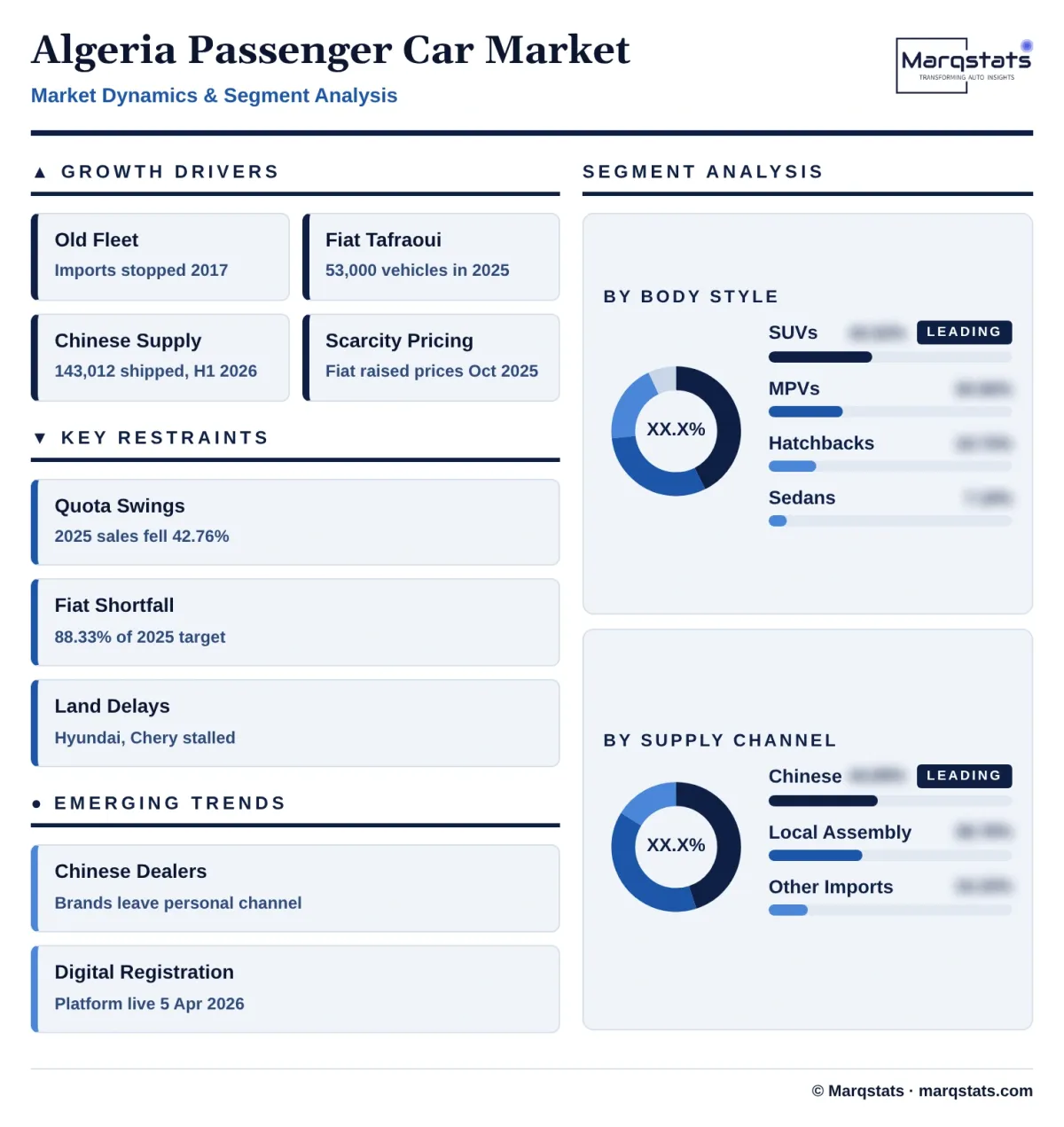
Compact SUVs and crossovers account for 42.52% of 2025 value, USD 900.56 million, and grow at 17.22% a year to USD 1,992.87 million. Marqstats estimates 25,815 units in 2025, 36.56% of the market, mostly Geely Coolray and GX3 Pro, Chery Tiggo, Jetour and Haval models sold by dealers, with local SUV assembly adding volume after 2027.
Hatchbacks account for 19.73% of 2025 value, USD 417.74 million, and grow fastest among body styles, at 21.46% a year, to USD 1,104.37 million. About 16,662 units were sold in 2025, led by the Fiat 500 until its assembly ended in September 2025 and by Opel and other small imports, and the locally built Grande Panda drives growth to 41,466 units by 2030.
Compact MPVs and ludospaces account for 30.56% of 2025 value, USD 647.22 million, and grow at 9.81% a year to USD 1,033.20 million. The Fiat Doblo Panorama, launched in February 2025 at DZD 3,349,000 and raised to DZD 3,599,000 in October 2025, drives this body style, and Marqstats estimates about 23,062 units in 2025.
Sedans account for 7.19% of 2025 value, USD 152.27 million, and grow at 11.26% a year to USD 259.60 million. About 5,061 units were sold in 2025, mainly Chery Arrizo and Geely Emgrand models, and buyers keep moving to SUVs, which holds the share down.
Petrol and LPG cars account for 93.34% of 2025 value, USD 1,976.70 million, and grow at 11.14% a year to USD 3,351.49 million, while their share falls to 76.34%. Diesel passenger cars are restricted in the personal import regime and scarce in dealer allocations, so petrol and dual-fuel LPG conversions supported by Naftal's Sirghaz programme carry nearly all of the market.
Hybrid and plug-in hybrid cars account for 4.66% of 2025 value, USD 98.73 million, and grow at 45.45% a year to USD 642.65 million and 14.64% of the market. Marqstats estimates about 2,824 units in 2025, almost all Chinese-brand imports, rising to 17,628 units as dealers add hybrid versions of compact SUVs.
Battery-electric cars account for 2.00% of 2025 value, USD 42.36 million, and grow fastest, at 56.36% a year, to USD 395.90 million and 9.02% of the market. Marqstats estimates about 1,059 units in 2025, mostly imports by individuals and dealers of Chinese models, rising to 9,492 units as Chinese brands add battery models and the more favourable tax treatment attracts buyers.
Locally assembled cars account for 38.78% of 2025 value, USD 821.37 million, and grow fastest, at 27.10% a year, to USD 2,724.76 million and 62.07% of the market. In 2025 this meant 30,900 Fiat Doblo Panorama and Fiat 500 cars from Tafraoui, 43.77% of units, and by 2030 it includes about 72,600 Fiat cars and 18,000 cars from Chery, Hyundai and other licensed plants.
Chinese-brand dealer imports account for 44.89% of 2025 value, USD 950.56 million, the largest layer in 2025, and grow at 4.61% a year to USD 1,190.96 million. Marqstats estimates 29,800 cars in 2025, 42.21% of units, from Geely, Chery, Jetour, Haval and similar brands, and a share that falls to 24.34% of units by 2030 as local assembly replaces imports.
Other-brand dealer imports account for 16.33% of 2025 value, USD 345.86 million, and grow at 6.52% a year to USD 474.32 million. Marqstats estimates 9,900 cars in 2025, 14.02% of units, from Opel, Hyundai, Dacia and Renault, Kia and other brands that sell at higher prices and in limited allocations.
By Geography
Algiers and Central North
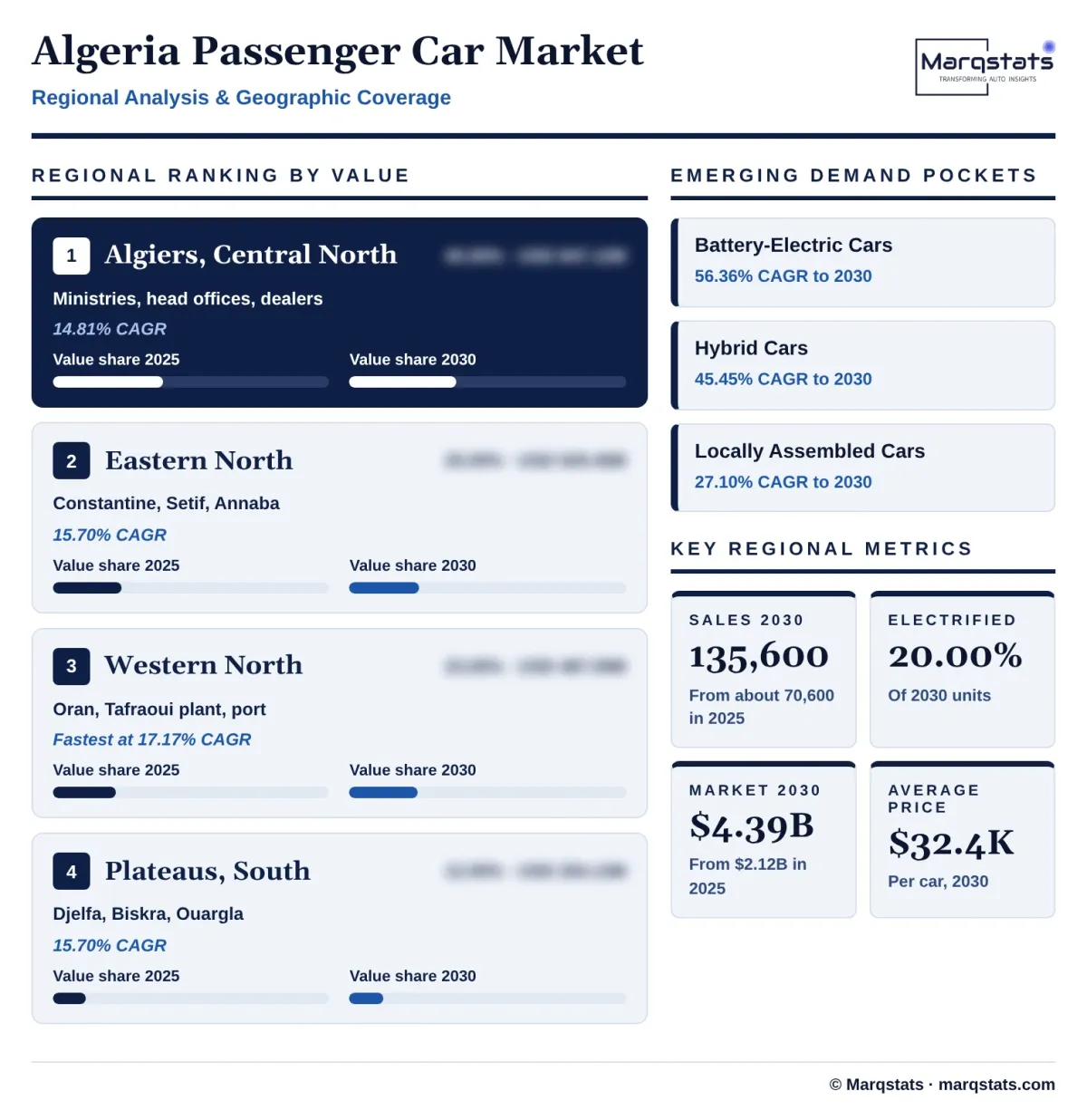
Algiers and the Central North account for 40.00% of 2025 value, USD 847.12 million, and grow at 14.81% a year to USD 1,690.17 million, 38.50% by 2030. The region covers Algiers, Blida, Boumerdes, Tipaza, Tizi Ouzou, Bouira and Medea, the ministries, head offices and the densest dealer network. Marqstats assumes registrations overstate local use because rental firms, lessors and state bodies register fleets in the capital, and allocates value by registration, as buyers and lenders do.
Western North
Western North accounts for 23.00% of 2025 value, USD 487.09 million, and grows fastest, at 17.17% a year, to USD 1,075.56 million and 24.50% by 2030. Oran, Mostaganem, Ain Temouchent, Tlemcen, Sidi Bel Abbes and Relizane sit around the Tafraoui plant and the Oran port, and Hyundai's planned plant would add to this cluster.
Eastern North
Eastern North accounts for 25.00% of 2025 value, USD 529.45 million, and grows at 15.70% a year to USD 1,097.51 million. Constantine, Setif, Batna, Annaba, Bejaia and Jijel combine trading wealth, a large rural base and ports at Annaba and Jijel, and Bordj Bou Arreridj is the reported site for Chery assembly.
High Plateaus and South
The High Plateaus and South account for 12.00% of 2025 value, USD 254.13 million, and grow at 15.70% a year to USD 526.80 million. Djelfa, Laghouat, Biskra, Ouargla, Ghardaia and Bechar have long distances and fewer dealers, so growth follows dealer openings and the spread of SUVs.
How Competition Is Evolving
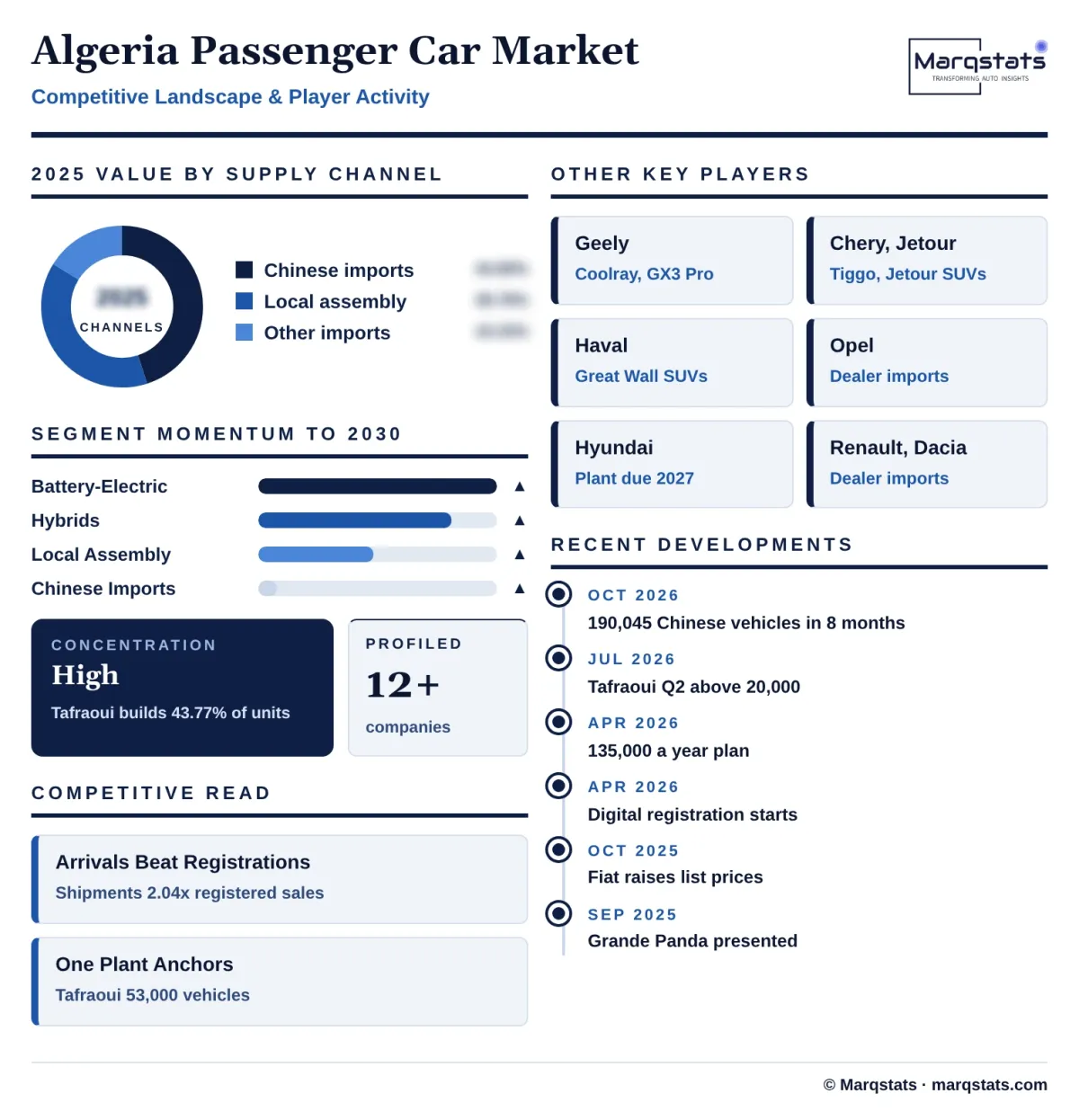
The market is highly concentrated by supplier layer, with one plant at its centre. Marqstats estimates that locally assembled cars from the Stellantis plant at Tafraoui were 43.77% of 2025 units, Chinese-brand dealer imports 42.21% and other-brand dealer imports 14.02%. By 2030 local assembly reaches 66.81% of units, so the market's largest risk and largest opportunity sit in the same industrial site.
Fiat El Djazaïr is the only passenger-car assembler at scale. It built 17,000 vehicles in 2024 and 53,000 in 2025, has built 90,000 since December 2023, plans 90,000 in 2026 and 135,000 a year by 2028, and sells the Doblo Panorama, Doblo van, Fiat 500 and Grande Panda. Marqstats estimates that 58.30% of 2025 output was passenger cars, and that Fiat held 43.77% of all passenger-car units.
Chinese brands compete on features and price. The national chronology for the first half of 2025 ranked Fiat first, Geely second and Opel third by volume, with Jetour seventh and Haval tenth, and DFSK falling 64.3%. Geely and Chery sell through dealers, while Jetour and Haval gain through individual imports, and the China Passenger Car Association data show Chinese shipments of 143,012 vehicles in the first half of 2026.
Competition is shifting from access to local content. Dealers hold quota, assemblers hold licences, and individuals import with their own currency, so the winners are the brands that can combine all three. Chery and Hyundai hold preliminary assembly licences, and Hyundai's plant was reported in August 2025 for 2027, so entrants after 2027 face an incumbent with established suppliers and customers.
Companies Covered
Companies covered in the report include:
Recent Market Activity
Table of Contents
Coverage & Segmentation
The study covers the Algeria passenger car market, with 2025 as the base year, 2021 – 2025 as the historical period and 2026 – 2030 as the forecast period. It covers new passenger cars of category M1 registered in Algeria and supplied by local assembly or by authorised dealer imports, segmented by body style, powertrain, supply channel and region. Values are retail values including customs duty, value-added tax and dealer margin in US dollars, and dinar figures use the 2025 average of DZD 131.67 per US dollar.
Light commercial vehicles including the Fiat Doblo van, pickups, minibuses, trucks, buses, used cars and cars under three years old that individuals import under Article 110 of the Finance Act 2020 are excluded. The excluded under-three-year channel was 54,418 vehicles in 2025. The live Marqstats Algeria Commercial Vehicle Market and Algeria Automotive Manufacturing Market reports overlap through Tafraoui output and the national chronology of 102,651 vehicles, and their figures should not be added to this market. Segment and regional splits are Marqstats estimates.