Market Snapshot
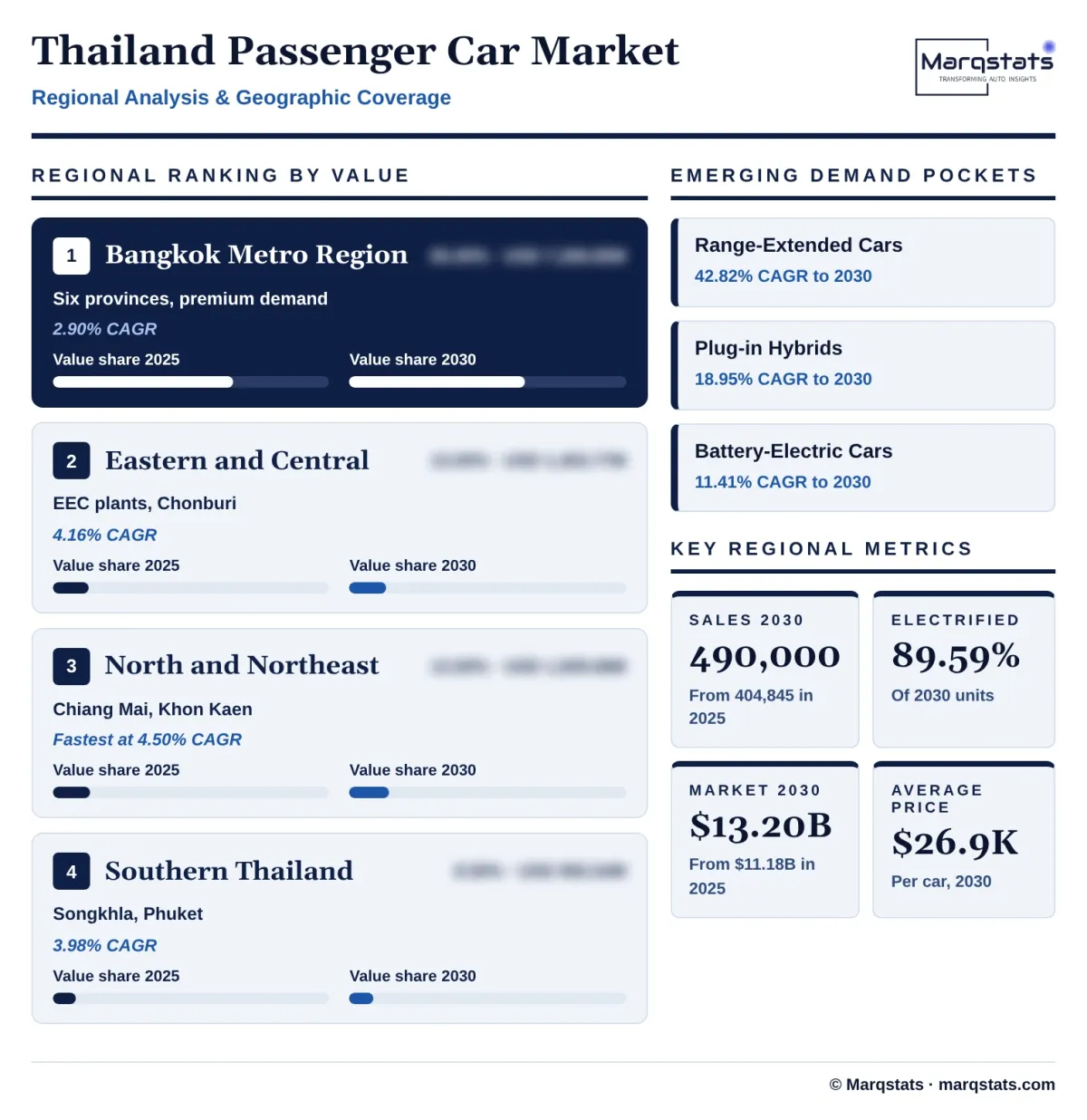
The Thailand passenger car market size is estimated at USD 11,182.84 million in 2025 and is projected to reach USD 13,204.52 million by 2030, growing at a CAGR of 3.38% over 2026 – 2030. Sales rise from 404,845 to 490,000 cars a year, a 3.89% rate, as battery-electric and hybrid cars climb from 68.16% to 89.59% of sales.
Marqstats defines the market as the retail value of new passenger cars and passenger SUVs sold in Thailand each year, as counted by the Federation of Thai Industries (FTI) Automotive Industry Club, across battery-electric, hybrid, plug-in hybrid, range-extended and petrol or diesel cars. Value is the transaction price paid by the buyer, including 7% value added tax and excise, converted at the 2025 average of THB 33.74 per US dollar. One-tonne pickups, pickup-based passenger vehicles (PPVs), vans, buses, trucks, exports and used cars are excluded.
Hybrid cars hold 41.81% of 2025 value, the largest powertrain, while battery-electric cars took 29.72% of units and grow to 45.92% by 2030. Locally assembled cars account for 74.89% of value and imported cars for 25.11%. The Bangkok Metropolitan Region accounts for 65.00% of value, while Northern and Northeastern Thailand grows fastest at 4.50% a year.
Key Takeaways
Market Overview & Analysis
Report Summary
Marqstats sizes the Thailand passenger car market as the retail value of new passenger cars and passenger SUVs sold in the country in a calendar year. The unit base is the FTI domestic sales series for passenger cars, which counted 404,845 cars in 2025, up 18.39%: 120,301 battery-electric, 146,059 hybrid, 8,621 plug-in hybrid, 971 range-extended and 128,893 petrol or diesel cars. One-tonne pickups and PPVs such as the Toyota Fortuner and Isuzu MU-X are counted by the FTI as separate classes and are excluded.
Two official series describe the same market in different ways. Toyota Motor Thailand Co., Ltd. reported 2025 industry sales of 239,236 passenger cars, up 6.7%, out of 621,166 vehicles, and placed 381,930 vehicles in its commercial class. Its commercial class, less 187,733 pickups and PPVs and the FTI counts of 15,305 trucks and 13,283 other vehicles, leaves 165,609 vehicles, exactly the gap between the FTI and Toyota passenger totals. Marqstats reads these as passenger SUVs and crossovers that the Toyota series books outside its car class, and uses the FTI total because it counts every powertrain and body style a household buys.
Passenger cars became the majority of Thai vehicle demand in 2025. They took 65.18% of the 621,166 vehicles sold, while pickups excluding PPVs fell 12.0% to 143,817 on the Toyota count, as banks kept tight credit for the small businesses and farmers who buy pickups. Electric cars carried the gain: FTI battery-electric sales rose 80.27%, hybrid sales rose 24%, and petrol and diesel car sales fell 16.87%.
Thailand is also a car exporter, which is why production and sales diverge. The FTI counted 550,456 passenger cars built in 2025, of which 322,445 were for the home market and 228,011 for export. Marqstats estimates that about 82,400 of the 404,845 cars sold, 20.35% of units, were imported fully built, most of them battery-electric cars from China and premium cars from Europe and Japan.
At the 2025 average rate of THB 33.74 per US dollar, the market was worth about THB 377.31 billion in 2025 and reaches about THB 445.52 billion by 2030. The average value per car is about USD 27,623 in 2025 and USD 26,948 in 2030, falling slightly as cheaper locally built electric cars replace imports and price competition among Chinese brands continues.
Thailand Passenger Car Market Size and Forecast
The Thailand passenger car market grows from USD 11,182.84 million in 2025 to USD 13,204.52 million in 2030, a CAGR of 3.38%. Volume drives the growth: sales rise at 3.89% a year, from 404,845 to 490,000 cars, while the average value per car eases at 0.49% a year, from about USD 27,623 to USD 26,948, as battery-electric prices fall and the expensive imported share shrinks.
The path is uneven. FTI data show passenger car and passenger SUV sales of 240,426 in January to June 2026, up 24.13%, with battery-electric sales up 93.07% to 104,418 and petrol and diesel car sales down 24.83%. Higher fuel prices after a THB 6 a litre rise on 26 March 2026 and buying ahead of the planned 2027 excise step-up lift Marqstats' 2026 estimate to 490,000 cars and USD 13,419.68 million, 20.00% above 2025. Sales then fall to about 455,000 in 2027, worth USD 12,545.09 million, as demand pulled into 2026 is not repeated.
The 2025 value is built bottom-up from powertrain volumes and prices. Marqstats values 120,301 battery-electric cars at an average of about THB 850,000, 146,059 hybrids at about THB 1,080,008, 128,893 petrol and diesel cars at about THB 800,000, 8,621 plug-in hybrids at about THB 1,500,000 and 971 range-extended cars at about THB 1,300,000, all including value added tax and excise. The hybrid price matches the live Marqstats Thailand hybrid electric vehicle page, so both pages give the same hybrid value in baht.
Prices move in opposite directions by powertrain. Marqstats expects the average battery-electric price to fall to about THB 780,000 by 2030 as BYD, Changan, GAC Aion and Chery build more cars locally, and the average hybrid price to ease to THB 1,010,002. The petrol and diesel average rises to about THB 860,000, because the cheapest eco-cars lose volume first and the cars that remain are larger or premium models.
Marqstats tracks four indicators to monitor the forecast: monthly FTI sales by powertrain, the share of battery-electric sales that is imported after 1 January 2027, the output of battery-electric plants against the 386,000 cars a year of capacity approved by the Board of Investment, and the excise schedule for hybrids and mild hybrids that the EV Board set for 2026 to 2032.
Market Dynamics
Key Drivers
Five forces lifted Thai passenger car demand by 18.39% in 2025 and kept it rising through 2026.
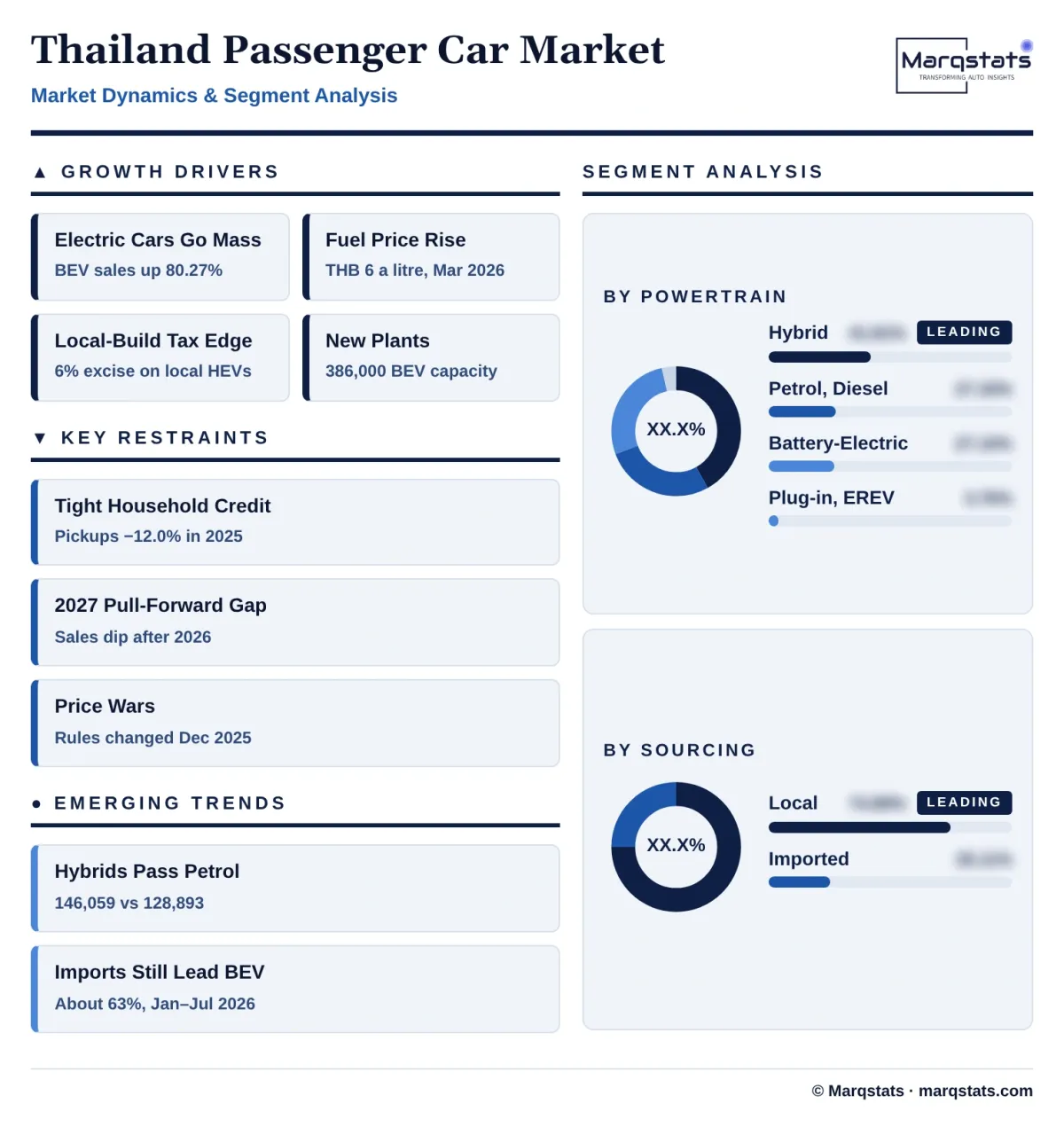
- Electric cars won mass buyers in 2025. FTI battery-electric car sales rose 80.27% to 120,301 and reached 19.37% of all vehicle sales, while BYD, MG, GAC Aion, Changan and Jaecoo offered battery-electric models priced close to petrol eco-cars. In January to June 2026 battery-electric sales rose a further 93.07% to 104,418.
- Fuel prices pushed buyers toward electric drive. The THB 6 a litre rise on 26 March 2026 raised the running cost of every petrol and diesel car, and in June 2026 FTI battery-electric sales rose 140.47% while petrol and diesel car sales fell 33.72%, a direct switch rather than new demand.
- Tax rules reward cars built in Thailand. Locally built hybrids that emit up to 100 grams of carbon dioxide a kilometre pay 6% excise and those up to 120 grams pay 9%, plug-in hybrids with at least 80 kilometres of electric range pay 5% from January 2026, and the excise restructuring the EV Board agreed in principle on 10 September 2026 sets higher rates for fully imported electric cars and lower rates for Thai-built cars with local parts.
- Investment brings new plants and models. The Board of Investment had approved 21 battery-electric car projects with 386,000 cars a year of capacity and THB 41.08 billion of investment by June 2025, and Chery opened a Rayong plant on 20 April 2026 targeting 80,000 cars a year by 2030, adding to plants run by BYD, GAC Aion, Changan and Great Wall Motor.
- A planned tax step-up brings sales forward. The EV Board agreed in principle on 10 September 2026 to raise excise on fully imported electric cars, a step Marqstats expects from 1 January 2027 once the government approves the detailed rules, which gives buyers and importers a reason to close deals in the last months of 2026.
Key Restraints
Four constraints cap growth after the 2026 surge and squeeze the cheapest petrol cars.
- Credit stays tight for many households. Toyota counted a 12.0% fall in pickup sales excluding PPVs in 2025, and its January 2026 forecast expected passenger car sales to fall 6.2% to 224,500 in 2026, a sign that lenders still screen lower-income buyers hard even as wealthier city buyers switch to electric cars.
- The pull-forward leaves a gap in 2027. Marqstats expects sales to fall from about 490,000 in 2026 to about 455,000 in 2027 as imported electric cars become dearer and buyers who moved early leave the market for several years.
- Price wars cut dealer and maker margins. The Cabinet changed the EV 3.0 and EV 3.5 rules on 9 December 2025 explicitly to ease oversupply and price wars, and subsidy payments can now be suspended for makers that miss their conditions.
- Local plants run well below capacity. The FTI counted 70,914 battery-electric cars built in 2025, about 18.37% of the 386,000 cars a year of approved capacity, so makers carry fixed costs that push them to cut prices or export.
Key Trends
Four shifts are changing what Thais buy, where it is built and how it is taxed.
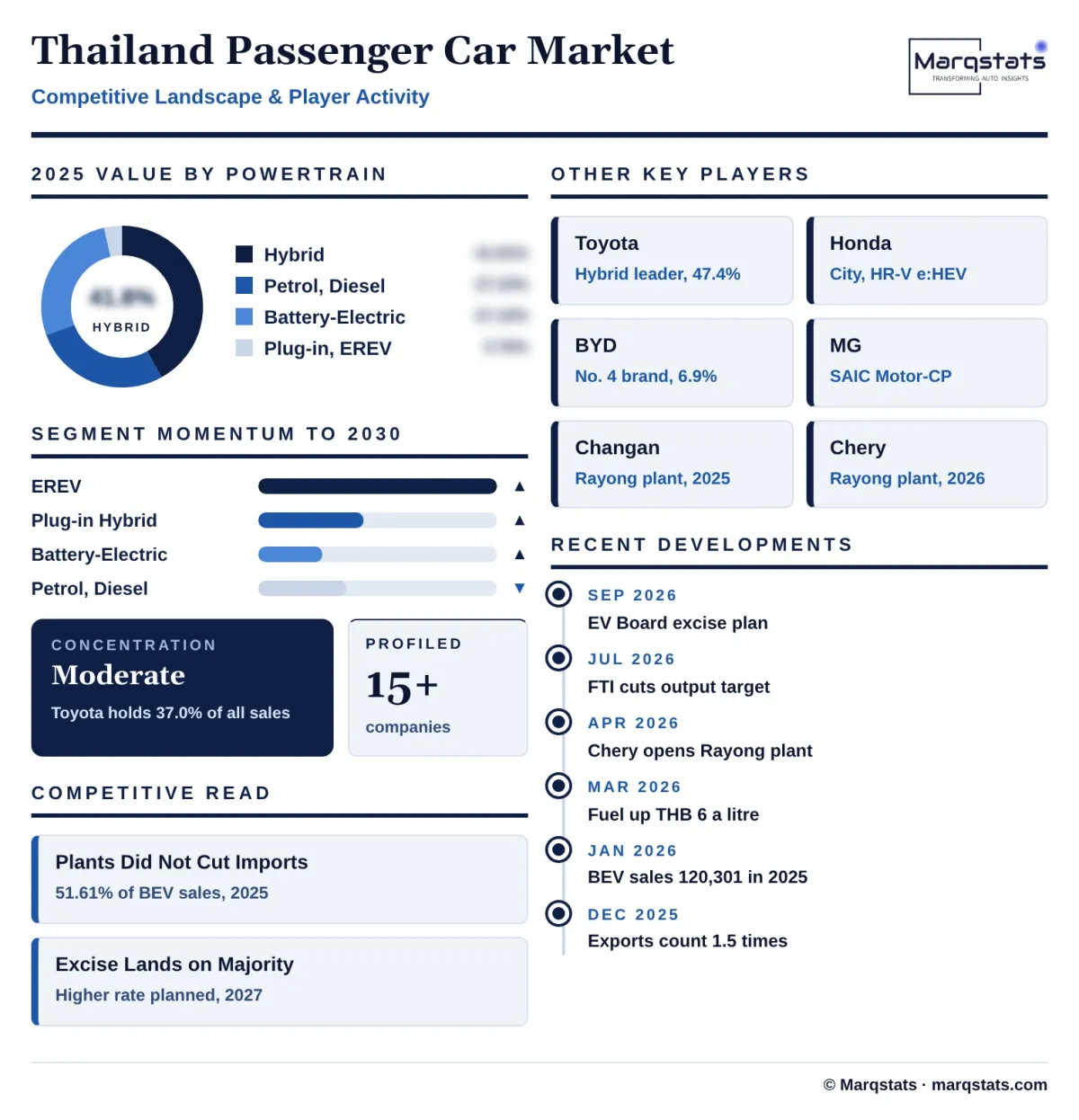
- Hybrids outsell petrol cars. FTI hybrid sales of 146,059 in 2025 overtook petrol and diesel car sales of 128,893 for the first time, and Toyota reported 47.4% of the hybrid market.
- Range-extended cars enter the data. The FTI counted 971 range-extended cars in 2025, the first year it reported the class, and 839 in January to June 2026.
- Exports count toward local production. Since the EV Board change of July 2025, one battery-electric car built for export counts as 1.5 cars toward compensatory production, which turns Thai plants toward right-hand-drive export markets.
- Chinese brands move from import to assembly. Changan opened its Rayong plant in May 2025 and Chery in April 2026, and the FTI counted 34,030 battery-electric cars built in January to June 2026, up 43%.
Strategic Implications
- For Chinese electric car makers, the planned excise step-up turns local content into a price advantage. Makers that can show local production or local parts keep the lower rate, while importers face a higher one, so plans for 2027 models should start from the Thai plant, not the Chinese one.
- For Japanese makers, hybrids are the defence. Toyota and Honda already build hybrids in Thailand at 6% or 9% excise, and the hybrid segment still grows at 3.56% a year in value, but the share of petrol and diesel cars falls from 31.84% to 10.41% of units, so lines that build eco-cars need new work.
- For dealers and lenders, 2026 is a peak year, not a new level. Marqstats expects sales to drop by about 35,000 cars in 2027, and stock or credit lines built for 2026 volumes should be cut before the excise change takes effect.
- For parts suppliers, battery-electric plants running at under one fifth of approved capacity give buyers bargaining power. Suppliers that can supply battery packs, motors and power electronics with Thai content help makers qualify for the lower excise and gain share as imports fall.
- For charging and energy firms, demand follows the cars to the provinces. Marqstats expects provincial regions to grow faster than Bangkok, and the Board of Investment had approved 20,080 charging stations, including 7,360 direct-current units, by June 2025.
Market Segmentation
Battery-electric cars account for 27.10% of 2025 value, USD 3,030.70 million, and grow at 11.41% a year to USD 5,201.54 million and 39.39% of the market. The FTI counted 120,301 sales in 2025, 29.72% of units, and Marqstats expects 225,000 by 2030. BYD, MG, GAC Aion, Changan, Jaecoo, Geely and Tesla sell most of these cars, and the share built in Thailand rises as the planned excise step-up takes effect.
Hybrid cars account for 41.81% of 2025 value, USD 4,675.31 million, and grow at 3.56% a year to USD 5,567.89 million and 42.18% of the market. Sales of 146,059 in 2025 rise to about 186,000 by 2030. Toyota Yaris Cross, Corolla Cross and Camry hybrids and Honda City and HR-V e:HEV models lead, and the 6% excise for low-emission local hybrids keeps their prices steady.
Petrol and diesel cars account for 27.33% of 2025 value, USD 3,056.15 million, and shrink at 15.72% a year to USD 1,299.94 million and 9.84% of the market. Sales of 128,893 fall to about 51,000 by 2030. Eco-cars such as the Toyota Yaris Ativ, Honda City and Nissan Almera hold on longest, while premium petrol models lose ground to hybrids and electric cars.
Plug-in hybrids account for 3.43% of 2025 value, USD 383.27 million, and grow at 18.95% a year to USD 912.86 million and 6.91% of the market. FTI sales rose 260.56% to 8,621 in 2025 and Marqstats expects 22,000 by 2030, led by BYD, Great Wall Motor, Mercedes-Benz and BMW models that qualify for 5% excise with at least 80 kilometres of electric range.
Range-extended cars account for 0.33% of 2025 value, USD 37.41 million, and grow fastest, at 42.82% a year, to USD 222.29 million and 1.68% of the market. The FTI counted 971 in 2025, the first year it reported the class, and Marqstats expects 6,000 by 2030, though the planned higher excise on fully imported electric cars favours makers that assemble locally.
Sedans, hatchbacks and other cars in the Toyota car class account for 51.72% of 2025 value, USD 5,783.61 million, and grow at 0.89% a year to USD 6,046.84 million. Toyota counted 239,236 such cars in 2025, 59.09% of units, and Marqstats expects 260,000 by 2030. Eco-car sedans, the BYD Dolphin and the MG4 keep this body style large, but it loses share to crossovers.
Passenger SUVs and crossovers account for 48.28% of 2025 value, USD 5,399.23 million, and grow at 5.80% a year to USD 7,157.68 million and 54.21% of the market. Marqstats estimates 165,609 units in 2025 from the gap between the FTI and Toyota passenger totals, rising to 230,000 by 2030 as the Yaris Cross, HR-V, BYD Atto 3, Sealion 6 and Sealion 7 and Jaecoo 5 EV take more buyers.
Cars assembled in Thailand account for 74.89% of 2025 value, USD 8,374.30 million, and grow at 5.77% a year to USD 11,085.37 million and 83.95% of the market. The FTI counted 322,445 passenger cars built for the home market in 2025, and Marqstats expects about 435,000 by 2030 as Chinese makers shift battery-electric supply to Rayong and Chonburi plants.
Imported cars account for 25.11% of 2025 value, USD 2,808.54 million, and shrink at 5.48% a year to USD 2,119.15 million and 16.05% of the market. Marqstats estimates about 82,400 imported cars in 2025, the gap between sales and production for the home market, falling to 55,000 by 2030 as the planned higher excise on imported electric cars applies, expected from 2027. Imports that remain are mostly premium models.
By Geography
Bangkok Metropolitan Region
The Bangkok Metropolitan Region, which covers Bangkok, Nakhon Pathom, Nonthaburi, Pathum Thani, Samut Prakan and Samut Sakhon, accounts for 65.00% of 2025 value, USD 7,268.85 million, and grows at 2.90% a year to USD 8,384.87 million and 63.50% by 2030. Department of Land Transport provincial records put the region at 58.20% of all 2025 light-vehicle registrations and 69.37% of electric vehicle registrations. Its share of passenger car value is higher still, because pickups sell more in the provinces and premium cars sell more in the capital.
Eastern and Central Thailand
Eastern and Central Thailand accounts for 13.00% of 2025 value, USD 1,453.77 million, and grows at 4.16% a year to USD 1,782.61 million. Chonburi took 3.57% and Rayong 1.51% of 2025 light-vehicle registrations, and the plants of the Eastern Economic Corridor create both factory jobs and company car demand around Laem Chabang, Si Racha and Pattaya.
Northern and Northeastern Thailand
Northern and Northeastern Thailand accounts for 13.50% of 2025 value, USD 1,509.68 million, and grows fastest, at 4.50% a year, to USD 1,881.64 million and 14.25% by 2030. Chiang Mai took 3.64% of all 2025 registrations and 3.87% of electric vehicle registrations, the only large province where the electric share exceeded its overall share, while Nakhon Ratchasima and Khon Kaen took 2.18% and 1.89%.
Southern Thailand
Southern Thailand accounts for 8.50% of 2025 value, USD 950.54 million, and grows at 3.98% a year to USD 1,155.40 million. Songkhla took 1.76% and Phuket 1.66% of 2025 light-vehicle registrations, and tourism and rubber and palm oil incomes support hybrid and compact SUV purchases.
How Competition Is Evolving
The market is moderately concentrated, with Japanese makers leading by volume and Chinese makers leading in electric cars. Toyota Motor Thailand reported 2025 sales of 230,038 vehicles, 37.0% of the total market, and 82,258 passenger cars, 34.4% of the Toyota passenger car class, up 22.9%. Toyota also reported 47.4% of the hybrid market and 48.7% of the eco-car segment.
BYD became the fourth-largest brand in Thailand in 2025, with a 6.9% share of light vehicle sales and growth of 53.7%, behind Toyota, Honda and Isuzu. MG grew 43.6%, GAC Aion 175% and Changan 109.8%, and Jaecoo reached a 1.5% share in its first full year, with the Jaecoo 5 EV taking third place in December 2025. Honda sales fell 13.8% and Mitsubishi sales 5.3%, as hybrids from Japan competed with lower-priced electric cars from China.
Competition is moving from imports to factories. The import share of battery-electric sales was about 51.61% in 2025 on Marqstats estimates and about 63% in January to July 2026 on FTI data, while plants built by BYD, GAC Aion, Changan, Great Wall Motor and Chery used only a fraction of approved capacity. Under the excise restructuring the EV Board agreed in principle in September 2026, importers of cars with no local production or local parts are set to pay higher rates, expected from 1 January 2027, so makers with Thai plants and local suppliers win on price.
Premium brands are a distinct layer. Mercedes-Benz and BMW assemble cars in Thailand, and Tesla, Porsche and Lexus import fully built cars. The live Marqstats Thailand luxury car page counts 44,348 luxury registrations in 2025, about 10.95% of the passenger cars sized here.
Companies Covered
Companies covered in the report include:
Recent Market Activity
Table of Contents
Coverage & Segmentation
The study covers the Thailand passenger car market, with 2025 as the base year, 2021 – 2025 as the historical period and 2026 – 2030 as the forecast period. It covers new passenger cars and passenger SUVs sold in Thailand as counted by the FTI, segmented by powertrain, body type, sourcing and region. Values are retail transaction values including value added tax and excise, in US dollars at the 2025 average rate of THB 33.74 per US dollar.
One-tonne pickups, including double-cab models, and PPVs such as the Toyota Fortuner, Isuzu MU-X and Mitsubishi Pajero Sport are excluded; they belong to the live Marqstats Thailand pickup truck page, which does not overlap with this market. Vans, buses, trucks, motorcycles, exported cars and used cars are also excluded. The live Marqstats Thailand hybrid electric vehicle and Thailand luxury car pages are subsets of this market, and the Thailand electric vehicle page covers electric vehicles of all classes, so their figures should not be added to this market.