Market Snapshot
The Romania passenger car market size is estimated at USD 4,604.54 million in 2025 and is projected to reach USD 5,538.68 million by 2030, growing at a CAGR of 3.76% over 2026 – 2030. Registrations of new cars rise from 155,855 in 2025 to 168,000 in 2030, a 1.51% annual rate, while the average price of a new car climbs from about EUR 26,145 to EUR 29,176 as plug-in hybrids, hybrids and sport utility vehicles take a larger share.
Marqstats defines the market as the retail transaction value of new M1 passenger cars registered for the first time in Romania, as counted by the Association of Automobile Manufacturers and Importers (APIA) from records of the Directorate for Driving Licences and Vehicle Registration (DRPCIV, cited by APIA as DGPCI). Value includes value-added tax, at 19% until July 2025 and 21% from 1 August 2025, and is converted to US dollars at EUR 1 = USD 1.13. Used imports, light commercial vehicles, pickups, motorcycles and cars exported from the Mioveni and Craiova plants are excluded.
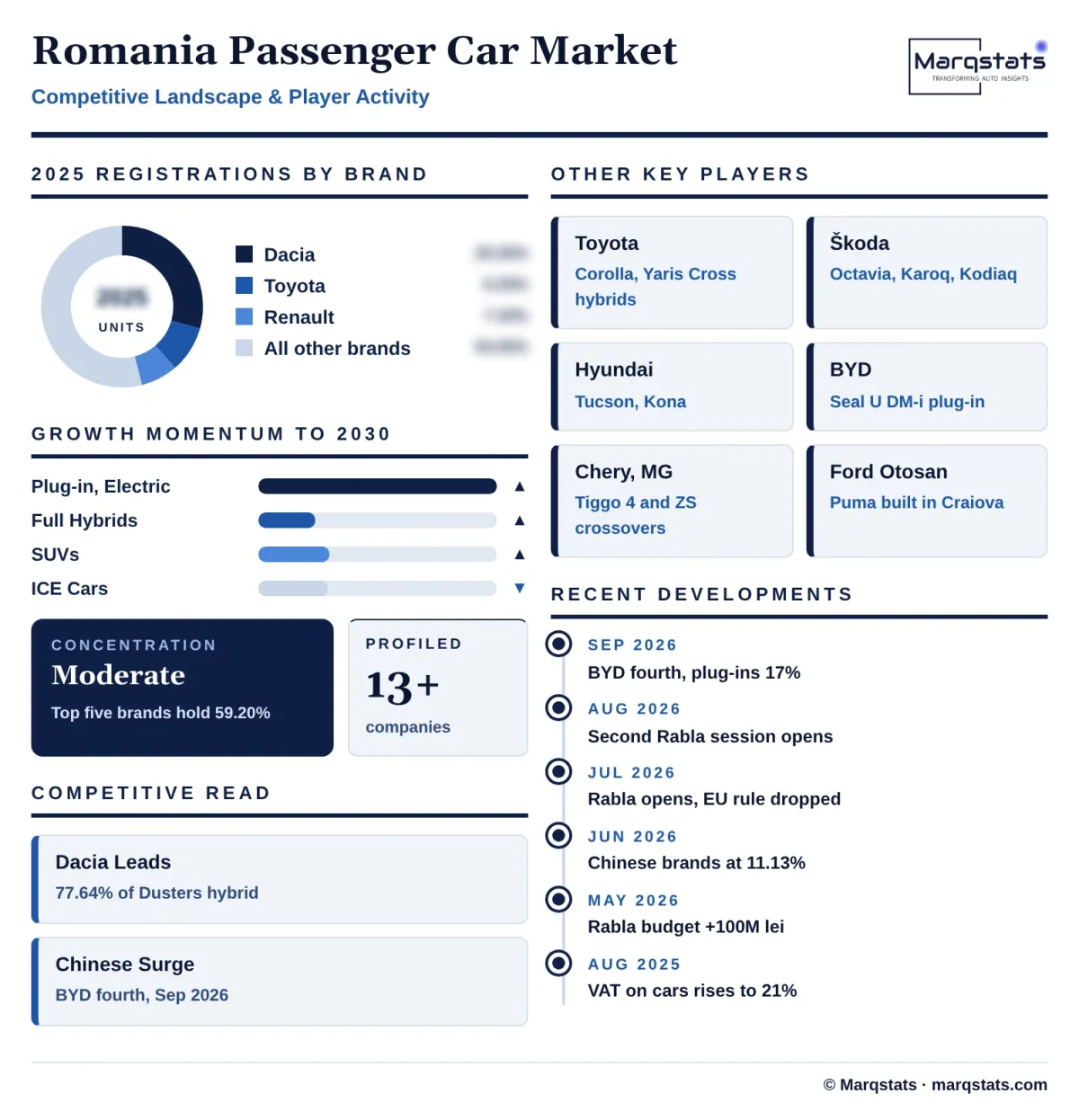
SUVs and crossovers account for 55.23% of 2025 value, plug-in and battery-electric cars for 16.53% and the mid price band of EUR 20,000 to 35,000 for 40.20%. Bucharest-Ilfov leads with 33.00% of value, while Transylvania (North-West and Centre) grows fastest at 4.73% a year. Dacia holds 29.36% of 2025 registrations, and Chinese brands reached 11.13% of first-half 2026 registrations.
Key Takeaways
Market Overview & Analysis
Report Summary
Marqstats sizes the Romania passenger car market as the retail transaction value of new M1 passenger cars registered for the first time each year. The count follows the registrations published by the Association of Automobile Manufacturers and Importers (APIA) from records of the Directorate for Driving Licences and Vehicle Registration (DRPCIV, cited by APIA as DGPCI), which gave 155,855 new cars for 2025, up 4.7%. The tabulation of Directorate for Driving Licences and Vehicle Registration (DRPCIV) records published by the Romanian Automotive Manufacturers Association (ACAROM) shows 156,803, a difference of 948 cars, or 0.61%, which Marqstats attributes to cut-off dates and category treatment.
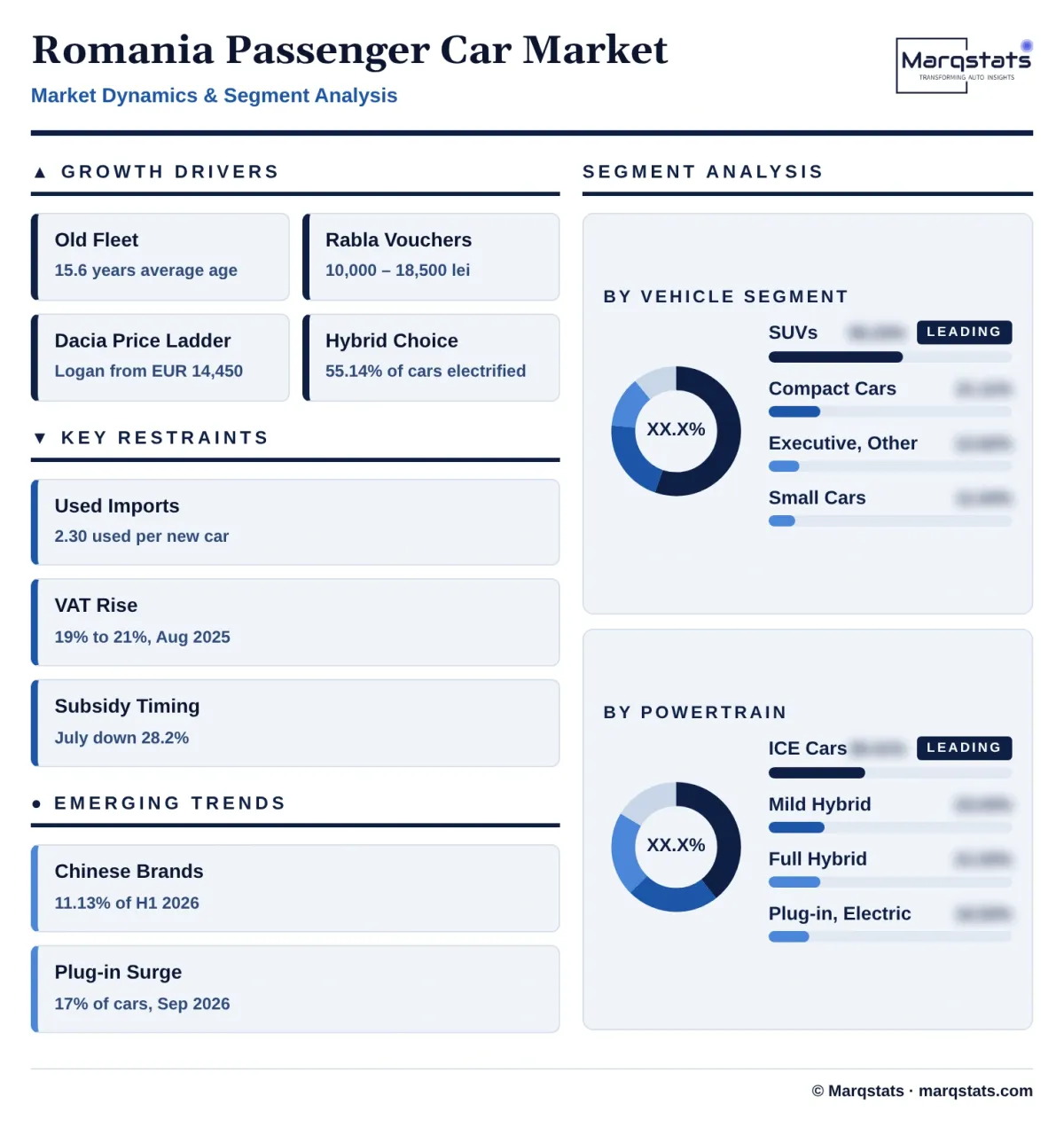
The new-car market sits on a large and old fleet. The registered passenger car fleet reached 8,774,808 cars at the end of 2025 and the average age was 15.6 years, about three years above the European Union average of 12.7 years. New cars replace only 1.78% of that fleet each year. The rest of Romania's car supply comes from used imports, which reached 360,103 cars in 2025, up 9.51% from 328,834, and which keep entry-level buyers out of the new-car market.
The 2025 anchor has to be read carefully because two series are in circulation. APIA reports 155,855 new cars for 2025 and a 4.7% rise, which implies about 148,860 in 2024, while the DRPCIV series gives 151,105 for 2024 and 156,803 for 2025, a 3.77% rise. The two series should not be mixed. The electrified share was 55.14% in APIA data, made up of 36,476 mild hybrids, 30,567 full hybrids, 10,079 plug-in hybrids and 8,833 battery-electric cars, which leaves 69,900 petrol, diesel and LPG cars, 44.86% of the total.
The cycle turned in 2026. Registrations fell 24% in February, rose 0.3% over the first half, fell 28.2% in July and about 37% in August, and fell 11.5% to 10,952 cars in September, leaving the first nine months of 2026 10.5% below 2025. The high base matters: November 2025 rose 36.6% to 13,816 cars and December 2025 rose 58.4% to 21,203. Marqstats estimates 2026 at 141,000 cars, a 9.53% fall, and USD 4,257.20 million, a 7.54% fall, because the average price keeps rising.
Policy and competition both changed during 2025 and 2026. Value-added tax on cars rose from 19% to 21% on 1 August 2025. The Rabla Auto 2026 scheme for individuals opened on 20 July 2026 with 300 million lei and vouchers of 10,000 to 18,500 lei, and the Ministry of Environment dropped the requirement for cars to be built in the European Union before launch. Chinese brands, led by BYD, Chery and MG, moved from near zero to 11.13% of first-half 2026 registrations.
Romania Passenger Car Market Size and Forecast
The Romania passenger car market grows from USD 4,604.54 million in 2025 to USD 5,538.68 million in 2030, a CAGR of 3.76%. Volume contributes 1.51 points a year, with registrations moving from 155,855 to 168,000 cars, and the average price contributes 2.22% a year, from about USD 29,544 (EUR 26,145, RON 131,936) to USD 32,968 (EUR 29,176). The path is not straight: value falls 7.54% in 2026 and then grows 6.19% in 2027, 6.40% in 2028, 7.26% in 2029 and 7.35% in 2030.
The 2025 value is built bottom-up from APIA registrations by vehicle segment and Marqstats average transaction prices including value-added tax. Marqstats estimates 81,824 SUVs and crossovers at EUR 27,500 each, 37,405 compact cars at EUR 23,000, 27,275 small cars at EUR 16,500 and 9,351 executive and other cars at EUR 55,000. The price anchors are Dacia list prices of EUR 14,450 for the Logan, EUR 15,150 for the Sandero, EUR 19,500 for the Duster and EUR 23,350 for the Bigster after the August 2025 tax rise, Kia Sportage at EUR 30,047 before it, and premium German models above EUR 55,000.
The segment shares rest on APIA monthly data. SUVs were 52.4% of registrations in November 2025 and 51.7% in December 2025, and Class C and Class B cars were 26.4% and 15.1% in November and 25% and 16.7% in December. Marqstats sets the 2025 full-year split at 52.50% SUVs, 24.00% compact cars, 17.50% small cars and 6.00% executive and other cars, and moves SUVs to 60.00% by 2030 because SUVs reached 61.3% of September 2026 registrations.
Powertrain units come directly from APIA for 2025 and follow a rising plug-in curve afterwards. Petrol, LPG and diesel cars fall from 69,900 to 48,720, mild hybrids from 36,476 to 30,240, while full hybrids rise to 38,640 and plug-in and battery-electric cars to 50,400, 30.00% of 2030 units against 12.13% in 2025. Price relativities of 1.00, 1.12, 1.22 and 1.55 against a petrol car turn those units into the value split by powertrain.
Marqstats tracks five indicators to monitor the forecast: monthly APIA registrations, the pace at which the Environment Fund Administration (AFM) approves Rabla vouchers, used-car import registrations at DRPCIV, the share of Chinese brands in new registrations, and the number of public DC charging points, which reached 3,536 at the end of 2025. A year-on-year gain in the new-car share of first registrations above the 31.81% assumed for 2030 would lift the forecast.
Market Dynamics
Key Drivers
Five forces support demand for new passenger cars in Romania even as 2026 registrations fall.
- An old fleet creates replacement demand. The registered passenger car fleet of 8,774,808 cars has an average age of 15.6 years against 12.7 years across the European Union, and new cars replace only 1.78% of it each year. Every year in which new registrations stay near 155,855 adds to the stock of cars that must be replaced, which is why Marqstats forecasts growth after the 2026 dip.
- The Rabla voucher scheme supports buyers directly. Rabla Auto 2026 offers 10,000 lei (USD 2,239.24) for a petrol, LPG or gas car, 12,000 lei for a hybrid, 15,000 lei for a plug-in hybrid and 18,500 lei (USD 4,142.59) for a battery-electric or fuel-cell car, in exchange for scrapping an old vehicle. The lowest voucher equals 7.58% of the average new-car price and the highest 14.02%, enough to tip price-sensitive buyers toward new cars.
- Dacia keeps a low entry price. After value-added tax rose to 21% in August 2025, Dacia list prices were EUR 14,450 for the Logan, EUR 15,150 for the Sandero and EUR 19,500 for the Duster, rises of only 1% to 2%. Dacia delivered 29.36% of 2025 registrations, and 77.64% of Duster registrations in 2025 were hybrids, so the brand sells electrified cars at entry-level prices.
- Hybrids give buyers an electrified car without a charger. APIA counted 85,955 electrified cars in 2025, 55.14% of registrations, with full hybrids up 41.51% to 30,567 and mild hybrids up 19.66% to 36,476. Toyota Corolla full hybrids reached 4,442 registrations, up 35.4%, and the Ford Puma and Škoda Octavia lead the mild-hybrid models behind the Duster.
- Charging and brand choice are widening. Romania ended 2025 with 3,576 AC and 3,536 DC public charging points, DC points up 85.5% in a year, while BYD, Chery and MG gave buyers new SUVs and plug-in hybrids from 2025. Both developments support the 22.29% CAGR Marqstats forecasts for plug-in and battery-electric value.
Key Restraints
Four constraints keep growth below the pace of electrification and hold the market under its late-2025 peak.
- Used imports take the entry-level buyer. DRPCIV recorded 360,103 used cars registered for the first time in 2025 against 156,803 new ones, 2.30 to 1, and used imports grew 9.51% against 3.77% for new cars. While used imports offer a lower entry price than the cheapest new Dacia at EUR 14,450, Marqstats expects the new-car market to stay near 30% of first registrations.
- Value-added tax and prices took a step up in 2025. The rate on cars rose from 19% to 21% on 1 August 2025, Dacia raised prices 1% to 2%, and Kia and MG raised prices about 2%. Marqstats sees the combination as widening the price gap between new cars and used imports.
- Subsidy timing swings the market. The Rabla scheme for individuals opened on 20 July 2026, but registrations fell 28.2% in July, about 37% in August and 11.5% in September. Marqstats reads this as buyers delaying purchases until vouchers were confirmed, and as the cost of a high base after November 2025 (+36.6%) and December 2025 (+58.4%).
- Battery-electric cars are going backwards. Registrations of battery-electric cars fell 9.05% to 8,833 in 2025 and the 2025 leader, the Dacia Spring, fell 51% to 1,596. The 120 million lei plug-in pot funds at most 6,486 battery-electric vouchers at 18,500 lei, so subsidies alone cannot restore the 2023 share of 12.5% for plug-in cars.
Key Trends
Four shifts are changing which cars Romanians buy, from which brands and with which powertrains.
- Chinese brands move from the fringe to a double-digit share. Their share of registrations rose from 9.46% in January 2026 to 14.34% in May and reached 11.13% for the first half, with BYD at 2,140 cars, Chery at 2,011 and MG at 1,757. The Chery Tiggo 4 (898) and MG ZS (810) lead by volume.
- Plug-in hybrids overtake battery-electric cars. Plug-in hybrid registrations rose 59.03% to 10,079 in 2025, and in September 2026 their share reached 17% against 8% for battery-electric cars. The BYD Seal U DM-i is the top plug-in model of 2026 with 1,230 registrations from January to September.
- Diesel keeps shrinking. Diesel was 6.7% of registrations in November 2025, 4.6% in December and 3.8% in September 2026, and diesel cars are not eligible for Rabla vouchers, which removes the powertrain that dominated the market a decade ago.
- SUVs take the whole market. SUVs were 61.3% of registrations in September 2026, up from about 52% in late 2025, as Dacia, Toyota, Škoda and the Chinese brands concentrate their launches on crossovers while price-sensitive small-car buyers stay in the used market.
Strategic Implications
- For importers and brand distributors, the realistic growth path is share gain inside a market of 168,000 cars in 2030, not volume growth. Hybrids and plug-in hybrids in the EUR 20,000 to 35,000 band, which holds 40.20% of value, are where Marqstats expects both price realisation and Rabla support to be strongest.
- For Dacia and Renault Group, the task is to defend a 29.36% share while the entry price rises toward EUR 15,000. Hybrid Duster and Bigster volumes, which already make up 77.64% of Duster registrations, protect margin, and the Logan and Sandero keep used-import buyers within reach of new cars.
- For Chinese entrants, the first-half share of 11.13% shows that dealer networks, not product, were the constraint in 2025. The plug-in hybrid route used by BYD and Chery matches a market where 12.13% of cars are plug-in today and where public DC charging points number 3,536.
- For lenders, leasing companies and dealer groups, the fight is with the used-import channel. A five-point shift of first registrations from used to new would add 25,845 cars, so financing products that put a new Logan or Sandero within the budget of a used-car buyer are worth more than another point of brand share.
- For charging operators and component suppliers, plug-in value of USD 2,081.70 million in 2030 and 50,400 plug-in cars a year justify DC corridors and power electronics capacity, while the local plants at Mioveni and Craiova supply export markets rather than domestic buyers.
Market Segmentation
SUVs and crossovers account for 55.23% of 2025 value, USD 2,542.68 million, and grow at 6.65% a year to USD 3,508.24 million and 63.34% of the market. Marqstats estimates 81,824 units in 2025, led by the Dacia Duster at 14,065 registrations and the Bigster at 3,498, with Toyota, Hyundai Tucson and Kona, Škoda Karoq and Kodiaq, and the BYD Seal U following.
Compact cars of Class C account for 21.11% of 2025 value, USD 972.16 million, and grow slowly, at 0.82% a year, to USD 1,012.61 million. About 37,405 units were registered in 2025, among them the Toyota Corolla full hybrid at 4,442 and the Škoda Octavia, and this segment loses share as buyers choose crossover bodies at similar prices.
Small cars of Class A and B account for 11.04% of 2025 value, USD 508.54 million, and slip by 0.30% a year to USD 500.99 million. The Dacia Logan at 15,299 registrations, the Sandero at 8,099 and the Renault Clio at 5,080, up 99.5%, make this the entry segment where new cars compete directly with used imports.
Executive and other cars account for 12.62% of 2025 value, USD 581.16 million, from only 6.00% of units. They fall 2.32% a year to USD 516.84 million as premium buyers from Mercedes-Benz, BMW and Audi move to SUV bodies and plug-in powertrains, which Marqstats counts in the SUV and powertrain lines.
Petrol, LPG and diesel cars account for 39.41% of 2025 value, USD 1,814.73 million, and fall 6.48% a year to USD 1,298.27 million and 23.44% of the market. APIA data give 69,900 units in 2025, 44.86% of registrations, and diesel is now below 5% of monthly registrations.
Mild hybrids account for 23.03% of 2025 value, USD 1,060.62 million, and fall 3.18% a year to USD 902.52 million. APIA counted 36,476 units in 2025, up 19.66%, led by the Dacia Duster at 6,823, the Ford Puma at 1,691 and the Škoda Octavia at 1,519, and Marqstats expects full hybrids to take share from them.
Full hybrids account for 21.03% of 2025 value, USD 968.16 million, and grow at 5.35% a year to USD 1,256.19 million and 22.68% of the market. APIA counted 30,567 units in 2025, up 41.51%, led by the Toyota Corolla (4,442), the Dacia Duster (4,097) and the Toyota Yaris Cross (2,866).
Plug-in and battery-electric cars account for 16.53% of 2025 value, USD 761.03 million, and grow fastest, at 22.29% a year, to USD 2,081.70 million and 37.59% of the market. APIA counted 10,079 plug-in hybrids (+59.03%) and 8,833 battery-electric cars (-9.05%) in 2025, with the Ford Kuga plug-in at 845 and the Dacia Spring at 1,596 as the leading models.
The entry band of up to EUR 20,000 including tax holds 38.00% of 2025 units and 23.08% of value, USD 1,062.78 million, and grows only 0.18% a year to USD 1,072.57 million. Dacia's Logan, Sandero, Jogger and Duster and the Renault Clio sit here, and this band competes directly with used imports.
The mid band of EUR 20,000 to 35,000 holds 42.00% of units and 40.20% of 2025 value, USD 1,850.96 million, and grows 4.48% a year to USD 2,304.71 million. Hybrid Toyotas, Škoda, Hyundai, Volkswagen and Ford models, the Dacia Bigster and most Chinese SUVs and plug-in hybrids are priced here.
The upper band of EUR 35,000 to 55,000 holds 15.00% of units and 23.47% of 2025 value, USD 1,080.57 million, and grows 5.03% a year to USD 1,381.35 million. Larger SUVs, plug-in hybrids from Volkswagen Group and Ford and electric cars from Tesla and Hyundai fill this band.
The premium band above EUR 55,000 holds 5.00% of units and 13.25% of 2025 value, USD 610.23 million, and grows 5.03% a year to USD 780.05 million. Mercedes-Benz, BMW, Audi, Porsche and Volvo dominate, and corporate leasing from Bucharest drives most registrations.
By Geography
Bucharest-Ilfov
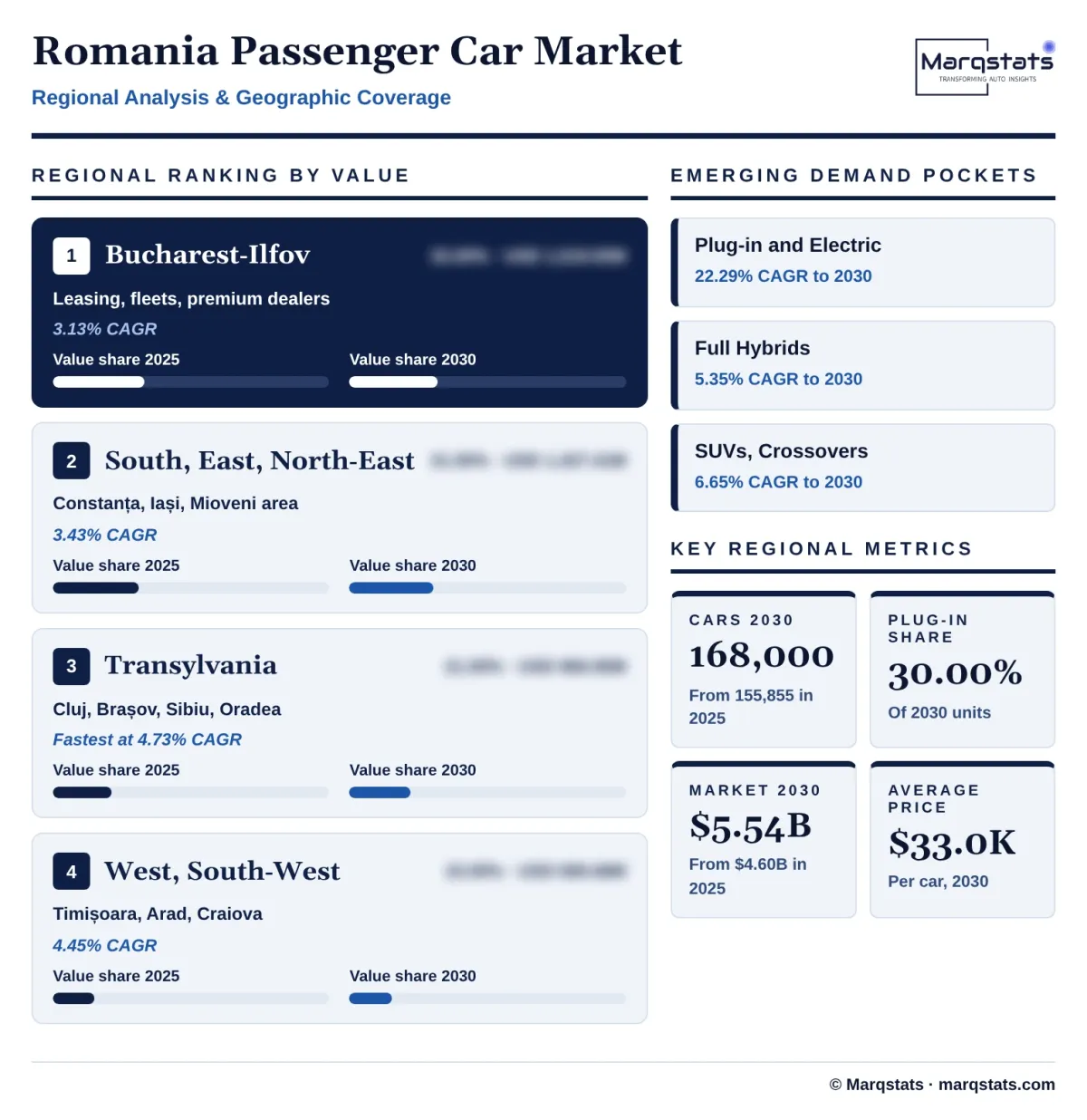
Bucharest-Ilfov accounts for 33.00% of 2025 value, USD 1,519.50 million, and grows at 3.13% a year to USD 1,772.37 million and 32.00% by 2030. Marqstats allocates value by the location of buyers and company seats, and the concentration of corporate leasing, premium dealers and high incomes in the capital gives it a share far above its population. Its share eases as buyers in other cities adopt hybrids and Chinese brands.
South, East and North-East
South, East and North-East account for 31.00% of 2025 value, USD 1,427.41 million, and grow at 3.43% a year to USD 1,689.30 million. Constanța, Iași, Galați and the Argeș county around Mioveni, where Dacia builds its cars, form a price-sensitive region where used imports and the Rabla voucher matter most for entry-level buyers.
Transylvania (North-West and Centre)
Transylvania (North-West and Centre) accounts for 21.00% of 2025 value, USD 966.95 million, and grows fastest, at 4.73% a year, to USD 1,218.51 million and 22.00% by 2030. Cluj-Napoca, Brașov, Sibiu and Oradea have higher incomes, dense dealer networks and a large technology and services workforce, which favours SUVs, hybrids and plug-in cars.
West and South-West
West and South-West account for 15.00% of 2025 value, USD 690.68 million, and grow at 4.45% a year to USD 858.50 million. Timișoara and Arad draw on Western European supply chains and cross-border commuting, and Craiova, where Ford Otosan builds the Puma, Puma Gen-E and Courier, adds a local employer base that buys cars.
How Competition Is Evolving
The market is moderately concentrated and led by one brand. Dacia delivered 29.36% of 2025 registrations, Toyota 9.25%, Renault 7.34%, Škoda 7.25% and Hyundai 6.00%, so the top five brands hold 59.20% of the market. Dacia and Renault together are Renault Group and account for 36.70%, the largest single group.
Momentum differs sharply by brand. Renault rose 26.6% in 2025, helped by the Clio, Toyota 13.9% on full-hybrid demand, Škoda 6.5% and Dacia 2.9%, while Hyundai fell 8.9%. In the Dacia range the Logan (15,299), Duster (14,065), Sandero (8,099) and Bigster (3,498) remain the four most registered Dacia models.
Chinese brands are the new competitive force. BYD entered Romania in May 2025, reached 2,140 registrations in the first half of 2026, 3,465 by August and 4,173 by September, with 4.31% of registrations and sixth place for the nine months, and fourth place among all brands in September 2026 with 708 cars and 6.4% of the month. Chery registered 2,011 and MG 1,757 in the first half.
Competition is shifting from price to access and powertrain. Importers face a market in which 55.14% of cars are electrified and diesel is under 5%, so brands with hybrid and plug-in hybrid ranges in the EUR 20,000 to 35,000 band, dealer networks beyond Bucharest and finance offers that compete with used imports are gaining share.
Companies Covered
Companies covered in the report include:
Recent Market Activity
Table of Contents
Coverage & Segmentation
The study covers the Romania passenger car market, with 2025 as the base year, 2021 – 2025 as the historical period and 2026 – 2030 as the forecast period. It covers new M1 passenger cars registered for the first time in Romania, segmented by vehicle segment, powertrain, price band and region. Values are retail transaction values including value-added tax in US dollars at EUR 1 = USD 1.13, and lei figures use the 2025 average of RON 4.4658 per US dollar.
Used cars registered for the first time after import are excluded, as are light commercial vehicles, pickups, buses, motorcycles and cars built in Mioveni and Craiova for export. Segment and regional splits are Marqstats estimates built on APIA registrations, Dacia and other list prices, and company disclosures. The live Marqstats Europe Used Car Market report measures used-car transactions, with Romania inside its Rest of Europe group, and its figures should not be added to this market.