Market Snapshot
The Kazakhstan passenger car market size is estimated at USD 5,554.92 million in 2025 and is projected to reach USD 8,384.74 million by 2030, growing at a CAGR of 8.58% over 2026 – 2030. Marqstats estimates 216,600 new M1 cars were sold through official dealers in 2025, rising to 253,000 by 2030, a 3.16% annual rate, while the average price per car climbs from about KZT 13.37 million to KZT 17.28 million as the mix moves toward crossovers, plug-in models and premium trims.
Marqstats defines the market as the retail value of new category M1 passenger cars sold in Kazakhstan through official dealer networks, including sedans, crossovers, SUVs, hatchbacks and people carriers that are assembled locally from kits or imported fully built. Value is counted at the dealer transaction price including value added tax, converted at KZT 521.34 per US dollar, the 2025 average. Light and heavy commercial vehicles, pickups, buses, used cars and grey imports are excluded.
Mainstream cars priced between KZT 10 million and KZT 18 million account for 46.96% of 2025 value, petrol and diesel cars for 96.89% of units and crossovers and SUVs for 60.94% of units. Almaty and its region account for 33.00% of value, while Shymkent and the south grow fastest, at 9.46% a year, ahead of the west at 9.35% and Astana at 9.21%.
Key Takeaways
Market Overview & Analysis
Report Summary
Marqstats sizes the Kazakhstan passenger car market as the retail value of new M1 cars sold by official dealers each year. It counts sedans, hatchbacks, crossovers, SUVs and people carriers, whether built in Kazakhstan from kits by Hyundai Trans Kazakhstan, Allur, Kia Qazaqstan and Astana Motors Manufacturing Kazakhstan or imported fully built from China, Japan, Korea, Russia and Europe. Vans, pickups, trucks, buses, used cars and cars moved across the border outside dealer networks are excluded.
Kazakhstan is the largest new car market in Central Asia by official sales, and it has become a manufacturing base rather than an import market. The KAU recorded 234,852 new vehicles sold by dealers in 2025, up 14.4% from 205,227 in 2024 and the second year above 200,000. Domestic plants built 171,144 vehicles in 2025, of which 158,944 were passenger cars, and all ten best-selling models are assembled in Kazakhstan. In December 2025 eight of every ten new vehicles sold were domestically produced.
The headline number is wider than the passenger car market. The KAU publishes a single dealer total for passenger and commercial vehicles, and its brand table includes commercial lines such as GAZ with 3,599 units. Marqstats removes commercial and non-M1 vehicles, estimated at 18,252 units, to reach 216,600 M1 cars in 2025, or 92.23% of the KAU total. A widely circulated indicator of 193,000 passenger cars is not a KAU or Bureau of National Statistics release, and Marqstats does not use it.
The market is large relative to the fleet. The Bureau of National Statistics counted 5,995.0 thousand registered vehicles on 1 June 2026 and 6,088.7 thousand on 1 September 2026, of which passenger cars were 5,105.4 thousand, or 83.9%. New M1 sales of 216,600 cars equal about 4.24% of the passenger car fleet each year, a replacement rate that implies a fleet turning over every 24 years and leaves room for renewal demand as fleet age and credit conditions change.
Prices and tax shape the mix. Kazakhstan raised value added tax from 12% to 16% on 1 January 2026 under the new Tax Code, which lifts the retail price of every car sold through a dealer, and the Ministry of Ecology and Natural Resources changed the recycling fee methodology for vehicles from Russia and Belarus from 8 May 2026 by Order No. 54. Localised models carry the price advantage: Chevrolet cut the Cobalt Optimum from KZT 8.19 million to KZT 7.29 million in June 2025, and AMMKZ models fell by 7% to 19.5% after the plant opened.
Kazakhstan Passenger Car Market Size and Forecast
The Kazakhstan passenger car market grows from USD 5,554.92 million in 2025 to USD 8,384.74 million in 2030, a CAGR of 8.58%. Volume grows at 3.16% a year, from 216,600 to 253,000 cars, and the average price per car grows at 5.26% a year, from about USD 25,646 to USD 33,141. All values use the 2025 average of KZT 521.34 per US dollar for every year, so the forecast shows real volume and mix effects and the tenge price inflation inside them, not a currency view.
The 2025 value is built bottom-up from price segments. Marqstats estimates about 90,000 economy cars at an average of KZT 8.2 million, 100,000 mainstream cars at KZT 13.6 million and 26,600 premium cars at KZT 30.0 million, including value added tax. The economy anchor is the Chevrolet Cobalt, which started at KZT 6.7 million in January 2026 and sold 31,802 units in 2025, with the Chevrolet Onix at KZT 6.99 million for the base manual version. The mainstream anchors are the Changan CS55 Plus at KZT 9.89 million to KZT 11.09 million and the Chevrolet Tracker at KZT 9.99 million, rising to the Hyundai Tucson and Kia Sportage, whose launch ranges ran from KZT 12.49 million to KZT 19.0 million.
The average price of KZT 13.37 million per M1 car is consistent with the KAU figure of KZT 16.1 million for the average new vehicle in the first half of 2025, because the KAU average covers commercial vehicles, pickups and premium SUVs that lift it above the passenger car mix. The base is also checked against supply: Kazakh plants built 158,944 passenger cars in 2025, and Marqstats estimates about 70% of M1 retail units were locally assembled, with the rest imported from China, Japan, Korea, Russia and Europe.
Growth in 2026 is modest in volume and stronger in value. KAU data show 165,678 dealer sales in January to September 2026, up 2.6%, and Marqstats expects 2026 M1 sales of 222,000 cars, up 2.49%, with value of USD 5,989.82 million, up 7.83%. Auto loan issuance fell 17.7% in value in the first quarter of 2026 as the weighted average rate rose to 24.3%, which is why Marqstats holds volume growth near 3.16% a year and lets price and mix carry the value forecast.
Marqstats tracks four indicators to monitor the forecast: monthly KAU dealer sales by brand, domestic passenger car output reported by the Bureau of National Statistics, the average car loan and approval rate reported by the national financial regulator, and the recycling fee and value added tax rules that set the landed cost of imported cars.
Market Dynamics
Key Drivers
Five forces are lifting demand for new cars in Kazakhstan even as the fiscal rules around them tighten.
- Local assembly lowers prices. The AMMKZ plant in Almaty opened in September 2025 with a capacity of 120,000 units a year for Chery, Changan and Haval, and prices of those models fell 7% to 15% from 16 September 2025. KAU data show Changan sales up 104.2% to 15,645 units in January to September 2026, so each new local line pulls demand away from imports.
- A large, ageing fleet needs renewal. The Bureau of National Statistics counted 5,105.4 thousand passenger cars on 1 September 2026, and 28% of passenger cars registered in August 2026 were more than 20 years old. New M1 sales equal only about 4% of the fleet a year, so even slow income growth keeps replacement demand high.
- A broad choice of models at KZT 7 million to KZT 12 million. The Chevrolet Cobalt from KZT 6.7 million, the Chevrolet Onix at KZT 6.99 million and the Changan CS55 Plus from KZT 9.89 million give first-time and fleet buyers new, locally built cars at a price that keeps the economy and mainstream segments at 72.44% of value.
- Industrial policy backs production. Kazakh plants built 171,144 vehicles in 2025, up from 145,290 in 2024, and the Kazakhstan Automobile Union expects about 209,000 in 2026. Kia Qazaqstan began production in Kostanay in 2025, GAC is starting local production in Kostanay and Li Auto production is planned at the Allur plant, which widens the choice of locally built models.
- Electrified models are arriving. Dealer sales of electric and plug-in cars rose from 1,083 in 2024 to 4,242 in 2025 and 3,657 in the first half of 2026, with BYD selling 2,042 of them. Charging stations rose from 300 to 800 during 2025, which lowers the range barrier in Almaty and Astana.
Key Restraints
Four constraints hold back volume growth and push the market toward higher prices rather than more cars.
- Credit is tight and costly. The national financial regulator reported that the weighted average consumer loan rate rose from 14.8% to 24.3% over the year to the first quarter of 2026, and car loan issuance fell 17.7% in value to KZT 397.7 billion. The average car loan is KZT 6.7 million, enough to fund an economy car but not the KZT 14 million to KZT 19 million Hyundai Tucson or Kia Sportage.
- Tax rises lift the sticker price. Value added tax rose from 12% to 16% on 1 January 2026 under the new Tax Code, adding about 3.6% to every dealer price, and a 16% rate also applies to electric cars from 2026. Dealers can absorb part of it on locally built models, but imports cannot.
- Import rules are tighter. Order No. 54 of the Minister of Ecology and Natural Resources, dated 20 March 2026, changed the recycling fee calculation for vehicles from Russia and Belarus from 8 May 2026, and the Industry Minister said in March 2026 that Kazakhstan was mirroring Russian increases. Buyers of Russian-built models such as Lada face less predictable prices.
- Price competition cuts margins. Chevrolet cut the Cobalt Optimum by KZT 900,000 in June 2025, and AMMKZ models fell by up to 19.5%. Hyundai lost 22.7% of units in the first nine months of 2026, so incumbents defend share with discounts, and distributor parts stocks grew, with the Chery parts warehouse up 47% and GWM parts stocks more than doubled.
Key Trends
Four shifts are changing who builds, sells and buys new cars in Kazakhstan.
- Chinese brands take the lead. KAU data put Chinese brands at 39% of 2025 dealer sales, unchanged from 2024, and a reported 56.2% in June 2026. Changan, Haval, Chery, Jetour, Geely, JAC, GAC, MG and Soueast now compete on price and local build, and MG and Soueast appeared in official statistics for the first time in the first half of 2026.
- Localisation becomes the main competitive lever. Allur, Hyundai Trans Kazakhstan, Kia Qazaqstan and AMMKZ together built 158,944 passenger cars in 2025, and distributors now compete on how many models are made in Kazakhstan, how fast parts arrive and how much a local line cuts the price.
- Plug-in hybrids and range extenders outsell pure electric cars. Of 3,657 electrified cars sold by dealers in the first half of 2026, 2,640 were plug-in hybrids or range extenders and 1,017 were battery-electric, led by the BYD Song Plus DM-i with 737 units and the Geely Galaxy EX5 with 655.
- Crossovers keep taking share from sedans. The Chevrolet Cobalt remains the best-selling model, but Tucson, Sportage, Mufasa, Santa Fe, CS55 Plus and JAC S3 Pro fill the rest of the top ten, and Marqstats expects crossovers and SUVs to reach 63.24% of units by 2030.
Strategic Implications
- For automakers outside Kazakhstan, the route to volume is a kit supply and assembly deal with Astana Motors, Allur, Hyundai Trans Kazakhstan or a new Kostanay partner. Importing fully built cars still works for premium and electrified models, but economy and mainstream cars compete with local prices that fell by 7% to 19.5% in a single year.
- For incumbent brands, share now follows the localisation calendar. Hyundai lost 22.7% in nine months because Changan, Haval and Chery cut prices first, and a defender needs a locally built model priced under KZT 12 million, not a discount on a KZT 15 million crossover.
- For dealers and distributors, stock discipline matters more than reach. Rising inventories and parts stocks at Chery, Changan and GWM show that supply has run ahead of 2.6% market growth, and dealers with credit partners and used-car trade-in programmes will protect margins best.
- For lenders and leasing companies, a 24.3% average rate and a KZT 6.7 million average loan mean the addressable customer is the economy and entry mainstream buyer. Subsidised or captive finance on Cobalt, Onix and CS55 Plus class cars is the largest unmet need.
- For suppliers and investors, the forecast supports Tier 2 investment in wiring, seating, glass and plastics near Almaty and Kostanay, because every extra local model raises assembly volume, and the electrified segment justifies charging and battery service capacity in Almaty, Astana and Shymkent first.
Market Segmentation
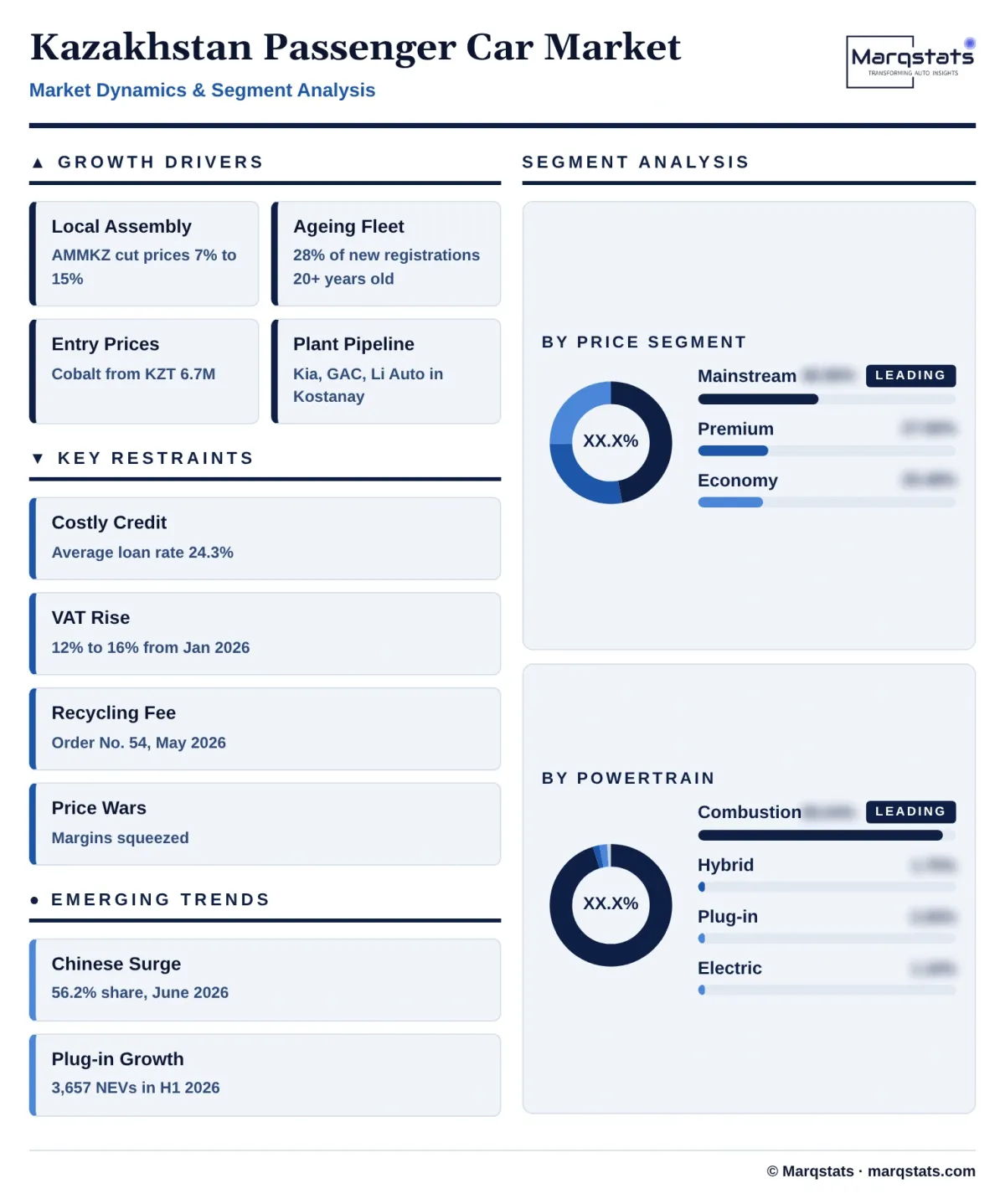
Economy cars account for 25.48% of 2025 value, USD 1,415.58 million, and grow at only 2.95% a year to USD 1,637.32 million and 19.53% of the market. Marqstats estimates about 90,000 units in 2025, led by the Chevrolet Cobalt at 31,802 and the Chevrolet Onix at 5,732, with the Chery Tiggo 2 at 5,278, the JAC S3 Pro at 5,127 and Lada, Kia Soluto and budget Changan models. Volume stays flat at about 88,000 units because buyers trade up as soon as credit allows.
Mainstream cars lead value, with 46.96% of 2025 value, USD 2,608.67 million, and grow at 8.25% a year to USD 3,876.93 million. About 100,000 units were sold in 2025, among them the Hyundai Tucson at 20,697, the Kia Sportage at 10,988, the Hyundai Mufasa at 8,203, the Hyundai Elantra at 7,867 and the Changan CS55 Plus at 5,558. Marqstats expects 124,000 units by 2030 as local Chinese crossovers move into this band.
Premium cars grow fastest, at 13.40% a year, from USD 1,530.67 million, 27.56% of 2025 value, to USD 2,870.49 million and 34.23% in 2030. The band holds the Hyundai Santa Fe at 5,764, Toyota and Lexus, which sold 11,338 and 3,057 units in 2025 in all categories, BYD at 3,245, Land Rover and other European premium brands. Marqstats estimates 26,600 units in 2025 and 41,000 in 2030 as plug-in hybrids and large crossovers gain share.
Internal combustion cars account for 95.04% of 2025 value, USD 5,279.01 million, and 96.89% of units, and grow at 4.25% a year to USD 6,500.98 million while their share of units falls to 84.98%. Petrol dominates; the Cobalt, Tucson and Sportage all run on petrol engines, and diesel is a small share.
Conventional hybrids account for 1.75% of 2025 value, USD 97.48 million, and grow at 39.53% a year to USD 515.54 million and 4.35% of units. Toyota leads, with the Camry selling 274 hybrid units in the first four months of 2026 and 765 hybrids by Toyota in the first half, and Lexus and Hyundai add volume. KAU does not count conventional hybrids in its new-energy total, so Marqstats estimates 2,500 units in 2025.
Plug-in hybrids and range extenders account for 2.05% of 2025 value, USD 114.10 million, and grow at 51.13% a year to USD 899.55 million and 6.72% of units. KAU recorded 2,640 plug-in and range-extender sales in the first half of 2026, led by the BYD Song Plus DM-i at 737, the Geely Galaxy EX5 at 655 and the Li Auto L6 at 340. Marqstats estimates 2,592 units in 2025.
Battery-electric cars account for 1.16% of 2025 value, USD 64.33 million, and grow at 48.76% a year to USD 468.67 million and 3.95% of units. KAU recorded 1,017 battery-electric sales in the first half of 2026. The Bureau of National Statistics counted 32,479 electric vehicles in the fleet on 1 June 2026, 17,506 of them in Almaty, and Marqstats estimates 1,650 new units in 2025.
Crossovers and SUVs account for 68.73% of 2025 value, USD 3,818.12 million, and 60.94% of units, and grow at 9.23% a year to USD 5,936.57 million and 63.24% of units. The Tucson, Sportage, Mufasa, Santa Fe, CS55 Plus, Tiggo and Jolion families anchor the body type, and Marqstats estimates 132,000 units in 2025.
Sedans account for 28.27% of 2025 value, USD 1,570.22 million, and grow at 6.97% a year to USD 2,199.71 million. The Chevrolet Cobalt, Onix, Hyundai Elantra, Kia Soluto and Toyota Camry hold the body type, which Marqstats estimates at 76,000 units in 2025, with the Cobalt alone equal to 41.85% of them.
Hatchbacks, people carriers and other M1 bodies account for 3.00% of 2025 value, USD 166.58 million, and grow at 8.32% a year to USD 248.46 million. Marqstats estimates 8,600 units in 2025, mostly compact hatchbacks, Lada models and seven-seat family vehicles.
By Geography
Almaty City and Almaty Region
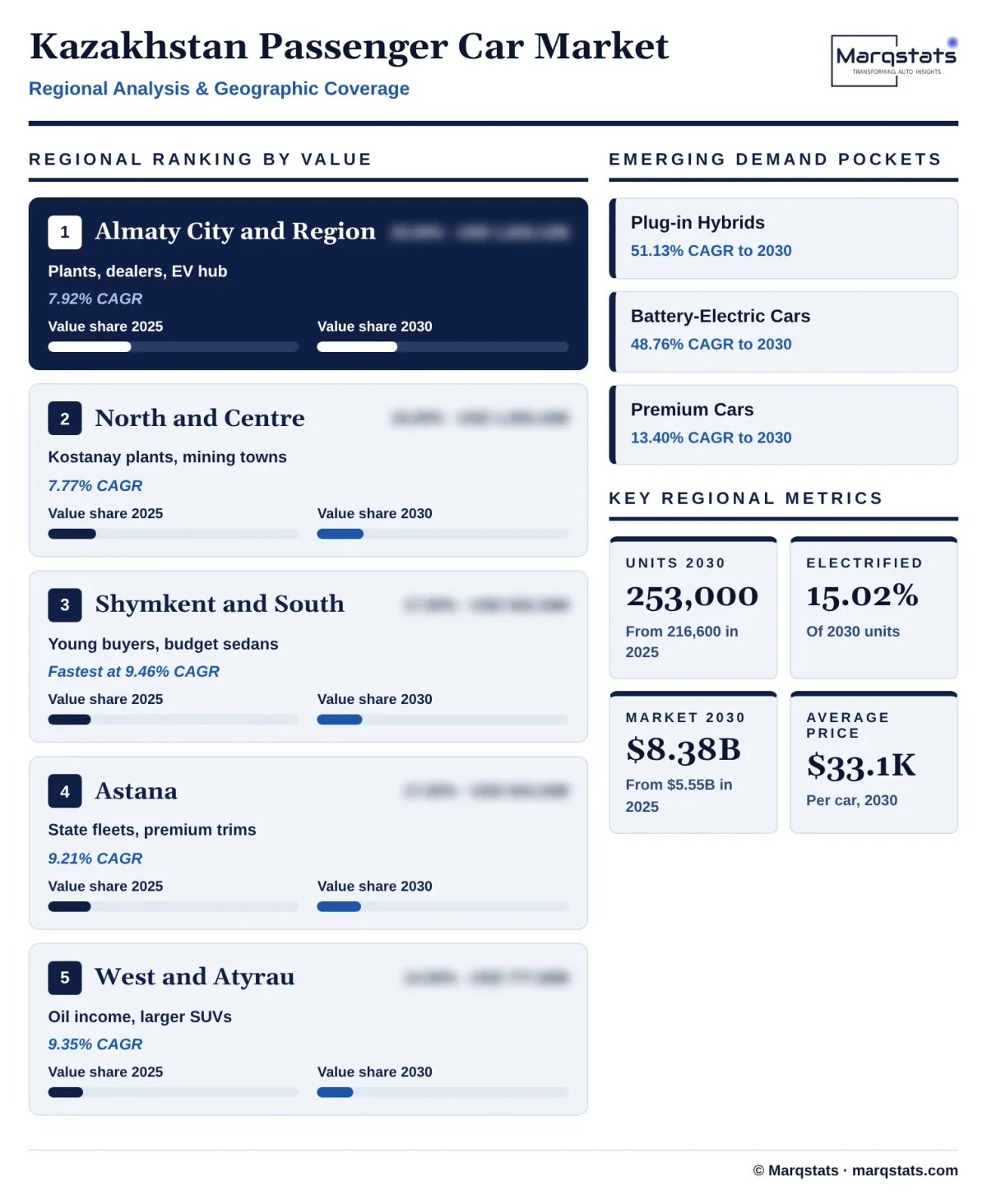
Almaty city and region lead with 33.00% of 2025 value, USD 1,833.12 million, and grow at 7.92% a year to USD 2,683.11 million and 32.00% by 2030. Almaty city held about 614 thousand registered vehicles, Almaty Region about 523 thousand and Zhetisu about 89 thousand in early 2026, Almaty had 17,506 of the 32,479 electric vehicles, and the AMMKZ and Hyundai Trans Kazakhstan plants sit in the Almaty industrial zone. Marqstats allocates value by buyer location, not by corporate registration address.
Astana
Astana accounts for 17.00% of 2025 value, USD 944.34 million, and grows at 9.21% a year to USD 1,467.33 million and 17.50% by 2030. The capital held about 394 thousand registered vehicles and 3,235 electric vehicles, and ministries, state companies and executive fleets buy higher-priced Toyota, Hyundai and Kia models, which lifts the average price above the national mean.
Shymkent and the South
Shymkent and the south, covering Shymkent, Turkestan, Zhambyl and Kyzylorda, account for 17.00% of 2025 value, USD 944.34 million, and grow fastest, at 9.46% a year, to USD 1,484.10 million and 17.70% by 2030. Turkestan Region held about 427 thousand registered vehicles, a young and fast-growing population buys the Chevrolet Cobalt and Onix first, and Shymkent had 1,042 electric vehicles in June 2026, so charging remains thin.
North and Centre
The north and centre, covering Kostanay, Akmola, Karaganda, Pavlodar, North Kazakhstan, Abai, East Kazakhstan and Ulytau, account for 19.00% of 2025 value, USD 1,055.43 million, and grow at 7.77% a year to USD 1,534.41 million and 18.30% by 2030. Kostanay hosts the Allur and Kia Qazaqstan plants, which built 92,100 and 2,885 vehicles in 2025, yet local production does not guarantee local share because most buyers in the region live in mining and farming towns that favour four-wheel-drive crossovers.
West and Mangystau-Atyrau
West and Mangystau-Atyrau, covering Atyrau, Mangystau, Aktobe and West Kazakhstan, account for 14.00% of 2025 value, USD 777.69 million, and grow at 9.35% a year, to USD 1,215.79 million and 14.50% by 2030. Oil and gas incomes support larger crossovers and premium trims, and Marqstats assumes a higher average price per car in the region for that reason.
How Competition Is Evolving
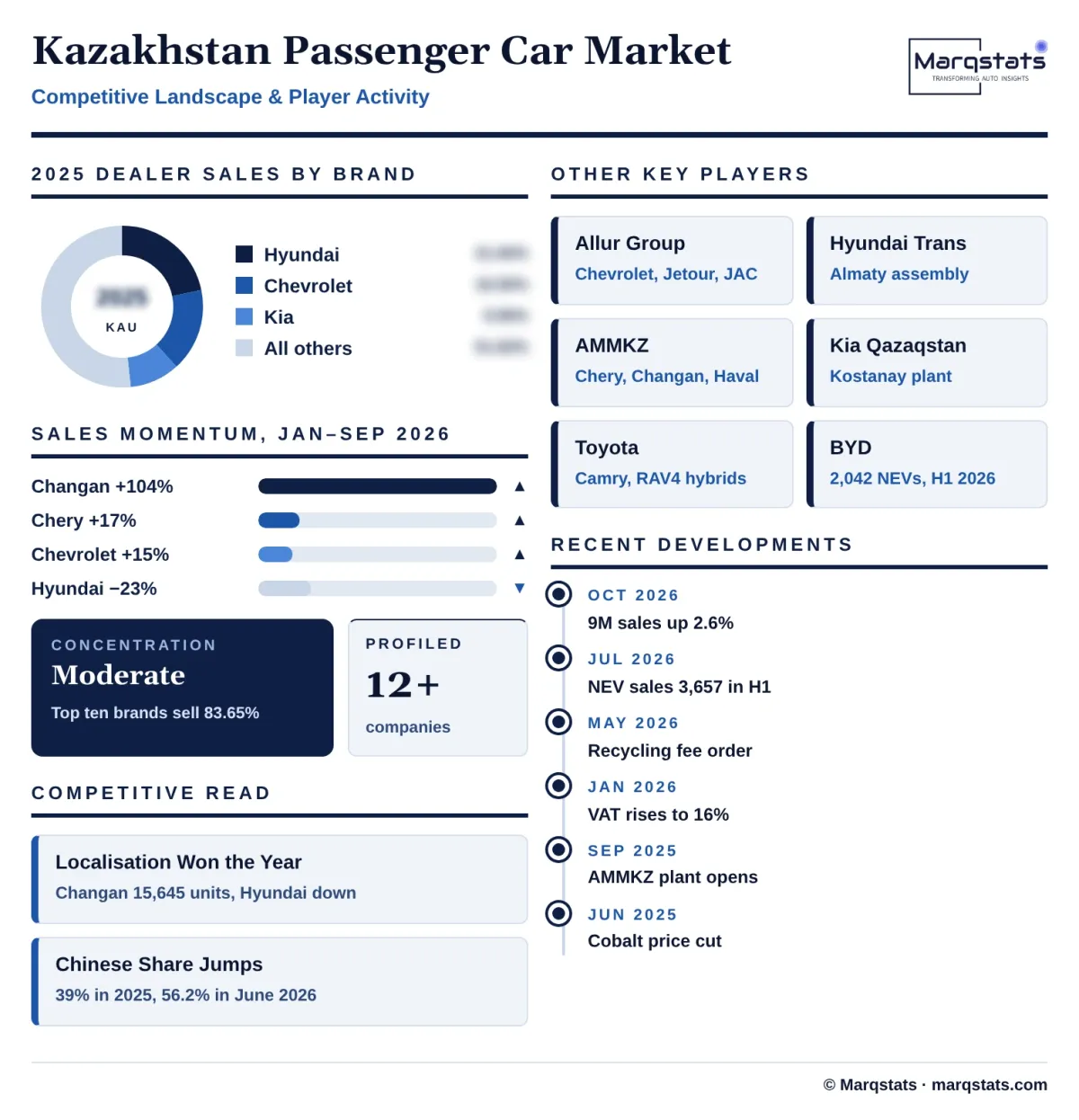
The market is concentrated and led by Hyundai, Chevrolet and Kia, with Chinese brands closing fast. The KAU table for 2025 puts Hyundai first with 50,868 units, 21.66% of the 234,852 dealer total, Chevrolet second with 38,880 units, 16.56%, and Kia third with 23,402 units, 9.96%. The top ten brands sold 196,464 units, 83.65% of the total, and these figures cover all vehicle types, so they overstate the share of each brand in the M1 market where commercial lines such as GAZ are present.
Hyundai leads by volume but is losing share. Hyundai Trans Kazakhstan in Almaty built 52,040 vehicles in 2025, and the Tucson sold 20,697 units, the Mufasa 8,203, the Elantra 7,867 and the Santa Fe 5,764. In January to September 2026 Hyundai sold 27,495 units, down 22.7%, while Chevrolet sold 26,272, up 14.7%, and Kia 18,964, up 7.8%, so Chevrolet took first place in the first half of 2026 with 17,586 units against 17,247 for Hyundai.
Chinese brands compete through localisation. Chery sold 14,570 units, Jetour 14,507, Haval 11,688, Changan 11,260, JAC 10,330 and Geely 9,621 in 2025, and in January to September 2026 Changan reached 15,645, Chery 11,994 and Haval 9,656. Allur assembles Jetour and JAC models in Kostanay, while AMMKZ assembles Chery, Changan and Haval and built 15,180 vehicles in the four months after opening.
Competition is shifting from price to access. With the market up only 2.6%, distributors now fight on localised models, parts availability and financing. Changan cut container delivery times from China from 70 days to 43 days, Chery and GWM increased parts stocks, and new entrants such as MG with 713 units and Soueast with 520 units in the first half of 2026 show that Chinese groups are adding brands, not only models.
Companies Covered
Companies covered in the report include:
Recent Market Activity
Table of Contents
Coverage & Segmentation
The study covers the Kazakhstan passenger car market, with 2025 as the base year, 2024 as the comparison year and 2026 – 2030 as the forecast period. It covers new category M1 cars sold through official dealers, sedans, hatchbacks, crossovers, SUVs and people carriers, built in Kazakhstan from kits or imported fully built, segmented by price segment, powertrain, body type and region. Values are retail dealer transaction prices including value added tax, in US dollars at KZT 521.34 per US dollar, the 2025 average. The scope ladder runs from 234,852 KAU dealer sales of all vehicle types, less 18,252 Marqstats-estimated vans, pickups, trucks and buses, to 216,600 M1 cars.
Light and heavy commercial vehicles (N1, N2, N3), buses (M2, M3), used cars, grey imports and cars sold outside dealer networks are excluded. Segment and regional splits are Marqstats estimates built on KAU brand and model sales, plant output and published price lists. The live Marqstats Kazakhstan EV Maintenance Market report covers servicing of battery-electric and plug-in vehicles, not new car sales, and its figures should not be added to this market.