Market Snapshot
The Thailand bus and coach market size is estimated at USD 714.09 million in 2025 and is projected to reach USD 900.58 million by 2030, growing at a CAGR of 4.75% over 2026 – 2030. New bus registrations rise from 5,971 to 7,000 a year, a 3.23% annual rate, while the average value per bus climbs from about USD 119,593 to USD 128,654 as electric 12 metre city buses take a larger share of the mix.
Marqstats defines the market as the delivered value of new buses and coaches first registered with the Department of Land Transport (DLT) in its scheduled, non-scheduled and private bus categories, whether imported complete, built on imported chassis with a Thai body, or assembled from kits. Value is counted at the price paid by the operator or lessor, including the body and fitted equipment, before value added tax, registration fees and finance charges. Passenger vans registered under the Motor Vehicle Act, trucks, rail rolling stock, tuk-tuks and used buses are excluded.
Heavy buses and coaches of 10 metres and above account for 53.54% of 2025 value, diesel buses for 87.77% and non-scheduled tour, charter and contract services for 61.33%. The Bangkok Metropolitan Region accounts for 47.00% of value, and battery-electric buses grow fastest, at 44.61% a year, as the 1,520-bus lease of the Bangkok Mass Transit Authority (BMTA) is delivered from March 2027.
Key Takeaways
Market Overview & Analysis
Report Summary
Marqstats sizes the Thailand bus and coach market as the delivered value of new buses and coaches that enter the national fleet each year. The unit of count is the first registration recorded by the Department of Land Transport under the Land Transport Act B.E. 2522 in three categories: scheduled route buses, non-scheduled buses for hire and private buses. Heavy buses and coaches of 10 metres and above, medium buses of 8 to 10 metres and minibuses below 8 metres are all counted, whether delivered complete, built on an imported chassis with a Thai body, or assembled from kits.
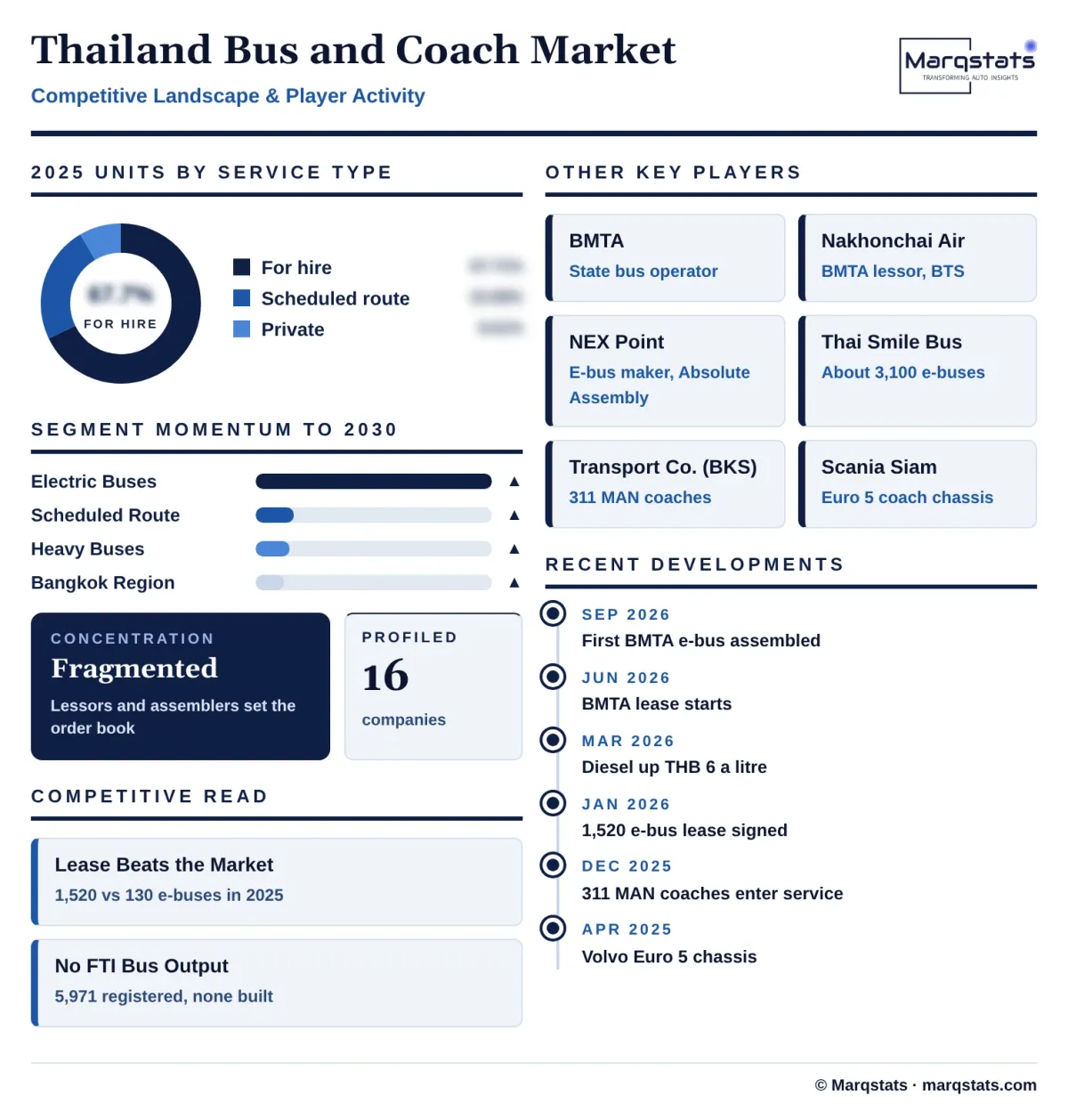
The fleet is large and ageing. At the end of 2024 the DLT register held 57,889 non-scheduled buses, 24,543 scheduled route buses in category 4 and 13,974 private buses, a total of 96,406 in these three categories. First registrations of 5,971 in 2025 equal 6.19% of that stock, which implies a replacement cycle of about 16.1 years, long enough to explain why the state and large coach operators have started to retire vehicles on contract rather than wait for them to fail.
Buses are not built in the plants of the automotive industry. FTI production statistics for 2025 show total vehicle output of 1,455,569 units, 893,921 one-tonne pickups and 11,192 trucks above 5 tonnes, and no buses. The bus market is therefore served by chassis supplied by Scania, Volvo, MAN, Hino and Isuzu and fitted with Thai bodies, by chassis kits assembled by Thai bodybuilders, and by electric buses assembled at Absolute Assembly in Chachoengsao from imported components. This is also why registrations, not production, are the right measure of the domestic market.
Passenger vans are a separate market. The DLT registered 19,980 private passenger cars with more than seven seats under the Motor Vehicle Act in 2025, 3.35 times the number of buses, and these Toyota Commuter type vans, used for shuttles and informal feeder services, are excluded. Trucks are also excluded: the DLT first-registered 58,700 non-scheduled and private trucks in 2025, and they sit in the Marqstats Thailand truck and pickup truck reports.
The market was volatile in the years after the pandemic. Marqstats estimates about 3,900 buses in 2021, worth USD 427.68 million, when tourism was closed. The DLT recorded 5,015 first registrations in 2022, 8,242 in 2023 as Thai Smile Bus added its second wave of electric buses, 6,072 in 2024 and 5,971 in 2025. At the 2025 average rate of THB 33.74 per US dollar, the market was worth USD 564.82 million in 2022, USD 1,001.55 million in 2023, USD 716.26 million in 2024 and USD 714.09 million in 2025, equal to about THB 24.09 billion.
Thailand Bus and Coach Market Size and Forecast
The Thailand bus and coach market grows from USD 714.09 million in 2025 to USD 900.58 million in 2030, a CAGR of 4.75%. Volume contributes most of the growth: registrations rise at 3.23% a year, from 5,971 to 7,000 buses, and the average value per bus rises at 1.47% a year, from about USD 119,593 to USD 128,654, as heavy buses and electric buses take a larger share of units.
The path is not smooth. Marqstats expects 6,100 registrations in 2026, worth USD 736.72 million, a rise of 3.17%, after the DLT recorded 1,091 first registrations in January and February 2026. The market then jumps to 7,800 buses and USD 1,008.77 million in 2027, a rise of 36.93%, when the BMTA takes 500 buses by the end of March, 500 in April and 520 in late May. It falls back to USD 894.94 million in 2028 and USD 868.87 million in 2029 and recovers to USD 900.58 million in 2030, so the five-year CAGR understates the size of the 2027 peak.
The 2025 value is built bottom-up from classes and prices. Marqstats estimates 2,150 heavy buses at about THB 6.00 million (USD 177,830) each, 1,850 medium buses at THB 3.60 million (USD 106,698) and 1,971 minibuses at THB 2.30 million (USD 68,168), valued at the operator or lessor price including the body and before value added tax. A price of about THB 5.50 million for a 12 metre electric city bus is consistent with the THB 6 billion project cost reported for up to 1,200 electric buses of Energy Absolute, which is THB 5.00 million a bus at the time of the December 2023 financing.
Electric buses add value faster than volume. Marqstats expects battery-electric registrations to move from 130 in 2025 to 1,900 in 2027 and 780 in 2030, so their share of units rises from 2.18% to 11.14%. Natural gas buses fall from 520 to 180 units. Electric buses are priced at about 1.30 times the diesel average because nearly all are 12 metre city buses, which lifts their share of value to 13.98% in 2030.
Marqstats tracks four indicators to monitor the forecast: monthly DLT first registrations of scheduled and non-scheduled buses, the delivery pace of the BMTA lease from the Absolute Assembly plant, the approval of the second BMTA phase of 800 electric buses, and the diesel price after the increase of THB 6 a litre on 26 March 2026. Phase two is included at 500 buses in 2028 because approval from the House of Representatives is still pending.
Market Dynamics
Key Drivers
Five forces are lifting demand for new buses and coaches in Thailand, led by public fleet renewal and the fuel price shock of 2026.
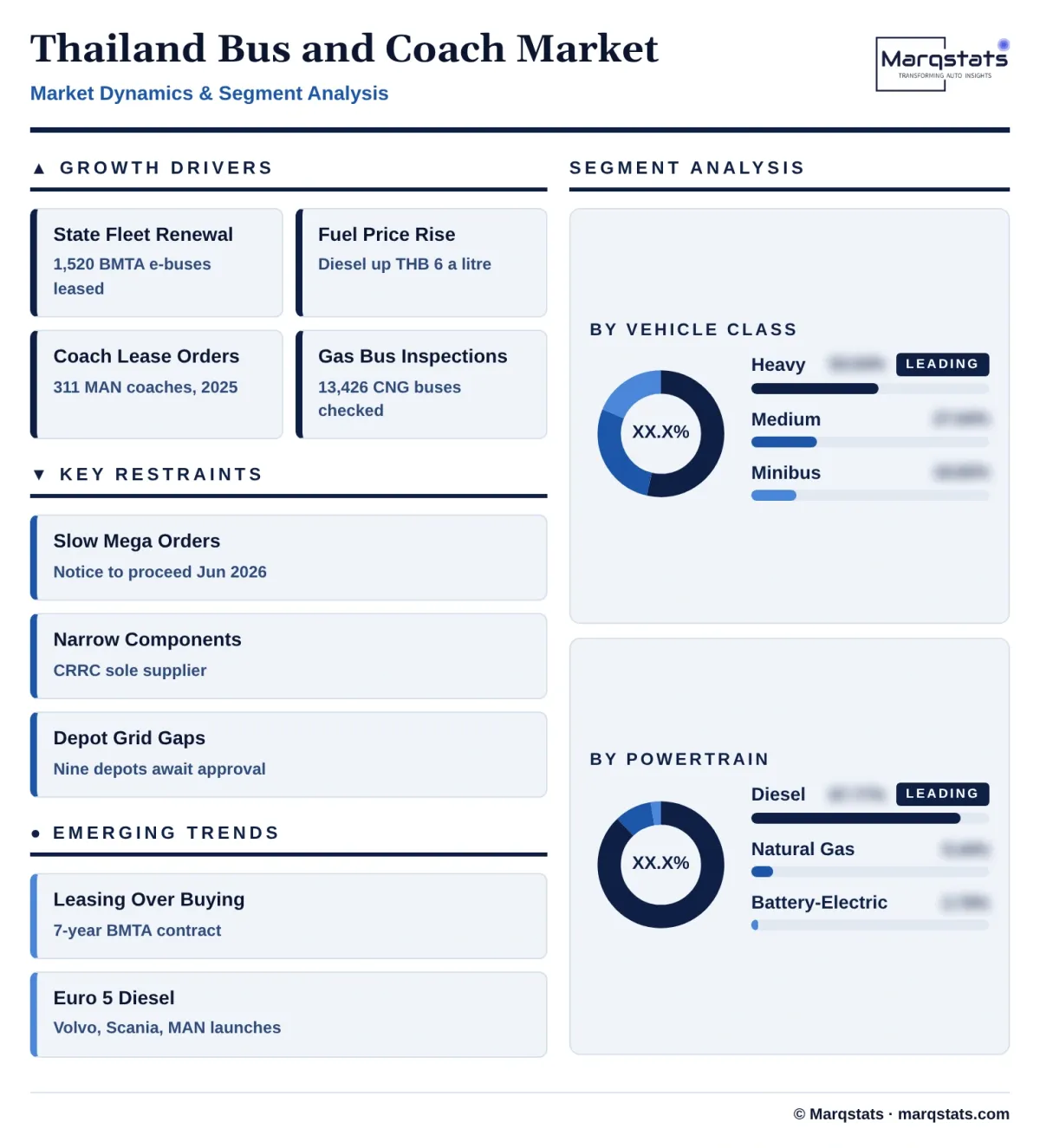
- State fleet renewal sets the pace. The BMTA signed a seven-year lease for 1,520 air-conditioned electric buses with Nakhonchai Air on 29 January 2026, replacing the same number of non-air-conditioned buses, with 500 buses due by the end of March 2027, 500 in April and 520 in late May. A second phase of 800 buses, with a budget above THB 8 billion, awaits approval, and the Transport Minister wants all 3,465 interprovincial buses leaving Bangkok to be electric by 2029. Royal Decree No. 798 of 9 September 2025 adds a corporate income tax deduction of 200% of the price of domestically made or assembled large electric buses and trucks, against 150% for imported ones, for contracts dated between 27 March and 31 December 2025, and the Cabinet draft estimated about 10,000 vehicles, of which 6,000 buses.
- Fuel prices favour electric buses. The diesel price rose by THB 6 a litre on 26 March 2026, and The Ministry of Transport cites operating cost of about THB 40 a kilometre for diesel and THB 20 for electric buses, and BMTA estimates total savings above THB 4 billion a year from maintenance, fuel and staff. Higher diesel prices lift the case for electric buses at city operators and for newer, more efficient Euro 5 diesel buses elsewhere.
- Long-distance coach operators are renewing fleets. The Transport Company Limited leased 311 MAN Lion's Coach buses with Euro 5 engines from Itthiphon Import under a five-year contract, delivered in four lots between September and December 2025 to replace expired leases and retired vehicles. The 311 leased buses compare with the 254 buses the company operated when the contract was signed, and the lease model is likely to spread to other coach operators.
- Safety rules push out old gas buses. After the fire of 1 October 2024 on a gas-fuelled school bus that killed 23 people, the DLT ordered inspection of cylinders on buses fuelled by compressed natural gas, a fleet of about 13,426 passenger buses, and the transport ministry explored limits on the years a bus can stay in service. Operators that cannot pass inspection or insure old gas buses replace them with diesel or electric vehicles.
- Tourism and contract services sustain non-scheduled demand. Non-scheduled buses are the largest category of the register, with 57,889 vehicles at the end of 2024 and 4,043 first registrations in 2025, serving tour groups, schools, factories and event transport, and operators renew them as the vehicles age.
Key Restraints
Four constraints keep registrations close to 2025 levels outside the years of the large state leases.
- Large orders are concentrated and slow. The BMTA lease waited four months between contract signature and notice to proceed on 4 June 2026, the first components for 40 buses reached Chachoengsao only on 30 August 2026, and the second phase of 800 buses still needs parliamentary approval, so any slippage moves several hundred buses between years.
- Component supply is narrow. CRRC became the only supplier of components for the BMTA buses after Foton withdrew from the supply of 1,000 buses, and the plant of Absolute Assembly is rated at 15 buses a day against a BMTA minimum plan of 12 a day. A supply interruption affects the largest order in the market.
- The depot grid is not ready. BMTA operates 12 depots, of which only the first three, at Chiang Rak, Khet Samut Prakan and Khlong Bang Phai, start construction of charging systems by the end of October 2026 at about THB 190 million, and the other nine, at over THB 400 million, await approval from a new board. The union warns that charging investments on leased land are a financial risk.
- Private buyers delay electric buses. Krungsri Research counted only 101 electric bus registrations from January to September 2025, 2.9% of new bus registrations, down 64.1% from a year earlier, because charter and tour operators face higher upfront prices, uncertain resale values and few public chargers on intercity routes.
Key Trends
Four shifts are changing who buys buses, what powers them and where they are built.
- Leasing replaces buying. The BMTA lease runs seven years, the Transport Company Limited lease runs five, and the Ministry of Transport has proposed leasing 800 buses from Thai Smile Bus as a stopgap, so lessors such as Nakhonchai Air and Itthiphon Import now decide which buses are bought.
- Chinese electric components feed Thai assembly. Absolute Assembly, owned 55% by Energy Absolute and 45% by NEX Point, assembles the BMTA buses with CRRC components, and the plant has a stated capacity of 3,000 to 9,000 vehicles a year, so Thailand assembles electric buses locally while FTI member plants build none.
- Euro 5 arrives on diesel buses. Thailand introduced Euro 5 fuel standards in January 2024, Scania Siam launched Euro 5 buses in March 2024, Volvo Bus Thailand released a Euro 5 chassis in April 2025, and the MAN coaches of the Transport Company Limited were described as the first Euro 5 coaches in Thailand.
- Intercity routes become the next electric target. The Transport Minister wants all buses leaving Bangkok on interprovincial routes, 3,465 vehicles covering 2.2 million kilometres a day, to be electric by 2029, which would move electric demand from city buses to coaches.
Strategic Implications
- For bus chassis makers, the practical route into Thailand is a kit or chassis supply deal with a Thai bodybuilder or an assembler such as Absolute Assembly. Complete imports are rare, FTI member plants build no buses, and the largest orders go to lessors that contract a local assembler.
- For bodybuilders, the shift to lessors and to electric buses changes what they sell. Monocoque bodies, roof-mounted battery packs and high-voltage systems are now part of the specification, and a plant that can build 15 buses a day wins state contracts that smaller builders cannot serve.
- For operators, the lease is the main financing decision. A seven-year lease that includes maintenance and charging, such as the BMTA contract of about THB 15 billion, shifts residual value and repair risk to the lessor, and private coach operators with weak balance sheets can use the same model.
- For energy and charging providers, the 12 BMTA depots are a defined market. Nine depots await approval at over THB 400 million, charging takes about three hours a bus mainly between 22:00 and 04:00, and depot grid upgrades decide how fast deliveries can be accepted.
- For investors in used bus and parts businesses, a fleet of 96,406 registered buses in three categories and a replacement cycle of about 16 years means steady demand for refurbishment, components and remarketing of retired diesel and gas buses.
Market Segmentation
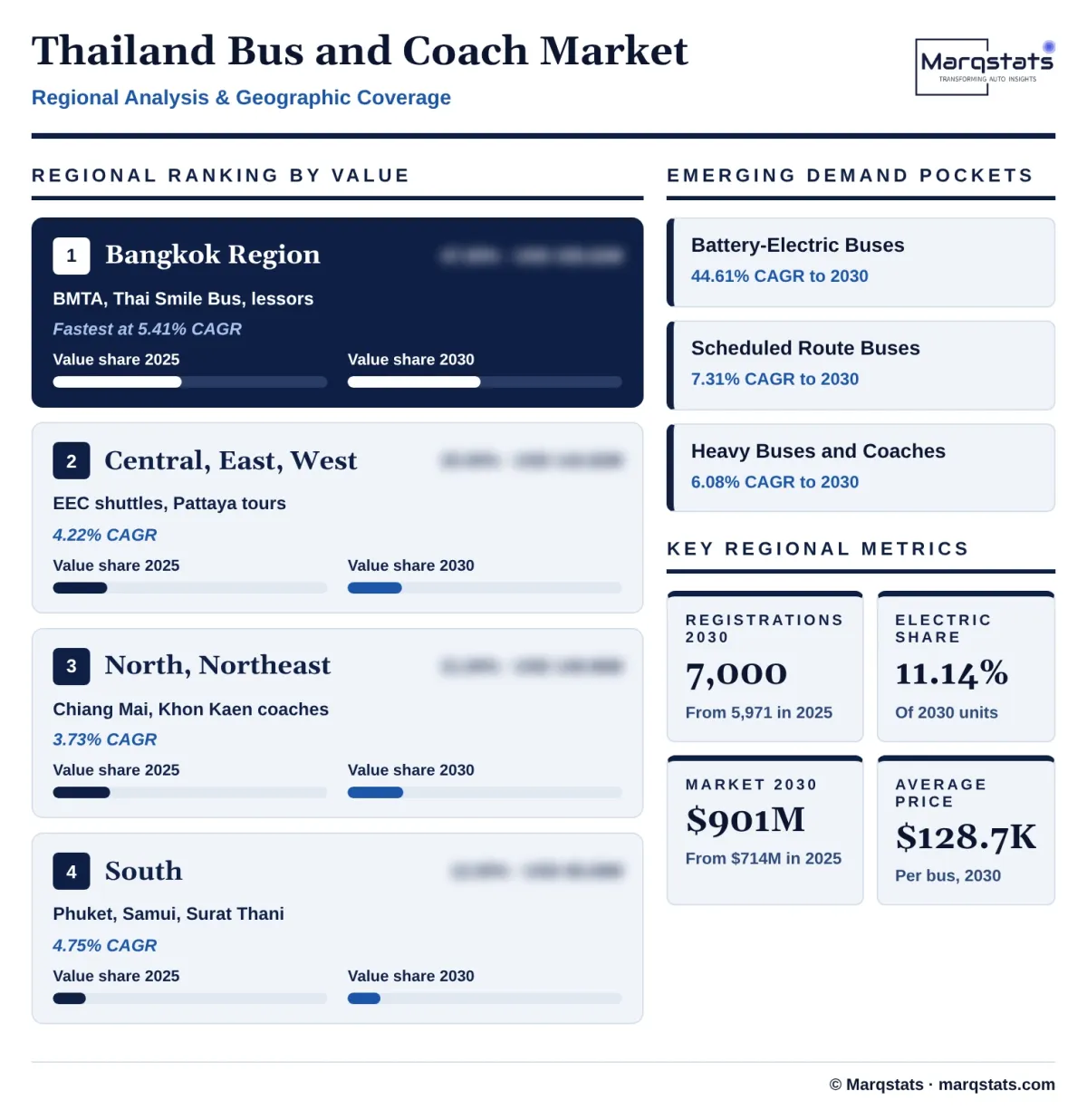
Heavy buses and coaches of 10 metres and above account for 53.54% of 2025 value, USD 382.34 million, and grow at 6.08% a year to USD 513.49 million and 57.02% of the market. Marqstats estimates 2,150 units in 2025 at about THB 6.00 million each, covering 12 metre city buses, intercity coaches such as the MAN Lion's Coach and Scania and Volvo coach chassis. The 1,520 BMTA buses fall in this class and lift units to 3,750 in 2027.
Medium buses of 8 to 10 metres account for 27.64% of 2025 value, USD 197.39 million, and grow at 3.90% a year to USD 238.96 million. Marqstats estimates 1,850 units in 2025 at about THB 3.60 million each, mostly Hino and Isuzu chassis with Thai bodies used as school buses, staff buses, provincial route buses and short-haul charter vehicles.
Minibuses below 8 metres account for 18.82% of 2025 value, USD 134.36 million, and grow at 1.97% a year to USD 148.13 million. Marqstats estimates 1,971 units in 2025 at about THB 2.30 million each, including the 7 metre, 20 seat Sakun C C-Bus built on a Hino chassis and small rural route buses. Vans registered under the Motor Vehicle Act are not counted.
Diesel buses account for 87.77% of 2025 value, USD 626.80 million, and grow at 3.66% a year to USD 750.07 million, although their share falls to 83.29%. Marqstats estimates 5,321 diesel registrations in 2025, covering Euro 3 to Euro 5 chassis. Euro 5 buses from Scania Siam, Volvo Bus Thailand and MAN keep the segment competitive for long-distance coaches.
Natural gas buses account for 9.44% of 2025 value, USD 67.38 million, and fall at 18.26% a year to USD 24.59 million and 2.73% of the market. Marqstats estimates 520 registrations in 2025, falling to 180 in 2030, as the cylinder inspections ordered after the October 2024 fire, insurance costs and the BMTA move to electric buses cut demand.
Battery-electric buses account for 2.79% of 2025 value, USD 19.91 million, and grow fastest, at 44.61% a year, to USD 125.92 million and 13.98% of the market. Marqstats estimates 130 registrations in 2025, 1,900 in 2027 as the BMTA buses arrive and 780 in 2030. Thai Smile Bus runs about 3,100 electric buses from earlier programmes, so the installed base is large but new registrations were low in 2025.
Scheduled route buses account for 32.17% of 2025 value, USD 229.75 million, and grow fastest among service types, at 7.31% a year, to USD 326.96 million and 36.31% of the market. The DLT first-registered 1,414 scheduled buses in 2025. BMTA, Thai Smile Bus, provincial route operators and the Transport Company Limited buy in this category, and the BMTA lease lifts registrations to 3,000 in 2027.
Non-scheduled buses account for 61.33% of 2025 value, USD 437.94 million, and grow at 3.35% a year to USD 516.26 million. The DLT first-registered 4,043 non-scheduled buses in 2025, down from 5,381 in 2023 including the Thai Smile Bus wave, and these cover tour groups, schools, factories, airport transfers and events.
Private buses account for 6.50% of 2025 value, USD 46.40 million, and grow at 4.33% a year to USD 57.36 million. The DLT first-registered 514 private buses in 2025, owned by hotels, schools, universities, factories and government bodies for their own use, usually medium buses and minibuses.
By Geography
Bangkok Metropolitan Region
The Bangkok Metropolitan Region, covering Bangkok, Nonthaburi, Pathum Thani, Samut Prakan, Samut Sakhon and Nakhon Pathom, accounts for 47.00% of 2025 value, USD 335.62 million, and grows fastest, at 5.41% a year, to USD 436.78 million and 48.50% by 2030. BMTA, Thai Smile Bus, Nakhonchai Air and most coach companies register vehicles at head offices in the capital, so registration shares overstate where buses run. Marqstats allocates value by registration, as buyers and lenders do.
Central, Eastern and Western Regions
Central, Eastern and Western regions account for 20.00% of 2025 value, USD 142.82 million, and grow at 4.22% a year to USD 175.61 million. Chonburi, Rayong and Chachoengsao buy factory shuttle and tourist buses for the Eastern Economic Corridor and Pattaya, and the Absolute Assembly plant at Ban Pho in Chachoengsao assembles the BMTA electric buses.
Northern and Northeastern Regions
Northern and Northeastern regions account for 21.00% of 2025 value, USD 149.96 million, and grow at 3.73% a year to USD 180.12 million. Chiang Mai, Khon Kaen and Nakhon Ratchasima are the hubs for interprovincial coaches, school and provincial route buses, and the Transport Company Limited routes to Chiang Mai, Mae Sot and Nakhon Phanom start from Bangkok.
Southern Region
The Southern region accounts for 12.00% of 2025 value, USD 85.69 million, and grows at 4.75% a year to USD 108.07 million. Phuket, Surat Thani and Songkhla buy airport transfer coaches, island tour buses and provincial route buses, and the Koh Samui route of the Transport Company Limited adds long-distance demand.
How Competition Is Evolving
The market is moderately fragmented and organised in layers, not by brand. Chassis come from Scania Siam, Volvo Bus Thailand, MAN through its Thai partner TopBest, Hino Motors Sales (Thailand) and Tri Petch Isuzu Sales, bodies come from Thai builders such as Sakun C Innovation, and electric buses are assembled by Absolute Assembly with components from CRRC Corporation Limited. Because the DLT counts registrations by licence category and not by brand, Marqstats does not rank brands and describes competition by named actions.
The lessor has become the decisive buyer. Nakhonchai Air Company Limited, owned by BTS, is the counterparty to the BMTA and appointed NEX Point Public Company Limited to manufacture the 1,520 buses, with Absolute Assembly as the assembler. Energy Absolute Public Company Limited holds 55% of that plant and NEX Point holds 45%. Beiqi Foton Motor Co., Ltd. was to supply 1,000 buses of components and withdrew, and CRRC became the sole component supplier.
Thai Smile Bus Company Limited holds the largest installed base of electric buses in Bangkok, about 3,100 buses after its programme of 2023, financed in part by a THB 3.9 billion loan from the Asian Development Bank, the Japan International Cooperation Agency and Export-Import Bank of Thailand to Energy Absolute for up to 1,200 buses. Its stopgap lease of 800 buses to the BMTA, proposed in April 2026, shows how fleet owners compete with new-build suppliers.
Coach competition is moving to Euro 5 and to lessors. The Transport Company Limited chose the MAN Lion's Coach on chassis-in-the-box kits from TopBest, delivered by Itthiphon Import, while Scania Siam reported strong demand for Euro 5 buses from public operators, which made up about 70% of its bus sales after the March 2024 launch, and Volvo Bus Thailand released a Euro 5 chassis in April 2025.
Companies Covered
Companies covered in the report include:
Recent Market Activity
Table of Contents
Coverage & Segmentation
The study covers the Thailand bus and coach market, with 2025 as the base year, 2021 – 2025 as the historical period and 2026 – 2030 as the forecast period. It covers new buses and coaches first registered with the Department of Land Transport as scheduled, non-scheduled or private buses under the Land Transport Act B.E. 2522, whether imported complete, built on imported chassis with a Thai body or assembled from kits, segmented by vehicle class, powertrain, service type and region. Values are delivered prices to the operator or lessor in US dollars, including the body and before value added tax, registration fees and finance charges, and baht figures use the 2025 average of THB 33.74 per US dollar.
Passenger vans registered under the Motor Vehicle Act, of which the DLT first-registered 19,980 in 2025, trucks and pickups, rail rolling stock, tuk-tuks, used buses and lease finance are excluded. Segment and regional splits are Marqstats estimates built on DLT registration counts, contract disclosures, financing documents and price benchmarks. The live Marqstats report on the Thailand electric commercial vehicle market counts electric vans, trucks and buses on a different basis, and its electric bus line should not be added to the battery-electric buses in this market.