Market Snapshot
The Vietnam bus and coach market size is estimated at USD 852.46 million in 2025 and is projected to reach USD 1,209.85 million by 2030, growing at a CAGR of 7.25% over 2026 – 2030. Annual deliveries rise from 13,148 to 16,900 buses and coaches, a 5.15% annual rate, while the average value per vehicle climbs from about USD 64,836 to USD 71,589 as city transit buses, most of them electric, take a larger share of the mix.
Marqstats defines the market as the value of new buses and coaches with ten or more seats, including the driver, delivered to operators in Vietnam, whether assembled from kits by Vietnamese plants, built on imported chassis with a local body or imported complete. Value is the ex-factory or landed price including the body, before value added tax, special consumption tax, registration fees and finance charges. Trucks, vans and minibuses below ten seats, passenger cars and used coaches are excluded.
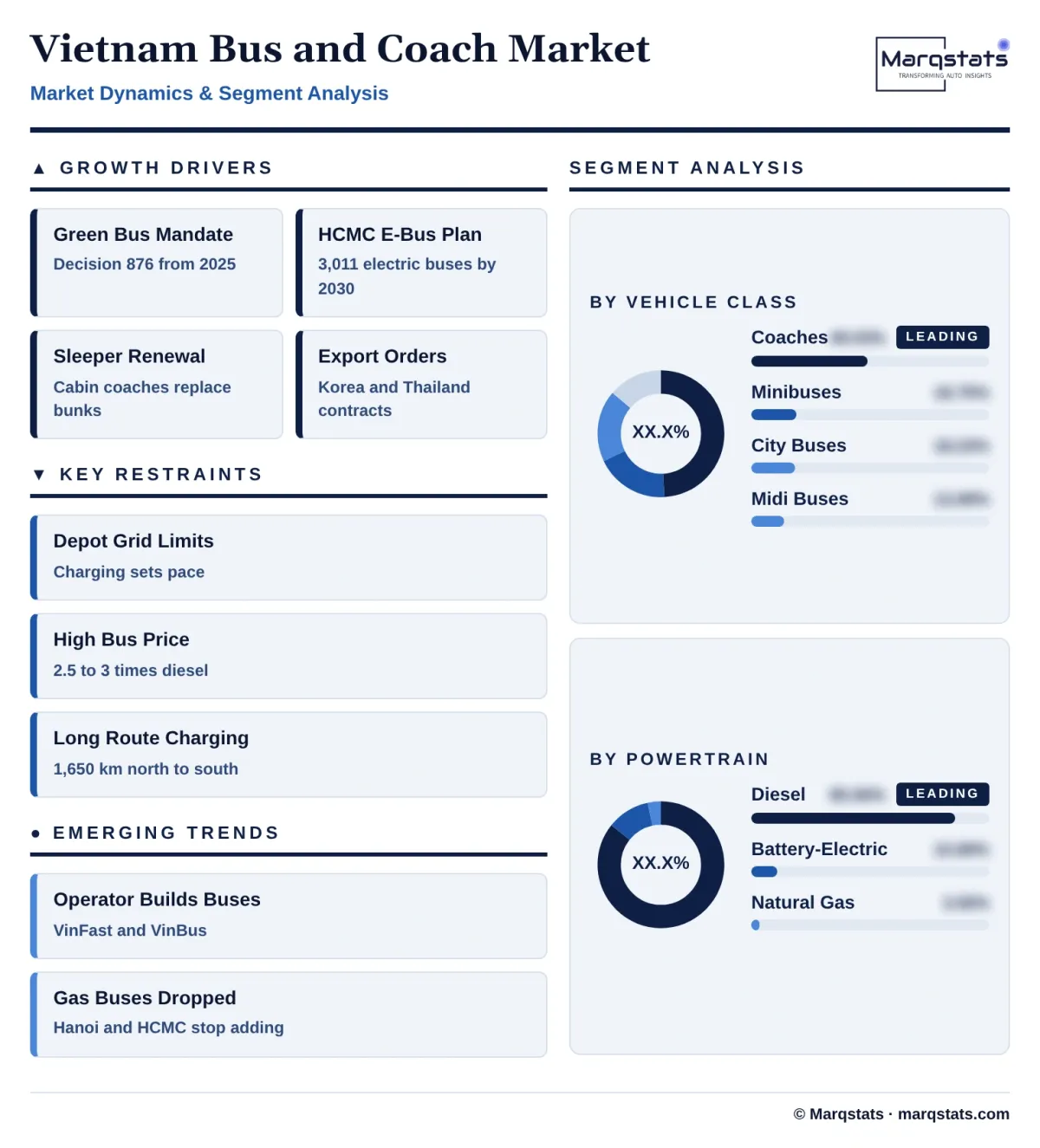
Intercity and sleeper coaches account for 49.03% of 2025 value, diesel vehicles for 85.56% and Southern Vietnam for 40.00%. City transit buses grow fastest among vehicle classes, at 15.79% a year, and battery-electric buses grow at 32.90% a year as Hanoi and Ho Chi Minh City replace diesel and gas fleets under Decision 876/QD-TTg.
Key Takeaways
Market Overview & Analysis
Report Summary
Marqstats sizes the Vietnam bus and coach market as the delivered value of new vehicles with ten or more seats, in four classes: minibuses of 10 to 16 seats, midi and medium buses of 17 to 29 seats, city transit buses and intercity and sleeper coaches. The count covers vehicles assembled from kits by THACO, Hyundai Thanh Cong, Kim Long Motor, SAMCO and other builders, vehicles built on imported chassis by bodybuilders such as Tracomeco and GAZ Thanh Dat, and complete imports, including the electric buses of VinFast.
The association series is the starting point and not the answer. VAMA reported members' retail sales of 313,359 vehicles in 2025, made up of 218,974 passenger vehicles and 94,385 commercial vehicles, and within commercial vehicles it reported 8,668 buses, up 12%, and 70,746 trucks. VinFast, Hyundai Thanh Cong and the smaller builders sit outside that count, so Marqstats adds a non-member layer of 4,480 vehicles built from company and project evidence.
The layers are Hyundai Thanh Cong at about 1,480 buses, VinFast and VinBus at about 580 electric buses, Kim Long Motor at about 650, SAMCO at about 750, Tracomeco and other bodybuilders at about 500, GAZ Thanh Dat at about 120 and Chinese importers at about 400. The Hyundai Thanh Cong layer is the 12,882 vehicles of its commercial line in 2025 less the 11,400 trucks counted in the Marqstats Vietnam truck analysis, so a bus is counted once across the two analyses. The other layers are Marqstats estimates.
Marqstats estimates 11,750 vehicles in 2024, so 2025 deliveries of 13,148 are 2.27% higher, in line with the 12% rise in VAMA bus sales. At the 2025 average rate of VND 26,009 per US dollar, the 2025 market of USD 852.46 million equals about VND 22.17 trillion, an average of about USD 64,836 (VND 1,686 million) per vehicle.
Vietnam also has a live Marqstats analysis of the electric vehicle market, which counts electric cars, buses, trucks and two-wheelers. Electric buses are a subset of this market and the two should not be added. Vietnam trucks and passenger cars are sized separately, and vans below ten seats are not counted in any of the three.
Vietnam Bus and Coach Market Size and Forecast
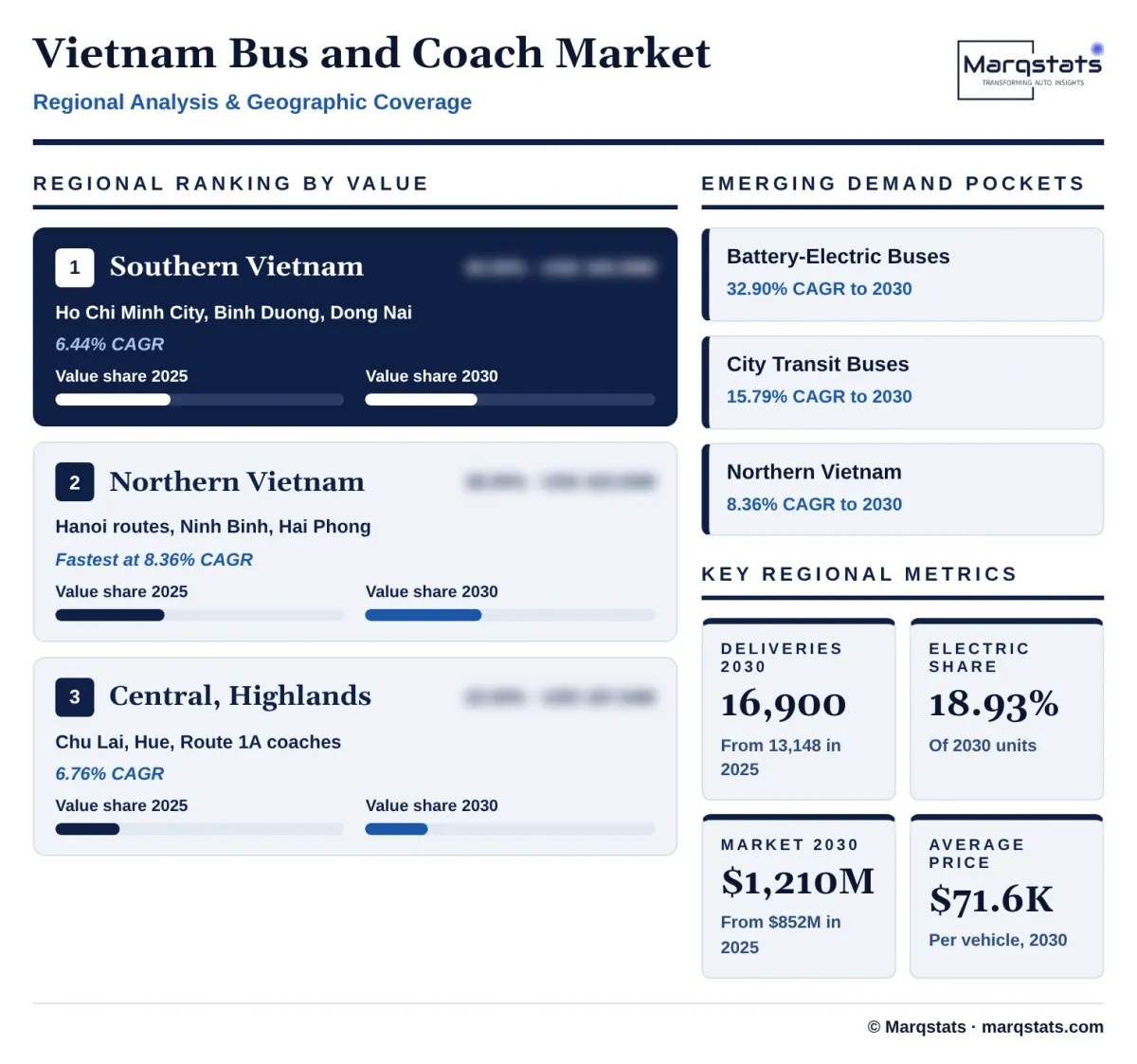
The Vietnam bus and coach market grows from USD 852.46 million in 2025 to USD 1,209.85 million in 2030, a CAGR of 7.25%. Volume supplies most of the growth: deliveries rise 5.15% a year from 13,148 to 16,900 vehicles, and the average value per vehicle rises 2.00% a year from about USD 64,836 to USD 71,589 as the mix moves toward city transit buses and coach prices follow inflation.
Marqstats expects 13,790 deliveries in 2026, worth USD 911.57 million, a rise of 6.93%. VAMA reported commercial vehicle sales of 72,733 in January to September 2026, up 10%, and Transerco added 288 electric buses on 10 Hanoi routes from 1 April 2026 and 53 more on 18 April, so 2026 starts ahead of the five-year path. Growth stays between 7.21% and 7.67% a year after 2027 because the electric transition is steady and not a single order.
The 2025 value is built bottom-up from classes and prices. Marqstats estimates 5,400 minibuses at about VND 770 million (USD 29,605), 2,350 midi and medium buses at VND 1,320 million (USD 50,752), 1,650 city transit buses at VND 2,450 million (USD 94,198) and 3,748 intercity and sleeper coaches at VND 2,900 million (USD 111,500), all before value added tax. The coach price is anchored on dealer list prices of VND 2,980 million for a 47-seat Kim Long 99S and VND 3,737 million to 4,200 million for its 34-berth and 24-berth sleepers, which include value added tax.
Electric buses add value faster than volume. Marqstats expects battery-electric deliveries to rise from 760 in 2025 to 3,200 in 2030, so their share of units rises from 5.78% to 18.93% and their share of value from 10.89% to 31.82%. Natural gas buses fall from 450 to 100 units, and electric buses are priced at about twice the diesel average for the same class, in line with the premium municipal bids reflect.
Marqstats tracks four indicators to monitor the forecast: monthly VAMA bus sales, the conversion pace of Transerco and VinBus routes in Hanoi and Ho Chi Minh City, the depot grid connections that decide how many electric buses a city can accept, and the order book of Kim Long Motor with FUTA Bus Lines and its export contracts, which draw on the same Huế plant.
Market Dynamics
Key Drivers
Five forces lift demand for new buses and coaches in Vietnam, led by municipal electrification rules and the renewal of intercity sleeper fleets.
- Municipal electrification rules set the pace. Decision 876/QD-TTg of 22 July 2022 requires newly added and replacement urban buses to use electricity or green energy from 2025, and Hanoi revised its bus plan in May 2025 to replace all petrol and diesel public buses with electric or green-energy vehicles by 2030, with every bus inside Ring Road 4 electric. Transerco aims for more than 51% of its fleet to be green by the end of 2026 and added 28 VinFast Green Bus vehicles on routes 22A and 22B on 5 October 2026 and 25 VinFast EB8 buses on routes 30 and 50 on 6 October.
- Ho Chi Minh City has set the largest procurement target. The city plan adds 3,011 electric buses between 2025 and 2030, made up of 1,537 replacement vehicles and 1,474 for route expansion that feed Metro Line 1, and VinBus converted 169 buses on nine routes to VinFast EB6 and EB8 in March 2026 after placing 58 EB8 on routes 33 and 150 in December 2025. The city also issued Decision 62/2026/QD-UBND on the management of public bus passenger transport.
- Intercity sleeper fleets are being renewed. Interprovincial operators replace ageing 40-bunk coaches with 22 to 34 berth cabin coaches, and Kim Long Motor delivered 250 sleeper coaches and minibuses to transport companies in December 2024 and prepared 100 pure electric sleeper coaches for FUTA Bus Lines in October 2026, which shows that long-distance operators now buy electric coaches.
- Domestic assembly supports exports and scale. Kim Long Motor signed a contract in April 2025 for 200 electric buses for DAON Mobility of South Korea, with a first batch of 50, and in December 2025 a contract with Thavee Group of Thailand for 3,000 buses a year, mainly electric, while THACO exports Mercedes-Benz coaches built at Chu Lai, so export orders raise plant utilisation.
- Safety and business rules lift standards. Decree 10/2020/ND-CP requires passenger transport operators to fit cameras and data recorders, and QCVN 09:2024/BGTVT updates the technical safety regulation for motor vehicles, so older minibuses and coaches face higher inspection and compliance cost and operators renew them faster.
Key Restraints
Four constraints keep growth below the pace of the electric transition and make delivery years uneven.
- Charging depots limit the rate of electric acceptance. VinBus runs three depots in Hanoi, the Ocean Park depot holds up to 100 buses and charges up to 80 at once through 40 units, and the city of Ho Chi Minh has designated 25 depot sites for medium voltage grid connection, so a bus order is limited by the pace of grid work.
- Electric buses cost more to buy. Municipal reports cite a price of 2.5 to 3 times a diesel bus, and the preferential interest subsidies announced in Ho Chi Minh City cover only operators that win route concessions, which leaves private coach operators on diesel.
- Long-distance routes lack fast chargers. Vietnam stretches over 1,650 kilometres from north to south, and only a small number of electric sleeper coaches such as the 100 Kim Long vehicles for FUTA Bus Lines have started on interprovincial routes, so diesel keeps the market outside the cities through 2030.
- Delivery years are uneven. Municipal tenders, route concessions and subsidy payments are decided city by city, and a single concession such as the 288 buses of 1 April 2026 in Hanoi moves hundreds of vehicles between quarters, which makes the five-year path an average and not a straight line.
Key Trends
Four shifts are changing who builds buses, what powers them and where they are sold.
- The operator and the manufacturer are merging. VinFast builds its buses, sells them to its own VinBus operator and to Transerco, and about 2,000 VinFast electric buses run in Vietnam, of which about 600 are operated directly by VinBus, so integrated groups set the electric order book.
- Domestic builders chase exports. Kim Long Motor opened a Yuchai engine plant of US$260 million in December 2025 and raised the planned investment in Huế to VND 25.6 trillion in July 2025, while VinFast showed its EB8 and EB12 at Busworld Europe in October 2025.
- Gas buses are being dropped. Hanoi and Ho Chi Minh City have stopped adding compressed natural gas buses, so Marqstats expects deliveries to fall from 450 in 2025 to 100 in 2030.
- Minibuses move upmarket. Corporate shuttles, airport transfers and limousine services buy 16-seat vehicles such as the Hyundai Solati, listed at VND 1,080 million in October 2026, while Kim Long lists its X9 at VND 669 million, so price tiers widen.
Strategic Implications
- For component suppliers, the entry route is a supply deal with a domestic assembler. Kim Long Motor, THACO, SAMCO and VinFast build locally and complete imports of non-ASEAN origin face tariffs, so e-axles, battery packs and control software reach the market through kit supply.
- For bodybuilders, the shift to monocoque electric bodies and low-floor city buses changes the product. Tracomeco, GAZ Thanh Dat and SAMCO must either move to electric platforms or concentrate on sleeper conversions and minibuses.
- For operators, the financing structure decides the technology. Interest subsidies in Ho Chi Minh City and operator-owned fleets at VinBus lower the cost of electric buses, while private coach firms with no concession should keep diesel for long routes and test electric buses on fixed short-haul routes.
- For energy and charging providers, the depot is the market. Hanoi and Ho Chi Minh City need grid connections for each new route conversion, and battery storage at terminals can buffer peaks.
- For investors, the non-member layer carries the growth. About a third of deliveries and almost all electric buses are outside the association series, so monitoring VAMA alone understates both the market and the electric transition.
Market Segmentation
Minibuses account for 18.75% of 2025 value, USD 159.87 million, and grow at 4.18% a year to USD 196.20 million. Marqstats estimates 5,400 units at about VND 770 million each, covering the Ford Transit, Hyundai Solati, Kim Long X9 and GAZelle Next, used for corporate shuttles, airport transfers and limousine services. The Hyundai Solati was listed at VND 1,080 million in October 2026 while the Kim Long X9 was listed at VND 669 million.
Midi and medium buses account for 13.99% of 2025 value, USD 119.27 million, and grow at 3.10% a year to USD 138.95 million. Marqstats estimates 2,350 units at about VND 1,320 million, including the THACO Town at VND 1,250 to 1,400 million and the Hyundai County at VND 1,400 to 1,550 million, used for school, staff and provincial route transport.
City transit buses account for 18.23% of 2025 value, USD 155.43 million, and grow fastest among classes, at 15.79% a year, to USD 323.54 million and 26.74% of the market. Marqstats estimates 1,650 units at about VND 2,450 million, of which 760 are electric (46.06% of the class if all are counted here), and the class reaches 3,300 units in 2030 as Decision 876/QD-TTg and the Hanoi and Ho Chi Minh City plans take effect.
Intercity and sleeper coaches account for 49.03% of 2025 value, USD 417.89 million, and grow at 5.69% a year to USD 551.16 million. Marqstats estimates 3,748 units at about VND 2,900 million, including 47-seat coaches such as the THACO Mercedes-Benz and Hyundai Universe and 22 to 34 berth sleepers such as the Kim Long 99 and THACO Mobihome.
Diesel vehicles account for 85.56% of 2025 value, USD 729.36 million, and grow at 2.33% a year to USD 818.20 million, although their share falls to 67.63%. Marqstats estimates 11,938 diesel deliveries in 2025, covering almost all minibuses, midi buses and coaches.
Compressed natural gas buses account for 3.55% of 2025 value, USD 30.24 million, and fall 26.20% a year to USD 6.62 million. Marqstats estimates 450 deliveries in 2025 and 100 in 2030 because Hanoi and Ho Chi Minh City have stopped adding gas buses.
Battery-electric buses account for 10.89% of 2025 value, USD 92.86 million, and grow fastest, at 32.90% a year, to USD 385.03 million and 31.82% of the market. Marqstats estimates 760 deliveries in 2025, of which about 580 came from VinFast and about 180 from Kim Long Motor, importers and other builders, and 3,200 in 2030.
By Geography
Southern Vietnam
Southern Vietnam accounts for 40.00% of 2025 value, USD 340.99 million, and grows at 6.44% a year to USD 465.79 million. Ho Chi Minh City is the largest single bus market, with commuting flows into Binh Duong, Dong Nai and Long An and the home base of SAMCO, and its plan adds 3,011 electric buses by 2030.
Northern Vietnam
Northern Vietnam accounts for 38.00% of 2025 value, USD 323.93 million, and grows fastest, at 8.36% a year, to USD 483.94 million and 40.00% by 2030. Transerco is replacing diesel routes in Hanoi, the Hyundai Thanh Cong plant is in Ninh Binh, and the VinFast plant is in Hai Phong.
Central Vietnam and Highlands
Central Vietnam and the Highlands account for 22.00% of 2025 value, USD 187.54 million, and grow at 6.76% a year to USD 260.12 million. THACO builds buses at Chu Lai in Quang Nam, Kim Long Motor builds at Chan May in Hue, and the National Route 1A and North-South Expressway corridors carry interprovincial coaches.
How Competition Is Evolving
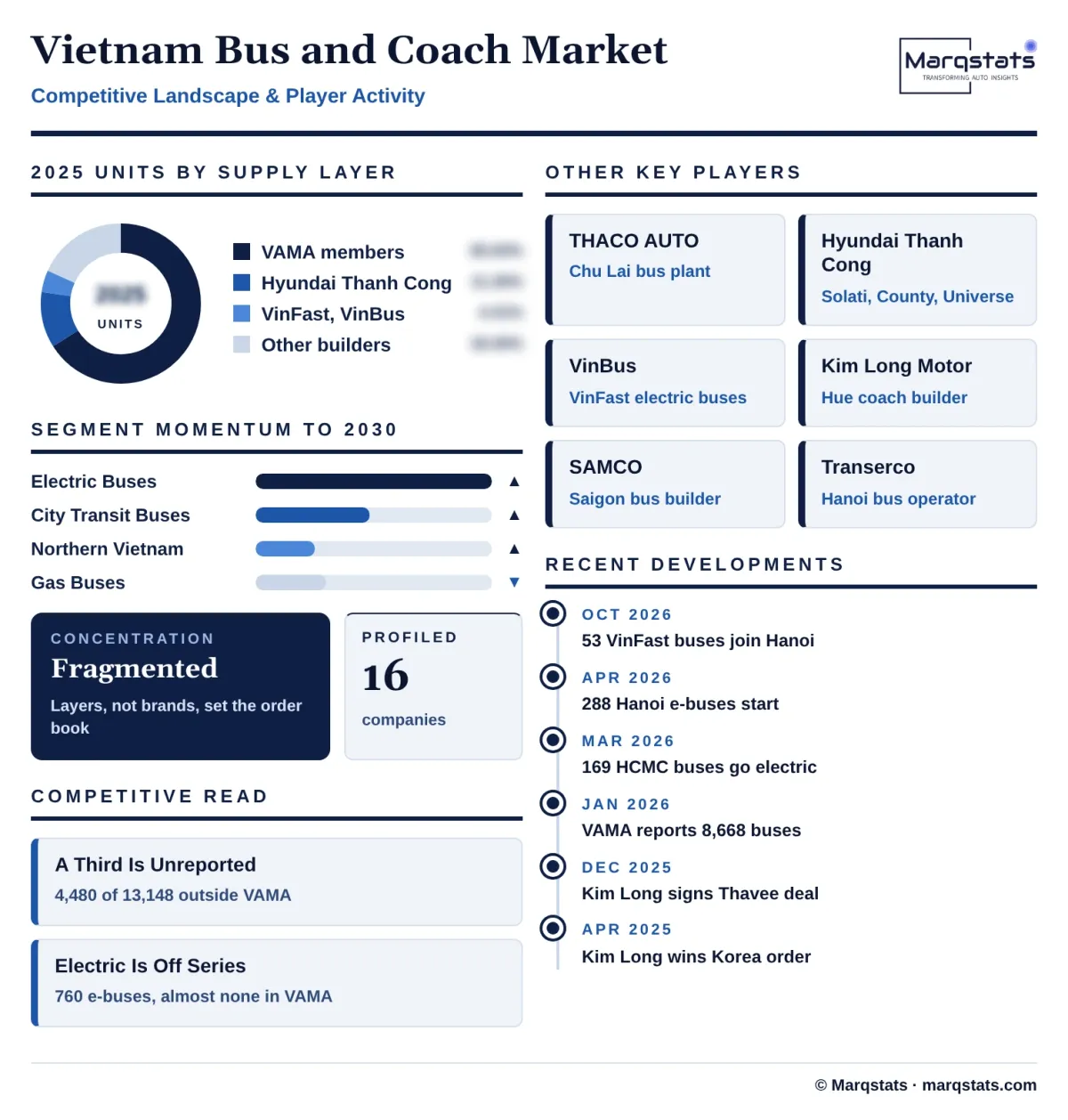
The market is organised in layers and not by brand. VAMA members, led by THACO Auto, supplied 8,668 buses in 2025, 65.93% of the market, and a non-member layer of 4,480 vehicles comes from Hyundai Thanh Cong, VinFast, Kim Long Motor, SAMCO, bodybuilders and importers. Because Vietnam publishes no brand ranking of buses, Marqstats does not rank brands and describes competition by named, dated actions.
THACO Auto is the scale player. It sold more than 90,000 vehicles in 2025, of which trucks and buses exceeded 26,000, builds buses at Chu Lai and sells the THACO Mobihome, the THACO Town and Mercedes-Benz coaches. Hyundai Thanh Cong sold 12,882 commercial vehicles including buses in 2025 and competes with the Solati, County and Universe.
Kim Long Motor is the disruptor. It prices its coaches below Hyundai and THACO, lists a 47-seat Kim Long 99S at VND 2,980 million and a 16-seat X9 at VND 669 million, and has won export contracts in South Korea and Thailand, while Hue City raised its planned investment to VND 25.6 trillion in July 2025.
VinFast and VinBus lead electric city buses. About 2,000 VinFast electric buses operate in Vietnam, VinBus operates about 600, and the EB6, EB8 and EB12 platforms run on routes in Hanoi and Ho Chi Minh City. SAMCO and the Green and Smart Mobility group are developing electric municipal buses.
Companies Covered
Companies covered in the report include:
Recent Market Activity
Table of Contents
Coverage & Segmentation
The study covers the Vietnam bus and coach market, with 2025 as the base year, 2021 – 2025 as the historical period and 2026 – 2030 as the forecast period. It covers new buses and coaches with ten or more seats including the driver, whether assembled from kits, built on imported chassis with a local body or imported complete, segmented by vehicle class, powertrain and region. Values are ex-factory or landed prices including the body, in US dollars, before value added tax, special consumption tax, registration fees and finance charges, and dong figures use the 2025 average of VND 26,009 per US dollar.
Trucks, vans and minibuses below ten seats, passenger cars, used coaches and rail vehicles are excluded. Buses reported by VAMA, 8,668 in 2025, were excluded from the Marqstats Vietnam truck analysis and are counted here, and the Hyundai Thanh Cong layer is the 12,882 commercial vehicles less the 11,400 trucks counted there. The live Marqstats Vietnam electric vehicle report counts electric cars, buses, trucks and two-wheelers, and its electric buses are the same vehicles as the battery-electric buses here and should not be added. Splits are Marqstats estimates built on association releases, company and municipal disclosures and price lists.
