Market Snapshot
Middle bar: base-year value × (1 + CAGR), rounded to two decimals. This is a calculated illustration, not a separately researched annual estimate.
The Brazil bus market size is estimated at USD 4,743.79 million in 2025 (BRL 26.42 billion) and is projected to reach USD 6,764.86 million by 2030, growing at a CAGR of 7.36% over 2026 – 2030. Registrations rise from 28,844 to 31,900 buses, a 2.03% annual rate, while the average value of a complete bus climbs from about USD 164,464 to USD 212,065 as battery-electric buses take a larger share of urban purchases.
Marqstats defines the market as the purchase value of new complete buses, meaning the rolling chassis and the passenger body together, registered for road use in Brazil. Each bus is counted once, at the point where the Federação Nacional da Distribuição de Veículos Automotores (FENABRAVE) records it as a plated vehicle, and it is valued at the price an operator, municipality or school authority pays for the finished vehicle. Chassis output, body output and exports are shown as reconciliation points and are never added to the total. Trucks, vans, used buses and bodies sold for export are excluded.
Urban transit accounts for 41.25% of 2025 value, diesel buses meeting the Proconve P8 standard for 92.53% and the chassis layer for 53.28% of the price of a complete bus. The Southeast accounts for 52.00% of value and grows fastest, at 7.97% a year, because São Paulo city alone has 2,009 electric buses in service.
Key Takeaways
Market Overview & Analysis
Report Summary
Marqstats sizes the Brazil bus market as the purchase value of new complete buses, with the rolling chassis and the passenger body counted together as one vehicle. The count follows FENABRAVE bus registrations, which recorded 28,844 plated buses in 2025, up 4.23% from 27,674 in 2024. A complete bus is valued at what the buyer pays, taxes included, and Brazilian real values are converted at the 2025 average rate of BRL 5.57 per US dollar. Exports of chassis and bodies, trucks, vans and used buses are outside the market.
Brazil builds buses in two stages, and that is why three official counts coexist. The Associação Nacional dos Fabricantes de Veículos Automotores (ANFAVEA) reported chassis production of 28,191 units in 2025, up 1.6% from 27,749, with exports of 6,452 chassis, up 33.8%, and domestic licensing of 23,954 units, up 6.8% from 22,435. FABUS recorded body production of 27,516 units including Volare integral buses, up 1.66% from 27,067, or 24,315 excluding Volare. Each series measures the same fleet at a different point in the chain, so Marqstats uses plates as the single counting point and reports the others as checks.
The gap between plates and ANFAVEA licensing is 4,890 units, and most of it is brand coverage. FENABRAVE counts every plated bus, including Marcopolo Volare integral buses (3,246), Caio Induscar electric buses built on Eletra Industrial Ltda. chassis (288), BYD do Brasil Ltda. (195), Higer (29) and Ankai (9), which together are 3,767 units. The remaining 1,123 units reflect timing between invoicing and plating and the small group of non-member importers in the ANFAVEA series. The reconciliation matters because a chassis-only or body-only view of Brazil mixes exports, stock and integral vehicles.
The 2026 cycle has turned down. FENABRAVE registered 12,990 buses in the first half of 2026, down 7.97% from 14,115, and 18,119 in January to August, down 4.25%, with August itself up 18.70% to 2,437. ANFAVEA reported January to August chassis production of 19,918, down 6.2%, licensing of 14,544, down 7.6%, and exports of 3,174, down 30.3%. Marcopolo S.A. told an industry forum on 25 August 2026 that it expects the market to fall 5% to 10% in 2026, and the bodybuilders point to credit restriction, interest rates and diesel costs that urban operators have not passed on to fares.
Public programmes decide the shape of the recovery. The Ministry of Cities qualified R$ 577.4 million of Novo PAC fleet renewal financing for 323 buses on 4 August 2026, 81 electric and 242 Euro VI diesel, and the federal MOVE Brasil heavy-vehicle programme reserved R$ 2 billion of its R$ 21.2 billion for buses and micro-buses, of which BNDES had approved about R$ 1.6 billion by 16 June 2026. Against that, the Fundo Nacional de Desenvolvimento da Educação (FNDE) revoked the Caminho da Escola tender for about 7,500 school buses, reported on 3 February 2026, which removes the largest single order the industry had expected.
Brazil Bus Market Size and Forecast
The Brazil bus market grows from USD 4,743.79 million in 2025 to USD 6,764.86 million in 2030, a CAGR of 7.36%. In Brazilian reais at the constant 2025 rate, value rises from BRL 26.42 billion to BRL 37.68 billion. Volume contributes 2.03% a year, from 28,844 to 31,900 registrations, and the average value of a complete bus rises 5.22% a year, from about USD 164,464 to USD 212,065, because electric buses, double-deck coaches and articulated urban buses carry higher prices.
The 2025 value is built bottom-up from registrations and prices. Marqstats estimates 10,961 urban, 6,057 intercity and charter coach, 6,346 micro and minibus and 5,480 school and rural registrations, priced at about BRL 900,000 for an urban diesel bus, BRL 2,150,000 for an electric urban bus, BRL 1,650,000 for a coach, BRL 450,000 for a micro or minibus and BRL 480,000 for a school bus. The electric price is consistent with the R$ 547.7 million that BNDES financed for the 250 electric buses delivered to São Paulo on 30 September 2026, about R$ 2.19 million each including 49 articulated units. The diesel price is consistent with the Novo PAC awards of 4 August 2026, which imply about R$ 910,550 per bus in Barra Mansa and R$ 969,900 in Contagem before charging and civil works.
The base is checked against the manufacturing chain. Marcopolo S.A. sold 11,006 vehicles in Brazil in 2025 and reported net revenue of R$ 9.057 billion, up 5.4%, across 15,048 vehicles sold in Brazil, exported from Brazil and built abroad, which implies revenue near R$ 600,000 per vehicle including parts and services. Marqstats estimates the body and fit-out layer at 46.72% of the price of a complete bus, about BRL 427,984 on an average bus of about BRL 916,063, which is consistent with that revenue per vehicle once the group's coaches, integral Volare vehicles, parts and services are weighted.
The forecast follows the cycle. Marqstats expects registrations to fall to 27,700 in 2026, then to rise to 29,200 in 2027, 30,300 in 2028, 31,100 in 2029 and 31,900 in 2030, as credit eases, school and urban fleet renewal resumes and electric deliveries to São Paulo and the Novo PAC cities build. Value falls 5.51% in 2026 to USD 4,482.45 million and then grows 13.39% in 2027, 11.73% in 2028, 9.56% in 2029 and 8.73% in 2030. The 2030 level is a plateau, not a peak, because it sits only 10.59% above the 2025 unit count.
Electric and gas buses add value faster than volume. Marqstats expects battery-electric buses to rise from 849 registrations in 2025 to 4,200 in 2030 and gas and hybrid buses from 120 to 400, so their combined share of units grows from 3.36% to 14.42%. The electric price falls about 2% a year as battery costs decline, while diesel and coach prices rise about 4% a year with inflation, and the import tax on assembled and semi-knocked-down electrified vehicles rose to 35% in July 2026, which protects the local chassis and body chain.
Marqstats tracks five indicators to monitor the forecast: monthly FENABRAVE bus plates, ANFAVEA chassis licensing and exports, FABUS body output by segment, the pace of BNDES and Caixa Econômica Federal approvals under Novo PAC and MOVE Brasil, and the date of a new Caminho da Escola tender.
Market Dynamics
Key Drivers
Five forces are lifting Brazilian bus demand even as the 2026 cycle turns down in the largest segments.
- Federal fleet-renewal credit funds municipal purchases. The Novo PAC Mobilidade Urbana Sustentável fleet renewal line, funded by the Fundo de Garantia do Tempo de Serviço (FGTS) through Pró-Transporte, qualified R$ 577.4 million for 323 buses on 4 August 2026, and the May 2024 programme announcement covered 2,529 electric and 2,782 Euro VI buses in 98 municipalities with R$ 10.5 billion of BNDES and Caixa Econômica Federal credit. Each tranche converts into plated buses within a year, which supports urban demand through 2028.
- MOVE Brasil finances buses and micro-buses. The federal heavy-vehicle programme holds R$ 21.2 billion, of which R$ 2 billion is reserved for buses and micro-buses, and BNDES had approved about R$ 1.6 billion of that, around 80%, by 16 June 2026. The Federação Nacional da Distribuição de Veículos Automotores said company funds ran out by July, so deliveries from approved contracts should reach the registration series through late 2026 and early 2027.
- Electrification gives São Paulo a replacement cycle of its own. The city's electric fleet reached 2,009 buses on 30 September 2026, 1,821 battery buses and 188 trolleybuses, up from 502 at the end of 2024, after BNDES approved R$ 2.5 billion for 1,300 electric buses in November 2024 and the World Bank and the Inter-American Development Bank each committed USD 248.3 million in August 2026. The mayor put monthly fuel at about R$ 25,000 for a diesel bus and R$ 5,000 for electricity, and São Paulo Municipal Law 16.802 of 2018 commits the city to cut fossil CO2 from buses by 50% by 2028 and 100% by 2038, although the 2024 target of about 2,600 electric buses was missed.
- Micro-bus and minibus demand is rising under government programmes. FABUS reported micro-bus body output up 43% and mini-bus output up 160% in the first seven months of 2026, driven mainly by government programmes, and Marcopolo Volare registered 3,246 buses in 2025. Smaller buses are cheaper, so they keep unit volume up while urban and coach orders wait for credit.
- Brazilian chassis and bodies sell abroad. ANFAVEA recorded 6,452 chassis exports in 2025, up 33.8%, and Marcopolo S.A. exported 1,474 buses from Brazil and built another 2,568 abroad, selling to 30 to 40 countries a year, with Chile and Peru strong on mining. Export orders keep plants loaded and spread fixed costs when domestic orders slow, although exports fell 30.3% in the first eight months of 2026.
Key Restraints
Four constraints explain why 2026 registrations are falling and why recovery waits for 2027.
- Credit is the binding constraint. FABUS described credit restriction as a much bigger problem than interest rates in August 2026, and Marcopolo S.A. expects the 2026 market to fall 5% to 10%. Urban bus registrations fell about 22%, charter about 25% and highway about 35% in the first half of 2026 on Mercedes-Benz do Brasil data, so the largest-value segments are the ones starved of financing.
- Diesel costs are not passed on to fares. FABUS pointed to diesel price increases in the urban segment that operators were unable to recover through municipal fares, which cuts the cash flow that supports fleet renewal. An operator that cannot raise fares cannot service a loan on a BRL 900,000 diesel bus, let alone a BRL 2,150,000 electric one, so renewal depends on public subsidy.
- The school bus tender was revoked. The Fundo Nacional de Desenvolvimento da Educação revoked the Caminho da Escola bidding for about 7,500 buses across 13 models, reported on 3 February 2026, so the single largest institutional order of the cycle is postponed until a new notice is published after studies. Marcopolo S.A. expects the programme to help in 2027, but the date is not set.
- A strong real weakens export demand. Marcopolo S.A. said in August 2026 that the stronger real reduces export competitiveness, and ANFAVEA reported chassis exports down 30.3% in January to August 2026. Exports had cushioned the 2025 cycle, so their fall removes a source of plant loading just when domestic orders are soft.
Key Trends
Four shifts are changing which buses are built, bodied and bought in Brazil.
- Electric buses move from São Paulo to the regions. Battery-electric registrations rose 170.4% to 849 in 2025 and 89.39% to 589 in the first half of 2026, and Novo PAC awards now fund electric buses in Santana de Parnaíba, Pelotas and Canoas, so electrification is spreading beyond the capital.
- The mix shifts toward smaller buses. Micro and minibus output rose while urban and highway bodies fell in 2026, and Marcopolo-brand output dropped 24.4% in January to August 2026 while Neobus rose 61.0%, a sign that the group is selling more school and feeder bodies than coaches.
- Electric supply is a three-way contest. Eletra Industrial Ltda. with Caio Induscar led with 224 of 589 electric registrations in the first half of 2026, a 38.03% share, while Mercedes-Benz do Brasil Ltda. moved ahead of BYD do Brasil Ltda. with the eO 500 U, and CRRC, Volkswagen Caminhões e Ônibus and Higer entered the monthly top six.
- Import tax rules reward local assembly. The government raised the import tax on assembled and semi-knocked-down electrified vehicles to 35% from July 2026, taxes completely knocked-down kits at 14% until 1 January 2027, and set a USD 463 million exemption quota for kits, so Chinese makers must assemble in Brazil or partner with a local bodybuilder, while the MOVER programme under Law 14.902 of 2024 carries R$ 19.3 billion of credits for 2024 – 2028 for local content and efficiency.
Strategic Implications
- For chassis makers, the 2026 cycle favours the front-engine urban and school chassis that micro and minibus bodies need and penalises heavy coach platforms. Mercedes-Benz do Brasil Ltda. and Volkswagen Caminhões e Ônibus hold 69.55% of plates between them, and they keep that lead by financing through their own banks, as Banco Mercedes-Benz did for 50 OF 1721 chassis in Cuiabá in April 2026.
- For bodybuilders, group scale and segment balance decide results. Marcopolo S.A. built 47.11% of 2025 bodies by combining Marcopolo, Neobus and Volare, so a weak coach year is offset by school and feeder bodies, while single-segment builders of highway coaches carry the cycle risk alone.
- For municipalities and operators, the gap between a diesel and an electric bus is financed by public credit, not by fares. Buyers that file Novo PAC proposals early and bundle chargers into the financing, as Santana de Parnaíba and Pelotas did, secure electric buses at R$ 3.19 million to R$ 3.8 million per bus including infrastructure.
- For component and battery suppliers, the Brazilian electric bus is a local-content product. With electric registrations projected to rise from 849 to 4,200 and the chassis taking a growing share of the price, motors, inverters and battery packs assembled in Brazil win orders that imports can no longer serve at a 35% tax.
- For investors and lenders, the unit count is the wrong lead indicator. Plates, chassis licensing and body output differ by thousands of units, so tracking financing approvals and segment mix gives an earlier signal of value than any single registration series.
Market Segmentation
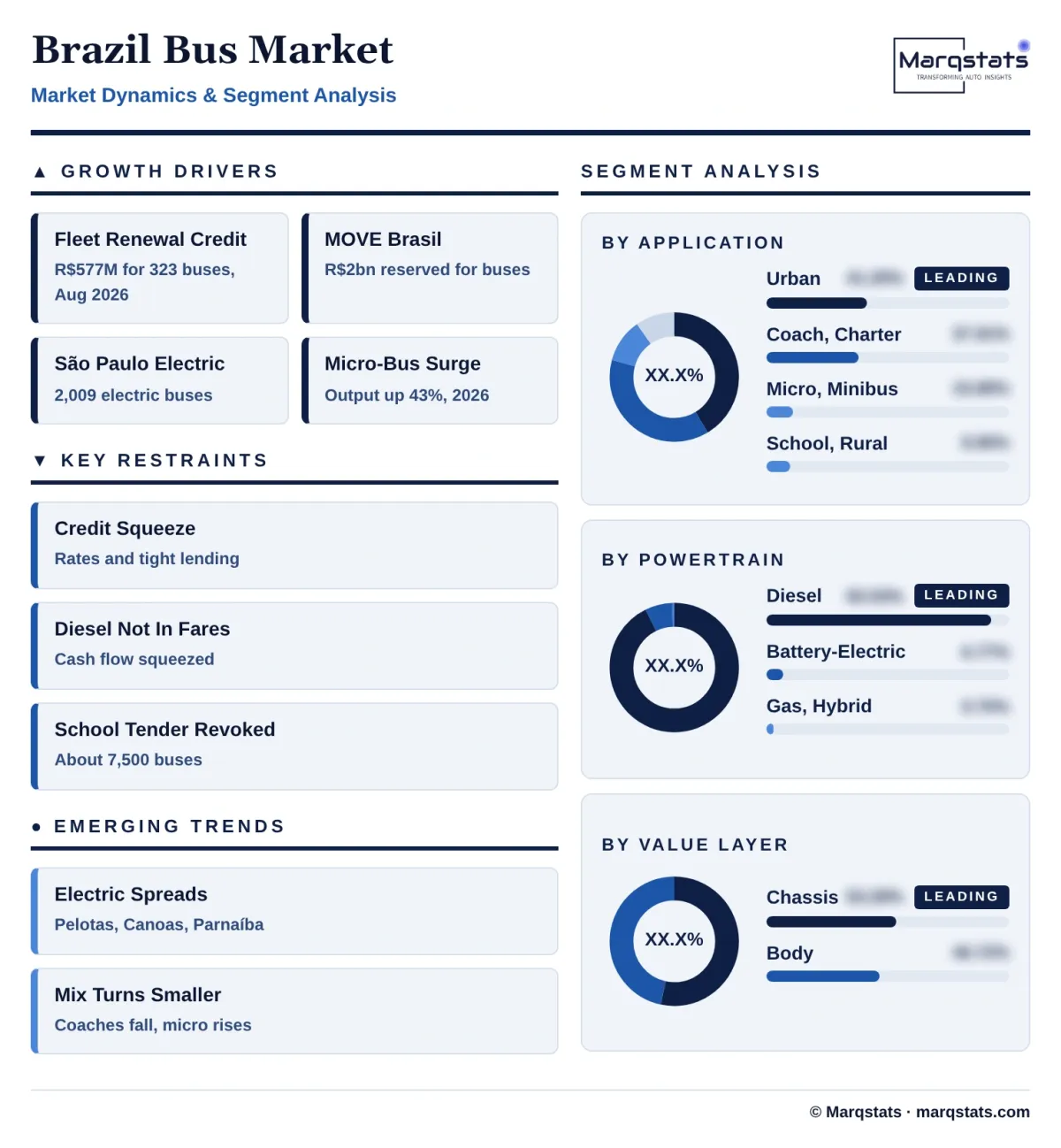
Urban transit accounts for 41.25% of 2025 value, USD 1,956.65 million, and grows at 9.43% a year to USD 3,070.72 million and 45.39% of the market. Marqstats estimates 10,961 registrations in 2025, falling to 9,695 in 2026 and recovering to 12,441 in 2030, led by Caio Induscar, Marcopolo Torino and Mascarello bodies on Mercedes-Benz and Volkswagen chassis. Electric buses give this segment its value growth: they are 7.44% of urban units in 2025 and 32.41% in 2030.
Intercity and charter coaches account for 37.91% of 2025 value, USD 1,798.24 million, and grow at 5.71% a year to USD 2,373.19 million. Marqstats estimates 6,057 registrations in 2025 and 4,432 in 2026, a 26.83% fall that matches FABUS highway body output down 26% in seven months. Coaches are the dearest segment per unit, at about BRL 1,650,000, so Scania, Volvo and Mercedes-Benz chassis with Marcopolo, Busscar, Comil and Irizar bodies carry a large share of value.
Micro and minibuses account for 10.89% of 2025 value, USD 516.66 million, and grow at 6.83% a year to USD 719.03 million. Registrations jump 30.95% to 8,310 in 2026 on FABUS data showing micro-bus output up 43% and mini-bus output up 160%, then settle at 7,178 by 2030 as the government-programme surge fades. Marcopolo Volare, Agrale and Iveco Daily lead this segment, which therefore loses share from 10.89% to 10.63% of value.
School and rural buses account for 9.95% of 2025 value, USD 472.24 million, and grow at 4.97% a year to USD 601.92 million. Registrations ease to 5,263 in 2026 after the revocation of the Caminho da Escola tender and recover to 5,741 in 2030 on a new notice. Neobus Ore bodies on Volkswagen, Iveco and Mercedes-Benz chassis serve this segment, and Neobus output rose 61.0% in January to August 2026.
Diesel buses meeting the Proconve P8 standard account for 92.53% of 2025 value, USD 4,389.19 million, and grow at 3.42% a year to USD 5,193.00 million, while their share of value falls to 76.76%. The standard is CONAMA Resolution 490 of 2018, the Euro VI equivalent, in force for heavy vehicles since 1 January 2023. Marqstats estimates 27,875 diesel registrations in 2025, 96.64% of units, and 27,300 in 2030, 85.58% of units.
Battery-electric buses account for 6.77% of 2025 value, USD 321.30 million, and grow at 34.93% a year to USD 1,436.80 million and 21.24% of the market. FENABRAVE recorded 849 electric plates in 2025, up from 314, and Marqstats expects 1,500 in 2026, up 76.68%, and 4,200 in 2030. Their share of units rises from 2.94% to 13.17%.
Natural gas, biomethane and hybrid buses account for 0.70% of 2025 value, USD 33.30 million, and grow at 32.32% a year to USD 135.06 million and 2.00% of the market. Marqstats estimates 120 registrations in 2025 and 400 in 2030, concentrated in urban fleets and coach operators that want lower emissions without depot charging, and priced at about 1.25 times a diesel bus of the same type.
The chassis and powertrain layer accounts for 53.28% of 2025 value, USD 2,527.64 million, and grows at 8.28% a year to USD 3,762.25 million and 55.61% of the market. It covers the rolling chassis with engine or electric driveline, axles, suspension and brakes from Mercedes-Benz do Brasil Ltda., Volkswagen Caminhões e Ônibus, Scania, Volvo, Iveco and Agrale. Marqstats allocates about 52% of a diesel urban bus to the chassis and about 68% of an electric one.
The body and fit-out layer accounts for 46.72% of 2025 value, USD 2,216.15 million, and grows at 6.26% a year to USD 3,002.61 million and 44.39% of the market. It covers the passenger shell, interior, air conditioning, accessibility equipment and information systems built by Marcopolo S.A., Caio Induscar, Mascarello, Comil, Busscar and Irizar. Both layers are shares of the same complete bus and are never added to the market total.
By Geography
Southeast
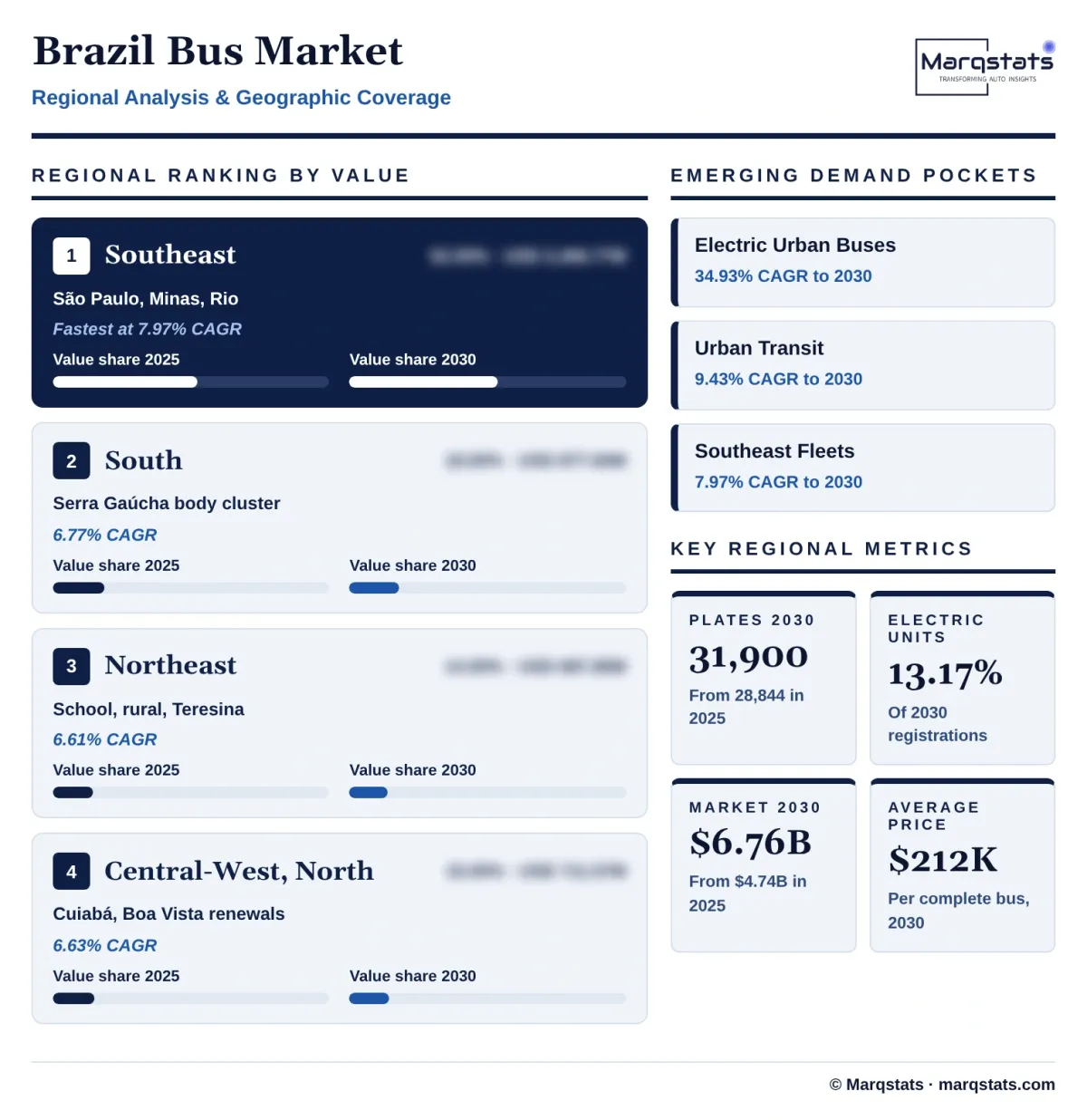
The Southeast accounts for 52.00% of 2025 value, USD 2,466.77 million, and grows fastest, at 7.97% a year, to USD 3,619.20 million and 53.50% by 2030. São Paulo city runs 2,009 electric buses, Contagem in Minas Gerais was qualified for 187 buses on 4 August 2026 and Barra Mansa in Rio de Janeiro for 40, and Mercedes-Benz do Brasil Ltda., Scania, Volkswagen Caminhões e Ônibus, Caio Induscar and Irizar build in the state of São Paulo or Rio de Janeiro. Marqstats allocates value by plate region, which overstates the Southeast because leasing and fleet firms register buses at their head offices.
South
The South accounts for 18.50% of 2025 value, USD 877.60 million, and grows at 6.77% a year to USD 1,217.67 million. The Serra Gaúcha around Caxias do Sul is the bodybuilding heartland, with Marcopolo, Neobus, Volare, Agrale and Comil, and Volvo builds chassis at Curitiba. Pelotas qualified for 15 electric buses and Canoas for 27 buses on 4 August 2026, which show how Novo PAC credit reaches the region.
Northeast
The Northeast accounts for 14.50% of 2025 value, USD 687.85 million, and grows at 6.61% a year to USD 947.08 million. School and rural buses matter most here, so the revoked Caminho da Escola tender hits the region hardest, while Teresina in Piauí was qualified for R$ 95 million of fleet-renewal financing on 4 August 2026 and Salvador runs a municipal electrification programme.
Central-West
The Central-West accounts for 9.00% of 2025 value, USD 426.94 million, and grows at 6.87% a year to USD 595.31 million. Agribusiness charter, interstate coaches and the capital Brasília drive demand, and Cuiabá chose 50 Mercedes-Benz OF 1721 chassis with Marcopolo Torino bodies in April 2026, financed through Banco Mercedes-Benz under the Refrota programme.
North
The North accounts for 6.00% of 2025 value, USD 284.63 million, and grows at 6.26% a year to USD 385.60 million. Rural school transport, river-linked cities and Manaus drive demand, and Boa Vista bought 18 OF 1721 buses with Mascarello bodies in December 2025, with Banco Mercedes-Benz financing about 70% of the purchase.
How Competition Is Evolving
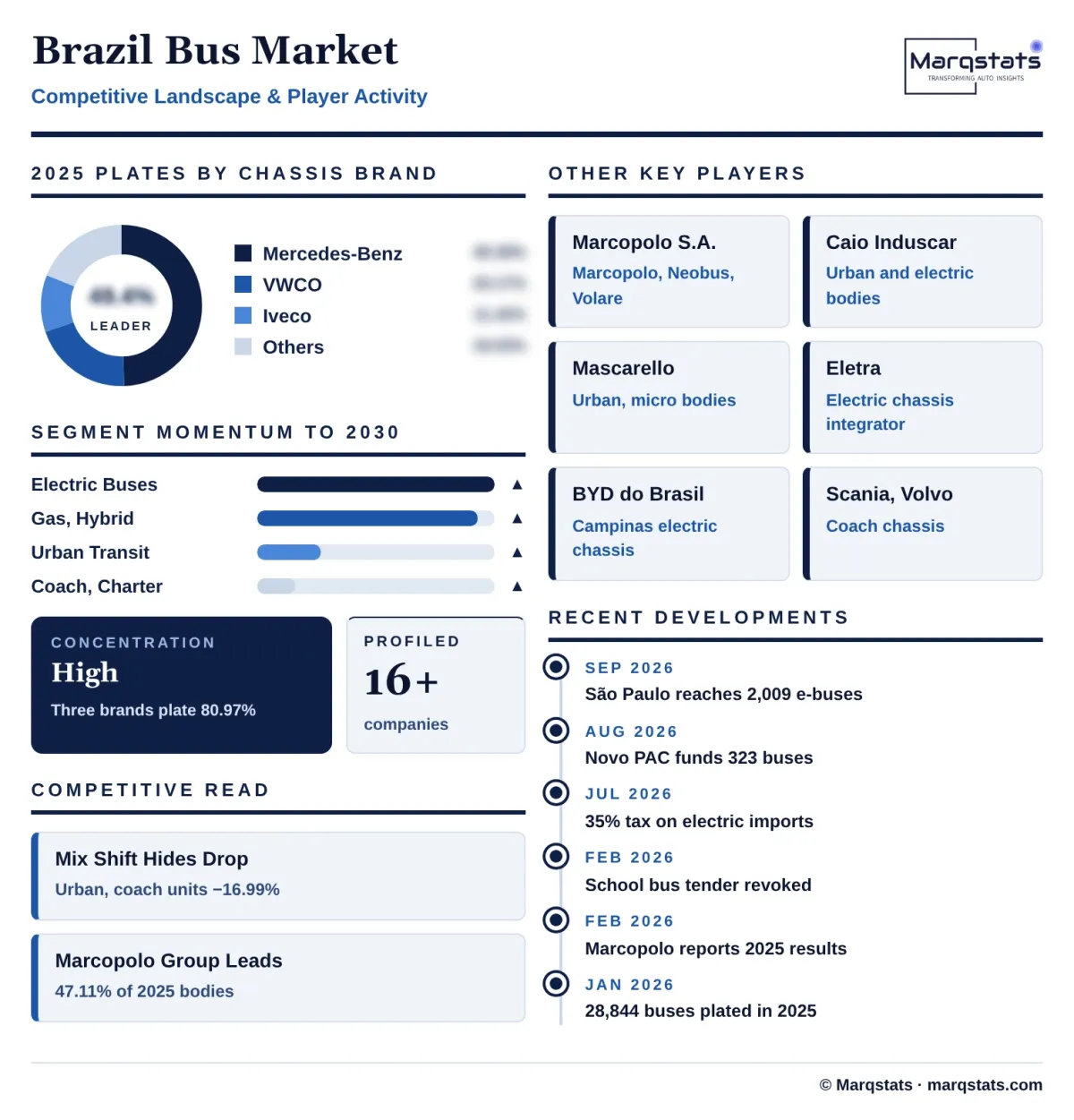
The market is highly concentrated at the chassis stage and moderately concentrated at the body stage. FENABRAVE plates for 2025 show Mercedes-Benz at 14,244 buses and 49.38%, Volkswagen Caminhões e Ônibus at 5,819 and 20.17%, Iveco at 3,295 and 11.42%, Marcopolo Volare at 3,246 and 11.25%, Scania at 866 and 3.00%, Volvo at 556 and 1.93%, Caio Induscar at 288 and 1.00%, Agrale at 268 and 0.93% and BYD at 195 and 0.68%, so the top three brands hold 80.97% of plates.
Mercedes-Benz is losing ground in 2026 while the second tier holds. ANFAVEA licensing for January to August 2026 shows Mercedes-Benz at 5,717, down 17.3%, Volkswagen Caminhões e Ônibus at 3,955, up 0.7%, Agrale at 2,002, down 7.6%, Iveco at 1,784, up 13.0%, Scania at 300, down 37.6% and Volvo at 268, down 22.1%. FENABRAVE shares for the same months put Mercedes-Benz at 46.32%, Volkswagen at 22.22%, Iveco at 12.44% and Marcopolo at 10.57%, so the leader drops about three points while the Volkswagen and Iveco shares rise.
The body stage is controlled by two groups. FABUS recorded Marcopolo at 7,492 bodies in 2025, Caio Induscar at 7,327, Volare at 3,201, Mascarello at 3,181, Neobus at 2,270, Comil at 1,998 and Irizar at 702, and the three Marcopolo S.A. brands together built 12,963, or 47.11% of 27,516 units, matching the 47.1% share that Marcopolo reported for the Brazilian bodywork market. Marcopolo S.A. earned net revenue of R$ 9.057 billion and net profit of R$ 1.235 billion in 2025, and sold 11,006 vehicles in Brazil.
Competition is moving from price to financing and electrification. Mercedes-Benz, Volkswagen and Iveco finance through captive banks, bodybuilders sell through the same dealer networks, and the electric segment is contested by Eletra Industrial Ltda. with Caio Induscar, Mercedes-Benz, BYD, CRRC, Higer and Ankai. Between January and August 2026 Neobus output rose 61.0%, Busscar 81.7% and Mascarello 12.5%, while Marcopolo-brand output fell 24.4% and Comil 2.2%, showing the market rewarding school, feeder and rebadged bodies over heavy coaches.
Companies Covered
Companies covered in the report include:
Recent Market Activity
Table of Contents
Coverage & Segmentation
The study covers the Brazil bus market, with 2025 as the base year, 2021 – 2025 as the historical period and 2026 – 2030 as the forecast period. It covers new complete buses, meaning chassis and passenger body together, registered for road use in Brazil and valued at the price paid by the buyer, taxes included, in US dollars at BRL 5.57 per US dollar, the 2025 average. The study is segmented by application, powertrain, value-chain layer and region, and each bus is counted once at the point of plating.
Chassis exports, body exports, buses built abroad by Brazilian groups, trucks, vans, used buses and bodies sold separately are excluded. Chassis and body production figures are reconciliation points and are never added to the registration-based total, so no bus is counted twice. Segment and regional splits are Marqstats estimates built on registration series, manufacturer disclosures, financing awards and price benchmarks. Live Marqstats reports on the Latin America electric bus market, the Brazil electric truck market and the Brazil electric vehicle market overlap with parts of this market, and their figures should not be added to it.
