Market Snapshot
Key Takeaways
Market Overview & Analysis
Report Summary
The ASEAN commercial electric vehicle market covers battery electric buses, electric trucks (light, medium, and heavy), and electric vans and urban cargo vehicles deployed by commercial operators across the six major ASEAN economies — Indonesia, Malaysia, Thailand, the Philippines, Vietnam, and Singapore — with contextual analysis of emerging commercial EV activity in Lao PDR, Cambodia, and Brunei. The study period spans 2021 to 2030, with 2025 as the base year. Unlike the broader ASEAN EV market — which is predominantly shaped by passenger car adoption — the commercial EV market follows different adoption dynamics: demand is primarily institutional (government transit agencies, state-owned logistics operators, municipal bus procurement bodies) rather than retail consumer, charging requirements are depot-based rather than residential, and total-cost-of-ownership economics are evaluated over fleet operational lifetimes of 10–15 years rather than individual consumer purchase decisions.
The ASEAN commercial EV transition is real but highly non-uniform across both vehicle sub-segments and geographies. Electric buses are the most commercially advanced segment because procurement is centralised, routes are fixed, utilisation is predictable, and public funding or state-backed procurement reduces adoption risk. Global electric bus sales grew approximately 30% in 2024, and this momentum is visible across ASEAN through the large bus tenders and fleet targets described above. Electric trucks and vans are earlier-stage, with adoption still concentrated in pilots, niche logistics use cases, and OEM-led ecosystem experiments. Electric school buses, institutional shuttles, and fleet minivans represent an intermediate category between traditional bus and van that is scaling fastest through mobility-service platforms — VinFast's Green lineup in Vietnam is the clearest regional proof point.
The market's 2026–2030 trajectory depends on three parallel development tracks: (1) public bus procurement scaling from city-level to national-level programmes, with Indonesia and Malaysia representing the largest untapped procurement pipelines; (2) electric van and light commercial vehicle unit economics reaching fleet-operator parity with diesel, enabled by falling LFP battery costs and localisation; and (3) battery-swap and fast-charging infrastructure development at depots and along freight corridors, which is the critical enabling condition for medium and heavy electric truck adoption. Independent assessments consistently identify 2026–2027 as the period when buses and controlled fleet segments will dominate growth, 2027–2029 as the period when urban cargo vans and municipal service fleets accelerate, and 2028 onward as the window when heavier truck adoption expands where charging, payload economics, and route profiles make it viable.
Market Dynamics
Key Drivers
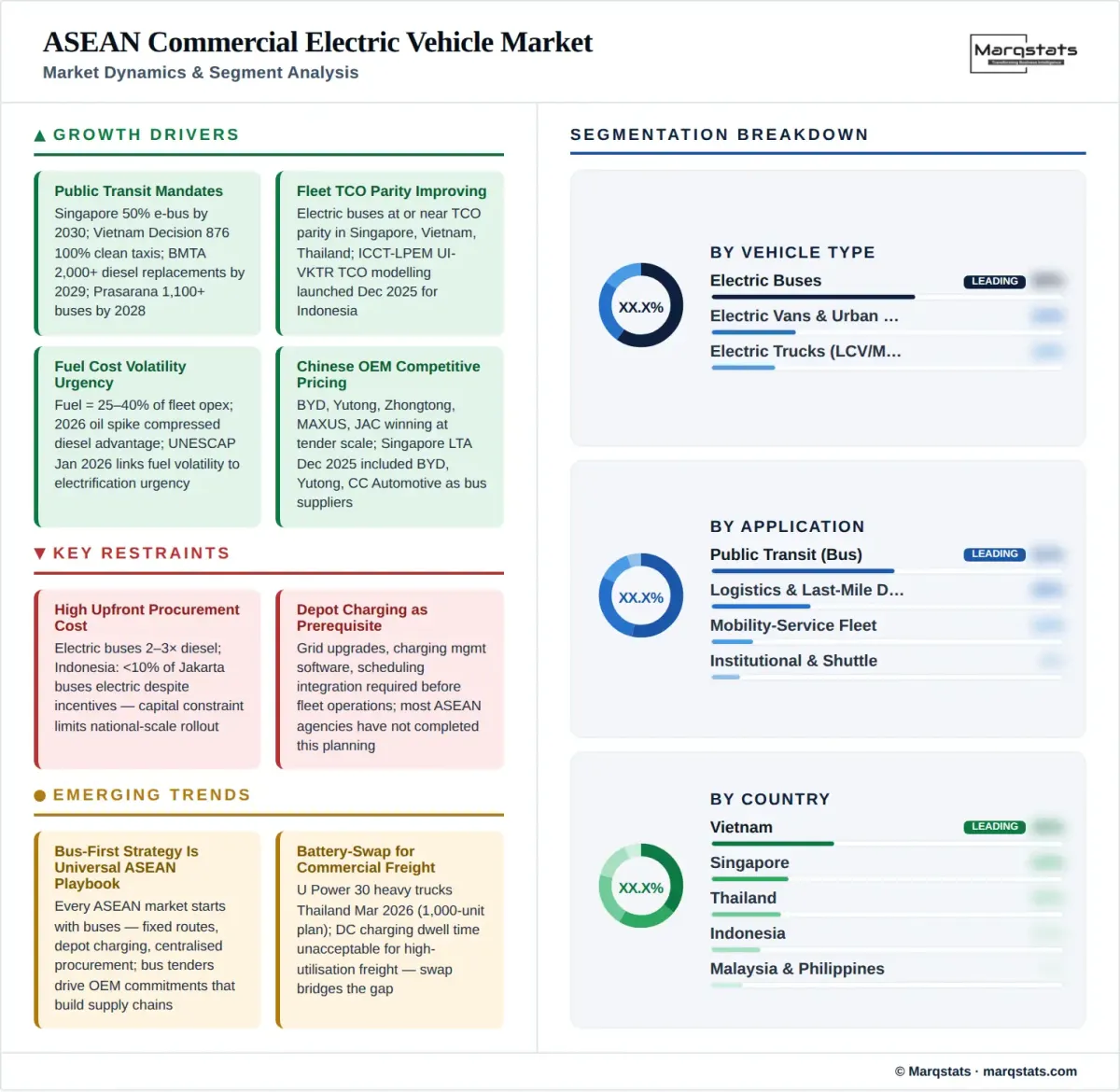
- Public transit electrification mandates and state procurement creating bankable demand: Government mandates — Singapore's 50% electric bus fleet by 2030, Vietnam's Government Decision 876 requiring 100% clean-energy urban taxis by 2030, Thailand's Bangkok Mass Transit Authority fleet replacement programme, Malaysia's Prasarana blueprint, and Indonesia's Transjakarta 100%-EV-by-2030 commitment — transform commercial EV demand from speculative to contracted, enabling OEMs and infrastructure providers to plan investments with defined volume pipelines.
- Fleet TCO parity improving faster than for passenger EVs: Commercial fleet operators evaluate total lifecycle cost — fuel savings, maintenance differentials, residual values, financing costs, and charging infrastructure — over 10-15 year asset lifetimes. Electric buses already demonstrate TCO parity or advantage versus diesel equivalents in depot-charging scenarios across Singapore, Vietnam, and parts of Thailand. The ICCT-LPEM UI-VKTR TCO modelling programme launched in December 2025 for Indonesian electric trucks and buses is designed to accelerate this analysis and provide fleet operators with market-specific economic validation.
- Rising fuel costs making commercial fleet electrification urgent: Fuel costs represent 25–40% of operating costs for commercial vehicle fleets. The 2026 Middle East conflict-driven oil price surge directly compressed the economic advantage of diesel fleets and accelerated operator interest in electric alternatives. UNESCAP noted in January 2026 that several ASEAN countries are using electric buses as the practical first step in decarbonising transport, explicitly linking fuel cost volatility to the urgency of fleet electrification decisions.
- Chinese OEM entry with competitive bus and van pricing: BYD, Yutong, Zhongtong, MAXUS, JAC, and U Power are bringing Chinese commercial EV platforms — developed and cost-reduced in China's world-leading commercial EV market — to ASEAN at price points that are progressively competitive with diesel alternatives. Singapore's December 2025 LTA bus procurement included BYD, Yutong, and Zhongtong-CC Automotive as suppliers alongside ST Engineering-CRRC, demonstrating that Chinese commercial EV OEMs now win at competitive tender scale.
- Localisation and domestic manufacturing building supply resilience: PT VKTR Sakti Industries' April 2026 plant inauguration in Indonesia (10,000-unit bus and truck annual capacity), Kim Long Motor's Hue manufacturing complex with BYD Battery partnership in Vietnam, and Ashok Leyland's PT Pindad MoU are establishing domestic assembly and battery supply chains that reduce import dependency, lower landed costs, and satisfy local-content requirements that are increasingly linked to procurement eligibility.
Key Restraints
- High upfront procurement cost versus diesel alternatives: Electric buses cost approximately two to three times more than equivalent diesel buses in ASEAN markets, requiring transit agencies to absorb larger initial capital outlays or secure concessional financing. In Indonesia and Vietnam, where public transport budgets are constrained, this cost differential is the primary barrier to large-scale fleet electrification beyond pilot programmes, as reported by Indonesia's Ministry of Transportation noting less than 10% of Jakarta buses are electric despite incentives.
- Depot charging infrastructure investment is a prerequisite, not an add-on: Deploying electric buses without dedicated depot charging — including grid upgrades, charging management software, and operational scheduling systems — creates operational failures that discredit electrification programmes. Singapore's LTA specifically included charging-system tenders for depots and integrated transport hubs alongside its December 2025 bus procurement, modelling best practice. Most ASEAN transit agencies have not yet completed this integrated infrastructure planning.
- Electric truck payload penalty and range limitations constraining freight use cases: Current generation electric heavy trucks carry a payload penalty of 1–3 tonnes versus diesel equivalents due to battery weight. In ASEAN's logistics sector — where maximum payload utilisation is critical to profitability — this penalty directly impacts commercial viability for most freight operators. Battery-swapping addresses range limitations but requires standardised swap infrastructure that does not yet exist at scale across ASEAN freight corridors.
- Policy and procurement uncertainty in key markets: Indonesia's post-2025 EV incentive framework remained under discussion as of April 2026, creating uncertainty for commercial EV procurers planning multi-year fleet transitions. Malaysia's commercial EV policy support remains less explicit than its passenger EV framework. The Philippines has yet to translate its EVIS passenger EV incentive into an equivalent commercial fleet electrification programme.
Key Trends
- Bus-first strategy is the dominant ASEAN commercial EV playbook: Every ASEAN country with a concrete commercial EV programme has started with buses — fixed routes, depot charging, centralised procurement, and public funding reduce the financial and operational risk of electrification. The bus-first approach in Singapore, Vietnam, Thailand, Indonesia, and Malaysia is creating a regional template: large bus tenders generate OEM manufacturing commitments, which build supply chains, which reduce unit costs, which unlock the next procurement cycle.
- Mobility-service EVs bridging the bus-van gap: VinFast's Green lineup (Limo Green, Herio Green, Nerio Green, Minio Green) and EC Van, accounting for approximately 49% of VinFast's Q4 2025 deliveries, represent a structurally important intermediate vehicle category — ride-hailing EVs, fleet minivans, and mobility-service vehicles — that scale commercial EV demand through private mobility operators rather than government procurement. This category is scaling fastest in Vietnam and is expected to become significant in Indonesia (VinFast's 20,000-unit MoU with transport operators by 2028) and the Philippines.
- Battery-swap as a commercial freight enabler: For heavy trucks and high-utilisation commercial vehicles where DC charging dwell times are operationally unacceptable, battery-swap systems offer a solution. U Power's 30-truck Thailand deployment in March 2026 is the region's most advanced commercial battery-swap programme. Vietnam's V-Green and Indonesia's SPBKLU network are primarily motorcycle-swap focused but demonstrate the operational model. Standardisation of commercial vehicle battery swap interfaces — currently a gap — will be the key enabler for scaling beyond pilots.
- Commercial EV OEM ecosystem consolidation underway: The ASEAN commercial EV OEM landscape is consolidating around four distinct competitive archetypes: public-bus specialists (BYD, Yutong, Zhongtong-CC Automotive, VKTR), mobility-service platform operators (VinFast-VinBus-Green SM), urban logistics and van specialists (MAXUS, JAC, Kim Long Motor), and heavy-truck innovators (U Power, Jiuzi Holdings). This specialisation is making the commercial EV market more investable by reducing the range of OEM approaches that fleet operators need to evaluate.
Market Segmentation
Electric buses are the dominant sub-segment of ASEAN's commercial EV market, accounting for the majority of market value in 2025. The segment benefits from structural advantages that accelerate adoption: fixed routes enable optimised charging scheduling, depot-based overnight charging eliminates range anxiety, high daily utilisation maximises TCO benefits, and state procurement reduces financial risk for both buyers and suppliers. Across ASEAN, the cumulative electric bus fleet by end-2025 included approximately 2,886 units in Thailand alone (EVAT data), with significant fleets also in Vietnam and Singapore. The electric bus segment is projected to grow at the fastest CAGR through 2030, supported by the cumulative pipeline of national transit electrification programmes. BYD, Yutong, Zhongtong (CC Automotive), Higer, and CRRC are the primary OEM suppliers, with PT VKTR Teknologi Mobilitas dominating Indonesia's domestic supply and Kim Long Motor building commercial bus manufacturing capacity in Vietnam.
Electric trucks are at an early-commercial stage across ASEAN, with meaningful deployment concentrated in light commercial vehicle (LCV) applications, city logistics, and industrial pilots. Heavy electric trucks remain volume-constrained by payload penalties, charging infrastructure gaps, and TCO uncertainty in ASEAN's route and freight profile context. Thailand is the most active experimentation market: U Power's 30 battery-swapping heavy trucks delivered in March 2026 target a real freight use case (versus showroom deployment), and MAXUS and JAC have launched electric LCV ranges targeting logistics fleets. In Vietnam, Jiuzi Holdings secured agreements for over 100 electric heavy trucks and Kim Long Motor's GK48-EV van with 305 km range and 6.2 m³ cargo capacity is positioned for urban logistics fleet operators. Indonesia's TCO research programme (ICCT-LPEM UI-VKTR, December 2025) signals the market is moving from feasibility to commercial-viability modelling — a development that typically precedes fleet procurement decisions by 12–18 months. Electric truck adoption is projected to scale in ASEAN from 2028 onward, when charging infrastructure, standardised battery configurations, and improved energy density progressively close the TCO and payload gap.
Electric vans and urban cargo vehicles represent the fastest-growing truck sub-segment in ASEAN, driven by e-commerce last-mile delivery growth, urban emission restrictions, and the availability of purpose-built electric van platforms at competitive price points. Vietnam leads this category through VinFast's EC Van and Kim Long Motor's GK48-EV (VND 480 million, 305 km, BYD battery, 6.2 m³ cargo). Thailand is the primary target market for MAXUS eDeliver commercial range and JAC electric vans, both launched in 2025–2026 specifically for logistics and SME business users. Independent analyses indicate that e-commerce fulfillment fleets in ASEAN are logging 20–30% fuel savings from electric van deployments, creating a self-reinforcing economic case that is pulling adoption without requiring subsidy support. This segment is expected to become the largest-volume electric truck category in ASEAN by 2028, driven by the breadth of affordable sub-USD 50,000 electric van platforms entering the market.
Public transit is the highest-value application in ASEAN's commercial EV market, accounting for the majority of electric bus procurement value. State-owned or state-subsidised bus operators — Singapore's LTA-franchised operators, Transjakarta (Jakarta), HCMC's municipal bus network, Thailand's Bangkok Mass Transit Authority, and Malaysia's Prasarana — are the primary buyers. This procurement structure creates predictable, bulk-order demand that OEMs and infrastructure providers can plan around. Singapore's December 2025 procurement of 660 electric buses is the single largest commercial EV tender action in ASEAN history, and its inclusion of integrated charging-system tenders for depots and transport hubs sets the regional benchmark for full-system electrification planning.
Logistics and urban delivery is the fastest-growing application in ASEAN's commercial EV market by unit volume, driven by e-commerce growth across all six major ASEAN markets and the operational economics of electric delivery vehicles in dense urban environments. The segment spans electric motorcycles and cargo bikes (two-wheeler logistics), electric vans and small trucks (LCV logistics), and electric rigid trucks (medium-duty urban delivery). Key operators include VinFast-affiliated Green SM logistics in Vietnam, Grab and Gojek fleet electrification programmes across ASEAN, and institutional fleet operators in Thailand, Indonesia, and Malaysia transitioning to electric delivery vehicles as CAPEX economics improve. Selex Motors in Vietnam specifically targets logistics fleet operators with electric motorcycles.
Institutional and shuttle service EVs — including corporate shuttles, school buses, hotel transfer vehicles, and airport ground support — represent a growing application driven by ESG commitments from large enterprises and the commercial logic of high-daily-utilisation fleet electrification. Vietnam's GSM-VinBus electric school bus launch in late 2025 is ASEAN's first dedicated electric school bus service, using purpose-designed buses aligned with Vietnam's 2024 Road Traffic Safety Law. Airport and industrial zone shuttle electrification is gaining traction in Singapore (Changi Airport ground support), Malaysia's technology parks, and Indonesia's industrial estates in West Java. This segment typically moves to electrification before general logistics fleets because of closed-circuit routes, predictable distances, and depot facilities.
By Geography
Vietnam
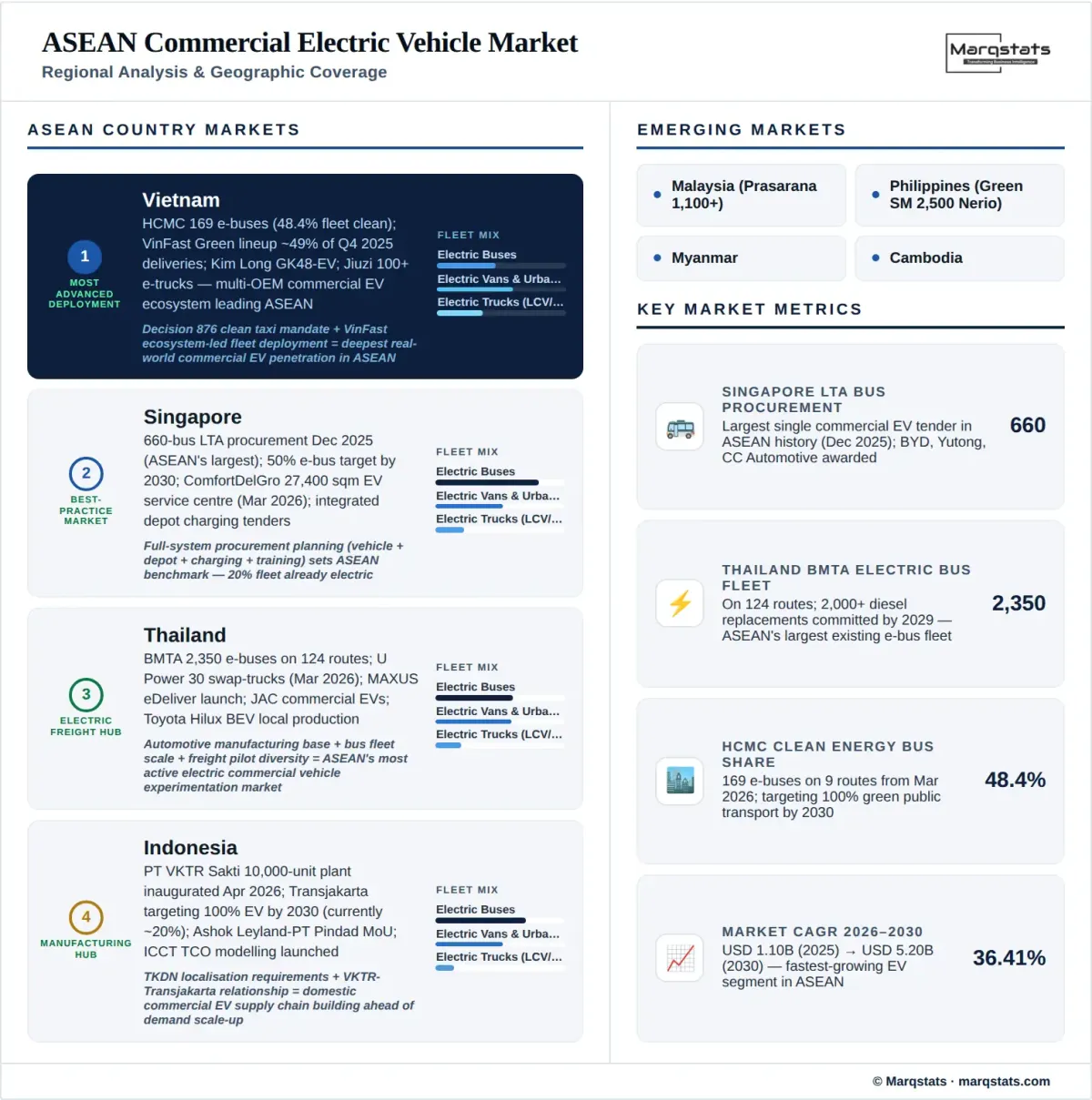
Vietnam is ASEAN's most advanced commercial EV deployment market, combining the region's strongest real-world bus electrification at city scale with the broadest mobility-service EV fleet base and emerging commercial van manufacturing. Ho Chi Minh City's 169-bus deployment on nine routes from March 1, 2026 — with 48.4% of its total fleet already on clean energy — makes it ASEAN's most advanced city-scale electric transit network. VinFast's commercial Green lineup (Limo Green 7-seat MPV, Herio Green compact, Nerio Green C-SUV, Minio Green city EV, EC Van) collectively accounted for approximately 49% of VinFast's Q4 2025 deliveries, demonstrating that fleet and mobility-service demand has overtaken pure retail consumer sales as Vietnam's primary EV volume driver. Kim Long Motor's GK48-EV commercial van (VND 480 million, 305 km range, 6.2 m³ cargo), manufactured at the new Hue plant with BYD battery technology, and Jiuzi Holdings' 100+ electric heavy truck agreements are building a multi-OEM commercial ecosystem that extends beyond VinFast's ecosystem.
Singapore
Singapore is ASEAN's most structured and policy-disciplined commercial EV market. The December 2025 LTA award of 660 electric bus contracts — the largest single EV commercial procurement action in ASEAN — is systematically planned as a full-system transition including integrated depot charging tenders, not just vehicle procurement. Singapore's 50% electric bus fleet target by 2030 is being actively tendered and contracted, with 20% of the public fleet already running on electric power by 2024. ComfortDelGro Engineering's new 27,400 sqm EV-capable automotive centre at Ubi Road (opened March 2026) — with 260 vehicle bays, 58 EV charging points, battery storage, and the LTA's EV Specialist Safety training programme — models the infrastructure depth required for city-scale fleet electrification. Singapore operates as the regional benchmark for commercial EV system planning, even though its market size is modest relative to Indonesia or Vietnam.
Indonesia
Indonesia is ASEAN's most important commercial EV manufacturing story, even as its on-road commercial EV fleet remains small relative to its population and fleet size. The April 2026 inauguration of PT VKTR Sakti Industries' electric bus and truck assembly plant — Indonesia's first dedicated large-scale commercial EV production facility, with 10,000-unit annual capacity — marks the country's most significant commercial EV manufacturing milestone. VKTR's Transjakarta supply relationship and TKDN strategy position it as the dominant domestic player in Indonesia's public bus fleet electrification, which is the primary near-term commercial EV demand driver. Transjakarta currently operates approximately 20% of its fleet on electric power and is targeting 100% electrification by 2030. The Ashok Leyland-PT Pindad MoU for joint electric bus and defence vehicle manufacturing adds an international commercial EV development partnership to the domestic ecosystem. Indonesia's near-term commercial EV market is electric buses first, selective municipal and industrial trucks second, and broader freight fleets third, as TCO economics and charging infrastructure develop.
Thailand
Thailand is ASEAN's most interesting next market for electric trucks and vans, with an existing automotive industrial base and logistics network that provides a natural platform for commercial EV scaling once economics improve. The Bangkok Mass Transit Authority's 2,350 electric buses on 124 routes and its commitment to replacing 2,000+ diesel buses by 2029 makes Thailand one of ASEAN's largest electric bus markets by fleet size. For electric freight, Thailand is progressing through a pilot-heavy phase: U Power's 30 battery-swapping heavy trucks designated for Thailand in March 2026 target a real freight use case; MAXUS launched its full eDeliver commercial van lineup in March 2026 specifically for business and logistics users; and JAC launched electric commercial vehicles around the same period. Toyota's battery-electric Hilux — locally produced in Thailand — has commercial pickup applications, and the Toyota-Changan-BYD manufacturing concentration in Rayong creates a natural environment for electric commercial vehicle experimentation and scale-up.
Malaysia
Malaysia's clearest commercial EV signal is bus electrification through Prasarana's programme to introduce over 1,100 electric buses between 2025 and 2030, targeting 100% fleet electrification by 2037. Malaysia has a 30% electric bus fleet target by 2030. This makes Malaysia a relevant market for electric bus OEMs and depot charging and infrastructure suppliers, but the commercial EV demand intensity is lower than Vietnam or Singapore, and Malaysia's commercial van and truck electrification is at an early stage. BYD's August 2025 announcement of a CKD facility in Tanjung Malim specifically for electric buses and other vehicles supports the supply-side development of Malaysia's commercial EV market.
Philippines
The Philippines has yet to develop a significant commercial EV fleet, but its Electric Vehicle Industry Development Act and EVIS (Electric Vehicle Incentive Strategy) are creating the policy foundation for commercial fleet electrification. Green SM's launch of the first all-electric taxi service in the Philippines in June 2025 — deploying 2,500 VinFast Nerio Green EVs in Metro Manila — represents the most visible commercial EV deployment in the country. The government's mandate for a 5% EV share in government and corporate fleets under EVIDA creates institutional demand for commercial EVs that, while modest in absolute terms, could catalyse broader fleet operator interest. Mitsubishi Motors' plans for local HEV production at its Santa Rosa plant by 2028 under EVIS, while not a commercial EV initiative per se, signals growing OEM investment in Philippines vehicle manufacturing that could eventually extend to commercial EVs.
How Competition Is Evolving
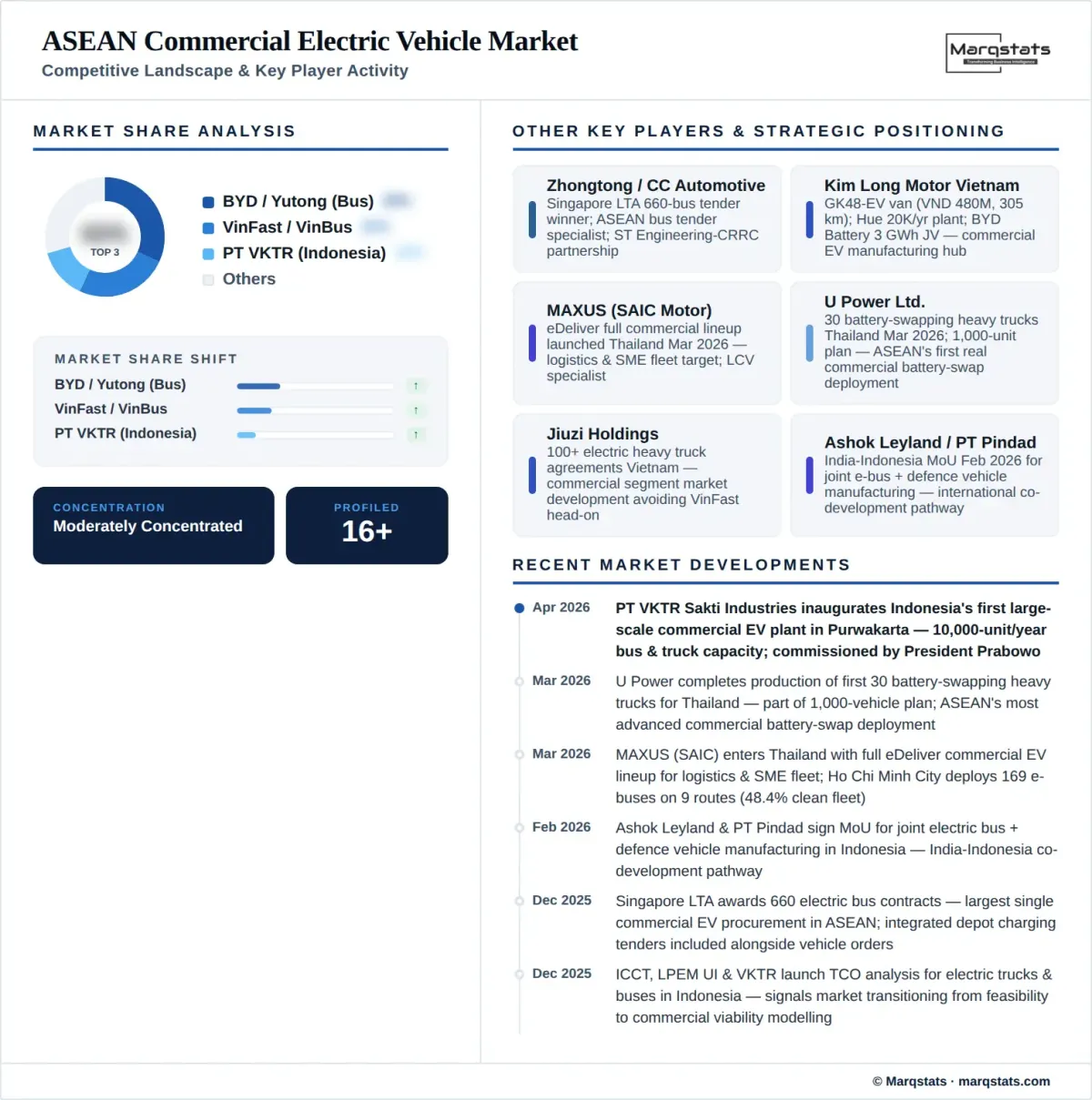
The ASEAN commercial EV competitive landscape is structured around four distinct strategic archetypes that reflect different market entry points and demand sources. The public-bus localisation strategy — strongest in Indonesia and Singapore — is dominated by VKTR (domestic Indonesian assembly), BYD, Yutong, Zhongtong (CC Automotive), and ST Engineering-CRRC, all of which supply at tender scale and must satisfy local-content or manufacturing-commitment requirements to participate in major bus procurement rounds. The ecosystem-led fleet strategy — strongest in Vietnam — is dominated by VinFast's integrated commercial vehicle, charging, and mobility-services platform, supported by VinBus and Green SM as fleet operators and Kim Long Motor as an independent commercial EV manufacturer.
The commercial van and urban logistics entry strategy — strongest in Thailand — is led by MAXUS (SAIC Motor), JAC, and Kim Long Motor, targeting logistics operators and SME fleet buyers with purpose-built electric delivery platforms. The heavy-truck pilot and battery-swap strategy — most visible in Thailand and emerging in Vietnam — is led by U Power (battery-swap system developer) and Jiuzi Holdings (electric truck specialist), using Thailand and Vietnam as early proving grounds for commercial battery-swap operations in a market where depot DC charging infrastructure is still insufficient for high-utilisation freight applications.
The competitive field is also distinguished by the winner-takes-most dynamics in bus procurement: large tender wins (Singapore's 660-bus contract, Transjakarta's ongoing fleet expansion, Prasarana's Malaysia programme) create volume and localisation advantages that compound over successive procurement cycles. Independent analyses indicate that BYD and Yutong are the most consistently winning brands across ASEAN bus tenders, while VKTR's localisation depth and Transjakarta relationship give it structural protection in Indonesia's public procurement market. The medium-term competitive risk is the TKDN escalation in Indonesia (60% by 2027) and equivalent localisation pressures in other markets, which will favour OEMs with established domestic manufacturing or component supply over pure CBU importers.
Companies Covered
The report profiles 16+ companies with full strategy and financials analysis, including:
Recent Market Activity
Table of Contents
Coverage & Segmentation
This report provides a comprehensive analysis of the ASEAN commercial electric vehicle market covering the 2021–2030 study period, with 2025 as the base year, historical data from 2021 to 2025, and a forward-looking forecast from 2026 to 2030. The study encompasses battery electric buses (BEBs), plug-in hybrid electric buses (PHEBs), electric light commercial vehicles (eLCVs), electric medium and heavy trucks, and electric vans and urban cargo vehicles. The report explicitly excludes passenger EVs (covered in the Marqstats ASEAN Electric Vehicle Market report) and electric motorcycles and two-wheelers (covered separately). Geographic coverage includes all six major ASEAN economies: Indonesia, Malaysia, Thailand, the Philippines, Vietnam, and Singapore, with supplementary analysis of Lao PDR, Cambodia, and Brunei.
The competitive intelligence covers 16 commercial EV OEMs and key ecosystem providers including charging infrastructure operators, fleet management software providers, and battery-swap network developers. Policy analysis covers national public transit electrification mandates, local-content requirements affecting commercial EV procurement, depot charging governance frameworks, and fleet operator TCO incentive structures. Primary research for this report includes 40+ interviews with commercial EV fleet operators, transit agency procurement officials, OEM commercial vehicle executives, charging infrastructure providers, and government transport ministry officials across ASEAN's major markets.