Market Snapshot
The South Korea bus market size is estimated at USD 1,905.10 million in 2025 and is projected to reach USD 2,506.12 million by 2030, growing at a CAGR of 5.64% over 2026 – 2030. Deliveries rise from 8,209 to 9,330 buses a year, a 2.59% annual rate, while the average value per bus climbs from about USD 232,075 to USD 268,609 as hydrogen fuel-cell and battery-electric buses replace diesel and compressed natural gas models.
Marqstats defines the market as the purchase value, before national and municipal subsidies, of new medium and heavy buses of 9 metres and above registered in South Korea in a year. It covers 9 metre mid-size buses and 11 to 12 metre urban, express, intercity and charter buses, such as the Hyundai Universe and Elec City, the Kia Granbird, the Woojin Apollo and the BYD eBus, across diesel, battery-electric, hydrogen fuel-cell and compressed natural gas powertrains. Minibuses, vans, used buses and bus bodies sold separately are excluded.
Battery-electric buses account for 37.16% of 2025 value and hydrogen fuel-cell buses for 32.13%, although diesel still makes up 41.11% of units. Hydrogen buses grow fastest, at 10.69% a year, and the Seoul Capital Area holds 48.93% of value, while Yeongnam grows fastest among regions at 6.24% a year.
Key Takeaways
Market Overview & Analysis
Report Summary
Marqstats sizes the South Korea bus market as the purchase value, before subsidies, of new medium and heavy buses of 9 metres and above that enter service each year. It counts 9 metre mid-size buses, 11 metre and 12 metre urban low-floor buses, and high-floor express, intercity and charter coaches, across diesel, battery-electric, hydrogen fuel-cell and compressed natural gas powertrains. Minibuses such as the Hyundai County, vans such as the Hyundai Staria and Kia Carnival, used buses and bodies sold separately are excluded.
The market is small in units and large in value per vehicle. The Ministry of Land, Infrastructure and Transport (MOLIT) registered 6,833 new 9 metre and larger buses in 2023, 8,233 in 2024, a rise of 20.49%, and 8,209 in 2025, a fall of 0.29%. A diesel coach costs about KRW 200 million, a battery-electric transit bus about KRW 348 million and a hydrogen bus about KRW 739 million, so a shift in powertrain mix moves value faster than volume.
Powertrain mix changed sharply in 2024 and 2025. Battery-electric deliveries rose 42% to 3,378 in 2024 and fell 14.36% to 2,893 in 2025, hydrogen deliveries rose from 363 in 2023 to 1,045 in 2024 and 1,177 in 2025, diesel recovered 17.51% to 3,375 and compressed natural gas fell 18.55% to 764. The Kaiz U Data Laboratory (Carisyou) processes the MOLIT registrations that Commercial Vehicle Magazine reports, and Marqstats uses them as the unit base.
Policy sets the pace for urban buses but not for coaches. The enforcement rules of the Act on Promotion of Movement Convenience for the Transportation Vulnerable, announced in July 2022, set replaced city, rural and village route buses to be low-floor from 19 January 2023, which excluded intercity buses and scheduled wide-area express seated buses for 2027. Subsidies for electric buses now depend on battery energy density, and the 2026 hydrogen programme funds 1,800 buses.
The first quarter of 2026 shows the policy lag. Deliveries fell 14.8% to 1,317 buses from 1,546, urban-type buses fell 40.5% to 263, and battery-electric buses fell to a 15.1% share from 22.6% as the Korea Environment Corporation moved subsidies to a public-call selection that can delay payment by two to three months or more. Marqstats expects the market to dip to 7,670 buses in 2026 and recover from 2027.
South Korea Bus Market Size and Forecast
The South Korea bus market grows from USD 1,905.10 million in 2025 to USD 2,506.12 million in 2030, a CAGR of 5.64%. Price and mix contribute more than volume: deliveries rise at 2.59% a year, from 8,209 to 9,330 buses, and the average value per bus rises at 2.97% a year, from about USD 232,075 to USD 268,609, as hydrogen buses rise from 14.34% to 23.04% of units. In won terms the market grows from about KRW 2,708.10 billion to KRW 3,562.46 billion at the 2025 average rate of KRW 1,421.5 per US dollar.
The 2025 value is built bottom-up from registrations and prices. Marqstats applies about KRW 200 million per diesel bus, anchored on Hyundai Universe list prices of KRW 179 million to KRW 227.5 million in August 2025, and about KRW 205 million per compressed natural gas bus, anchored on the Universe Prime CNG list price of KRW 203.35 million. Battery-electric buses use the 2024 transaction averages of KRW 364.83 million for domestic and KRW 311.74 million for imported models, which weights to about KRW 348 million across 2,893 buses. Hydrogen buses use about KRW 700 million for the city-type Elec City and KRW 780 million for the Universe express coach.
The registration base is firm and the forecast follows named drivers. Domestic makers delivered 7,268 buses in 2025 and importers 941, and the registered powertrain counts sum to the 8,209 total. Marqstats expects battery-electric deliveries to fall to 2,300 in 2026 and recover to 3,950 in 2030, hydrogen deliveries to rise from 1,177 to 2,150, diesel to ease from 3,375 to 2,750 and compressed natural gas to fall from 764 to 480. The 2030 battery-electric count of 3,950 matches the electric bus count in the live Marqstats South Korea Electric Commercial Vehicle report.
Prices move at different rates. Marqstats holds battery-electric prices flat, because falling cell costs offset the higher energy density that the subsidy rules require, lets hydrogen prices fall 2.00% a year as production moves from 500 buses a year at Hyundai Jeonju in 2024 toward a 3,000-bus target, and lifts diesel and compressed natural gas prices by 2.00% and 1.50% a year for emission content. Imported battery-electric buses fall from 31.87% of battery-electric units in 2025 to 18.00% in 2030, which raises the average electric bus price.
Marqstats tracks five indicators to monitor the forecast: monthly MOLIT registrations by powertrain and length class, the pace of public-call subsidy selections at the Korea Environment Corporation, hydrogen bus awards against the 1,800-bus national budget, the number of large-capacity hydrogen stations, and Kia Corporation decisions on its Granbird coach line.
Market Dynamics
Key Drivers
Five forces are lifting spending on new buses in South Korea even as unit volumes stay close to 8,200 a year.
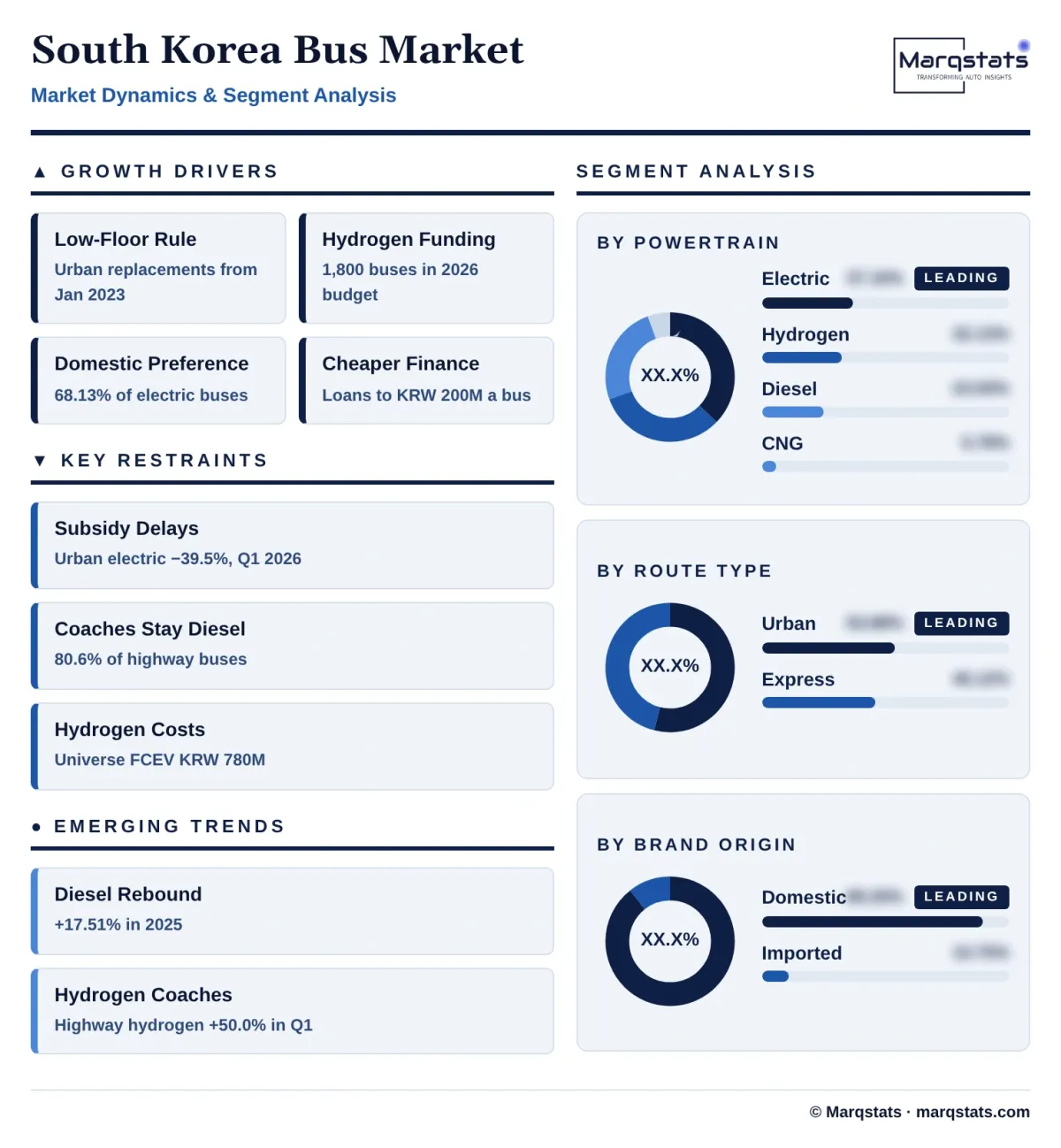
- The low-floor replacement rule renews urban fleets. The July 2022 enforcement rules of the Act on Promotion of Movement Convenience for the Transportation Vulnerable set replaced city, rural and village route buses to be low-floor from 19 January 2023, and no urban-type diesel bus was sold in the first quarter of 2026, when all 263 urban-type deliveries were electric, hydrogen or compressed natural gas buses.
- Hydrogen buses carry funded demand. The 2026 programme of the Ministry of Climate, Energy and Environment funds 7,820 hydrogen vehicles with KRW 576.2 billion of national money, including 1,800 buses, 800 low-floor and 1,000 high-floor, with national grants of KRW 210 million and KRW 260 million per bus and total public funding of KRW 300 million to KRW 350 million.
- Subsidy design favours domestic electric buses. Domestic makers raised their share of battery-electric registrations to 68.13% in 2025 from 63.98% in 2024, imported battery-electric deliveries fell 24.2% to 922, and battery energy density thresholds of 530 Wh/L for large buses in 2026, rising to 614 Wh/L from 2029, reduce grants for lower-density packs.
- Cheaper finance eases replacement. In February 2026 the government offered low-interest loans of up to KRW 200 million per electric or hydrogen bus, at a rate reported as 2.01%, which cuts the carrying cost of the net price after grants for municipal route operators.
- Domestic capacity is built. Woojin Industrial Systems opened a Gimcheon electric bus plant in March 2024 with a capacity of 1,000 buses a year, and Hyundai Motor Company targeted about 3,000 hydrogen buses a year at Jeonju in 2025 against about 500 in 2024, so supply no longer limits orders.
Key Restraints
Four constraints slow the shift to zero-emission buses and keep diesel in the long-distance coach segment.
- Subsidy process changes delay deliveries. In 2026 the Korea Environment Corporation moved electric bus subsidies to a public-call selection, warned that payments could be delayed by two to three months or more, and one electric bus maker withdrew its 2026 supply plan, so urban-type battery-electric deliveries fell 39.5% to 196 in the first quarter.
- Coaches fall outside the rules. Highway-type buses were 1,054 of 1,317 first-quarter deliveries, 80.6% of them diesel and only 3 battery-electric, because the low-floor rule excludes intercity buses and long routes, luggage bays and cruising speeds make battery buses hard to place.
- Hydrogen costs strain budgets. A Universe fuel-cell coach lists at KRW 780 million, public money covers KRW 300 million to KRW 350 million of each hydrogen bus, and Hyundai counted 80 large-capacity hydrogen stations in April 2026, so each extra bus needs both a grant and a nearby station.
- The supplier base is narrowing. Of 18 Chinese bus makers that entered Korea between 2017 and 2025, only 10 were still selling in 2025, several have left operators without service support, and Kia Corporation plans to stop making large buses within two years, which reduces buyer choice.
Key Trends
Four shifts are changing who builds, buys and powers buses in South Korea.
- Diesel returns at the coach end. Diesel buses rose 17.51% in 2025 and Hyundai diesel deliveries rose 38.9% to 1,938 while Kia held at 1,418, as charter and express operators renewed fleets that zero-emission rules do not yet reach.
- Hydrogen moves to express routes. Universe express coaches took 576 of 1,166 hydrogen bus deliveries in 2025, and highway-type hydrogen deliveries rose 50.0% to 120 in the first quarter of 2026 while urban-type hydrogen fell 64.0% to 31.
- Domestic electric makers take share. Woojin Industrial Systems grew 83.7% to 439 buses in 2025, KGM Commercial delivered 271, and Higer Bus fell 51.4% to 227 as subsidy rules favoured domestic models.
- Production consolidates at Hyundai. Kia Corporation plans to move large bus production to Hyundai Motor Company, Hyundai built 99.07% of hydrogen buses in 2025, and its Jeonju plant plans to start a 12.5 metre low-floor hydrogen bus in 2027.
Strategic Implications
- For Hyundai Motor Company, the Kia exit turns the Universe into the platform for all large coaches. Hyundai already delivered 62.19% of 2025 units, and adding the Granbird customer base requires a diesel and hydrogen coach line that can absorb about 1,400 buses a year while fuel-cell cost falls.
- For Woojin Industrial Systems and KGM Commercial, domestic subsidy preference is the opening but the 2026 selection delay is the test. Both makers need working capital to carry buses through a payment gap of two to three months or more, and the 420 kilometre low-floor project points to the next product.
- For Chinese importers such as BYD, Higer, CHTC and Skywell, the energy density rule makes price alone insufficient. Imported buses cost a mid-200 million won range against a mid-300 million won range for Korean models, but grants of roughly KRW 200 million now go to qualifying domestic low-floor models, so staying means higher density cells and local service.
- For hydrogen suppliers and station operators, the volume that matters is express coaches in Gyeonggi, Incheon and Yeongnam. Marqstats expects 2,150 hydrogen buses in 2030, which needs hydrogen stations along commuter corridors rather than only in depots.
- For municipal operators and lenders, the net price after grants decides the powertrain. A low-floor electric bus with grants of roughly KRW 200 million and a loan of up to KRW 200 million, or a hydrogen bus with public funding of KRW 300 million to KRW 350 million, is only viable where depot charging or a nearby hydrogen station exists.
Market Segmentation
Diesel buses account for 24.93% of 2025 value, USD 474.85 million, and fall at 2.09% a year to USD 427.19 million and 17.05% of value, while units ease from 3,375 to 2,750. Hyundai delivered 1,938 and Kia 1,418 diesel buses in 2025, together 99.44% of the segment, mostly Universe and Granbird express, intercity and charter coaches.
Battery-electric buses account for 37.16% of 2025 value, USD 708.05 million, and grow at 6.87% a year to USD 987.22 million and 39.39% of value. Units fall from 2,893 to 2,300 in 2026 and reach 3,950 in 2030. Hyundai delivered 1,240 in 2025, Woojin 428, BYD 355, KGM Commercial 268 and Higer 227.
Hydrogen fuel-cell buses account for 32.13% of 2025 value, USD 612.02 million, and grow fastest, at 10.69% a year, to USD 1,017.14 million and 40.58% of value. Units rise from 1,177 to 2,150. Hyundai delivered 1,166 in 2025, 590 Elec City city buses and 576 Universe express coaches, and Woojin delivered 11 Apollo 900 H2 buses.
Compressed natural gas buses account for 5.78% of 2025 value, USD 110.18 million, and fall at 7.51% a year to USD 74.57 million and 2.98% of value. Units drop from 764 to 480. Hyundai delivered 761 and KGM Commercial 3 in 2025, and operators are moving CNG replacement to electric and hydrogen buses.
Urban and low-floor transit buses account for 53.88% of 2025 value, USD 1,026.51 million, and grow at 6.79% a year to USD 1,425.73 million and 56.89% of value. Marqstats estimates 3,680 urban-type buses in 2025, nearly all battery-electric, plus 601 city-type hydrogen buses and city compressed natural gas buses. Volumes dip to 3,090 in 2026 and reach 5,003 by 2030.
Express, intercity and charter coaches account for 46.12% of 2025 value, USD 878.59 million, and grow at 4.22% a year to USD 1,080.39 million. Marqstats estimates 4,529 coaches in 2025, including all diesel buses and the 576 Universe hydrogen coaches, falling slowly to 4,327 by 2030.
Domestic brands account for 89.25% of 2025 value, USD 1,700.23 million, and grow at 6.66% a year to USD 2,347.24 million and 93.66% of value. Hyundai, Kia, Woojin, KGM Commercial and Beomhan Motors delivered 7,268 buses, 88.54% of units, and Marqstats expects 8,600 in 2030.
Imported brands account for 10.75% of 2025 value, USD 204.87 million, and fall at 4.96% a year to USD 158.88 million and 6.34% of value. BYD, Higer, CHTC and Skywell and smaller importers delivered 941 buses, 11.46% of units, down 22.7% from 2024, and Marqstats expects 730 in 2030.
By Geography
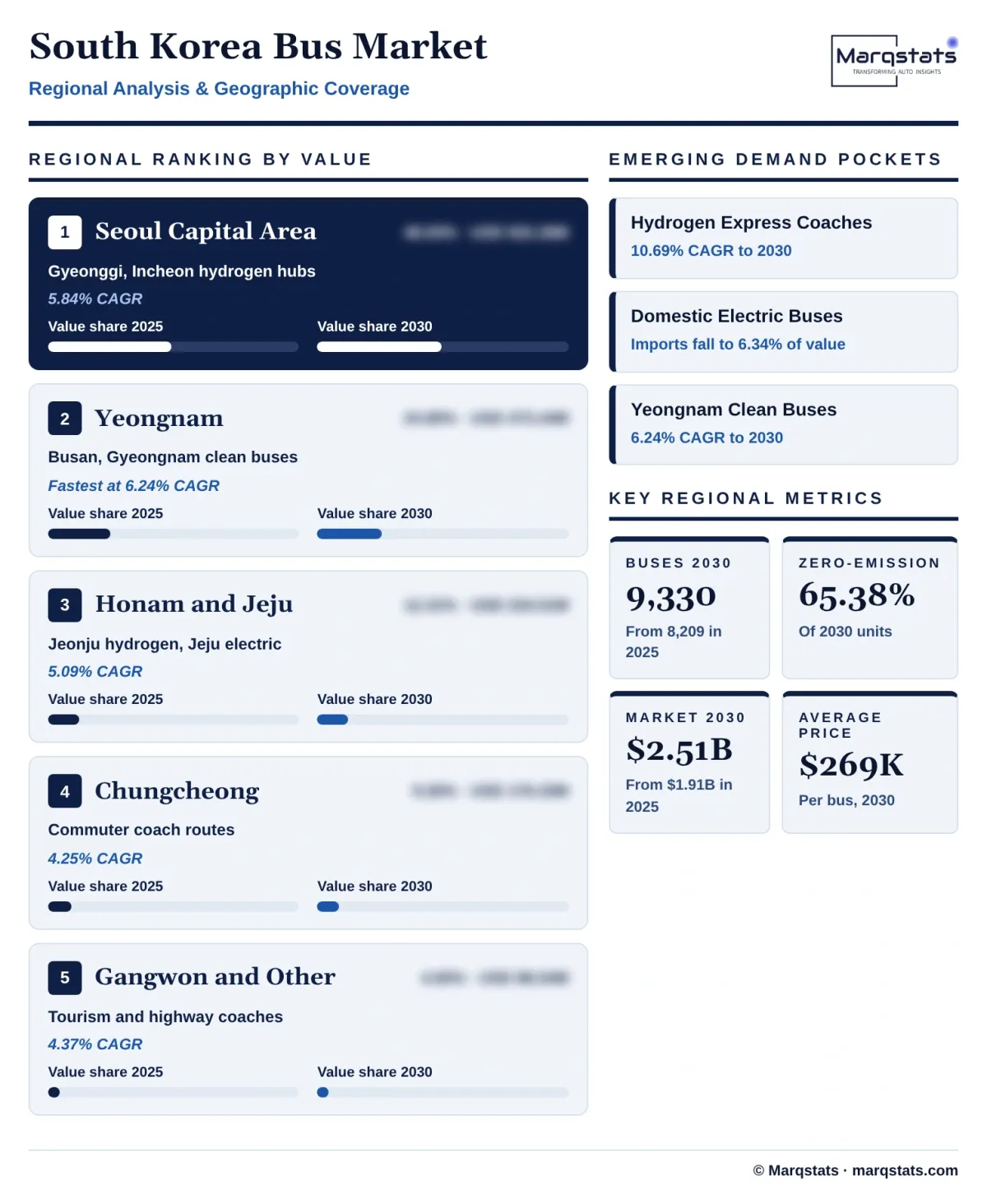
Seoul Capital Area
The Seoul Capital Area accounts for 48.93% of 2025 value, USD 932.28 million, and grows at 5.84% a year to USD 1,238.15 million. It held 55% of 11 metre and larger electric bus registrations, 1,158 of 2,106, and 544 of the 1,166 Hyundai hydrogen buses, 46.66%, with Gyeonggi taking 314, Incheon 204 and Seoul only 26 as refuelling sites inside the city are few.
Yeongnam
Yeongnam accounts for 24.85% of 2025 value, USD 473.44 million, and grows fastest among regions, at 6.24% a year, to USD 640.68 million. It took 331 hydrogen buses, led by Busan with 109, and 526 large electric buses, with Busan at 179 and Gyeongnam at 176, so both clean powertrains scale there.
Honam and Jeju
Honam and Jeju account for 12.31% of 2025 value, USD 234.51 million, and grow at 5.09% a year to USD 300.53 million. Jeonbuk registered 105 hydrogen buses, and Jeonju runs 178 hydrogen buses among its 412 city buses, while Jeju bought 140 large electric buses, 137 of them from Woojin Industrial Systems.
Chungcheong
Chungcheong accounts for 9.26% of 2025 value, USD 176.33 million, and grows at 4.25% a year to USD 217.13 million. It took 86 hydrogen buses and 164 large electric buses, with Chungnam and Chungbuk leading, and its mix leans toward diesel coaches on commuter routes.
Gangwon and Other
Gangwon and other areas account for 4.65% of 2025 value, USD 88.54 million, and grow at 4.37% a year to USD 109.63 million. Gangwon took 58 hydrogen buses, 33 of them Universe coaches for tourism and highway routes, and 51 large electric buses, 24 of them from BYD.
How Competition Is Evolving
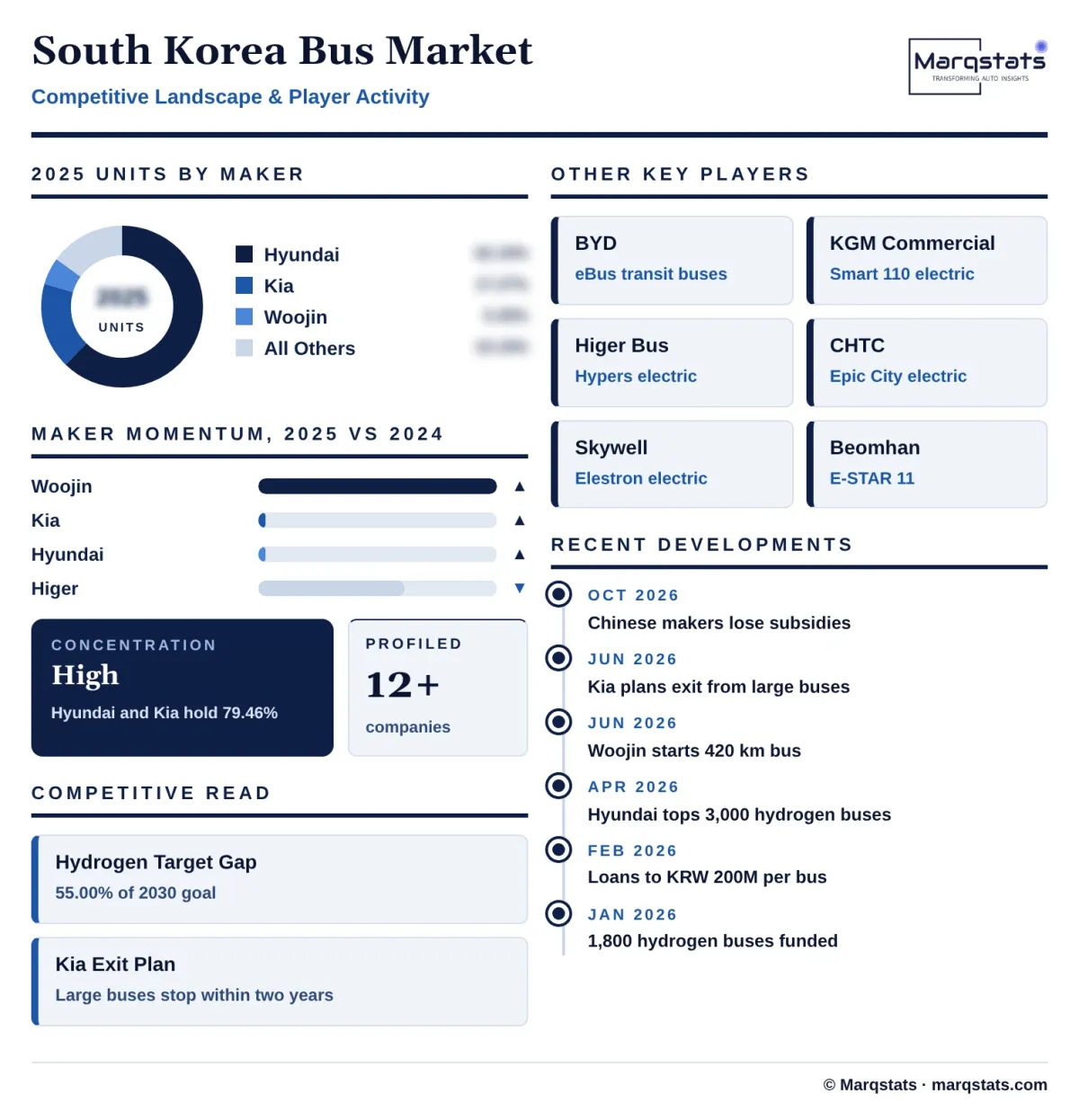
The market is highly concentrated and led by two domestic groups. Hyundai Motor Company delivered 5,105 buses in 2025, 62.19% of units, and Kia Corporation 1,418, 17.27%, so the two hold 79.46%. Woojin Industrial Systems follows with 439 buses, 5.35%, BYD with 355, 4.32%, KGM Commercial with 271, 3.30%, Higer Bus with 227, 2.77%, CHTC with 188, 2.29% and Skywell with 113, 1.38%, while Beomhan Motors delivered 35 and other importers 58.
Hyundai leads every powertrain it enters. It delivered 1,938 diesel, 1,240 electric, 1,166 hydrogen and 761 compressed natural gas buses in 2025, holding 99.07% of hydrogen buses and 42.86% of battery-electric buses, and it passed 3,000 cumulative hydrogen bus sales in March 2026. Kia Corporation sells only the diesel Granbird, 1,418 buses in 2025, and reported plans to stop large bus production within two years.
Competition in electric buses has moved from price to eligibility. Woojin Industrial Systems grew 83.7% to 439 buses and operates a 1,000-bus plant at Gimcheon, KGM Commercial turned a profit on KRW 107.7 billion of revenue, and the Chinese makers lost ground as Higer fell 51.4%. In October 2026 many Chinese makers were excluded from subsidies, so imported battery-electric deliveries are likely to keep falling.
Marqstats expects the next phase to be set by hydrogen coaches and by what happens to the Granbird customers. If Hyundai absorbed all Kia volume its share of 2025 units would be 79.46%, and the 12.5 metre low-floor hydrogen bus planned for 2027 and the Woojin 420 kilometre electric project show where challengers will compete.
Companies Covered
Companies covered in the report include:
Recent Market Activity
Table of Contents
Coverage & Segmentation
The study covers the South Korea bus market, with 2025 as the base year, 2023 – 2025 as the historical period and 2026 – 2030 as the forecast period. It covers new medium and heavy buses of 9 metres and above registered in South Korea, segmented by powertrain, route type, brand origin and region. Values are purchase values before national and municipal subsidies in US dollars, and won figures use the 2025 average of KRW 1,421.5 per US dollar.
Minibuses and vans, used buses, bus bodies and conversions sold separately, and trucks are excluded. The live Marqstats South Korea Electric Commercial Vehicle report is the broader parent for battery-electric buses: it counts 2,700 electric buses in 2025 and excludes hydrogen, while the analysis here counts 2,893 registered battery-electric buses of 9 metres and above and adds hydrogen, diesel and natural gas buses. Figures in the two reports should not be added. Segment and regional splits are Marqstats estimates.